

The DOI matches its Crossref record; 5 of the 5 references it cites were found in a registry or an index.
Ancient DNA reveals the timing and persistence of organellar genetic bottlenecks over 3,000 years of sunflower domestication and improvement
Abstract
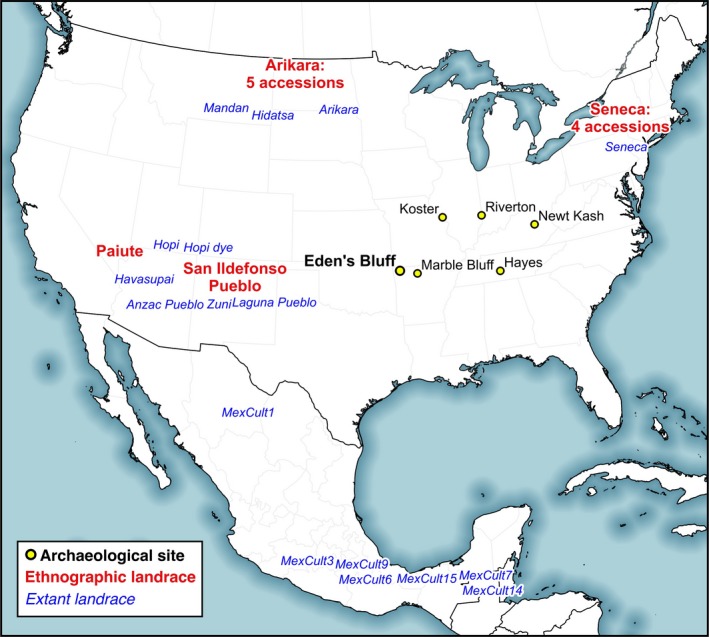
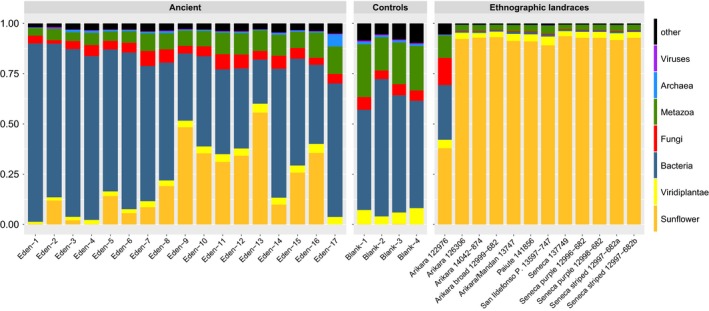
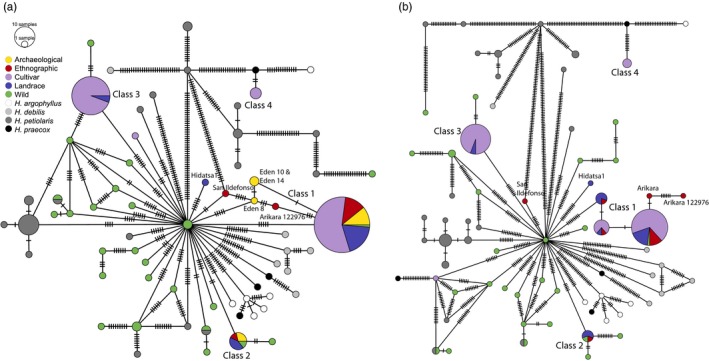
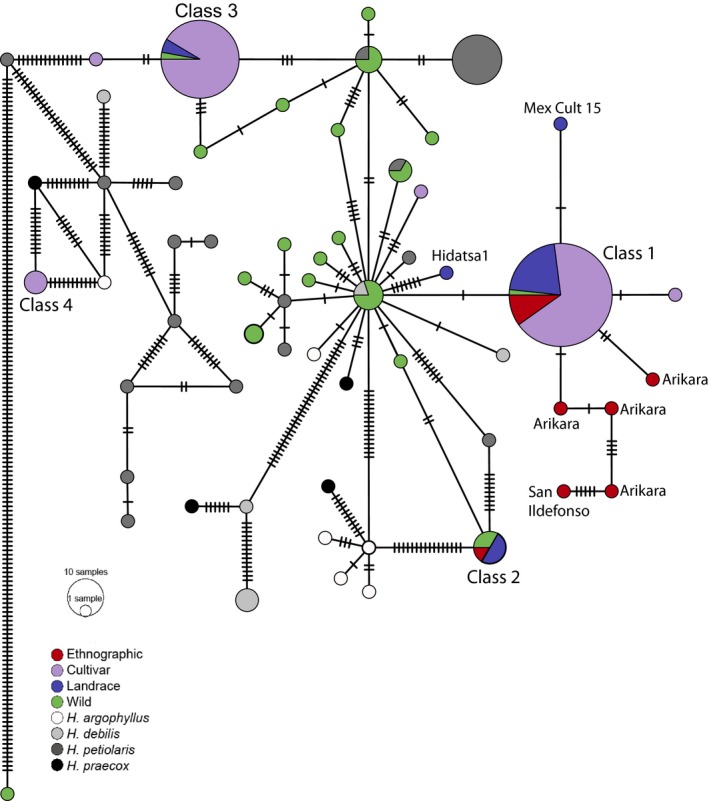
Here, we report a comprehensive paleogenomic study of archaeological and ethnographic sunflower remains that provides significant new insights into the process of domestication of this important crop.DNA from both ancient and historic contexts yielded high proportions of endogenous DNA, and although archaeological DNA was found to be highly degraded, it still provided sufficient coverage to analyze genetic changes over time. Shotgun sequencing data from specimens from the Eden's Bluff archaeological site in Arkansas yielded organellar DNA sequence from specimens up to 3,100 years old. Their sequences match those of modern cultivated sunflowers and are consistent with an early domestication bottleneck in this species. Our findings also suggest that recent breeding of sunflowers has led to a loss of genetic diversity that was present only a century ago in Native American landraces. These breeding episodes also left a profound signature on the mitochondrial and plastid haplotypes in cultivars, as two types were intentionally introduced from other Helianthus species for crop improvement. These findings gained from ancient and historic sunflower specimens underscore how future in‐depth gene‐based analyses can advance our understanding of the pace and targets of selection during the domestication of sunflower and other crop species.
Overview
The claims and statistics of this paper haven’t been checked yet.
Run the check — free, no account needed. It reads the open-access text and checks the sources it cites.
Integrity signals
Registry
Cites
Statistics
Figures
Verification
Claims the paper makes
The claims and statistics of this paper haven’t been checked yet.
Run the check — free, no account needed. It reads the open-access text and checks the sources it cites.
Claims other papers make about this one
Each is checked against this paper’s own text: does it say what the citing paper says it does?
The cited source says what the claim attributes to it.
In the citing paper
“Paleogenomic data also do not support the presence of a strong demographic bottleneck during early domestication stages (see 292 for a review in major crops), but rather studies of wheat 293 , sunflowers 294 , and horses 148 support more recent losses of genetic diversity.”
From Ancient DNA analysis (2021) · cites this paper as [293]
Self-check
Percentages, sums and reported differences re-computed from the paper’s own numbers.
The self-check needs the paper’s full text.
Citations
Cites
mapDamage2.0: fast approximate Bayesian estimates of ancient DNA damage parameters
Jónsson, H., Ginolhac, A., Schubert, M., Johnson, P. L. F., & Orlando, L. (2013) · Bioinformatics · doi:10.1093/bioinformatics/btt193 · Cited by 1,669
Dabney, J., Knapp, M., Glocke, I., Gansauge, M.-T., Weihmann, A., Nickel, B., Valdiosera, C., García, N., Pääbo, S., Arsuaga, J.-L., et al. (2013) · Proceedings of the National Academy of Sciences · doi:10.1073/pnas.1314445110 · Cited by 1,443
Dealing with outliers and offsets in radiocarbon dating
Bronk Ramsey, C. (2009) · Radiocarbon · doi:10.1017/s0033822200034093 · Cited by 1,204
The Origin of European Cattle: Evidence from Modern and Ancient DNA
Beja-Pereira, A., Caramelli, D., Lalueza-Fox, C., Vernesi, C., Ferrand, N., Casoli, A., Goyache, F., Royo, L. J., Conti, S., Lari, M., et al. (2006) · Proceedings of the National Academy of Sciences · doi:10.1073/pnas.0509210103 · Cited by 342
Optimization of DNA Recovery and Amplification from Non-Carbonized Archaeobotanical Remains
Wales, N., Andersen, K., Cappellini, E., Ávila-Arcos, M. C., & Gilbert, M. T. P. (2014) · PLoS ONE · doi:10.1371/journal.pone.0086827 · Cited by 80
Self-citation
Research works printed but not linked: 85
- 10.1016/S0022-2836(05)80360-2 · DOI · Paper page
- 10.1007/BF00223700 · DOI
- Asch D. L., 1985, Prehistoric food production in North America, 149
- 10.1146/annurev.es.18.110187.002421 · DOI
- 10.1038/nature22380 · DOI
- 10.1105/TPC.010116 · DOI
- 10.1093/oxfordjournals.molbev.a026036 · DOI · Paper page
- 10.1111/nph.13255 · DOI
- 10.2298/HEL0338127d · DOI
- 10.1073/pnas.1104853108 · DOI
- 10.1016/j.cub.2010.01.059 · DOI
- 10.1111/nph.12560 · DOI
- Brown J. A., 1984, Prehistoric southern Ozark marginality: A myth exposed
- 10.1007/s00334-014-0489-4 · DOI
- 10.1093/genetics/161.3.1257 · DOI
- 10.1016/j.ajhg.2013.10.002 · DOI
- 10.1073/pnas.0905845106 · DOI
- 10.1371/journal.pone.0071941 · DOI
- 10.1105/tpc.108.059808 · DOI
- 10.1126/science.289.5482.1139b · DOI
- 10.2307/281459 · DOI
- 10.1101/cshperspect.a012567 · DOI · Paper page
- 10.1093/bioinformatics/btr330 · DOI
- Davis H. A., 1967, A brief history of archaeological work in Arkansas up to 1967, Bulletin of the Arkansas Archeological Society, 10, 2
- 10.1098/rstb.2013.0387 · DOI
- Fritz G. J.(1986).Prehistoric Ozark agriculture: The University of Arkansas Rockshelter Collections. Ph.D. dissertation University of North Carolina at Chapel Hill.
- Fritz G. J., 1997, People, plants, and landscapes: Studies in paleoethnobotany, 42, 10.2307/jj.30297157.9 · DOI
- 10.1016/j.tree.2005.07.005 · DOI · Paper page
- 10.1126/science.1146971 · DOI
- Gilmore M. R., 1919, Uses of plants by the Indians of the Missouri River region, 10.5962/bhl.title.32507 · DOI
- Gilmore M. R., 1931, Vegetal remains of the Ozark bluff‐dweller culture, Papers of the Michigan Academy of Science, Arts, and Letters, 14, 83
- 10.1007/BF02098682 · DOI
- Harrington M. R., 1924, Explorations in the Ozark Region, Indian Notes, 1, 3
- 10.1525/aa.1924.26.1.02a00020 · DOI
- Harrington M. R., 1960, The Ozark bluff‐dwellers
- 10.1038/nature02710 · DOI
- 10.1371/journal.pgen.1000834 · DOI
- Heiser C. B., 1951, The sunflower among the North American Indians, Proceedings of the American Philosophical Society, 95, 432
- Heiser C. B., 1976, The sunflower
- 10.1038/35072071 · DOI · Paper page
- 10.1101/gr.120618.111 · DOI
- 10.1139/b11-032 · DOI
- 10.1007/978-1-4614-9572-7_13 · DOI
- 10.1073/pnas.1318678111 · DOI
- Korell M., 1992, Construction of a sunflower pedigree map, Proceedings of the 13th International Sunflower Conference, 2, 1479
- 10.1073/pnas.0703411104 · DOI
- 10.1111/2041-210X.12410 · DOI
- 10.1073/pnas.0711760105 · DOI
- 10.1007/BF02866560 · DOI
- 10.1093/bioinformatics/btp324 · DOI · Paper page
- 10.1007/s001220050746 · DOI
- 10.1534/genetics.105.051110 · DOI
- 10.1038/ng.3611 · DOI
- 10.1101/gr.107524.110 · DOI · Paper page
- 10.1101/pdb.prot5448 · DOI
- 10.1002/j.1537-2197.1996.tb12718.x · DOI
- 10.1038/srep37347 · DOI
- 10.1093/bioinformatics/btp696 · DOI
- 10.1038/nature07895 · DOI
- R Core Team, 2013, R: A language and environment for statistical computing
- 10.1016/j.cub.2016.09.036 · DOI
- 10.2458/azu_js_rc.55.16947 · DOI · Paper page
- 10.1007/BF02860477 · DOI
- Sabo G., 1990, Prehistoric culture history human adaptation in the Ozark and Ouachita Mountains
- 10.1186/s12915-014-0087-z · DOI · Paper page
- 10.1111/j.1558-5646.2011.01537.x · DOI
- 10.1016/j.bbamcr.2013.03.010 · DOI
- 10.1038/nprot.2014.063 · DOI · Paper page
- 10.1186/s13104-016-1900-2 · DOI
- 10.2298/HEL1155001S · DOI
- 10.2135/cropsci2016.10.0856 · DOI
- 10.1016/0378-4290(92)90003-R · DOI
- 10.1073/pnas.0604335103 · DOI
- 10.1086/659645 · DOI
- 10.1007/s00334-013-0393-3 · DOI
- 10.1007/s10682-015-9797-0 · DOI
- 10.1073/pnas.0901846106 · DOI
- 10.3732/ajb.1100335 · DOI
- 10.1046/j.1365-294X.2003.02070.x · DOI
- 10.1073/pnas.1609701113 · DOI
- 10.2144/000114364 · DOI
- 10.1111/mec.13044 · DOI
- 10.1093/jhered/esl001 · DOI
- 10.1534/genetics.107.075333 · DOI
- 10.1073/pnas.1501711112 · DOI
Cited by
Sorted by citations
Orlando, L., Allaby, R., Skoglund, P., Der Sarkissian, C., Stockhammer, P. W., Ávila-Arcos, M. C., Fu, Q., Krause, J., Willerslev, E., Stone, A. C., et al. (2021) · Nature Reviews Methods Primers · doi:10.1038/s43586-020-00011-0 · Cited by 411
Metadata
- Authors
- Wales, N., Akman, M., Watson, R. H. B., Sánchez Barreiro, F., Smith, B. D., Gremillion, K. J., Gilbert, M. T. P., & Blackman, B. K.
- Affiliations
- Department of Plant and Microbial Biology University of California Berkeley CA USA
- Centre for GeoGenetics Natural History Museum of Denmark University of Copenhagen Copenhagen Denmark
- The Santa Fe Institute Santa Fe NM USA
- Department of Anthropology Ohio State University Columbus OH USA
- ORCID
- Wales, Nathan
- Venue
- Evolutionary Applications
- Publisher
- Wiley
- Published
- 2018-02-13
- Volume
- 12
- Issue
- 1
- Pages
- 38-53
- ISSN
- 1752-4571
- PMC
- PMC6304678
- Cited by
- 35
- References
- 5
- Language
- en
- Funders
- National Science Foundation (1354622, 1640788)
- Danmarks Grundforskningsfond
About these checks
Registry, retraction, Cites and statistics results are computed, not judged, with one exception: a printed reference that no index lists is read once by a model before it counts as a citation error. Claims are extracted by a model and kept only when their quote appears verbatim in the text; each cited source is then checked, with a model’s help, for whether it says what the claim relies on. Those verdicts can be wrong — read the claim’s quote and the cited source before relying on one.
Statistics and arithmetic are recomputed, not judged.
Confidence bands are shown only for fields calibrated on our annotated test set. None is calibrated yet, so no band is shown.
What counts as a claim ›How we measure confidence ›How we check this ›
Are you an author, or do you see a problem with this page? Request a review
