

The DOI matches its Crossref record; 52 of the 52 references it cites were found in a registry or an index.
Cysteine residues exposed on protein surfaces are the dominant intramitochondrial thiol and may protect against oxidative damage
Open accessAbstract
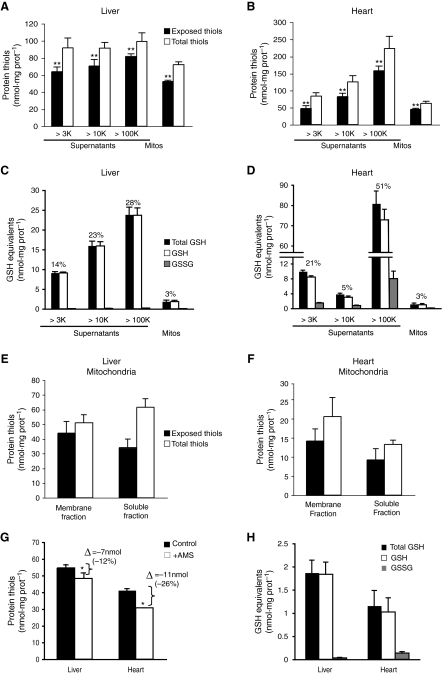
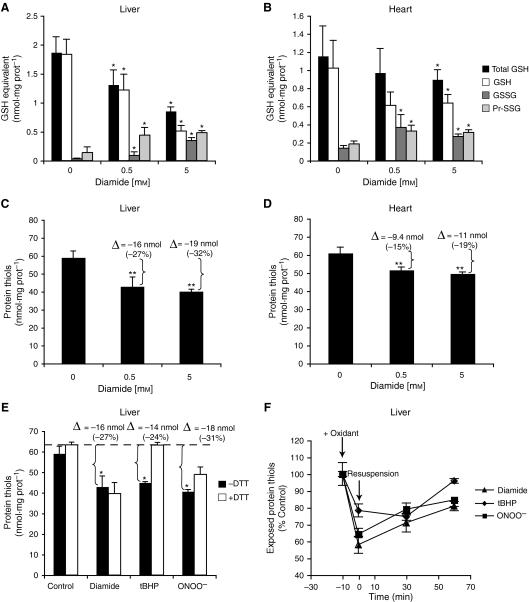
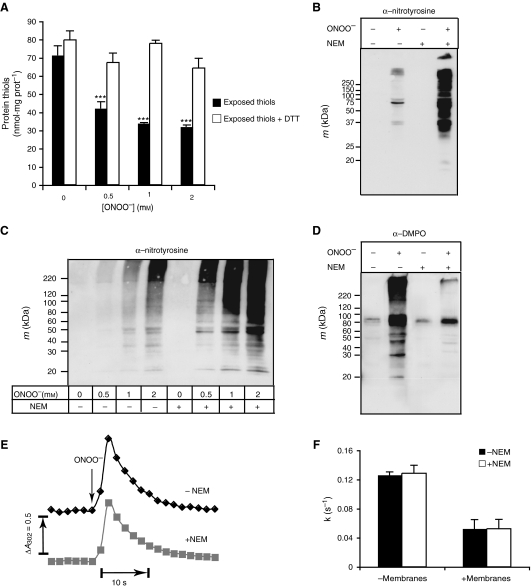
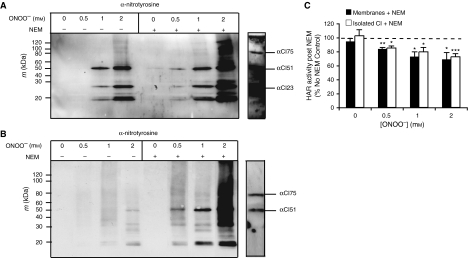
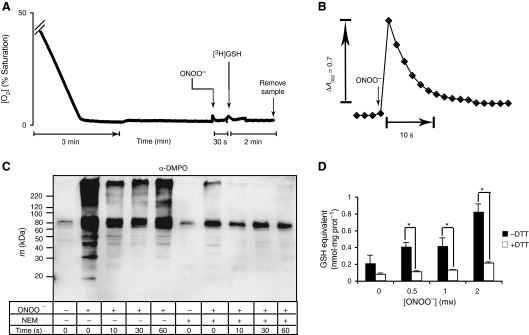
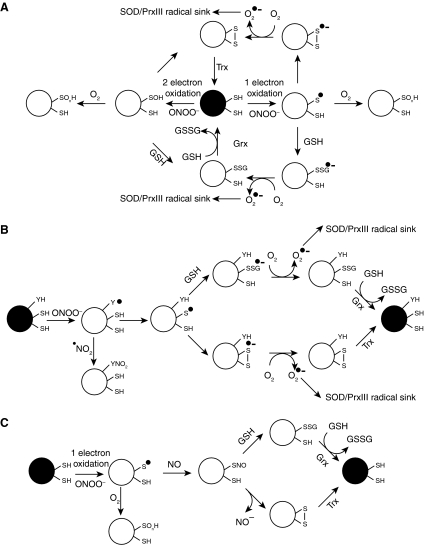
Cysteine plays a number of important roles in protecting the cell from oxidative damage through its thiol functional group. These defensive functions are generally considered to be carried out by the low molecular weight thiol glutathione and by cysteine residues in the active sites of proteins such as thioredoxin and peroxiredoxin. In addition, there are thiols exposed on protein surfaces that are not directly involved with protein function, although they can interact with the intracellular environment. In the present study, in subcellular fractions prepared from rat liver or heart, we show that the quantitatively dominant free thiols are those of cysteine residues exposed on protein surfaces and not those carried by glutathione. Within the mitochondrial matrix, the concentration of exposed protein thiols is 60–90 m m, which is approximately 26‐fold higher than the glutathione concentration in that compartment. This suggests that exposed protein thiols are of greater importance than glutathione for nonenzyme catalysed reactions of thiols with reactive oxygen and nitrogen species and with electrophiles within the cell. One such antioxidant role for exposed protein thiols may be to prevent protein oxidative damage. In the present study, in mitochondrial membranes and in complex I, we show that exposed protein thiols protect against tyrosine nitration and protein dysfunction caused by peroxynitrite. Therefore, exposed protein thiols are the dominant free thiol within the cell and may play a critical role in intracellular antioxidant defences against oxidative damage.
Overview
The claims and statistics of this paper haven’t been checked yet.
Run the check — free, no account needed. It reads the open-access text and checks the sources it cites.
Integrity signals
Registry
Cites
Statistics
Figures
Verification
Claims the paper makes
The claims and statistics of this paper haven’t been checked yet.
Run the check — free, no account needed. It reads the open-access text and checks the sources it cites.
Claims other papers make about this one
Each is checked against this paper’s own text: does it say what the citing paper says it does?
In the citing paper
“thiol residues are as capable as deprotonated amines of mediating nucleophilic attack, if not more so, and are found in large numbers in the mitochondrial matrix ((Requejo et al. 2010)).”
From The Mitochondrial Acylome Emerges: Proteomics, Regulation by Sirtuins, and Metabolic and Disease Implications (2018) · cites this paper as Requejo et al. 2010
Self-check
Percentages, sums and reported differences re-computed from the paper’s own numbers.
The self-check needs the paper’s full text.
Citations
Cites
Measurement of protein using bicinchoninic acid
Smith, P. K., Krohn, R. I., Hermanson, G. T., Mallia, A. K., Gartner, F. H., Provenzano, M. D., Fujimoto, E. K., Goeke, N. M., Olson, B. J., & Klenk, D. C. (1985) · Analytical Biochemistry · doi:10.1016/0003-2697(85)90442-7 · Cited by 18,482
How mitochondria produce reactive oxygen species
Murphy, M. P. (2009) · Biochemical Journal · doi:10.1042/bj20081386 · Cited by 8,207
Self-citationBeckman, J. S., Beckman, T. W., Chen, J., Marshall, P. A., & Freeman, B. A. (1990) · Proceedings of the National Academy of Sciences · doi:10.1073/pnas.87.4.1620 · Cited by 7,029
Schafer, F. Q., & Buettner, G. R. (2001) · Free Radical Biology and Medicine · doi:10.1016/s0891-5849(01)00480-4 · Cited by 4,587
Reconciling the chemistry and biology of reactive oxygen species
Winterbourn, C. C. (2008) · Nature Chemical Biology · doi:10.1038/nchembio.85 · Cited by 2,504
Peroxynitrite oxidation of sulfhydryls.
Radí, R., Beckman, J. S., Bush, K., & Freeman, B. Α. (1991) · Journal of Biological Chemistry · doi:10.1016/s0021-9258(20)64313-7 · Cited by 2,492
Peroxynitrite: biochemistry, pathophysiology and development of therapeutics
Szabó, C., Ischiropoulos, H., & Radi, R. (2007) · Nature Reviews Drug Discovery · doi:10.1038/nrd2222 · Cited by 2,134
A new collection method for the evaluation of nasal mucus proteins
Ruocco, L. A., Fattori, Romanelli, Martelloni, L., Casani, Samolewska, & Rezzonico (1998) · Clinical & Experimental Allergy · doi:10.1046/j.1365-2222.1998.00312.x · Cited by 1,296
Extensive Nitration of Protein Tyrosines in Human Atherosclerosis Detected by Immunohistochemistry
Beckman, J. S., Ye, Y. Z., Anderson, P. G., Chen, J., Accavitti, M. A., Tarpey, M. M., & White, C. R. (1994) · Biological Chemistry Hoppe-Seyler · doi:10.1515/bchm3.1994.375.2.81 · Cited by 1,122
Reactivity of biologically important thiol compounds with superoxide and hydrogen peroxide
Winterbourn, C. C., & Metodiewa, D. (1999) · Free Radical Biology and Medicine · doi:10.1016/s0891-5849(99)00051-9 · Cited by 799
Cited by
Sorted by citations
The thiol pool in human plasma: The central contribution of albumin to redox processes
Turell, L., Radí, R., & Álvarez, B. (2013) · Free Radical Biology and Medicine · doi:10.1016/j.freeradbiomed.2013.05.050 · Cited by 712
Lavie, L. (2014) · Sleep Medicine Reviews · doi:10.1016/j.smrv.2014.07.003 · Cited by 732
Biochemistry of Peroxynitrite and Protein Tyrosine Nitration
Ferrer‐Sueta, G., Campolo, N., Trujillo, M., Bartesaghi, S., Carballal, S., Romero, N., Álvarez, B., & Radí, R. (2018) · Chemical Reviews · doi:10.1021/acs.chemrev.7b00568 · Cited by 653
Heger, M., van Golen, R. F., Broekgaarden, M., & Michel, M. C. (2013) · Pharmacological Reviews · doi:10.1124/pr.110.004044 · Cited by 594
A Quantitative Tissue-Specific Landscape of Protein Redox Regulation during Aging
Xiao, H., Jedrychowski, M. P., Schweppe, D. K., Huttlin, E. L., Yu, Q., Heppner, D. E., Li, J., Long, J., Mills, E. L., Szpyt, J., et al. (2020) · Cell · doi:10.1016/j.cell.2020.02.012 · Cited by 412
Metadata
- Authors
- Requejo, R., Hurd, T. R., Costa, N. J., & Murphy, M. P.
- Affiliations
- MRC Mitochondrial Biology Unit (GB)
- Venue
- The FEBS Journal
- Publisher
- Wiley
- Published
- 2010-02-24
- Volume
- 277
- Issue
- 6
- Pages
- 1465-1480
- ISSN
- 1742-464X (ISSN-L)
- 1742-4658
- PMC
- PMC2847196
- OpenAlex
- W1524076404
- Cited by
- 231
- References
- 52
- Citations by year
- 2026: 7 · 2025: 7 · 2024: 14 · 2023: 12 · 2022: 15 · 2021: 13 · 2020: 11 · 2019: 13 · 2018: 20 · 2017: 11 · 2016: 14 · 2015: 18 · 2014: 24 · 2013: 16 · 2012: 14
- FWCI
- 6.77
- Type
- journal article
- Language
- en
- Open access
- green
- www.ncbi.nlm.nih.gov
- Locations
- FEBS Journal (publishedVersion)
- PubMed Central (publishedVersion, cc-by)
- PubMed (publishedVersion)
- Funders
- Ministerio de Ciencia y Tecnología
- Medical Research Council
- Topics
- Life Sciences › Biochemistry, Genetics and Molecular Biology › Molecular Biology › Redox biology and oxidative stress
- Life Sciences › Biochemistry, Genetics and Molecular Biology › Biochemistry › Sulfur Compounds in Biology
- Health Sciences › Medicine › Biochemistry (medical) › Antioxidant Activity and Oxidative Stress
- Keywords
- cysteine residues, mitochondrial matrix, glutathione, oxidative damage, antioxidant defense, peroxynitrite, tyrosine nitration, protein oxidation, mitochondrial complex I, reactive oxygen species, reactive nitrogen species, electrophiles, rat liver, rat heart
- MeSH terms
- Animals, Cells, Cultured, Cysteine, Glutathione, Membrane Proteins, Mitochondria, Heart, Mitochondria, Liver, Sulfhydryl Compounds, Oxidative Stress, Rats
About these checks
Registry, retraction, Cites and statistics results are computed, not judged, with one exception: a printed reference that no index lists is read once by a model before it counts as a citation error. Claims are extracted by a model and kept only when their quote appears verbatim in the text; each cited source is then checked, with a model’s help, for whether it says what the claim relies on. Those verdicts can be wrong — read the claim’s quote and the cited source before relying on one.
Statistics and arithmetic are recomputed, not judged.
Confidence bands are shown only for fields calibrated on our annotated test set. None is calibrated yet, so no band is shown.
What counts as a claim ›How we measure confidence ›How we check this ›
Are you an author, or do you see a problem with this page? Request a review
