

The DOI matches its Crossref record; 95 of the 95 references it cites were found in a registry or an index.
The role of polyphenols in modern nutrition
Open accessAbstract
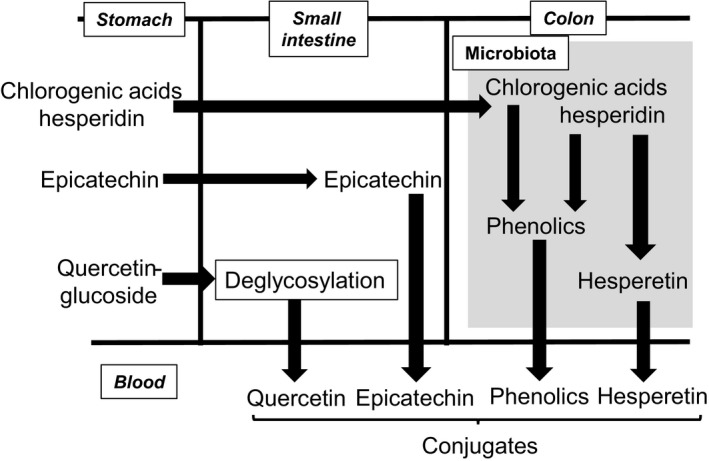
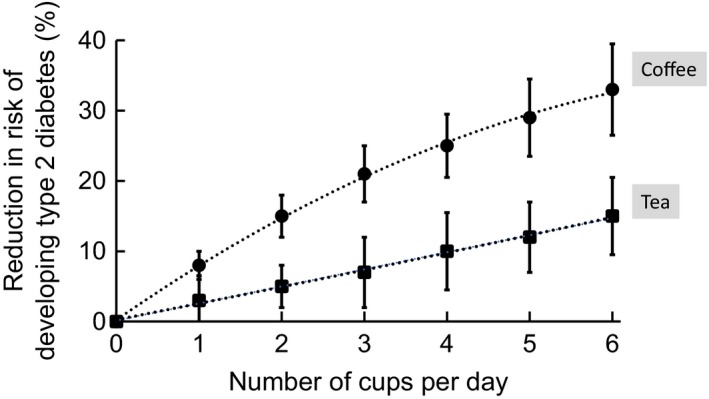
Abstract Polyphenols are found in plant‐based foods and beverages, notably apples, berries, citrus fruit, plums, broccoli, cocoa, tea and coffee and many others. There is substantial epidemiological evidence that a diet high in polyphenol‐rich fruit, vegetables, cocoa and beverages protects against developing cardiovascular disease and type 2 diabetes. The absorption and metabolism of these compounds have been well described and, for many, the gut microbiota play a critical role in absorption; taking into consideration the parent compound and the metabolites from colon bacteria catabolism, more than 80% of a dose can be absorbed and ultimately excreted in the urine. Common polyphenols in the diet are flavanols (cocoa, tea, apples, broad beans), flavanones (hesperidin in citrus fruit), hydroxycinnamates (coffee, many fruits), flavonols (quercetin in onions, apples and tea) and anthocyanins (berries). Many intervention studies, mechanistic in vitro data and epidemiological studies support a role for polyphenols against the development of chronic diseases. For example, flavanols decrease endothelial dysfunction, lower blood pressure and cholesterol, and modulate energy metabolism. Coffee and tea both reduce the risk of developing type 2 diabetes, through action of their constituent polyphenols. Despite extensive research, the exact mechanisms of action of polyphenols in the human body have not been decisively proven, but there is strong evidence that some targets such as nitric oxide metabolism, carbohydrate digestion and oxidative enzymes are important for health benefits. Consumption of polyphenols as healthy dietary components is consistent with the advice to eat five or more portions of fruit and vegetables per day, but it is currently difficult to recommend what ‘doses’ of specific polyphenols should be consumed to derive maximum benefit.
Overview
The claims and statistics of this paper haven’t been checked yet.
Run the check — free, no account needed. It reads the open-access text and checks the sources it cites.
Integrity signals
Registry
Cites
Statistics
Figures
Verification
Claims the paper makes
The claims and statistics of this paper haven’t been checked yet.
Run the check — free, no account needed. It reads the open-access text and checks the sources it cites.
Claims other papers make about this one
Each is checked against this paper’s own text: does it say what the citing paper says it does?
In the citing paper
“Often polyphenols act synergistically with other nutrients to influence glucose homeostasis and cellular processes”
From Mediterranean diet nutrients to turn the tide against insulin resistance and related diseases (2020) · cites this paper as [232]
In the citing paper
“it is uncertain whether isolated supplements would have the maximum effect without eating a variety of whole foods, as in the MedDiet eating pattern [232]”
From Mediterranean diet nutrients to turn the tide against insulin resistance and related diseases (2020) · cites this paper as [232]
In the citing paper
“However, despite representing a novel treatment paradigm for IR and IR-related diseases, polyphenol-based synthetic supplements may have several drawbacks [232].”
From Mediterranean diet nutrients to turn the tide against insulin resistance and related diseases (2020) · cites this paper as [232]
Self-check
Percentages, sums and reported differences re-computed from the paper’s own numbers.
The self-check needs the paper’s full text.
Citations
Cites
Dietary Intake and Bioavailability of Polyphenols
Scalbert, A., & Williamson, G. (2000) · The Journal of Nutrition · doi:10.1093/jn/130.8.2073s · Cited by 3,658 · cited 1×
“Polyphenols belong to the latter and are a diverse group of molecules that are consumed in all diets (Scalbert & Williamson 2000).”
BackgroundSelf-citationDel Rio, D., Rodriguez-Mateos, A., Spencer, J. P. E., Tognolini, M., Borges, G., & Crozier, A. (2013) · Antioxidants & Redox Signaling · doi:10.1089/ars.2012.4581 · Cited by 2,601
Hertog, M. G. L. (1995) · Archives of Internal Medicine · doi:10.1001/archinte.1995.00430040053006 · Cited by 1,853
Phenol-Explorer: an online comprehensive database on polyphenol contents in foods
Neveu, V., Pérez‐Jiménez, J., Vos, F., Crespy, V., Chaffaut, L. D., Mennen, L. I., Knox, C., Eisner, R., Cruz, J., Wishart, D. S., et al. (2010) · Database · doi:10.1093/database/bap024 · Cited by 1,442
Hooper, L., Kroon, P. A., Rimm, E. B., Cohn, J. S., Harvey, I., Le Cornu, K. A., Ryder, J. J., Hall, W. L., & Cassidy, A. (2008) · The American Journal of Clinical Nutrition · doi:10.1093/ajcn/88.1.38 · Cited by 1,097
Absorption of dietary quercetin glycosides and quercetin in healthy ileostomy volunteers
Hollman, P. C. H., de Vries, J., van Leeuwen, S., Mengelers, M. J. B., & Katan, M. (1995) · American Journal of Clinical Nutrition · doi:10.1093/ajcn/62.6.1276 · Cited by 956
Ding, M., Bhupathiraju, S. N., Chen, M., van Dam, R. M., & Hu, F. B. (2014) · Diabetes Care · doi:10.2337/dc13-1203 · Cited by 511 · cited 1×
“Data from systematic reviews and meta-analyses show that the reduction in risk is ~8% for each cup of coffee consumed per day and that this is independent of whether the coffee is decaffeinated or not (Bhupathiraju et al. 2013; Ding et al. 2014).”
BackgroundDietary intake of 337 polyphenols in French adults
Pérez‐Jiménez, J., Fezeu, L., Touvier, M., Arnault, N., Manach, C., Herçberg, S., Galan, P., & Scalbert, A. (2011) · American Journal of Clinical Nutrition · doi:10.3945/ajcn.110.007096 · Cited by 435
Mullen, W., Edwards, C. A., & Crozier, A. (2006) · British Journal Of Nutrition · doi:10.1079/bjn20061809 · Cited by 421
Possible effects of dietary polyphenols on sugar absorption and digestion
Williamson, G. (2012) · Molecular Nutrition & Food Research · doi:10.1002/mnfr.201200511 · Cited by 389
Cited by
Sorted by citations
Tena, N., Martı́n, J., & Asuero, A. G. (2020) · Antioxidants · doi:10.3390/antiox9050451 · Cited by 547
“However, the antioxidative activity of anthocyanins does not necessarily transfer to biological activity because any actions on the body depends both on bioavailability and cellular molecular targets [61].”
Role of Dietary Nutrients in the Modulation of Gut Microbiota: A Narrative Review
Yang, Q., Liang, Q., Balakrishnan, B., Belobrajdic, D. P., Feng, Q.-J., & Zhang, W. Y. (2020) · Nutrients · doi:10.3390/nu12020381 · Cited by 487
Vuolo, M. M., Lima, V. S., & Maróstica, M. R. (2019) · Elsevier eBooks · doi:10.1016/b978-0-12-814774-0.00002-5 · Cited by 412
Composition and functionality of bee pollen: A review
Thakur, M., & Nanda, V. (2020) · Trends in Food Science & Technology · doi:10.1016/j.tifs.2020.02.001 · Cited by 367
Flavonoid intake is associated with lower mortality in the Danish Diet Cancer and Health Cohort
Bondonno, N. P., Dalgaard, F., Kyrø, C., Murray, K., Bondonno, C. P., Lewis, J. R., Croft, K. D., Gislason, G., Scalbert, A., Cassidy, A., et al. (2019) · Nature Communications · doi:10.1038/s41467-019-11622-x · Cited by 335
Metadata
- Authors
- Williamson, G.
- Affiliations
- University of Leeds (GB)
- Corresponding author
- Williamson, G.
- ORCID
- Williamson, G.
- Venue
- Nutrition Bulletin
- Publisher
- Wiley
- Published
- 2017-08-15
- Volume
- 42
- Issue
- 3
- Pages
- 226-235
- ISSN
- 1467-3010 (ISSN-L)
- 1471-9827
- PMC
- PMC5601283
- OpenAlex
- W2749105166
- Cited by
- 551
- References
- 95
- Citations by year
- 2026: 62 · 2025: 55 · 2024: 54 · 2023: 61 · 2022: 79 · 2021: 71 · 2020: 71 · 2019: 62 · 2018: 32 · 2017: 3
- FWCI
- 5.25
- Type
- journal article
- Language
- en
- Open access
- hybrid
- doi.org
- Licence
- Locations
- Nutrition Bulletin (publishedVersion, cc-by)
- Europe PMC (PubMed Central) (publishedVersion, cc-by)
- PubMed Central (publishedVersion, cc-by)
- PubMed (publishedVersion)
- White Rose Research Online (University of Leeds, The University of Sheffield, University of York) (acceptedVersion)
- Funders
- European Research Council (POLYTRUE? 322467)
- Biotechnology and Biological Sciences Research Council (DRINC BB/M027406/1)
- Topics
- Health Sciences › Medicine › Biochemistry (medical) › Phytochemicals and Antioxidant Activities
- Health Sciences › Medicine › Public Health, Environmental and Occupational Health › Nutritional Studies and Diet
- Health Sciences › Nursing › Nutrition and Dietetics › Pomegranate: compositions and health benefits
- Keywords
- polyphenols, dietary polyphenols, cardiovascular disease, type 2 diabetes, gut microbiota, flavan-3-ols, flavonoids, hydroxycinnamic acids, anthocyanins, Theobroma cacao, tea, coffee, fruit and vegetable intake, endothelial dysfunction, nitric oxide, oxidative enzymes, chronic disease prevention
About these checks
Registry, retraction, Cites and statistics results are computed, not judged, with one exception: a printed reference that no index lists is read once by a model before it counts as a citation error. Claims are extracted by a model and kept only when their quote appears verbatim in the text; each cited source is then checked, with a model’s help, for whether it says what the claim relies on. Those verdicts can be wrong — read the claim’s quote and the cited source before relying on one.
Statistics and arithmetic are recomputed, not judged.
Confidence bands are shown only for fields calibrated on our annotated test set. None is calibrated yet, so no band is shown.
What counts as a claim ›How we measure confidence ›How we check this ›
Are you an author, or do you see a problem with this page? Request a review
