

The DOI matches its Crossref record; 233 of the 234 references it cites were found in a registry or an index.
Epigenetics and aging
Open accessAbstract
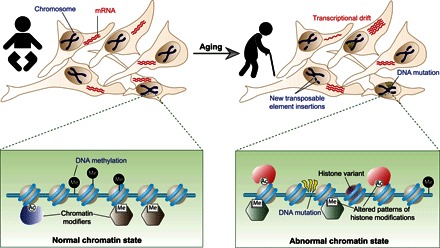
Researchers review how random changes and our environment (for example, diet) determines our life span.
Overview
The claims and statistics of this paper haven’t been checked yet.
Run the check — free, no account needed. It reads the open-access text and checks the sources it cites.
Integrity signals
Registry
Cites
Statistics
Figures


Verification
Claims the paper makes
The claims and statistics of this paper haven’t been checked yet.
Run the check — free, no account needed. It reads the open-access text and checks the sources it cites.
Claims other papers make about this one
Each is checked against this paper’s own text: does it say what the citing paper says it does?
The cited source says what the claim attributes to it.
In the citing paper
“Epigenetic changes linked to aging, including changes in DNA methylation (DNAme) patterns, H3K4me3 and H3K9me3 and H3K27me3 (Benayoun et al., 2015; Pal and Tyler, 2016; Sen et al., 2016) are also seen in multicellular organisms.”
From Loss of epigenetic information as a cause of mammalian aging (2023) · cites this paper as Pal and Tyler, 2016
The cited source says what the claim attributes to it.
In the citing paper
“These changes are complex and generally cell-type specific, but a consistent trend is the loss of heterochromatin and an associated transcriptional de-repression at sites across the genome, which has been observed in species from yeast to humans55–57.”
From The role of retrotransposable elements in ageing and age-associated diseases (2021) · cites this paper as [56]
In the citing paper
“Aging affects all organ systems through common underlying mechanisms such as changes in the immune system, oxidative stress, and DNA damage and replication errors, as well as epigenetic changes and accumulation of abnormal proteins across multiple organ systems.35–38”
From Defining Optimal Brain Health in Adults: A Presidential Advisory From the American Heart Association/American Stroke Association (2017) · cites this paper as [35]
In the citing paper
“while post-translational modifications like ubiquitination, sumoylation, O-GlcNAcylation, and ADP-ribosylation, can have varying influences on transcriptional dysregulation (Pal and Tyler 2016, Peleg et al. 2016).”
From Benefits of Metformin in Attenuating the Hallmarks of Aging (2020) · cites this paper as Pal and Tyler 2016
In the citing paper
“Histone modifications such as acetylation and phosphorylation can lead to active transcription, loss of cellular homeostasis and age-associated metabolic decline”
From Benefits of Metformin in Attenuating the Hallmarks of Aging (2020) · cites this paper as Pal and Tyler 2016
Self-check
Percentages, sums and reported differences re-computed from the paper’s own numbers.
The self-check needs the paper’s full text.
Citations
Cites
López-Otín, C., Blasco, M. A., Partridge, L., Serrano, M., & Kroemer, G. (2013) · Cell · doi:10.1016/j.cell.2013.05.039 · Cited by 14,982
Chromatin modifications and their function
Kouzarides, T. (2007) · Cell · doi:10.1016/j.cell.2007.02.005 · Cited by 10,883
Crystal structure of the nucleosome core particle at 2.8 Å resolution
Luger, K., Mäder, A. W., Richmond, R. K., Sargent, D. F., & Richmond, T. J. (1997) · Nature · doi:10.1038/38444 · Cited by 9,466
DNA methylation age of human tissues and cell types
Horvath, S. (2013) · Genome Biology · doi:10.1186/gb-2013-14-10-r115 · Cited by 7,075
Regulation of chromatin by histone modifications
Bannister, A. J., & Kouzarides, T. (2011) · Cell Research · doi:10.1038/cr.2011.22 · Cited by 6,012
The ENCODE Project Consortium (2007) · Nature · doi:10.1038/nature05874 · Cited by 5,223
Landscape of transcription in human cells
Djebali, S., Davis, C. A., Merkel, A., Dobin, A., Lassmann, T., Mortazavi, A., Tanzer, A., Lagarde, J., Lin, W., Schlesinger, F., et al. (2012) · Nature · doi:10.1038/nature11233 · Cited by 5,187
Non-coding RNAs in human disease
Esteller, M. (2011) · Nature Reviews Genetics · doi:10.1038/nrg3074 · Cited by 4,825
Resveratrol improves health and survival of mice on a high-calorie diet
Baur, J. A., Pearson, K. J., Price, N. L., Jamieson, H. A., Lerin, C., Kalra, A., Prabhu, V. V., Allard, J. S., Lopez-Lluch, G., Lewis, K., et al. (2006) · Nature · doi:10.1038/nature05354 · Cited by 4,290
Small molecule activators of sirtuins extend Saccharomyces cerevisiae lifespan
Howitz, K. T., Bitterman, K. J., Cohen, H. Y., Lamming, D. W., Lavu, S., Wood, J. G., Zipkin, R. E., Chung, P., Kisielewski, A., Zhang, L.-L., et al. (2003) · Nature · doi:10.1038/nature01960 · Cited by 3,796
Research works printed but not linked: 1
- D. W. Lamming D. A. Sinclair The regulation of lifespan by sirtuins in Saccharomyces cerevisiae dissertation Harvard University (2008).
Cited by
Benefits of Metformin in Attenuating the Hallmarks of Aging
Kulkarni, A. S., Gubbi, S., & Barzilai, N. (2020) · Cell Metabolism · doi:10.1016/j.cmet.2020.04.001 · Cited by 766
Cellular mechanotransduction in health and diseases: from molecular mechanism to therapeutic targets
Di, X., Gao, X., Peng, L., Ai, J., Jin, X., Qi, S., Li, H., Wang, K., & Luo, D. (2023) · Signal Transduction and Targeted Therapy · doi:10.1038/s41392-023-01501-9 · Cited by 622
Loss of epigenetic information as a cause of mammalian aging
Yang, J.-H., Hayano, M., Griffin, P. T., Amorim, J. A., Bonkowski, M. S., Apostolides, J. K., Salfati, E. L., Blanchette, M., Munding, E. M., Bhakta, M., et al. (2023) · Cell · doi:10.1016/j.cell.2022.12.027 · Cited by 643
The Impact of Nutrition and Environmental Epigenetics on Human Health and Disease
Tiffon, C. (2018) · International Journal of Molecular Sciences · doi:10.3390/ijms19113425 · Cited by 499
Aging Hallmarks and the Role of Oxidative Stress
Maldonado, E., Morales-Pison, S., Urbina, F., & Solari, A. (2023) · Antioxidants · doi:10.3390/antiox12030651 · Cited by 425
Metadata
- Authors
- Pal, S., & Tyler, J. K.
- Affiliations
- The University of Texas MD Anderson Cancer Center (US)
- Weill Cornell Medicine (US)
- Corresponding author
- Tyler, Jessica K.
- Venue
- Science Advances
- Published
- 2016-07
- Volume
- 2
- Issue
- 7
- Pages
- e1600584-e1600584
- ISSN
- 2375-2548 (ISSN-L)
- PMC
- PMC4966880
- OpenAlex
- W2491494855
- Cited by
- 860
- References
- 234
- Citations by year
- 2026: 74 · 2025: 106 · 2024: 108 · 2023: 101 · 2022: 91 · 2021: 106 · 2020: 81 · 2019: 76 · 2018: 57 · 2017: 53 · 2016: 4
- FWCI
- 5.73
- Type
- journal article
- Language
- en
- Open access
- gold
- doi.org
- Licence
- cc-by-nc
- Locations
- Science Advances (publishedVersion, cc-by-nc)
- PubMed Central (publishedVersion, cc-by-nc)
- PubMed (publishedVersion)
- Funders
- National Institutes of Health (ID0EM4AE8935, RO1 CA95641)
- Topics
- Life Sciences › Biochemistry, Genetics and Molecular Biology › Molecular Biology › Epigenetics and DNA Methylation
- Life Sciences › Biochemistry, Genetics and Molecular Biology › Aging › Genetics, Aging, and Longevity in Model Organisms
- Life Sciences › Biochemistry, Genetics and Molecular Biology › Molecular Biology › Genomics and Chromatin Dynamics
- Keywords
- epigenetics, aging, histone modifications, DNA methylation, histone variants, non-coding RNA, replicative senescence, transposable elements, genomic instability, transgenerational epigenetic inheritance, lifespan regulation, age-related diseases, cancer
- MeSH terms
- Aging, Chromatin, Histones, Humans, Retroelements, DNA Methylation, RNA, Untranslated, Epigenomics
About these checks
Registry, retraction, Cites and statistics results are computed, not judged, with one exception: a printed reference that no index lists is read once by a model before it counts as a citation error. Claims are extracted by a model and kept only when their quote appears verbatim in the text; each cited source is then checked, with a model’s help, for whether it says what the claim relies on. Those verdicts can be wrong — read the claim’s quote and the cited source before relying on one.
Statistics and arithmetic are recomputed, not judged.
Confidence bands are shown only for fields calibrated on our annotated test set. None is calibrated yet, so no band is shown.
What counts as a claim ›How we measure confidence ›How we check this ›
Are you an author, or do you see a problem with this page? Request a review
How to cite
Cite CoChat for the checks on this page, and the paper for its own findings.
- This page
- CoChat. (2026). Citation check: Epigenetics and aging. https://app.cochat.ai/papers/10.1126/sciadv.1600584
- The paper
- Pal, S., & Tyler, J. K. (2016). Epigenetics and aging. Science Advances. https://doi.org/10.1126/sciadv.1600584
Data sources
Bibliographic data: Semantic Scholar, OpenAlex, Crossref.
Contains information from the Semantic Scholar Academic Graph Datasets, made available under the ODC Attribution License (ODC-BY 1.0).
Semantic Scholar’s data is described in: Kinney, R., et al. (2023). The Semantic Scholar Open Data Platform. arXiv:2301.10140.
