

Machine learning unifies the modeling of materials and molecules
Open accessThe DOI matches its Crossref record; 70 of the 71 references it cites were found in a registry or an index.
Abstract
Statistical learning based on a local representation of atomic structures provides a universal model of chemical stability.
Overview
The claims and statistics of this paper haven’t been checked yet.
Free: it reads the open-access text and checks the first 5 claims that cite a source we can check. Create a free account to check every claim.
Integrity signals
Registry
Cites
Statistics
Figures
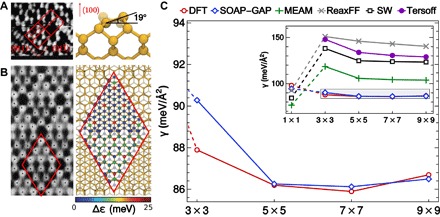
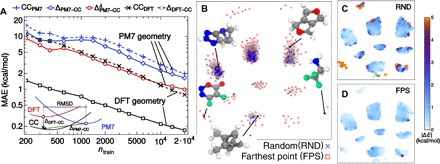
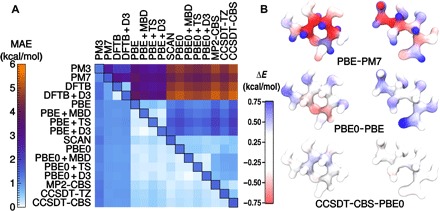
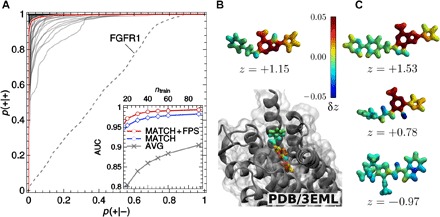
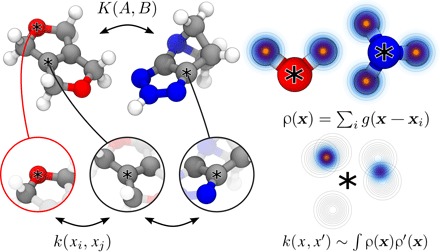
Verification
Claims the paper makes
The claims and statistics of this paper haven’t been checked yet.
Free: it reads the open-access text and checks the first 5 claims that cite a source we can check. Create a free account to check every claim.
Claims other papers make about this one
Each is checked against this paper’s own text: does it say what the citing paper says it does?
The cited source says what the claim attributes to it.
In the citing paper
“A critical assessment of the model performance as a function of the hyperparameters makes it possible to gauge the range of interactions 104 , or the locality of the physical phenomena underlying structure-property relations 105,106 for that system.”
From Unsupervised machine learning in atomistic simulations, between predictions and understanding (2019) · cites this paper as [104]
The cited source says what the claim attributes to it.
In the citing paper
“A low-dimensional representation of a dataset can help when it comes to identifying problematic regions, and understanding how a given representation 'sees' a set of structures 58,104,111 .”
From Unsupervised machine learning in atomistic simulations, between predictions and understanding (2019) · cites this paper as [104]
In the citing paper
“Gaussian process regression (GPR) was used to generate very accurate Gaussian atomic potentials (GAP) and then to train a SOAP–GAP model within a ML framework (GPR) that achieved a 99% accurate atomic-scale properties for Si surface reconstruction, stability of molecules, and protein ligands.209”
From QSAR without borders (2020) · cites this paper as [209]
In the citing paper
“To mitigate this limitation, read-across techniques are increasingly used to estimate the properties of nanomaterials.231”
From QSAR without borders (2020) · cites this paper as [231]
Self-check
Percentages, sums and reported differences re-computed from the paper’s own numbers.
The self-check needs the paper’s full text.
Citations
Cites
Density-functional thermochemistry. III. The role of exact exchange
Becke, A. D. (1993) · The Journal of Chemical Physics · doi:10.1063/1.464913 · Cited by 103,767
Self-Consistent Equations Including Exchange and Correlation Effects
Kohn, W., & Sham, L. J. (1965) · Physical Review · doi:10.1103/physrev.140.a1133 · Cited by 64,135
Hohenberg, P., & Kohn, W. (1964) · Physical Review · doi:10.1103/physrev.136.b864 · Cited by 53,541
Stephens, P. J., Devlin, F. J., Chabalowski, C. F., & Frisch, M. J. (1994) · The Journal of Physical Chemistry · doi:10.1021/j100096a001 · Cited by 23,248
Perdew, J. P., Chevary, J. A., Vosko, S. H., Jackson, K. A., Pederson, M. R., Singh, D. J., & Fiolhais, C. (1992) · Physical Review B · doi:10.1103/physrevb.46.6671 · Cited by 22,269
Development and testing of a general amber force field
Wang, J., Wolf, R. M., Caldwell, J. W., Kollman, P. A., & Case, D. A. (2004) · Journal of Computational Chemistry · doi:10.1002/jcc.20035 · Cited by 19,506
Self-consistent molecular orbital methods. XX. A basis set for correlated wave functions
Krishnan, R., Binkley, J. S., Seeger, R., & Pople, J. A. (1980) · The Journal of Chemical Physics · doi:10.1063/1.438955 · Cited by 17,772
Perdew, J. P., Chevary, J. A., Vosko, S. H., Jackson, K. A., Pederson, M. R., Singh, D. J., & Fiolhais, C. (1993) · Physical Review B · doi:10.1103/physrevb.48.4978.2 · Cited by 17,144
First principles methods using CASTEP
Clark, S. J., Segall, M. D., Pickard, C. J., Hasnip, P. J., Probert, M. I. J., Refson, K., & Payne, M. C. (2005) · Zeitschrift für Kristallographie - Crystalline Materials · doi:10.1524/zkri.220.5.567.65075 · Cited by 14,633
The Hungarian method for the assignment problem
Kuhn, H. W. (1955) · Naval Research Logistics Quarterly · doi:10.1002/nav.3800020109 · Cited by 13,120
Cited by
SchNet – A deep learning architecture for molecules and materials
Schütt, K. T., Sauceda, H. E., Kindermans, P.-J., Tkatchenko, A., & Müller, K.-R. (2018) · The Journal of Chemical Physics · doi:10.1063/1.5019779 · Cited by 2,217
Unke, O. T., Chmiela, S., Sauceda, H. E., Gastegger, M., Poltavsky, I., Schütt, K. T., Tkatchenko, A., & Müller, K.-R. (2021) · Chemical Reviews · doi:10.1021/acs.chemrev.0c01111 · Cited by 1,647
Graph Networks as a Universal Machine Learning Framework for Molecules and Crystals
Chen, C., Ye, W., Zuo, Y., Zheng, C., & Ong, S. P. (2019) · Chemistry of Materials · doi:10.1021/acs.chemmater.9b01294 · Cited by 1,552
Gaussian Process Regression for Materials and Molecules
Deringer, V. L., Bartók, A. P., Bernstein, N., Wilkins, D. M., Ceriotti, M., & Csányi, G. (2021) · Chemical Reviews · doi:10.1021/acs.chemrev.1c00022 · Cited by 1,221
Self-citationMachine Learning Interatomic Potentials as Emerging Tools for Materials Science
Deringer, V. L., Caro, M. A., & Csányi, G. (2019) · Advanced Materials · doi:10.1002/adma.201902765 · Cited by 1,036
Metadata
- Authors
- Bartók, A. P., De, S., Poelking, C., Bernstein, N., Kermode, J. R., Csányi, G., & Ceriotti, M.
- Affiliations
- Rutherford Appleton Laboratory (GB)
- École Polytechnique Fédérale de Lausanne (CH)
- University of Cambridge (GB)
- United States Naval Research Laboratory (US)
- University of Warwick (GB)
- Engineering Laboratory, University of Cambridge, Cambridge, UK.
- Corresponding author
- Ceriotti, Michele
- ORCID
- Venue
- Science Advances
- Published
- 2017-12
- Volume
- 3
- Issue
- 12
- Pages
- e1701816-e1701816
- ISSN
- 2375-2548 (ISSN-L)
- PMC
- PMC5729016
- OpenAlex
- W2620687153
- Cited by
- 764
- References
- 71
- Citations by year
- 2026: 43 · 2025: 79 · 2024: 67 · 2023: 91 · 2022: 96 · 2021: 114 · 2020: 130 · 2019: 90 · 2018: 52 · 2017: 2
- FWCI
- 31.56
- Type
- journal article
- Language
- en
- Open access
- gold
- doi.org
- Licence
- cc-by-nc
- Locations
- Science Advances (publishedVersion, cc-by-nc)
- PubMed Central (publishedVersion, cc-by-nc)
- PubMed (publishedVersion)
- Warwick Research Archive Portal (University of Warwick) (acceptedVersion)
- arXiv (Cornell University) (submittedVersion)
- Apollo (University of Cambridge) (submittedVersion, cc-by-nc)
- Cambridge University Engineering Department Publications Database (submittedVersion)
- Infoscience (Ecole Polytechnique Fédérale de Lausanne) (submittedVersion)
- Infoscience (Ecole Polytechnique Fédérale de Lausanne) (submittedVersion, cc-by-nc-nd)
- Science and Technology Facilities Council (submittedVersion)
- arXiv (Cornell University)
- Apollo
- Funders
- Office of Naval Research (award361580, U.S. Naval Research Laboratory, core basic research program)
- Engineering and Physical Sciences Research Council (award324327, EP/L014742/1, EP/J010847/1 and EP/J022012/1, award324329, EP/L014742/1, EP/P002188/1, award361574, EP/M022501/1, award361582, EP/K013564/1, EP/P022561/1)
- Swiss National Science Foundation (award324328, NCCR MARVEL)
- Leverhulme Trust (award361572, Leverhulme Early Career Fellowship)
- Isaac Newton Trust (award361573)
- European Research Council (award324326, 677013-HBMAP, award324330, 67658 - NOMAD)
- Topics
- Physical Sciences › Materials Science › Materials Chemistry › Machine Learning in Materials Science
- Physical Sciences › Physics and Astronomy › Atomic and Molecular Physics, and Optics › Advanced Chemical Physics Studies
- Life Sciences › Pharmacology, Toxicology and Pharmaceutics › Drug Discovery › Computational Drug Discovery Methods
- Keywords
- machine learning, molecular stability, atomistic modeling, local chemical environment, silicon surface reconstruction, protein-ligand binding, potential energy surface, quantum effects
About these checks
Registry, retraction, Cites and statistics results are computed, not judged, with one exception: a printed reference that no index lists is read once by a model before it counts as a citation error. Claims are extracted by a model and kept only when their quote appears verbatim in the text; each cited source is then checked, with a model’s help, for whether it says what the claim relies on. Those verdicts can be wrong — read the claim’s quote and the cited source before relying on one.
Statistics and arithmetic are recomputed, not judged.
Confidence bands are shown only for fields calibrated on our annotated test set. None is calibrated yet, so no band is shown.
What counts as a claim ›How we measure confidence ›How we check this ›
Are you an author, or do you see a problem with this page? Request a review
How to cite
Cite CoChat for the checks on this page, and the paper for its own findings.
- This page
- CoChat. (2026). Citation check: Machine learning unifies the modeling of materials and molecules. https://app.cochat.ai/papers/10.1126/sciadv.1701816
- The paper
- Bartók, A. P., De, S., Poelking, C., Bernstein, N., Kermode, J. R., Csányi, G., & Ceriotti, M. (2017). Machine learning unifies the modeling of materials and molecules. Science Advances. https://doi.org/10.1126/sciadv.1701816
Data sources
Bibliographic data: Semantic Scholar, OpenAlex, Crossref.
Contains information from the Semantic Scholar Academic Graph Datasets, made available under the ODC Attribution License (ODC-BY 1.0).
Semantic Scholar’s data is described in: Kinney, R., et al. (2023). The Semantic Scholar Open Data Platform. arXiv:2301.10140.
