

Deep neural network processing of DEER data
Open accessThe DOI matches its Crossref record; 70 of the 70 references it cites were found in a registry or an index.
Abstract
Deep neural networks successfully solve Fredholm equations and extract molecular-scale distance distributions from EPR data.
Overview
The claims and statistics of this paper haven’t been checked yet.
Free: it reads the open-access text and checks the first 5 claims that cite a source we can check. Create a free account to check every claim.
Integrity signals
Registry
Cites
Statistics
Figures
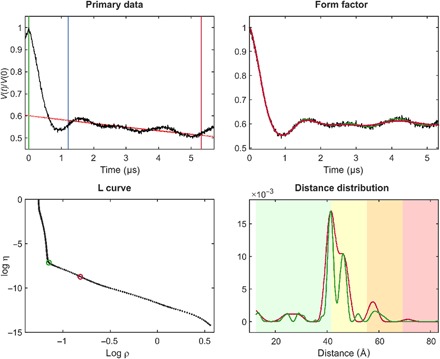
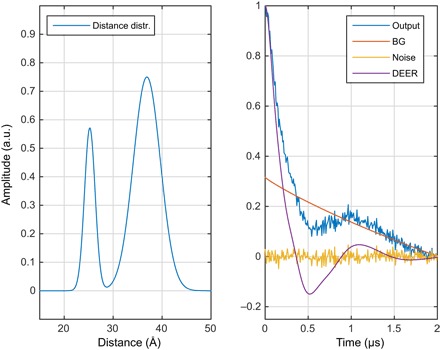
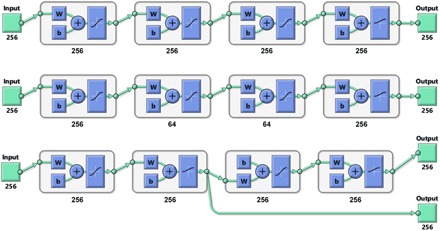
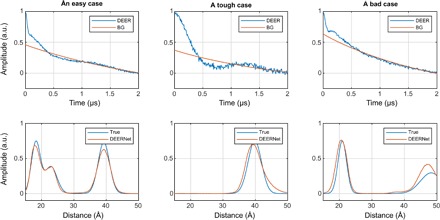


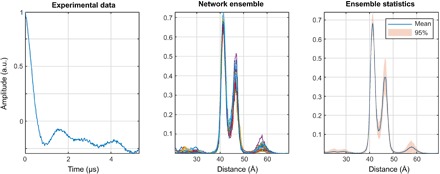
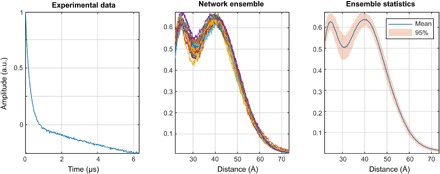
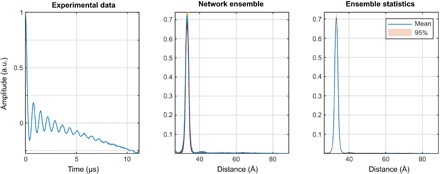
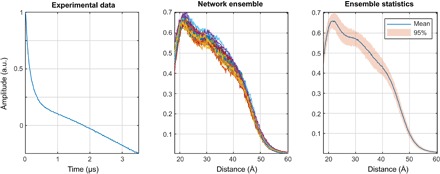
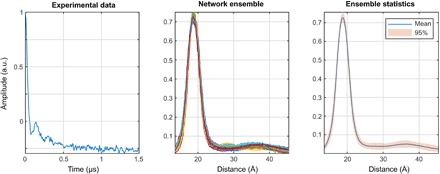

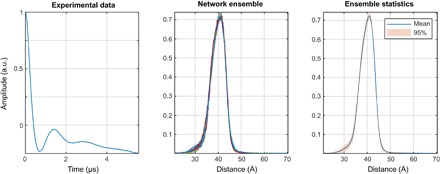
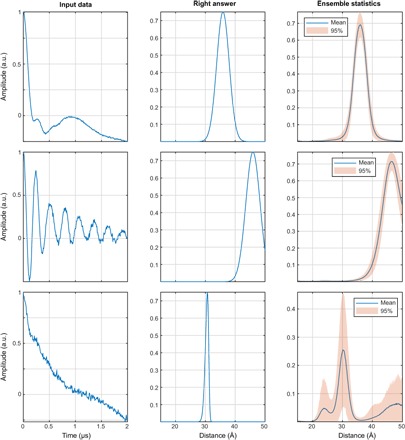
Verification
Claims the paper makes
The claims and statistics of this paper haven’t been checked yet.
Free: it reads the open-access text and checks the first 5 claims that cite a source we can check. Create a free account to check every claim.
Self-check
Percentages, sums and reported differences re-computed from the paper’s own numbers.
The self-check needs the paper’s full text.
Citations
Cites
Multilayer feedforward networks are universal approximators
Hornik, K., Stinchcombe, M., & White, H. (1989) · Neural Networks · doi:10.1016/0893-6080(89)90020-8 · Cited by 21,728 · cited 3×
“Multilayer feedforward networks are known to be universal approximators ( 46 ), but the present case is particularly appealing because the required network is likely to be quite small.”
BackgroundInfluentialA logical calculus of the ideas immanent in nervous activity
McCulloch, W. S., & Pitts, W. (1943) · The Bulletin of Mathematical Biophysics · doi:10.1007/bf02478259 · Cited by 18,566
Multilayer feedforward networks are universal approximators
HornikK., StinchcombeM., & WhiteH. (1989) · Neural Networks · doi:10.5555/70405.70408 · Cited by 9,081
A general regression neural network
Specht, D. F. (1991) · IEEE Transactions on Neural Networks · doi:10.1109/72.97934 · Cited by 4,492
On the approximate realization of continuous mappings by neural networks
Funahashi, K.-I. (1989) · Neural Networks · doi:10.1016/0893-6080(89)90003-8 · Cited by 4,206
A scaled conjugate gradient algorithm for fast supervised learning
Møller, M. F. (1993) · Neural Networks · doi:10.1016/s0893-6080(05)80056-5 · Cited by 4,052
A direct adaptive method for faster backpropagation learning: the RPROP algorithm
Riedmiller, M., & Braun, H. (2002) · IEEE International Conference on Neural Networks · doi:10.1109/icnn.1993.298623 · Cited by 3,917 · cited 2×
“Neural network training requires a library of inputs and their corresponding outputs covering a range that is representative of all possibilities ( 48 , 49 , 59 ).”
BackgroundMethodAnalysis of Discrete Ill-Posed Problems by Means of the L-Curve
Hansen, P. C. (1992) · SIAM Review · doi:10.1137/1034115 · Cited by 3,903
Universal approximation bounds for superpositions of a sigmoidal function
Barron, A. R. (1993) · IEEE Transactions on Information Theory · doi:10.1109/18.256500 · Cited by 2,804
Dead-Time Free Measurement of Dipole–Dipole Interactions between Electron Spins
Pannier, M., Veit, S., Godt, A., Jeschke, G., & Spiess, H. W. (2000) · Journal of Magnetic Resonance · doi:10.1006/jmre.1999.1944 · Cited by 1,056 · cited 5×
“Godt, Co-conformational distribution of nanosized [2]catenanes determined by pulse EPR measurements.”
BackgroundInfluentialSelf-citation
Research works printed but not linked: 1
- Milov A. D., Salikhov K. M., Shirov M. D., Use of the double resonance in electron spin echo method for the study of paramagnetic center spatial distribution in solids. Fizika Tverdogo Tela 23, 975– 982 (1981).
Cited by
Items 201–224 of 224
Dynamic basis of lipopolysaccharide export by LptB2FGCPreprint
Dajka, M., Rath, T., Morgner, N., & Joseph, B. (2024) · eLife · doi:10.7554/elife.99338.1
Dynamic basis of lipopolysaccharide export by LptB2FGCPreprint
Dajka, M., Rath, T., Morgner, N., & Joseph, B. (2024) · eLife · doi:10.7554/elife.99338.2
Remmel, L., Meyer, A., Ackermann, K., Hagelueken, G., Bennati, M., & Bode, B. E. (2024) · Angewandte Chemie · doi:10.1002/ange.202411241
eLife assessment: Dynamic basis of lipopolysaccharide export by LptB2FGC
Stockbridge, R. B. (2024) · eLife · doi:10.7554/elife.99338.3.sa0
Investigation of the lipopolysaccharide transport system using electron spin resonance spectroscopy
Dajka, M. (2024) · Publication Server of Goethe University Frankfurt am Main (Goethe University Frankfurt) · doi:10.21248/gups.88124
Modi, M., Sule, S., Palumbo, J., Rozowski, M., Hampton, G. S., Bouhrara, M., Czaja, W., & Spencer, R. G. S. (2026) · NMR in Biomedicine · doi:10.1002/nbm.70276
Calcium-Dependent S100A8 Amyloid Fibril Formation via S100A1-Mediated Transient Interaction
Karalkevičiu̅tė, V., Baronaitė, I., Peštenytė, A., Veiveris, D., Usevičius, G., Šimėnas, M., Žiaunys, M., Smirnovas, V., & Šulskis, D. (2025) · ACS Chemical Neuroscience · doi:10.1021/acschemneuro.5c00086
(2025) · Magnetic Resonance · doi:10.5194/mr-2025-11-rc1
Unveiling the structure of RNA using EPR spectroscopy
Papa, M. (2023) · St Andrews Research Repository (St Andrews Research Repository) · doi:10.17630/sta/457
Dynamic basis of lipopolysaccharide export by LptB2FGC
Dajka, M., Rath, T., Morgner, N., & Joseph, B. (2024) · Refubium (Universitätsbibliothek der Freien Universität Berlin) · doi:10.17169/refubium-45211
Integrating EPR and computational modeling to measure protein structure and dynamics
Bogetti, X. (2024) · D-Scholarship@Pitt (University of Pittsburgh)
Controlling Polymer Conformation and Hydration with Monomer Sequence
DeStefano, A. J. (2023) · eScholarship (California Digital Library)
The roadmap towards AI-assisted pulse programming for solid-state NMR
Li, Y., Concilio, M. G., & Kong, X. (2026) · Solid State Nuclear Magnetic Resonance · doi:10.1016/j.ssnmr.2026.102078
Pierro, A. (2021) · theses.fr (ABES) · doi:10.70675/39f8a77cz8a4fz4b03za3ccz3de625c18f55 · Cited by 1
A nucleotide-triggered molecular switch orchestrating septin polymerizationPreprint
Grupp, B., Jäckel, B., Gunter, A., Rehberger, J., Steimle, S., Gehrke, J. F., Sieg, C., Strittmatter, J., Wunder, T., Vomhof, T., et al. (2026) · bioRxiv (Cold Spring Harbor Laboratory) · doi:10.64898/2026.05.07.723466
FENNEC: photon-level deep learning for classifying bursts in diffusion-based single-molecule FRETPreprint
Schiffrin, B., & Crossley, J. A. (2026) · bioRxiv (Cold Spring Harbor Laboratory) · doi:10.64898/2026.07.14.737247
Application of artificial intelligence in NMR-based metabolomics
Pandey, S., Marwari, D., Mishra, A. K., & Sinha, N. (2026) · Annual reports on NMR spectroscopy · doi:10.1016/bs.arnmr.2026.04.002
dHis-Cu( ii ) based EPR distances at W-band: navigating the challenges of excitation
Moriglioni, N. A., Limbach, Y., Mkami, H. E., Hunter, R. I., Ackermann, K., SMITH, G. M., Bode, B. E., & Saxena, S. (2026) · Physical Chemistry Chemical Physics · doi:10.1039/d6cp02541b
Spins Afar─Long-Range Pulse Dipolar EPR Spectroscopy Uncovers Curvature in TRIM25’s Coiled Coil
Limbach, Y., Ackermann, K., Chakraborty, A., Norman, D., & Bode, B. E. (2026) · The Journal of Physical Chemistry Letters · doi:10.1021/acs.jpclett.6c02671
TorchSpin: Differentiable Electron Paramagnetic Resonance Simulation in PyTorchPreprint
Follmer, A. H. (2026) · arXiv (Cornell University) · doi:10.48550/arxiv.2610.18924
“Their A tensors were [20, 20, 90], [8, 8, 12], and [5, 5, 7] MHz, respectively.”
InfluentialBrennan, P. J., Garces, A. M., Grosskopf, J. D., Pani, B., & Lerch, M. T. (2026) · bioRxiv (Cold Spring Harbor Laboratory) · doi:10.64898/2026.10.26.761934
“Here, the neural network analysis DEERNet [67] fitting routine was employed, with reported 95% confidence intervals.”
Limbach, Y., Schult, P., Paeschke, K., Bode, B. E., & Schiemann, O. (2026) · Applied Magnetic Resonance · doi:10.1007/s00723-026-01889-x
Metadata
- Authors
- Worswick, S. G., Spencer, J. A., Jeschke, G., & Kuprov, I.
- Affiliations
- University of Southampton (GB)
- ETH Zurich (CH)
- Corresponding author
- Kuprov, Ilya
- Venue
- Science Advances
- Published
- 2018-08-03
- Volume
- 4
- Issue
- 8
- Pages
- eaat5218-eaat5218
- ISSN
- 2375-2548 (ISSN-L)
- PMC
- PMC6108566
- OpenAlex
- W2888649302
- Semantic Scholar
- ec65776701840f1806d48e77ed4d7837e220e480
- Cited by
- 212
- References
- 70
- Citations by year
- 2026: 13 · 2025: 26 · 2024: 33 · 2023: 36 · 2022: 47 · 2021: 30 · 2020: 11 · 2019: 15 · 2018: 1
- FWCI
- 7.44
- Type
- journal article
- Language
- en
- Open access
- gold
- doi.org
- Licence
- cc-by
- Locations
- Science Advances (publishedVersion, cc-by)
- Europe PMC (PubMed Central) (publishedVersion, cc-by)
- PubMed Central (publishedVersion, cc-by)
- PubMed (publishedVersion)
- ePrints Soton (University of Southampton) (submittedVersion)
- Repository for Publications and Research Data (ETH Zurich) (submittedVersion, cc-by)
- ETH Zürich Research Collection (cc-by)
- Funders
- Engineering and Physical Sciences Research Council (EP/N006895/1)
- Topics
- Physical Sciences › Chemistry › Spectroscopy › Electron Spin Resonance Studies
- Physical Sciences › Materials Science › Electronic, Optical and Magnetic Materials › Magnetism in coordination complexes
- Physical Sciences › Chemistry › Spectroscopy › Advanced NMR Techniques and Applications
- Keywords
- double electron-electron resonance, artificial neural networks, model-independent analysis, distance distribution, exchange interaction, synthetic training data, uncertainty estimation, PELDOR, spinach
About these checks
Registry, retraction, Cites and statistics results are computed, not judged, with one exception: a printed reference that no index lists is read once by a model before it counts as a citation error. Claims are extracted by a model and kept only when their quote appears verbatim in the text; each cited source is then checked, with a model’s help, for whether it says what the claim relies on. Those verdicts can be wrong — read the claim’s quote and the cited source before relying on one.
Statistics and arithmetic are recomputed, not judged.
Confidence bands are shown only for fields calibrated on our annotated test set. None is calibrated yet, so no band is shown.
What counts as a claim ›How we measure confidence ›How we check this ›
Are you an author, or do you see a problem with this page? Request a review
Data sources
Bibliographic data: Semantic Scholar, OpenAlex, Crossref.
Contains information from the Semantic Scholar Academic Graph Datasets, made available under the ODC Attribution License (ODC-BY 1.0).
Semantic Scholar’s data is described in: Kinney, R., et al. (2023). The Semantic Scholar Open Data Platform. arXiv:2301.10140.
