

The DOI matches its Crossref record; 40 of the 40 references it cites were found in a registry or an index.
Hierarchically patterned self-powered sensors for multifunctional tactile sensing
Open accessAbstract
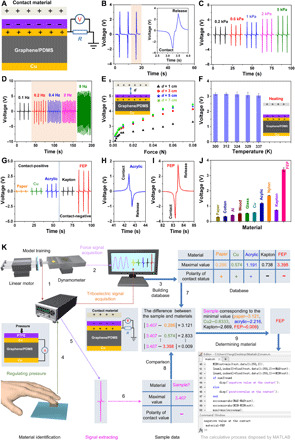
A multifunctional self-powered sensor is developed for pressure, temperature, and material sensing.
Overview
The claims and statistics of this paper haven’t been checked yet.
Free: it reads the open-access text and checks the first 5 claims that cite a source we can check. Create a free account to check every claim.
Integrity signals
Registry
Cites
Statistics
Figures



Verification
Claims the paper makes
The claims and statistics of this paper haven’t been checked yet.
Free: it reads the open-access text and checks the first 5 claims that cite a source we can check. Create a free account to check every claim.
Claims other papers make about this one
Each is checked against this paper’s own text: does it say what the citing paper says it does?
The cited source says what the claim attributes to it.
In the citing paper
“The development of novel dual-parameter sensors that transduce different stimuli into separate signals can minimize signal interference, allowing the detection of both temperature and pressure at a single point without decoupling analysis.[107,228,229]”
From Flexible Electronics and Devices as Human–Machine Interfaces for Medical Robotics (2022) · cites this paper as [228]
Self-check
Percentages, sums and reported differences re-computed from the paper’s own numbers.
The self-check needs the paper’s full text.
Citations
Cites
Kim, D.-H., Lu, N., Ma, R., Kim, Y.-S., Kim, R.-H., Wang, S., Wu, J., Won, S. M., Tao, H., Islam, A., et al. (2011) · Science · doi:10.1126/science.1206157 · Cited by 4,836
Self-citationPursuing prosthetic electronic skin
Chortos, A., Liu, J., & Bao, Z. (2016) · Nature Materials · doi:10.1038/nmat4671 · Cited by 2,396 · cited 1×
“For example, electronic skins and flexible sensors have been implemented in robotics and wearable health-monitoring devices to detect ambient changes of strain, vibration, and the direction of applied pressure ( 7 – 13 ).”
Progress in triboelectric nanogenerators as a new energy technology and self-powered sensors
Wang, Z. L., Chen, J., & Lin, L. (2015) · Energy & Environmental Science · doi:10.1039/c5ee01532d · Cited by 2,174
Self-citationCoding and use of tactile signals from the fingertips in object manipulation tasks
Johansson, R. S., & Flanagan, J. R. (2009) · Nature Reviews Neuroscience · doi:10.1038/nrn2621 · Cited by 2,063
Quantifying the triboelectric series
Zou, H., Zhang, Y., Guo, L., Wang, P., He, X., Dai, G., Zheng, H., Chen, C., Wang, A. C., Xu, C., et al. (2019) · Nature Communications · doi:10.1038/s41467-019-09461-x · Cited by 1,920
Self-citationPu, X., Liu, M., Chen, X., Sun, J., Du, C., Zhang, Y., Zhai, J., Hu, W., & Wang, Z. L. (2017) · Science Advances · doi:10.1126/sciadv.1700015 · Cited by 1,218 · cited 1×
“Triboelectric nanogenerator (TENG) is a promising alternative approach to bridging the technological gap (24, 25).”
Self-citationSoft Microfluidic Assemblies of Sensors, Circuits, and Radios for the Skin
Xu, S., Zhang, Y., Jia, L., Mathewson, K. E., Jang, K.-I., Kim, J., Fu, H., Huang, X., Chava, P., Wang, R., et al. (2014) · Science · doi:10.1126/science.1250169 · Cited by 1,199
Inflammation-free, gas-permeable, lightweight, stretchable on-skin electronics with nanomeshes
Miyamoto, A., Lee, S., Cooray, N. F., Lee, S., Mori, M., Matsuhisa, N., Jin, H., Yoda, L., Yokota, T., Itoh, A., et al. (2017) · Nature Nanotechnology · doi:10.1038/nnano.2017.125 · Cited by 1,181
Learning the signatures of the human grasp using a scalable tactile glove
Sundaram, S., Kellnhofer, P., Li, Y., Zhu, J.-Y., Torralba, A., & Matusik, W. (2019) · Nature · doi:10.1038/s41586-019-1234-z · Cited by 1,162 · cited 1×
“(23) recently demonstrated a scalable tactile glove that can perceive individual objects by deep convolution neural networks.”
Yao, H., Ge, J., Wang, C., Wang, X., Hu, W., Zheng, Z., Ni, Y., & Yu, S. (2013) · Advanced Materials · doi:10.1002/adma.201303041 · Cited by 1,137
Cited by
Triboelectric nanogenerator sensors for soft robotics aiming at digital twin applications
Jin, T., Sun, Z., Li, L., Zhang, Q., Zhu, M., Zhang, Z., Yuan, G., Chen, T., Tian, Y., Hou, X., et al. (2020) · Nature Communications · doi:10.1038/s41467-020-19059-3 · Cited by 695
Flexible Electronics and Devices as Human–Machine Interfaces for Medical Robotics
Heng, W., Solomon, S., & Gao, W. (2022) · Advanced Materials · doi:10.1002/adma.202107902 · Cited by 609
Wearable Thermoelectric Materials and Devices for Self‐Powered Electronic Systems
Jia, Y., Jiang, Q., Sun, H., Liu, P., Hu, D., Pei, Y., Liu, W., Crispin, X., Fabiano, S., Ma, Y., et al. (2021) · Advanced Materials · doi:10.1002/adma.202102990 · Cited by 600
Piezoelectric materials for flexible and wearable electronics: A review
Wu, Y., Ma, Y., Zheng, H., & Ramakrishna, S. (2021) · Materials & Design · doi:10.1016/j.matdes.2021.110164 · Cited by 521
Sun, Z., Zhu, M., Shan, X., & Lee, C. (2022) · Nature Communications · doi:10.1038/s41467-022-32745-8 · Cited by 532
Metadata
- Authors
- Wang, Y., Wu, H., Xu, L., Zhang, H., Yang, Y., & Wang, Z. L.
- Affiliations
- Chinese Academy of Sciences (CN)
- Guangxi University (CN)
- Georgia Institute of Technology (US)
- Corresponding author
- Yang, Ya
- Wang, Zhong Lin
- Venue
- Science Advances
- Published
- 2020-08-21
- Volume
- 6
- Issue
- 34
- Pages
- eabb9083-eabb9083
- ISSN
- 2375-2548 (ISSN-L)
- PMC
- PMC7438107
- OpenAlex
- W3054245704
- Semantic Scholar
- 483f9ded75cb353f8b1dc5127642c06282245fe2
- Cited by
- 425
- References
- 40
- Citations by year
- 2026: 37 · 2025: 62 · 2024: 85 · 2023: 78 · 2022: 82 · 2021: 75 · 2020: 6
- FWCI
- 18.93
- Type
- journal article
- Language
- en
- Open access
- gold
- doi.org
- Licence
- Locations
- Science Advances (publishedVersion, cc-by)
- PubMed Central (publishedVersion, cc-by)
- PubMed (publishedVersion)
- Topics
- Physical Sciences › Engineering › Biomedical Engineering › Advanced Sensor and Energy Harvesting Materials
- Physical Sciences › Engineering › Mechanical Engineering › Advanced Materials and Mechanics
- Physical Sciences › Engineering › Electrical and Electronic Engineering › Nanomaterials and Printing Technologies
- Keywords
- self-powered sensors, flexible sensors, hydrophobic films, pressure sensing, temperature sensing, thermoelectric effect, material identification, wearable devices, hierarchy
About these checks
Registry, retraction, Cites and statistics results are computed, not judged, with one exception: a printed reference that no index lists is read once by a model before it counts as a citation error. Claims are extracted by a model and kept only when their quote appears verbatim in the text; each cited source is then checked, with a model’s help, for whether it says what the claim relies on. Those verdicts can be wrong — read the claim’s quote and the cited source before relying on one.
Statistics and arithmetic are recomputed, not judged.
Confidence bands are shown only for fields calibrated on our annotated test set. None is calibrated yet, so no band is shown.
What counts as a claim ›How we measure confidence ›How we check this ›
Are you an author, or do you see a problem with this page? Request a review
How to cite
Cite CoChat for the checks on this page, and the paper for its own findings.
- This page
- CoChat. (2026). Citation check: Hierarchically patterned self-powered sensors for multifunctional tactile sensing. https://app.cochat.ai/papers/10.1126/sciadv.abb9083
- The paper
- Wang, Y., Wu, H., Xu, L., Zhang, H., Yang, Y., & Wang, Z. L. (2020). Hierarchically patterned self-powered sensors for multifunctional tactile sensing. Science Advances. https://doi.org/10.1126/sciadv.abb9083
Data sources
Bibliographic data: Semantic Scholar, OpenAlex, Crossref.
Contains information from the Semantic Scholar Academic Graph Datasets, made available under the ODC Attribution License (ODC-BY 1.0).
Semantic Scholar’s data is described in: Kinney, R., et al. (2023). The Semantic Scholar Open Data Platform. arXiv:2301.10140.
