

Two-qubit silicon quantum processor with operation fidelity exceeding 99%
Open accessThe DOI matches its Crossref record; 37 of the 37 references it cites were found in a registry or an index.
Abstract
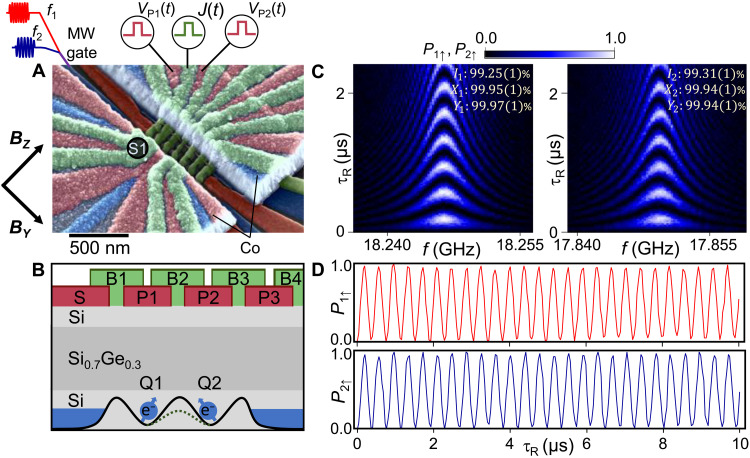
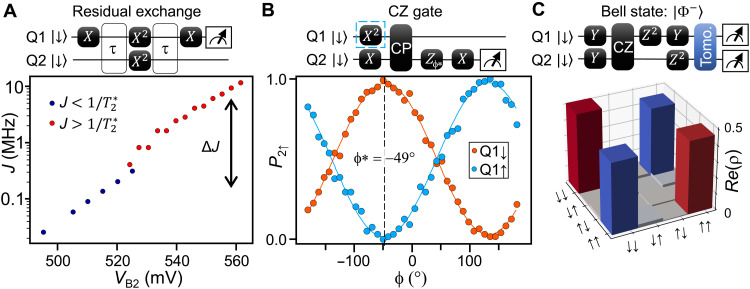
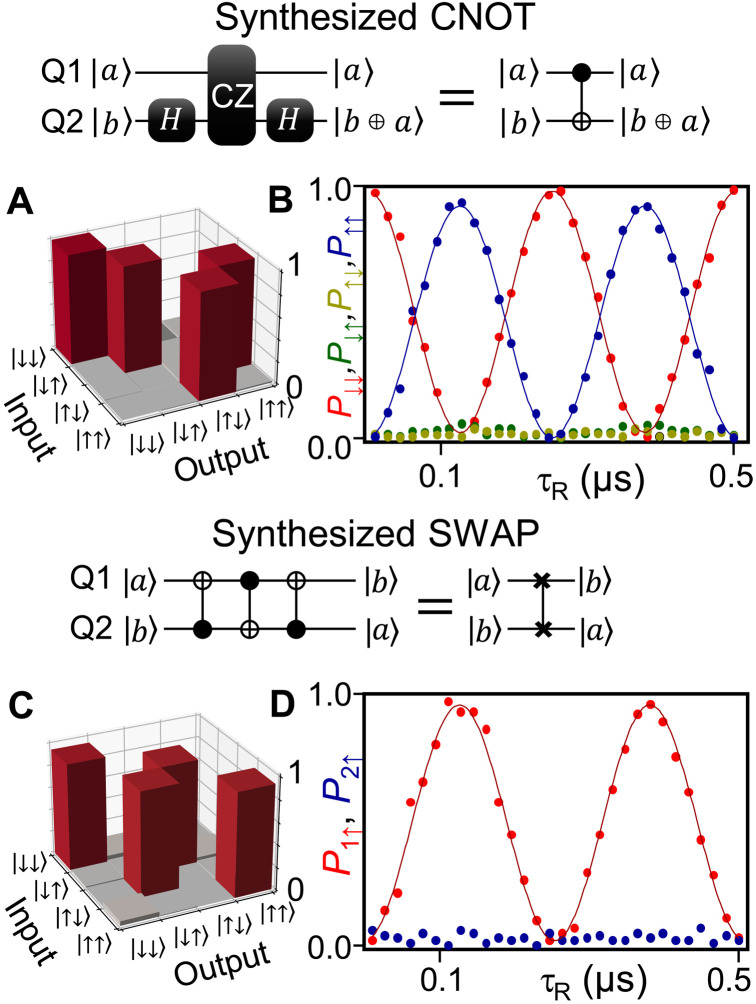
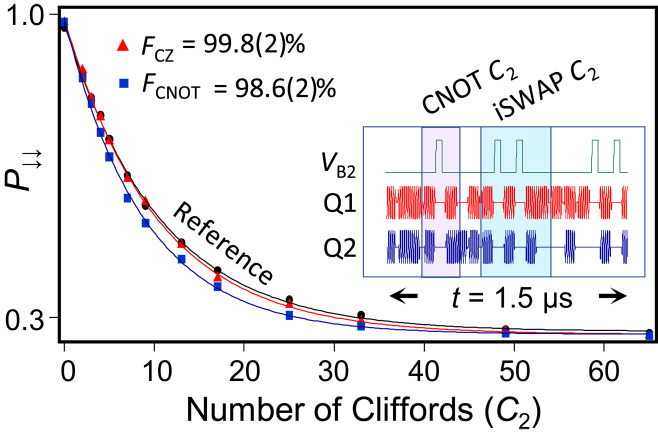
Silicon spin qubits satisfy the necessary criteria for quantum information processing. However, a demonstration of high-fidelity state preparation and readout combined with high-fidelity single- and two-qubit gates, all of which must be present for quantum error correction, has been lacking. We use a two-qubit Si/SiGe quantum processor to demonstrate state preparation and readout with fidelity greater than 97%, combined with both single- and two-qubit control fidelities exceeding 99%. The operation of the quantum processor is quantitatively characterized using gate set tomography and randomized benchmarking. Our results highlight the potential of silicon spin qubits to become a dominant technology in the development of intermediate-scale quantum processors.
Overview
The claims and statistics of this paper haven’t been checked yet.
Free: it reads the open-access text and checks the first 5 claims that cite a source we can check. Create a free account to check every claim.
Integrity signals
Registry
Cites
Statistics
Figures
Verification
Claims the paper makes
The claims and statistics of this paper haven’t been checked yet.
Free: it reads the open-access text and checks the first 5 claims that cite a source we can check. Create a free account to check every claim.
Self-check
Percentages, sums and reported differences re-computed from the paper’s own numbers.
The self-check needs the paper’s full text.
Citations
Cites
Quantum computation with quantum dots
Loss, D., & DiVincenzo, D. P. (1998) · Physical Review A · doi:10.1103/physreva.57.120 · Cited by 6,840
Coherent Manipulation of Coupled Electron Spins in Semiconductor Quantum Dots
Petta, J. R., Johnson, A. C., Taylor, J. M., Laird, E. A., Yacoby, A., Lukin, M. D., Marcus, C. M., Hanson, M. P., & Gossard, A. C. (2005) · Science · doi:10.1126/science.1116955 · Cited by 3,183
Self-citationSurface codes: Towards practical large-scale quantum computation
Fowler, A. G., Mariantoni, M., Martinis, J. M., & Cleland, A. N. (2012) · Physical Review A · doi:10.1103/physreva.86.032324 · Cited by 3,059 · cited 1×
“Our demonstration represents the highest total operation fidelity in a two-qubit processor realized in silicon quantum dots, with performance capable of fault tolerant operation (32).”
BackgroundSpins in few-electron quantum dots
Hanson, R., Kouwenhoven, L. P., Petta, J. R., Tarucha, S., & Vandersypen, L. M. K. (2007) · Reviews of Modern Physics · doi:10.1103/revmodphys.79.1217 · Cited by 2,665
Self-citationSuperconducting quantum circuits at the surface code threshold for fault tolerance
Barends, R., Kelly, J., Megrant, A., Veitia, A., Sank, D., Jeffrey, E., White, T. C., Mutus, J., Fowler, A. G., Campbell, B., et al. (2014) · Nature · doi:10.1038/nature13171 · Cited by 1,733
Single-shot read-out of an individual electron spin in a quantum dot
Elzerman, J. M., Hanson, R., Willems van Beveren, L. H., Witkamp, B., Vandersypen, L. M. K., & Kouwenhoven, L. P. (2004) · Nature · doi:10.1038/nature02693 · Cited by 1,679
Trapped-ion quantum computing: Progress and challenges
Bruzewicz, C. D., Chiaverini, J., McConnell, R., & Sage, J. M. (2019) · Applied Physics Reviews · doi:10.1063/1.5088164 · Cited by 1,483
Driven coherent oscillations of a single electron spin in a quantum dot
Koppens, F. H. L., Buizert, C., Tielrooij, K. J., Vink, I. T., Nowack, K. C., Meunier, T., Kouwenhoven, L. P., & Vandersypen, L. M. K. (2006) · Nature · doi:10.1038/nature05065 · Cited by 1,359
Coherent Control of a Single Electron Spin with Electric Fields
Nowack, K. C., Koppens, F. H. L., Nazarov, Y. V., & Vandersypen, L. M. K. (2007) · Science · doi:10.1126/science.1148092 · Cited by 1,001
A two-qubit logic gate in silicon
Veldhorst, M., Yang, C. H., Hwang, J. C. C., Huang, W., Dehollain, J. P., Muhonen, J. T., Simmons, S., Laucht, A., Hudson, F. E., Itoh, K. M., et al. (2015) · Nature · doi:10.1038/nature15263 · Cited by 919
Research works printed but not linked: 1
- X. Xue, T. F. Watson, J. Helsen, D. R. Ward, D. E. Savage, M. G. Lagally, S. N. Coppersmith, M. A. Eriksson, S. Wehner, L. M. K. Vandersypen, Benchmarking gate fidelities in a Si/SiGe two-qubit device. Phys. Rev. X 9, 021011 (2019).
Cited by
Items 301–328 of 328
State Control and Measurement System for Semiconductor Quantum Dots Qubits
Mikhailov, P. O., Surkov, M. A., Shorokhov, V. V., & Трифонов, А. С. (2025) · Russian Microelectronics · doi:10.1134/s1063739725601171
Color It, Code It, Cancel It: k -Local Dynamical Decoupling from Classical Additive Codes
Nguyen, M. T. P., Rimbach-Russ, M., & Bosco, S. (2026) · PRX Quantum · doi:10.1103/8q24-zj73 · Cited by 7
“…2-local interactions is generated by the decoupling group However, if we know that the residual two-qubit interactions are restricted to terms of the form X i X j , Y i Y j , or Z i Z j , as in spin qubits [56–59], the reduced decoupling group still suppress all the relevant residual interactions.”
Hybrid circuit quantum electrodynamics with a hole spin in silicon
Yu, C. X. (2022) · theses.fr (ABES) · doi:10.70675/5d372839zf41cz4f16z8834zfa670184a3f9 · Cited by 1
Towards Scalable Si and Ge Spin Qubit Architectures : Highlights from Modelling
Martínez, B. (2022) · theses.fr (ABES) · doi:10.70675/255c74a8z7866z4efczbf93ze3a557f678c1 · Cited by 2
Kriekouki, I. (2022) · theses.fr (ABES) · doi:10.70675/9fed023fze214z429fzbf66z0d82f6e955c8 · Cited by 5
Spin-photons interface and quantum gates for spins in carbon nanotubes
Neukelmance, B. (2024) · theses.fr (ABES) · doi:10.70675/81330814z0190z4f2dza227zb50e198f8e5b · Cited by 1
Klemt, B. (2023) · theses.fr (ABES) · doi:10.70675/c9289d27z7165z4474z83c2ze6a5cd30184e · Cited by 1
Statistical structure of charge disorder in Si / Si - Ge quantum dots
Samadi, S., Cywiński, Ł., & Krzywda, J. A. (2026) · Physical Review Applied · doi:10.1103/x86t-n64x · Cited by 1
Quantum stirling cycle in an anisotropic three-qubit Heisenberg chain
Ding, R., & Tao, Y. (2026) · Physica A Statistical Mechanics and its Applications · doi:10.1016/j.physa.2026.131618
Role of overparametrization in quantum approximate optimization
Rabinovich, D., Kardashin, A., & Adhikary, S. (2026) · Physical Review A · doi:10.1103/m1d6-1v47 · Cited by 4
Surface magnon polaritons for fault-tolerant quantum computing in Si/SiGe spin qubits
Qian, C., Zhou, H., Lu, X., Sigllito, A., & Zhen, B. (2026) · Image Sensing Technologies: Materials, Devices, Systems, and Applications · doi:10.1117/12.3100608
“7,8 To further improve performance, gates must be operated faster to decouple noise.”
InfluentialDislocation- and crosshatch-free high-mobility silicon two-dimensional electron gases
Zhang, J., Liu, F. Y., Ming, M., Liao, L.-X., Zhou, X.-Y., & Zhang, J.-J. (2026) · APL Materials · doi:10.1063/5.0334357
Zero-noise extrapolation via cyclic permutations of quantum circuit layouts
Anonymous, Rabinovich, D., Korolev, N., & Lakhmanskiy, K. (2026) · Physical Review A · doi:10.1103/wb3p-1sm4 · Cited by 2
“These devices are characterized by limited qubit counts, short coherence times, and imperfect gate operations, which together restrict the depth of quantum circuits that can be executed within a fixed error tolerance [2–5].”
Mitigating residual exchange coupling in resonant singlet-triplet qubits
Anonymous, Torres-Leal, F., & Nichol, J. M. (2026) · Physical Review Applied · doi:10.1103/gjn5-kc41 · Cited by 3
“Recent experimental advances have demonstrated both single-and two-qubit gate fideli-ties exceeding 99% for single-spin-1 / 2 qubits [5, 24–26], reaching the threshold required for error correction using the surface code [27, 28].”
Snakelike trajectories of electrons released from quantum dots driven by the spin Hall effect
Szafran, B., & Wójcik, P. (2026) · Physical review. B./Physical review. B · doi:10.1103/bk42-s5p1
Leakage-suppressed parametric entangling gates in a spin-resonator hybrid system
Anonymous, Guo, A.-L., Zhang, B.-Y., & Zhu, X. (2026) · Physical Review A · doi:10.1103/hrcl-68g8
Multimodal deep learning for automated atomic qubits fabrication in silicon
Cui, Y., Wu, K., Wu, P., Yang, L., Duan, M., Wang, G., Shi, K., Lyu, Y., Huang, P., Xin, T., et al. (2026) · Machine Learning Science and Technology · doi:10.1088/2632-2153/ae8e30
“Recent milestones include the demonstration of long-coherence qubits [4], high-fidelity quantum gates [5– 7], CMOS-compatible chip fabrication [8–11], and prototype integrated processors [12–14].”
Entanglement characterization in Quantum Networks based on entanglement distance
Han, Q., Xing, S., Wu, X., LI, J., & Huang, X. (2026) · Physica A Statistical Mechanics and its Applications · doi:10.1016/j.physa.2026.131831
Robust two-qubit gates for semiconductor spin qubits based on dynamical dimensionality reduction
Anonymous, Zhou, J., & Xue, Z. (2026) · Physical Review A · doi:10.1103/gkrd-lm18
Impact of gate-voltage noise on silicon spin-qubit variational quantum eigensolvers
Wang, X., Khromets, B., Merino, Z. D., & Baugh, J. (2026) · Quantum Science and Technology · doi:10.1088/2058-9565/ae9188
Nakane, J. J., Asai, H., Hashizume, M., Horiba, T., Kutsuki, K., Iizuka, S., Chiashi, Y., Oka, H., Kato, K., Kajita, S., et al. (2026) · IEEE Journal of the Electron Devices Society · doi:10.1109/jeds.2026.3719324
“Recently, both single-and two-qubit gates in silicon have reached fidelities above 99% [6], [7], [8], [9], [10], [11], [12], exceeding typical fault-tolerant thresholds [13], [14].”
Vegh, N. M., Philippopoulos, P., Prentki, R. J., Zhang, W., Zhu, Y., Beaudoin, F., & Guo, H. (2026) · Semiconductor Science and Technology · doi:10.1088/1361-6641/ae949d · Cited by 1
Fast readout of quantum dot spin qubits via Andreev spins
Anonymous, Laubscher, K., Vecchio, P. D., Chatterjee, A., Fatemi, V., & Bosco, S. (2026) · Physical Review Applied · doi:10.1103/qcch-2hhy · Cited by 7
Theory of spin qubits and the path to scalability
McIntyre, Z. M., Sarkar, A., & Loss, D. (2026) · New Journal of Physics · doi:10.1088/1367-2630/ae973f · Cited by 6
Optimization of Si / Si -Ge heterostructures for large and robust valley splitting in silicon qubits
Anonymous, Ermoneit, L., Schreiber, L. R., Koprucki, T., & Kantner, M. (2026) · Physical Review Applied · doi:10.1103/pd5d-sddp · Cited by 6
Bridging pulse and circuit levels: a geometric framework for deterministic error suppression
Zeng, J., Liang, H., Hai, Y.-J., & Deng, X. (2026) · Quantum Science and Technology · doi:10.1088/2058-9565/ae9b3b · Cited by 2
Exchange interaction in gate-defined quantum dots beyond the Hubbard model
Anonymous, Bethke, P., Shehata, M. M. E. K., Simion, G., Wolfe, M. A., Botzem, T., McNeil, R. P. G., Ritzmann, J., Ludwig, A., Wieck, A. D., et al. (2026) · Physical review. B./Physical review. B · doi:10.1103/fb37-f7ky · Cited by 2
“Experimentally, the use of exchange coupling is well established with recent results showing two-qubit gate fidelities above the error correction threshold [1–3].”
Electron-mediated coupling schemes between nuclear-spin qudits in silicon
Anonymous, Xu, F., Xiang, Y., Zhang, S., Song, J., Zhai, Y., Duan, M., Pan, T., Tian, Z., Wang, G., et al. (2026) · Physical Review Applied · doi:10.1103/mr2x-jt6m
Metadata
- Authors
- Mills, A. R., Guinn, C. R., Gullans, M. J., Sigillito, A. J., Feldman, M. M., Nielsen, E., & Petta, J. R.
- Affiliations
- Princeton University (US)
- Sandia National Laboratories (US)
- Corresponding author
- Petta, Jason R.
- ORCID
- Venue
- Science Advances
- Published
- 2022-04-08
- Volume
- 8
- Issue
- 14
- Pages
- eabn5130-eabn5130
- ISSN
- 2375-2548 (ISSN-L)
- PMC
- PMC8986105
- OpenAlex
- W3217600686
- Cited by
- 329
- References
- 37
- Citations by year
- 2026: 48 · 2025: 86 · 2024: 91 · 2023: 72 · 2022: 32
- FWCI
- 28.63
- Type
- journal article
- Language
- en
- Open access
- gold
- doi.org
- Licence
- cc-by-nc
- Locations
- Science Advances (publishedVersion, cc-by-nc)
- PubMed Central (publishedVersion, cc-by-nc)
- PubMed (publishedVersion)
- arXiv (Cornell University) (submittedVersion)
- OSTI OAI (U.S. Department of Energy Office of Scientific and Technical Information) (submittedVersion)
- arXiv (Cornell University)
- Funders
- National Science Foundation (NA0003525, DE‐NA0003525, 2011750)
- U.S. Department of Energy (DENA0003525, NA0003525)
- Princeton University (DMR-2011750)
- Princeton Center for Complex Materials (DMR-2011750)
- Defense Advanced Research Projects Agency (NA0003525, DENA0003525, D18AC0025)
- Office of Science (DE-NA0003525, NA0003525)
- National Nuclear Security Administration (NA0003525, DENA-0003525)
- Intelligence Advanced Research Projects Activity
- Materials Research Science and Engineering Center, Harvard University (DMR2011750)
- Division of Materials Research (DMR2011750, 2011750)
- Advanced Scientific Computing Research (DE-NA-0003525)
- Army Research Office (W911NF-15-1-, DE-NA0003525, W911NF, W911NF-15-1-0149, W911NF-15)
- Sandia National Laboratories (NA0003525, DE‐NA,0003525)
- Topics
- Physical Sciences › Physics and Astronomy › Condensed Matter Physics › Quantum and electron transport phenomena
- Physical Sciences › Materials Science › Materials Chemistry › Diamond and Carbon-based Materials Research
- Physical Sciences › Computer Science › Artificial Intelligence › Quantum Computing Algorithms and Architecture
- Keywords
- silicon spin qubits, two-qubit gates, single-qubit gates, gate fidelity, gate set tomography, randomized benchmarking, quantum error correction
About these checks
Registry, retraction, Cites and statistics results are computed, not judged, with one exception: a printed reference that no index lists is read once by a model before it counts as a citation error. Claims are extracted by a model and kept only when their quote appears verbatim in the text; each cited source is then checked, with a model’s help, for whether it says what the claim relies on. Those verdicts can be wrong — read the claim’s quote and the cited source before relying on one.
Statistics and arithmetic are recomputed, not judged.
Confidence bands are shown only for fields calibrated on our annotated test set. None is calibrated yet, so no band is shown.
What counts as a claim ›How we measure confidence ›How we check this ›
Are you an author, or do you see a problem with this page? Request a review
Data sources
Bibliographic data: Semantic Scholar, OpenAlex, Crossref.
Contains information from the Semantic Scholar Academic Graph Datasets, made available under the ODC Attribution License (ODC-BY 1.0).
Semantic Scholar’s data is described in: Kinney, R., et al. (2023). The Semantic Scholar Open Data Platform. arXiv:2301.10140.
