

Two-qubit silicon quantum processor with operation fidelity exceeding 99%
Open accessThe DOI matches its Crossref record; 37 of the 37 references it cites were found in a registry or an index.
Abstract
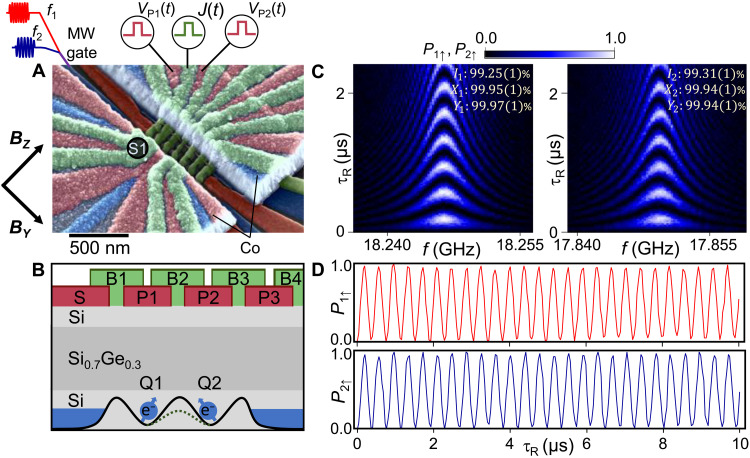
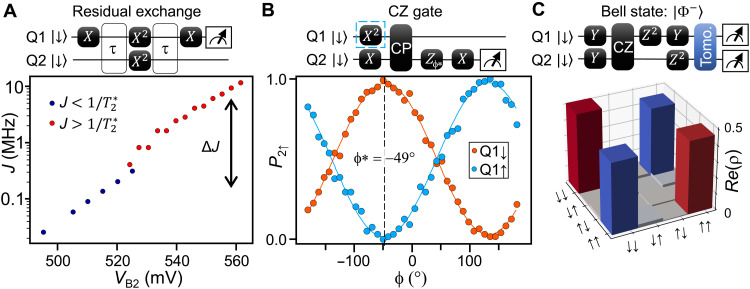
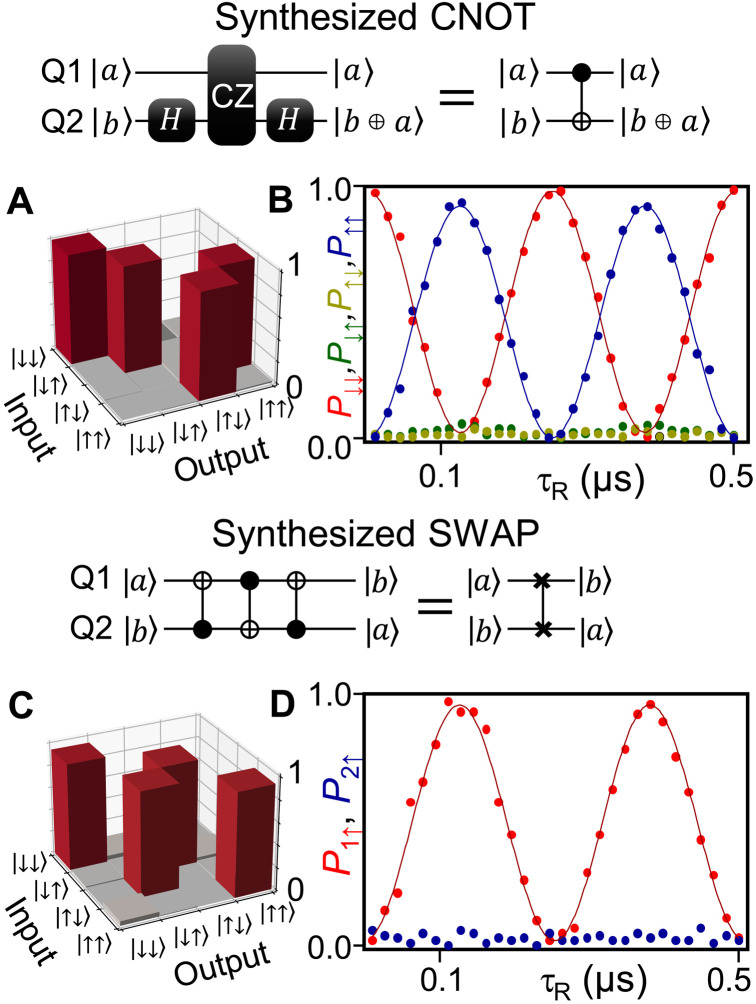
Silicon spin qubits satisfy the necessary criteria for quantum information processing. However, a demonstration of high-fidelity state preparation and readout combined with high-fidelity single- and two-qubit gates, all of which must be present for quantum error correction, has been lacking. We use a two-qubit Si/SiGe quantum processor to demonstrate state preparation and readout with fidelity greater than 97%, combined with both single- and two-qubit control fidelities exceeding 99%. The operation of the quantum processor is quantitatively characterized using gate set tomography and randomized benchmarking. Our results highlight the potential of silicon spin qubits to become a dominant technology in the development of intermediate-scale quantum processors.
Overview
The claims and statistics of this paper haven’t been checked yet.
Free: it reads the open-access text and checks the first 5 claims that cite a source we can check. Create a free account to check every claim.
Integrity signals
Registry
Cites
Statistics
Figures
Verification
Claims the paper makes
The claims and statistics of this paper haven’t been checked yet.
Free: it reads the open-access text and checks the first 5 claims that cite a source we can check. Create a free account to check every claim.
Self-check
Percentages, sums and reported differences re-computed from the paper’s own numbers.
The self-check needs the paper’s full text.
Citations
Cites
Quantum computation with quantum dots
Loss, D., & DiVincenzo, D. P. (1998) · Physical Review A · doi:10.1103/physreva.57.120 · Cited by 6,840
Coherent Manipulation of Coupled Electron Spins in Semiconductor Quantum Dots
Petta, J. R., Johnson, A. C., Taylor, J. M., Laird, E. A., Yacoby, A., Lukin, M. D., Marcus, C. M., Hanson, M. P., & Gossard, A. C. (2005) · Science · doi:10.1126/science.1116955 · Cited by 3,183
Self-citationSurface codes: Towards practical large-scale quantum computation
Fowler, A. G., Mariantoni, M., Martinis, J. M., & Cleland, A. N. (2012) · Physical Review A · doi:10.1103/physreva.86.032324 · Cited by 3,059 · cited 1×
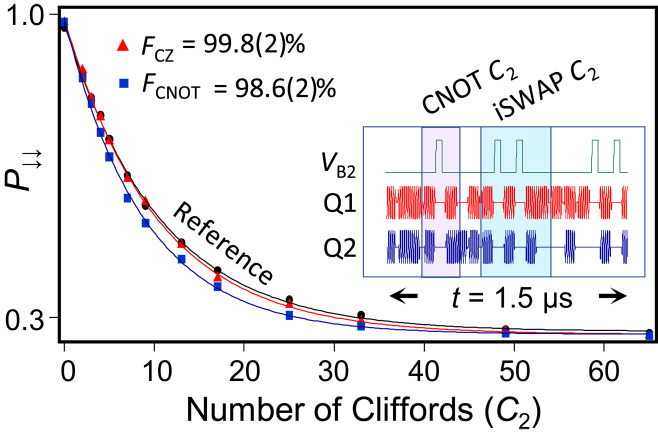
“Our demonstration represents the highest total operation fidelity in a two-qubit processor realized in silicon quantum dots, with performance capable of fault tolerant operation (32).”
BackgroundSpins in few-electron quantum dots
Hanson, R., Kouwenhoven, L. P., Petta, J. R., Tarucha, S., & Vandersypen, L. M. K. (2007) · Reviews of Modern Physics · doi:10.1103/revmodphys.79.1217 · Cited by 2,665
Self-citationSuperconducting quantum circuits at the surface code threshold for fault tolerance
Barends, R., Kelly, J., Megrant, A., Veitia, A., Sank, D., Jeffrey, E., White, T. C., Mutus, J., Fowler, A. G., Campbell, B., et al. (2014) · Nature · doi:10.1038/nature13171 · Cited by 1,733
Single-shot read-out of an individual electron spin in a quantum dot
Elzerman, J. M., Hanson, R., Willems van Beveren, L. H., Witkamp, B., Vandersypen, L. M. K., & Kouwenhoven, L. P. (2004) · Nature · doi:10.1038/nature02693 · Cited by 1,679
Trapped-ion quantum computing: Progress and challenges
Bruzewicz, C. D., Chiaverini, J., McConnell, R., & Sage, J. M. (2019) · Applied Physics Reviews · doi:10.1063/1.5088164 · Cited by 1,483
Driven coherent oscillations of a single electron spin in a quantum dot
Koppens, F. H. L., Buizert, C., Tielrooij, K. J., Vink, I. T., Nowack, K. C., Meunier, T., Kouwenhoven, L. P., & Vandersypen, L. M. K. (2006) · Nature · doi:10.1038/nature05065 · Cited by 1,359
Coherent Control of a Single Electron Spin with Electric Fields
Nowack, K. C., Koppens, F. H. L., Nazarov, Y. V., & Vandersypen, L. M. K. (2007) · Science · doi:10.1126/science.1148092 · Cited by 1,001
A two-qubit logic gate in silicon
Veldhorst, M., Yang, C. H., Hwang, J. C. C., Huang, W., Dehollain, J. P., Muhonen, J. T., Simmons, S., Laucht, A., Hudson, F. E., Itoh, K. M., et al. (2015) · Nature · doi:10.1038/nature15263 · Cited by 919
A quantum-dot spin qubit with coherence limited by charge noise and fidelity higher than 99.9%
Yoneda, J., Takeda, K., Otsuka, T., Nakajima, T., Delbecq, M. R., Allison, G., Honda, T., Kodera, T., Oda, S., Hoshi, Y., et al. (2018) · Nature Nanotechnology · doi:10.1038/s41565-017-0014-x · Cited by 900
A programmable two-qubit quantum processor in silicon
Watson, T. F., Philips, S. G. J., Kawakami, E., Ward, D. R., Scarlino, P., Veldhorst, M., Savage, D. E., Lagally, M. G., Friesen, M., Coppersmith, S. N., et al. (2018) · Nature · doi:10.1038/nature25766 · Cited by 741 · cited 3×
“These results significantly improve upon past measurements with SPAM-corrected fidelities of 78 to 90% (11, 24, 28, 29) and are comparable to the simulated Bell state fidelities obtained by Xue et al.”
MethodResultScalable and Robust Randomized Benchmarking of Quantum Processes
Magesan, E., Gambetta, J. M., & Emerson, J. (2011) · Physical Review Letters · doi:10.1103/physrevlett.106.180504 · Cited by 724 · cited 1×
“3 of 5 We turn to the two-qubit interleaved RB protocol to quantify the overall performance of our processor (30).”
MethodElectron spin coherence exceeding seconds in high-purity silicon
Tyryshkin, A. M., Tojo, S., Morton, J. J. L., Riemann, H., Abrosimov, N. V., Becker, P., Pohl, H.-J., Schenkel, T., Thewalt, M. L. W., Itoh, K. M., et al. (2012) · Nature Materials · doi:10.1038/nmat3182 · Cited by 713 · cited 1×
“A transition to silicon, which can be isotopically enriched, has led to a several order-ofmagnitude increase in electron spin coherence times [8] as well as improved quantum control fidelities [9–11].”
BackgroundElectrically driven single-electron spin resonance in a slanting Zeeman field
Pioro-Ladrière, M., Obata, T., Tokura, Y., Shin, Y.-S., Kubo, T., Yoshida, K., Taniyama, T., & Tarucha, S. (2008) · Nature Physics · doi:10.1038/nphys1053 · Cited by 600 · cited 1×
“Single-qubit gates are achieved at the symmetric operating point in the (1,1) charge state using electric dipole spin resonance (EDSR) in the transverse field gradient created by the micromagnet (6, 17, 18).”
MethodEfficient Z gates for quantum computing
McKay, D. C., Wood, C. J., Sheldon, S., Chow, J. M., & Gambetta, J. M. (2017) · Physical Review A · doi:10.1103/physreva.96.022330 · Cited by 557
Resonantly driven CNOT gate for electron spins
Zajac, D. M., Sigillito, A. J., Russ, M., Borjans, F., Taylor, J. M., Burkard, G., & Petta, J. R. (2018) · Science · doi:10.1126/science.aao5965 · Cited by 552
Self-citationQuantum logic with spin qubits crossing the surface code threshold
Xue, X., Russ, M., Samkharadze, N., Undseth, B., Sammak, A., Scappucci, G., & Vandersypen, L. M. K. (2022) · Nature · doi:10.1038/s41586-021-04273-w · Cited by 524
Fast universal quantum gate above the fault-tolerance threshold in silicon
Noiri, A., Takeda, K., Nakajima, T., Kobayashi, T., Sammak, A., Scappucci, G., & Tarucha, S. (2022) · Nature · doi:10.1038/s41586-021-04182-y · Cited by 471 · cited 2×
“In contrast to previous implementations (12, 13, 24, 28), SPAM errors are very low (<3%).”
BackgroundResultFidelity benchmarks for two-qubit gates in silicon
Huang, W., Yang, C. H., Chan, K. W., Tanttu, T., Hensen, B., Leon, R. C. C., Fogarty, M. A., Hwang, J. C. C., Hudson, F. E., Itoh, K. M., et al. (2019) · Nature · doi:10.1038/s41586-019-1197-0 · Cited by 370
Reduced Sensitivity to Charge Noise in Semiconductor Spin Qubits via Symmetric Operation
Reed, M. D., Maune, B. M., Andrews, R. W., Borselli, M. G., Eng, K., Jura, M. P., Kiselev, A. A., Ladd, T. D., Merkel, S. T., Milosavljevic, I., et al. (2016) · Physical Review Letters · doi:10.1103/physrevlett.116.110402 · Cited by 297
Scalable Gate Architecture for a One-Dimensional Array of Semiconductor Spin Qubits
Zajac, D. M., Hazard, T. M., Mi, X., Nielsen, E., & Petta, J. R. (2016) · Physical Review Applied · doi:10.1103/physrevapplied.6.054013 · Cited by 291 · cited 2×
“Quantum dot electrons are vertically confined in an isotopically enriched [800 parts per million (ppm) of residual 29Si] 28Si quantum well, and lateral confinement is achieved using an overlapping aluminum gate stack (16).”
BackgroundSelf-citationShuttling a single charge across a one-dimensional array of silicon quantum dots
Mills, A. R., Zajac, D. M., Gullans, M. J., Schupp, F. J., Hazard, T. M., & Petta, J. R. (2019) · Nature Communications · doi:10.1038/s41467-019-08970-z · Cited by 283
Self-citationRealization of High-Fidelity CZ and ZZ -Free iSWAP Gates with a Tunable Coupler
Sung, Y., Ding, L., Braumüller, J., Vepsäläinen, A., Kannan, B., Kjaergaard, M., Greene, A., Samach, G. O., McNally, C., Kim, D., et al. (2021) · Physical Review X · doi:10.1103/physrevx.11.021058 · Cited by 262 · cited 2×
“Our two-qubit gate fidelity exceeds recent reports on spin qubits [12, 13] and is competitive with superconducting qubits [14, 15].”
BackgroundNoise Suppression Using Symmetric Exchange Gates in Spin Qubits
Martins, F., Malinowski, F. K., Nissen, P. D., Barnes, E., Fallahi, S., Gardner, G. C., Manfra, M. J., Marcus, C. M., & Kuemmeth, F. (2016) · Physical Review Letters · doi:10.1103/physrevlett.116.116801 · Cited by 242
Suppression of Qubit Crosstalk in a Tunable Coupling Superconducting Circuit
Mundada, P., Zhang, G., Hazard, T., & Houck, A. (2019) · Physical Review Applied · doi:10.1103/physrevapplied.12.054023 · Cited by 239 · cited 2×
“Our two-qubit gate fidelity exceeds recent reports on spin qubits (12, 13) and is competitive with superconducting qubits (14, 15).”
BackgroundSilicon qubit fidelities approaching incoherent noise limits via pulse engineering
Yang, C. H., Chan, K. W., Harper, R., Huang, W., Evans, T., Hwang, J. C. C., Hensen, B., Laucht, A., Tanttu, T., Hudson, F. E., et al. (2019) · Nature Electronics · doi:10.1038/s41928-019-0234-1 · Cited by 201
Nielsen, E., Gamble, J. K., Rudinger, K., Scholten, T., Young, K., & Blume-Kohout, R. (2021) · Quantum · doi:10.22331/q-2021-10-05-557 · Cited by 189
Self-citationFidelity benchmarks for two-qubit gates in silicon
Huang, W., Yang, C. H., Chan, K. W., Tanttu, T., Hensen, B., Leon, R. C. C., Fogarty, M. A., Hwang, J. C. C., Hudson, F. E., Itoh, K. M., et al. (2019) · RePEc: Research Papers in Economics · Cited by 155
Benchmarking Gate Fidelities in a Si/SiGe Two-Qubit Device
Xue, X., Watson, T. F., Helsen, J., Ward, D. R., Savage, D. E., Lagally, M. G., Coppersmith, S. N., Eriksson, M. A., Wehner, S., & Vandersypen, L. M. K. (2019) · Physical Review X · doi:10.1103/physrevx.9.021011 · Cited by 133
High-fidelity quantum gates in Si/SiGe double quantum dots
Russ, M., Zajac, D. M., Sigillito, A. J., Borjans, F., Taylor, J. M., Petta, J. R., & Burkard, G. (2018) · Physical Review B · doi:10.1103/physrevb.97.085421 · Cited by 115
Self-citationEfficient controlled-phase gate for single-spin qubits in quantum dots
Meunier, T., Calado, V. E., & Vandersypen, L. M. K. (2011) · Physical Review B · doi:10.1103/physrevb.83.121403 · Cited by 106
A Flexible Design Platform for Si/SiGe Exchange-Only Qubits with Low Disorder
Ha, W., Ha, S. D., Choi, M. D., Tang, Y., Schmitz, A. E., Levendorf, M. P., Lee, K., Chappell, J. M., Adams, T. S., Hulbert, D. R., et al. (2022) · Nano Letters · doi:10.1021/acs.nanolett.1c03026 · Cited by 76
Cryogenic amplifier for fast real-time detection of single-electron tunneling
Vink, I. T., Nooitgedagt, T., Schouten, R. N., Vandersypen, L. M. K., & Wegscheider, W. (2007) · Applied Physics Letters · doi:10.1063/1.2783265 · Cited by 71 · cited 1×
“Qubit state preparation and readout are achieved by spin-dependent tunneling with the reservoir, and cryogenic amplifiers are used to improve charge readout fidelity (2, 19, 20, 21).”
MethodRealization of high-fidelity CZ and ZZ-free iSWAP gates with a tunable coupler
Sung, Y., Ding, L., Braumüller, J., Vepsäläinen, A. P., Kannan, B., Kjærgaard, M., Greene, A., Samach, G., McNally, C., Kim, D. K., et al. (2020) · DSpace@MIT (Massachusetts Institute of Technology) · doi:10.48550/arxiv.2011.01261 · Cited by 46 · cited 2×
“Our two-qubit gate fidelity exceeds recent reports on spin qubits [12, 13] and is competitive with superconducting qubits [14, 15].”
BackgroundBell-state tomography in a silicon many-electron artificial molecule
Leon, R. C. C., Yang, C. H., Hwang, J. C. C., Lemyre, J. C., Tanttu, T., Huang, W., Huang, J. Y., Hudson, F. E., Itoh, K. M., Laucht, A., et al. (2021) · Nature Communications · doi:10.1038/s41467-021-23437-w · Cited by 34
Bell-state tomography in a silicon many-electron artificial molecule
Leon, R. C. C., Yang, C. H., Hwang, J. C. C., Lemyre, J. C., Tanttu, T., Huang, W., Huang, J. Y., Hudson, F. E., Itoh, K. M., Laucht, A., et al. (2021) · RePEc: Research Papers in Economics · Cited by 24
Research works printed but not linked: 1
- X. Xue, T. F. Watson, J. Helsen, D. R. Ward, D. E. Savage, M. G. Lagally, S. N. Coppersmith, M. A. Eriksson, S. Wehner, L. M. K. Vandersypen, Benchmarking gate fidelities in a Si/SiGe two-qubit device. Phys. Rev. X 9, 021011 (2019).
Cited by
Burkard, G., Ladd, T. D., Pan, A., Nichol, J. M., & Petta, J. R. (2023) · Reviews of Modern Physics · doi:10.1103/revmodphys.95.025003 · Cited by 715
Self-citationUniversal control of a six-qubit quantum processor in silicon
Philips, S. G. J., Mądzik, M. T., Amitonov, S. V., de Snoo, S. L., Russ, M., Kalhor, N., Volk, C., Lawrie, W. I. L., Brousse, D., Tryputen, L., et al. (2022) · Nature · doi:10.1038/s41586-022-05117-x · Cited by 410
Quantum error correction with silicon spin qubits
Takeda, K., Noiri, A., Nakajima, T., Kobayashi, T., & Tarucha, S. (2022) · Nature · doi:10.1038/s41586-022-04986-6 · Cited by 172
Review of performance metrics of spin qubits in gated semiconducting nanostructures
Stano, P., & Loss, D. (2022) · Nature Reviews Physics · doi:10.1038/s42254-022-00484-w · Cited by 165
Probing single electrons across 300-mm spin qubit wafers
Neyens, S., Zietz, O. K., Watson, T. F., Luthi, F., Nethwewala, A., George, H. C., Henry, E., Islam, M., Wagner, A. J., Borjans, F., et al. (2024) · Nature · doi:10.1038/s41586-024-07275-6 · Cited by 178
“EDSR enables high-fidelity and local electrical control of spin qubits 60 , and micromagnets can also be used to engineer the qubit frequencies along an array enabling addressability and high-fidelity two-qubit gates 6–8 .”
Metadata
- Authors
- Mills, A. R., Guinn, C. R., Gullans, M. J., Sigillito, A. J., Feldman, M. M., Nielsen, E., & Petta, J. R.
- Affiliations
- Princeton University (US)
- Sandia National Laboratories (US)
- Corresponding author
- Petta, Jason R.
- ORCID
- Venue
- Science Advances
- Published
- 2022-04-08
- Volume
- 8
- Issue
- 14
- Pages
- eabn5130-eabn5130
- ISSN
- 2375-2548 (ISSN-L)
- PMC
- PMC8986105
- OpenAlex
- W3217600686
- Cited by
- 329
- References
- 37
- Citations by year
- 2026: 48 · 2025: 86 · 2024: 91 · 2023: 72 · 2022: 32
- FWCI
- 28.63
- Type
- journal article
- Language
- en
- Open access
- gold
- doi.org
- Licence
- cc-by-nc
- Locations
- Science Advances (publishedVersion, cc-by-nc)
- PubMed Central (publishedVersion, cc-by-nc)
- PubMed (publishedVersion)
- arXiv (Cornell University) (submittedVersion)
- OSTI OAI (U.S. Department of Energy Office of Scientific and Technical Information) (submittedVersion)
- arXiv (Cornell University)
- Funders
- National Science Foundation (NA0003525, DE‐NA0003525, 2011750)
- U.S. Department of Energy (DENA0003525, NA0003525)
- Princeton University (DMR-2011750)
- Princeton Center for Complex Materials (DMR-2011750)
- Defense Advanced Research Projects Agency (NA0003525, DENA0003525, D18AC0025)
- Office of Science (DE-NA0003525, NA0003525)
- National Nuclear Security Administration (NA0003525, DENA-0003525)
- Intelligence Advanced Research Projects Activity
- Materials Research Science and Engineering Center, Harvard University (DMR2011750)
- Division of Materials Research (DMR2011750, 2011750)
- Advanced Scientific Computing Research (DE-NA-0003525)
- Army Research Office (W911NF-15-1-, DE-NA0003525, W911NF, W911NF-15-1-0149, W911NF-15)
- Sandia National Laboratories (NA0003525, DE‐NA,0003525)
- Topics
- Physical Sciences › Physics and Astronomy › Condensed Matter Physics › Quantum and electron transport phenomena
- Physical Sciences › Materials Science › Materials Chemistry › Diamond and Carbon-based Materials Research
- Physical Sciences › Computer Science › Artificial Intelligence › Quantum Computing Algorithms and Architecture
- Keywords
- silicon spin qubits, two-qubit gates, single-qubit gates, gate fidelity, gate set tomography, randomized benchmarking, quantum error correction
About these checks
Registry, retraction, Cites and statistics results are computed, not judged, with one exception: a printed reference that no index lists is read once by a model before it counts as a citation error. Claims are extracted by a model and kept only when their quote appears verbatim in the text; each cited source is then checked, with a model’s help, for whether it says what the claim relies on. Those verdicts can be wrong — read the claim’s quote and the cited source before relying on one.
Statistics and arithmetic are recomputed, not judged.
Confidence bands are shown only for fields calibrated on our annotated test set. None is calibrated yet, so no band is shown.
What counts as a claim ›How we measure confidence ›How we check this ›
Are you an author, or do you see a problem with this page? Request a review
Data sources
Bibliographic data: Semantic Scholar, OpenAlex, Crossref.
Contains information from the Semantic Scholar Academic Graph Datasets, made available under the ODC Attribution License (ODC-BY 1.0).
Semantic Scholar’s data is described in: Kinney, R., et al. (2023). The Semantic Scholar Open Data Platform. arXiv:2301.10140.
