

The DOI matches its Crossref record; 1 of the 1 references it cites were found in a registry or an index.
Induction of Chronic Myelogenous Leukemia in Mice by the P210 bcr/abl Gene of the Philadelphia Chromosome
Abstract
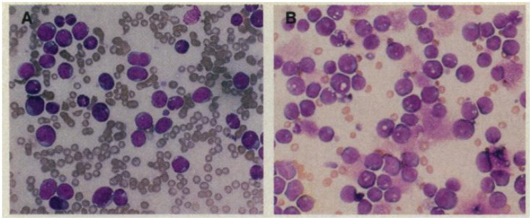
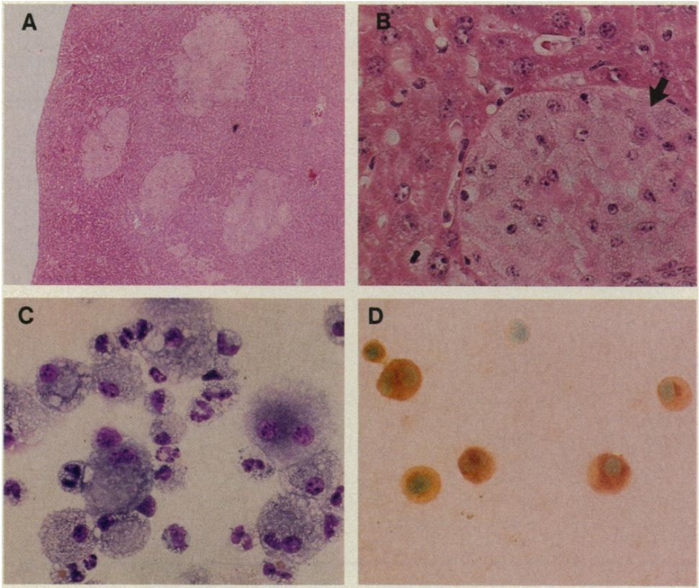
In tumor cells from virtually all patients with chronic myelogenous leukemia, the Philadelphia chromosome, a fusion of chromosomes 9 and 22, directs the synthesis of the P210 bcr/abl protein. The protein-tyrosine kinase activity and hybrid structure of P210 bcr/abl are similar to the oncogene product of the Abelson murine leukemia virus, P160 gag /v- abl , which induces acute lymphomas. To determine whether P210 bcr/abl can induce chronic myelogenous leukemia, murine bone marrow was infected with a retrovirus encoding P210 bcr/abl and transplanted into irradiated syngeneic recipients. Transplant recipients developed several hematologic malignancies; prominent among them was a myeloproliferative syndrome closely resembling the chronic phase of human chronic myelogenous leukemia. Tumor tissue from diseased mice harbored the provirus encoding P210 bcr/abl . These results demonstrate that P210 bcr/abl expression can induce chronic myelogenous leukemia. Retrovirus-mediated expression of the protein provides a murine model system for further analysis of the disease.
Overview
The claims and statistics of this paper haven’t been checked yet.
Run the check — free, no account needed. It reads the open-access text and checks the sources it cites.
Integrity signals
Registry
Cites
Statistics
Figures

Verification
Claims the paper makes
The claims and statistics of this paper haven’t been checked yet.
Run the check — free, no account needed. It reads the open-access text and checks the sources it cites.
Claims other papers make about this one
Each is checked against this paper’s own text: does it say what the citing paper says it does?
In the citing paper
“The characterizing feature of this disease is the presence of the Philadelphia Chromosome [t(9;22)(q34;q11)], a somatic mutation in which the 3 0 region of the Abelson leukemia virus (ABL) gene is fused to the 5 0 region of the breakpoint cluster region (BCR) gene”
From Rac Guanosine Triphosphatases Represent Integrating Molecular Therapeutic Targets for BCR-ABL-Induced Myeloproliferative Disease (2007) · cites this paper as Daley et al., 1990
In the citing paper
“The p210 isoform of the resulting BCR-ABL fusion protein is necessary and sufficient for the development of CML (Daley et al., 1990).”
From Rac Guanosine Triphosphatases Represent Integrating Molecular Therapeutic Targets for BCR-ABL-Induced Myeloproliferative Disease (2007) · cites this paper as Daley et al., 1990
In the citing paper
“Chronic myelogenous leukemia (CML) is a hematopoietic stem cell (HSC) malignancy induced by p210-BCR-ABL, characterized by myeloproliferation in the bone marrow (BM), and egress of leukemic stem cells and progenitors (LSC/P).1–3”
From Rac2 GTPase deficiency depletes BCR-ABL+ leukemic stem cells and progenitors in vivo (2010) · cites this paper as [1]
Self-check
Percentages, sums and reported differences re-computed from the paper’s own numbers.
The self-check needs the paper’s full text.
Citations
Cites
ROWLEY, J. D. (1973) · Nature · doi:10.1038/243290a0 · Cited by 4,291
Research works printed but not linked: 33
- BARKLIS, E, CHROMOSOMAL POSITION OR VIRUS MUTATION PERMITS RETROVIRUS EXPRESSION IN EMBRYONAL CARCINOMA-CELLS, CELL 47: 391 (1986). · DOI
- CHAMPLIN, R.E., CHRONIC MYELOGENOUS LEUKEMIA - RECENT ADVANCES, BLOOD 65: 1039 (1985). · DOI
- DALEY, G.Q., TRANSFORMATION OF AN INTERLEUKIN-3-DEPENDENT HEMATOPOIETIC-CELL LINE BY THE CHRONIC MYELOGENOUS LEUKEMIA-SPECIFIC P210BER/ABL PROTEIN, PROCEEDINGS OF THE NATIONAL ACADEMY OF SCIENCES OF THE UNITED STATES OF AMERICA 85: 9312 (1988).
- 10.1126/science.2440107 · DOI
- DANOS, O, SAFE AND EFFICIENT GENERATION OF RECOMBINANT RETROVIRUSES WITH AMPHOTROPIC AND ECOTROPIC HOST RANGES, PROCEEDINGS OF THE NATIONAL ACADEMY OF SCIENCES OF THE UNITED STATES OF AMERICA 85: 6460 (1988).
- DAVIS, R.L., ACTIVATION OF THE C-ABL-ONCOGENE BY VIRAL TRANSDUCTION OR CHROMOSOMAL TRANSLOCATION GENERATES ALTERED C-ABL-PROTEINS WITH SIMILAR INVITRO KINASE PROPERTIES, MOLECULAR AND CELLULAR BIOLOGY 5: 204 (1985).
- FRANZ, T, RETROVIRAL MUTANTS EFFICIENTLY EXPRESSED IN EMBRYONAL CARCINOMA-CELLS, PROCEEDINGS OF THE NATIONAL ACADEMY OF SCIENCES OF THE UNITED STATES OF AMERICA 83: 3292 (1986).
- GOFF, S.P., STRUCTURE OF THE ABELSON MURINE LEUKEMIA-VIRUS GENOME AND THE HOMOLOGOUS CELLULAR GENE - STUDIES WITH CLONED VIRAL-DNA, CELL 22: 777 (1980). · DOI
- 10.1016/0092-8674(84)90077-1 · DOI
- HARIHARAN, I.K., A BCR-V-ABL ONCOGENE INDUCES LYMPHOMAS IN TRANSGENIC MICE, MOLECULAR AND CELLULAR BIOLOGY 9: 2798 (1989).
- HARIHARAN, I.K., ONCOGENE RES 3: 387 (1988).
- HEARD, J.M., MULTILINEAGE HEMATOPOIETIC DISORDERS INDUCED BY TRANSPLANTATION OF BONE-MARROW CELLS EXPRESSING THE V-FMS ONCOGENE, CELL 51: 663 (1987). · DOI
- JOHNSON, G.R., A LETHAL MYELOPROLIFERATIVE SYNDROME IN MICE TRANSPLANTED WITH BONE-MARROW CELLS INFECTED WITH A RETROVIRUS EXPRESSING GRANULOCYTE-MACROPHAGE COLONY STIMULATING FACTOR, EMBO JOURNAL 8: 441 (1989). · DOI
- KELLER, G, EXPRESSION OF V-SRC INDUCES A MYELOPROLIFERATIVE DISEASE IN BONE-MARROW-RECONSTITUTED MICE, GENES & DEVELOPMENT 3: 827 (1989). · DOI
- KONOPKA, J.B., AN ALTERATION OF THE HUMAN C-ABL PROTEIN IN K562 LEUKEMIA-CELLS UNMASKS ASSOCIATED TYROSINE KINASE-ACTIVITY, CELL 37: 1035 (1984). · DOI
- KURZROCK, R, THE MOLECULAR-GENETICS OF PHILADELPHIA-CHROMOSOME POSITIVE LEUKEMIAS, NEW ENGLAND JOURNAL OF MEDICINE 319: 990 (1988). · DOI
- LEE, J.C., CONSTITUTIVE PRODUCTION OF A UNIQUE LYMPHOKINE (IL-3) BY THE WEHI-3 CELL-LINE, JOURNAL OF IMMUNOLOGY 128: 2393 (1982). · DOI
- LEMISCHKA, I.R., DEVELOPMENTAL POTENTIAL AND DYNAMIC BEHAVIOR OF HEMATOPOIETIC STEM-CELLS, CELL 45: 917 (1986). · DOI
- MCLAUGHLIN, J, INVITRO TRANSFORMATION OF IMMATURE HEMATOPOIETIC-CELLS BY THE P210 BCR ABL ONCOGENE PRODUCT OF THE PHILADELPHIA-CHROMOSOME, PROCEEDINGS OF THE NATIONAL ACADEMY OF SCIENCES OF THE UNITED STATES OF AMERICA 84: 6558 (1987).
- MESMASSON, A.M., OVERLAPPING CDNA CLONES DEFINE THE COMPLETE CODING REGION FOR THE P210C-ABL GENE-PRODUCT ASSOCIATED WITH CHRONIC MYELOGENOUS LEUKEMIA-CELLS CONTAINING THE PHILADELPHIA-CHROMOSOME, PROCEEDINGS OF THE NATIONAL ACADEMY OF SCIENCES OF THE UNITED STATES OF AMERICA 83: 9768 (1986).
- RASCHKE, W.C., FUNCTIONAL MACROPHAGE CELL LINES TRANSFORMED BY ABELSON LEUKEMIA-VIRUS, CELL 15: 261 (1978). · DOI
- RISSER, R, ABELSON VIRUS-INDUCED LYMPHOMAGENESIS IN MICE, JOURNAL OF EXPERIMENTAL MEDICINE 148: 714 (1978). · DOI
- ROSENBERG, N, THE VIRAL AND CELLULAR FORMS OF THE ABELSON (ABL) ONCOGENE, ADVANCES IN VIRUS RESEARCH 35: 39 (1988). · DOI
- ROSENTHAL, S, BLAST CRISIS OF CHRONIC GRANULOCYTIC LEUKEMIA - MORPHOLOGIC VARIANTS AND THERAPEUTIC IMPLICATIONS, AMERICAN JOURNAL OF MEDICINE 63: 542 (1977). · DOI
- 10.1016/0092-8674(89)90951-3 · DOI
- SECKERWALKER, L.M., VARIABLE PHILADELPHIA BREAKPOINTS AND POTENTIAL LINEAGE RESTRICTION OF BCR REARRANGEMENT IN ACUTE LYMPHOBLASTIC-LEUKEMIA, BLOOD 72: 784 (1988). · DOI
- 10.1038/315550a0 · DOI
- 10.1126/science.2898810 · DOI
- STOCKING, C, LONG TERMINAL REPEAT SEQUENCES IMPART HEMATOPOIETIC TRANSFORMATION PROPERTIES TO THE MYELOPROLIFERATIVE SARCOMA-VIRUS, PROCEEDINGS OF THE NATIONAL ACADEMY OF SCIENCES OF THE UNITED STATES OF AMERICA 82: 5746 (1985).
- TIDMARSH, G.F., IDENTIFICATION OF A NOVEL BONE MARROW-DERIVED B-CELL PROGENITOR POPULATION THAT COEXPRESSES B220 AND THY-1 AND IS HIGHLY ENRICHED FOR ABELSON LEUKEMIA-VIRUS TARGETS, MOLECULAR AND CELLULAR BIOLOGY 9: 2665 (1989).
- VANETTEN, R.A., THE MOUSE TYPE-IV C-ABL GENE-PRODUCT IS A NUCLEAR-PROTEIN, AND ACTIVATION OF TRANSFORMING ABILITY IS ASSOCIATED WITH CYTOPLASMIC LOCALIZATION, CELL 58: 669 (1989). · DOI
- WONG, PMC, RETROVIRUS-MEDIATED TRANSFER AND EXPRESSION OF THE INTERLEUKIN-3 GENE IN MOUSE HEMATOPOIETIC-CELLS RESULT IN A MYELOPROLIFERATIVE DISORDER, MOLECULAR AND CELLULAR BIOLOGY 9: 798 (1989).
- YOUNG, J.C., SELECTIVE TRANSFORMATION OF PRIMITIVE LYMPHOID-CELLS BY THE BCR ABL ONCOGENE EXPRESSED IN LONG-TERM LYMPHOID OR MYELOID CULTURES, MOLECULAR AND CELLULAR BIOLOGY 8: 4079 (1988).
Cited by
Lynch, T. J., Bell, D. W., Sordella, R., Gurubhagavatula, S., Okimoto, R. A., Brannigan, B. W., Harris, P. L., Haserlat, S. M., Supko, J. G., Haluska, F. G., et al. (2004) · New England Journal of Medicine · doi:10.1056/nejmoa040938 · Cited by 11,486
Cancer drug resistance: an evolving paradigm
Holohan, C., Van Schaeybroeck, S., Longley, D. B., & Johnston, P. G. (2013) · Nature Reviews Cancer · doi:10.1038/nrc3599 · Cited by 4,681
Clinical Resistance to STI-571 Cancer Therapy Caused by BCR-ABL Gene Mutation or Amplification
Gorre, M. E., Mohammed, M., Ellwood, K., Hsu, N., Paquette, R., Rao, P. N., & Sawyers, C. L. (2001) · Science · doi:10.1126/science.1062538 · Cited by 3,104
Dasatinib in imatinib-resistant Philadelphia chromosome-positive leukemias
Talpaz, M., Shah, N. P., Kantarjian, H., Donato, N., Nicoll, J., Paquette, R., Cortes, J., O'Brien, S., Nicaise, C., Bleickardt, E., et al. (2006) · New England Journal of Medicine · doi:10.1056/nejmoa055229 · Cited by 1,760
Granulocyte-macrophage progenitors as candidate leukemic stem cells in blast-crisis CML
Jamieson, C. H. M., Ailles, L. E., Dylla, S. J., Muijtjens, M., Jones, C., Zehnder, J. L., Gotlib, J., Li, K., Manz, M. G., Keating, A., et al. (2004) · New England Journal of Medicine · doi:10.1056/nejmoa040258 · Cited by 1,485
The impact of translocations and gene fusions on cancer causation
Mitelman, F., Johansson, B., & Mertens, F. (2007) · Nature Reviews Cancer · doi:10.1038/nrc2091 · Cited by 1,400
Ponatinib in Refractory Philadelphia Chromosome–Positive Leukemias
Cortes, J. E., Kantarjian, H., Shah, N. P., Bixby, D., Mauro, M. J., Flinn, I., O'Hare, T., Hu, S., Narasimhan, N. I., Rivera, V. M., et al. (2012) · New England Journal of Medicine · doi:10.1056/nejmoa1205127 · Cited by 769
Tsang, A. P., Visvader, J. E., Turner, C. A., Fujiwara, Y., Yu, C., Weiss, M. J., Crossley, M., & Orkin, S. H. (1997) · Cell · doi:10.1016/s0092-8674(00)80318-9 · Cited by 712
Copland, M., Hamilton, A., Elrick, L. J., Baird, J. W., Allan, E. K., Jordanides, N., Barow, M., Mountford, J. C., & Holyoake, T. L. (2006) · Blood · doi:10.1182/blood-2005-07-2947 · Cited by 635
Tanaka, N., Ishihara, M., Kitagawa, M., Harada, H., Kimura, T., Matsuyama, T., Lamphier, M. S., Aizawa, S., Mak, T. W., & Taniguchi, T. (1994) · Cell · doi:10.1016/0092-8674(94)90132-5 · Cited by 491
Biernaux, C., Loos, M., Sels, A., Huez, G., & Stryckmans, P. (1995) · Blood · doi:10.1182/blood.v86.8.3118.3118 · Cited by 485
A robustness-based approach to systems-oriented drug design
Kitano, H. (2007) · Nature Reviews Drug Discovery · doi:10.1038/nrd2195 · Cited by 488
Cancer progression by reprogrammed BCAA metabolism in myeloid leukaemia
Hattori, A., Tsunoda, M., Konuma, T., Kobayashi, M., Nagy, T., Glushka, J., Tayyari, F., McSkimming, D., Kannan, N., Tojo, A., et al. (2017) · Nature · doi:10.1038/nature22314 · Cited by 401
Ghilardi, N., & Skoda, R. C. (1997) · Molecular Endocrinology · doi:10.1210/mend.11.4.9907 · Cited by 326
Chan, I. T., Kutok, J. L., Williams, I. R., Cohen, S., Kelly, L., Shigematsu, H., Johnson, L., Akashi, K., Tuveson, D. A., Jacks, T., et al. (2004) · Journal of Clinical Investigation · doi:10.1172/jci20476 · Cited by 270
Diaz-Blanco, E., Bruns, I., Neumann, F., Fischer, J. C., Graef, T., Rosskopf, M., Brors, B., Pechtel, S., Bork, S., Koch, A., et al. (2007) · Leukemia · doi:10.1038/sj.leu.2404549 · Cited by 148
Thomas, E. K., Cancelas, J. A., Chae, H.-D., Cox, A. D., Keller, P. J., Perrotti, D., Neviani, P., Druker, B. J., Setchell, K. D. R., Zheng, Y., et al. (2007) · Cancer Cell · doi:10.1016/j.ccr.2007.10.015 · Cited by 147
Hao, S. X., & Ren, R. (2000) · Molecular and Cellular Biology · doi:10.1128/mcb.20.4.1149-1161.2000 · Cited by 143
Cross, N. C. P., Ernst, T., Branford, S., Cayuela, J.-M., Deininger, M., Fabarius, A., Kim, D. D. H., Machova Polakova, K., Radich, J. P., Hehlmann, R., et al. (2023) · Leukemia · doi:10.1038/s41375-023-02048-y · Cited by 120
BCR/ABL translocates to the nucleus and disrupts an ATR-dependent intra-S phase checkpoint
Dierov, J., Dierova, R., & Carroll, M. (2004) · Cancer Cell · doi:10.1016/s1535-6108(04)00056-x · Cited by 117
Scheller, M., Foerster, J., Heyworth, C. M., Waring, J. F., Löhler, J., Gilmore, G. L., Shadduck, R. K., Dexter, T. M., & Horak, I. (1999) · Blood · doi:10.1182/blood.v94.11.3764 · Cited by 111
Lindauer, M., & Hochhaus, A. (2010) · Recent Results in Cancer Research · doi:10.1007/978-3-642-01222-8_7 · Cited by 57
Rac2 GTPase deficiency depletes BCR-ABL+ leukemic stem cells and progenitors in vivo
Sengupta, A., Arnett, J., Dunn, S., Williams, D. A., & Cancelas, J. A. (2010) · Blood · doi:10.1182/blood-2009-10-247437 · Cited by 52
Magistroni, V., Mauri, M., D’Aliberti, D., Mezzatesta, C., Crespiatico, I., Nava, M., Fontana, D., Sharma, N., Parker, W., Schreiber, A., et al. (2019) · Haematologica · doi:10.3324/haematol.2017.179937 · Cited by 29
Metadata
- Authors
- Daley, G. Q., Van Etten, R. A., & Baltimore, D.
- Affiliations
- Whitehead Institute for Biomedical Research, Massachusetts Institute of Technology, Cambridge 02142.
- Venue
- Science
- Published
- 1990-02-16
- Volume
- 247
- Issue
- 4944
- Pages
- 824-830
- ISSN
- 0036-8075
- 1095-9203
- Cited by
- 1,756
- References
- 1
- Language
- en
About these checks
Registry, retraction, Cites and statistics results are computed, not judged, with one exception: a printed reference that no index lists is read once by a model before it counts as a citation error. Claims are extracted by a model and kept only when their quote appears verbatim in the text; each cited source is then checked, with a model’s help, for whether it says what the claim relies on. Those verdicts can be wrong — read the claim’s quote and the cited source before relying on one.
Statistics and arithmetic are recomputed, not judged.
Confidence bands are shown only for fields calibrated on our annotated test set. None is calibrated yet, so no band is shown.
What counts as a claim ›How we measure confidence ›How we check this ›
Are you an author, or do you see a problem with this page? Request a review
