

Evidence of humans in North America during the Last Glacial Maximum
Open accessThe DOI matches its Crossref record; 71 of the 71 references it cites were found in a registry or an index; none of the 29 sources its claims cite is checked for support yet.
Abstract
Early footsteps in the Americas: Despite a plethora of archaeological research over the past century, the timing of human migration into the Americas is still far from resolved. In a study of exposed outcrops of Lake Otero in White Sands National Park in New Mexico, Bennett et al . reveal numerous human footprints dating to about 23,000 to 21,000 years ago. These finds indicate the presence of humans in North America for approximately two millennia during the Last Glacial Maximum south of the migratory barrier created by the ice sheets to the north. This timing coincided with a Northern Hemispheric abrupt warming event, Dansgaard-Oeschger event 2, which drew down lake levels and allowed humans and megafauna to walk on newly exposed surfaces, creating tracks that became preserved in the geologic record. —AMS
Overview
CoChat Summary
TL;DR
In situ human footprints at White Sands National Park, New Mexico, are bracketed by calibrated 14C ages of ~23–21 ka, indicating human presence in North America during the Last Glacial Maximum. The authors report 61 human tracks across multiple horizons and argue this extends the temporal overlap between early inhabitants and Pleistocene megafauna.
Key findings
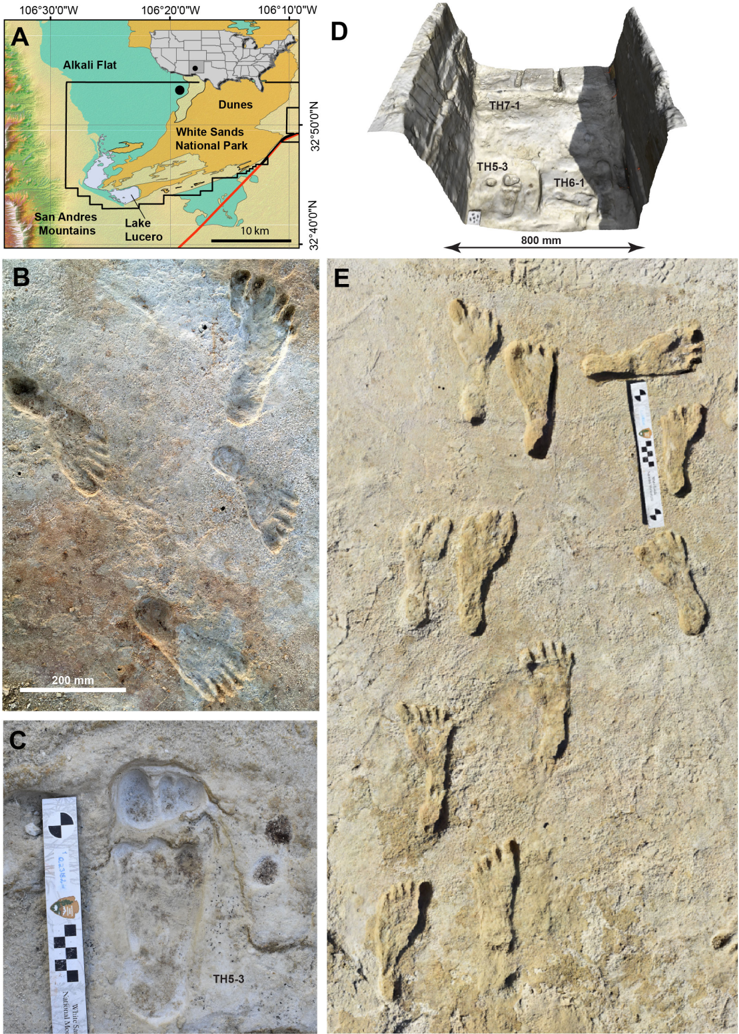
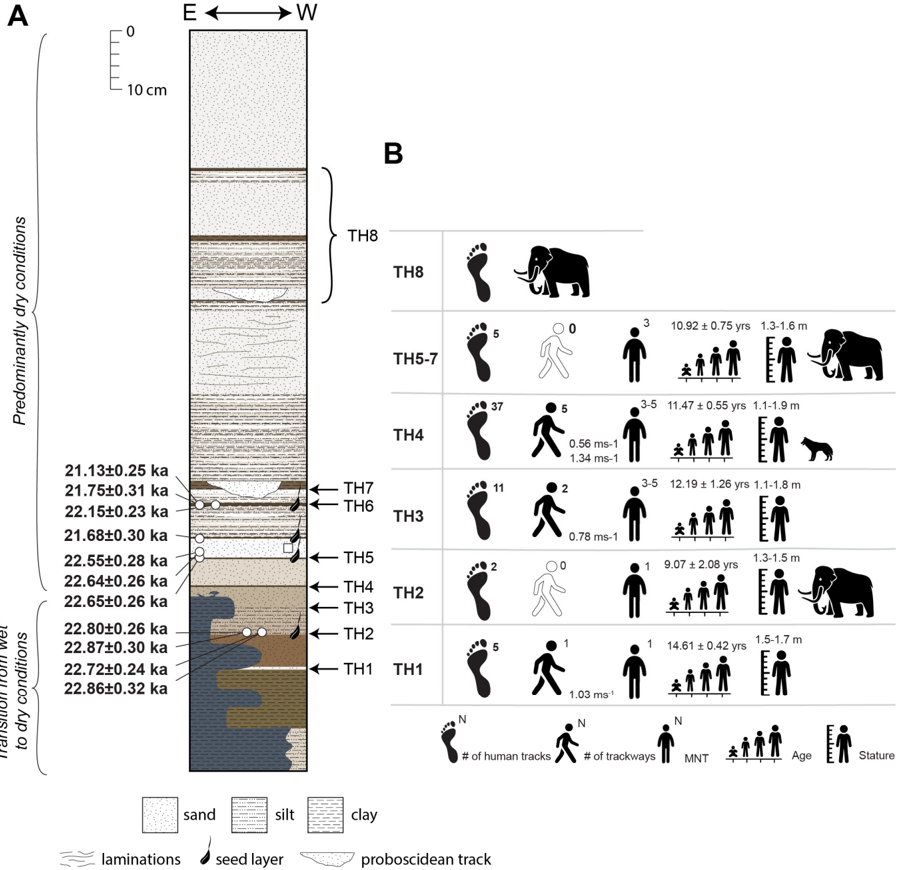
- 61 human tracks were documented at WHSA Locality 2 across seven footprint surfaces (TH1–TH7) and one multi-surface package (TH8); TH4 contains 37 tracks.
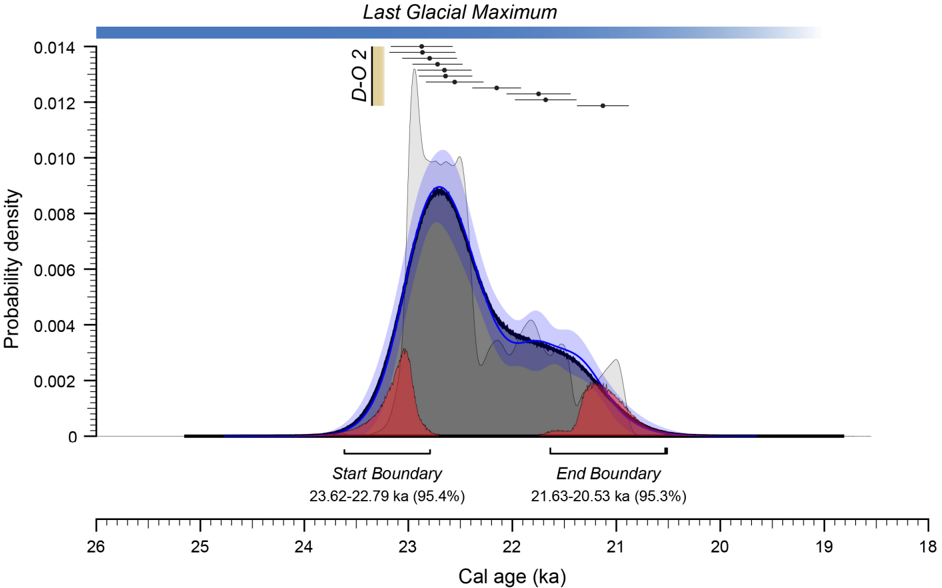
- Calibrated 14C ages from in situ *Ruppia cirrhosa* seed layers (N=11) range from 22.86 ± 0.32 to 21.13 ± 0.25 ka and maintain stratigraphic order between TH2 and TH6; KDE modeling places TH2–TH6 at ~23 to 21 ka, about two millennia during the LGM.
- Footprint anatomy is consistent with modern humans/*Hominipes modernus*; geomorphometric comparison with modern (N=356) and Namibian fossil (N=78) footprints shows broad similarity, with WHSA tracks flatter-footed and having longer toe pads.
- Proboscidean tracks in TH8 constrain the upper age to the late Pleistocene; human–megafauna overlap for at least two millennia suggests hunting, if present, was initially sustainable and raises a possible human role in extinctions previously thought to predate human arrival.
Methods
- Excavated in situ footprint-bearing sediments and trench stratigraphy at WHSA Locality 2; documented human tracks and compared their anatomy with *Hominipes modernus* and other Pleistocene/modern footprint samples.
- Radiocarbon dated in situ macroscopic seeds of the aquatic plant *Ruppia cirrhosa* sampled throughout the sequence; 11 calibrated ages were modeled with OxCal 4.4.2 KDE_Model, Boundary, and Interval functions using IntCal20; hard-water/reservoir effects were evaluated via geologic/hydrologic setting, stratigraphic order, and independent Tularosa Basin data.
- Geomorphometric comparison of WHSA tracks with modern (N=356) and fossil Namibian (N=78) footprints; stature, track-maker age, and walking-speed inferences were summarized from footprint dimensions.
Limitations
- Stated: stature, track-maker age, and walking-speed inferences require caution because the anthropometric affinity of the track-makers’ population is uncertain.
- Stated: radiocarbon dating of aquatic *Ruppia cirrhosa* may be subject to hard-water/reservoir effects that could make ages too old; the authors argue their chronology is robust, but this remains a potential caveat.
- Stated: the precise history of Lake Otero is not currently known, and exactly when people first arrived in the Western Hemisphere and when continuous occupation was established remain uncertain and contested. Evident from the text: demographic and behavioral interpretations (e.g., many tracks attributed to teenagers/children, division-of-labor hypothesis) are inferential from footprint evidence.
Model-written summary. Check it against the paper before relying on it.
Integrity signals
Registry
Cites
Statistics
Figures

Verification
Claims the paper makes
0 Valid · 0 Not valid · 15 Not checked · 25 Own results and interpretations
A result the paper reports from its own data — it cites no other source for it, so there is none to check. The quote shows it is in the paper.
In the paper
“A total of 61 human tracks have been identified and documented.”
plain- Asserted: passes — The authors put it forward as true.
- Checkable: passes — It can be checked against evidence.
- Load-bearing: unclear — It is unclear whether the paper’s conclusions depend on it.
- Based: passes — The paper gives a reason why it holds.
A result the paper states — it cites no source for it, so there is none to check. The quote shows it is in the paper.
In the paper
“This pattern is common to all excavated surfaces.”
plain- Asserted: passes — The authors put it forward as true.
- Checkable: passes — It can be checked against evidence.
- Load-bearing: unclear — It is unclear whether the paper’s conclusions depend on it.
- Based: unclear — It is unclear why the paper says it holds.
- Rests on an assumption not shown here.
A result the paper reports from its own data — it cites no other source for it, so there is none to check. The quote shows it is in the paper.
In the paper
“where multiple human footprints are stratigraphically constrained and bracketed by seed layers”
- Also stated in: § Main Text: · p. 2 · plain
“that occur on multiple stratigraphic horizons interbedded with seed layers”
plainstates an association- Asserted: passes — The authors put it forward as true.
- Checkable: passes — It can be checked against evidence.
- Load-bearing: passes — The paper’s conclusions depend on it.
- Based: passes — The paper gives a reason why it holds.
- Also stated in: § Main Text: · p. 2 · plain
A result the paper reports from its own data — it cites no other source for it, so there is none to check. The quote shows it is in the paper.
In the paper
“and maintain stratigraphic order within the uncertainties between TH2 and TH6 (Fig. 2)”
plainn = 11- Asserted: passes — The authors put it forward as true.
- Checkable: passes — It can be checked against evidence.
- Load-bearing: passes — The paper’s conclusions depend on it.
- Based: passes — The paper gives a reason why it holds.
A result the paper reports from its own data — it cites no other source for it, so there is none to check. The quote shows it is in the paper.
In the paper
“Footprints (humans, proboscidean, and canids) occur at all levels both in cross section and on excavated surfaces adjacent to the trench (Figs. 1B-E, 2, S4-S11).”
plain- Asserted: passes — The authors put it forward as true.
- Checkable: passes — It can be checked against evidence.
- Load-bearing: passes — The paper’s conclusions depend on it.
- Based: passes — The paper gives a reason why it holds.
22 more claims
Create a free account to see all 40 claims and to verify the 25 references still open.
- It may state two separate claims as one. 8
- Probably not a substantial claim. 8
Claims other papers make about this one
Each is checked against this paper’s own text: does it say what the citing paper says it does?
In the citing paper
“The recently reported discovery of footprints in sediments dating to 23–21 ka on an ancient lakeshore in New Mexico provides an unusually strong case for people in the Western Hemisphere during the LGM [82], although the dating has been disputed (e.g. [83]).”
From Beringia and the peopling of the Western Hemisphere (2023) · cites this paper as [82]
In the citing paper
“Seeds and pollen in the alluvium radiocarbon dated the track levels from ~23 ka to ~21 ka cal B.P. (1, 2).”
From Paleolake geochronology supports Last Glacial Maximum (LGM) age for human tracks at White Sands, New Mexico (2025) · cites this paper as [1]
In the citing paper
“WHSA Locality 2 is an archaeological site consisting of multiple, stratified human tracks and trackways found in stratified, low-energy, alluvial, and lake-margin deposits on the eastern side of paleolake Otero in the Tularosa Basin of southern New Mexico (1, 2).”
From Paleolake geochronology supports Last Glacial Maximum (LGM) age for human tracks at White Sands, New Mexico (2025) · cites this paper as [1]
In the citing paper
“Combined numerical age control from various studies of paleolake Otero suggests that it was a fluctuating shallow lake ~35 thousand years ago (ka ago) to ~12 thousand calibrated years before present (ka cal B.P.) (1, 15–18).”
From Paleolake geochronology supports Last Glacial Maximum (LGM) age for human tracks at White Sands, New Mexico (2025) · cites this paper as [1]
In the citing paper
“The human tracks in Locality 2 are in multiple layers of alluvium deposited along the margins of the paleolake.”
From Paleolake geochronology supports Last Glacial Maximum (LGM) age for human tracks at White Sands, New Mexico (2025) · cites this paper as [1]
20 more claims about this paper
Create a free account to see every claim other papers make about this one.
Citations
Cites
PAST: PALEONTOLOGICAL STATISTICAL SOFTWARE PACKAGE FOR EDUCATION AND DATA ANALYSIS
Hammer, Ø., Harper, D. A. T., & Ryan, P. D. (2001) · Palaeontologia Electronica · Cited by 17,871
(1985) · Academic Commons (Stony Brook University) · Cited by 12,330
Subcommission on geochronology: Convention on the use of decay constants in geo- and cosmochronology
Steiger, R. H., & Jäger, E. (1977) · Earth and Planetary Science Letters · doi:10.1016/0012-821x(77)90060-7 · Cited by 9,994
The IntCal20 Northern Hemisphere Radiocarbon Age Calibration Curve (0–55 cal kBP)
Reimer, P. J., Austin, W. E. N., Bard, E., Bayliss, A., Blackwell, P. G., Bronk Ramsey, C., Butzin, M., Cheng, H., Edwards, R. L., Friedrich, M., et al. (2020) · Radiocarbon · doi:10.1017/rdc.2020.41 · Cited by 7,900 · cited 1×
“4.2 ( 22, 23 ).”
InfluentialUser's Manual for Isoplot 3.00 - A Geochronological Toolkit for Microsoft Excel
Ludwig, K. R. (2003) · Cited by 7,734
Flexible paleoclimate age-depth models using an autoregressive gamma process
Blaauw, M., & Christen, J. A. (2011) · Bayesian Analysis · doi:10.1214/11-ba618 · Cited by 4,502
IsoplotR: A free and open toolbox for geochronology
Vermeesch, P. (2018) · Geoscience Frontiers · doi:10.1016/j.gsf.2018.04.001 · Cited by 3,537
Composition of the Continental Crust
Rudnick, R. L., & Gao, S. (2003) · Treatise on Geochemistry · doi:10.1016/b0-08-043751-6/03016-4 · Cited by 3,413
Clark, P. U., Dyke, A. S., Shakun, J. D., Carlson, A. E., Clark, J., Wohlfarth, B., Mitrovica, J. X., Hostetler, S. W., & McCabe, A. M. (2009) · Science · doi:10.1126/science.1172873 · Cited by 3,277
Cheng, H., Lawrence Edwards, R., Shen, C.-C., Polyak, V. J., Asmerom, Y., Woodhead, J., Hellstrom, J., Wang, Y., Kong, X., Spötl, C., et al. (2013) · Earth and Planetary Science Letters · doi:10.1016/j.epsl.2013.04.006 · Cited by 1,568
Research works printed but not linked: 2
- R. H. Tuttle in Laetoli: A Pliocene Site in Northern Tanzania M. D. Leakey J. M. Harris Eds. (Clarendon Press 1987) pp. 60–65.
- R. R. Haynes, The aquatic vascular flora of the southeastern United States: Endemism and origins. Sida. Bot. Miscellany 18, 23–28 (2000).
Cited by
Dalton, A. S., Stokes, C. R., & Batchelor, C. L. (2022) · Earth-Science Reviews · doi:10.1016/j.earscirev.2021.103875 · Cited by 104
Bergman, J., Pedersen, R. Ø., Lundgren, E. J., Lemoine, R. T., Monsarrat, S., Pearce, E. A., Schierup, M. H., & Svenning, J. (2023) · Nature Communications · doi:10.1038/s41467-023-43426-5 · Cited by 101
Megafauna extinctions in the late-Quaternary are linked to human range expansion, not climate change
Lemoine, R. T., Buitenwerf, R., & Svenning, J. (2023) · Anthropocene · doi:10.1016/j.ancene.2023.100403 · Cited by 78
Independent age estimates resolve the controversy of ancient human footprints at White Sands
Pigati, J. S., Springer, K. B., Honke, J. S., Wahl, D., Champagne, M. R., Zimmerman, S. R. H., Gray, H. J., Santucci, V. L., Odess, D., Bustos, D., et al. (2023) · Science · doi:10.1126/science.adh5007 · Cited by 68
Self-citationThe Bering Strait was flooded 10,000 years before the Last Glacial Maximum
Farmer, J. R., Pico, T., Underwood, O. M., Stout, R. C., Granger, J., Cronin, T. M., Fripiat, F., Martínez‐García, A., Haug, G. H., & Sigman, D. M. (2022) · Proceedings of the National Academy of Sciences · doi:10.1073/pnas.2206742119 · Cited by 68
Pre–Younger Dryas megafaunal extirpation at Rancho La Brea linked to fire-driven state shift
O’Keefe, F. R., Dunn, R. E., Weitzel, E. M., Waters, M. R., Martinez, L. N., Binder, W. J., Southon, J. R., Cohen, J. E., Meachen, J. A., DeSantis, L. R. G., et al. (2023) · Science · doi:10.1126/science.abo3594 · Cited by 48
The genetic history of the Southern Andes from present-day Mapuche ancestry
Arango-Isaza, E., Capodiferro, M. R., Aninao, M. J., Babiker, H. M. A., Aeschbacher, S., Achilli, A., Posth, C., Campbell, R., Martínez, F. I., Heggarty, P., et al. (2023) · Current Biology · doi:10.1016/j.cub.2023.05.013 · Cited by 64
Premature rejection in science: The case of the Younger Dryas Impact Hypothesis
Powell, J. L. (2022) · Science Progress · doi:10.1177/00368504211064272 · Cited by 37
A palaeoecological perspective on the transformation of the tropical Andes by early human activity
Bush, M. B., Rozas-Dávila, A., Raczka, M. F., Nascimento, M. N., Valencia, B. G., Sales, R. K., McMichael, C. N. H., & Gosling, W. D. (2022) · Philosophical Transactions of the Royal Society B Biological Sciences · doi:10.1098/rstb.2020.0497 · Cited by 56
Surovell, T. A., Allaun, S. A., Crass, B. A., Gingerich, J. A. M., Graf, K. E., Holmes, C. E., Kelly, R. L., Kornfeld, M., Krasinski, K. E., Larson, M. L., et al. (2022) · PLOS ONE · doi:10.1371/journal.pone.0264092 · Cited by 28
Potter, B. A., Chatters, J. C., Prentiss, A. M., Fiedel, S. J., Haynes, G., Kelly, R. L., Kilby, J. D., Lanoë, F., Holland-Lulewicz, J., Miller, D. S., et al. (2022) · PaleoAmerica · doi:10.1080/20555563.2021.1978721 · Cited by 53
Human Occupation of the North American Colorado Plateau ∼37,000 Years Ago
Rowe, T. B., Stafford, T. W., Fisher, D. C., Enghild, J. J., Quigg, J. M., Ketcham, R. A., Sagebiel, J. C., Hanna, R. D., & Colbert, M. W. (2022) · Frontiers in Ecology and Evolution · doi:10.3389/fevo.2022.903795 · Cited by 52
Founder effects identify languages of the earliest Americans
Nichols, J. (2024) · American Journal of Biological Anthropology · doi:10.1002/ajpa.24923 · Cited by 44
Atom counting with accelerator mass spectrometry
Kutschera, W., Jull, A. J. T., Paul, M., & Wallner, A. (2023) · Reviews of Modern Physics · doi:10.1103/revmodphys.95.035006 · Cited by 43
Evidence of artefacts made of giant sloth bones in central Brazil around the last glacial maximum
Pansani, T. R., Pobiner, B. L., Guériau, P., Thoury, M., Tafforeau, P., Baranger, E., Vialou, Á. V., Vialou, D., McSparron, C., Castro, M. C., et al. (2023) · Proceedings of the Royal Society B Biological Sciences · doi:10.1098/rspb.2023.0316 · Cited by 42
Hebda, C. F. G., McLaren, D., Mackie, Q., Fedje, D. W., Pedersen, M. W., Willerslev, E., Brown, K. J., & Hebda, R. J. (2022) · Quaternary Science Reviews · doi:10.1016/j.quascirev.2022.107388 · Cited by 39
Lucock, M. D. (2023) · American Journal of Biological Anthropology · doi:10.1002/ajpa.24564 · Cited by 35
“The Americas were believed to be colonized far later at around 16,000 years BP, however, recent evidence of human footprints from New Mexico suggests settlement may have occurred even earlier, between 21,000 and 23,000 years BP (Bennett et al., 2021).”
BackgroundLate quaternary biotic homogenization of North American mammalian faunas
Fraser, D., Villaseñor, A., Tóth, A. B., Balk, M. A., Eronen, J. T., Barr, W. A., Behrensmeyer, A. K., Davis, M., Du, A., Faith, J. T., et al. (2022) · Nature Communications · doi:10.1038/s41467-022-31595-8 · Cited by 34
Hall, J. R., Allison, M. S., Papadopoulos, M. T., Barfod, D. N., & Jones, S. M. (2023) · Paleoceanography and Paleoclimatology · doi:10.1029/2022pa004539 · Cited by 31
Ice and ocean constraints on early human migrations into North America along the Pacific coast
Praetorius, S., Alder, J. R., Condron, A., Mix, A. C., Walczak, M. H., Caissie, B., & Erlandson, J. M. (2023) · Proceedings of the National Academy of Sciences · doi:10.1073/pnas.2208738120 · Cited by 29
Dating the Pleistocene hominin ichnosites on South Africa’s Cape south coast
Helm, C., Carr, A. S., Lockley, M. G., Cawthra, H. C., Vynck, J. C. D., Dixon, M. G., Stear, W. M., & Thesen, G. H. H. (2023) · Ichnos/Ichnos : an international journal for plant and animal traces · doi:10.1080/10420940.2023.2204231 · Cited by 28
From North Asia to South America: Tracing the longest human migration through genomic sequencing
Gusareva, E. S., Ghosh, A. G., Харьков, В. Н., Khor, S., Зарубин, А. А., Moshkov, N., Kalsi, N., Ratan, A., Heinle, C. E., Cooke, N. P., et al. (2025) · Science · doi:10.1126/science.adk5081 · Cited by 27
Papa, M. D., Reyes, M. D. L., Poiré, D. G., Rascovan, N., Jofré, G., & Delgado, M. (2024) · PLoS ONE · doi:10.1371/journal.pone.0304956 · Cited by 26
Comment on “Evidence of humans in North America during the Last Glacial Maximum”
Madsen, D. B., Davis, L. G., Rhode, D., & Oviatt, C. G. (2022) · Science · doi:10.1126/science.abm4678 · Cited by 20
Oviatt, C. G., Madsen, D. B., Rhode, D., & Davis, L. G. (2023) · Quaternary Research · doi:10.1017/qua.2022.38 · Cited by 24
Gauvreau, A. M., Fedje, D. W., Dyck, A., Mackie, Q., Hebda, C. F. G., Holmes, K., White, Q. Y. E., Housty, W., Housty, R., & McLaren, D. (2023) · Journal of Archaeological Science Reports · doi:10.1016/j.jasrep.2023.103884 · Cited by 23
Pleistocene hunter-gatherer coastal adaptations in Atlantic Iberia
Bicho, N., & Esteves, E. (2022) · Frontiers in Earth Science · doi:10.3389/feart.2022.957214 · Cited by 22
Haynes, C. V. (2022) · PaleoAmerica · doi:10.1080/20555563.2022.2039861 · Cited by 21
INITIAL HUMAN COLONIZATION OF THE AMERICAS, REDUX
Fiedel, S. J. (2022) · Radiocarbon · doi:10.1017/rdc.2021.103 · Cited by 20
An Anthropological Conception of the Initial Peopling of the Americas
Gruhn, R. (2023) · PaleoAmerica · doi:10.1080/20555563.2023.2278948 · Cited by 20
Questioning the Anthropic Nature of Pedra Furada and the Piauí Sites
Coutouly, Y. A. G. (2021) · PaleoAmerica · doi:10.1080/20555563.2021.1943181 · Cited by 20
Response to Comment on “Evidence of humans in North America during the Last Glacial Maximum”
Pigati, J. S., Springer, K. B., Bennett, M. R., Bustos, D., Urban, T. M., Holliday, V. T., Reynolds, S. C., & Odess, D. (2022) · Science · doi:10.1126/science.abm6987 · Cited by 20
Self-citationCordilleran Ice Sheet Stability During the Last Deglaciation
Darvill, C. M., Menounos, B., Goehring, B. M., & Lesnek, A. J. (2022) · Geophysical Research Letters · doi:10.1029/2021gl097191 · Cited by 19
Estimating crossing success of human agents across sea straits out of Africa in the Late Pleistocene
Hölzchen, E., Hertler, C., Willmes, C., Anwar, I. P., Mateos, A., Rodríguez, J., Berndt, J. O., & Timm, I. J. (2022) · Palaeogeography Palaeoclimatology Palaeoecology · doi:10.1016/j.palaeo.2022.110845 · Cited by 18
Altamura, F., Lehmann, J., Rodríguez-Álvarez, B., Urban, B., van Kolfschoten, T., Verheijen, I., Conard, N. J., & Serangeli, J. (2023) · Quaternary Science Reviews · doi:10.1016/j.quascirev.2023.108094 · Cited by 18
Climatic and Ecological Change in the Americas: A Perspective from Historical Ecology
Whitaker, J. A., Armstrong, C. G., & Odonne, G. (2023) · Routledge eBooks · doi:10.4324/9781003316497 · Cited by 18
The Maya and Climate Change: Human-Environmental Relationships in the Classic Period Lowlands
Seligson, K. E. (2022) · doi:10.1093/oso/9780197652923.001.0001 · Cited by 18
Beringia and the peopling of the Western Hemisphere
Hoffecker, J. F., Elias, S. A., Scott, G. R., O'Rourke, D. H., Hlusko, L. J., Potapova, O., Pitulko, V., Pavlova, E., Bourgeon, L., & Vachula, R. S. (2023) · Proceedings of the Royal Society B: Biological Sciences · doi:10.1098/rspb.2022.2246 · Cited by 17
Holcomb, J. A., Mandel, R. D., Otárola‐Castillo, E., Rademaker, K., Rosencrance, R. L., McDonough, K. N., Miller, D. S., & Wygal, B. T. (2022) · PaleoAmerica · doi:10.1080/20555563.2022.2135476 · Cited by 17
A mid-Holocene age for Monte Verde challenges the timeline of human colonization of South America
Surovell, T. A., Méndez, C., García, J.-L., Lüthgens, C., Thompson, J. M., & Latorre, C. (2026) · Science · doi:10.1126/science.adw9217 · Cited by 17
Pigati, J. S., Springer, K. B., Holliday, V. T., Bennett, M. R., Bustos, D. F., Urban, T. M., Reynolds, S. C., & Odess, D. (2022) · PaleoAmerica · doi:10.1080/20555563.2022.2039863 · Cited by 17
Self-citationKessler, C., & Shafer, A. B. A. (2024) · Molecular Biology and Evolution · doi:10.1093/molbev/msae038 · Cited by 16
The genetic legacy of the Manila galleon trade in Mexico
Rodríguez-Rodríguez, J. E., Ioannidis, A. G., Medina-Muñoz, S. G., Barberena-Jonas, C., Blanco-Portillo, J., Quinto-Cortés, C. D., & Moreno‐Estrada, A. (2022) · Philosophical Transactions of the Royal Society B Biological Sciences · doi:10.1098/rstb.2020.0419 · Cited by 15
State of Traditional Ecological Knowledge in the wildlife management profession
Werdel, T. J., Matarrita‐Cascante, D., & Lucero, J. E. (2024) · Journal of Wildlife Management · doi:10.1002/jwmg.22579 · Cited by 15
Rachal, D. M., Dello-Russo, R., & Cuba, M. (2024) · Quaternary Research · doi:10.1017/qua.2023.74 · Cited by 14
Envisioning translational hyperscanning: how applied neuroscience might improve family-centered care
Provenzi, L., Roberti, E., & Capelli, E. (2022) · Social Cognitive and Affective Neuroscience · doi:10.1093/scan/nsac061 · Cited by 14
Perrotti, A. G., Kiahtipes, C. A., Russell, J. M., Jackson, S. T., Gill, J. L., Robinson, G., Krause, T. R., & Williams, J. W. (2022) · Quaternary Science Reviews · doi:10.1016/j.quascirev.2022.107696 · Cited by 14
Beringia and the Settlement of the Western Hemisphere
Hoffecker, J. F., Питулько, В. В., & Павлова, Е. А. (2022) · Вестник Санкт-Петербургского университета. Серия 2. История · doi:10.21638/spbu02.2022.313 · Cited by 14
Unresolved: Persistent Problems with the White Sands Locality 2 Geochronology
Rhode, D., Neudorf, C. M., Rachal, D., Davis, L. G., Madsen, D. B., & Dello-Russo, R. (2024) · PaleoAmerica · doi:10.1080/20555563.2024.2345979 · Cited by 14
Rachal, D. M., Mead, J. I., Dello‐Russo, R., & Cuba, M. T. (2022) · Geoarchaeology · doi:10.1002/gea.21937 · Cited by 12
Fossil footprints and what they mean for hominin paleobiology
Hatala, K. G., Roach, N. T., & Behrensmeyer, A. K. (2022) · Evolutionary Anthropology Issues News and Reviews · doi:10.1002/evan.21963 · Cited by 14
Landscape Is Alive: Nuwuvi Pilgrimage and Power Places in Nevada
Stoffle, R. W., Arnold, R., & Vlack, K. V. (2022) · Land · doi:10.3390/land11081208 · Cited by 14
Holliday, V. T., Windingstad, J. D., Bright, J., Phillips, B. G., Butler, J. B., Breslawski, R., & Bowman, J. E. (2025) · Science Advances · doi:10.1126/sciadv.adv4951 · Cited by 13
Self-citationA Late Pleistocene hominin footprint site on the North African coast of Morocco
Sédrati, M., González, J. A. M., Duveau, J., M’rini, A. E., Mayoral, E., Díaz‐Martínez, I., Anthony, E. J., Bulot, G., Sedrati, A., Gall, R. L., et al. (2024) · Scientific Reports · doi:10.1038/s41598-024-52344-5 · Cited by 13
Menéndez, L. P., Paul, K. S., Castro, C. D. L. F., de Almeida, T. F., Delgado, M., Figueiro, G., Jorgensen, K. C., Kuzminsky, S. C., López‐Sosa, M. C., Nichols, J., et al. (2022) · Evolutionary Anthropology Issues News and Reviews · doi:10.1002/evan.21937 · Cited by 13
Trans–Holocene Bayesian chronology for tree and field crop use from El Gigante rockshelter, Honduras
Kennett, D. J., Harper, T. K., VanDerwarker, A. M., Thakar, H. B., Domic, A. I., Blake, M., Benz, B. F., George, R. J., Scheffler, T. E., Culleton, B. J., et al. (2023) · PLoS ONE · doi:10.1371/journal.pone.0287195 · Cited by 13
Labarca, R., Frugone‐Álvarez, M., Vilches, L., Blanco, J. F., Peñaloza, Á., Godoy-Aguirre, C., Lizama-Catalán, Á., Oyarzo, C., Tornero, C., González-Guarda, E., et al. (2024) · PLoS ONE · doi:10.1371/journal.pone.0302465 · Cited by 12
Characterizing the American Upper Paleolithic
Madsen, D. B., Davis, L. G., Williams, T. J., Izuho, M., & Iizuka, F. (2025) · Science Advances · doi:10.1126/sciadv.ady9545 · Cited by 12
Possible shod-hominin tracks on South Africa’s Cape coast
Helm, C., Lockley, M. G., Cawthra, H. C., Vynck, J. C. D., Dixon, M. G., Rust, R., Stear, W. M., Tonder, M. V., & Zipfel, B. (2023) · Ichnos/Ichnos : an international journal for plant and animal traces · doi:10.1080/10420940.2023.2249585 · Cited by 12
Talking with a Volcano: Native American Perspectives on the Eruption of Sunset Crater, Arizona
Stoffle, R. W., & Vlack, K. V. (2022) · Land · doi:10.3390/land11020196 · Cited by 11
Fariña, R. A., Tambusso, P. S., Varela, L., Gascue, A., & Stafford, T. W. (2022) · PaleoAmerica · doi:10.1080/20555563.2022.2137927 · Cited by 11
Hemisphere-wide evidence of Early Paleoindian megaherbivore specialization
Potter, B. A., Chatters, J. C., Prates, L., Pérez, S. I., Surovell, T. A., Politis, G. G., Wooller, M. J., & Kelly, R. L. (2026) · Science Advances · doi:10.1126/sciadv.aef9628 · Cited by 10
Des civilisations du végétal préhistoriques sous les tropiques ?
Xhauflair, H., Lourdeau, A., Gaffney, D., Ford, A., Tanudirjo, D. A., & Jago-on, S. (2023) · L Anthropologie · doi:10.1016/j.anthro.2023.103192 · Cited by 10
New age constraints for human entry into the Americas on the north Pacific coast
Steffen, M. L. (2024) · Scientific Reports · doi:10.1038/s41598-024-54592-x · Cited by 10
Onset of dune construction based on archaeological evidence, White Sands, New Mexico
Holliday, V. T., Cuba, M. T., Lee, W., Windingstad, J. D., Fenerty, B., & Bustos, D. F. (2023) · Quaternary Research · doi:10.1017/qua.2023.22 · Cited by 9
Self-citationWhite, J. T., Henry, A., Kuehn, S. C., Loso, M. G., & Rasic, J. T. (2022) · Quaternary International · doi:10.1016/j.quaint.2022.08.012 · Cited by 9
Archaeological Recovery of Late Pleistocene Hair and Environmental DNA from Interior Alaska
Wygal, B. T., Krasinski, K. E., Metcalfe, J. Z., McMahan, D., Holmes, C. E., Crass, B. A., Wriston, T. A., Shirazi, S., Vershinina, A. O., & Shapiro, B. (2022) · Environmental Archaeology · doi:10.1080/14614103.2022.2031836 · Cited by 9
Canesin, L. E. C., Vilaça, S. T., Oliveira, R. R. M., Al-Ajli, F. O., Tracey, A., Sims, Y., Formenti, G., Fedrigo, O. D., Banhos, Á., Sanaiotti, T. M., et al. (2024) · Scientific Reports · doi:10.1038/s41598-024-70305-w · Cited by 9
Early prehistory of South America and population dynamics: Issues and hypotheses
Pérez-Balarezo, A., González-Varas, M., van Havre, G., & Zhou, Y. (2023) · L Anthropologie · doi:10.1016/j.anthro.2023.103139 · Cited by 9
Vunduk, J., & Biketova, A. Y. (2022) · Royal Society of Chemistry eBooks · doi:10.1039/9781839167522-00327 · Cited by 9
Neolithic track sites from Formby Point, England: New data and insights
Wiseman, A. L. A., Vicari, D., Belvedere, M., & Groote, I. D. (2022) · Journal of Archaeological Science Reports · doi:10.1016/j.jasrep.2022.103546 · Cited by 9
The Geochronology of White Sands Locality 2 is Resolved
Pigati, J. S., Springer, K. B., Gray, H. J., Bennett, M. R., & Bustos, D. (2024) · PaleoAmerica · doi:10.1080/20555563.2024.2376298 · Cited by 8
Self-citationWendt, J. A. F., McWethy, D. B., Hempson, G. P., Brookshire, E. N. J., & Fuhlendorf, S. D. (2023) · Environmental Research Letters · doi:10.1088/1748-9326/ad0ad0 · Cited by 8
A genomic perspective on South American human history
Silva, M. A. C. E., Ferraz, T., & Hünemeier, T. (2022) · Genetics and Molecular Biology · doi:10.1590/1678-4685-gmb-2022-0078 · Cited by 8
Firewood and Energy Sovereignty on Navajo Nation
Magargal, K., Yellowman, J., Chee, S., Wabel, M., Macfarlan, S. J., & Codding, B. F. (2023) · Human Ecology · doi:10.1007/s10745-023-00411-2 · Cited by 8
Conservation biology and conservation paleobiology meet the Anthropocene together: history matters
Walker, S. E. (2023) · Frontiers in Earth Science · doi:10.3389/feart.2023.1166243 · Cited by 7
Bennett, M. R., Urban, T. M., Bustos, D. F., Reynolds, S. C., Jolie, E. A., Strehlau, H. C., Odess, D., Springer, K. B., & Pigati, J. S. (2025) · Quaternary Science Advances · doi:10.1016/j.qsa.2025.100274 · Cited by 5
Self-citationDomínguez‐Rodrigo, M., & Baquedano, E. (2022) · PaleoAmerica · doi:10.1080/20555563.2022.2137926 · Cited by 7
Erlandson, J. M., & Braje, T. J. (2022) · California Archaeology · doi:10.1080/1947461x.2022.2125711 · Cited by 7
An Efficient Coalescent Model for Heterochronously Sampled Molecular Data
Cappello, L., Véber, A., & Palacios, J. A. (2024) · Journal of the American Statistical Association · doi:10.1080/01621459.2024.2330732 · Cited by 7
Carpenter, K. (2022) · Geology of the Intermountain West · doi:10.31711/giw.v9.pp49-114 · Cited by 7
The Quaternary record of vertebrate tracks and trackways
de Carvalho, C. N., Helm, C., Melchor, R. N., Feola, S. F., Goldstein, D., & Camens, A. B. (2025) · Elsevier eBooks · doi:10.1016/b978-0-443-38351-9.00004-9 · Cited by 6
The Last Glacial Maximum in the Tropics: Human Responses to Global Change, 30–10 ka
Leplongeon, A., Arous, E. B., Mesfin, I., Forestier, H., Gallet, X., Griggo, C., Puaud, S., Sémah, A., Vialou, Á. V., Pleurdeau, D., et al. (2025) · Journal of World Prehistory · doi:10.1007/s10963-025-09197-1 · Cited by 6
Pérez-Balarezo, A. (2022) · theses.fr (ABES) · doi:10.70675/018f40c0z3d9cz4c30z819fz1ba39c3db53f · Cited by 6
Underrepresented Populations at the Archaic Introgression Frontier
Villanea, F. A., & Witt, K. E. (2022) · Frontiers in Genetics · doi:10.3389/fgene.2022.821170 · Cited by 6
Households and communities: evolution in Homo sapiens
Manning, P. M. (2023) · The History of the Family · doi:10.1080/1081602x.2023.2239780 · Cited by 6
Ardelean, C. F., Arroyo‐Cabrales, J., Rivera-González, I. I., Solís, C., Rodríguez‐Ceja, M., Quintero, J. I. M., Sánchez-Vázquez, V. M., Mitrani, A., & Ruvalcaba‐Sil, J. L. (2023) · L Anthropologie · doi:10.1016/j.anthro.2023.103135 · Cited by 6
Menéndez, L. P., Barbieri, C., Cruz, I. G. L., Schmelzle, T., Breidenstein, A., Barquera, R., Borzi, G., Schuenemann, V. J., & Sánchez-Villagra, M. R. (2023) · Swiss Journal of Palaeontology · doi:10.1186/s13358-023-00293-3 · Cited by 6
Prehistoric global migration of vanishing gut microbes with humans
Carter, M. M., Liu, Z., Olm, M. R., Martin, M., Sprockett, D. D., Ghadermazi, P., Trumble, B. C., Kaplan, H. S., Stieglitz, J., Rodríguez, D. E., et al. (2026) · Nature · doi:10.1038/s41586-026-11106-1 · Cited by 6
The Paleolithic of Maritime Northeast Asia and the Search for Maritime Beringians
Fitzhugh, B. (2022) · The Archaeology of Asia-Pacific Navigation · doi:10.1007/978-981-19-1118-7_15 · Cited by 6
A Human Behavioral Ecology of the Colonization of Unfamiliar Landscapes
Schmuck, N., Clark, J. L., Carlson, R. J., & Baichtal, J. F. (2022) · Journal of Archaeological Method and Theory · doi:10.1007/s10816-022-09554-w · Cited by 6
Pansani, T. R., Dantas, M. A. T., Asevedo, L., Cherkinsky, A. E., Vialou, D., Vialou, Á. V., & Pacheco, M. L. A. F. (2023) · Journal of Quaternary Science · doi:10.1002/jqs.3553 · Cited by 5
Lucas, S. G., Espinoza, E., & Alvarado, G. E. (2023) · Geological Society London Special Publications · doi:10.1144/sp543-2022-255 · Cited by 5
Storied Rocks: Portals to Other Dimensions
Stoffle, R. W., Vlack, K. V., Bell, A., & Uribe, B. E. (2024) · Arts · doi:10.3390/arts13060168 · Cited by 5
Scale Matters: The Quality of Quantity in Human Culture and Sociality
Widlok, T., & Cruz, M. D. (2022) · Edition Kulturwissenschaft · doi:10.14361/9783839460993 · Cited by 5
From footprint morphometrics to the stature of fossil hominins: A common but uncertain estimate
Duveau, J. (2022) · L Anthropologie · doi:10.1016/j.anthro.2022.103067 · Cited by 5
A cluster of Pleistocene hominin ichnosites on South Africa’s Cape South Coast
Helm, C., Carr, A. S., Cawthra, H. C., Vynck, J. C. D., Dixon, M. G., Hattingh, S., Rust, R., Stear, W. M., Thesen, G. H. H., van Berkel, F., et al. (2024) · Ichnos/Ichnos : an international journal for plant and animal traces · doi:10.1080/10420940.2024.2415141 · Cited by 5
World Prehistory and Archaeology: Pathways Through Time
Chazan, M. (2021) · Routledge eBooks · doi:10.4324/9780367815271 · Cited by 5
Introduction to rivers of South America
Graça, M. A. S., Latrubesse, E. M., Callisto, M., de Mello, F. T., & Rodríguez‐Olarte, D. (2024) · Elsevier eBooks · doi:10.1016/b978-0-12-823429-7.00023-9 · Cited by 5
Indigenous People Prevented Climate-Induced Ecological Change for Millennia
Mueller, N. G. (2023) · Routledge eBooks · doi:10.4324/9781003316497-5 · Cited by 5
Metadata
- Authors
- Bennett, M. R., Bustos, D., Pigati, J. S., Springer, K. B., Urban, T. M., Holliday, V. T., Reynolds, S. C., Budka, M., Honke, J. S., Hudson, A. M., Fenerty, B., Connelly, C., Martinez, P. J., Santucci, V. L., & Odess, D.
- Affiliations
- Bournemouth University (GB)
- National Park Service (US)
- United States Geological Survey (US)
- Cornell University (US)
- University of Arizona (US)
- Corresponding author
- Bennett, Matthew R.
- Odess, Daniel
- ORCID
- Venue
- Science
- Published
- 2021-09-24
- Volume
- 373
- Issue
- 6562
- Pages
- 1528-1531
- ISSN
- 0036-8075 (ISSN-L)
- 1095-9203
- OpenAlex
- W3200576454
- Cited by
- 239
- References
- 69
- Citations by year
- 2026: 33 · 2025: 38 · 2024: 39 · 2023: 48 · 2022: 71 · 2021: 10
- FWCI
- 63.56
- Type
- journal article
- Language
- en
- Open access
- Locations
- Science (publishedVersion)
- PubMed (publishedVersion)
- Bournemouth University Research Online (Bournemouth University) (acceptedVersion)
- UA Campus Repository (The University of Arizona) (acceptedVersion)
- Funders
- U.S. Department of the Interior
- University of Arizona Foundation
- Western National Parks Association
- U.S. Geological Survey
- National Park Service
- Natural Environment Research Council (NE/M021459/1, NE/H004246/1)
- Topics
- Social Sciences › Anthropology › Pleistocene-Era Hominins and Archaeology
- Social Sciences › Archeology › Archaeology and ancient environmental studies
- Physical Sciences › Earth and Planetary Sciences › Atmospheric Science › Geology and Paleoclimatology Research
- Keywords
- Last Glacial Maximum, human footprint, radiocarbon dating, seed layer, Pleistocene megafauna, stratigraphic context
- MeSH terms
- Foot, Fossils, Humans, New Mexico, North America, Geologic Sediments, Ice Cover, History, Ancient, Climate Change, Human Migration
About these checks
Registry, retraction, Cites and statistics results are computed, not judged, with one exception: a printed reference that no index lists is read once by a model before it counts as a citation error. Claims are extracted by a model and kept only when their quote appears verbatim in the text; each cited source is then checked, with a model’s help, for whether it says what the claim relies on. Those verdicts can be wrong — read the claim’s quote and the cited source before relying on one.
A language model drew the claims from the paper on 2026-11-23, under version 3 of the claim definition (model deepseek-v4.1-flash, prompt extract-v3).
A second model labelled each claim on 2026-11-23 (model jev-1.13-20260917, definition revision gold-guideline-v0.2).
Statistics and arithmetic are recomputed, not judged.
Confidence bands are shown only for fields calibrated on our annotated test set. None is calibrated yet, so no band is shown.
What counts as a claim ›How we measure confidence ›How we check this ›
Are you an author, or do you see a problem with this page? Request a review
Data sources
Bibliographic data: Semantic Scholar, OpenAlex, Crossref.
Contains information from the Semantic Scholar Academic Graph Datasets, made available under the ODC Attribution License (ODC-BY 1.0).
Semantic Scholar’s data is described in: Kinney, R., et al. (2023). The Semantic Scholar Open Data Platform. arXiv:2301.10140.
