

Evidence of humans in North America during the Last Glacial Maximum
Open accessThe DOI matches its Crossref record; 71 of the 71 references it cites were found in a registry or an index; none of the 29 sources its claims cite is checked for support yet.
Abstract
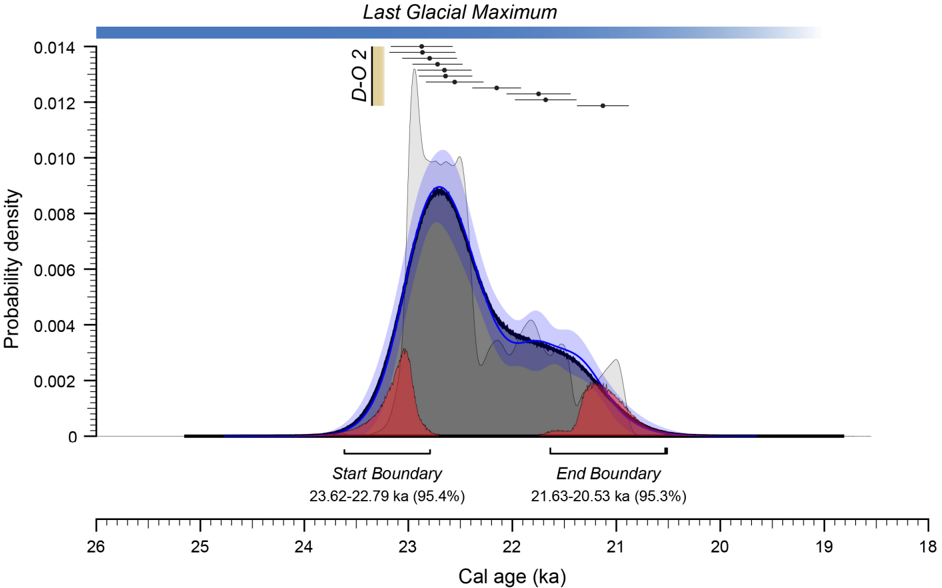
Early footsteps in the Americas: Despite a plethora of archaeological research over the past century, the timing of human migration into the Americas is still far from resolved. In a study of exposed outcrops of Lake Otero in White Sands National Park in New Mexico, Bennett et al . reveal numerous human footprints dating to about 23,000 to 21,000 years ago. These finds indicate the presence of humans in North America for approximately two millennia during the Last Glacial Maximum south of the migratory barrier created by the ice sheets to the north. This timing coincided with a Northern Hemispheric abrupt warming event, Dansgaard-Oeschger event 2, which drew down lake levels and allowed humans and megafauna to walk on newly exposed surfaces, creating tracks that became preserved in the geologic record. —AMS
Overview
CoChat Summary
TL;DR
In situ human footprints at White Sands National Park, New Mexico, are bracketed by calibrated 14C ages of ~23–21 ka, indicating human presence in North America during the Last Glacial Maximum. The authors report 61 human tracks across multiple horizons and argue this extends the temporal overlap between early inhabitants and Pleistocene megafauna.
Key findings
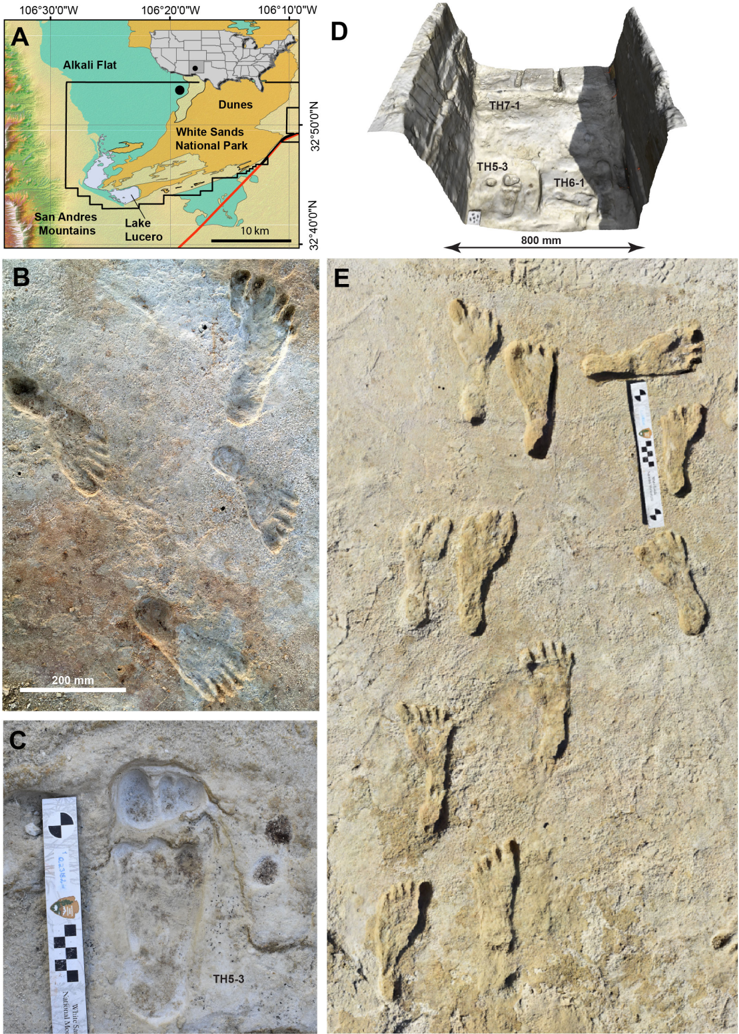
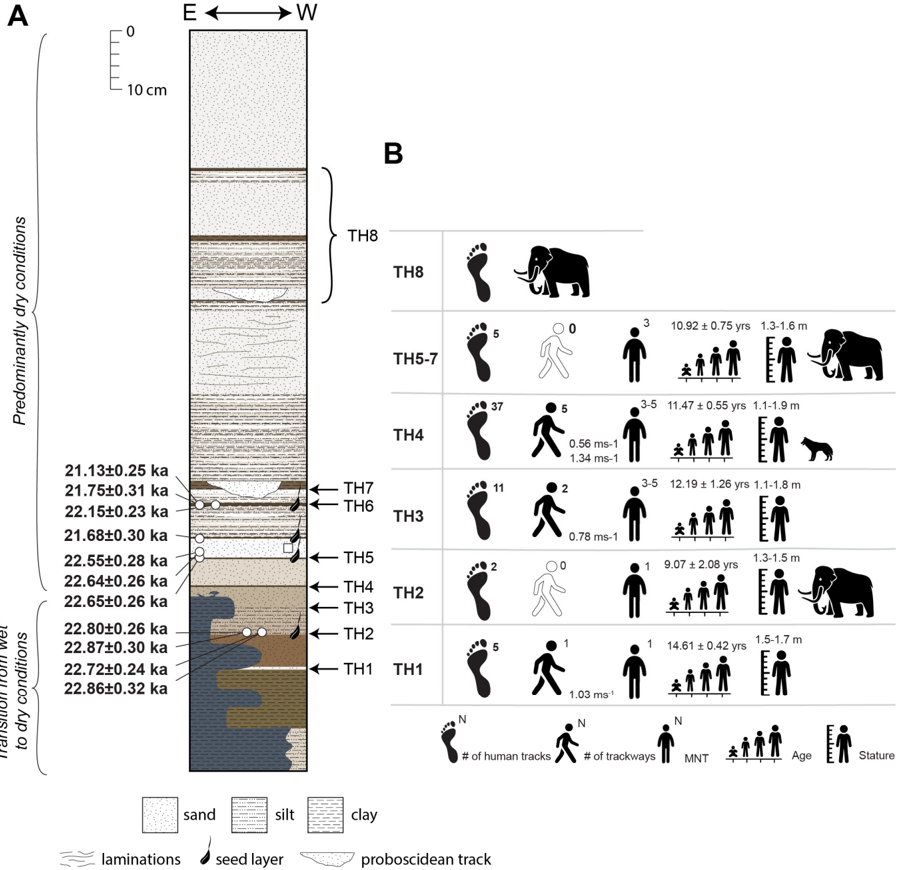
- 61 human tracks were documented at WHSA Locality 2 across seven footprint surfaces (TH1–TH7) and one multi-surface package (TH8); TH4 contains 37 tracks.
- Calibrated 14C ages from in situ *Ruppia cirrhosa* seed layers (N=11) range from 22.86 ± 0.32 to 21.13 ± 0.25 ka and maintain stratigraphic order between TH2 and TH6; KDE modeling places TH2–TH6 at ~23 to 21 ka, about two millennia during the LGM.
- Footprint anatomy is consistent with modern humans/*Hominipes modernus*; geomorphometric comparison with modern (N=356) and Namibian fossil (N=78) footprints shows broad similarity, with WHSA tracks flatter-footed and having longer toe pads.
- Proboscidean tracks in TH8 constrain the upper age to the late Pleistocene; human–megafauna overlap for at least two millennia suggests hunting, if present, was initially sustainable and raises a possible human role in extinctions previously thought to predate human arrival.
Methods
- Excavated in situ footprint-bearing sediments and trench stratigraphy at WHSA Locality 2; documented human tracks and compared their anatomy with *Hominipes modernus* and other Pleistocene/modern footprint samples.
- Radiocarbon dated in situ macroscopic seeds of the aquatic plant *Ruppia cirrhosa* sampled throughout the sequence; 11 calibrated ages were modeled with OxCal 4.4.2 KDE_Model, Boundary, and Interval functions using IntCal20; hard-water/reservoir effects were evaluated via geologic/hydrologic setting, stratigraphic order, and independent Tularosa Basin data.
- Geomorphometric comparison of WHSA tracks with modern (N=356) and fossil Namibian (N=78) footprints; stature, track-maker age, and walking-speed inferences were summarized from footprint dimensions.
Limitations
- Stated: stature, track-maker age, and walking-speed inferences require caution because the anthropometric affinity of the track-makers’ population is uncertain.
- Stated: radiocarbon dating of aquatic *Ruppia cirrhosa* may be subject to hard-water/reservoir effects that could make ages too old; the authors argue their chronology is robust, but this remains a potential caveat.
- Stated: the precise history of Lake Otero is not currently known, and exactly when people first arrived in the Western Hemisphere and when continuous occupation was established remain uncertain and contested. Evident from the text: demographic and behavioral interpretations (e.g., many tracks attributed to teenagers/children, division-of-labor hypothesis) are inferential from footprint evidence.
Model-written summary. Check it against the paper before relying on it.
Integrity signals
Registry
Cites
Statistics
Figures

Verification
Claims the paper makes
0 Valid · 0 Not valid · 15 Not checked · 25 Own results and interpretations
A result the paper reports from its own data — it cites no other source for it, so there is none to check. The quote shows it is in the paper.
In the paper
“A total of 61 human tracks have been identified and documented.”
plain- Asserted: passes — The authors put it forward as true.
- Checkable: passes — It can be checked against evidence.
- Load-bearing: unclear — It is unclear whether the paper’s conclusions depend on it.
- Based: passes — The paper gives a reason why it holds.
A result the paper states — it cites no source for it, so there is none to check. The quote shows it is in the paper.
In the paper
“This pattern is common to all excavated surfaces.”
plain- Asserted: passes — The authors put it forward as true.
- Checkable: passes — It can be checked against evidence.
- Load-bearing: unclear — It is unclear whether the paper’s conclusions depend on it.
- Based: unclear — It is unclear why the paper says it holds.
- Rests on an assumption not shown here.
A result the paper reports from its own data — it cites no other source for it, so there is none to check. The quote shows it is in the paper.
In the paper
“where multiple human footprints are stratigraphically constrained and bracketed by seed layers”
- Also stated in: § Main Text: · p. 2 · plain
“that occur on multiple stratigraphic horizons interbedded with seed layers”
plainstates an association- Asserted: passes — The authors put it forward as true.
- Checkable: passes — It can be checked against evidence.
- Load-bearing: passes — The paper’s conclusions depend on it.
- Based: passes — The paper gives a reason why it holds.
- Also stated in: § Main Text: · p. 2 · plain
A result the paper reports from its own data — it cites no other source for it, so there is none to check. The quote shows it is in the paper.
In the paper
“and maintain stratigraphic order within the uncertainties between TH2 and TH6 (Fig. 2)”
plainn = 11- Asserted: passes — The authors put it forward as true.
- Checkable: passes — It can be checked against evidence.
- Load-bearing: passes — The paper’s conclusions depend on it.
- Based: passes — The paper gives a reason why it holds.
A result the paper reports from its own data — it cites no other source for it, so there is none to check. The quote shows it is in the paper.
In the paper
“Footprints (humans, proboscidean, and canids) occur at all levels both in cross section and on excavated surfaces adjacent to the trench (Figs. 1B-E, 2, S4-S11).”
plain- Asserted: passes — The authors put it forward as true.
- Checkable: passes — It can be checked against evidence.
- Load-bearing: passes — The paper’s conclusions depend on it.
- Based: passes — The paper gives a reason why it holds.
22 more claims
Create a free account to see all 40 claims and to verify the 25 references still open.
- It may state two separate claims as one. 8
- Probably not a substantial claim. 8
Claims other papers make about this one
Each is checked against this paper’s own text: does it say what the citing paper says it does?
In the citing paper
“The recently reported discovery of footprints in sediments dating to 23–21 ka on an ancient lakeshore in New Mexico provides an unusually strong case for people in the Western Hemisphere during the LGM [82], although the dating has been disputed (e.g. [83]).”
From Beringia and the peopling of the Western Hemisphere (2023) · cites this paper as [82]
In the citing paper
“Seeds and pollen in the alluvium radiocarbon dated the track levels from ~23 ka to ~21 ka cal B.P. (1, 2).”
From Paleolake geochronology supports Last Glacial Maximum (LGM) age for human tracks at White Sands, New Mexico (2025) · cites this paper as [1]
In the citing paper
“WHSA Locality 2 is an archaeological site consisting of multiple, stratified human tracks and trackways found in stratified, low-energy, alluvial, and lake-margin deposits on the eastern side of paleolake Otero in the Tularosa Basin of southern New Mexico (1, 2).”
From Paleolake geochronology supports Last Glacial Maximum (LGM) age for human tracks at White Sands, New Mexico (2025) · cites this paper as [1]
In the citing paper
“Combined numerical age control from various studies of paleolake Otero suggests that it was a fluctuating shallow lake ~35 thousand years ago (ka ago) to ~12 thousand calibrated years before present (ka cal B.P.) (1, 15–18).”
From Paleolake geochronology supports Last Glacial Maximum (LGM) age for human tracks at White Sands, New Mexico (2025) · cites this paper as [1]
In the citing paper
“The human tracks in Locality 2 are in multiple layers of alluvium deposited along the margins of the paleolake.”
From Paleolake geochronology supports Last Glacial Maximum (LGM) age for human tracks at White Sands, New Mexico (2025) · cites this paper as [1]
20 more claims about this paper
Create a free account to see every claim other papers make about this one.
Citations
Cites
PAST: PALEONTOLOGICAL STATISTICAL SOFTWARE PACKAGE FOR EDUCATION AND DATA ANALYSIS
Hammer, Ø., Harper, D. A. T., & Ryan, P. D. (2001) · Palaeontologia Electronica · Cited by 17,871
(1985) · Academic Commons (Stony Brook University) · Cited by 12,330
Subcommission on geochronology: Convention on the use of decay constants in geo- and cosmochronology
Steiger, R. H., & Jäger, E. (1977) · Earth and Planetary Science Letters · doi:10.1016/0012-821x(77)90060-7 · Cited by 9,994
The IntCal20 Northern Hemisphere Radiocarbon Age Calibration Curve (0–55 cal kBP)
Reimer, P. J., Austin, W. E. N., Bard, E., Bayliss, A., Blackwell, P. G., Bronk Ramsey, C., Butzin, M., Cheng, H., Edwards, R. L., Friedrich, M., et al. (2020) · Radiocarbon · doi:10.1017/rdc.2020.41 · Cited by 7,900 · cited 1×
“4.2 ( 22, 23 ).”
InfluentialUser's Manual for Isoplot 3.00 - A Geochronological Toolkit for Microsoft Excel
Ludwig, K. R. (2003) · Cited by 7,734
Flexible paleoclimate age-depth models using an autoregressive gamma process
Blaauw, M., & Christen, J. A. (2011) · Bayesian Analysis · doi:10.1214/11-ba618 · Cited by 4,502
IsoplotR: A free and open toolbox for geochronology
Vermeesch, P. (2018) · Geoscience Frontiers · doi:10.1016/j.gsf.2018.04.001 · Cited by 3,537
Composition of the Continental Crust
Rudnick, R. L., & Gao, S. (2003) · Treatise on Geochemistry · doi:10.1016/b0-08-043751-6/03016-4 · Cited by 3,413
Clark, P. U., Dyke, A. S., Shakun, J. D., Carlson, A. E., Clark, J., Wohlfarth, B., Mitrovica, J. X., Hostetler, S. W., & McCabe, A. M. (2009) · Science · doi:10.1126/science.1172873 · Cited by 3,277
Cheng, H., Lawrence Edwards, R., Shen, C.-C., Polyak, V. J., Asmerom, Y., Woodhead, J., Hellstrom, J., Wang, Y., Kong, X., Spötl, C., et al. (2013) · Earth and Planetary Science Letters · doi:10.1016/j.epsl.2013.04.006 · Cited by 1,568
Research works printed but not linked: 2
- R. H. Tuttle in Laetoli: A Pliocene Site in Northern Tanzania M. D. Leakey J. M. Harris Eds. (Clarendon Press 1987) pp. 60–65.
- R. R. Haynes, The aquatic vascular flora of the southeastern United States: Endemism and origins. Sida. Bot. Miscellany 18, 23–28 (2000).
Cited by
Items 101–200 of 239
Letham, B. (2024) · PaleoAmerica · doi:10.1080/20555563.2024.2318129 · Cited by 5
Dating the arrival of humans in the Americas
Philippsen, B. (2023) · Science · doi:10.1126/science.adk3075 · Cited by 5
Walk the world and beyond: Hominin footprints
de Carvalho, C. N., Helm, C., Goldstein, D., Camens, A. B., Belaústegui, Z., Baucon, A., & Muñíz, F. (2025) · Elsevier eBooks · doi:10.1016/b978-0-443-38351-9.00007-4 · Cited by 4
Menéndez, L. P., & Yáñez, B. (2026) · Evolutionary Biology/Evolutionary biology · doi:10.1007/978-3-032-13925-2_15 · Cited by 4
Early to Middle Holocene hydroclimate changes in the Guern El Louläilet depressions, Algerian Sahara
Yahiaoui, N., Mansour, B., Katrantsiotis, C., Risberg, J., Reimer, P. J., & Mahboubi, M. (2022) · Journal of Paleolimnology · doi:10.1007/s10933-022-00267-4 · Cited by 4
Braje, T. J., Maloney, J. M., Gusick, A. E., Erlandson, J. M., & Klotsko, S. A. (2022) · World Archaeology · doi:10.1080/00438243.2022.2077825 · Cited by 4
Release Our River, Let the Salmon Swim: Skokomish Efforts to Restore Their River
Stoffle, R. W. (2022) · Frontiers in Conservation Science · doi:10.3389/fcosc.2022.898000 · Cited by 4
Rachal, D., & Dello‐Russo, R. D. (2025) · Journal of Archaeological Science · doi:10.1016/j.jas.2025.106232 · Cited by 4
Ichnological research on Tibetan hominin hand and footprints and its indicative significance
Zhang, D. D., Wang, L., Bennett, M. R., Zhang, H., Zhang, S., Li, T., Su, J., Yang, X., Song, S., Chen, S., et al. (2024) · Chinese Science Bulletin (Chinese Version) · doi:10.1360/tb-2023-1219 · Cited by 4
“My Uncle Was Resting His Country”: Dene Kinship and Insights into the More Distant Past
Ives, J. W. (2024) · Cambridge University Press eBooks · doi:10.1017/9781009416665.004 · Cited by 4
Hübbe, M. (2024) · Revista Argentina de Antropología Biológica · doi:10.24215/18536387e082 · Cited by 4
Theft of Pine Nuts : Pinyon Pine as a Survivance Vehicle in the Great Basin (USA)
Thomas, D. H., Millar, C. I., Benner, M., Cossette, D., Fillmore, H., Teeman, D. L., & Wewa, W. (2025) · American Antiquity · doi:10.1017/aaq.2025.10128 · Cited by 4
A critical review of Late Pleistocene human-megafaunal interactions in Mexico
Solís-Torres, Ó. R., Arroyo‐Cabrales, J., Roberts, P., & Amano, N. (2025) · Quaternary Science Reviews · doi:10.1016/j.quascirev.2025.109200 · Cited by 3
Smith, Q. A., Tomé, C. P., Gearty, W., Smith, F. A., Shizuka, D., & Lyons, S. K. (2025) · Global Ecology and Biogeography · doi:10.1111/geb.70113 · Cited by 3
Carrillo-Briceño, J. D., Chichkoyan, K. V., Jaimes, A., Becerra‐Valdivia, L., Wilson, O. E., Verger, K. L., Mothé, D., Vargas, D., Reyes-Cespedes, A. E., Hilbert, L. M., et al. (2026) · Quaternary Science Reviews · doi:10.1016/j.quascirev.2026.110154 · Cited by 3
Late Pleistocene megafaunal extinctions
Elias, S. A. (2023) · Elsevier eBooks · doi:10.1016/b978-0-323-99931-1.00037-4 · Cited by 3
The Human Paradox: Worlds Apart in a Connected World
Gaffikin, F. (2023) · Routledge eBooks · doi:10.4324/9781003106593 · Cited by 3
Future Palaeontologists Will Detect Current Mammal Latitudinal Biodiversity Gradient
Galván, S., Gamboa, S., Chiarenza, A. A., Rotatori, F. M., Oliver, A., & Varela, S. (2025) · Global Ecology and Biogeography · doi:10.1111/geb.70075 · Cited by 3
Breaking the Clovis glass ceiling: Native American oral history of the Pleistocene
Stoffle, R. W., Vlack, K. A. V., Lim, H. H., Bell, A., & Yarrington, L. (2024) · AIMS Geosciences · doi:10.3934/geosci.2024023 · Cited by 3
Ogorode, I., Anani, O. A., Vincent-Akpu, I. F., Babatunde, B. B., & Sikoki, F. D. (2025) · Ecology and Evolutionary Biology · doi:10.11648/j.eeb.20251003.11 · Cited by 3
A Long History of Home-bases, Huts, Houses, Villages, Towns, Cities and Megacities
Edwards, P. C. (2025) · Journal of Big History · doi:10.22339/jbh.v7i4.7401 · Cited by 3
Shamans, Portals, and Water Babies: Southern Paiute Mirrored Landscapes in Southern Nevada
Vlack, K. V., Arnold, R., & Bell, A. (2025) · Arts · doi:10.3390/arts14030056 · Cited by 3
Celestial Light Marker: An Engineered Calendar in a Topographically Spectacular Geoscape
Stoffle, R. W., Vlack, K. V., & Lim, H. H. (2025) · Arts · doi:10.3390/arts14020025 · Cited by 3
Bustos, D., Santucci, V. L., Odess, D., Martinez, P. J., & Connelly, C. J. (2024) · Parks Stewardship Forum · doi:10.5070/p540162922 · Cited by 3
Self-citationUrban, M., & Naranjo, M. G. (2025) · Scientific Reports · doi:10.1038/s41598-025-86265-8 · Cited by 3
The Late Pleistocene and Holocene of Oceania
Worthy, T. H., McInerney, P., & Blokland, J. C. (2023) · Elsevier eBooks · doi:10.1016/b978-0-323-99931-1.00079-9 · Cited by 2
Indefensible Spaces: Policing and the Struggle for Housing
Kurwa, R. (2025) · University of California Press eBooks · doi:10.1525/luminos.235 · Cited by 2
Gypsum Overlook: an Early Holocene Occupation in the Northern Tularosa Basin, New Mexico
Cuba, M. T., Andrews, B. N., Boehm, A. R., Butler, J., Diehl, M. W., Holliday, V. T., Windingstad, J. D., & Meltzer, D. J. (2025) · Journal of Field Archaeology · doi:10.1080/00934690.2025.2541464 · Cited by 2
Self-citationWygal, B. T., Krasinski, K. E., Barber, L., Holmes, C. E., & Crass, B. A. (2025) · Quaternary International · doi:10.1016/j.quaint.2025.110087 · Cited by 2
Advancements in radiocarbon dating: An overview of its impact on Mexican archaeology
Solís, C., Rodríguez‐Ceja, M., Alcántara‐Chávez, A., & Martínez‐Carrillo, M. Á. (2024) · Archaeometry · doi:10.1111/arcm.13028 · Cited by 2
Rocky Mountain paleontology: Digging the past with an eye to the future
Hagadorn, J. W. (2022) · The Mountain Geologist · doi:10.31582/rmag.mg.59.3.93 · Cited by 2
Fariña, R. A., Hayes, E. H., Lemoine, L. A., Fullagar, R., Tambusso, P. S., & Varela, L. (2025) · Swiss Journal of Palaeontology · doi:10.1186/s13358-025-00379-0 · Cited by 2
Becerra‐Valdivia, L., & Higham, T. (2021) · PaleoAmerica · doi:10.1080/20555563.2021.1988229 · Cited by 2
Windows of opportunity for the peopling of the Americas
Lesnek, A. J. (2023) · Proceedings of the National Academy of Sciences · doi:10.1073/pnas.2300979120 · Cited by 2
Johnson, E., & Moretti, J. A. (2022) · PaleoAmerica · doi:10.1080/20555563.2022.2075134 · Cited by 2
La extinción de la megafauna del Pleistoceno. ¿Análoga con la actual?
Alaminos Miranda, V., & Sanagustín, J. I. C. (2024) · Zaguan (Universidad de Zaragoza) · Cited by 2
American Crow (Corvus brachyrhynchos)
Caffrey, C., Verbeek, N. A., Clark, A. B., McGowan, K. J., & Pyle, P. (2025) · Cornell Lab of Ornithology eBooks · doi:10.2173/bow.amecro.01.6 · Cited by 2
de Carvalho, C. N., Hunt, A. P., Alcalá, L., Fischer, T. P., Helm, C., Page, K. N., Baucon, A., Kustatscher, E., Russo, G. L., Arena, L., et al. (2025) · Elsevier eBooks · doi:10.1016/b978-0-443-38351-9.00014-1 · Cited by 2
The Longevity of Coast Salish Presence: An Archaeological History of the Salish Sea
Angelbeck, B. (2024) · ANU Press eBooks · doi:10.22459/sa.2024.07 · Cited by 2
Large Felid Tracks and Bones From Chilly Bowl Cave, Arkansas
Bushell, M., & Schubert, B. W. (2024) · Journal of Cave and Karst Studies · doi:10.4311/2023pa011 · Cited by 2
Santucci, V., Tweet, J., Visaggi, C. C., & Hodnett, J.-P. M. (2024) · Parks Stewardship Forum · doi:10.5070/p540162919 · Cited by 2
Self-citationCelebrating Creation on the Colorado River
Vlack, K. V., Stoffle, R. W., Lim, H. H., & Larsson, S. (2025) · Heritage · doi:10.3390/heritage8090346 · Cited by 2
Perspectives on Collector Collaboration: The Northern Arizona Paleoindian Project
Rowe, M. J., Adams, E. C., Clark, D., Cundiff, R., Bailey, K., & Soza, D. R. (2022) · Advances in Archaeological Practice · doi:10.1017/aap.2021.44 · Cited by 2
Jett, S. C. (2023) · Journal of Scientific Exploration · doi:10.31275/20232915 · Cited by 2
George, J., Dimson, M., Dunn, R. E., Lindsey, E., Farrell, A. B., Aguilar, B. P., & MacDonald, G. M. S. D. (2024) · New Phytologist · doi:10.1111/nph.20324 · Cited by 1
Haut-Labourdette, M., Ledru, M., Govin, A., Christine, H. Y., & Boëda, É. (2025) · Palaeogeography Palaeoclimatology Palaeoecology · doi:10.1016/j.palaeo.2025.113367 · Cited by 1
Ardelean, C. F., Arroyo‐Cabrales, J., Schwenninger, J., Rivera-González, I. I., Ocampo-Díaz, Y. Z. E., López-Doncel, R. A., Solis-Rosales, C., Rodríguez‐Ceja, M., Ruvalcaba‐Sil, J. L., Gónzalez, E. C., et al. (2026) · PaleoAmerica · doi:10.1080/20555563.2026.2671506 · Cited by 1
Salis, A. T., Schubert, B. W., Bray, S. C. E., Heiniger, H., Meachen, J., Cooper, A., & Mitchell, K. J. (2025) · Zoological Journal of the Linnean Society · doi:10.1093/zoolinnean/zlaf001 · Cited by 1
Preservation biases in the fossil record distort species ecological niche and distribution models
Bellvé, A. M., Syverson, V. J. P., Blois, J. L., & Jarzyna, M. A. (2026) · Ecography · doi:10.1002/ecog.08085 · Cited by 1
Surovell, T. A. (2026) · Cambridge Prisms Extinction · doi:10.1017/ext.2026.10017 · Cited by 1
Early and Middle Pleistocene of North America
Moretti, J. A., & Bell, C. J. (2024) · Elsevier eBooks · doi:10.1016/b978-0-323-99931-1.00113-6 · Cited by 1
A Tale of Native American Whole-Genome Sequencing and Other Technologies
Aguilar-Ordóñez, I., Guzmán-Linares, J., Ballesteros-Villascán, J., Mirón-Toruño, F., Pérez-González, A. P., García-López, J., Cruz-López, F., & Morett, E. (2022) · Diversity · doi:10.3390/d14080647 · Cited by 1
Genomic insights into the recent population history of Mapuche Native AmericansPreprint
Vicuña, L., Mikhailova, A., Norambuena, T., Il'ina, A. V., Klimenkova, O., Shchur, V., & Eyheramendy, S. (2021) · bioRxiv (Cold Spring Harbor Laboratory) · doi:10.1101/2021.11.25.470066 · Cited by 1
3 Eventualizing Human Diversity Dynamics: Admixture Modeling through Time and Space
Barragán, C. A., Yair, S., & Griesemer, J. R. (2025) · University of California Press eBooks · doi:10.1525/luminos.218.d · Cited by 1
Continental trace fossils as versatile indicators of past environments
Guerrero-Arenas, R., Jiménez-Hidalgo, E., Bravo-Cuevas, V. M., & Velázquez-Aguilar, M. (2026) · Frontiers in Ecology and Evolution · doi:10.3389/fevo.2026.1883902 · Cited by 1
Concluding Remarks and a New Agenda
Miotti, L., Hermo, D., & Salemme, M. (2022) · The Latin American studies book series · doi:10.1007/978-3-030-92503-1_18 · Cited by 1
Humans experienced abrupt environmental changes at White Sands during the Last Glacial Maximum
Springer, K. B., Pigati, J. S., Tierney, J. E., Honke, J. S., Jiménez-Moreno, G., Bustos, D., Urban, T. M., Odess, D., Jolie, E. A., Smith, A. J., et al. (2026) · Science Advances · doi:10.1126/sciadv.aeh0707 · Cited by 1
Self-citationLeone, K. L., Lepper, B. T., Eren, M. I., & Pansing, L. L. (2022) · Journal of Archaeological Science Reports · doi:10.1016/j.jasrep.2022.103345 · Cited by 1
Gao, Y., Zhang, D. D., Zhang, H., Zhang, S., Li, T., Chen, S., Luo, C., & Cheng, H. (2025) · Archaeological and Anthropological Sciences · doi:10.1007/s12520-025-02181-y · Cited by 1
Mackay, H., Whelton, H. L., Reuther, J. D., Potter, B. A., Edwards, M. E., Henderson, A. C. G., Bull, I. D., Baldwin, E., Clarke, C., Mayfield, R. J., et al. (2026) · Quaternary Science Reviews · doi:10.1016/j.quascirev.2026.110193 · Cited by 1
Tracking the Last Glacial Maximum in the tropics: Human-environment interactions between 30-10 kaPreprint
Leplongeon, A., Arous, E. B., Mesfin, I., Forestier, H., Gallet, X., Griggo, C., Puaud, S., Sémah, A., Vialou, Á. V., Pleurdeau, D., et al. (2025) · OSF Preprints (OSF Preprints) · doi:10.31219/osf.io/39z72_v1 · Cited by 1
Tracking the Last Glacial Maximum in the tropics: Human-environment interactions between 30-10 kaPreprint
Leplongeon, A., Arous, E. B., Mesfin, I., Forestier, H., Gallet, X., Griggo, C., Puaud, S., Sémah, A., Vialou, Á. V., Pleurdeau, D., et al. (2025) · OSF Preprints (OSF Preprints) · doi:10.31219/osf.io/39z72 · Cited by 1
Understanding the US-Mexico Border Through a Decolonial Lens
Natividad, N. D. (2023) · Springer eBooks · doi:10.1007/978-3-031-33030-8_10 · Cited by 1
Menéndez, L. P., López‐Sosa, M. C., & Solari, A. (2022) · RUNA archivo para las ciencias del hombre · doi:10.34096/runa.v43i2.10882 · Cited by 1
Millar, C. I., Thomas, D. H., Benner, M., Cossette, D., Fillmore, H., Teeman, D. L., & Wewa, W. (2026) · Quaternary Research · doi:10.1017/qua.2025.10039 · Cited by 1
Morgan, G., McDonald, H. G., & Czaplewski, N. J. (2025) · Quaternary · doi:10.3390/quat9010002 · Cited by 1
Palombo, M. R., & Panarello, A. (2025) · Quaternary · doi:10.3390/quat8010005 · Cited by 1
Everett, M., Maryon, S., Hunt, A., Strehlau, H., Reynolds, S. C., & Bennett, M. R. (2026) · Journal of Archaeological Science Reports · doi:10.1016/j.jasrep.2026.105592 · Cited by 1
Self-citationSeligson, K. E. (2022) · Oxford University Press eBooks · doi:10.1093/oso/9780197652923.003.0005 · Cited by 1
Seligson, K. E. (2022) · Oxford University Press eBooks · doi:10.1093/oso/9780197652923.002.0004 · Cited by 1
Lesnek, A. J., Licciardi, J. M., Briner, J. P., & Baichtal, J. F. (2026) · Scientific Reports · doi:10.1038/s41598-026-68405-w · Cited by 1
Altamura, F., & Serangeli, J. (2023) · Journal of Mediterranean Earth Sciences · Cited by 1
ICHNOLOGY IN ROCK ART SCIENCE: EXAMPLES FROM SOUTHERN AFRICA
Helm, C., Stear, W. M., Cawthra, H. C., Vynck, J. C. D., & Rust, R. (2023) · Rock Art Research · doi:10.56801/rar.v40i1.256 · Cited by 1
North America, Southwest: The Mogollon
Sedig, J. W. (2023) · Elsevier eBooks · doi:10.1016/b978-0-323-90799-6.00115-4 · Cited by 1
LEAST COST PATH ANALYSIS OF THE O’ODHAM ORIOLE SONG SERIES JOURNEY
Todd, M. E. (2024) · UA Campus Repository (The University of Arizona) · Cited by 1
Langdon, J. H. (2022) · Springer texts in social sciences · doi:10.1007/978-3-031-14157-7_20
Modern Humans Disperse From Africa
Langdon, J. H. (2022) · Springer texts in social sciences · doi:10.1007/978-3-031-14157-7_19
White, J. T., & Johnson, J. F. C. (2026) · Quaternary Science Reviews · doi:10.1016/j.quascirev.2026.109844
Elicki, O., & Breitkreuz, C. (2023) · Springer eBooks · doi:10.1007/978-3-662-65764-5_11
The First Globalization: Foraging Bands on the Global Human Frontier, 100,000–12,000 BP
Burr, T. C. (2025) · Emerging globalities and civilizational perspectives · doi:10.1007/978-3-031-91532-1_3
Slimp, M., Martinez, L. N., Kapp, J. D., Kirby, M. E., MacDonald, G. M. S. D., Hankins, D. L., Melrose, S., Johnson, M. G., Shapiro, B., & Meyer, R. S. (2026) · bioRxiv (Cold Spring Harbor Laboratory) · doi:10.64898/2026.06.11.731745
杨, 庆., 赵, 克., 赵, 凌., 周, 新., 陆, 丽., 张, 雅., 张, 立., 王, 建., 鲁, 心., & 李, 小. (2026) · SCIENTIA SINICA Terrae · doi:10.1360/n072025-0323
Yang, Q., Zhao, K., Lingxia, Z., Zhou, X., Lu, L., Zhang, Y., Zhang, L., Wang, J., Lu, X., & Li, X. Z. (2026) · Science China Earth Sciences · doi:10.1007/s11430-025-1858-0
Highway to the Hot Springs: Park science builds our origin stories
Lull, R. B. (2026) · Oxford University Press eBooks · doi:10.1093/9780197824450.003.0007
Hudson, M. J., Amos, T. D., Bostoen, K., Knapen, M., lewallen, A.-E., Watkins, J., White, J. A., & Zancan, C. (2026) · Frontiers in Human Dynamics · doi:10.3389/fhumd.2026.1889368
Pathogens as Tracers of Past Human Demography and Migrations
Houldcroft, C. J. (2024) · Elsevier eBooks · doi:10.1016/b978-0-443-28818-0.00032-x
The Adaptive Landscape of Human Migration
Bell, A. V. (2024) · Oxford University Press eBooks · doi:10.1093/oxfordhb/9780198869252.013.56
Human–Carnivore Interactions in the Pleistocene
Hayward, M. W., Valkenburgh, B. V., Bugir, C. K., & Johnson, C. N. (2026) · Oxford University Press eBooks · doi:10.1093/9780191996665.003.0002
Admixture dynamics in colonial Mexico and the genetic legacy of the Manila GalleonPreprint
Rodríguez-Rodríguez, J. E., Ioannidis, A. G., Landa-Chavarría, E., Blanco-Portillo, J., Quinto-Cortés, C. D., Peñaloza‐Espinosa, R. I., Sandoval, K., & Moreno‐Estrada, A. (2021) · bioRxiv (Cold Spring Harbor Laboratory) · doi:10.1101/2021.10.09.463780
Nagasaki, K., & Nagasak, S. (2024) · International Journal of Innovative Research and Scientific Studies · doi:10.53894/ijirss.v7i2.2622
The ethics and challenges of studying the genetics of marginalized populations
(2023) · Frontiers research topics · doi:10.3389/978-2-8325-3424-3
Straus, L. G., Morales, M. R. G., Fontes, L. M., Gutiérrez-Zugasti, I., & Cuenca-Solana, D. (2025) · PaleoAmerica · doi:10.1080/20555563.2025.2584884
Smith, Q., Tomé, P. C., Gearty, W., Smith, A. F., Shizuka, D., & Lyons, S. K. (2025) · Lincoln (University of Nebraska) · doi:10.5281/zenodo.16621465
(2022) · OAPEN (The OAPEN Foundation)
Taphonomy of Beringian Karstic Sites: A Case Study from Bluefish Cave III, Yukon, Canada
Bourgeon, L., Norman, L. E. Y., & Mandel, R. D. (2026) · PaleoAmerica · doi:10.1080/20555563.2026.2694234
North America, Patterns of Biodiversity In
Hargreaves, A. L., & Lechowicz, M. J. (2022) · Elsevier eBooks · doi:10.1016/b978-0-12-822562-2.00063-3
Metadata
- Authors
- Bennett, M. R., Bustos, D., Pigati, J. S., Springer, K. B., Urban, T. M., Holliday, V. T., Reynolds, S. C., Budka, M., Honke, J. S., Hudson, A. M., Fenerty, B., Connelly, C., Martinez, P. J., Santucci, V. L., & Odess, D.
- Affiliations
- Bournemouth University (GB)
- National Park Service (US)
- United States Geological Survey (US)
- Cornell University (US)
- University of Arizona (US)
- Corresponding author
- Bennett, Matthew R.
- Odess, Daniel
- ORCID
- Venue
- Science
- Published
- 2021-09-24
- Volume
- 373
- Issue
- 6562
- Pages
- 1528-1531
- ISSN
- 0036-8075 (ISSN-L)
- 1095-9203
- OpenAlex
- W3200576454
- Cited by
- 239
- References
- 69
- Citations by year
- 2026: 33 · 2025: 38 · 2024: 39 · 2023: 48 · 2022: 71 · 2021: 10
- FWCI
- 63.56
- Type
- journal article
- Language
- en
- Open access
- Locations
- Science (publishedVersion)
- PubMed (publishedVersion)
- Bournemouth University Research Online (Bournemouth University) (acceptedVersion)
- UA Campus Repository (The University of Arizona) (acceptedVersion)
- Funders
- U.S. Department of the Interior
- University of Arizona Foundation
- Western National Parks Association
- U.S. Geological Survey
- National Park Service
- Natural Environment Research Council (NE/M021459/1, NE/H004246/1)
- Topics
- Social Sciences › Anthropology › Pleistocene-Era Hominins and Archaeology
- Social Sciences › Archeology › Archaeology and ancient environmental studies
- Physical Sciences › Earth and Planetary Sciences › Atmospheric Science › Geology and Paleoclimatology Research
- Keywords
- Last Glacial Maximum, human footprint, radiocarbon dating, seed layer, Pleistocene megafauna, stratigraphic context
- MeSH terms
- Foot, Fossils, Humans, New Mexico, North America, Geologic Sediments, Ice Cover, History, Ancient, Climate Change, Human Migration
About these checks
Registry, retraction, Cites and statistics results are computed, not judged, with one exception: a printed reference that no index lists is read once by a model before it counts as a citation error. Claims are extracted by a model and kept only when their quote appears verbatim in the text; each cited source is then checked, with a model’s help, for whether it says what the claim relies on. Those verdicts can be wrong — read the claim’s quote and the cited source before relying on one.
A language model drew the claims from the paper on 2026-11-23, under version 3 of the claim definition (model deepseek-v4.1-flash, prompt extract-v3).
A second model labelled each claim on 2026-11-23 (model jev-1.13-20260917, definition revision gold-guideline-v0.2).
Statistics and arithmetic are recomputed, not judged.
Confidence bands are shown only for fields calibrated on our annotated test set. None is calibrated yet, so no band is shown.
What counts as a claim ›How we measure confidence ›How we check this ›
Are you an author, or do you see a problem with this page? Request a review
Data sources
Bibliographic data: Semantic Scholar, OpenAlex, Crossref.
Contains information from the Semantic Scholar Academic Graph Datasets, made available under the ODC Attribution License (ODC-BY 1.0).
Semantic Scholar’s data is described in: Kinney, R., et al. (2023). The Semantic Scholar Open Data Platform. arXiv:2301.10140.
