

Evidence of humans in North America during the Last Glacial Maximum
Open accessThe DOI matches its Crossref record; 71 of the 71 references it cites were found in a registry or an index; none of the 29 sources its claims cite is checked for support yet.
Abstract
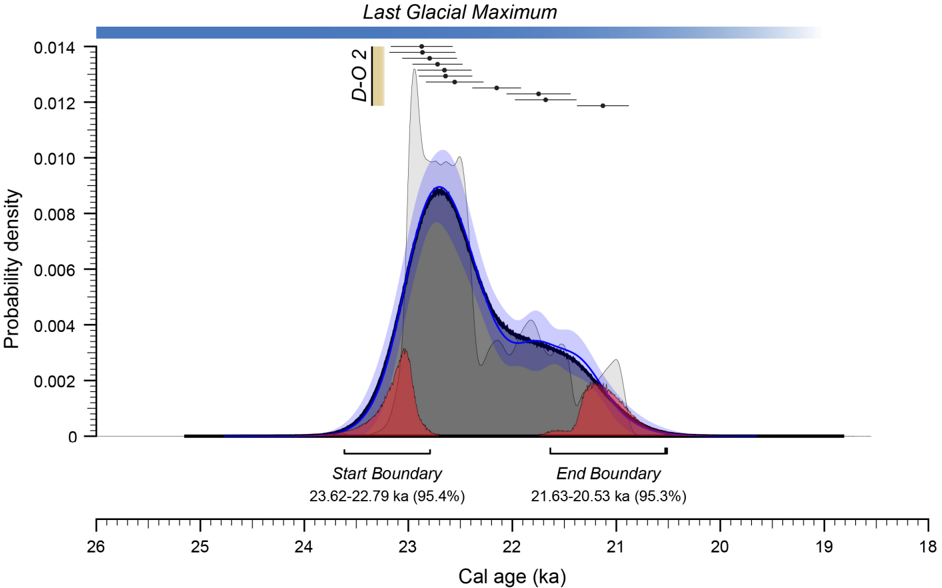
Early footsteps in the Americas: Despite a plethora of archaeological research over the past century, the timing of human migration into the Americas is still far from resolved. In a study of exposed outcrops of Lake Otero in White Sands National Park in New Mexico, Bennett et al . reveal numerous human footprints dating to about 23,000 to 21,000 years ago. These finds indicate the presence of humans in North America for approximately two millennia during the Last Glacial Maximum south of the migratory barrier created by the ice sheets to the north. This timing coincided with a Northern Hemispheric abrupt warming event, Dansgaard-Oeschger event 2, which drew down lake levels and allowed humans and megafauna to walk on newly exposed surfaces, creating tracks that became preserved in the geologic record. —AMS
Overview
CoChat Summary
TL;DR
In situ human footprints at White Sands National Park, New Mexico, are bracketed by calibrated 14C ages of ~23–21 ka, indicating human presence in North America during the Last Glacial Maximum. The authors report 61 human tracks across multiple horizons and argue this extends the temporal overlap between early inhabitants and Pleistocene megafauna.
Key findings
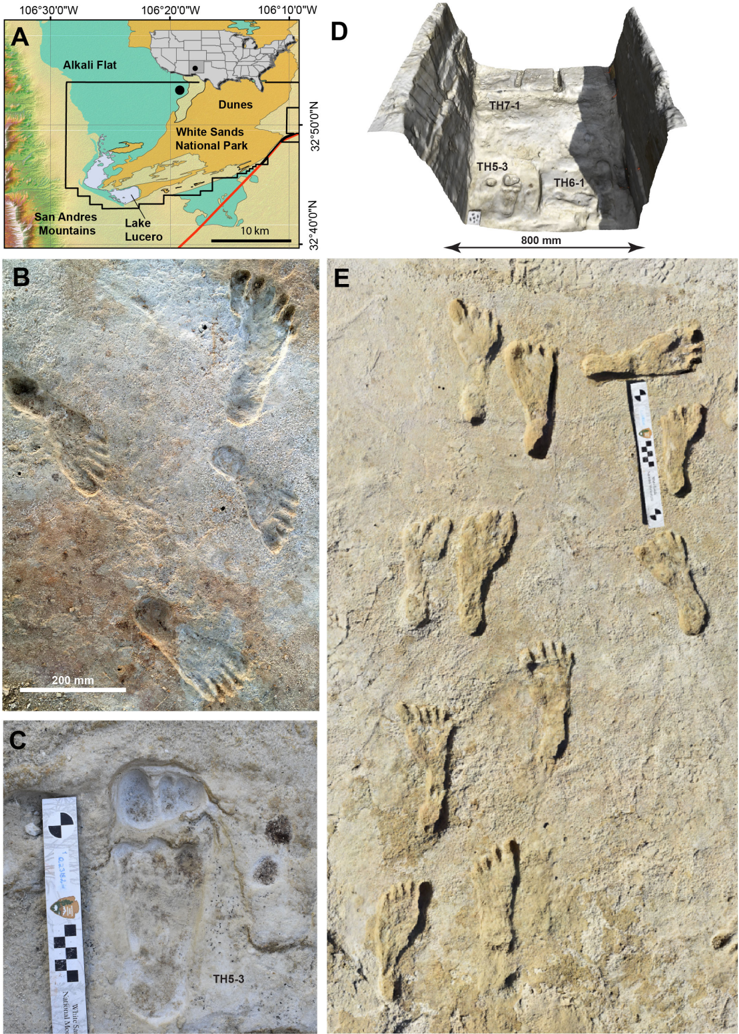
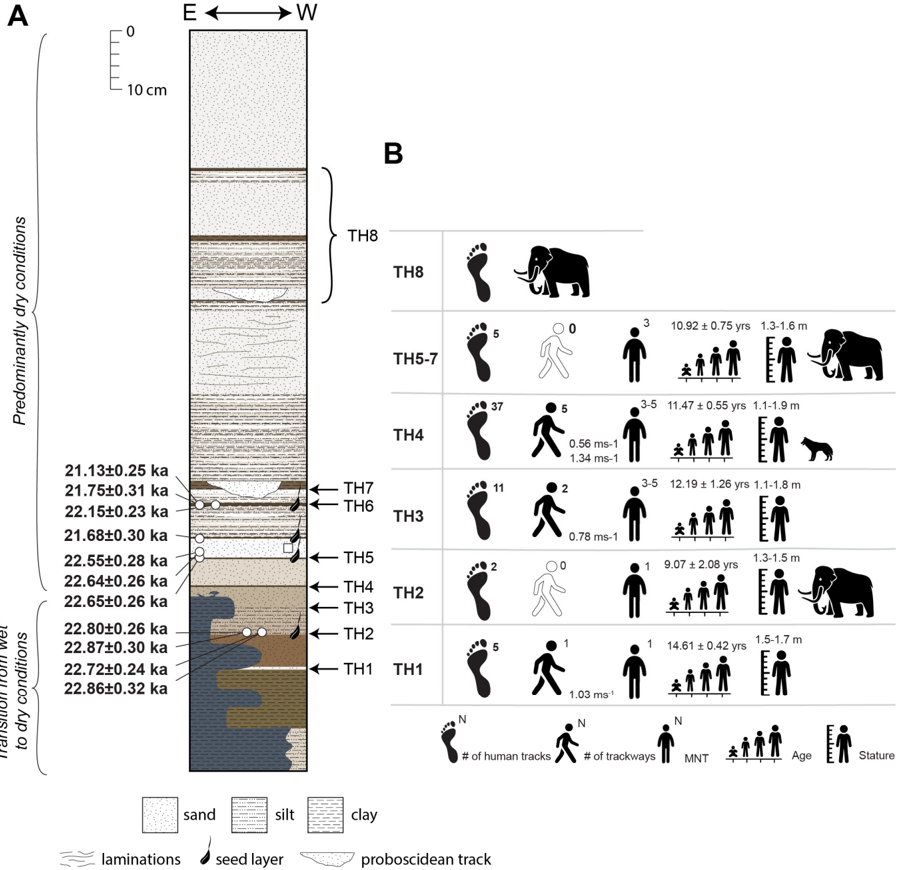
- 61 human tracks were documented at WHSA Locality 2 across seven footprint surfaces (TH1–TH7) and one multi-surface package (TH8); TH4 contains 37 tracks.
- Calibrated 14C ages from in situ *Ruppia cirrhosa* seed layers (N=11) range from 22.86 ± 0.32 to 21.13 ± 0.25 ka and maintain stratigraphic order between TH2 and TH6; KDE modeling places TH2–TH6 at ~23 to 21 ka, about two millennia during the LGM.
- Footprint anatomy is consistent with modern humans/*Hominipes modernus*; geomorphometric comparison with modern (N=356) and Namibian fossil (N=78) footprints shows broad similarity, with WHSA tracks flatter-footed and having longer toe pads.
- Proboscidean tracks in TH8 constrain the upper age to the late Pleistocene; human–megafauna overlap for at least two millennia suggests hunting, if present, was initially sustainable and raises a possible human role in extinctions previously thought to predate human arrival.
Methods
- Excavated in situ footprint-bearing sediments and trench stratigraphy at WHSA Locality 2; documented human tracks and compared their anatomy with *Hominipes modernus* and other Pleistocene/modern footprint samples.
- Radiocarbon dated in situ macroscopic seeds of the aquatic plant *Ruppia cirrhosa* sampled throughout the sequence; 11 calibrated ages were modeled with OxCal 4.4.2 KDE_Model, Boundary, and Interval functions using IntCal20; hard-water/reservoir effects were evaluated via geologic/hydrologic setting, stratigraphic order, and independent Tularosa Basin data.
- Geomorphometric comparison of WHSA tracks with modern (N=356) and fossil Namibian (N=78) footprints; stature, track-maker age, and walking-speed inferences were summarized from footprint dimensions.
Limitations
- Stated: stature, track-maker age, and walking-speed inferences require caution because the anthropometric affinity of the track-makers’ population is uncertain.
- Stated: radiocarbon dating of aquatic *Ruppia cirrhosa* may be subject to hard-water/reservoir effects that could make ages too old; the authors argue their chronology is robust, but this remains a potential caveat.
- Stated: the precise history of Lake Otero is not currently known, and exactly when people first arrived in the Western Hemisphere and when continuous occupation was established remain uncertain and contested. Evident from the text: demographic and behavioral interpretations (e.g., many tracks attributed to teenagers/children, division-of-labor hypothesis) are inferential from footprint evidence.
Model-written summary. Check it against the paper before relying on it.
Integrity signals
Registry
Cites
Statistics
Figures

Verification
Claims the paper makes
0 Valid · 0 Not valid · 15 Not checked · 25 Own results and interpretations
A result the paper reports from its own data — it cites no other source for it, so there is none to check. The quote shows it is in the paper.
In the paper
“A total of 61 human tracks have been identified and documented.”
plain- Asserted: passes — The authors put it forward as true.
- Checkable: passes — It can be checked against evidence.
- Load-bearing: unclear — It is unclear whether the paper’s conclusions depend on it.
- Based: passes — The paper gives a reason why it holds.
A result the paper states — it cites no source for it, so there is none to check. The quote shows it is in the paper.
In the paper
“This pattern is common to all excavated surfaces.”
plain- Asserted: passes — The authors put it forward as true.
- Checkable: passes — It can be checked against evidence.
- Load-bearing: unclear — It is unclear whether the paper’s conclusions depend on it.
- Based: unclear — It is unclear why the paper says it holds.
- Rests on an assumption not shown here.
A result the paper reports from its own data — it cites no other source for it, so there is none to check. The quote shows it is in the paper.
In the paper
“where multiple human footprints are stratigraphically constrained and bracketed by seed layers”
- Also stated in: § Main Text: · p. 2 · plain
“that occur on multiple stratigraphic horizons interbedded with seed layers”
plainstates an association- Asserted: passes — The authors put it forward as true.
- Checkable: passes — It can be checked against evidence.
- Load-bearing: passes — The paper’s conclusions depend on it.
- Based: passes — The paper gives a reason why it holds.
- Also stated in: § Main Text: · p. 2 · plain
A result the paper reports from its own data — it cites no other source for it, so there is none to check. The quote shows it is in the paper.
In the paper
“and maintain stratigraphic order within the uncertainties between TH2 and TH6 (Fig. 2)”
plainn = 11- Asserted: passes — The authors put it forward as true.
- Checkable: passes — It can be checked against evidence.
- Load-bearing: passes — The paper’s conclusions depend on it.
- Based: passes — The paper gives a reason why it holds.
A result the paper reports from its own data — it cites no other source for it, so there is none to check. The quote shows it is in the paper.
In the paper
“Footprints (humans, proboscidean, and canids) occur at all levels both in cross section and on excavated surfaces adjacent to the trench (Figs. 1B-E, 2, S4-S11).”
plain- Asserted: passes — The authors put it forward as true.
- Checkable: passes — It can be checked against evidence.
- Load-bearing: passes — The paper’s conclusions depend on it.
- Based: passes — The paper gives a reason why it holds.
22 more claims
Create a free account to see all 40 claims and to verify the 25 references still open.
- It may state two separate claims as one. 8
- Probably not a substantial claim. 8
Claims other papers make about this one
Each is checked against this paper’s own text: does it say what the citing paper says it does?
In the citing paper
“The recently reported discovery of footprints in sediments dating to 23–21 ka on an ancient lakeshore in New Mexico provides an unusually strong case for people in the Western Hemisphere during the LGM [82], although the dating has been disputed (e.g. [83]).”
From Beringia and the peopling of the Western Hemisphere (2023) · cites this paper as [82]
In the citing paper
“Seeds and pollen in the alluvium radiocarbon dated the track levels from ~23 ka to ~21 ka cal B.P. (1, 2).”
From Paleolake geochronology supports Last Glacial Maximum (LGM) age for human tracks at White Sands, New Mexico (2025) · cites this paper as [1]
In the citing paper
“WHSA Locality 2 is an archaeological site consisting of multiple, stratified human tracks and trackways found in stratified, low-energy, alluvial, and lake-margin deposits on the eastern side of paleolake Otero in the Tularosa Basin of southern New Mexico (1, 2).”
From Paleolake geochronology supports Last Glacial Maximum (LGM) age for human tracks at White Sands, New Mexico (2025) · cites this paper as [1]
In the citing paper
“Combined numerical age control from various studies of paleolake Otero suggests that it was a fluctuating shallow lake ~35 thousand years ago (ka ago) to ~12 thousand calibrated years before present (ka cal B.P.) (1, 15–18).”
From Paleolake geochronology supports Last Glacial Maximum (LGM) age for human tracks at White Sands, New Mexico (2025) · cites this paper as [1]
In the citing paper
“The human tracks in Locality 2 are in multiple layers of alluvium deposited along the margins of the paleolake.”
From Paleolake geochronology supports Last Glacial Maximum (LGM) age for human tracks at White Sands, New Mexico (2025) · cites this paper as [1]
20 more claims about this paper
Create a free account to see every claim other papers make about this one.
Citations
Cites
PAST: PALEONTOLOGICAL STATISTICAL SOFTWARE PACKAGE FOR EDUCATION AND DATA ANALYSIS
Hammer, Ø., Harper, D. A. T., & Ryan, P. D. (2001) · Palaeontologia Electronica · Cited by 17,871
(1985) · Academic Commons (Stony Brook University) · Cited by 12,330
Subcommission on geochronology: Convention on the use of decay constants in geo- and cosmochronology
Steiger, R. H., & Jäger, E. (1977) · Earth and Planetary Science Letters · doi:10.1016/0012-821x(77)90060-7 · Cited by 9,994
The IntCal20 Northern Hemisphere Radiocarbon Age Calibration Curve (0–55 cal kBP)
Reimer, P. J., Austin, W. E. N., Bard, E., Bayliss, A., Blackwell, P. G., Bronk Ramsey, C., Butzin, M., Cheng, H., Edwards, R. L., Friedrich, M., et al. (2020) · Radiocarbon · doi:10.1017/rdc.2020.41 · Cited by 7,900 · cited 1×
“4.2 ( 22, 23 ).”
InfluentialUser's Manual for Isoplot 3.00 - A Geochronological Toolkit for Microsoft Excel
Ludwig, K. R. (2003) · Cited by 7,734
Flexible paleoclimate age-depth models using an autoregressive gamma process
Blaauw, M., & Christen, J. A. (2011) · Bayesian Analysis · doi:10.1214/11-ba618 · Cited by 4,502
IsoplotR: A free and open toolbox for geochronology
Vermeesch, P. (2018) · Geoscience Frontiers · doi:10.1016/j.gsf.2018.04.001 · Cited by 3,537
Composition of the Continental Crust
Rudnick, R. L., & Gao, S. (2003) · Treatise on Geochemistry · doi:10.1016/b0-08-043751-6/03016-4 · Cited by 3,413
Clark, P. U., Dyke, A. S., Shakun, J. D., Carlson, A. E., Clark, J., Wohlfarth, B., Mitrovica, J. X., Hostetler, S. W., & McCabe, A. M. (2009) · Science · doi:10.1126/science.1172873 · Cited by 3,277
Cheng, H., Lawrence Edwards, R., Shen, C.-C., Polyak, V. J., Asmerom, Y., Woodhead, J., Hellstrom, J., Wang, Y., Kong, X., Spötl, C., et al. (2013) · Earth and Planetary Science Letters · doi:10.1016/j.epsl.2013.04.006 · Cited by 1,568
A 60 000 year Greenland stratigraphic ice core chronology
Svensson, A., Andersen, K. K., Bigler, M., Clausen, H. B., Dahl-Jensen, D., Davies, S. M., Johnsen, S. J., Muscheler, R., Parrenin, F., Rasmussen, S. O., et al. (2008) · Climate of the Past · doi:10.5194/cp-4-47-2008 · Cited by 1,109
de Onis, M., & Blössner, M. (2003) · International Journal of Epidemiology · doi:10.1093/ije/dyg099 · Cited by 701
Performance of catalytically condensed carbon for use in accelerator mass spectrometry
Vogel, J. S., Southon, J. R., Nelson, D. E., & Brown, T. A. (1984) · Nuclear Instruments and Methods in Physics Research Section B: Beam Interactions with Materials and Atoms · doi:10.1016/0168-583x(84)90529-9 · Cited by 695
Estimates of speeds of dinosaurs
ALEXANDER, R. M. (1976) · Nature · doi:10.1038/261129a0 · Cited by 636
WHO global database on child growth and malnutrition
de Onís, M., & Blössner, M. (1997) · World Health Organization eBooks · Cited by 631
Dalton, A. S., Margold, M., Stokes, C. R., Tarasov, L., Dyke, A. S., Adams, R. S., Allard, S., Arends, H. E., Atkinson, N., Attig, J. W., et al. (2020) · Quaternary Science Reviews · doi:10.1016/j.quascirev.2020.106223 · Cited by 374
Natale, V., & Rajagopalan, A. (2014) · BMJ Open · doi:10.1136/bmjopen-2013-003735 · Cited by 301
Early Hominin Foot Morphology Based on 1.5-Million-Year-Old Footprints from Ileret, Kenya
Bennett, M. R., Harris, J. W. K., Richmond, B. G., Braun, D. R., Mbua, E., Kiura, P., Olago, D., Kibunjia, M., Omuombo, C., Behrensmeyer, A. K., et al. (2009) · Science · doi:10.1126/science.1168132 · Cited by 272
Self-citationAdditional estimates of continental surface Precambrian shield composition in Canada
Shaw, D. M., Dostal, J., & Keays, R. R. (1976) · Geochimica et Cosmochimica Acta · doi:10.1016/0016-7037(76)90195-2 · Cited by 226
A standard protocol for documenting modern and fossil ichnological data
Falkingham, P. L., Bates, K. T., Avanzini, M., Bennett, M., Bordy, E. M., Breithaupt, B. H., Castanera, D., Citton, P., Díaz‐Martínez, I., Farlow, J. O., et al. (2018) · Palaeontology · doi:10.1111/pala.12373 · Cited by 226
Self-citationDelanghe, D., Bard, E., & Hamelin, B. (2002) · Marine Chemistry · doi:10.1016/s0304-4203(02)00100-7 · Cited by 189
Late Pleistocene exploration and settlement of the Americas by modern humans
Waters, M. R. (2019) · Science · doi:10.1126/science.aat5447 · Cited by 176
Hominin Footprints from Early Pleistocene Deposits at Happisburgh, UK
Ashton, N., Lewis, S. G., De Groote, I., Duffy, S. M., Bates, M., Bates, R., Hoare, P., Lewis, M., Parfitt, S. A., Peglar, S., et al. (2014) · PLoS ONE · doi:10.1371/journal.pone.0088329 · Cited by 176
Uranium-Series Ages of Pacific Atoll Coral
Thurber, D. L., Broecker, W. S., Blanchard, R. L., & Potratz, H. A. (1965) · Science · doi:10.1126/science.149.3679.55 · Cited by 158
Bison phylogeography constrains dispersal and viability of the Ice Free Corridor in western Canada
Heintzman, P. D., Froese, D., Ives, J. W., Soares, A. E. R., Zazula, G. D., Letts, B., Andrews, T. D., Driver, J. C., Hall, E., Hare, P. G., et al. (2016) · Proceedings of the National Academy of Sciences · doi:10.1073/pnas.1601077113 · Cited by 157
The timing and effect of the earliest human arrivals in North America
Becerra‐Valdivia, L., & Higham, T. (2020) · Nature · doi:10.1038/s41586-020-2491-6 · Cited by 146
Current evidence allows multiple models for the peopling of the Americas
Potter, B. A., Baichtal, J. F., Beaudoin, A. B., Fehren-Schmitz, L., Haynes, C. V., Holliday, V. T., Holmes, C. E., Ives, J. W., Kelly, R. L., Llamas, B., et al. (2018) · Science Advances · doi:10.1126/sciadv.aat5473 · Cited by 128
Self-citationAnthropometry of infants, children and youths to age 18 for product safety design
(1978) · Applied Ergonomics · doi:10.1016/0003-6870(78)90100-x · Cited by 126
Human Footprints: Fossilised Locomotion?
Bennett, M. R., & Morse, S. A. (2014) · Springer eBooks · doi:10.1007/978-3-319-08572-2 · Cited by 125
Self-citationStride length and speed for adults, children, and fossil hominids
Alexander, R. M. (1984) · American Journal of Physical Anthropology · doi:10.1002/ajpa.1330630105 · Cited by 123
Broughton, J. M., & Weitzel, E. M. (2018) · Nature Communications · doi:10.1038/s41467-018-07897-1 · Cited by 120
Lesnek, A. J., Briner, J. P., Lindqvist, C., Baichtal, J. F., & Heaton, T. H. (2018) · Science Advances · doi:10.1126/sciadv.aar5040 · Cited by 118
Overkill, glacial history, and the extinction of North America’s Ice Age megafauna
Meltzer, D. J. (2020) · Proceedings of the National Academy of Sciences · doi:10.1073/pnas.2015032117 · Cited by 108
The ‘Goldilocks’ effect: preservation bias in vertebrate track assemblages
Falkingham, P. L., Bates, K. T., Margetts, L., & Manning, P. L. (2011) · Journal of The Royal Society Interface · doi:10.1098/rsif.2010.0634 · Cited by 103
Holocene footprints in Namibia: The influence of substrate on footprint variability
Morse, S. A., Bennett, M. R., Liutkus-Pierce, C. M., Thackeray, F., McClymont, J. M., Savage, R., & Crompton, R. H. (2013) · American Journal of Physical Anthropology · doi:10.1002/ajpa.22276 · Cited by 102
Self-citationDingwall, H. L., Hatala, K. G., Wunderlich, R. E., & Richmond, B. G. (2013) · Journal of Human Evolution · doi:10.1016/j.jhevol.2013.02.004 · Cited by 102
Ludwig, K. R., Wallace, A. R., & Simmons, K. R. (1985) · Economic Geology · doi:10.2113/gsecongeo.80.7.1858 · Cited by 90
Pleistocene footprints show intensive use of lake margin habitats by Homo erectus groups
Roach, N. T., Hatala, K. G., Ostrofsky, K. R., Villmoare, B., Reeves, J. S., Du, A., Braun, D. R., Harris, J. W. K., Behrensmeyer, A. K., & Richmond, B. G. (2016) · Scientific Reports · doi:10.1038/srep26374 · Cited by 85
Footprints preserve terminal Pleistocene hunt? Human-sloth interactions in North America
Bustos, D., Jakeway, J., Urban, T. M., Holliday, V. T., Fenerty, B., Raichlen, D. A., Budka, M., Reynolds, S. C., Allen, B. D., Love, D. W., et al. (2018) · Science Advances · doi:10.1126/sciadv.aar7621 · Cited by 78
Self-citationDuveau, J., Berillon, G., Verna, C., Laisné, G., & Cliquet, D. (2019) · Proceedings of the National Academy of Sciences · doi:10.1073/pnas.1901789116 · Cited by 75
The Great Paleolithic War: How Science Forged an Understanding of America's Ice Age Past
Meltzer, D. J. (2015) · University of Chicago Press eBooks · doi:10.7208/chicago/9780226293363.001.0001 · Cited by 73
Anthropometric Survey (ANSUR) II Pilot Study: Methods and Summary Statistics
Paquette, S., Gordon, C. C., & Bradtmiller, B. (2009) · Cited by 71
The Pueblos. With comparative data on the bulk of the tribes of the Southwest and northern Mexico
Hrdlička, A. (1935) · American Journal of Physical Anthropology · doi:10.1002/ajpa.1330200302 · Cited by 70
Fladmark + 40: What Have We Learned about a Potential Pacific Coast Peopling of the Americas?
Braje, T. J., Erlandson, J. M., Rick, T. C., Davis, L., Dillehay, T., Fedje, D. W., Froese, D., Gusick, A., Mackie, Q., McLaren, D., et al. (2020) · American Antiquity · doi:10.1017/aaq.2019.80 · Cited by 69
Zhou, A., Chen, F., Wang, Z., Yang, M., Qiang, M., & Zhang, J. (2009) · Radiocarbon · doi:10.1017/s0033822200055909 · Cited by 68
The Laetoli footprints and early hominin locomotor kinematics
Raichlen, D. A., Pontzer, H., & Sockol, M. D. (2007) · Journal of Human Evolution · doi:10.1016/j.jhevol.2007.07.005 · Cited by 52
Bischoff, J. L., Rosenbauer, R. J., & Smith, G. I. (1985) · Science · doi:10.1126/science.227.4691.1222 · Cited by 52
The great Paleolithic war: how science forged an understanding of America's Ice Age past
(2016) · Choice Reviews Online · doi:10.5860/choice.196167 · Cited by 52
Holliday, V. T., Mayer, J. H., & Fredlund, G. G. (2008) · Quaternary Research · doi:10.1016/j.yqres.2008.02.009 · Cited by 50
Self-citationDynamic response of desert wetlands to abrupt climate change
Springer, K. B., Manker, C. R., & Pigati, J. S. (2015) · Proceedings of the National Academy of Sciences · doi:10.1073/pnas.1513352112 · Cited by 46
Self-citationWalking in mud: Remarkable Pleistocene human trackways from White Sands National Park (New Mexico)
Bennett, M. R., Bustos, D., Odess, D., Urban, T. M., Lallensack, J. N., Budka, M., Santucci, V. L., Martinez, P., Wiseman, A. L. A., & Reynolds, S. C. (2020) · Quaternary Science Reviews · doi:10.1016/j.quascirev.2020.106610 · Cited by 38
Self-citationHominid Ichnotaxonomy: An Exploration of a Neglected Discipline
Kim, J. Y., Kim, K. S., Lockley, M. G., & Matthews, N. (2008) · Ichnos · doi:10.1080/10420940802467868 · Cited by 37
Techniques for verifying human footprints: reappraisal of pre-Clovis footprints in Central Mexico
Morse, S. A., Bennett, M. R., González, S., & Huddart, D. (2010) · Quaternary Science Reviews · doi:10.1016/j.quascirev.2010.03.012 · Cited by 37
Self-citationHatala, K. G., Harcourt‐Smith, W. E. H., Gordon, A. D., Zimmer, B. W., Richmond, B. G., Pobiner, B. L., Green, D. J., Metallo, A., Rossi, V., & Liutkus-Pierce, C. M. (2020) · Scientific Reports · doi:10.1038/s41598-020-64095-0 · Cited by 36
Ancient human footprints in C iur‐ I zbuc C ave, R omania
Webb, D., Robu, M., Moldovan, O. T., Constantin, S., Tomus, B., & Neag, I. (2014) · American Journal of Physical Anthropology · doi:10.1002/ajpa.22561 · Cited by 32
Ferreira, A. A., Welch, J. R., da Cunha, G. M., & Coimbra, C. Ε. A. (2016) · Annals of Human Biology · doi:10.1080/03014460.2016.1195445 · Cited by 30
Geoarchaeology of the Boca Negra Wash Area, Albuquerque Basin, New Mexico, USA
Holliday, V. T., Huckell, B. B., Mayer, J. H., Forman, S. L., & McFadden, L. D. (2006) · Geoarchaeology · doi:10.1002/gea.20139 · Cited by 28
Self-citationAllen, B. D., Love, D. W., & Myers, R. G. (2009) · New Mexico Geology · doi:10.58799/nmg-v31n1.9 · Cited by 23
Contesting early archaeology in California
Ferraro, J. V., Binetti, K. M., Wiest, L. A., Esker, D., Baker, L. E., & Forman, S. L. (2018) · Nature · doi:10.1038/nature25165 · Cited by 22
Hominin tracks in southern Africa: a review and an approach to identification
Helm, C., Lockley, M. G., Cole, K., Noakes, T. D., & McCrea, R. T. (2019) · Cited by 22
Menking, K. M., Polyak, V. J., Anderson, R. Y., & Asmerom, Y. (2018) · Quaternary Science Reviews · doi:10.1016/j.quascirev.2018.09.030 · Cited by 20
Exceptional preservation of children’s footprints from a Holocene footprint site in Namibia
Bennett, M. R., Morse, S. A., Liutkus-Pierce, C. M., McClymont, J. M., Evans, M., Crompton, R. H., & Thackeray, F. (2014) · Journal of African Earth Sciences · doi:10.1016/j.jafrearsci.2014.05.015 · Cited by 20
Self-citationUrban, T. M., Bennett, M. R., Bustos, D., Manning, S. W., Reynolds, S. C., Belvedere, M., Odess, D., & Santucci, V. L. (2019) · Scientific Reports · doi:10.1038/s41598-019-52996-8 · Cited by 18
Self-citationNunataks and valley glaciers: Over the mountains and through the ice
Dawe, R. J., & Kornfeld, M. (2017) · Quaternary International · doi:10.1016/j.quaint.2017.03.062 · Cited by 16
Paleoindians, paleolakes and paleoplayas: Landscape geoarchaeology of the Tularosa Basin, New Mexico
Holliday, V. T., Harvey, A., Cuba, M. T., & Weber, A. M. (2018) · Geomorphology · doi:10.1016/j.geomorph.2018.08.012 · Cited by 15
Self-citationFiedel, S. J., Potter, B. A., Morrow, J. E., Faught, M. K., Vance Haynes, C., & Chatters, J. C. (2021) · PaleoAmerica · doi:10.1080/20555563.2020.1778416 · Cited by 12
From barefoot hunter gathering to shod pavement pounding. Where to from here? A narrative review
Francis, P., & Schofield, G. (2020) · BMJ Open Sport & Exercise Medicine · doi:10.1136/bmjsem-2019-000577 · Cited by 10
Digital Technology for Forensic Footwear Analysis and Vertebrate Ichnology
Bennett, M. R., & Budka, M. (2019) · doi:10.1007/978-3-319-93689-5 · Cited by 9
Self-citationInferences from Footprints: Archaeological Best Practice
Bennett, M. R., & Reynolds, S. C. (2021) · Springer eBooks · doi:10.1007/978-3-030-60406-6_2 · Cited by 7
Self-citationEvidence of humans in North America during the Last Glacial Maximum: 3D Track Data
Bennett (2021) · Bournemouth University Research Online (Bournemouth University) · doi:10.18746/bmth.data.00000186
Data release for Evidence of humans in North America during the Last Glacial Maximum
Bennett, M. R., Bustos, D. F., Pigati, J. S., Springer, K. B., Urban, T. M., Holliday, V. T., Reynolds, S. C., Budka, M., Honke, J. S., Fenerty, B., et al. (2021) · USGS DOI Tool Production Environment · doi:10.5066/p9abzem9
Self-citation
Research works printed but not linked: 2
- R. H. Tuttle in Laetoli: A Pliocene Site in Northern Tanzania M. D. Leakey J. M. Harris Eds. (Clarendon Press 1987) pp. 60–65.
- R. R. Haynes, The aquatic vascular flora of the southeastern United States: Endemism and origins. Sida. Bot. Miscellany 18, 23–28 (2000).
Cited by
Dalton, A. S., Stokes, C. R., & Batchelor, C. L. (2022) · Earth-Science Reviews · doi:10.1016/j.earscirev.2021.103875 · Cited by 104
Bergman, J., Pedersen, R. Ø., Lundgren, E. J., Lemoine, R. T., Monsarrat, S., Pearce, E. A., Schierup, M. H., & Svenning, J. (2023) · Nature Communications · doi:10.1038/s41467-023-43426-5 · Cited by 101
Megafauna extinctions in the late-Quaternary are linked to human range expansion, not climate change
Lemoine, R. T., Buitenwerf, R., & Svenning, J. (2023) · Anthropocene · doi:10.1016/j.ancene.2023.100403 · Cited by 78
Independent age estimates resolve the controversy of ancient human footprints at White Sands
Pigati, J. S., Springer, K. B., Honke, J. S., Wahl, D., Champagne, M. R., Zimmerman, S. R. H., Gray, H. J., Santucci, V. L., Odess, D., Bustos, D., et al. (2023) · Science · doi:10.1126/science.adh5007 · Cited by 68
Self-citationThe Bering Strait was flooded 10,000 years before the Last Glacial Maximum
Farmer, J. R., Pico, T., Underwood, O. M., Stout, R. C., Granger, J., Cronin, T. M., Fripiat, F., Martínez‐García, A., Haug, G. H., & Sigman, D. M. (2022) · Proceedings of the National Academy of Sciences · doi:10.1073/pnas.2206742119 · Cited by 68
Metadata
- Authors
- Bennett, M. R., Bustos, D., Pigati, J. S., Springer, K. B., Urban, T. M., Holliday, V. T., Reynolds, S. C., Budka, M., Honke, J. S., Hudson, A. M., Fenerty, B., Connelly, C., Martinez, P. J., Santucci, V. L., & Odess, D.
- Affiliations
- Bournemouth University (GB)
- National Park Service (US)
- United States Geological Survey (US)
- Cornell University (US)
- University of Arizona (US)
- Corresponding author
- Bennett, Matthew R.
- Odess, Daniel
- ORCID
- Venue
- Science
- Published
- 2021-09-24
- Volume
- 373
- Issue
- 6562
- Pages
- 1528-1531
- ISSN
- 0036-8075 (ISSN-L)
- 1095-9203
- OpenAlex
- W3200576454
- Cited by
- 239
- References
- 69
- Citations by year
- 2026: 33 · 2025: 38 · 2024: 39 · 2023: 48 · 2022: 71 · 2021: 10
- FWCI
- 63.56
- Type
- journal article
- Language
- en
- Open access
- Locations
- Science (publishedVersion)
- PubMed (publishedVersion)
- Bournemouth University Research Online (Bournemouth University) (acceptedVersion)
- UA Campus Repository (The University of Arizona) (acceptedVersion)
- Funders
- U.S. Department of the Interior
- University of Arizona Foundation
- Western National Parks Association
- U.S. Geological Survey
- National Park Service
- Natural Environment Research Council (NE/M021459/1, NE/H004246/1)
- Topics
- Social Sciences › Anthropology › Pleistocene-Era Hominins and Archaeology
- Social Sciences › Archeology › Archaeology and ancient environmental studies
- Physical Sciences › Earth and Planetary Sciences › Atmospheric Science › Geology and Paleoclimatology Research
- Keywords
- Last Glacial Maximum, human footprint, radiocarbon dating, seed layer, Pleistocene megafauna, stratigraphic context
- MeSH terms
- Foot, Fossils, Humans, New Mexico, North America, Geologic Sediments, Ice Cover, History, Ancient, Climate Change, Human Migration
About these checks
Registry, retraction, Cites and statistics results are computed, not judged, with one exception: a printed reference that no index lists is read once by a model before it counts as a citation error. Claims are extracted by a model and kept only when their quote appears verbatim in the text; each cited source is then checked, with a model’s help, for whether it says what the claim relies on. Those verdicts can be wrong — read the claim’s quote and the cited source before relying on one.
A language model drew the claims from the paper on 2026-11-23, under version 3 of the claim definition (model deepseek-v4.1-flash, prompt extract-v3).
A second model labelled each claim on 2026-11-23 (model jev-1.13-20260917, definition revision gold-guideline-v0.2).
Statistics and arithmetic are recomputed, not judged.
Confidence bands are shown only for fields calibrated on our annotated test set. None is calibrated yet, so no band is shown.
What counts as a claim ›How we measure confidence ›How we check this ›
Are you an author, or do you see a problem with this page? Request a review
Data sources
Bibliographic data: Semantic Scholar, OpenAlex, Crossref.
Contains information from the Semantic Scholar Academic Graph Datasets, made available under the ODC Attribution License (ODC-BY 1.0).
Semantic Scholar’s data is described in: Kinney, R., et al. (2023). The Semantic Scholar Open Data Platform. arXiv:2301.10140.
