

The Candida albicans toxin candidalysin mediates distinct epithelial inflammatory responses through p38 and EGFR-ERK pathways
Open accessThe DOI matches its Crossref record; 97 of the 97 references it cites were found in a registry or an index.
Abstract
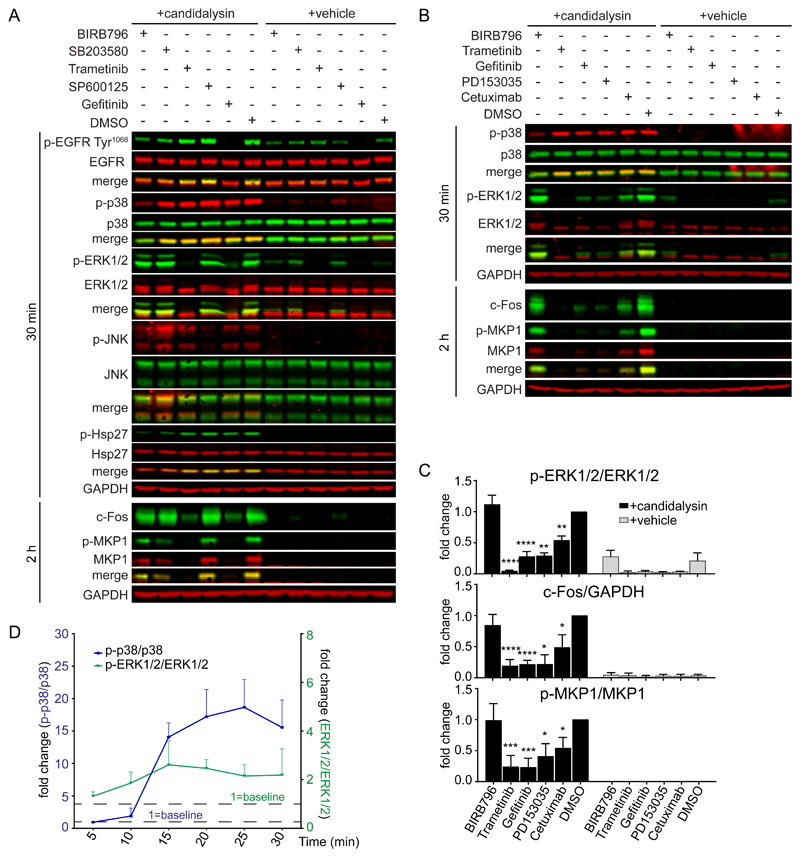
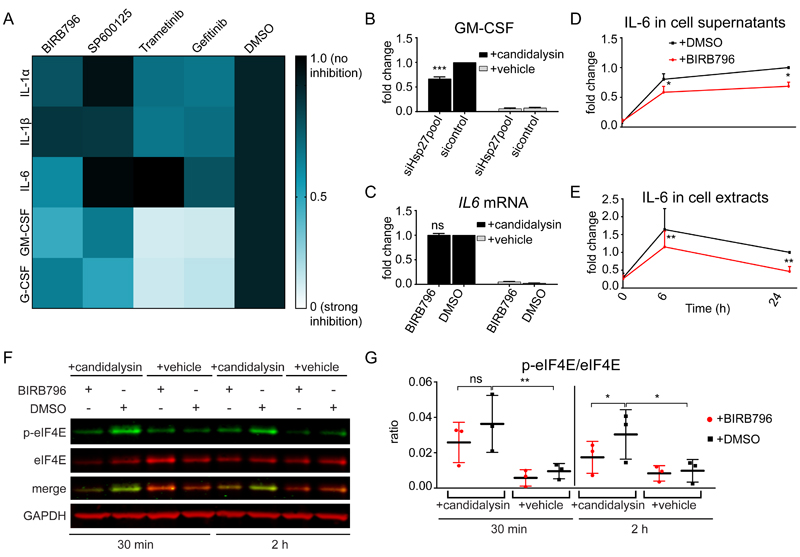
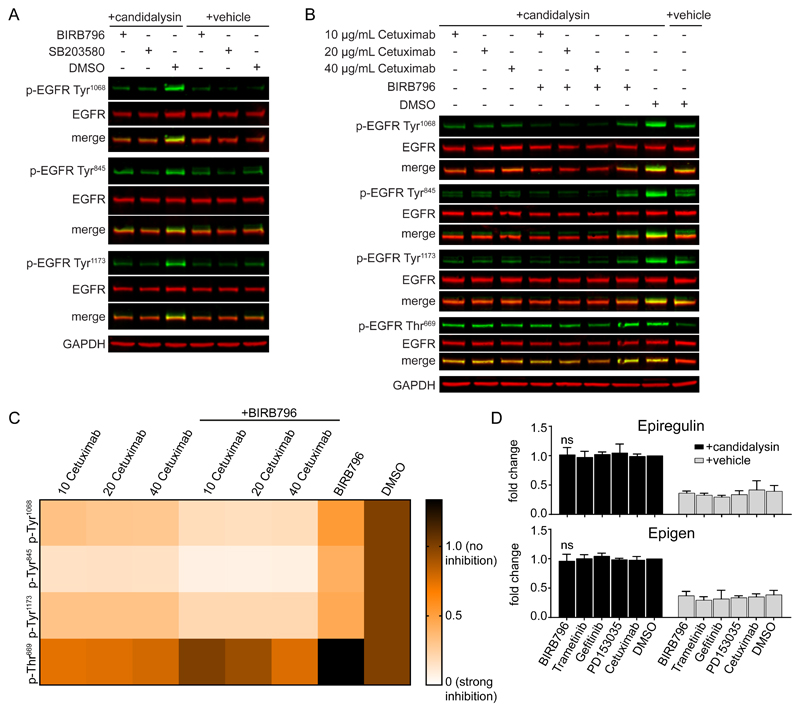
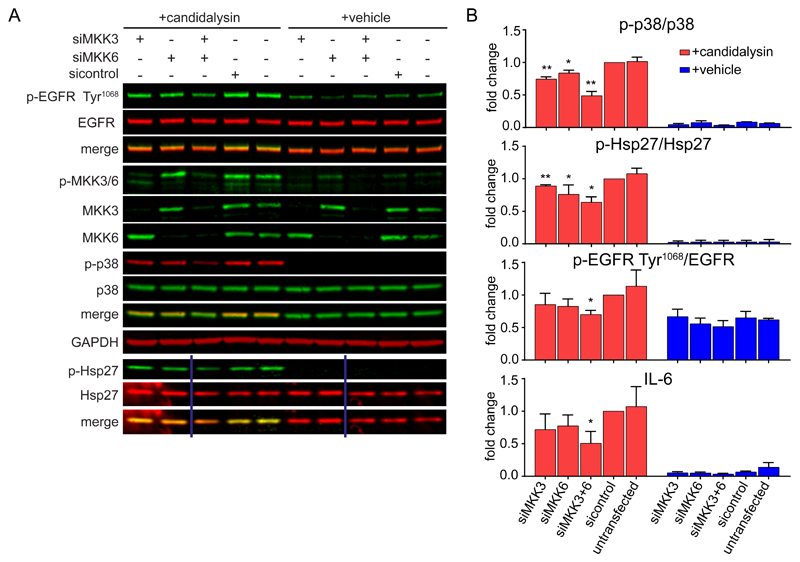
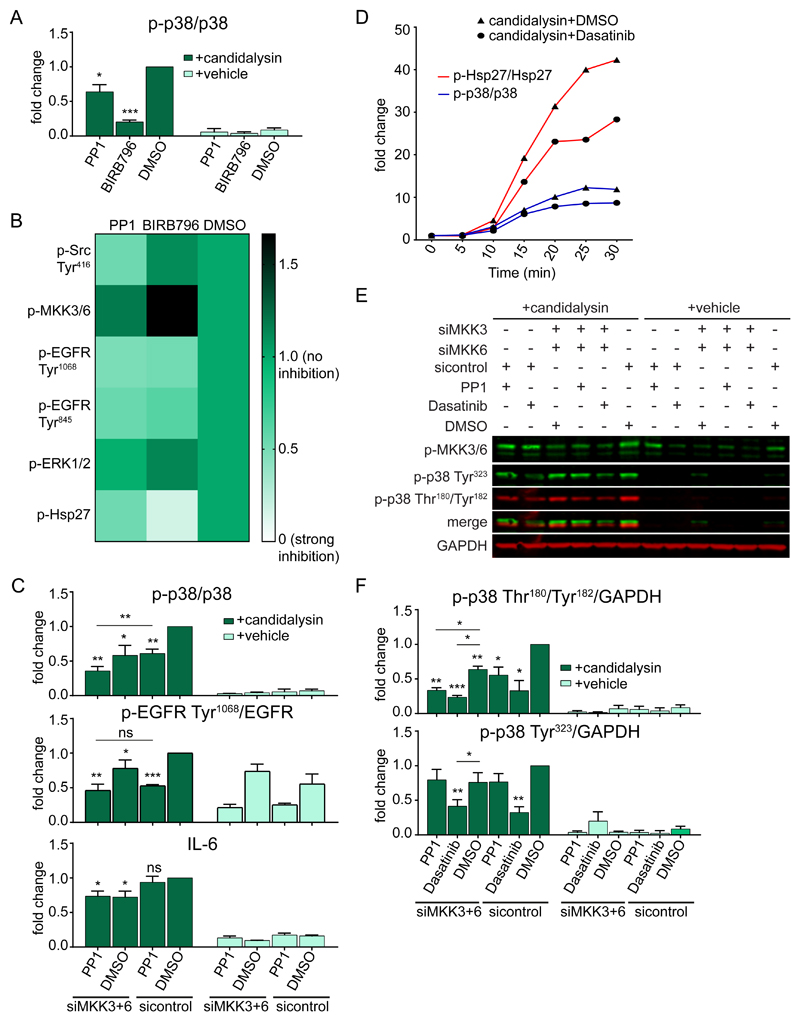
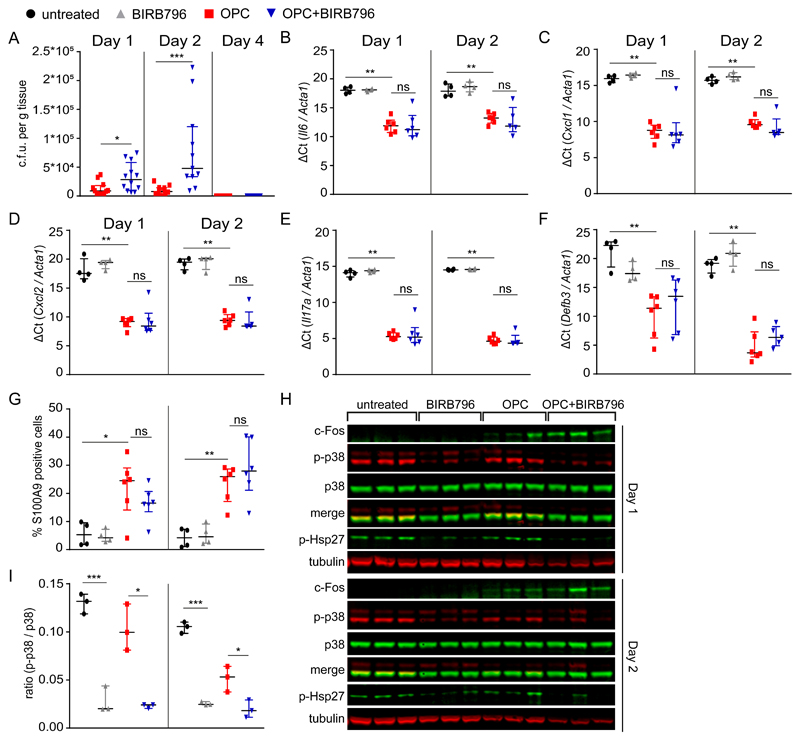
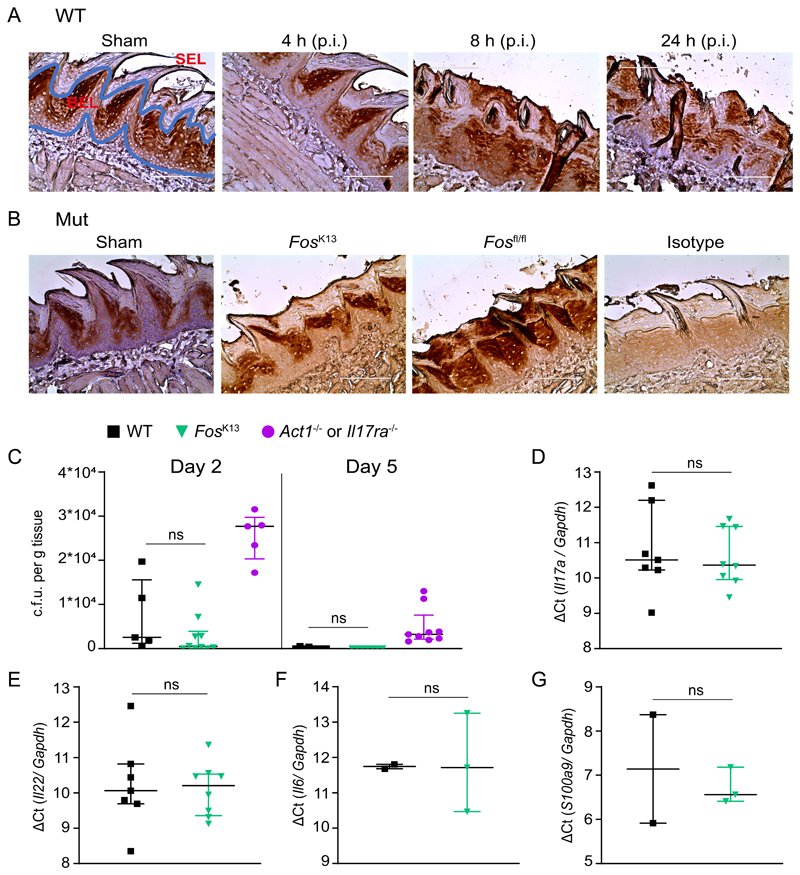
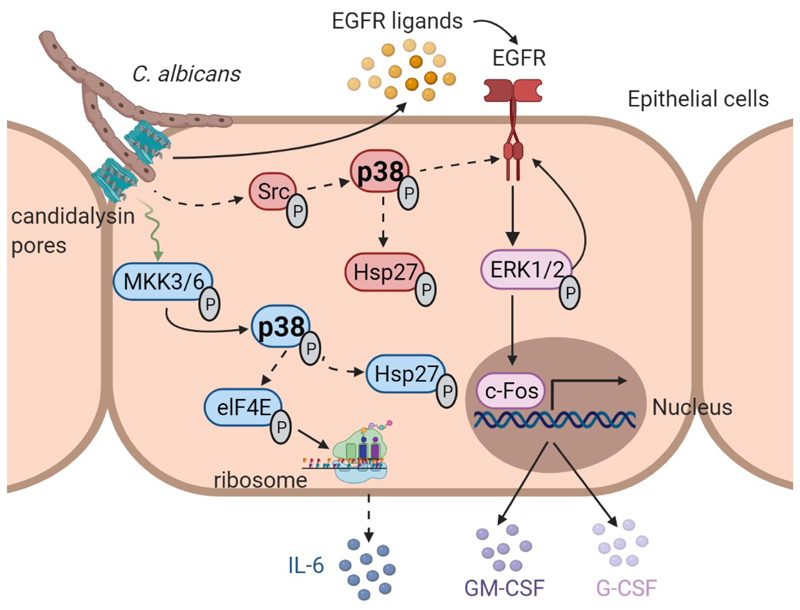
The fungal pathogen Candida albicans secretes the peptide toxin candidalysin, which damages epithelial cells and drives an innate inflammatory response mediated by the epidermal growth factor receptor (EGFR) and mitogen-activated protein kinase (MAPK) pathways and the transcription factor c-Fos. In cultured oral epithelial cells, candidalysin activated the MAPK p38, which resulted in heat shock protein 27 (Hsp27) activation, IL-6 release, and EGFR phosphorylation without affecting the induction of c-Fos. p38 activation was not triggered by EGFR but by two nonredundant pathways involving MAPK kinases (MKKs) and the kinase Src, which differentially controlled p38 signaling outputs. Whereas MKKs mainly promoted p38-dependent release of IL-6, Src promoted p38-mediated phosphorylation of EGFR in a ligand-independent fashion. In parallel, candidalysin also activated the EGFR-ERK pathway in a ligand-dependent manner, resulting in c-Fos activation and release of the neutrophil-activating chemokines G-CSF and GM-CSF. In mice, early clearance events of oral C. albicans infection required p38 but not c-Fos. These findings delineate how candidalysin activates the pathways downstream of the MAPKs p38 and ERK that differentially contribute to immune activation during C. albicans infection.
Overview
The claims and statistics of this paper haven’t been checked yet.
Free: it reads the open-access text and checks the first 5 claims that cite a source we can check. Create a free account to check every claim.
Integrity signals
Registry
Cites
Statistics
Figures
Verification
Claims the paper makes
The claims and statistics of this paper haven’t been checked yet.
Free: it reads the open-access text and checks the first 5 claims that cite a source we can check. Create a free account to check every claim.
Self-check
Percentages, sums and reported differences re-computed from the paper’s own numbers.
The self-check needs the paper’s full text.
Citations
Cites
QuPath: Open source software for digital pathology image analysis
Bankhead, P., Loughrey, M. B., Fernández, J. A., Dombrowski, Y., McArt, D. G., Dunne, P. D., McQuaid, S., Gray, R. T., Murray, L. J., Coleman, H. G., et al. (2017) · Scientific Reports · doi:10.1038/s41598-017-17204-5 · Cited by 8,908
Hidden Killers: Human Fungal Infections
Brown, G. D., Denning, D. W., Gow, N. A. R., Levitz, S. M., Netea, M. G., & White, T. C. (2012) · Science Translational Medicine · doi:10.1126/scitranslmed.3004404 · Cited by 4,284
Activation and function of the MAPKs and their substrates, the MAPK-activated protein kinases
Cargnello, M., & Roux, P. P. (2011) · Microbiology and Molecular Biology Reviews · doi:10.1128/mmbr.00031-10 · Cited by 3,274
CELLULAR FUNCTIONS REGULATED BY SRC FAMILY KINASES
Thomas, S. M., & Brugge, J. S. (1997) · Annual Review of Cell and Developmental Biology · doi:10.1146/annurev.cellbio.13.1.513 · Cited by 2,498 · cited 1×
“In addition, phosphorylation of SFKs at a canonical site in the Src activation loop, Tyr416, (55) did not occur following candidalysin stimulation (fig.”
BackgroundOlayioye, M. A. (2000) · The EMBO Journal · doi:10.1093/emboj/19.13.3159 · Cited by 2,434 · cited 1×
“Tyr1068 and Tyr1173 are autophosphorylation sites, and attenuation of their phosphorylation by p38 inhibitors indicates that p38 may modulate EGFR dimer formation (39,78) or EGFR trafficking (78).”
Epidermal Growth Factor Receptor Cell Proliferation Signaling Pathways
Wee, P., & Wang, Z. (2017) · Cancers · doi:10.3390/cancers9050052 · Cited by 2,027 · cited 1×
“However, although activation of MAPK cascades is highly complex and interconnected (25, 26), EGFR is generally considered to activate the ERK1/2 pathway and not p38, whereas p38 can signal upstream of EGFR (27, 28).”
BackgroundActivation and signaling of the p38 MAP kinase pathway
ZARUBIN, T., & HAN, J. (2005) · Cell Research · doi:10.1038/sj.cr.7290257 · Cited by 1,707
ERK1/2 MAP kinases: Structure, function, and regulation
Roskoski, R. (2012) · Pharmacological Research · doi:10.1016/j.phrs.2012.04.005 · Cited by 1,650 · cited 1×
“MNK1/2 can be phosphorylated by both p38 and ERK1/2 (73); however, ERK1/2 inhibition had no effect on IL-6 release, indicating that MNK1/2 are not involved in IL-6 release by candidalysin.”
BackgroundIndependent Human MAP-Kinase Signal Transduction Pathways Defined by MEK and MKK Isoforms
Dérijard, B., Raingeaud, J., Barrett, T., Wu, I.-H., Han, J., Ulevitch, R. J., & Davis, R. J. (1995) · Science · doi:10.1126/science.7839144 · Cited by 1,555
Targeting PI3K/Akt/mTOR Signaling in Cancer
Porta, C., Paglino, C., & Mosca, A. (2014) · Frontiers in Oncology · doi:10.3389/fonc.2014.00064 · Cited by 1,485
Research works printed but not linked: 1
- Mikami F Epidermal growth factor receptor acts as a negative regulator for bacterium nontypeable Haemophilus influenzae-induced Toll-like receptor 2 expression via an Src-dependent p38 mitogen-activated protein kinase signaling pathway J Biol Chem 2005 280 36185 36194 16115866
Cited by
Commensalism and pathogenesis of Candida albicans at the mucosal interface
Schille, T. B., Sprague, J. L., Naglik, J. R., Brunke, S., & Hube, B. (2025) · Nature Reviews Microbiology · doi:10.1038/s41579-025-01174-x · Cited by 88
Self-citationIs Candida albicans a contributor to cancer? A critical review based on the current evidence
Wang, X., Zhang, W., Wu, W., Wu, S., Young, A., & Yan, Z. (2023) · Microbiological Research · doi:10.1016/j.micres.2023.127370 · Cited by 44
Talapko, J., Meštrović, T., Dmitrović, B., Juzbašić, M., Matijević, T., Bekić, S., Erić, S., Flam, J., Belić, D., Erić, A. P., et al. (2023) · Microorganisms · doi:10.3390/microorganisms11061476 · Cited by 47
PIEZO1 activates non-canonical EGFR internalization and signaling
Pardo-Pastor, C., & Rosenblatt, J. (2023) · Science Advances · doi:10.1126/sciadv.adi1328 · Cited by 42
“This could expand previous findings that SFKs activate p38 in response to radiation and to Candida infections to promote survival and infection clearance (58, 59), respectively, via ligand independent EGFR signaling.”
Sprague, J. L., Schille, T. B., Allert, S., Trümper, V., Lier, A., Großmann, P., Priest, E. L., Tsavou, A., Panagiotou, G., Naglik, J. R., et al. (2024) · PLoS Pathogens · doi:10.1371/journal.ppat.1012031 · Cited by 38
Self-citation
Metadata
- Authors
- Nikou, S.-A., Zhou, C., Griffiths, J. S., Kotowicz, N. K., Coleman, B. M., Green, M. J., Moyes, D. L., Gaffen, S. L., Naglik, J. R., & Parker, P. J.
- Affiliations
- King's College London (GB)
- University of Pittsburgh (US)
- The Francis Crick Institute (GB)
- Corresponding author
- Naglik, Julian R.
- Parker, Peter J.
- ORCID
- Venue
- Science Signaling
- Published
- 2022-04-05
- Volume
- 15
- Issue
- 728
- Pages
- eabj6915-eabj6915
- ISSN
- 1937-9145 (ISSN-L)
- 1945-0877
- PMC
- PMC7612652
- OpenAlex
- W4224015814
- Cited by
- 65
- References
- 96
- Citations by year
- 2026: 15 · 2025: 21 · 2024: 15 · 2023: 11 · 2022: 3
- FWCI
- 6.11
- Type
- journal article
- Language
- en
- Open access
- hybrid
- doi.org
- Licence
- cc-by
- Locations
- Science Signaling (publishedVersion, cc-by)
- PubMed (publishedVersion)
- PubMed Central (acceptedVersion, cc-by)
- Funders
- Wellcome Trust (FC001130, 214229/Z/18/Z, 214229)
- Francis Crick Institute (10009, CC1061, 10130)
- Cancer Research UK (FC001130)
- National Institute for Health and Care Research (IS‐BRC-1215‐20006)
- National Institutes of Health (5r37de022550-12)
- National Institute of Dental and Craniofacial Research (R37-DE022550, R01DE022550)
- Topics
- Health Sciences › Medicine › Infectious Diseases › Antifungal resistance and susceptibility
- Life Sciences › Biochemistry, Genetics and Molecular Biology › Molecular Biology › Fungal and yeast genetics research
- Life Sciences › Biochemistry, Genetics and Molecular Biology › Molecular Biology › Protein Kinase Regulation and GTPase Signaling
- Keywords
- Candida albicans, candidalysin, mycotoxins, epithelial inflammation, p38 MAPK, c-fos, HSP27, interleukin-6, granulocyte colony-stimulating factor, GM-CSF, MAPK kinase, Src kinase, oral epithelial cells, innate immune response, neutrophil activation, oral candidiasis
- MeSH terms
- Animals, Candida albicans, Fungal Proteins, Phosphorylation, MAP Kinase Signaling System, p38 Mitogen-Activated Protein Kinases, Mice, ErbB Receptors
About these checks
Registry, retraction, Cites and statistics results are computed, not judged, with one exception: a printed reference that no index lists is read once by a model before it counts as a citation error. Claims are extracted by a model and kept only when their quote appears verbatim in the text; each cited source is then checked, with a model’s help, for whether it says what the claim relies on. Those verdicts can be wrong — read the claim’s quote and the cited source before relying on one.
Statistics and arithmetic are recomputed, not judged.
Confidence bands are shown only for fields calibrated on our annotated test set. None is calibrated yet, so no band is shown.
What counts as a claim ›How we measure confidence ›How we check this ›
Are you an author, or do you see a problem with this page? Request a review
How to cite
Cite CoChat for the checks on this page, and the paper for its own findings.
- This page
- CoChat. (2026). Citation check: The Candida albicans toxin candidalysin mediates distinct epithelial inflammatory responses through p38 and EGFR-ERK pathways. https://app.cochat.ai/papers/10.1126/scisignal.abj6915
- The paper
- Nikou, S.-A., Zhou, C., Griffiths, J. S., Kotowicz, N. K., Coleman, B. M., Green, M. J., Moyes, D. L., Gaffen, S. L., Naglik, J. R., & Parker, P. J. (2022). The Candida albicans toxin candidalysin mediates distinct epithelial inflammatory responses through p38 and EGFR-ERK pathways. Science Signaling. https://doi.org/10.1126/scisignal.abj6915
Data sources
Bibliographic data: Semantic Scholar, OpenAlex, Crossref.
Contains information from the Semantic Scholar Academic Graph Datasets, made available under the ODC Attribution License (ODC-BY 1.0).
Semantic Scholar’s data is described in: Kinney, R., et al. (2023). The Semantic Scholar Open Data Platform. arXiv:2301.10140.
