

SCY-078 Is Fungicidal against Candida Species in Time-Kill Studies
Open accessThe DOI matches its Crossref record; 19 of the 19 references it cites were found in a registry or an index.
Abstract
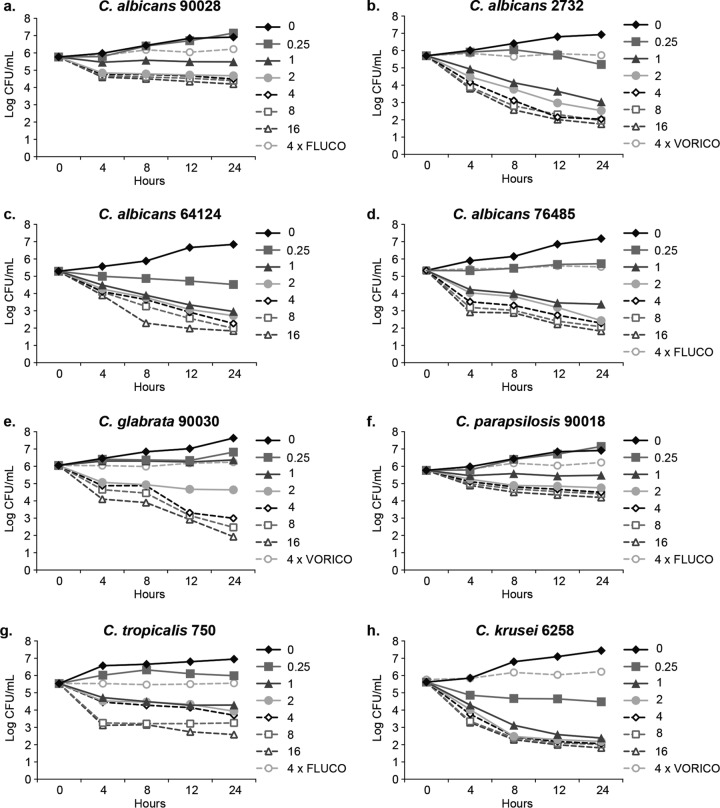
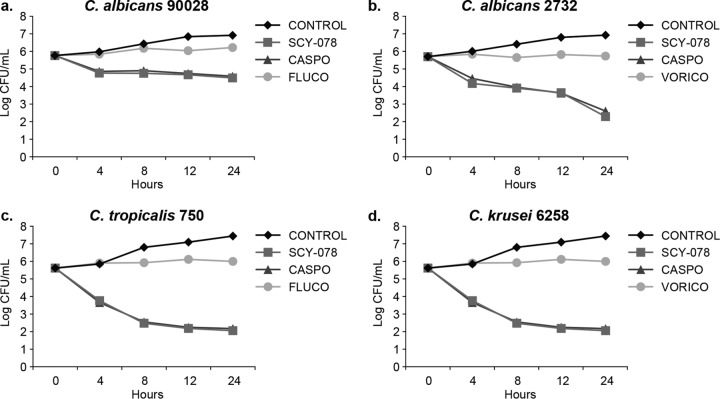
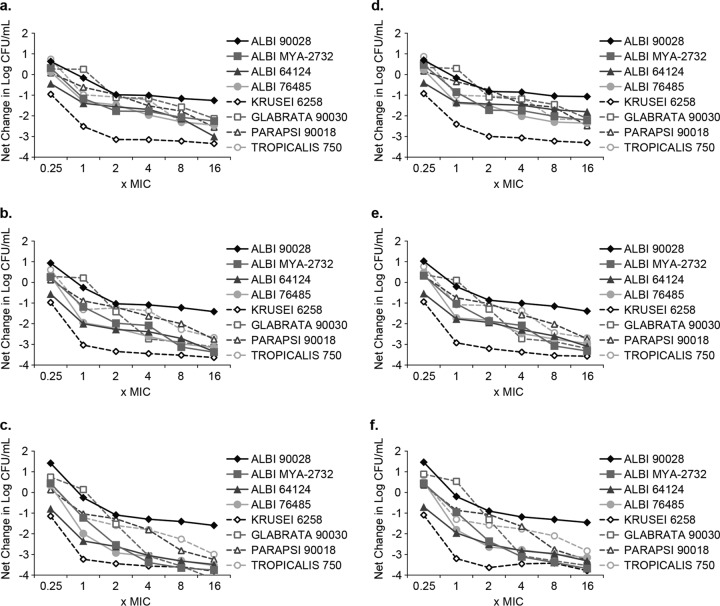
SCY-078 is an orally bioavailable ß-1,3-glucan synthesis inhibitor (GSI) and the first-in-class of structurally novel triterpene antifungals in clinical development for treating candidemia and invasive candidiasis. In vitro susceptibilities by broth microdilution, antifungal carryover, and time-kill dynamics were determined for three reference (ATCC) strains ( Candida albicans 90028, Candida parapsilosis 90018, and Candida tropicalis 750), a quality-control (QC) strain ( Candida krusei 6258), and four other strains ( C. albicans MYA-2732, 64124, and 76485 and Candida glabrata 90030). Caspofungin (CASP), fluconazole (FLC), and voriconazole (VRC) were comparators. For time-kill experiments, SCY-078 and CASP were evaluated at 0.25, 1, 2, 4, 8, and 16 times the MIC 80 , and FLU and VRC were evaluated at 4× MIC 80 . The time to reach 50%, 90%, and 99.9% reduction in the number of CFUs from the starting inoculum was determined. Net change in the number of CFU per milliliter was used to determine 50% and 90% effective concentrations and maximum effect (EC 50 , EC 90 , and E max , respectively). The SCY-078 MIC range was between 0.0625 and 1 μg/ml and generally similar to that of CASP. Antifungal carryover was not observed for SCY-078. SCY-078 was fungicidal against seven isolates at ≥4× MIC (kill of ≥3 log 10 ) and achieved a 1.7-log 10 reduction in CFU count/milliliter against C. albicans 90028. CASP behaved similarly against each isolate and achieved a 1.5-log 10 reduction in the number of CFU/milliliter against C. albicans 90028. Reductions of 50% in CFU count/milliliter were achieved rapidly (1 to 2.8 h); fungicidal endpoints were reached at 12.1 to 21.8 h at ≥4× MIC. EC 90 was reached at ∼5× MIC at each time point to 24 h. The EC 50 and EC 90 values were generally similar (8 to 24 h). Time-kill behavior of CASP was similar to that of SCY-078. FLC and VRC were fungistatic. Overall, SCY-078 has primarily fungicidal activity against Candida spp. and behaved comparably to CASP.
Overview
The claims and statistics of this paper haven’t been checked yet.
Free: it reads the open-access text and checks the first 5 claims that cite a source we can check. Create a free account to check every claim.
Integrity signals
Registry
Cites
Statistics
Figures
Verification
Claims the paper makes
The claims and statistics of this paper haven’t been checked yet.
Free: it reads the open-access text and checks the first 5 claims that cite a source we can check. Create a free account to check every claim.
Claims other papers make about this one
Each is checked against this paper’s own text: does it say what the citing paper says it does?
The cited source says what the claim attributes to it.
In the citing paper
“In time-to-kill experiments, ibrexafungerp showed mainly fungicidal activity against Candida albicans and non-albicans isolates (Scorneaux et al., 2017).”
From Fungal Cell Wall: Emerging Antifungals and Drug Resistance. (2019) · cites this paper as Scorneaux et al., 2017
Self-check
Percentages, sums and reported differences re-computed from the paper’s own numbers.
The self-check needs the paper’s full text.
Citations
Cites
Antibiotic resistance threats in the United States, 2019
(U.S.), C. F. D. C. A. P. (2019) · doi:10.15620/cdc:82532 · Cited by 5,782
Antifungal drug resistance: mechanisms, epidemiology, and consequences for treatment
Pfaller, M. A. (2012) · The American Journal of Medicine · doi:10.1016/j.amjmed.2011.11.001 · Cited by 903
Nosocomial fungal infections: epidemiology, diagnosis, and treatment
Perlroth, J., Choi, B., & Spellberg, B. (2007) · Medical Mycology · doi:10.1080/13693780701218689 · Cited by 738 · cited 2×
“, amphotericin B) are associated with high rates of toxicity and side effects, and drug-drug interactions are a major disadvantage of the azoles (1, 4).”
BackgroundResultEchinocandin resistance: an emerging clinical problem?
Arendrup, M. C., & Perlin, D. S. (2014) · Current Opinion in Infectious Diseases · doi:10.1097/qco.0000000000000111 · Cited by 299 · cited 1×
“Candida resistance to echinocandins has emerged over recent years and is most commonly associated with Candida glabrata, with resistance rates of 10% at selected institutions (7).”
BackgroundPatients at High Risk of Invasive Fungal Infections: When and How to Treat
Rüping, M. J. G. T., Vehreschild, J. J., & Cornely, O. A. (2008) · Drugs · doi:10.2165/00003495-200868140-00002 · Cited by 253
Guery, B. P., Arendrup, M. C., Auzinger, G., Azoulay, É., Borges Sá, M., Johnson, E. M., Müller, E., Putensen, C., Rotstein, C., Sganga, G., et al. (2009) · Intensive Care Medicine · doi:10.1007/s00134-008-1338-7 · Cited by 173
In vitro pharmacodynamic properties of MK-0991 determined by time-kill methods
Ernst, E. J., Klepser, M. E., Ernst, M. E., Messer, S. A., & Pfaller, M. A. (1999) · Diagnostic Microbiology and Infectious Disease · doi:10.1016/s0732-8893(98)00130-8 · Cited by 158
Ernst, E. J., Roling, E. E., Petzold, C. R., Keele, D. J., & Klepser, M. E. (2002) · Antimicrobial Agents and Chemotherapy · doi:10.1128/aac.46.12.3846-3853.2002 · Cited by 157
Jiménez-Ortigosa, C., Paderu, P., Motyl, M. R., & Perlin, D. S. (2014) · Antimicrobial Agents and Chemotherapy · doi:10.1128/aac.02145-13 · Cited by 122
Pfaller, M. A., Messer, S. A., & Coffmann, S. (1995) · Journal of Clinical Microbiology · doi:10.1128/jcm.33.5.1094-1097.1995 · Cited by 109
Research works printed but not linked: 2
- CLSI. 2008 Reference method for broth dilution antifungal susceptibility testing of yeasts; approved standard, 3rd ed CLSI document M27-A3. Clinical and Laboratory Standards Institute, Wayne, PA.
- CLSI. 2012 Reference method for broth dilution antifungal susceptibility testing of yeasts; fourth informational supplement. CLSI document M27-S4. Clinical and Laboratory Standards Institute, Wayne, PA.
Cited by
The Fungal Cell Wall: Candida, Cryptococcus, and Aspergillus Species
Garcia-Rubio, R., de Oliveira, H. C., Rivera, J., & Trevijano-Contador, N. (2020) · Frontiers in Microbiology · doi:10.3389/fmicb.2019.02993 · Cited by 917
Fungal Cell Wall: Emerging Antifungals and Drug Resistance.
Lima, S. L., Colombo, A. L., & de Almeida Junior, J. N. (2019) · Frontiers in Microbiology · doi:10.3389/fmicb.2019.02573 · Cited by 223
Antifungal drugs: What brings the future?
Van Daele, R., Spriet, I., Wauters, J., Maertens, J., Mercier, T., Van Hecke, S., & Brüggemann, R. (2019) · Medical Mycology · doi:10.1093/mmy/myz012 · Cited by 223
Update on Candida krusei , a potential multidrug-resistant pathogen
Jamiu, A. T., Albertyn, J., Sebolai, O. M., & Pohl, C. H. (2020) · Medical Mycology · doi:10.1093/mmy/myaa031 · Cited by 213
Candida auris Pan-Drug-Resistant to Four Classes of Antifungal Agents
Jacobs, S. E., Jacobs, J. L., Dennis, E. K., Taimur, S., Rana, M., Patel, D., Gitman, M., Patel, G., Schaefer, S., Iyer, K., et al. (2022) · Antimicrobial Agents and Chemotherapy · doi:10.1128/aac.00053-22 · Cited by 190
Metadata
- Authors
- Scorneaux, B., Angulo, D., Borroto-Esoda, K., Ghannoum, M., Peel, M., & Wring, S.
- Affiliations
- Scynexis (United States) (US)
- Scynexis, Inc., Jersey City, New Jersey, USA
- Case Western Reserve University (US)
- Corresponding author
- Wring, Stephen
- Venue
- Antimicrobial Agents and Chemotherapy
- Publisher
- American Society for Microbiology
- Published
- 2017-03
- Volume
- 61
- Issue
- 3
- ISSN
- 0066-4804 (ISSN-L)
- 1098-6596
- PMC
- PMC5328566
- OpenAlex
- W2568587140
- Semantic Scholar
- 48bc13fe1616c3598da8afe3b767f2ee6f5a4bb4
- Cited by
- 88
- References
- 19
- Citations by year
- 2026: 6 · 2025: 8 · 2024: 8 · 2023: 7 · 2022: 12 · 2021: 16 · 2020: 12 · 2019: 11 · 2018: 5 · 2017: 3
- FWCI
- 6.74
- Type
- journal article
- Language
- en
- Open access
- hybrid
- doi.org
- Licence
- cc-by
- creativecommons.org/licenses/by/4.0/ (vor)
- journals.asm.org/non-commercial-tdm-license (tdm)
- Locations
- Antimicrobial Agents and Chemotherapy (publishedVersion, cc-by)
- PubMed Central (publishedVersion, cc-by)
- PubMed (publishedVersion)
- Funders
- Shandong Academy of Sciences
- Topics
- Health Sciences › Medicine › Infectious Diseases › Antifungal resistance and susceptibility
- Life Sciences › Agricultural and Biological Sciences › Plant Science › Fungal Plant Pathogen Control
- Life Sciences › Agricultural and Biological Sciences › Food Science › Essential Oils and Antimicrobial Activity
- Keywords
- Candida albicans, Candida parapsilosis, Candida tropicalis, Candida krusei, Candida glabrata, candidemia, invasive candidiasis, time-kill kinetics, fungicidal activity, caspofungin, fluconazole, voriconazole, antifungal susceptibility, oral bioavailability
- MeSH terms
- Caspofungin, Antifungal Agents, Biological Availability, Candida, Candida albicans, Candidiasis, Dose-Response Relationship, Drug, Glycosides, Humans, Microbial Sensitivity Tests, Triterpenes, Models, Statistical, Fluconazole, Candida tropicalis, Echinocandins, Lipopeptides, Voriconazole
About these checks
Registry, retraction, Cites and statistics results are computed, not judged, with one exception: a printed reference that no index lists is read once by a model before it counts as a citation error. Claims are extracted by a model and kept only when their quote appears verbatim in the text; each cited source is then checked, with a model’s help, for whether it says what the claim relies on. Those verdicts can be wrong — read the claim’s quote and the cited source before relying on one.
Statistics and arithmetic are recomputed, not judged.
Confidence bands are shown only for fields calibrated on our annotated test set. None is calibrated yet, so no band is shown.
What counts as a claim ›How we measure confidence ›How we check this ›
Are you an author, or do you see a problem with this page? Request a review
How to cite
Cite CoChat for the checks on this page, and the paper for its own findings.
- This page
- CoChat. (2026). Citation check: SCY-078 Is Fungicidal against Candida Species in Time-Kill Studies. https://app.cochat.ai/papers/10.1128/aac.01961-16
- The paper
- Scorneaux, B., Angulo, D., Borroto-Esoda, K., Ghannoum, M., Peel, M., & Wring, S. (2017). SCY-078 Is Fungicidal against Candida Species in Time-Kill Studies. Antimicrobial Agents and Chemotherapy. https://doi.org/10.1128/aac.01961-16
Data sources
Bibliographic data: Semantic Scholar, OpenAlex, Crossref.
Contains information from the Semantic Scholar Academic Graph Datasets, made available under the ODC Attribution License (ODC-BY 1.0).
Semantic Scholar’s data is described in: Kinney, R., et al. (2023). The Semantic Scholar Open Data Platform. arXiv:2301.10140.
