

Discovery of a Sexual Cycle in Aspergillus lentulus, a Close Relative of A. fumigatus
Open accessThe DOI matches its Crossref record; 70 of the 71 references it cites were found in a registry or an index.
Abstract
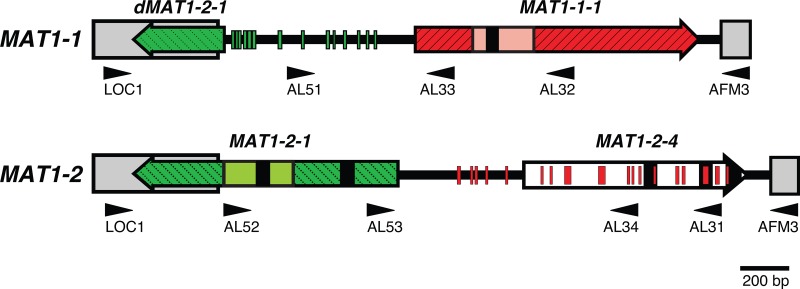
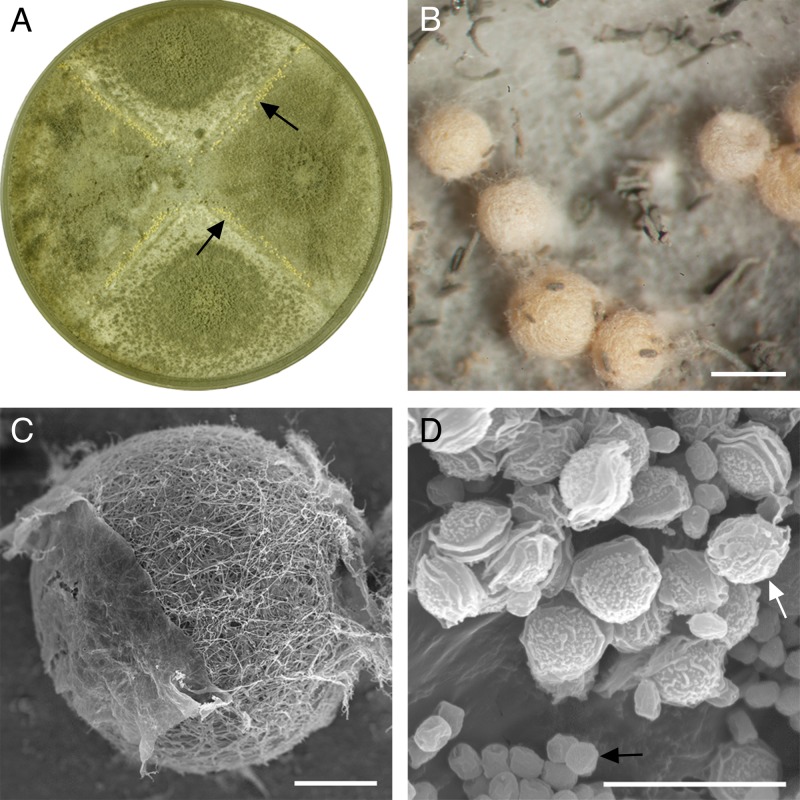
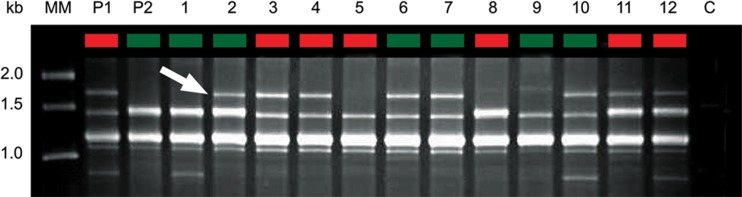
Aspergillus lentulus was described in 2005 as a new species within the A. fumigatus sensu lato complex. It is an opportunistic human pathogen causing invasive aspergillosis with high mortality rates, and it has been isolated from clinical and environmental sources. The species is morphologically nearly identical to A. fumigatus sensu stricto, and this similarity has resulted in their frequent misidentification. Comparative studies show that A. lentulus has some distinguishing growth features and decreased in vitro susceptibility to several antifungal agents, including amphotericin B and caspofungin. Similar to the once-presumed-asexual A. fumigatus, it has only been known to reproduce mitotically. However, we now show that A. lentulus has a heterothallic sexual breeding system. A PCR-based mating-type diagnostic detected isolates of either the MAT1-1 or MAT1-2 genotype, and examination of 26 worldwide clinical and environmental isolates revealed similar ratios of the two mating types (38% versus 62%, respectively).MAT1-1 and MAT1-2 idiomorph regions were analyzed, revealing the presence of characteristic alpha and high-mobility-group (HMG) domain genes, together with other more unusual features such as a MAT1-2-4 gene. We then demonstrated that A. lentulus possesses a functional sexual cycle with mature cleistothecia, containing heat-resistant ascospores, being produced after 3 weeks of incubation. Recombination was confirmed using molecular markers. However, isolates of A. lentulus failed to cross with highly fertile strains of A. fumigatus, demonstrating reproductive isolation between these sibling species. The discovery of the A. lentulus sexual stage has significant implications for the management of drug resistance and control of invasive aspergillosis associated with this emerging fungal pathogen.
Overview
The claims and statistics of this paper haven’t been checked yet.
Free: it reads the open-access text and checks the first 5 claims that cite a source we can check. Create a free account to check every claim.
Integrity signals
Registry
Cites
Statistics
Figures
Verification
Claims the paper makes
The claims and statistics of this paper haven’t been checked yet.
Free: it reads the open-access text and checks the first 5 claims that cite a source we can check. Create a free account to check every claim.
Claims other papers make about this one
Each is checked against this paper’s own text: does it say what the citing paper says it does?
The source backs part of the claim, not all of it — or backs it for a different population, condition or comparison.
In the citing paper
“Moreover, sex is very specific and exclusive for the species A. fumigatus. Attempted crosses between isolates of A. fumigatus and the close relative A. lentulus failed to produce cleistothecia.”
From Aspergillus fumigatus and Aspergillosis in 2019 (2019) · cites this paper as [16]
Experimental — accuracy not yet measuredIn the citing paper
“This phenomenon (of sexual preference strictly between A. fumigatus spp.) is of medical significance, because most isolates of A. lentulus exhibit natural resistance to antifungal agents with potent activity against A. fumigatus, limiting the risk of gene flow between different Aspergillus species (16).”
From Aspergillus fumigatus and Aspergillosis in 2019 (2019) · cites this paper as [16]
Self-check
Percentages, sums and reported differences re-computed from the paper’s own numbers.
The self-check needs the paper’s full text.
Citations
Cites
Statistical Methods for Research Workers
(1945) · American Journal of Clinical Pathology · doi:10.1093/ajcp/15.11.552b · Cited by 10,880
The Fungal Community: Its Organization and Role in the Ecosystem
Shearer, C. A., Carroll, G. C., & Wicklow, D. T. (1993) · Mycologia · doi:10.2307/3760630 · Cited by 696
Discovery of a sexual cycle in the opportunistic fungal pathogen Aspergillus fumigatus
O’Gorman, C. M., Fuller, H. T., & Dyer, P. S. (2009) · Nature · doi:10.1038/nature07528 · Cited by 555
Self-citationRECOMBINATION AND THE MULTILOCUS STRUCTURE OF FUNGAL POPULATIONS
Milgroom, M. G. (1996) · Annual Review of Phytopathology · doi:10.1146/annurev.phyto.34.1.457 · Cited by 549
Genomic Islands in the Pathogenic Filamentous Fungus Aspergillus fumigatus
Fedorova, N. D., Khaldi, N., Joardar, V. S., Maiti, R., Amedeo, P., Anderson, M. J., Crabtree, J., Silva, J. C., Badger, J. H., Albarraq, A., et al. (2008) · PLoS Genetics · doi:10.1371/journal.pgen.1000046 · Cited by 508
Self-citationCellular and Molecular Biology of Filamentous Fungi
(2010) · ASM Press eBooks · doi:10.1128/9781555816636 · Cited by 431
The Amsterdam Declaration on Fungal Nomenclature
Hawksworth, D. L., Crous, P. W., Redhead, S. A., Reynolds, D. R., Samson, R. A., Seifert, K. A., Taylor, J. W., Wingfield, M. J., Abaci, Ö., Aime, C., et al. (2011) · IMA Fungus · doi:10.5598/imafungus.2011.02.01.14 · Cited by 410
Self-citationAspergillus lentulus sp. nov., a New Sibling Species of A. fumigatus
Balajee, S. A., Gribskov, J. L., Hanley, E., Nickle, D., & Marr, K. A. (2005) · Eukaryotic Cell · doi:10.1128/ec.4.3.625-632.2005 · Cited by 404
Self-citationRecent advances in understanding of the evolution and maintenance of sex
Hurst, L. D., & Peck, J. R. (1996) · Trends in Ecology & Evolution · doi:10.1016/0169-5347(96)81041-x · Cited by 354
Evidence for Sexuality in the Opportunistic Fungal Pathogen Aspergillus fumigatus
Paoletti, M., Rydholm, C., Schwier, E. U., Anderson, M. J., Szakacs, G., Lutzoni, F., Debeaupuis, J.-P., Latgé, J.-P., Denning, D. W., & Dyer, P. S. (2005) · Current Biology · doi:10.1016/j.cub.2005.05.045 · Cited by 308
Self-citation
Research works printed but not linked: 2
- Dyer PS 2007 Sexual reproduction and significance of MAT in the aspergilli, p 123– 142 Heitman J Kronstad JWTaylor, JW, Casselton LA (ed), Sex in fungi: molecular determination and evolutionary principles. ASM Press, Washington, DC
- Takada M Udagawa SI Norizuki K 1986 Isolation of Neosartorya fennelliae and interspecific pairings between N. fennelliae, N. spathulata, and Aspergillus fumigatus. Trans. Mycol. Soc. Jpn. 27: 415– 423
Cited by
Aspergillus fumigatus and Aspergillosis in 2019
Latgé, J.-P., & Chamilos, G. (2019) · Clinical Microbiology Reviews · doi:10.1128/cmr.00140-18 · Cited by 1,400
Paulussen, C., Hallsworth, J. E., Álvarez‐Pérez, S., Nierman, W. C., Hamill, P. G., Blain, D., Rediers, H., & Lievens, B. (2017) · Microbial Biotechnology · doi:10.1111/1751-7915.12367 · Cited by 334
Clinical implications of globally emerging azole resistance in Aspergillus fumigatus
Meis, J. F., Chowdhary, A., Rhodes, J. L., Fisher, M. C., & Verweij, P. E. (2016) · Philosophical Transactions of the Royal Society B: Biological Sciences · doi:10.1098/rstb.2015.0460 · Cited by 308
Modern Taxonomy of Biotechnologically Important Aspergillus and Penicillium Species
Houbraken, J., de Vries, R. P., & Samson, R. A. (2014) · Advances in Applied Microbiology · doi:10.1016/b978-0-12-800262-9.00004-4 · Cited by 280
Aspergillus fumigatus and Related Species
Sugui, J. A., Kwon-Chung, K. J., Juvvadi, P. R., Latge, J.-P., & Steinbach, W. J. (2015) · Cold Spring Harbor Perspectives in Medicine · doi:10.1101/cshperspect.a019786 · Cited by 278
“The major species known to cause disease in humans are found in five Aspergillus sections: Fumigati, Flavi, Nigri, Terrei, and Nidulante.”
BackgroundInfluential
Metadata
- Authors
- Swilaiman, S. S., O'Gorman, C. M., Balajee, S. A., & Dyer, P. S.
- Affiliations
- University of Nottingham (GB)
- School of Biology, University of Nottingham, University Park, Nottingham, United Kingdom
- Centers for Disease Control and Prevention (US)
- Corresponding author
- Dyer, Paul S.
- Venue
- Eukaryotic Cell
- Publisher
- American Society for Microbiology
- Published
- 2013-07
- Volume
- 12
- Issue
- 7
- Pages
- 962-969
- ISSN
- 1535-9778 (ISSN-L)
- 1535-9786
- PMC
- PMC3697472
- OpenAlex
- W2001634520
- Cited by
- 50
- References
- 71
- Citations by year
- 2026: 1 · 2025: 1 · 2024: 1 · 2022: 1 · 2021: 4 · 2020: 3 · 2019: 3 · 2018: 5 · 2017: 6 · 2016: 6 · 2015: 1 · 2014: 14 · 2013: 4
- FWCI
- 3.73
- Type
- journal article
- Language
- en
- Open access
- diamond
- doi.org
- Licence
- cc-by
- creativecommons.org/licenses/by/3.0/ (vor)
- journals.asm.org/non-commercial-tdm-license (tdm)
- Locations
- Eukaryotic Cell (publishedVersion, cc-by)
- Europe PMC (PubMed Central) (publishedVersion, cc-by)
- PubMed Central (publishedVersion, cc-by)
- PubMed (publishedVersion)
- Funders
- Johns Hopkins University
- Wellcome Trust
- Topics
- Life Sciences › Biochemistry, Genetics and Molecular Biology › Molecular Biology › Fungal and yeast genetics research
- Health Sciences › Medicine › Infectious Diseases › Antifungal resistance and susceptibility
- Life Sciences › Agricultural and Biological Sciences › Plant Science › Plant Pathogens and Fungal Diseases
- Keywords
- Aspergillus lentulus, heterothallism, reproductive cycle, mating type genes, MAT1-1, MAT1-2, cleistothecia, ascospores, recombination, reproductive isolation, invasive aspergillosis, antifungal resistance, fungal pathogens
- MeSH terms
- Aspergillus, Aspergillus fumigatus, Crosses, Genetic, Genotype, Humans, Meiosis, Recombination, Genetic, Reproduction, Spores, Fungal, Genes, Mating Type, Fungal, Genetic Loci
About these checks
Registry, retraction, Cites and statistics results are computed, not judged, with one exception: a printed reference that no index lists is read once by a model before it counts as a citation error. Claims are extracted by a model and kept only when their quote appears verbatim in the text; each cited source is then checked, with a model’s help, for whether it says what the claim relies on. Those verdicts can be wrong — read the claim’s quote and the cited source before relying on one.
Statistics and arithmetic are recomputed, not judged.
Confidence bands are shown only for fields calibrated on our annotated test set. None is calibrated yet, so no band is shown.
What counts as a claim ›How we measure confidence ›How we check this ›
Are you an author, or do you see a problem with this page? Request a review
How to cite
Cite CoChat for the checks on this page, and the paper for its own findings.
- This page
- CoChat. (2026). Citation check: Discovery of a Sexual Cycle in Aspergillus lentulus, a Close Relative of A. fumigatus. https://app.cochat.ai/papers/10.1128/ec.00040-13
- The paper
- Swilaiman, S. S., O'Gorman, C. M., Balajee, S. A., & Dyer, P. S. (2013). Discovery of a Sexual Cycle in Aspergillus lentulus, a Close Relative of A. fumigatus. Eukaryotic Cell. https://doi.org/10.1128/ec.00040-13
Data sources
Bibliographic data: Semantic Scholar, OpenAlex, Crossref.
Contains information from the Semantic Scholar Academic Graph Datasets, made available under the ODC Attribution License (ODC-BY 1.0).
Semantic Scholar’s data is described in: Kinney, R., et al. (2023). The Semantic Scholar Open Data Platform. arXiv:2301.10140.
