

The Fungal Pathogen Aspergillus fumigatus Regulates Growth, Metabolism, and Stress Resistance in Response to Light
Open accessThe DOI matches its Crossref record; 64 of the 64 references it cites were found in a registry or an index.
Abstract
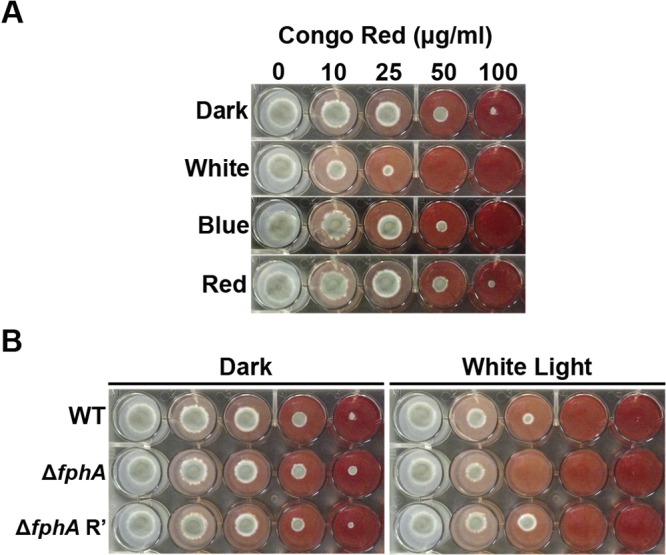
Light is a pervasive environmental factor that regulates development, stress resistance, and even virulence in numerous fungal species. Though much research has focused on signaling pathways in Aspergillus fumigatus , an understanding of how this pathogen responds to light is lacking. In this report, we demonstrate that the fungus does indeed respond to both blue and red portions of the visible spectrum. Included in the A. fumigatus light response is a reduction in conidial germination rates, increased hyphal pigmentation, enhanced resistance to acute ultraviolet and oxidative stresses, and an increased susceptibility to cell wall perturbation. By performing gene deletion analyses, we have found that the predicted blue light receptor LreA and red light receptor FphA play unique and overlapping roles in regulating the described photoresponsive behaviors of A. fumigatus . However, our data also indicate that the photobiology of this fungus is complex and likely involves input from additional photosensory pathways beyond those analyzed here. Finally, whole-genome microarray analysis has revealed that A. fumigatus broadly regulates a variety of metabolic genes in response to light, including those involved in respiration, amino acid metabolism, and metal homeostasis. Together, these data demonstrate the importance of the photic environment on the physiology of A. fumigatus and provide a basis for future studies into this unexplored area of its biology. IMPORTANCE Considerable effort has been taken to understand how the mold pathogen Aspergillus fumigatus senses its environment to facilitate growth within the immunocompromised host. Interestingly, it was shown that the deletion of a blue light photoreceptor in two divergent fungal pathogens, Cryptococcus neoformans and Fusarium oxysporum , leads to an attenuation of virulence in their respective animal infection models. This suggests that light signaling pathways are conservatively involved in the regulation of fungal pathogenesis. However, an understanding of whether and how A. fumigatus responds to light is lacking. Here we demonstrate that this organism coordinates broad aspects of its physiology with the photic environment, including pathways known to be involved in virulence, such as carbohydrate metabolism and oxidative stress resistance. Moreover, the photoresponse of A. fumigatus differs in notable ways from the well-studied model Aspergillus nidulans . Therefore, this work should represent a general advancement in both photobiology and A. fumigatus research communities.
Overview
The claims and statistics of this paper haven’t been checked yet.
Free: it reads the open-access text and checks the first 5 claims that cite a source we can check. Create a free account to check every claim.
Integrity signals
Registry
Cites
Statistics
Figures
Verification
Claims the paper makes
The claims and statistics of this paper haven’t been checked yet.
Free: it reads the open-access text and checks the first 5 claims that cite a source we can check. Create a free account to check every claim.
Claims other papers make about this one
Each is checked against this paper’s own text: does it say what the citing paper says it does?
The source backs part of the claim, not all of it — or backs it for a different population, condition or comparison.
In the citing paper
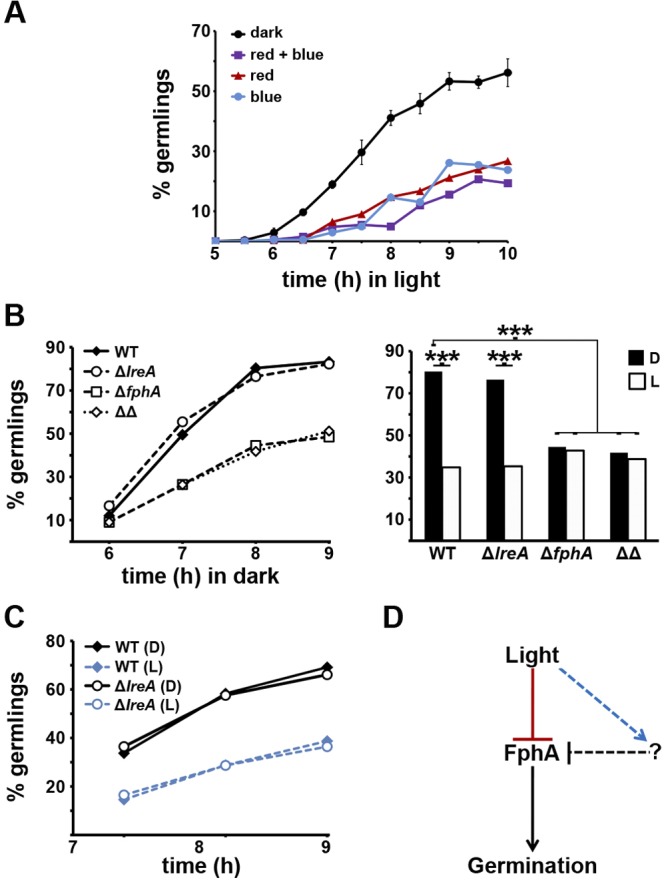
“Instead, LreA drove the synthesis of mycelial pigmentation, and FphA was required for germination, suggesting that light served as a stress signaling mechanism in A. fumigatus rather than having a developmental role.”
From Aspergillus fumigatus and Aspergillosis in 2019 (2019) · cites this paper as [448]
Experimental — accuracy not yet measuredThe cited source says what the claim attributes to it.
In the citing paper
“Light-induced and -repressed genes have been identified by transcriptome analysis, and the photoadaptation of this species to constant or short light stimuli has begun to be analyzed (448, 449).”
From Aspergillus fumigatus and Aspergillosis in 2019 (2019) · cites this paper as [448]
In the citing paper
“In contrast to that in A. nidulans, the asexual sporulation process was not regulated by light in A. fumigatus despite the presence of both LreA and FphA orthologs in the genome (448).”
From Aspergillus fumigatus and Aspergillosis in 2019 (2019) · cites this paper as [448]
Self-check
Percentages, sums and reported differences re-computed from the paper’s own numbers.
The self-check needs the paper’s full text.
Citations
Cites
Metals, Toxicity and Oxidative Stress
Valko, M., Morris, H., & Cronin, M. (2005) · Current Medicinal Chemistry · doi:10.2174/0929867053764635 · Cited by 5,018 · cited 1×
“As both the redox activity of the mitochondria and iron-mediated Fenton chemistry are major sources of endogenous oxidative stress for the cell (57), the downregulation of these gene categories may provide an oxidant-protected cellular state in A.”
Background[4] Genetic and microbiological research techniques for Neurospora crassa
Davis, R. H., & de Serres, F. J. (1970) · Methods in Enzymology · doi:10.1016/0076-6879(71)17168-6 · Cited by 1,104 · cited 1×
“ulated onto a minimal medium slant (64) and incubated for 1 week at”
BackgroundThe induction and repression of nitrate reductase in the fungus Aspergillus nidulans
Cove, D. J. (1966) · Biochimica et Biophysica Acta (BBA) - Enzymology and Biological Oxidation · doi:10.1016/s0926-6593(66)80120-0 · Cited by 1,038
Segal, B. H. (2009) · New England Journal of Medicine · doi:10.1056/nejmra0808853 · Cited by 661
Biosynthesis of fungal melanins and their importance for human pathogenic fungi
Langfelder, K., Streibel, M., Jahn, B., Haase, G., & Brakhage, A. A. (2003) · Fungal Genetics and Biology · doi:10.1016/s1087-1845(02)00526-1 · Cited by 634 · cited 2×
“As examples, loss of hyphal pigmentation, reduced germination kinetics, and defects in cell wall homeostasis are all associated with attenuated virulence phenotypes in murine models of invasive aspergillosis (49, 56).”
BackgroundWhite Collar-1, a Circadian Blue Light Photoreceptor, Binding to the frequency Promoter
Froehlich, A. C., Liu, Y., Loros, J. J., & Dunlap, J. C. (2002) · Science · doi:10.1126/science.1073681 · Cited by 520 · cited 1×
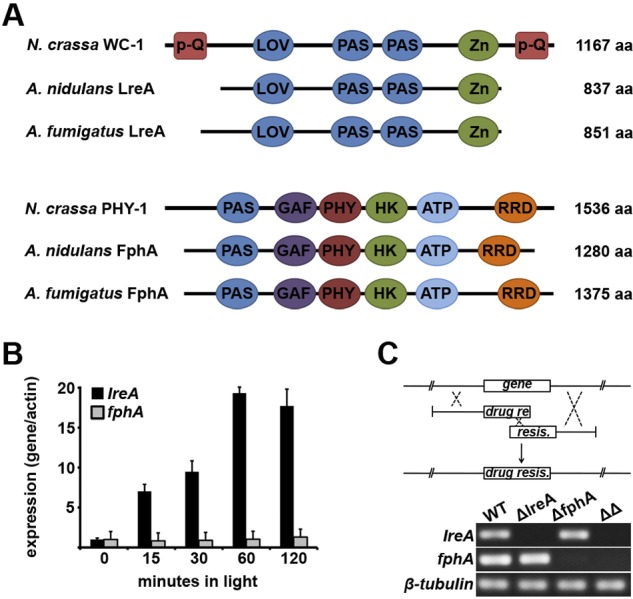
“WC-1 is a Zn finger transcription factor that contains a specialized PAS (PerAnt-Sim) domain, called the LOV domain (light-oxygenvoltage), which binds flavin adenine dinucleotide (FAD) as the photon-absorbing chromophore (9, 10).”
BackgroundSelf-citationUpton, A., Kirby, K. A., Carpenter, P., Boeckh, M., & Marr, K. A. (2007) · Clinical Infectious Diseases · doi:10.1086/510592 · Cited by 514 · cited 1×
“Even with the use of antifungal agents, the mortality rates associated with invasive aspergillosis remain around 50%, thus making the development of novel treatment strategies imperative (23, 24).”
BackgroundSplit-Marker Recombination for Efficient Targeted Deletion of Fungal Genes
Catlett, N. L., Lee, B.-N., Yoder, O. C., & Turgeon, B. G. (2003) · Fungal Genetics Reports · doi:10.4148/1941-4765.1150 · Cited by 488 · cited 1×
“tions were accomplished using the split-marker method (63), as depicted”
MethodWhite collar-1, a central regulator of blue light responses in Neurospora, is a zinc finger protein.
Ballario, P., Vittorioso, P., Magrelli, A., Talora, C., Cabibbo, A., & Macino, G. (1996) · The EMBO Journal · doi:10.1002/j.1460-2075.1996.tb00510.x · Cited by 453 · cited 1×
“crassa, the wc-1 message is increased upon exposure to light (35).”
BackgroundWhite Collar-1, a DNA Binding Transcription Factor and a Light Sensor
He, Q., Cheng, P., Yang, Y., Wang, L., Gardner, K. H., & Liu, Y. (2002) · Science · doi:10.1126/science.1072795 · Cited by 419
Cited by
Items 101–136 of 136
Shen, Y., Yang, X., Zhu, M., Duan, S., Liu, Q., & Yang, J. (2024) · Journal of Fungi · doi:10.3390/jof10090626 · Cited by 6
“Light also has a wide range of effects on the metabolism of A. fumigatus [65].”
BackgroundThe Complexity of Fungal Vision
Fischer, R., Aguirre, J., Herrera‐Estrella, A., & Corrochano, L. M. (2017) · ASM Press eBooks · doi:10.1128/9781555819583.ch20 · Cited by 6
Characterization of Blue Light Receptors LreA and LreB in Aspergillus flavus
Park, H.-M., Son, Y.-E., Cho, H.-J., Yu, J., & Park, H.-S. (2025) · Journal of Microbiology and Biotechnology · doi:10.4014/jmb.2411.11054 · Cited by 2
“In A. fumigatus , the absence of lreA decreases conidiation under light conditions [41, 42].”
Leister, K., Dong, Y., Landmark, A., Ma, Y., Schreckenberger, B., Yu, Z., Lü, L., & Fischer, R. (2025) · mBio · doi:10.1128/mbio.02204-25 · Cited by 3
“Despite the sequence similarity between AfFphA and AnFphA, deletion of fphA in A. fumigatus had minor light-depend ent phenotypes (6, 19).”
Li, G., Zhang, Z., Chen, Y., Chen, T., Li, B., & Tian, S. (2023) · Engineering · doi:10.1016/j.eng.2023.08.015 · Cited by 2
Arsić-Arsenijević, V. S., Pekmezovic, M. G., Rajković, K., Vekić, B., Barac, A. M., Otašević, S., & Petković, L. (2014) · International Journal of Medical Sciences · doi:10.7150/ijms.8325 · Cited by 2
“fumigatus metabolites that are important for its pathogenicity, including aeration, temperature, pH level, duration of fermentation, exposure to light and medium composition [20, 21, 22].”
BackgroundRao, J., Nelson, D., Fleming, C. C., & Martin, T. (2020) · European Journal of Biology and Biotechnology · doi:10.24018/ejbio.2020.1.5.70 · Cited by 1
Paixão, A. C. D. C., Macedo, G. L., & Netto, R. A. C. (2018) · Acta Biológica Paranaense · doi:10.5380/abpr.v47i0.61563 · Cited by 1
Pang, H., Lee, Y., Wang, G., Liaw, L.-L., Chen, F. F., & Chen, Y.-P. (2020) · IOP Conference Series Materials Science and Engineering · doi:10.1088/1757-899x/782/2/022108 · Cited by 1
The Development of Photo-activated Antimicrobial Dyes Against Opportunistic Infections
Jalab, M. (2020) · CLOK (University of Central Lancashire) · Cited by 1
Zetina-Serrano, C. (2020) · theses.fr (ABES) · doi:10.70675/a9a1920dz4cfcz454dz945fz5bbeaffced5a · Cited by 3
Lee, S., Kwon, Y., Shin, H.-M., Chang, W.-B., Nam, S.-Y., Hong, E. Y., Cha, J., & Heo, J.-W. (2016) · Research in Plant Disease · doi:10.5423/rpd.2016.22.2.100
Continuous measurement of the cosmic-ray intensity. 2. Measurement of neutron component
Ishida, Y., & Kanno, T. (1971) · OSTI OAI (U.S. Department of Energy Office of Scientific and Technical Information)
Dias, L. P. (2018) · Digital Library of Theses and Dissertations (Universidade de São Paulo) · doi:10.11606/t.97.2018.tde-03122018-184427
Machi, H. A. (2019) · eDiss (Georg-August-Universität Göttingen) · doi:10.53846/goediss-7556
Developmental regulators and secreted effector molecules of the fungal pathogen Verticillium spp.
Leonard, M. (2020) · eDiss (Georg-August-Universität Göttingen) · doi:10.53846/goediss-8222
Baró, L., Dolinko, A. E., Rosenfeldt, S., Skigin, D. C., & Carmarán, C. C. (2021) · CONICET Digital (CONICET) · doi:10.48550/arxiv.2104.10848
“However, in the investigations on the cellular events related to light in fungal organisms, few mentions (Fuller et al. 2013) have been made about the role of the first obstacle that the cell presents to light: the cell wall.”
BackgroundAspergillus- Human Interactions: From the Environment to Clinical Significance
Thammahong, A. (2022) · IntechOpen eBooks · doi:10.5772/intechopen.98509 · Cited by 2
Lam, M. I., Vojnits, K., Zhao, M., MacNaughton, P., & Pakpour, S. (2022) · bioRxiv (Cold Spring Harbor Laboratory) · doi:10.1101/2022.01.14.476401 · Cited by 1
Choi, J., Gihaz, S., Munshi, M., Singh, P., Vydyam, P., Hamel, P. P., Adams, E. M., Fuller, K. K., & Mamoun, C. B. (2023) · bioRxiv (Cold Spring Harbor Laboratory) · doi:10.1101/2023.12.10.571002
Self-citationTurnbull, C., Sobral, R., Difford, G. F., & Kovi, M. R. (2024) · SSRN Electronic Journal · doi:10.2139/ssrn.4849508
Chhoker, K., Hausner, G., & Harris, S. D. (2025) · bioRxiv (Cold Spring Harbor Laboratory) · doi:10.1101/2025.09.23.676125 · Cited by 1
“2015; Fuller et al. 2013; 2015; 2016).”
Zhang, F., Hu, Y., Liu, M., Liu, B., & Meng, X. (2025) · Postharvest Biology and Technology · doi:10.1016/j.postharvbio.2025.114056
Valente, J. (2014) · Portuguese National Funding Agency for Science, Research and Technology (RCAAP Project by FCT) · Cited by 1
Jiang, C., Lv, G., Ge, J., He, B., Zhang, Z., Hu, Z., & Zeng, B. (2021) · Figshare · doi:10.6084/m9.figshare.14450910
Jiang, C., Lv, G., Ge, J., He, B., Zhang, Z., Hu, Z., & Zeng, B. (2021) · Figshare · doi:10.6084/m9.figshare.14450916
Jiang, C., Lv, G., Ge, J., He, B., Zhang, Z., Hu, Z., & Zeng, B. (2021) · Figshare · doi:10.6084/m9.figshare.14450913
Jiang, C., Lv, G., Ge, J., He, B., Zhang, Z., Hu, Z., & Zeng, B. (2021) · Figshare · doi:10.6084/m9.figshare.14450901
Jiang, C., Lv, G., Ge, J., He, B., Zhang, Z., Hu, Z., & Zeng, B. (2021) · Figshare · doi:10.6084/m9.figshare.14450907
Jiang, C., Lv, G., Ge, J., He, B., Zhang, Z., Hu, Z., & Zeng, B. (2021) · Figshare · doi:10.6084/m9.figshare.14450904
Sukdee, S., Thepsilvisut, O., Pholtaisong, J., Prajuabjinda, O., & Chutimanukul, P. (2026) · Frontiers in Fungal Biology · doi:10.3389/ffunb.2026.1791721 · Cited by 1
“These shared proteins likely govern basal adaptive processes such as redox balance, general stress responses, or energy redistribution, which may re fl ect a conserved mechanism of light adaptation across fungi (Fuller et al., 2013).”
Ozimek, E., Nowak, A., Hanaka, A., Jaroszuk‐Ściseł, J., Majewska, M., Słomka, A., Ząbek, P., Swadźba, R., & Radwański, K. (2026) · Agronomy · doi:10.3390/agronomy16060602
Ri, T., Masaki, T., & Degawa, Y. (2026) · Fungal Biology · doi:10.1016/j.funbio.2026.101886
Blue LED-Associated Morphological Changes and Gene Expression Responses in Trichoderma harzianum
Yu, D.-R., Jung, M. S., Park, Y., & Jang, M.-J. (2026) · Biology · doi:10.3390/biology15161390
“In particular, blue light is known as an environmental signal that can induce mycelial growth inhibition, promotion of sporulation, metabolic changes, and stress-related responses in various fungi [5–7].”
Wang, Z., Lu, S., Li, G., Tian, S., & Zhang, Z. (2026) · Food Control · doi:10.1016/j.foodcont.2026.112582
Hua, T., Bott, N., & Phan, H. (2026) · Springer eBooks · doi:10.1007/978-981-95-2300-9_10-1
Metadata
- Authors
- Fuller, K. K., Ringelberg, C. S., Loros, J. J., & Dunlap, J. C.
- Affiliations
- Dartmouth College (US)
- Venue
- mBio
- Publisher
- American Society for Microbiology
- Published
- 2013-05
- Volume
- 4
- Issue
- 2
- ISSN
- 2150-7511 (ISSN-L)
- 2161-2129
- PMC
- PMC3604765
- OpenAlex
- W2123110434
- Cited by
- 136
- References
- 64
- Citations by year
- 2026: 6 · 2025: 7 · 2024: 6 · 2023: 5 · 2022: 9 · 2021: 24 · 2020: 13 · 2019: 11 · 2018: 10 · 2017: 11 · 2016: 16 · 2015: 7 · 2014: 7 · 2013: 3
- FWCI
- 4.93
- Type
- journal article
- Language
- en
- Open access
- gold
- doi.org
- Licence
- cc-by-nc-sa
- creativecommons.org/licenses/by-nc-sa/3.0/ (vor)
- journals.asm.org/non-commercial-tdm-license (tdm)
- Locations
- mBio (publishedVersion, cc-by-nc-sa)
- Europe PMC (PubMed Central) (publishedVersion, cc-by-nc-sa)
- PubMed Central (publishedVersion, cc-by-nc-sa)
- PubMed (publishedVersion)
- DOAJ (DOAJ: Directory of Open Access Journals) (submittedVersion, cc-by-sa)
- Funders
- University of Missouri
- University of Cincinnati
- Dartmouth College
- National Institutes of Health (P01 GM68087)
- National Institute of General Medical Sciences (P01GM068087, R01GM083336, P01 GM68087, R01 GM34985, R01GM034985, GM083336)
- Topics
- Life Sciences › Biochemistry, Genetics and Molecular Biology › Molecular Biology › Fungal and yeast genetics research
- Health Sciences › Medicine › Infectious Diseases › Antifungal resistance and susceptibility
- Life Sciences › Agricultural and Biological Sciences › Plant Science › Light effects on plants
- Keywords
- Aspergillus fumigatus, light signaling, photoreceptors, blue light, red light, conidial germination, oxidative stress resistance, fungal virulence, metabolic regulation, metal homeostasis
- MeSH terms
- Aspergillus fumigatus, Cell Wall, Light, Pigments, Biological, Spores, Fungal, Stress, Physiological, Ultraviolet Rays, Signal Transduction, Gene Expression Regulation, Fungal, Gene Deletion, Oxidative Stress, Hyphae
About these checks
Registry, retraction, Cites and statistics results are computed, not judged, with one exception: a printed reference that no index lists is read once by a model before it counts as a citation error. Claims are extracted by a model and kept only when their quote appears verbatim in the text; each cited source is then checked, with a model’s help, for whether it says what the claim relies on. Those verdicts can be wrong — read the claim’s quote and the cited source before relying on one.
Statistics and arithmetic are recomputed, not judged.
Confidence bands are shown only for fields calibrated on our annotated test set. None is calibrated yet, so no band is shown.
What counts as a claim ›How we measure confidence ›How we check this ›
Are you an author, or do you see a problem with this page? Request a review
Data sources
Bibliographic data: Semantic Scholar, OpenAlex, Crossref.
Contains information from the Semantic Scholar Academic Graph Datasets, made available under the ODC Attribution License (ODC-BY 1.0).
Semantic Scholar’s data is described in: Kinney, R., et al. (2023). The Semantic Scholar Open Data Platform. arXiv:2301.10140.
