

Factors Required for Activation of Urease as a Virulence Determinant in Cryptococcus neoformans
Open accessThe DOI matches its Crossref record; 53 of the 53 references it cites were found in a registry or an index.
Abstract
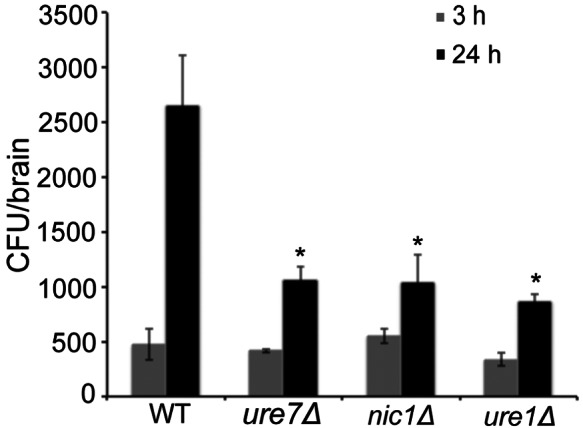
Urease in Cryptococcus neoformans plays an important role in fungal dissemination to the brain and causing meningoencephalitis. Although urea is not required for synthesis of apourease encoded by URE1 , the available nitrogen source affected the expression of URE1 as well as the level of the enzyme activity. Activation of the apoenzyme requires three accessory proteins, Ure4, Ure6, and Ure7, which are homologs of the bacterial urease accessory proteins UreD, UreF, and UreG, respectively. A yeast two-hybrid assay showed positive interaction of Ure1 with the three accessory proteins encoded by URE4 , URE6 , and URE7 . Metalloproteomic analysis of cryptococcal lysates using inductively coupled plasma mass spectrometry (ICP-MS) and a biochemical assay of urease activity showed that, as in many other organisms, urease is a metallocentric enzyme that requires nickel transported by Nic1 for its catalytic activity. The Ure7 accessory protein (bacterial UreG homolog) binds nickel likely via its conserved histidine-rich domain and appears to be responsible for the incorporation of Ni 2+ into the apourease. Although the cryptococcal genome lacks the bacterial UreE homolog, Ure7 appears to combine the functions of bacterial UreE and UreG, thus making this pathogen more similar to that seen with the plant system. Brain invasion by the ure1 , ure7 , and nic1 mutant strains that lack urease activity was significantly less effective in a mouse model. This indicated that an activated urease and not the Ure1 protein was responsible for enhancement of brain invasion and that the factors required for urease activation in C. neoformans resemble those of plants more than those of bacteria. IMPORTANCE Cryptococcus neoformans is the major fungal agent of meningoencephalitis in humans. Although urease is an important factor for cryptococcal brain invasion, the enzyme activation system has not been studied. We show that urease is a nickel-requiring enzyme whose activity level is influenced by the type of available nitrogen source. C. neoformans contains all the bacterial urease accessory protein homologs and nickel transporters except UreE, a nickel chaperone. Cryptococcal Ure7 (a homolog of UreG) apparently functions as both the bacterial UreG and UreE in activating the Ure1 apoenzyme. The cryptococcal urease accessory proteins Ure4, Ure6, and Ure7 interacted with Ure1 in a yeast two-hybrid assay, and deletion of any one of these not only inactivated the enzyme but also reduced the efficacy of brain invasion. This is the first study showing a holistic picture of urease in fungi, clarifying that urease activity, and not Ure1 protein, contributes to pathogenesis in C. neoformans
Overview
The claims and statistics of this paper haven’t been checked yet.
Free: it reads the open-access text and checks the first 5 claims that cite a source we can check. Create a free account to check every claim.
Integrity signals
Registry
Cites
Statistics
Figures
Verification
Claims the paper makes
The claims and statistics of this paper haven’t been checked yet.
Free: it reads the open-access text and checks the first 5 claims that cite a source we can check. Create a free account to check every claim.
Claims other papers make about this one
Each is checked against this paper’s own text: does it say what the citing paper says it does?
In the citing paper
“This is supported by the fact that urease-positive cryptococcal strains cause a reduction in levels of the tight junction protein ZO1 in HBMECs, while urease-deficient strains have no effect on monolayer integrity [156].”
From Mechanisms of fungal dissemination (2021) · cites this paper as [156]
Self-check
Percentages, sums and reported differences re-computed from the paper’s own numbers.
The self-check needs the paper’s full text.
Citations
Cites
A novel genetic system to detect protein–protein interactions
Fields, S., & Song, O.-K. (1989) · Nature · doi:10.1038/340245a0 · Cited by 6,114 · cited 1×
“We systematically studied pairwise interactions where a single “bait” test protein was individually assayed in a Y2H system against a “prey” test protein (33, 34).”
MethodMolecular biology of microbial ureases
Mobley, H. L. T., Island, M. D., & Hausinger, R. P. (1995) · Microbiological Reviews · doi:10.1128/mmbr.59.3.451-480.1995 · Cited by 1,469 · cited 3×
“To determine if C. neoformans cells affected the integrity of HBMEC tight junctions at all, we prolonged the incubation period to 24 h. Due to the absence of a true positive control, a pathogenic E. coli strain E44 (5) which is known to be an effective disrupter of the tight junctions was used as the positive control.”
BackgroundMethodInfluentialTHE ISOLATION AND CRYSTALLIZATION OF THE ENZYME UREASE
Sumner, J. B. (1926) · Journal of Biological Chemistry · doi:10.1016/s0021-9258(18)84560-4 · Cited by 898
The crystal structure of urease from Klebsiella aerogenes
Jabri, E., Carr, M., Hausinger, R., & Karplus, P. (1995) · Science · doi:10.1126/science.7754395 · Cited by 830 · cited 1×
“These form a trimer (UreAUreB-UreC)3 that contains a binuclear nickel (Ni) metallocenter per UreC (13, 14).”
BackgroundGenetic regulation of nitrogen metabolism in the fungi.
Marzluf, G. A. (1997) · Microbiology and molecular biology reviews : MMBR · doi:10.1128/.61.1.17-32.1997 · Cited by 720
Urease as a Virulence Factor in Experimental Cryptococcosis
Cox, G. M., Mukherjee, J., Cole, G. T., Casadevall, A., & Perfect, J. R. (2000) · Infection and Immunity · doi:10.1128/iai.68.2.443-448.2000 · Cited by 522 · cited 1×
“neoformans, the URE1 gene (CNAG_05540) encodes the urease apoenzyme, which has been deleted and studied for its role in virulence (2, 18).”
BackgroundGene transfer in Cryptococcus neoformans by use of biolistic delivery of DNA
Toffaletti, D. L., Rude, T. H., Johnston, S. A., Durack, D. T., & Perfect, J. R. (1993) · Journal of Bacteriology · doi:10.1128/jb.175.5.1405-1411.1993 · Cited by 488 · cited 1×
“transformed into the H99 cells as previously described (52).”
MethodAnderson, J. M., Stevenson, B. R., Jesaitis, L. A., Goodenough, D. A., & Mooseker, M. S. (1988) · The Journal of cell biology · doi:10.1083/jcb.106.4.1141 · Cited by 368 · cited 1×
“The protein is located on the cytoplasmic membrane surface of intercellular tight junctions (36).”
BackgroundEvidence of a Role for Monocytes in Dissemination and Brain Invasion by Cryptococcus neoformans
Charlier, C., Nielsen, K., Daou, S., Brigitte, M., Chretien, F., & Dromer, F. (2009) · Infection and Immunity · doi:10.1128/iai.01065-08 · Cited by 362
Protein-folding location can regulate manganese-binding versus copper- or zinc-binding
Tottey, S., Waldron, K. J., Firbank, S. J., Reale, B., Bessant, C., Sato, K., Cheek, T. R., Gray, J., Banfield, M. J., Dennison, C., et al. (2008) · Nature · doi:10.1038/nature07340 · Cited by 314
Self-citation
Cited by
Items 101–139 of 139
Geddes, J. M. H. (2015) · cIRcle (University of British Columbia) · doi:10.14288/1.0166201
“…of urease, which is responsible for the hydrolysis of urea to ammonia and carbamate resulting in the induction of a localized increase in pH, enhances the ability of C. neoformans to invade the CNS (Casadevall and Perfect, 1998; Cox et al., 2000; Olszewski et al., 2004; Singh et al., 2013).”
BackgroundThe role of Cryptococcus neoformans derived phospholipase B1 during host infection
Evans, R. J. (2016) · University of Birmingham Institutional Research Archive (University of Birmingham)
Metal Binding and Response of Helicobacter pylori HypB and Escherichia coli YjiA
Sydor, A. M. (2014) · TSpace (University of Toronto)
Fernandes, J. D. S. (2015) · Digital Library of Theses and Dissertations (Universidade de São Paulo) · doi:10.11606/d.87.2015.tde-03092015-125658
Papel da homeostase de cálcio na patogênese e sinalização celular de Cryptococcus neoformans
Squizani, E. D. (2016) · Lume (Universidade Federal do Rio Grande do Sul)
Ribeiro, N. S. (2014) · Lume (Universidade Federal do Rio Grande do Sul)
Efeito da hipóxia sobre a expressão proteica de Cryptococcus gattii
Balaguez, C. B. (2014) · Lume (Universidade Federal do Rio Grande do Sul)
Ferreira, F. F. (2018) · RIUnB Institutional Repository (University of Brasília) · doi:10.26512/2018.03.d.32523
Intein Prp8: potencial terapêutico de um elemento genético invasivo
Fernandes, J. A. L. (2018) · Americanae (AECID Library)
Reposicionamento do fármaco amiodarona como alternativa terapêutica para a criptococose
Oliveira, N. K. (2019) · Lume (Universidade Federal do Rio Grande do Sul)
Calvete, C. L. (2019) · Digital Library of Theses and Dissertations (Universidade de São Paulo) · doi:10.11606/d.87.2019.tde-13112019-102408
Efeito do agonista de TLR2-Pam3CSk4 em estratégia vacinal contra a infecção por Cryptococcus gattii
de Campos, G. Y. (2020) · Digital Library of Theses and Dissertations (Universidade de São Paulo) · doi:10.11606/d.17.2020.tde-08042021-081156
Phenotypic and Genotypic Identification of Ureolytic Bacteria Isolated from Coastal Sites
Makishah, N. H. A. (2021) · Science of Advanced Materials · doi:10.1166/sam.2021.3975
Análise do efeito antifúngico de compostos sintéticos sobre Cryptococcus spp.
de Freitas, A. L. D. (2019) · Digital Library of Theses and Dissertations (Universidade de São Paulo) · doi:10.11606/d.87.2019.tde-21072021-121654
Klein, B. S., McBride, J. A., & Gauthier, G. M. (2020) · Elsevier eBooks · doi:10.1016/b978-0-12-809633-8.21010-8
Lortholary, O. (2019) · Faculty Opinions – Post-Publication Peer Review of the Biomedical Literature · doi:10.3410/f.718480135.793560300
Felizardo, G. (2021) · Digital Library of Theses and Dissertations (Universidade de São Paulo) · doi:10.11606/d.87.2021.tde-28112022-114824
Historical hallmarks in urease study
Caruso, P. B., & Ligabue‐Braun, R. (2024) · Elsevier eBooks · doi:10.1016/b978-0-323-91800-8.00008-4
Ureases as drug targets in fungal infections
Martinelli, A. H. S., Perin, A. P. A., & Lopes, F. C. (2024) · Elsevier eBooks · doi:10.1016/b978-0-323-91800-8.00003-5
Mota, C., Kim, K., Son, Y. J., Thak, E. J., Lee, S., Kim, J.-E., Yoon, J., Kang, M., Hwang, H., Bahn, Y., et al. (2024) · eLife · doi:10.7554/elife.103729.1
The Main Virulence factors of Cryptococcus neoformans
Jabbar, S. H., & Abbas, A. H. (2025) · Kufa Journal For Veterinary Medical Sciences · doi:10.36326/kjvs/2024/v15i217345
Étude des ARN des vésicules extracellulaires chez Cryptococcus neoformans
Taheraly, A. (2024) · theses.fr (ABES) · doi:10.70675/87765aafza890z4276za5dez7b341f33c123
Folha, J. D. S. (2020) · RIUnB Institutional Repository (University of Brasília)
Sociobiologia de Cryptococcus spp. : de comunidades estruturadas à dinâmica de populações
Lopes, W. (2021) · Lume (Universidade Federal do Rio Grande do Sul)
Urease activity of the systemic fungal pathogen Emergomyces africanus
Lerm, B.-A. (2017) · SUNScholar (Stellenbosch University)
Atividade antifúngica do espilantol contra leveduras dos complexos de espécies Cryptococcus
Costa, R. P. (2024) · Lume (Universidade Federal do Rio Grande do Sul)
Caracterização de proteínas mediadoras da sinalização de cálcio no patógeno Cryptococcus neoformans
Squizani, E. D. (2020) · Lume (Universidade Federal do Rio Grande do Sul)
de Castro, R. J. A. (2019) · LA Referencia (Red Federada de Repositorios Institucionales de Publicaciones Científicas)
Azevedo, C. S. (2017) · LA Referencia (Red Federada de Repositorios Institucionales de Publicaciones Científicas)
Estudo funcional do fator de transcrição Pdr802 na biologia do patógeno Cryptococcus neoformans
Reuwsaat, J. C. V. (2021) · Lume (Universidade Federal do Rio Grande do Sul)
Análise ex vivo do potencial antifúngico da molécula plumieridina em Cryptococcus neoformans
Barcellos, V. D. A. (2018) · Lume (Universidade Federal do Rio Grande do Sul)
Calvete, C. L. (2018) · LA Referencia (Red Federada de Repositorios Institucionales de Publicaciones Científicas)
Gagliano, G. S. (2024) · LA Referencia (Red Federada de Repositorios Institucionales de Publicaciones Científicas)
Rangdist, S., Kanklang, E., Pakdeesiriwong, N., Penkhrue, W., Wangboon, C., Weeranantanapan, O., Chumkiew, S., Chantree, P., Martviset, P., Chayakulkeeree, M., et al. (2026) · bioRxiv (Cold Spring Harbor Laboratory) · doi:10.64898/2026.01.30.702728
Characterization and Design of Nickel-binding Proteins towards Metal Recovery Applications
Diep, P. (2023) · TSpace (University of Toronto)
Cellular Coordination of Transcription Factors and Regulatory Genes for Cryptococcal Virulence
Folorunso, O. S., & Sebolai, O. M. (2026) · Cellular Microbiology · doi:10.1155/cmi/4775883
Alkashef, N. M., Khan, A. A., & Seleem, M. N. (2026) · PLoS neglected tropical diseases · doi:10.1371/journal.pntd.0014627
“On the other hand, the activity of the urease enzyme is crucial for breaching the BBB endothelium, thereby allowing brain invasion [54,55].”
Metadata
- Authors
- Singh, A., Panting, R. J., Varma, A., Saijo, T., Waldron, K. J., Jong, A., Ngamskulrungroj, P., Chang, Y. C., Rutherford, J. C., & Kwon-Chung, K. J.
- Affiliations
- National Institutes of Health (US)
- Newcastle University (GB)
- University of Southern California (US)
- ORCID
- Venue
- mBio
- Publisher
- American Society for Microbiology
- Published
- 2013-07
- Volume
- 4
- Issue
- 3
- Pages
- e00220-13
- ISSN
- 2150-7511 (ISSN-L)
- 2161-2129
- PMC
- PMC3663189
- OpenAlex
- W2104180071
- Cited by
- 108
- References
- 53
- Citations by year
- 2026: 9 · 2025: 10 · 2024: 10 · 2023: 8 · 2022: 6 · 2021: 9 · 2020: 7 · 2019: 9 · 2018: 8 · 2017: 11 · 2015: 11 · 2014: 7 · 2013: 2
- FWCI
- 4.86
- Type
- journal article
- Language
- en
- Open access
- gold
- doi.org
- Licence
- cc-by-nc-sa
- creativecommons.org/licenses/by-nc-sa/3.0/ (vor)
- journals.asm.org/non-commercial-tdm-license (tdm)
- Locations
- mBio (publishedVersion, cc-by-nc-sa)
- Europe PMC (PubMed Central) (publishedVersion, cc-by-nc-sa)
- PubMed Central (publishedVersion, cc-by-nc-sa)
- PubMed (publishedVersion)
- DOAJ (DOAJ: Directory of Open Access Journals) (submittedVersion, cc-by-sa)
- Funders
- Royal Society
- Newcastle University
- Fakultet Medicinskih Nauka, Univerziteta U Kragujevcu
- National Institutes of Health
- Directorate for Biological Sciences
- Biotechnology and Biological Sciences Research Council (BB/H006605/1, 1369379)
- National Institute of Allergy and Infectious Diseases
- Topics
- Health Sciences › Medicine › Infectious Diseases › Fungal Infections and Studies
- Life Sciences › Biochemistry, Genetics and Molecular Biology › Molecular Biology › Fungal and yeast genetics research
- Life Sciences › Immunology and Microbiology › Microbiology › Bacterial Infections and Vaccines
- Keywords
- Cryptococcus neoformans, urease, nickel incorporation, nitrogen source, brain invasion, meningoencephalitis, virulence factors, fungal dispersal, histidine-rich domain, metalloproteomics, urease activity
- MeSH terms
- Animals, Brain, Cryptococcosis, Cryptococcus neoformans, Disease Models, Animal, Female, Fungal Proteins, Mice, Inbred C57BL, Nickel, Protein Binding, Urease, Two-Hybrid System Techniques, Protein Interaction Mapping, Virulence Factors, Mice
About these checks
Registry, retraction, Cites and statistics results are computed, not judged, with one exception: a printed reference that no index lists is read once by a model before it counts as a citation error. Claims are extracted by a model and kept only when their quote appears verbatim in the text; each cited source is then checked, with a model’s help, for whether it says what the claim relies on. Those verdicts can be wrong — read the claim’s quote and the cited source before relying on one.
Statistics and arithmetic are recomputed, not judged.
Confidence bands are shown only for fields calibrated on our annotated test set. None is calibrated yet, so no band is shown.
What counts as a claim ›How we measure confidence ›How we check this ›
Are you an author, or do you see a problem with this page? Request a review
Data sources
Bibliographic data: Semantic Scholar, OpenAlex, Crossref.
Contains information from the Semantic Scholar Academic Graph Datasets, made available under the ODC Attribution License (ODC-BY 1.0).
Semantic Scholar’s data is described in: Kinney, R., et al. (2023). The Semantic Scholar Open Data Platform. arXiv:2301.10140.
