

Application of a Neutral Community Model To Assess Structuring of the Human Lung Microbiome
Open accessThe DOI matches its Crossref record; 49 of the 50 references it cites were found in a registry or an index.
Abstract
DNA from phylogenetically diverse microbes is routinely recovered from healthy human lungs and used to define the lung microbiome. The proportion of this DNA originating from microbes adapted to the lungs, as opposed to microbes dispersing to the lungs from other body sites and the atmosphere, is not known. We use a neutral model of community ecology to distinguish members of the lung microbiome whose presence is consistent with dispersal from other body sites and those that deviate from the model, suggesting a competitive advantage to these microbes in the lungs. We find that the composition of the healthy lung microbiome is consistent with predictions of the neutral model, reflecting the overriding role of dispersal of microbes from the oral cavity in shaping the microbial community in healthy lungs. In contrast, the microbiome of diseased lungs was readily distinguished as being under active selection. We also assessed the viability of microbes from lung samples by cultivation with a variety of media and incubation conditions. Bacteria recovered by cultivation from healthy lungs represented species that comprised 61% of the 16S rRNA-encoding gene sequences derived from bronchoalveolar lavage samples. IMPORTANCE Neutral distribution of microbes is a distinguishing feature of the microbiome in healthy lungs, wherein constant dispersal of bacteria from the oral cavity overrides differential growth of bacteria. No bacterial species consistently deviated from the model predictions in healthy lungs, although representatives of many of the dispersed species were readily cultivated. In contrast, bacterial populations in diseased lungs were identified as being under active selection. Quantification of the relative importance of selection and neutral processes such as dispersal in shaping the healthy lung microbiome is a first step toward understanding its impacts on host health.
Overview
The claims and statistics of this paper haven’t been checked yet.
Free: it reads the open-access text and checks the first 5 claims that cite a source we can check. Create a free account to check every claim.
Integrity signals
Registry
Cites
Statistics
Figures
Verification
Claims the paper makes
The claims and statistics of this paper haven’t been checked yet.
Free: it reads the open-access text and checks the first 5 claims that cite a source we can check. Create a free account to check every claim.
Claims other papers make about this one
Each is checked against this paper’s own text: does it say what the citing paper says it does?
The source backs part of the claim, not all of it — or backs it for a different population, condition or comparison.
In the citing paper
“This supports the hypothesis that, in health, the lung microbiota is a community of transiently present microorganisms that are derived from the URT, rather than a thriving, resident community as is commonly found in chronic respiratory diseases80,87,88.”
From The microbiota of the respiratory tract: gatekeeper to respiratory health (2017) · cites this paper as [87]
Experimental — accuracy not yet measuredThe check wasn’t confident either way, so it gives no verdict — never disputed.
In the citing paper
“Individuals with chronic airway diseases (e.g., cystic fibrosis, COPD) have increased bacterial populations in the lungs (77) and differences in the relative abundance of certain species”
From Respiratory viral infection-induced microbiome alterations and secondary bacterial pneumonia. (2018) · cites this paper as [77]
Experimental — accuracy not yet measuredIn the citing paper
“Multiple studies have shown that lung microbiota are more similar to those in the oropharynx, than those in the air, nasopharynx or lower digestive tract (Segal et al., 2013; Venkataraman et al., 2015).”
From Oral Microbiome and SARS-CoV-2: Beware of Lung Co-infection (2020) · cites this paper as Venkataraman et al., 2015
In the citing paper
“Contrary to dogma that normal healthy lungs are a sterile environment, a distinct, and somewhat dynamic lung microbiome can be identified using sequencing technology, with microaspiration serving as the primary route of microbial immigration from the URT to the LRT”
From Respiratory viral infection-induced microbiome alterations and secondary bacterial pneumonia. (2018) · cites this paper as [77]
In the citing paper
“the alveolar space is an ecologically unfavourable environment for most bacteria and reproduction is minimal.”
From The microbiome and critical illness (2016) · cites this paper as [112]
Self-check
Percentages, sums and reported differences re-computed from the paper’s own numbers.
The self-check needs the paper’s full text.
Citations
Cites
Schloss, P. D., Westcott, S. L., Ryabin, T., Hall, J. R., Hartmann, M., Hollister, E. B., Lesniewski, R. A., Oakley, B. B., Parks, D. H., Robinson, C. J., et al. (2009) · Applied and Environmental Microbiology · doi:10.1128/aem.01541-09 · Cited by 19,549
Structure, function and diversity of the healthy human microbiome
The Human Microbiome Project Consortium (2012) · Nature · doi:10.1038/nature11234 · Cited by 11,726
The Unified Neutral Theory of Biodiversity and Biogeography
Jetschke, G. (2002) · Ecology · doi:10.1890/0012-9658(2002)083[1771:tuntob]2.0.co;2 · Cited by 6,993
Hutchinson, G. E. (1957) · Cold Spring Harbor Symposia on Quantitative Biology · doi:10.1101/sqb.1957.022.01.039 · Cited by 6,228
Probable Inference, the Law of Succession, and Statistical Inference
Wilson, E. B. (1927) · Journal of the American Statistical Association · doi:10.1080/01621459.1927.10502953 · Cited by 4,476 · cited 1×
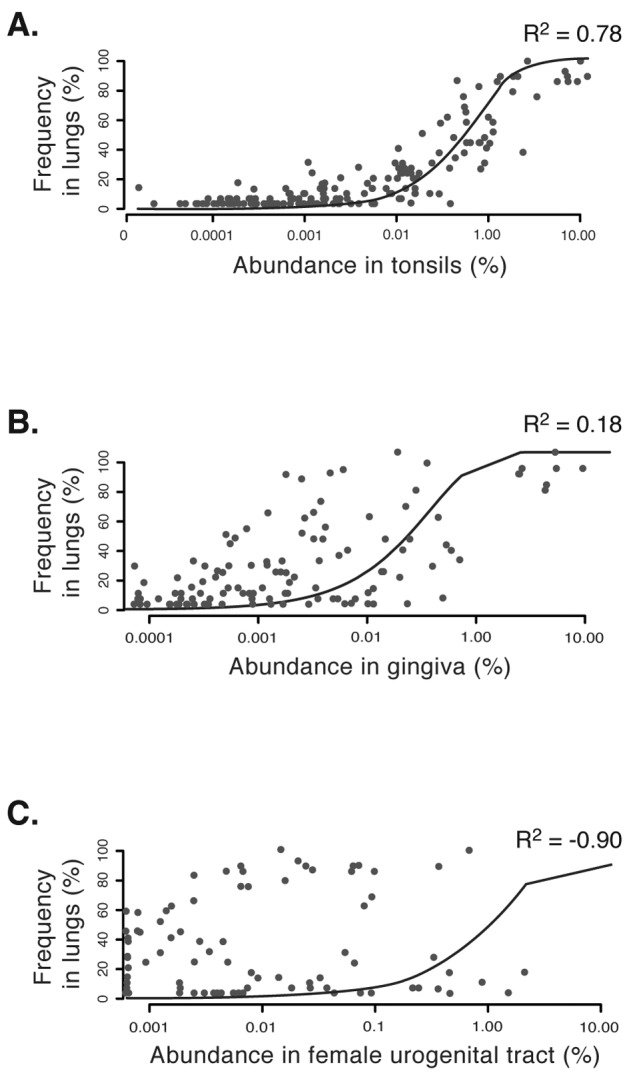
“Finally, the variability around this expected detection frequency was calculated using 95% binomial proportion confidence intervals (Wilson method [46]) with the HMisc package in R.”
MethodHomage to Santa Rosalia or Why Are There So Many Kinds of Animals?
Hutchinson, G. E. (1959) · The American Naturalist · doi:10.1086/282070 · Cited by 4,138
Quantifying the roles of immigration and chance in shaping prokaryote community structure
Sloan, W. T., Lunn, M., Woodcock, S., Head, I. M., Nee, S., & Curtis, T. P. (2006) · Environmental Microbiology · doi:10.1111/j.1462-2920.2005.00956.x · Cited by 1,887 · cited 1×
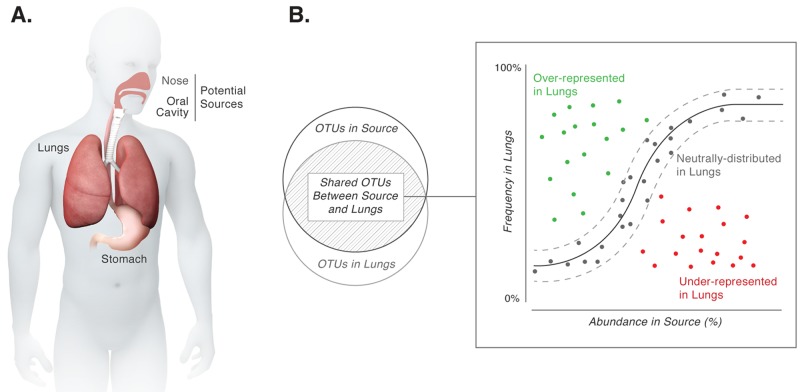
“Next, for each OTU shared between the lung and the source community, a beta probability distribution was used to calculate the expected frequency of detection in the lungs if it was present via dispersal and ecological drift (18).”
MethodWadsworth anaerobic bacteriology manual
Sutter, V. L., Citron, D. M., & Finegold, S. M. (1980) · Medical Entomology and Zoology · Cited by 1,388
Ecological Niches: Linking Classical and Contemporary Approaches
Chase, J. M., & Leibold, M. A. (2003) · Cited by 1,321
Recent findings on the viable but nonculturable state in pathogenic bacteria
Oliver, J. D. (2010) · FEMS Microbiology Reviews · doi:10.1111/j.1574-6976.2009.00200.x · Cited by 1,203 · cited 1×
“, Pneumocystis jirovecii in lungs) (41, 42).”
Cited by
Items 401–428 of 428
Christian Martin, H., Guzior, D. V., Gonzalez, C. T., Okros, M., Mielke, J., Padillo, L., Querido, G., Gil, M., Thomas, R. G., McClelland, M., et al. (2024) · Figshare · doi:10.6084/m9.figshare.26655229
Bacterial-fungal interactions in the air environment of composting facilities
Tao, Y., Xing, L., Li, J., Guo, Y., Xu, Q., Wang, X., Wang, J., Gao, M., & Chen, M. (2026) · Journal of Environmental Management · doi:10.1016/j.jenvman.2025.128438
The Role of the Respiratory Microbiome in Pneumonia
Baker, J. M., & Dickson, R. P. (2026) · Clinics in Chest Medicine · doi:10.1016/j.ccm.2025.12.004 · Cited by 1
Tan, Y., Liang, J., & Yi, Q. (2026) · Microbiology Spectrum · doi:10.1128/spectrum.02573-25
Occupational safety and health risk of seaport workers: A study in Bagerhat District
Aktar, R., Polly, A., Hossen, M. S., & Mimi, A. (2026) · Journal of Contemporary Studies in Epidemiology and Public Health · doi:10.29333/jconseph/18114
“Conversely, 85.5 percent of respondents ’ industries conducted regular machinery checks [25], demonstrating that the necessary measures to ensure the safety and health of all individuals affected by port operations should be managed in a manner that balances operational hazards with the costs…”
InfluentialRegard, L. (2019) · theses.fr (ABES) · doi:10.70675/0fc2d43fz2ce6z48b6za17bz193a5ee24f49
Bingula, R. (2019) · theses.fr (ABES) · doi:10.70675/0634dca5z63c4z42bdza47azaf2d4eb69fd8 · Cited by 1
Rôle du microbiote dans les interactions hôte-pathogène dans la tuberculose
Dumas, A. (2018) · theses.fr (ABES) · doi:10.70675/6773a408zdb52z44bbzb51ez3998deaf3ded
The organoid revolution to assess mycobacterial pulmonary infections
Leon‐Icaza, S. A. (2022) · theses.fr (ABES) · doi:10.70675/6e135d5fzb953z4ffcz9041z2684784040ad
Ndela, É. O. (2023) · theses.fr (ABES) · doi:10.70675/17b72026z076az4622za540z38bfb251dd02
Stavart, C., Gohy, S., Lebeer, S., Bambeke, F. V., Crabbé, A., & Pilette, C. (2026) · Frontiers in Cellular and Infection Microbiology · doi:10.3389/fcimb.2026.1796523 · Cited by 1
Hernandez, C. J. R., Cruz‐Cruz, A. D., Shrestha, C. L., Terekhova, M., Chen, P., Perpich, J. D., Potempa, B. A., Carey, K., Rohlfing, M. M., Peeples, M. E., et al. (2026) · Proceedings of the National Academy of Sciences · doi:10.1073/pnas.2503100123
“…even in healthy individuals, the lung microbiome is dominated by immigrating oral bacteria ( Prevotella sp., Fusobacterium sp., Streptococcus sp., Corynebacterium sp., and Porphyromonas sp.) that colonize the anatomically contiguous upper and lower airways via subclinical microaspiration (15–17).”
Uncovering Mechanistic Determinants of Host Phenotypes Using Microbial Systems Biology
Sumner, J. T., & Hartmann, E. M. (2026) · Integrative and Comparative Biology · doi:10.1093/icb/icag052
Jiménez, R. R., Thacher, P., Osborne, O. G., Gratwicke, B., & Muletz‐Wolz, C. R. (2026) · Ecosphere · doi:10.1002/ecs2.70699
The Composition of Dental Plaque in Patients With Pulmonary Hypertension
Song, J., Xing, Y., Liu, C., Yi, X., Hu, L., Hong, R., Luo, X., Jiang, C., Zhou, S., Hu, X., et al. (2026) · Comprehensive physiology · doi:10.1002/cph4.70238
“Further investigation is needed to elucidate the mechanistic links between oropharyngeal and lung microbiota (Bassis et al. 2015; Charlson et al. 2012, 2011; Pragman et al. 2018; Venkataraman et al. 2015).”
Stoner, S. N., Fairbanks-Mahnke, A., & Clark, S. E. (2026) · Journal of Bacteriology · doi:10.1128/jb.00228-26
“…to be sterile, advances in sequencing and culture methods in recent decades have proven the existence of a limited bio mass microbial community in the lower airways, resulting primarily from aspiration of oropharyngeal bacteria including Prevotella effectively “seeding” the lower airway (10, 62).”
Kageyama, S., Kan‐o, K., Asakawa, M., Ogata, H., Ogawa, T., Shiota, A., Jo, A., Ishii, Y., & Takeshita, T. (2026) · ISME Host Microbe · doi:10.1093/ismehm/aazag005
Li, W., Yuan, Y., Li, X., & Zhou, J. (2026) · Frontiers in Microbiology · doi:10.3389/fmicb.2026.1851847
“This model has been widely applied to study prokaryotic communities across diverse environments, including human, hot spring, lung, and animal gut microbi-omes (Venkataraman et al., 2015; Li and Ma, 2020a, 2020b; Ma, 2021a, 2021b, 2024; Ma and Ellison, 2018).”
Parolin, C., Gentile, E., Pellegrino, C., Spada, V., Bassi, C., Sabbioni, S., Vitali, B., Pinton, P., & Rimessi, A. (2026) · Biomedicines · doi:10.3390/biomedicines14091965
“Current ecological models indicate that the composition of the lung microbiome is determined primarily by the interplay of three processes: immigration from the upper airways, elimination, and local growth conditions [22,23].”
Ho, P.-M., Nazeer, R. R., Askenasy, I., Quinn, R. A., & Welch, M. (2026) · Journal of Cystic Fibrosis · doi:10.1016/j.jcf.2026.08.011
Feng, J., Li, S.-L., Chen, C., Zhang, L., Dai, X.-Y., Chen, X., Wu, H., Smets, B. F., Graham, D. W., Wu, D., et al. (2026) · Journal of Hazardous Materials · doi:10.1016/j.jhazmat.2026.143695
The role of the respiratory microbiome in acute and chronic respiratory diseases
Heinzinger, L. R., Segal, L. N., & Dickson, R. P. (2026) · Nature Reviews Microbiology · doi:10.1038/s41579-026-01377-w · Cited by 3
Metadata
- Authors
- Venkataraman, A., Bassis, C. M., Beck, J. M., Young, V. B., Curtis, J. L., Huffnagle, G. B., & Schmidt, T. M.
- Affiliations
- University of Michigan (US)
- VA Eastern Colorado Health Care System (US)
- Corresponding author
- Schmidt, Thomas M.
- ORCID
- Venue
- mBio
- Publisher
- American Society for Microbiology
- Published
- 2015-02-27
- Volume
- 6
- Issue
- 1
- ISSN
- 2150-7511 (ISSN-L)
- 2161-2129
- PMC
- PMC4324308
- OpenAlex
- W2105751172
- Cited by
- 428
- References
- 50
- Citations by year
- 2026: 22 · 2025: 27 · 2024: 39 · 2023: 50 · 2022: 37 · 2021: 47 · 2020: 46 · 2019: 37 · 2018: 39 · 2017: 38 · 2016: 26 · 2015: 20
- FWCI
- 37.17
- Type
- journal article
- Language
- en
- Open access
- gold
- doi.org
- Licence
- cc-by-nc-sa
- creativecommons.org/licenses/by-nc-sa/3.0/ (vor)
- journals.asm.org/non-commercial-tdm-license (tdm)
- Locations
- mBio (publishedVersion, cc-by-nc-sa)
- Europe PMC (PubMed Central) (publishedVersion, cc-by-nc-sa)
- PubMed Central (publishedVersion, cc-by-nc-sa)
- PubMed (publishedVersion)
- DOAJ (DOAJ: Directory of Open Access Journals) (submittedVersion, cc-by-sa)
- Funders
- U.S. Public Health Service (R01 0099549)
- National Heart, Lung, and Blood Institute (U01HL098961, R01HL114447, T32HL007749)
- National Institute of Diabetes and Digestive and Kidney Diseases (P30DK034933)
- Topics
- Physical Sciences › Environmental Science › Ecology › Microbial Community Ecology and Physiology
- Life Sciences › Biochemistry, Genetics and Molecular Biology › Molecular Biology › Gut microbiota and health
- Health Sciences › Dentistry › Periodontics › Oral microbiology and periodontitis research
- Keywords
- lung microbiome, neutral community model, microbial dispersal, oral cavity, bronchoalveolar lavage, bacterial culture, 16S rRNA gene sequences, microbial community structure
- MeSH terms
- Bacteria, Bronchoalveolar Lavage Fluid, DNA, Bacterial, Humans, Lung, Mouth, RNA, Ribosomal, 16S, Neural Networks, Computer, Microbiota
About these checks
Registry, retraction, Cites and statistics results are computed, not judged, with one exception: a printed reference that no index lists is read once by a model before it counts as a citation error. Claims are extracted by a model and kept only when their quote appears verbatim in the text; each cited source is then checked, with a model’s help, for whether it says what the claim relies on. Those verdicts can be wrong — read the claim’s quote and the cited source before relying on one.
Statistics and arithmetic are recomputed, not judged.
Confidence bands are shown only for fields calibrated on our annotated test set. None is calibrated yet, so no band is shown.
What counts as a claim ›How we measure confidence ›How we check this ›
Are you an author, or do you see a problem with this page? Request a review
Data sources
Bibliographic data: Semantic Scholar, OpenAlex, Crossref.
Contains information from the Semantic Scholar Academic Graph Datasets, made available under the ODC Attribution License (ODC-BY 1.0).
Semantic Scholar’s data is described in: Kinney, R., et al. (2023). The Semantic Scholar Open Data Platform. arXiv:2301.10140.
