

The DOI matches its Crossref record; 2 of the 2 references it cites were found in a registry or an index.
A red bole zircon record of cryptic silicic volcanism in the Deccan Traps, India
Abstract
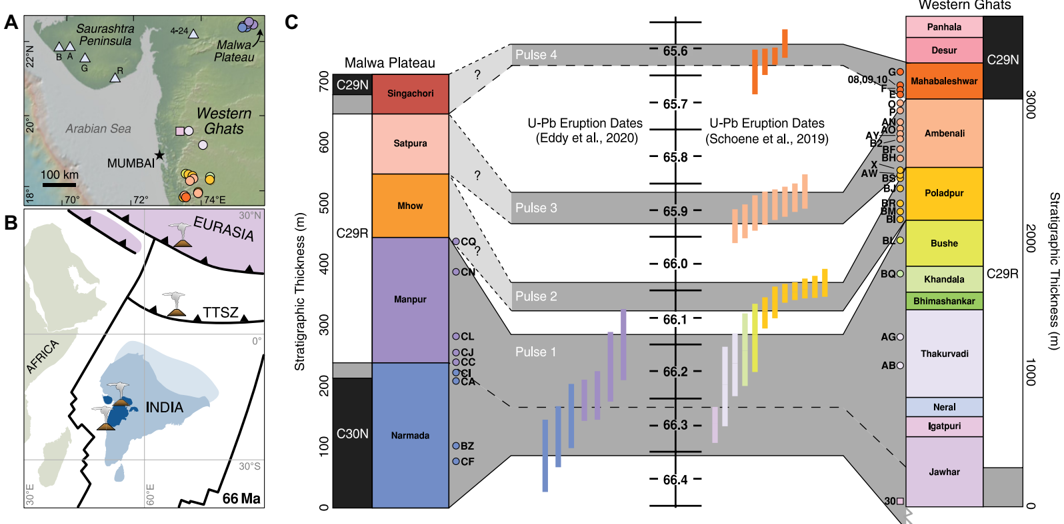
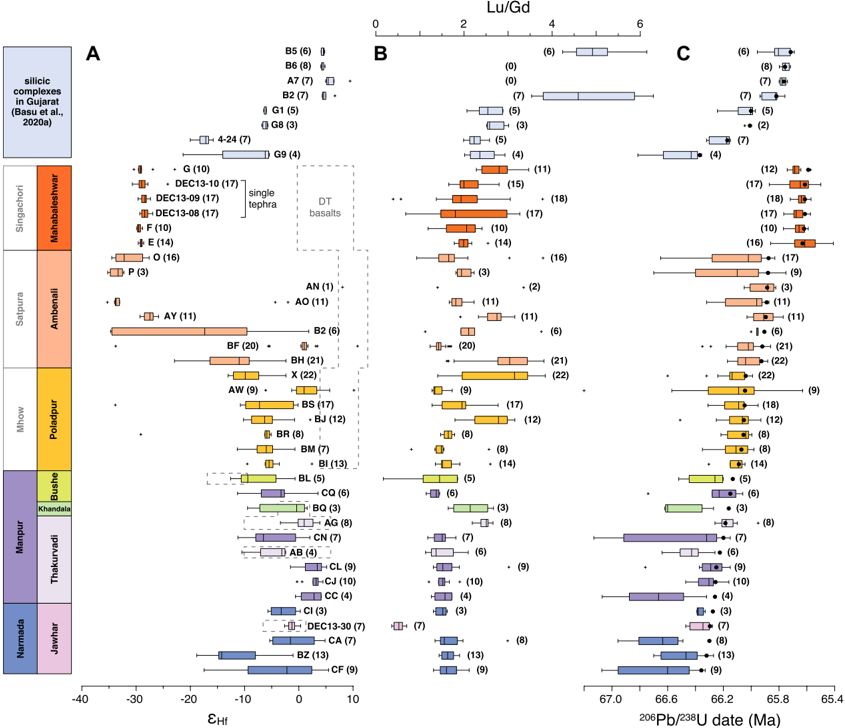
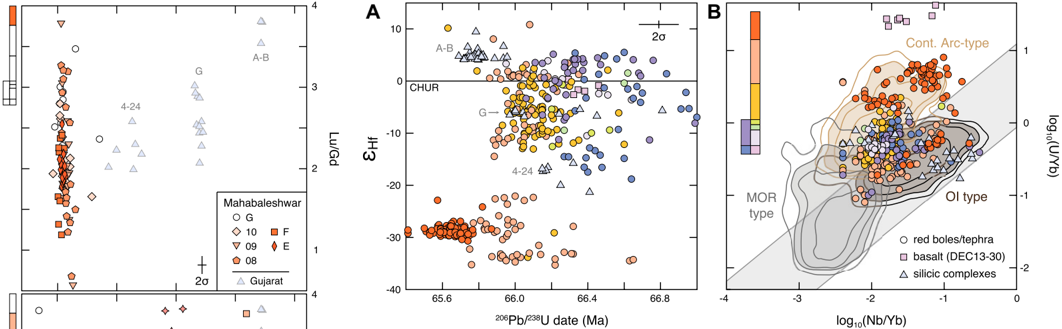
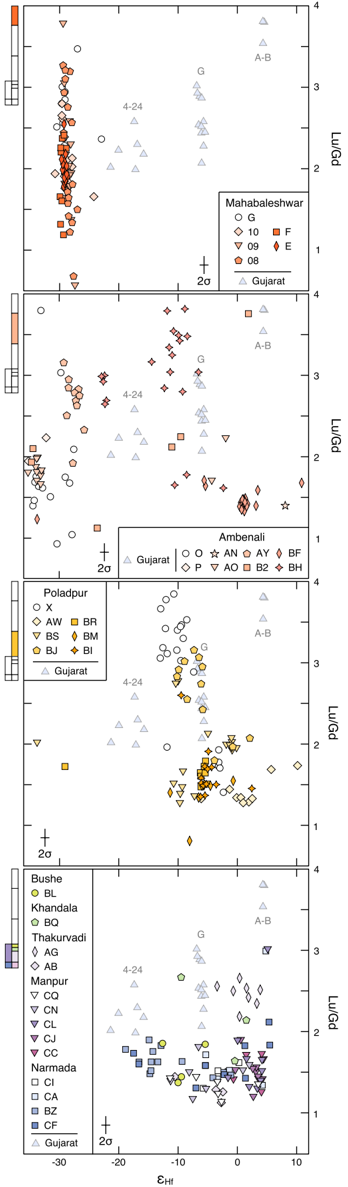
Silicic magmas within large igneous provinces (LIPs) are understudied relative to volumetrically dominant mafic magmas despite their prevalence and possible contribution to LIP-induced environmental degradation. In the 66 Ma Deccan LIP (India), evolved magmatism is documented, but its geographic distribution, duration, and significance remain poorly understood. Zircons deposited in weathered Deccan lava flow tops (“red boles”) offer a means of indirectly studying potentially widespread, silicic, explosive volcanism spanning the entire period of flood basalt eruptions. We explored this record through analysis of trace elements and Hf isotopes in zircon crystals previously dated by U–Pb geochronology. Our results show that zircon populations within individual red boles fingerprint distinct volcanic sources that likely developed in an intraplate setting on cratonic Indian lithosphere. However, our red bole zircon geochemical and isotopic characteristics do not match those from previously studied silicic magmatic centers, indicating that they must derive from yet undiscovered or understudied volcanic centers associated with the Deccan LIP.
Overview
The claims and statistics of this paper haven’t been checked yet.
Run the check — free, no account needed. It reads the open-access text and checks the sources it cites.
Integrity signals
Registry
Cites
Statistics
Figures
Verification
Claims the paper makes
The claims and statistics of this paper haven’t been checked yet.
Run the check — free, no account needed. It reads the open-access text and checks the sources it cites.
Claims other papers make about this one
Each is checked against this paper’s own text: does it say what the citing paper says it does?
In the citing paper
“Comparing the two major steps in the synchronized Os isotope records from Atlantic ODP Site 1262 and Pacific ODP Site 1209 with the latest radioisotopic dated DT eruptions (Fig. 2 and table S7) (10, 11, 13–15) provides compelling evidence of a direct linkage between large-scale volcanic activity and global changes in climate.”
From Earth orbital rhythms links timing of Deccan trap volcanism phases and global climate change (2025) · cites this paper as [10]
Self-check
Percentages, sums and reported differences re-computed from the paper’s own numbers.
The self-check needs the paper’s full text.
Citations
Cites
U-Pb constraints on pulsed eruption of the Deccan Traps across the end-Cretaceous mass extinction
Schoene, B., Eddy, M. P., Samperton, K. M., Keller, C. B., Keller, G., Adatte, T., & Khadri, S. F. R. (2019) · Science · doi:10.1126/science.aau2422 · Cited by 542
Self-citationThe eruptive tempo of Deccan volcanism in relation to the Cretaceous-Paleogene boundary
Sprain, C. J., Renne, P. R., Vanderkluysen, L., Pande, K., Self, S., & Mittal, T. (2019) · Science · doi:10.1126/science.aav1446 · Cited by 395
Research works printed but not linked: 34
- Basu, 2020, Widespread silicic and alkaline magmatism synchronous with the Deccan Traps flood basalts, India: Earth and Planetary Science Letters, 552, 116616
- Basu, 2020, A precise geochemical volcano-stratigraphy of the Deccan traps, Lithos, 376–377, 105754
- Bhaskar Rao, 2017, Evidence for Neoarchean basement for the Deccan volcanic flows around Koyna-Warna region, western India: Zircon U-Pb age and Hf-isotopic results, Journal of the Geological Society of India, 90, 752, 10.1007/s12594-017-0787-4 · DOI
- Bouilhol, 2013, Dating the India–Eurasia collision through arc magmatic records, Earth and Planetary Science Letters, 366, 163, 10.1016/j.epsl.2013.01.023 · DOI
- Bryan, 2002, Silicic volcanism: An undervalued component of large igneous provinces and volcanic rifted margins, 97, 10.1130/0-8137-2362-0.97 · DOI
- Chatterjee, 2001, Origin of the felsic and basaltic dikes and flows in the Rajula-Palitana-Sihor area of the Deccan Traps, Saurashtra, India: A geochemical and geochronological study, International Geology Review, 43, 1094, 10.1080/00206810109465063 · DOI
- Chenet, 2007, 40K–40Ar dating of the Main Deccan large igneous province: Further evidence of KTB age and short duration, Earth and Planetary Science Letters, 263, 1, 10.1016/j.epsl.2007.07.011 · DOI · Paper page
- Chu, 2011, India's hidden inputs to Tibetan orogeny revealed by Hf isotopes of Transhimalayan zircons and host rocks, Earth and Planetary Science Letters, 307, 479, 10.1016/j.epsl.2011.05.020 · DOI
- Courtillot, 2003, On the ages of flood basalt events, Comptes Rendus Geoscience, 335, 113, 10.1016/S1631-0713(03)00006-3 · DOI · Paper page
- Cucciniello, 2019, Mineralogy, geochemistry and 40Ar–39Ar geochronology of the Barda and Alech complexes, Saurashtra, northwestern Deccan Traps: Early silicic magmas derived by flood basalt fractionation, Geological Magazine, 156, 1668, 10.1017/S0016756818000924 · DOI · Paper page
- Duraiswami, 2020, A simple recipe for red bole formation in continental flood basalt provinces: Weathering of flow-top and flow-bottom breccias, Arabian Journal of Geosciences, 13, 1, 10.1007/s12517-020-05973-9 · DOI
- Eddy, 2020, U-Pb zircon age constraints on the earliest eruptions of the Deccan Large Igneous Province, Malwa Plateau, India: Earth and Planetary Science Letters, 540, 116249
- Ghosh, 2006, Inter-basaltic clay (bole bed) horizons from Deccan traps of India: Implications for palaeo-weathering and palaeo-climate during Deccan volcanism: Palaeogeography, Palaeoclimatology, Palaeoecology, 242, 90, 10.1016/j.palaeo.2006.05.018 · DOI
- Glišović, 2017, On the deep-mantle origin of the Deccan Traps, Science, 355, 613, 10.1126/science.aah4390 · DOI
- Grimes, 2015, “Fingerprinting” tectono-magmatic provenance using trace elements in igneous zircon, Contributions to Mineralogy and Petrology, 170, 46, 10.1007/s00410-015-1199-3 · DOI
- Hull, 2020, On impact and volcanism across the Cretaceous-Paleogene boundary, Science, 367, 266, 10.1126/science.aay5055 · DOI · Paper page
- Kasbohm, 2021, Radiometric constraints on the timing, tempo, and effects of large igneous province emplacement, 27
- Lightfoot, 1987, Petrogenesis of rhyolites and trachytes from the Deccan Trap: Sr, Nd and Pb isotope and trace element evidence, Contributions to Mineralogy and Petrology, 95, 44, 10.1007/BF00518029 · DOI
- Martin, 2020, Paleocene latitude of the Kohistan–Ladakh arc indicates multistage India–Eurasia collision, 29,487
- Mathur, 1926, Magmatic differentiation in Mount Girnar, The Journal of Geology, 34, 289, 10.1086/623314 · DOI
- Parisio, 2016, 40Ar/39Ar ages of alkaline and tholeiitic rocks from the northern Deccan Traps: Implications for magmatic processes and the K–Pg boundary, Journal of the Geological Society, 173, 679, 10.1144/jgs2015-133 · DOI · Paper page
- Ravikant, 2009, Zircon U-Pb and Hf isotopic constraints on petrogenesis of the Cretaceous–Tertiary granites in eastern Karakoram and Ladakh, India: Lithos, 110, 153
- Ray, 2008, Highly heterogeneous Precambrian basement under the central Deccan Traps, India: Direct evidence from xenoliths in dykes, Gondwana Research, 13, 375, 10.1016/j.gr.2007.10.005 · DOI
- Robock, 2000, Volcanic eruptions and climate, Reviews of Geophysics, 38, 191, 10.1029/1998RG000054 · DOI · Paper page
- Sahoo, 2020, Petro-geochemistry, Sr–Nd isotopes and 40Ar/39Ar ages of fractionated alkaline lamprophyres from the Mount Girnar igneous complex (NW India): Insights into the timing of magmatism and the lithospheric mantle beneath the Deccan Large Igneous Province, Lithos, 374, 105712
- Schoene, 2010, A new method integrating high-precision U-Pb geochronology with zircon trace element analysis (U-Pb TIMS-TEA), Geochimica et Cosmochimica Acta, 74, 7144, 10.1016/j.gca.2010.09.016 · DOI
- Schoene, 2015, U-Pb geochronology of the Deccan Traps and relation to the end-Cretaceous mass extinction, Science, 347, 182, 10.1126/science.aaa0118 · DOI · Paper page
- Schoene, 2021, An evaluation of Deccan Traps eruption rates using geochronologic data, Geochronology, 3, 181, 10.5194/gchron-3-181-2021 · DOI · Paper page
- Sheikh, 2020, Physical volcanology of the Pavagadh rhyolites, northern Deccan Traps: Stratigraphic, structural, and textural record of explosive and effusive eruptions, Journal of Volcanology and Geothermal Research, 404, 107024, 10.1016/j.jvolgeores.2020.107024 · DOI
- Sheth, 2008, The Mount Pavagadh volcanic suite, Deccan Traps: Geochemical stratigraphy and magmatic evolution, Journal of Asian Earth Sciences, 32, 5, 10.1016/j.jseaes.2007.10.001 · DOI
- Sheth, 2011, The Chogat-Chamardi subvolcanic complex, Saurashtra, northwestern Deccan Traps: Geology, petrochemistry, and petrogenetic evolution, Journal of Asian Earth Sciences, 41, 307, 10.1016/j.jseaes.2011.02.012 · DOI
- Sheth, 2021, Giant (30 km-diameter) silicic caldera of K/Pg boundary age in the northwestern Deccan Traps: The Alech Hills
- Smith, 2018, First U-Pb zircon ages for late Miocene Ashfall Konservat-Lagerstätte and Grove Lake ashes from eastern Great Plains, USA: PLoS One, 13, e0207103
- Widdowson, 1997, The geochemistry of Indian bole horizons: Palaeoenvironmental implications of Deccan intravolcanic palaeosurfaces, 269
Cited by
Earth orbital rhythms links timing of Deccan trap volcanism phases and global climate change
Westerhold, T., Dallanave, E., Penman, D., Schoene, B., Röhl, U., Gussone, N., & Kuroda, J. (2025) · Science Advances · doi:10.1126/sciadv.adr8584 · Cited by 17
Self-citation
Metadata
- Authors
- O’Connor, L., Szymanowski, D., Eddy, M. P., Samperton, K. M., & Schoene, B.
- Affiliations
- Department of Geosciences, Princeton University, Princeton, New Jersey 08544, USA
- Department of Earth, Atmospheric, and Planetary Sciences, Purdue University, West Lafayette, Indiana 47907, USA
- Trace Nuclear Measurement Technology Group, Savannah River National Laboratory, Aiken, South Carolina 29808, USA
- Venue
- Geology
- Publisher
- Geological Society of America
- Published
- 2022-01-05
- Volume
- 50
- Issue
- 4
- Pages
- 460-464
- ISSN
- 0091-7613
- 1943-2682
- Cited by
- 12
- References
- 2
- Language
- en
About these checks
Registry, retraction, Cites and statistics results are computed, not judged, with one exception: a printed reference that no index lists is read once by a model before it counts as a citation error. Claims are extracted by a model and kept only when their quote appears verbatim in the text; each cited source is then checked, with a model’s help, for whether it says what the claim relies on. Those verdicts can be wrong — read the claim’s quote and the cited source before relying on one.
Statistics and arithmetic are recomputed, not judged.
Confidence bands are shown only for fields calibrated on our annotated test set. None is calibrated yet, so no band is shown.
What counts as a claim ›How we measure confidence ›How we check this ›
Are you an author, or do you see a problem with this page? Request a review
How to cite
Cite CoChat for the checks on this page, and the paper for its own findings.
- This page
- CoChat. (2026). Citation check: A red bole zircon record of cryptic silicic volcanism in the Deccan Traps, India. https://app.cochat.ai/papers/10.1130/g49613.1
- The paper
- O’Connor, L., Szymanowski, D., Eddy, M. P., Samperton, K. M., & Schoene, B. (2022). A red bole zircon record of cryptic silicic volcanism in the Deccan Traps, India. Geology. https://doi.org/10.1130/g49613.1
