

The DOI matches its Crossref record; 3 of the 3 references it cites were found in a registry or an index.
An evaluation of Deccan Traps eruption rates using geochronologic data
Published version of a preprint
Abstract
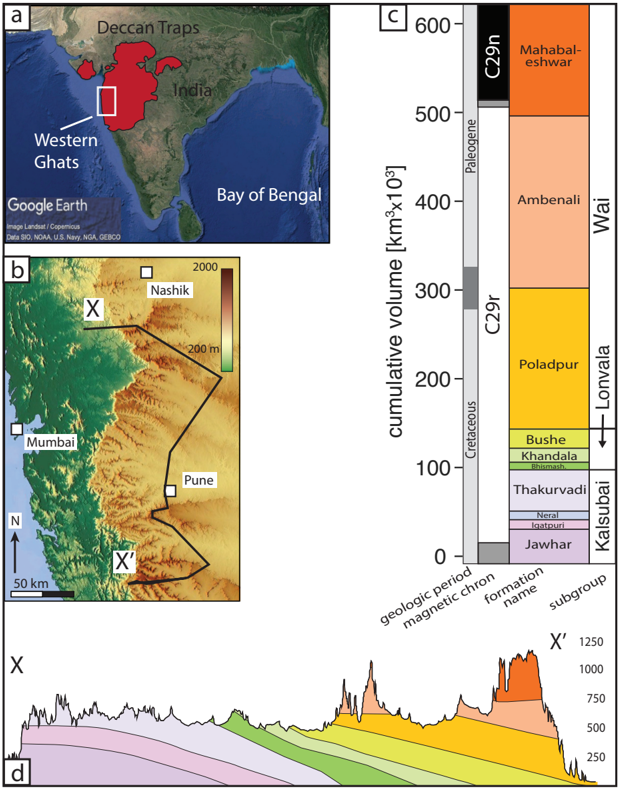
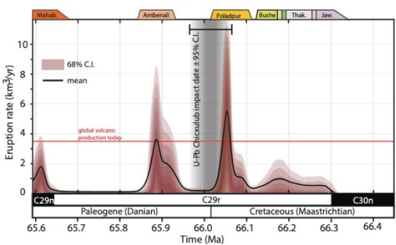
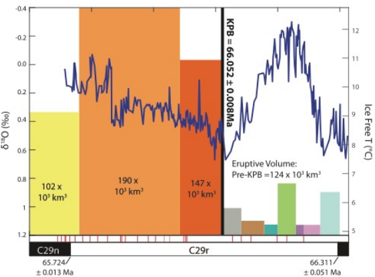
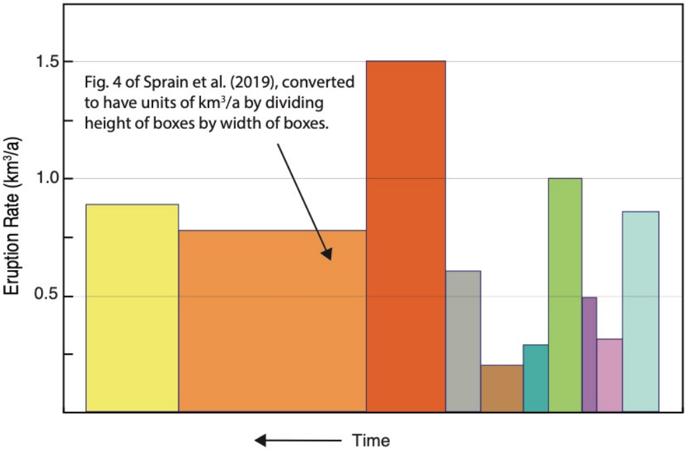
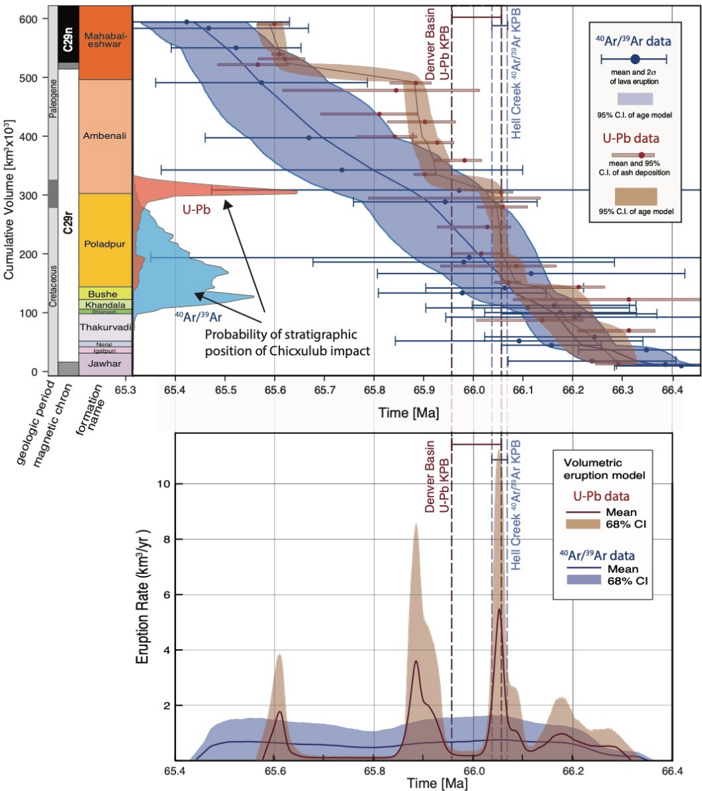
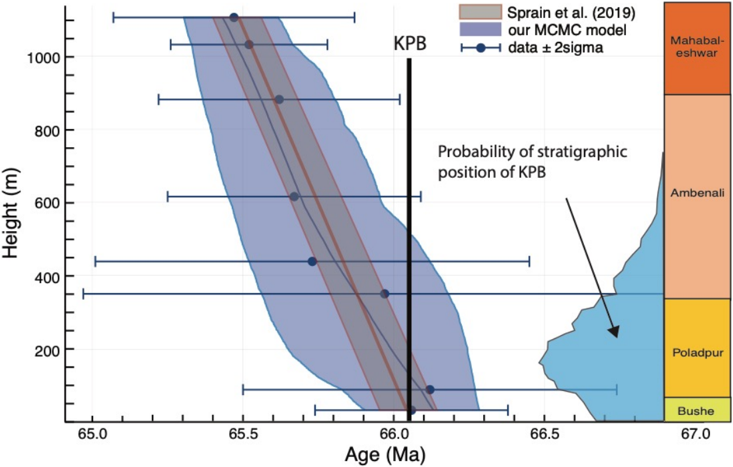
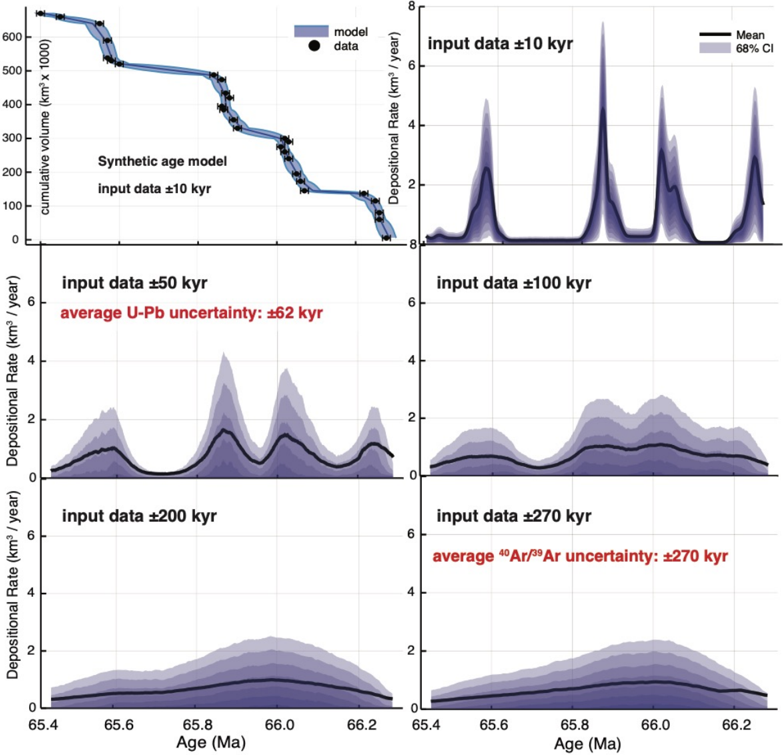
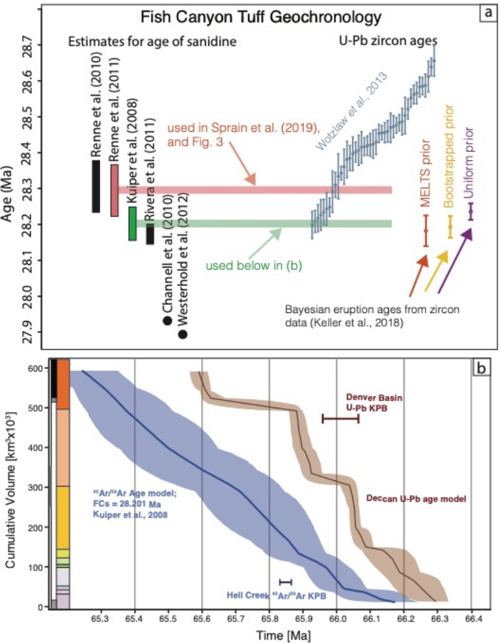
Recent attempts to establish the eruptive history of the Deccan Traps large igneous province have used both U−Pb (Schoene et al., 2019) and 40Ar/39Ar (Sprain et al., 2019) geochronology. Both of these studies report dates with high precision and unprecedented coverage for a large igneous province and agree that the main phase of eruptions began near the C30n–C29r magnetic reversal and waned shortly after the C29r–C29n reversal, totaling ∼ 700–800 kyr duration. These datasets can be analyzed in finer detail to determine eruption rates, which are critical for connecting volcanism, associated volatile emissions, and any potential effects on the Earth's climate before and after the Cretaceous–Paleogene boundary (KPB). It is our observation that the community has frequently misinterpreted how the eruption rates derived from these two datasets vary across the KPB. The U−Pb dataset of Schoene et al. (2019) was interpreted by those authors to indicate four major eruptive pulses before and after the KPB. The 40Ar/39Ar dataset did not identify such pulses and has been largely interpreted by the community to indicate an increase in eruption rates coincident with the Chicxulub impact (Renne et al., 2015; Richards et al., 2015). Although the overall agreement in eruption duration is an achievement for geochronology, it is important to clarify the limitations in comparing the two datasets and to highlight paths toward achieving higher-resolution eruption models for the Deccan Traps and for other large igneous provinces. Here, we generate chronostratigraphic models for both datasets using the same statistical techniques and show that the two datasets agree very well. More specifically, we infer that (1) age modeling of the 40Ar/39Ar dataset results in constant eruption rates with relatively large uncertainties through the duration of the Deccan Traps eruptions and provides no support for (or evidence against) the pulses identified by the U−Pb data, (2) the stratigraphic positions of the Chicxulub impact using the 40Ar/39Ar and U−Pb datasets do not agree within their uncertainties, and (3) neither dataset supports the notion of an increase in eruption rate as a result of the Chicxulub impact. We then discuss the importance of systematic uncertainties between the dating methods that challenge direct comparisons between them, and we highlight the geologic uncertainties, such as regional stratigraphic correlations, that need to be tested to ensure the accuracy of eruption models. While the production of precise and accurate geochronologic data is of course essential to studies of Earth history, our analysis underscores that the accuracy of a final result is also critically dependent on how such data are interpreted and presented to the broader community of geoscientists.
Overview
The claims and statistics of this paper haven’t been checked yet.
Run the check — free, no account needed. It reads the open-access text and checks the sources it cites.
Integrity signals
Registry
Cites
Statistics
Figures



Verification
Claims the paper makes
The claims and statistics of this paper haven’t been checked yet.
Run the check — free, no account needed. It reads the open-access text and checks the sources it cites.
Claims other papers make about this one
Each is checked against this paper’s own text: does it say what the citing paper says it does?
In the citing paper
“Sinnesael et al. (2025)-using Schoene et al.'s (2021) modeled pulses of eruptive rates-record significant fluctuations in the various isotopic proxies from the southern Atlantic records, that occurred during Chron C30n (∼600-800 k.y.preceding the KPgB).”
From Spatio-temporal volume recalibration shows Deccan volcanism caused Terminal Cretaceous Mass Extinction (2026) · cites this paper as Schoene et al. (2021)
Self-check
Percentages, sums and reported differences re-computed from the paper’s own numbers.
The self-check needs the paper’s full text.
Citations
Cites
U-Pb constraints on pulsed eruption of the Deccan Traps across the end-Cretaceous mass extinction
Schoene, B., Eddy, M. P., Samperton, K. M., Keller, C. B., Keller, G., Adatte, T., & Khadri, S. F. R. (2019) · Science · doi:10.1126/science.aau2422 · Cited by 542
Self-citationThe eruptive tempo of Deccan volcanism in relation to the Cretaceous-Paleogene boundary
Sprain, C. J., Renne, P. R., Vanderkluysen, L., Pande, K., Self, S., & Mittal, T. (2019) · Science · doi:10.1126/science.aav1446 · Cited by 395
Triggering of the largest Deccan eruptions by the Chicxulub impact
Richards, M. A., Alvarez, W., Self, S., Karlstrom, L., Renne, P. R., Manga, M., Sprain, C. J., Smit, J., Vanderkluysen, L., & Gibson, S. A. (2015) · Geological Society of America Bulletin · doi:10.1130/b31167.1 · Cited by 210
Research works printed but not linked: 100
- Alvarez, L. W., Alvarez, W., Asaro, F., and Michel, H. V.: Extraterrestrial cause for the Cretaceous-Tertiary extinction, Science, 208, 1095–1108, 1980. · DOI · Paper page
- Andersen, N. L., Jicha, B. R., Singer, B. S., and Hildreth, W.: Incremental heating of Bishop Tuff sanidine reveals preeruptive radiogenic Ar and rapid remobilization from cold storage, P. Natl. A. Sci. USA, 114, 12407, 10.1073/pnas.1709581114, 2017. · DOI
- Barry, T., Kelley, S., Reidel, S., Camp, V., Self, S., Jarboe, N., Duncan, R., Renne, P., Ross, M., and Wolff, J.: Eruption chronology of the Columbia River Basalt Group, in: The Columbia River Flood Basalt Province, Geological Society of America, Special Paper, 497, 45–66, 2013. · DOI
- Beane, J. E., Turner, C. A., Hooper, P. R., Subbarao, K. V., and Walsh, J. N.: Stratigraphy, composition and form of the Deccan Basalts, Western Ghats, India, B. Volcanol., 48, 61–83, 10.1007/BF01073513, 1986. · DOI · Paper page
- Blaauw, M. and Christen, J. A.: Flexible paleoclimate age-depth models using an autoregressive gamma process, Bayesian Anal., 6, 457–474, 2011. · DOI
- Black, B. A. and Gibson, S. A.: Deep Carbon and the Life Cycle of Large Igneous Provinces, Elements, 15, 319–324, 10.2138/gselements.15.5.319, 2019. · DOI
- Black, B. A. and Manga, M.: Volatiles and the tempo of flood basalt magmatism, Earth Planet. Sc. Lett., 458, 130–140, 10.1016/j.epsl.2016.09.035, 2017. · DOI
- Blackburn, T. J., Olsen, P. E., Bowring, S. A., McLean, N. M., Kent, D. V., Puffer, J., McHone, G., Rasbury, E. T., and Et-Touhami, M.: Zircon U-Pb Geochronology Links the End-Triassic Extinction with the Central Atlantic Magmatic Province, Science, 340, 941–945, 2013. · DOI
- Bond, D. P. G. and Wignall, P. B.: Large igneous provinces and mass extinctions: An update, Geol. S. Am. S., 505, 29–55, 2014. · DOI
- Burgess, S.: Deciphering mass extinction triggers, Science, 363, 815–816, 2019. · DOI
- Burgess, S., Muirhead, J., and Bowring, S.: Initial pulse of Siberian Traps sills as the trigger of the end-Permian mass extinction, Nat. Commun., 8, 1–6, 2017. · DOI
- Burgess, S. D. and Bowring, S. A.: High-precision geochronology confirms voluminous magmatism before, during, and after Earth's most severe extinction, Sci. Adv., 1, e1500470, 10.1126/sciadv.1500470, 2015. · DOI
- Byrnes, J. S. and Karlstrom, L.: Anomalous K-Pg–aged seafloor attributed to impact-induced mid-ocean ridge magmatism, Sci. Adv., 4, eaao2994, 10.1126/sciadv.aao2994, 2018. · DOI
- Chenet, A., Quidelleur, X., Fluteau, F., Courtillot, V., and Bajpai, S.: 40K-40Ar dating of the Main Deccan large igneous province: Further evidence of KTB age and short duration, Earth Planet. Sc. Lett., 263, 1–15, 10.1016/j.epsl.2007.07.011, 2007. · DOI · Paper page
- Chenet, A.-L., Fluteau, F., Courtillot, V., Gérard, M., and Subbarao, K. V.: Determination of rapid Deccan eruptions across the Cretaceous-Tertiary boundary using paleomagnetic secular variation: Results from a 1200 m-thick section in the Mahabaleshwar escarpment, J. Geophys. Res., 113, B04101, 10.1029/2006jb004635, 2008. · DOI · Paper page
- Chenet, A.-L., Courtillot, V., Fluteau, F., Gérard, M., Quidelleur, X., Khadri, S. F. R., Subbarao, K. V., and Thordarson, T.: Determination of rapid Deccan eruptions across the Cretaceous-Tertiary boundary using paleomagnetic secular variation: 2. Constraints from analysis of eight new sections and synthesis for a 3500 m-thick composite section, J. Geophys. Res., 114, B06103, 10.1029/2008jb005644, 2009. · DOI · Paper page
- Clyde, W. C., Ramezani, J., Johnson, K. R., Bowring, S. A., and Jones, M. M.: Direct high-precision U-Pb geochronology of the end-Cretaceous extinction and calibration of Paleocene astronomical timescales, Earth Planet. Sc. Lett., 452, 272–280, 2016. · DOI
- Condon, D., Schoene, B., McLean, N., Bowring, S., and Parrish, R.: Metrology and traceability of U-Pb isotope dilution geochronology (EARTHTIME Tracer Calibration Part I), Geochim. Cosmochim. Ac., 164, 464–480, 2015. · DOI
- Corfu, F.: A century of U-Pb geochronology: The long quest towards concordance, Geol. Soc. Am. Bull., 125, 33–47, 2013. · DOI
- Courtillot, V., Besse, J., Vandamme, D., Montigny, R., Jaeger, J.-J., and Cappetta, H.: Deccan flood basalts at the Cretaceous/Tertiary boundary?, Earth Planet. Sc. Lett., 80, 361–374, 10.1016/0012-821X(86)90118-4, 1986. · DOI · Paper page
- Courtillot, V., Feraud, G., Maluski, H., Vandamme, D., Moreau, M. G., and Besse, J.: Deccan flood basalts and the Cretaceous/Tertiary boundary, Nature, 333, 843–846, 1988. · DOI · Paper page
- Davies, J., Marzoli, A., Bertrand, H., Youbi, N., Ernesto, M., and Schaltegger, U.: End-Triassic mass extinction started by intrusive CAMP activity, Nat. Commun., 8, 15596, 10.1038/ncomms15596, 2017. · DOI
- Duraiswami, R. A., Sheth, H., Gadpallu, P., Youbi, N., and Chellai, E. H.: A simple recipe for red bole formation in continental flood basalt provinces: weathering of flow-top and flow-bottom breccias, Arab. J. Geosci., 13, 1–14, 2020. · DOI
- Eddy, M. P., Schoene, B., Samperton, K. M., Keller, G., Adatte, T., and Khadri, S. F.: U-Pb zircon age constraints on the earliest eruptions of the Deccan Large Igneous Province, Malwa Plateau, India, Earth Planet. Sc. Lett., 540, 116249, 10.1016/j.epsl.2020.116249, 2020. · DOI · Paper page
- Ellis, B. S., Mark, D. F., Pritchard, C. J., and Wolff, J. A.: Temporal dissection of the Huckleberry Ridge Tuff using the 40Ar/39Ar dating technique, Quat. Geochronol., 9, 34–41, 2012. · DOI
- Ernst, R. E. and Youbi, N.: How Large Igneous Provinces affect global climate, sometimes cause mass extinctions, and represent natural markers in the geological record, Palaeogeogr. Palaeocl., 478, 30–52, 2017. · DOI
- Galeotti, S., Sahy, D., Agnini, C., Condon, D., Fornaciari, E., Francescone, F., Giusberti, L., Pälike, H., Spofforth, D. J. A., and Rio, D.: Astrochronology and radio-isotopic dating of the Alano di Piave section (NE Italy), candidate GSSP for the Priabonian Stage (late Eocene), Earth Planet. Sc. Lett., 525, 115746, 10.1016/j.epsl.2019.115746, 2019. · DOI
- Ganino, C. and Arndt, N. T.: Climate changes caused by degassing of sediments during the emplacement of large igneous provinces, Geology, 37, 323–326, 2009. · DOI
- Ghosh, P., Sayeed, M. R. G., Islam, R., and Hundekari, S. M.: Inter-basaltic clay (bole bed) horizons from Deccan traps of India: Implications for palaeo-weathering and palaeo-climate during Deccan volcanism, Palaeogeogr. Palaeocl., 242, 90–109, 10.1016/j.palaeo.2006.05.018, 2006. · DOI
- Haslett, J. and Parnell, A.: A simple monotone process with application to radiocarbon-dated depth chronologies, J. R. Stat. Soc. C.-Appl., 57, 399–418, 2008. · DOI
- Henehan, M. J., Ridgwell, A., Thomas, E., Zhang, S., Alegret, L., Schmidt, D. N., Rae, J. W. B., Witts, J. D., Landman, N. H., Greene, S. E., Huber, B. T., Super, J. R., Planavsky, N. J., and Hull, P. M.: Rapid ocean acidification and protracted Earth system recovery followed the end-Cretaceous Chicxulub impact, P. Natl. Acad. Sci. USA, 116, 22500, 10.1073/pnas.1905989116, 2019. · DOI
- Hildebrand, A. R., Penfield, G. T., Kring, D. A., Pilkington, M., Camargo, Z., A., Jacobsen, S. B., and Boynton, W. V.: Chicxulub crater: a possible Cretaceous/Tertiary boundary impact crater on the Yucatan Peninsula, Mexico, Geology, 19, 867–871, 1991. · DOI · Paper page
- Hull, P. M., Bornemann, A., Penman, D. E., Henehan, M. J., Norris, R. D., Wilson, P. A., Blum, P., Alegret, L., Batenburg, S. J., and Bown, P. R.: On impact and volcanism across the Cretaceous–Paleogene boundary, Science, 367, 266–272, 2020. · DOI · Paper page
- Jay, A. E. and Widdowson, M.: Stratigraphy, structure and volcanology of the SE Deccan continental flood basalt province: implications for eruptive extent and volumes, J. Geol. Soc. London, 165, 177–188, 2008. · DOI · Paper page
- Kale, V. S., Dole, G., Shandilya, P., and Pande, K.: Stratigraphy and correlations in Deccan Volcanic Province, India: Quo vadis?, Bull. Geol. Soc. Am., 132, 588–607, 2020. · DOI
- Kasbohm, J. and Schoene, B.: Rapid eruption of the Columbia River flood basalt and correlation with the mid-Miocene climate optimum, Sci. Adv., 4, eaat8223, 10.1126/sciadv.aat8223, 2018. · DOI
- Kasbohm, J., Schoene, B., and Burgess, S.: Radiometric Constraints on the Timing, Tempo, and Effects of Large Igneous Province Emplacement, in: Large Igneous Provinces: A Driver of Global Environmental and Biotic Changes, edited by: Ernst, R. E., Dickson, A. J., and Bekker, A., American Geophysical Union, John Wiley and Sons, Inc., 27–82, 10.1002/9781119507444.ch2, 2020. · DOI
- Keller, C. B.: Chron.jl: A Bayesian framework for integrated eruption age and age-depth modelling, OSF (Open Science Framework), 10.17605/osf.io/TQX3F, 2018. · DOI
- Keller, C. B., Schoene, B., and Samperton, K. M.: A stochastic sampling approach to zircon eruption age interpretation, Geochem. Perspect. Lett., 8, 31–35, 2018. · DOI
- Keller, G., Adatte, T., Gardin, S., Bartolini, A., and Bajpai, S.: Main Deccan volcanism phase ends near the K–T boundary: Evidence from the Krishna–Godavari Basin, SE India, Earth Planet. Sc. Lett., 268, 293–311, 10.1016/j.epsl.2008.01.015, 2008. · DOI
- Kerr, A. C. and Ward, P. D.: A Dominant Role for The K-Pg Impact, available at: https://science.sciencemag.org/content/363/6429/862/tab-e-letters, last access: 17 August 2019.
- Knight, K. B., Renne, P. R., Halkett, A., and White, N.: 40Ar/39Ar dating of the Rajahmundry Traps, Eastern India and their relationship to the Deccan Traps, Earth Planet. Sc. Lett., 208, 85–99, 10.1016/s0012-821x(02)01154-8, 2003. · DOI · Paper page
- Kuiper, K. F., Deino, A., Hilgen, F. J., Krijgsman, W., Renne, P. R., and Wijbrans, J. R.: Synchronizing rocks clocks of Earth history, Science, 320, 500–504, 10.1126/science.1154339 2008. · DOI · Paper page
- Kwon, J., Min, K., Bickel, P. J., and Renne, P. R.: Statistical methods for jointly estimating the decay constant of 40K and the age of a dating standard, Math. Geol., 34, 457–474, 2002. · DOI
- Linzmeier, B. J., Jacobson, A. D., Sageman, B. B., Hurtgen, M. T., Ankney, M. E., Petersen, S. V., Tobin, T. S., Kitch, G. D., and Wang, J.: Calcium isotope evidence for environmental variability before and across the Cretaceous–Paleogene mass extinction, Geology, 48, 34–38, 2020. · DOI
- Machlus, M. L., Shea, E. K., Hemming, S. R., Ramezani, J., and Rasbury, E. T.: An assessment of sanidine from the Fire Clay tonstein as a Carboniferous 40Ar/39Ar monitor standard and for inter-method comparison to U-Pb zircon geochronology, Chem. Geol., 539, 119485, 10.1016/j.chemgeo.2020.119485, 2020. · DOI
- Mahood, G. A. and Benson, T. R.: Using 40Ar/39Ar ages of intercalated silicic tuffs to date flood basalts: Precise ages for Steens Basalt Member of the Columbia River Basalt Group, Earth Planet. Sc. Lett., 459, 340–351, 2017. · DOI
- Mark, D. F., Renne, P. R., Dymock, R. C., Smith, V. C., Simon, J. I., Morgan, L. E., Staff, R. A., Ellis, B. S., and Pearce, N. J.: High-precision 40Ar/39Ar dating of Pleistocene tuffs and temporal anchoring of the Matuyama-Brunhes boundary, Quat. Geochronol., 39, 1–23, 2017. · DOI
- Marzoli, A., Callegaro, S., Dal Corso, J., Davies, J. H., Chiaradia, M., Youbi, N., Bertrand, H., Reisberg, L., Merle, R., and Jourdan, F.: The Central Atlantic Magmatic Province (CAMP): A Review, in: The Late Triassic World, edited by: Tanner, L., Topics in Geobiology, vol 46, Springer, Cham, 10.1007/978-3-319-68009-5_4, 2018. · DOI
- Mattinson, J. M.: Revising the “gold standard” – the uranium decay constants of Jaffey et al., 1971, Eos Trans. AGU, Spring Meet. Suppl., Abstract V61A-02, 2000.
- Mattinson, J. M.: Zircon U-Pb chemical-abrasion (“CA-TIMS”) method: combined annealing and multi-step dissolution analysis for improved precision and accuracy of zircon ages, Chem. Geol., 220, 47–56, 2005. · DOI
- Mattinson, J. M.: Analysis of the relative decay constants of 235U and 238U by multi-step CA-TIMS measurements of closed-system natural zircon samples, Chem. Geol., 275, 186–198, 2010. · DOI
- McDougall, I. and Harrison, T. M.: Geochronology and Thermochronology by the 40Ar/39Ar method, 2nd edn., Oxford University Press, New York, NY, 1999.
- McLean, D. M.: Deccan Traps mantle degassing in the terminal Cretaceous marine extinctions, Cretaceous Res., 6, 235–259, 1985. · DOI
- McLean, N. M., Condon, D. J., Schoene, B., and Bowring, S. A.: Evaluating uncertainties in the calibration of isotopic reference materials and multi-element isotopic tracers (EARTHTIME Tracer Calibration Part II), Geochim. Cosmochim. Ac., 164, 481–501, 2015. · DOI
- Milligan, J. N., Royer, D. L., Franks, P. J., Upchurch, G. R., and McKee, M. L.: No evidence for a large atmospheric CO2 spike across the Cretaceous–Paleogene boundary, Geophys. Res. Lett., 46, 3462–3472, 2019. · DOI
- Min, K., Mundil, R., Renne, P. R., and Ludwig, K. R.: A test for systematic errors in 40Ar/39Ar geochronology through comparison with U-Pb analysis of a 1.1 Ga rhyolite, Geochim. Cosmochim. Ac., 64, 73–98, 2000. · DOI
- Minnis, P., Harrison, E. F., Stowe, L. L., Gibson, G., Denn, F. M., Doelling, D., and Smith, W.: Radiative climate forcing by the Mount Pinatubo eruption, Science, 259, 1411–1415, 1993. · DOI
- Mitchell, C. and Widdowson, M.: A geological map of the southern Deccan Traps, India and its structural implications, J. Geol. Soc. London, 148, 495–505, 1991. · DOI
- Parisio, L., Jourdan, F., Marzoli, A., Melluso, L., Sethna, S. F., and Bellieni, G.: 40Ar/39Ar ages of alkaline and tholeiitic rocks from the northern Deccan Traps: implications for magmatic processes and the K–Pg boundary, J. Geol. Soc. London, 173, 679–688, 2016. · DOI · Paper page
- Parnell, A. C., Buck, C. E., and Doan, T. K.: A review of statistical chronology models for high-resolution, proxy-based Holocene palaeoenvironmental reconstruction, Quaternary Sci. Rev., 30, 2948–2960, 10.1016/j.quascirev.2011.07.024, 2011. · DOI
- Parsons-Davis, T., Wimpenny, J., Keller, C. B., Thomas, K., Samperton, K. M., Renne, P. R., Mundil, R., Moody, K., Knight, K., and Kristo, M. J.: New measurement of the 238U decay constant with inductively coupled plasma mass spectrometry, J. Radioanal. Nucl. Ch., 318, 711–721, 2018. · DOI
- Rampino, M. R. and Caldeira, K.: Antipodal hotspot pairs on the Earth, Geophys. Res. Lett., 19, 2011–2014, 1992. · DOI
- Reiners, P. W., Carlson, R. W., Renne, P. R., Cooper, K. M., Granger, D. E., McLean, N. M., and Schoene, B.: Geochronology and thermochronology, John Wiley & Sons, Hoboken, NJ, 2017. · DOI
- Renne, P.: Interactive comment on “An evaluation of Deccan Traps eruptions rates using geochronologic data” by Blair Schoene et al., Geochronology Discuss., 10.5194/gchron-2020-11-RC3, 2020. · DOI
- Renne, P. R., Karner, D. B., and Ludwig, K. R.: Absolute ages aren't exactly, Science, 282, 1840–1841, 1998. · DOI
- Renne, P. R., Mundil, R., Balco, G., Min, K., and Ludwig, K. R.: Joint determination of 40K decay constants and 40Ar/40K for the Fish Canyon sanidine standard, and improved accuracy for 40Ar/39Ar geochronology, Geochim. Cosmochim. Ac., 74, 5349–5367, 2010. · DOI
- Renne, P. R., Balco, G., Ludwig, K. R., Mundil, R., and Min, K.: Response to the comment by WH Schwarz et al. on “Joint determination of 40K decay constants and 40Ar*/40K for the Fish Canyon sanidine standard, and improved accuracy for 40Ar/39Ar geochronology” by P. R. Renne et al. (2010), Geochim. Cosmochim. Ac., 75, 5097–5100, 2011. · DOI
- Renne, P. R., Deino, A. L., Hilgen, F. J., Kuiper, K. F., Mark, D. F., Mitchell III, W. S., Morgan, L. E., Mundil, R., and Smit, J.: Time scales of critical events around the Cretaceous–Paleogene boundary, Science, 339, 684–687, 10.1126/science.1230492, 2013. · DOI · Paper page
- Renne, P. R., Sprain, C. J., Richards, M. A., Self, S., Vanderkluysen, L., and Pande, K.: State shift in Deccan volcanism at the Cretaceous–Paleogene boundary, possibly induced by impact, Science, 350, 76–78, 2015. · DOI · Paper page
- Ricci, J., Quidelleur, X., Pavlov, V., Orlov, S., Shatsillo, A., and Courtillot, V.: New 40Ar/39Ar and K-Ar ages of the Viluy traps (Eastern Siberia): further evidence for a relationship with the Frasnian–Famennian mass extinction, Palaeogeogr. Palaeocl., 386, 531–540, 2013. · DOI
- Rivera, T. A., Storey, M., Zeeden, C., Hilgen, F. J., and Kuiper, K.: A refined astronomically calibrated 40Ar/39Ar age for Fish Canyon sanidine, Earth Planet. Sc. Lett., 311, 420–426, 2011. · DOI
- Robock, A.: Volcanic eruptions and climate, Rev. Geophys., 38, 191–219, 2000. · DOI · Paper page
- Sahy, D., Condon, D. J., Hilgen, F. J., and Kuiper, K. F.: Reducing Disparity in Radio-Isotopic and Astrochronology-Based Time Scales of the Late Eocene and Oligocene, Paleoceanography, 32, 1018–1035, 10.1002/2017PA003197, 2017. · DOI
- Sayyed, M., Pardeshi, R., and Islam, R.: Palaeoweathering characteristics of an intrabasaltic red bole of the Deccan Flood Basalts near Shrivardhan of western coast of India, J. Earth Syst. Sci., 123, 1717–1728, 2014. · DOI
- Schaltegger, U., Schmitt, A., and Horstwood, M.: U-Th-Pb zircon geochronology by ID-TIMS, SIMS, and laser ablation ICP-MS: Recipes, interpretations, and opportunities, Chem. Geol., 402, 89–110, 2015. · DOI
- Schöbel, S., de Wall, H., Ganerød, M., Pandit, M. K., and Rolf, C.: Magnetostratigraphy and 40Ar-39Ar geochronology of the Malwa Plateau region (Northern Deccan Traps), central western India: Significance and correlation with the main Deccan Large Igneous Province sequences, J. Asian Earth Sci., 89, 28–45, 10.1016/j.jseaes.2014.03.022, 2014. · DOI · Paper page
- Schoene, B.: U-Th-Pb geochronology, in: Treatise on Geochemistry, edited by: Rudnick, R., Elsevier, Oxford, UK, 341–378, 2014. · DOI
- Schoene, B., Crowley, J. L., Condon, D. C., Schmitz, M. D., and Bowring, S. A.: Reassessing the uranium decay constants for geochronology using ID-TIMS U-Pb data, Geochim. Cosmochim. Ac., 70, 426–445, 2006. · DOI
- Schoene, B., Guex, J., Bartolini, A., Schaltegger, U., and Blackburn, T. J.: Correlating the end-Triassic mass extinction and flood basalt volcanism at the 100 000 year level, Geology, 38, 387–390, 10.1130/G30683.1, 2010. · DOI
- Schoene, B., Samperton, K. M., Eddy, M. P., Keller, G., Adatte, T., Bowring, S. A., Khadri, S. F., and Gertsch, B.: U-Pb geochronology of the Deccan Traps and relation to the end-Cretaceous mass extinction, Science, 347, 182–184, 2015. · DOI · Paper page
- Schulte, P., Alegret, L., Arenillas, I., Arz, J. A., Barton, P. J., Bown, P. R., Bralower, T. J., Christeson, G. L., Claeys, P., and Cockell, C. S.: The Chicxulub asteroid impact and mass extinction at the Cretaceous–Paleogene boundary, Science, 327, 1214–1218, 2010. · DOI · Paper page
- Self, S., Blake, S., Sharma, K., Widdowson, M., and Sephton, S.: Sulfur and chlorine in late Cretaceous Deccan magmas and eruptive gas release, Science, 319, 1654–1657, 10.1126/science.1152830, 2008. · DOI · Paper page
- Self, S., Schmidt, A., and Mather, T. A.: Emplacement characteristics, time scales, and volcanic gas release rates of continental flood basalt eruptions on Earth, Geol. S. Am. S., 505, 319–337, 2014. · DOI
- Sepúlveda, J., Alegret, L., Thomas, E., Haddad, E., Cao, C., and Summons, R. E.: Stable Isotope Constraints on Marine Productivity Across the Cretaceous–Paleogene Mass Extinction, Paleoceanogr. Paleoclimatol., 34, 1195–1217, 10.1029/2018pa003442, 2019. · DOI
- Shellnutt, J. G., Denyszyn, S. W., and Mundil, R.: Precise age determination of mafic and felsic intrusive rocks from the Permian Emeishan large igneous province (SW China), Gondwana Res., 22, 118–126, 2012. · DOI
- Sheth, H., Vanderkluysen, L., Demonterova, E. I., Ivanov, A. V., and Savatenkov, V. M.: Geochemistry and 40Ar/39Ar geochronology of the Nandurbar-Dhule mafic dyke swarm: Dyke-sill-flow correlations and stratigraphic development across the Deccan flood basalt province, Geol. J., 54, 157–176, 2019. · DOI · Paper page
- Simon, J. I., Renne, P. R., and Mundil, R.: Implications of pre-eruptive magmatic histories of zircons for U-Pb geochronology of silicic extrusions, Earth Planet. Sc. Lett., 266, 182–194, 2008. · DOI
- Smit, J. and Hertogen, J.: An extraterrestrial event at the Cretaceous–Tertiary boundary, Nature, 285, 198–200, 1980. · DOI
- Sprain, C. J.: Interactive comment on “An evaluation of Deccan Traps eruptions rates using geochronologic data” by Blair Schoene et al., Geochronology Discuss., 10.5194/gchron-2020-11-RC2, 2020. · DOI
- Sprain, C. J., Renne, P. R., Clemens, W. A., and Wilson, G. P.: Calibration of chron C29r: New high-precision geochronologic and paleomagnetic constraints from the Hell Creek region, Montana, Bulletin, 130, 1615–1644, 2018. · DOI · Paper page
- Svensen, H., Planke, S., Malthe-Sørenssen, A., Jamtveit, B., Myklebust, R., Eidem, T. R., and Rey, S. S.: Release of methane from a volcanic basin as a mechanism for initial Eocene global warming, Nature, 429, 542–545, 2004. · DOI
- Svensen, H., Planke, S., and Corfu, F.: Zircon dating ties NE Atlantic sill emplacement to initial Eocene global warming, J. Geol. Soc. London, 167, 433–436, 2010. · DOI
- Svensen, H., Corfu, F., Polteau, S., Hammer, Ø., and Planke, S.: Rapid magma emplacement in the Karoo large igneous province, Earth Planet. Sc. Lett., 325, 1–9, 2012. · DOI
- Thordarson, T. and Self, S.: The Roza Member, Columbia River Basalt Group: A gigantic pahoehoe lava flow field formed by endogenous processes?, J. Geophys. Res.-Sol. Ea., 103, 27411–27445, 1998. · DOI · Paper page
- Villeneuve, M., Sandeman, H. A., and Davis, W. J.: A method for intercalibration of U-Th-Pb and 40Ar-39Ar ages in the Phanerozoic, Geochim. Cosmochim. Ac., 64, 4017–4030, 2000. · DOI
- Voosen, P.: Did volcanic eruptions help kill off the dinosaurs?, AAAS, Washington, D.C., 10.1126/science.aax1020, 2019. · DOI
- Widdowson, M., Walsh, J. N., and Subbarao, K. V.: The geochemistry of Indian bole horizons: palaeoenvironmental implications of Deccan intravolcanic palaeosurfaces, Geological Society, London, Special Publications, 120, 269–281, 10.1144/gsl.sp.1997.120.01.17, 1997. · DOI
- Wotzlaw, J.-F., Schaltegger, U., Frick, D. A., Dungan, M. A., Gerdes, A., and Günther, D.: Tracking the evolution of large-volume silicic magma reservoirs from assembly to supereruption, Geology, 41, 867–870, 2013. · DOI
- Wright, A. J., Edwards, R. J., van de Plassche, O., Blaauw, M., Parnell, A. C., van der Borg, K., de Jong, A. F., Roe, H. M., Selby, K., and Black, S.: Reconstructing the accumulation history of a saltmarsh sediment core: Which age-depth model is best?, Quat. Geochronol., 39, 35–67, 2017. · DOI
Cited by
Mercury linked to Deccan Traps volcanism, climate change and the end-Cretaceous mass extinction
Keller, G., Mateo, P., Monkenbusch, J., Thibault, N., Punekar, J., Spangenberg, J. E., Abramovich, S., Ashckenazi-Polivoda, S., Schoene, B., Eddy, M. P., et al. (2020) · Global and Planetary Change · doi:10.1016/j.gloplacha.2020.103312 · Cited by 130
Self-citationThe Magmatic Architecture of Continental Flood Basalts I: Observations From the Deccan Traps
Mittal, T., Richards, M. A., & Fendley, I. M. (2021) · Journal of Geophysical Research: Solid Earth · doi:10.1029/2021jb021808 · Cited by 42
Kale, V. S., Upasani, D., Rajput, M., Dole, G., & Pillai, S. P. (2026) · Geological Society of America Bulletin · doi:10.1130/b38412.1 · Cited by 3
Metadata
- Authors
- Schoene, B., Eddy, M. P., Keller, C. B., & Samperton, K. M.
- Venue
- Geochronology
- Publisher
- Copernicus GmbH
- Published
- 2021-04-16
- Volume
- 3
- Issue
- 1
- Pages
- 181-198
- ISSN
- 2628-3719
- Cited by
- 73
- References
- 3
- Language
- en
About these checks
Registry, retraction, Cites and statistics results are computed, not judged, with one exception: a printed reference that no index lists is read once by a model before it counts as a citation error. Claims are extracted by a model and kept only when their quote appears verbatim in the text; each cited source is then checked, with a model’s help, for whether it says what the claim relies on. Those verdicts can be wrong — read the claim’s quote and the cited source before relying on one.
Statistics and arithmetic are recomputed, not judged.
Confidence bands are shown only for fields calibrated on our annotated test set. None is calibrated yet, so no band is shown.
What counts as a claim ›How we measure confidence ›How we check this ›
Are you an author, or do you see a problem with this page? Request a review
How to cite
Cite CoChat for the checks on this page, and the paper for its own findings.
- This page
- CoChat. (2026). Citation check: An evaluation of Deccan Traps eruption rates using geochronologic data. https://app.cochat.ai/papers/10.5194/gchron-3-181-2021
- The paper
- Schoene, B., Eddy, M. P., Keller, C. B., & Samperton, K. M. (2021). An evaluation of Deccan Traps eruption rates using geochronologic data. Geochronology. https://doi.org/10.5194/gchron-3-181-2021
