

Review of health information technology usability study methodologies
Open accessThe DOI matches its Crossref record; 77 of the 78 references it cites were found in a registry or an index.
Abstract
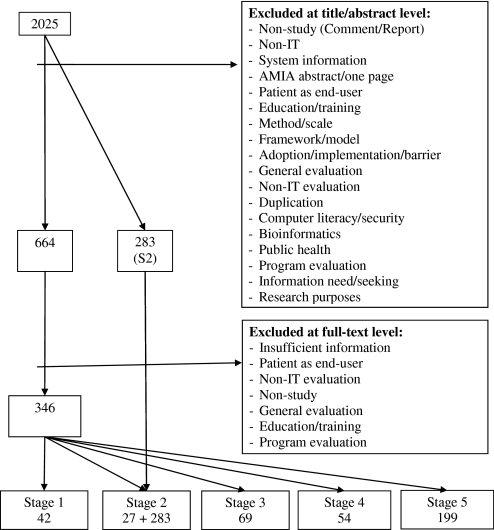
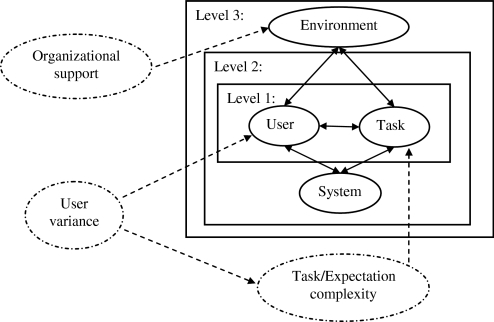
Usability factors are a major obstacle to health information technology (IT) adoption. The purpose of this paper is to review and categorize health IT usability study methods and to provide practical guidance on health IT usability evaluation. 2025 references were initially retrieved from the Medline database from 2003 to 2009 that evaluated health IT used by clinicians. Titles and abstracts were first reviewed for inclusion. Full-text articles were then examined to identify final eligibility studies. 629 studies were categorized into the five stages of an integrated usability specification and evaluation framework that was based on a usability model and the system development life cycle (SDLC)-associated stages of evaluation. Theoretical and methodological aspects of 319 studies were extracted in greater detail and studies that focused on system validation (SDLC stage 2) were not assessed further. The number of studies by stage was: stage 1, task-based or user-task interaction, n=42; stage 2, system-task interaction, n=310; stage 3, user-task-system interaction, n=69; stage 4, user-task-system-environment interaction, n=54; and stage 5, user-task-system-environment interaction in routine use, n=199. The studies applied a variety of quantitative and qualitative approaches. Methodological issues included lack of theoretical framework/model, lack of details regarding qualitative study approaches, single evaluation focus, environmental factors not evaluated in the early stages, and guideline adherence as the primary outcome for decision support system evaluations. Based on the findings, a three-level stratified view of health IT usability evaluation is proposed and methodological guidance is offered based upon the type of interaction that is of primary interest in the evaluation.
Overview
The claims and statistics of this paper haven’t been checked yet.
Free: it reads the open-access text and checks the first 5 claims that cite a source we can check. Create a free account to check every claim.
Integrity signals
Registry
Cites
Statistics
Figures
Verification
Claims the paper makes
The claims and statistics of this paper haven’t been checked yet.
Free: it reads the open-access text and checks the first 5 claims that cite a source we can check. Create a free account to check every claim.
Claims other papers make about this one
Each is checked against this paper’s own text: does it say what the citing paper says it does?
The cited source says what the claim attributes to it.
In the citing paper
“Usability challenges present a major barrier to health information technology adoption 29”
From A chatbot for hypertension self-management support: user-centered design, development, and usability testing (2023) · cites this paper as [29]
Self-check
Percentages, sums and reported differences re-computed from the paper’s own numbers.
The self-check needs the paper’s full text.
Citations
Cites
Perceived usefulness, perceived ease of use, and user acceptance of information technology
Davis, F. D. (1989) · MIS Quarterly · doi:10.2307/249008 · Cited by 68,483
(1993) · Cited by 9,879
Nielsen, J. (1995) · Conference companion on Human factors in computing systems - CHI '95 · doi:10.1145/223355.223730 · Cited by 2,620
IBM computer usability satisfaction questionnaires: Psychometric evaluation and instructions for use
Lewis, J. R. (1995) · International Journal of Human-Computer Interaction · doi:10.1080/10447319509526110 · Cited by 2,429
Development of an instrument measuring user satisfaction of the human-computer interface
Chin, J. P., Diehl, V. A., & Norman, L. K. (1988) · Proceedings of the SIGCHI conference on Human factors in computing systems - CHI '88 · doi:10.1145/57167.57203 · Cited by 1,609
Participatory Design: Principles and Practices
(2017) · CRC Press eBooks · doi:10.1201/9780203744338 · Cited by 1,500 · cited 1×
“Although we found only one theoretical framework and one method not covered in our review, approaches such as participatory design and ethnography provide overall frameworks that link sets of methods together in a manner that is greater than the sum of their parts.(79) Therefore, a review that included searches of add…”
MethodA Practical Guide to Usability Testing
Dumas, J. F., & Redish, J. C. (1993) · Cited by 1,335
Poissant, L. (2005) · Journal of the American Medical Informatics Association · doi:10.1197/jamia.m1700 · Cited by 901 · cited 4×
“Rahimi and Vimar-lund 10 reviewed general methods used to evaluate health IT.”
MethodInfluentialBiomedical Informatics: Computer Applications in Health Care and Biomedicine
(2024) · Biomedical Informatics: Computer Applications in Health Care and Biomedicine · doi:10.33029/9704-8204-9-bin-2024-1-744 · Cited by 777
Cognitive and usability engineering methods for the evaluation of clinical information systems.
Kushniruk, A. W., & Patel, V. L. (2004) · Journal of Biomedical Informatics · doi:10.1016/j.jbi.2004.01.003 · Cited by 760 · cited 1×
“Kushniruk and Patel 8 provided a methodological review for cognitive and usability engineering methods.”
The cognitive walkthrough method: a practitioner's guide
Wharton, C., Rieman, J., Lewis, C., & Polson, P. G. (1994) · John Wiley & Sons, Inc. eBooks · Cited by 713
Wizard of Oz studies — why and how
Dahlbäck, N., Jönsson, A., & Ahrenberg, L. (1993) · Knowledge-Based Systems · doi:10.1016/0950-7051(93)90017-n · Cited by 706
Koppel, R., Wetterneck, T., Telles, J. L., & Karsh, B.-T. (2008) · Journal of the American Medical Informatics Association · doi:10.1197/jamia.m2616 · Cited by 685 · cited 1×
“72 73 Guideline adherence as the primary outcome for clinical decision support systems Clinical decision support systems were typically evaluated for their effectiveness by clinician adherence to guideline recommendations.”
Clinical Decision-Support Systems
Musen, M. A., Middleton, B., & Greenes, R. A. (2014) · Biomedical Informatics · doi:10.1007/978-1-4471-4474-8_22 · Cited by 483
Usability Meanings and Interpretations in ISO Standards
Abran, A., Khelifi, A., Suryn, W., & Seffah, A. (2003) · Software Quality Journal · doi:10.1023/a:1025869312943 · Cited by 451
Evaluation of health information systems—problems and challenges
Ammenwerth, E., Gräber, S., Herrmann, G., Bürkle, T., & König, J. (2003) · International Journal of Medical Informatics · doi:10.1016/s1386-5056(03)00131-x · Cited by 412 · cited 2×
“Ammenwerth et al 7 summarized general recommendations for IT evaluation based on the three challenges listed in this section.”
Usability—context, framework, definition, design and evaluation
Shackel, B. (1991) · Cambridge University Press eBooks · Cited by 399
Patterson, E. S., Cook, R. I., & Render, M. L. (2002) · Journal of the American Medical Informatics Association · doi:10.1197/jamia.m1061 · Cited by 370
Human factors for informatics usability
(1992) · Applied Ergonomics · doi:10.1016/0003-6870(92)90090-i · Cited by 354
Categorizing the unintended sociotechnical consequences of computerized provider order entry
Ash, J. S., Sittig, D. F., Dykstra, R. H., Guappone, K., Carpenter, J. D., & Seshadri, V. (2007) · International Journal of Medical Informatics · doi:10.1016/j.ijmedinf.2006.05.017 · Cited by 267 · cited 1×
“16 17 The meaning of usability should therefore be composed of four major components: user, tool, task, and environment.”
Clemensen, J., Larsen, S. B., Kyng, M., & Kirkevold, M. (2007) · Qualitative Health Research · doi:10.1177/1049732306293664 · Cited by 265
Exploring Barriers and Facilitators to the Use of Computerized Clinical Reminders
Saleem, J. J., Patterson, E. S., Militello, L., Render, M. L., Orshansky, G., & Asch, S. M. (2005) · Journal of the American Medical Informatics Association · doi:10.1197/jamia.m1777 · Cited by 250 · cited 1×
“65 Physicians are more adherent to guideline recommendations when they are less familiar with the patient.”
Rousseau, N., McColl, E., Newton, J., Grimshaw, J., & Eccles, M. (2003) · BMJ · doi:10.1136/bmj.326.7384.314 · Cited by 221
Clinical Decision Support Systems
(2016) · Health Informatics · doi:10.1007/978-3-319-31913-1 · Cited by 196
Evaluation Methods in Biomedical Informatics
Friedman, C. P., & Wyatt, J. C. (2006) · Health Informatics · doi:10.1007/0-387-30677-3 · Cited by 186 · cited 1×
“Friedman and Wyatt’s table of nine generic study types describes similar ideas of incorporating users and tasks into the usability evaluation at certain system development time points.(11) The stratified view of health IT usability evaluation extends the concept of evaluating with users and tasks to considering levels…”
BackgroundZheng, K., Haftel, H. M., Hirschl, R. B., O'Reilly, M., & Hanauer, D. A. (2010) · Journal of the American Medical Informatics Association · doi:10.1136/jamia.2010.004440 · Cited by 176
Technology Implementation and Workarounds in the Nursing Home
Vogelsmeier, A. A., Halbesleben, J. R. B., & Scott-Cawiezell, J. R. (2008) · Journal of the American Medical Informatics Association · doi:10.1197/jamia.m2378 · Cited by 172
Methods to Evaluate Health information Systems in Healthcare Settings: A Literature Review
Rahimi, B., & Vimarlund, V. (2007) · Journal of Medical Systems · doi:10.1007/s10916-007-9082-z · Cited by 155 · cited 1×
“Rahimi and Vimar-lund 10 reviewed general methods used to evaluate health IT.”
Ruland, C. M., Starren, J. B., & Vatne, T. M. (2007) · Journal of Biomedical Informatics · doi:10.1016/j.jbi.2007.10.004 · Cited by 140 · cited 1×
“67 e 71 In our review, 29 qualitative studies integrated clinicians from the beginning stages of the system development process to de fi ne clinician needs, system speci fi cation or work fl ow as is done with participatory design approaches.”
Barriers to electronic health record use during patient visits.
Linder, J. A., Schnipper, J. L., Tsurikova, R., Melnikas, A., Volk, L. A., & Middleton, B. (2006) · Europe PMC (PubMed Central) · Cited by 132
Designing Medical Informatics Research and Library--Resource Projects to Increase What Is Learned
Stead, W. W., Haynes, R. B., Fuller, S., Friedman, C. P., Travis, L. E., Beck, J. R., Fenichel, C. H., Chandrasekaran, B., Buchanan, B. G., Abola, E. E., et al. (1994) · Journal of the American Medical Informatics Association · doi:10.1136/jamia.1994.95236134 · Cited by 127
Human Factors Barriers to the Effective Use of Ten HIV Clinical Reminders
Patterson, E. S., Nguyen, A. D., Halloran, J. P., & Asch, S. M. (2004) · Journal of the American Medical Informatics Association · doi:10.1197/jamia.m1364 · Cited by 115
Yu, H. Q., Lee, M., Kaufman, D. R., Ely, J., Osheroff, J. A., Hripcsak, G. M., & Cimino, J. J. (2007) · Journal of Biomedical Informatics · doi:10.1016/j.jbi.2007.03.002 · Cited by 114
Visual display terminals: Usability issues and health concerns
(1985) · Applied Ergonomics · doi:10.1016/0003-6870(85)90019-5 · Cited by 104
The significance of a usability evaluation of an emerging laboratory order entry system
Peute, L., & Jaspers, M. (2006) · International Journal of Medical Informatics · doi:10.1016/j.ijmedinf.2006.06.003 · Cited by 103
Elske, A., & Nicolette, D. K. (2004) · Studies in Health Technology and Informatics · doi:10.3233/978-1-60750-949-3-1289 · Cited by 97
When and how to evaluate health information systems?
Wyatt, J. C. (2003) · International Journal of Medical Informatics · doi:10.1016/s1386-5056(02)00108-9 · Cited by 95 · cited 1×
“…potential stage 2 study contained any MeSH terms such as ‘ user e computer interface ’ , ‘ task performance and analysis ’ , ‘ attitude to computers ’ , and ‘ user performance ’ , we further evaluated it at the full-text level to avoid missing publications for classi fi cation as stages 3, 4, or 5.”
Sociotechnical Requirements Analysis for Clinical Systems
Pratt, W., Dourish, P., Shabot, M. M., & Reddy, M. (2003) · Methods of Information in Medicine · doi:10.1055/s-0038-1634346 · Cited by 91 · cited 1×
“16 17 The meaning of usability should therefore be composed of four major components: user, tool, task, and environment.”
Saleem, J. J., Patterson, E. S., Militello, L., Anders, S., Falciglia, M., Wissman, J. A., Roth, E. M., & Asch, S. M. (2007) · Journal of the American Medical Informatics Association · doi:10.1197/jamia.m2163 · Cited by 90
Reasons for Physician Non-Adherence to Electronic Drug Alerts
Laurel, T., & Robyn, T. (2004) · Studies in Health Technology and Informatics · doi:10.3233/978-1-60750-949-3-1101 · Cited by 86 · cited 1×
“76 Therefore, measuring guideline adherence rates may not capture pure usability; adjustments should be made for other confounders, such as familiarity with patients and physicians ’ experience.”
Kaufman, D., Roberts, W. D., Merrill, J., Lai, T.-Y., & Bakken, S. (2006) · Nursing Research · doi:10.1097/00006199-200603001-00007 · Cited by 81 · cited 2×
“6 To ensure the best utilization of health IT, it is essential to be attentive to health IT usability, keeping in mind its intended users (eg, physicians, nurses, or pharmacists), task (eg, medication management, free-text data entry, or patient record search), and environment (eg, operation room,…”
Participatory design of a text message scheduling system to support young people with diabetes
Waller, A., Franklin, V., Pagliari, C., & Greene, S. (2006) · Health Informatics Journal · doi:10.1177/1460458206070023 · Cited by 80
Meeting the criteria of a nursing diagnosis classification: Evaluation of ICNP®, ICF, NANDA and ZEFP
Müller‐Staub, M., Lavin, M. A., Needham, I., & van Achterberg, T. (2006) · International Journal of Nursing Studies · doi:10.1016/j.ijnurstu.2006.02.001 · Cited by 75 · cited 1×
“For instance, researchers conducted a literature review to identify standardized criteria for nursing diagnoses classification.(27) Another study reviewed existing documents to identify phrases and concepts for the development of a terminology-based electronic nursing record system.”
Ammenwerth, E., & de Keizer, N. F. (2005) · PubMed · Cited by 63
Nurses' Experiences Using a Nursing Information System: Early Stage of Technology Implementation
LEE, T.-T. (2007) · CIN: Computers, Informatics, Nursing · doi:10.1097/01.ncn.0000289166.61863.0b · Cited by 57
Participatory design and an eligibility screening tool.
Gennari, J. H., & Reddy, M. (2000) · Europe PMC (PubMed Central) · Cited by 56
Computer-based data entry for nurses in the ICU.
Bradshaw, K. E., Sittig, D. F., Gardner, R. M., Pryor, T. A., & Budd, M. (1989) · PubMed · Cited by 56
de Keizer, N., & Ammenwerth, E. (2005) · Methods of Information in Medicine · doi:10.1055/s-0038-1633922 · Cited by 54
Development and evaluation of a terminology-based electronic nursing record system
Cho, I., & Park, H. (2003) · Journal of Biomedical Informatics · doi:10.1016/j.jbi.2003.09.004 · Cited by 49 · cited 1×
“Another study reviewed existing documents to identify phrases and concepts for the development of a terminology-based electronic nursing record system.(28) Many studies in this review also relied on interviews, focus groups, expert panels and observations for gathering information related to users’ needs.”
Perceptions of impact of electronic health records on nurses' work.
KOSSMAN, S. P. (2006) · PubMed · Cited by 48
Increasing the success of physician order entry through human factors engineering.
Chan, W. (2002) · PubMed · Cited by 46
Doran, D. M., Mylopoulos, J., Kushniruk, A., Nagle, L., Laurie‐Shaw, B., Sidani, S., Tourangeau, A. E., Lefebre, N., Reid‐Haughian, C., Carryer, J. R., et al. (2007) · Worldviews on Evidence-Based Nursing · doi:10.1111/j.1741-6787.2007.00084.x · Cited by 45 · cited 1×
“30 Methods used by researchers in this review to inform health IT interface designs included colored sticky notes, focus groups, 35 cognitive work analysis, 36 and card sorting.”
Kushniruk, A. W., Marc, T., Ben, S., Borycki, E. M., & Kannry, J. L. (2004) · Studies in health technology and informatics · doi:10.3233/978-1-60750-949-3-1073 · Cited by 44
The Utility and Cost Effectiveness of Voice Recognition Technology in Surgical Pathology
Henricks, W. H., Roumina, K., Skilton, B., Ozan, D. J., & Goss, G. R. (2002) · Modern Pathology · doi:10.1038/modpathol.3880564 · Cited by 43 · cited 1×
“…systems work well when vocabularies are limited and dictation tasks are performed in isolated, dedicated workspaces, such as radiology or pathology, 19 but are much less suitable in noisy public spaces, where performance is poor and the con fi - dentiality of patient health information is…”
Case Report: Activity Diagrams for Integrating Electronic Prescribing Tools into Clinical Workflow
Johnson, K. B., & FitzHenry, F. (2006) · Journal of the American Medical Informatics Association · doi:10.1197/jamia.m2008 · Cited by 42 · cited 1×
“One method used to represent the outcome of workflow analysis involves activity diagrams.(31) Another study demonstrated workflow analysis by using cognitive task analysis to characterize clinical processes in the emergency department in order to suggest possible technological solutions.”
MethodTechnology for emergency care: cognitive and workflow considerations.
Horsky, J., Gutnik, L. A., & Patel, V. L. (2006) · Europe PMC (PubMed Central) · Cited by 39
The cognitive complexity of a provider order entry interface.
Horsky, J., Kaufman, D. R., & Patel, V. L. (2003) · PubMed · Cited by 35
Golob, J. F., Fadlalla, A. M., Kan, J. A., Patel, N. P., Yowler, C. J., & Claridge, J. A. (2008) · Journal of the American College of Surgeons · doi:10.1016/j.jamcollsurg.2008.04.025 · Cited by 35 · cited 1×
“57 58 Although system impact is not the primary focus of stage 4, 32 studies assessed system utilization, patient outcomes, guideline adherence, and medication errors.”
Grémy, F., & Degoulet, P. (1993) · Medical Informatics · doi:10.3109/14639239309025309 · Cited by 34 · cited 2×
“Health IT types were based on the classi fi cation of Gremy and Degoulet 25 and three types of decision support functions described by Musen et al .”
Facilitating physicians' access to information via tailored text summarization.
Elhadad, N., McKeown, K. R., Kaufman, D., & Jordan, D. A. (2005) · PubMed · Cited by 33
Rudkin, S., Langdorf, M. I., Macias, D., Oman, J. A., & Kazzi, A. A. N. (2006) · European Journal of Emergency Medicine · doi:10.1097/01.mej.0000192049.04729.0c · Cited by 33
Interaction techniques for using handhelds and PCs together in a clinical setting
Alsos, O. A., & Svanæs, D. (2006) · Nordic Conference on Human-Computer Interaction · doi:10.1145/1182475.1182489 · Cited by 33
Assistive Computing Devices: A Pilot Study to Explore Nurses' Preferences and Needs
Mihailidis, A., KRONES, L., & Boger, J. N. (2006) · CIN Computers Informatics Nursing · doi:10.1097/00024665-200611000-00007 · Cited by 31 · cited 1×
“29 e 31 Researchers often use work fl ow analysis and work sampling to learn about users ’ work environments.”
Heuristic evaluation of clinical functions in four practice management systems
Thyvalikakath, T. P., Schleyer, T., & Monaco, V. (2007) · The Journal of the American Dental Association · doi:10.14219/jada.archive.2007.0138 · Cited by 29 · cited 1×
“42 Heuristic evaluation is not commonly used in stage 3, likely because it requires HCI experts or work domain experts to perform the evaluation.”
Detmer, W. M., Shiffman, S., Wyatt, J. C., Friedman, C. P., Lane, C. D., & Fagan, L. M. (1995) · Journal of the American Medical Informatics Association · doi:10.1136/jamia.1995.95202548 · Cited by 28 · cited 1×
“For example, application of a Wizard of Oz approach 77 78 in stage 3 would allow the examination of HCI issues without the presence of a fully developed rules engine.”
Usability testing of digital pen and paper system in nursing documentation.
Yen, P., & Gorman, P. (2005) · PubMed Central · Cited by 27
Self-citationStreet, A. F., Swift, K., Annells, M., Woodruff, R. K., Gliddon, T., Oakley, A., & Ottmann, G. (2007) · BMC Medical Informatics and Decision Making · doi:10.1186/1472-6947-7-26 · Cited by 25
Using cognitive work analysis to design clinical displays.
Effken, J. A., Loeb, R. G., Johnson, K., Johnson, S., & Reyna, V. F. (2001) · PubMed · Cited by 24
Shaw, R., Coia, J. E., & Michie, J. R. (1999) · Journal of Clinical Pathology · doi:10.1136/jcp.52.1.54 · Cited by 22 · cited 1×
“For example, although helpful for medication management, 18 barcode systems do not support free text to allow the entry of rich clinical data (change in task).”
Using human factors methods to design a new interface for an electronic medical record.
Saleem, J. J., Patterson, E. S., Militello, L. G., Asch, S. M., Doebbeling, B. N., & Render, M. L. (2007) · PubMed Central · Cited by 21
Mueller, M. R., Ganslandt, T., Frankewitsch, T., Krieglstein, C. F., Senninger, N. J., & Prokosch, H. U. (1999) · PubMed · Cited by 21
Cognitive Evaluation of an Innovative Psychiatric Clinical Knowledge Enhancement System
Trevor, C., Kaufman, D. R., White, T. M., Segal, G. R., Bennett, S. A., Patel, V. L., & Finnerty, M. T. (2004) · Studies in health technology and informatics · doi:10.3233/978-1-60750-949-3-1295 · Cited by 15 · cited 1×
“Five studies found in our literature review reported using cognitive walkthrough and think-aloud protocol; 43 e 47 10 others used think-aloud only to determine if users were able accomplish tasks.”
Jalloh, O., & Waitman, L. R. (2006) · Europe PMC (PubMed Central) · Cited by 11
Mobile documentation. Wireless PDAs boost job satisfaction for utilization review nurses.
Lanway, C., & Graham, P. L. (2003) · PubMed · Cited by 10
Relationship of estimated resolution time and computerized clinical reminder adherence.
Wu, S.-J., Lehto, M. R., Yih, Y., Saleem, J. J., & Doebbeling, B. N. (2007) · PubMed · Cited by 10
General practitioners' adherence with clinical reminders for secondary prevention of dyslipidemia.
Vashitz, G., Meyer, J., & Gilutz, H. (2007) · PubMed Central · Cited by 6
Is it possible for nurses and doctors to form a useful clinical overview of an EHR?
Neve, K., Iversen, R. K., & Ck, A. (2006) · PubMed · Cited by 6
Research works printed but not linked: 3
- Rubin J Handbook Of Usability Testing. New York: John Wiley & Sons, 1993
- Hyun S Johnson SB Bakken S User-centered approaches for eliciting functional requirements and designing user interfaces: a nursing documentation case study. J Biomed Inform 2008; In press.
- Lewis C Using the “Think Aloud” Method in Cognitive Interface Design. New York: IBM, 1982
Cited by
Yardley, L., Morrison, L., Bradbury, K., & Muller, I. (2015) · Journal of Medical Internet Research · doi:10.2196/jmir.4055 · Cited by 1,442
“…expert intervention developers to fully anticipate the priorities and needs of users [5], and so intervention developers already routinely elicit the views of target users in a variety of ways [6,7], but there is surprisingly little debate and detailed guidance concerning how best to do this [8].”
BackgroundMiddleton, B., Bloomrosen, M., Dente, M. A., Hashmat, B., Koppel, R., Overhage, J. M., Payne, T. H., Rosenbloom, S. T., Weaver, C., & Zhang, J. (2013) · Journal of the American Medical Informatics Association · doi:10.1136/amiajnl-2012-001458 · Cited by 618
Mohr, D. C., Schueller, S. M., Montague, E., Burns, M. N., & Rashidi, P. (2014) · Journal of Medical Internet Research · doi:10.2196/jmir.3077 · Cited by 510
Mohr, D. C., Lyon, A. R., Lattie, E. G., Reddy, M., & Schueller, S. M. (2017) · Journal of Medical Internet Research · doi:10.2196/jmir.7725 · Cited by 432
“Technology objectives typically include markers of usability including satisfaction, usefulness, ease of use, and absence of errors [72].”
BackgroundZahabi, M., Kaber, D. B., & Swangnetr, M. (2015) · Human Factors: The Journal of the Human Factors and Ergonomics Society · doi:10.1177/0018720815576827 · Cited by 240
“Furthermore, the Yen and Bakken (2012) review focused on identification of usability study methodologies with application to health information technology and not usability issues in existing designs of EMRs.”
Background
Metadata
- Authors
- Yen, P.-Y., & Bakken, S.
- Affiliations
- The Ohio State University (US)
- Corresponding author
- Yen, Po-Yin
- ORCID
- Yen, Po-Yin
- Venue
- Journal of the American Medical Informatics Association
- Publisher
- Oxford University Press (OUP)
- Published
- 2011-08-09
- Volume
- 19
- Issue
- 3
- Pages
- 413-422
- ISSN
- 1067-5027 (ISSN-L)
- 1527-974X
- PMC
- PMC3341772
- OpenAlex
- W2121431887
- Semantic Scholar
- 9e355b8a884bed1c649b029c0ca2e6fdbeb6f0b6
- Cited by
- 390
- References
- 78
- Citations by year
- 2026: 17 · 2025: 29 · 2024: 26 · 2023: 31 · 2022: 31 · 2021: 36 · 2020: 40 · 2019: 23 · 2018: 35 · 2017: 32 · 2016: 16 · 2015: 29 · 2014: 17 · 2013: 22 · 2012: 2
- FWCI
- 2.03
- Type
- journal article
- Language
- en
- Open access
- hybrid
- doi.org
- Licence
- cc-by-nc-nd
- Locations
- Journal of the American Medical Informatics Association (publishedVersion, cc-by-nc-nd)
- Europe PMC (PubMed Central) (publishedVersion, cc-by-nc)
- PubMed Central (publishedVersion, cc-by-nc)
- PubMed (publishedVersion)
- Funders
- National Institute of Nursing Research (P30NR010677)
- Topics
- Health Sciences › Health Professions › Health Information Management › Electronic Health Records Systems
- Physical Sciences › Computer Science › Human-Computer Interaction › Usability and User Interface Design
- Social Sciences › Decision Sciences › Information Systems and Management › Technology Adoption and User Behaviour
- Keywords
- health information technology, usability evaluation, usability model, system development life cycle, task-based assessment, decision support system, methodological recommendations
- MeSH terms
- Humans, Medical Informatics, Models, Theoretical, Research Design, Technology Assessment, Biomedical, User-Computer Interface
About these checks
Registry, retraction, Cites and statistics results are computed, not judged, with one exception: a printed reference that no index lists is read once by a model before it counts as a citation error. Claims are extracted by a model and kept only when their quote appears verbatim in the text; each cited source is then checked, with a model’s help, for whether it says what the claim relies on. Those verdicts can be wrong — read the claim’s quote and the cited source before relying on one.
Statistics and arithmetic are recomputed, not judged.
Confidence bands are shown only for fields calibrated on our annotated test set. None is calibrated yet, so no band is shown.
What counts as a claim ›How we measure confidence ›How we check this ›
Are you an author, or do you see a problem with this page? Request a review
Data sources
Bibliographic data: Semantic Scholar, OpenAlex, Crossref.
Contains information from the Semantic Scholar Academic Graph Datasets, made available under the ODC Attribution License (ODC-BY 1.0).
Semantic Scholar’s data is described in: Kinney, R., et al. (2023). The Semantic Scholar Open Data Platform. arXiv:2301.10140.
