

The DOI matches its Crossref record.
Efficacy and safety of sarilumab monotherapy versus adalimumab monotherapy for the treatment of patients with active rheumatoid arthritis (MONARCH): a randomised, double-blind, parallel-group phase III trial
Abstract
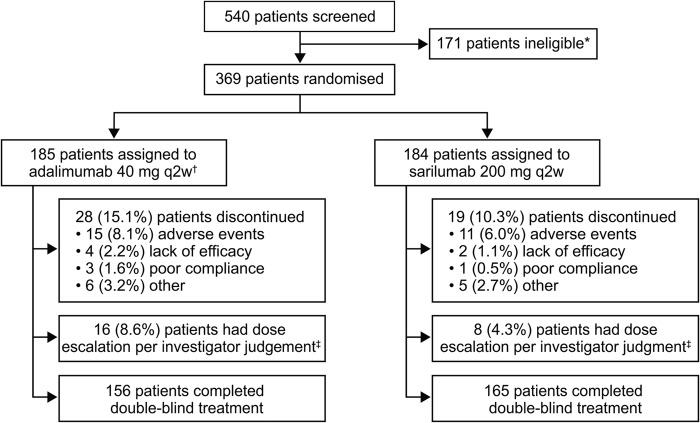
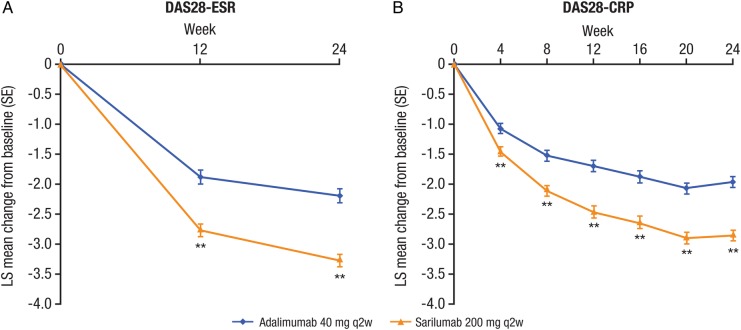
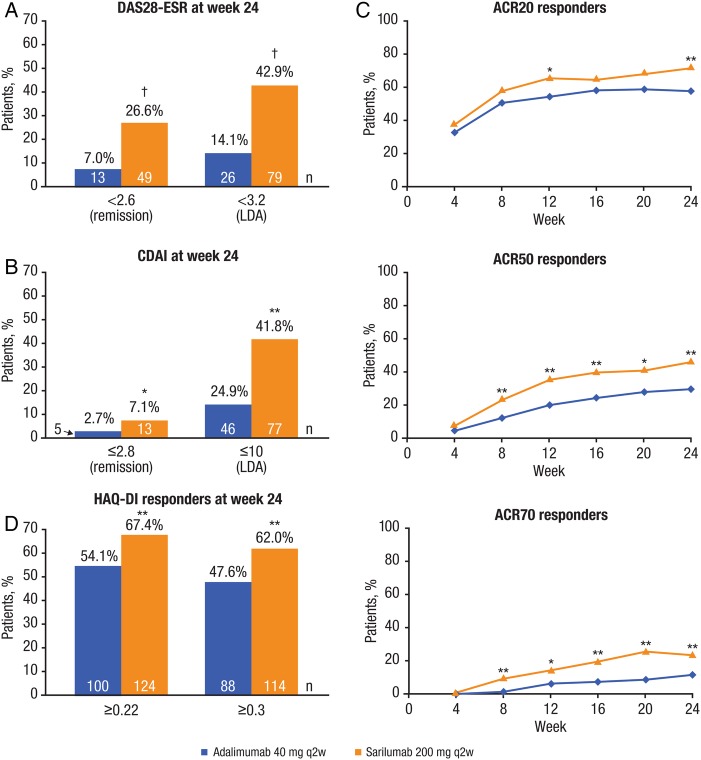
OBJECTIVES: To compare efficacy and safety of sarilumab monotherapy with adalimumab monotherapy in patients with active rheumatoid arthritis (RA) who should not continue treatment with methotrexate (MTX) due to intolerance or inadequate response. METHODS: MONARCH was a randomised, active-controlled, double-blind, double-dummy, phase III superiority trial. Patients received sarilumab (200 mg every 2 weeks (q2w)) or adalimumab (40 mg q2w) monotherapy for 24 weeks. The primary end point was change from baseline in 28-joint disease activity score using erythrocyte sedimentation rate (DAS28-ESR) at week 24. RESULTS: Sarilumab was superior to adalimumab in the primary end point of change from baseline in DAS28-ESR (-3.28 vs -2.20; p<0.0001). Sarilumab-treated patients achieved significantly higher American College of Rheumatology 20/50/70 response rates (sarilumab: 71.7%/45.7%/23.4%; adalimumab: 58.4%/29.7%/11.9%; all p≤0.0074) and had significantly greater improvement in Health Assessment Questionnaire-Disability Index (p=0.0037). Importantly, at week 24, more patients receiving sarilumab compared with adalimumab achieved Clinical Disease Activity Index remission (7.1% vs 2.7%; nominal p=0.0468) and low disease activity (41.8% vs 24.9%; nominal p=0.0005, supplemental analysis). Adverse events occurred in 63.6% (adalimumab) and 64.1% (sarilumab) of patients, the most common being neutropenia and injection site reactions (sarilumab) and headache and worsening RA (adalimumab). Incidences of infections (sarilumab: 28.8%; adalimumab: 27.7%) and serious infections (1.1%, both groups) were similar, despite neutropenia differences. CONCLUSIONS: Sarilumab monotherapy demonstrated superiority to adalimumab monotherapy by improving the signs and symptoms and physical functions in patients with RA who were unable to continue MTX treatment. The safety profiles of both therapies were consistent with anticipated class effects. TRIAL REGISTRATION NUMBER: NCT02332590.
Overview
The claims and statistics of this paper haven’t been checked yet.
Run the check — free, no account needed. It reads the open-access text and checks the sources it cites.
Integrity signals
Registry
Cites
Statistics
Figures
Verification
Claims the paper makes
The claims and statistics of this paper haven’t been checked yet.
Run the check — free, no account needed. It reads the open-access text and checks the sources it cites.
Claims other papers make about this one
Each is checked against this paper’s own text: does it say what the citing paper says it does?
In the citing paper
“the two IL-6R inhibitors were more efficacious than adalimumab”
From Targeting Interleukin-6 Signaling in Clinic (2019) · cites this paper as Burmester et al., 2017
Self-check
Percentages, sums and reported differences re-computed from the paper’s own numbers.
The self-check needs the paper’s full text.
Citations
Cites
No references could be resolved yet.
Research works printed but not linked: 36
- Upchurch, 2012, Evolution of treatment for rheumatoid arthritis, Rheumatology (Oxford), 51, vi28
- Singh, 2016, 2015 American College of Rheumatology guideline for the treatment of rheumatoid arthritis, Arthritis Rheumatol, 68, 1, 10.1002/art.39480 · DOI · Paper page
- Smolen, 2010, EULAR recommendations for the management of rheumatoid arthritis with synthetic and biological disease-modifying antirheumatic drugs, Ann Rheum Dis, 69, 964, 10.1136/ard.2009.126532 · DOI · Paper page
- Bathon, 2000, A comparison of etanercept and methotrexate in patients with early rheumatoid arthritis, N Engl J Med, 343, 1586, 10.1056/NEJM200011303432201 · DOI
- Keystone, 2004, Arthritis Rheum, 50, 1400, 10.1002/art.20217 · DOI
- Kremer, 2011, Arthritis Rheum, 63, 609, 10.1002/art.30158 · DOI
- Kremer, 2006, Effects of abatacept in patients with methotrexate-resistant active rheumatoid arthritis: a randomized trial, Ann Intern Med, 144, 865, 10.7326/0003-4819-144-12-200606200-00003 · DOI
- Lipsky, 2000, Infliximab and methotrexate in the treatment of rheumatoid arthritis, N Engl J Med, 343, 1594, 10.1056/NEJM200011303432202 · DOI
- Van der Heijde, 2016, Clinical and radiographic outcomes after 2 years of sarilumab in patients with rheumatoid arthritis [abstract], Ann Rheum Dis, 75, 724, 10.1136/annrheumdis-2016-eular.4389 · DOI
- Soliman, 2011, Impact of concomitant use of DMARDs on the persistence with anti-TNF therapies in patients with rheumatoid arthritis: results from the British Society for Rheumatology Biologics Register, Ann Rheum Dis, 70, 583, 10.1136/ard.2010.139774 · DOI
- Listing, 2006, Clinical and functional remission: even though biologics are superior to conventional DMARDs overall success rates remain low—results from RABBIT, the German biologics register, Arthritis Res Ther, 8, R66, 10.1186/ar1933 · DOI
- Lee, 2009, Utilization trends of tumor necrosis factor inhibitors among patients with rheumatoid arthritis in a United States observational cohort study, J Rheumatol, 36, 1611, 10.3899/jrheum.080889 · DOI
- Emery, 2013, Biologic and oral disease-modifying antirheumatic drug monotherapy in rheumatoid arthritis, Ann Rheum Dis, 72, 1897, 10.1136/annrheumdis-2013-203485 · DOI
- Backhaus, 2015, Comparison of tocilizumab and tumour necrosis factor inhibitors in rheumatoid arthritis: a retrospective analysis of 1603 patients managed in routine clinical practice, Clin Rheumatol, 34, 673, 10.1007/s10067-015-2879-0 · DOI
- Pappas, 2015, Characteristics associated with biologic monotherapy use in biologic-naive patients with rheumatoid arthritis in a US registry population, Rheumatol Ther, 2, 85, 10.1007/s40744-015-0008-9 · DOI
- Detert, 2015, Biologic monotherapy in the treatment of rheumatoid arthritis, Biologics, 9, 35
- Catay, 2016, Prevalence of biologics monotherapy in a cohort of patients with rheumatoid arthritis in daily clinical practice, BMC Musculoskelet Disord, 17, 110, 10.1186/s12891-016-0959-1 · DOI
- Srirangan, 2010, The role of interleukin 6 in the pathophysiology of rheumatoid arthritis, Ther Adv Musculoskelet Dis, 2, 247, 10.1177/1759720X10378372 · DOI · Paper page
- Steiner, 1999, Cytokine production by synovial T cells in rheumatoid arthritis, Rheumatology (Oxford), 38, 202, 10.1093/rheumatology/38.3.202 · DOI
- Matsumoto, 2006, Interleukin-6 levels in synovial fluids of patients with rheumatoid arthritis correlated with the infiltration of inflammatory cells in synovial membrane, Rheumatol Int, 26, 1096, 10.1007/s00296-006-0143-2 · DOI
- Sugiyama, 1995, Serum interleukin-6 level is a sensitive parameter of disease activity in rheumatoid arthritis, J Clin Rheumatol, 1, 93, 10.1097/00124743-199504000-00006 · DOI
- Houssiau, 1988, Interleukin-6 in synovial fluid and serum of patients with rheumatoid arthritis and other inflammatory arthritides, Arthritis Rheum, 31, 784, 10.1002/art.1780310614 · DOI · Paper page
- Dayer, 2010, Therapeutic targets in rheumatoid arthritis: the interleukin-6 receptor, Rheumatology (Oxford), 49, 15, 10.1093/rheumatology/kep329 · DOI
- Genovese, 2015, Sarilumab plus methotrexate in patients with active rheumatoid arthritis and inadequate response to methotrexate: results of a phase III study, Arthritis Rheumatol, 67, 1424, 10.1002/art.39093 · DOI · Paper page
- Fleischmann R, van Adelsberg J, Lin Y, et al. Sarilumab and non-biologic disease-modifying antirheumatic drugs in patients with active RA and inadequate response or intolerance to TNF inhibitors. Arthritis Rheumatol. In press.
- Gabay, 2013, Tocilizumab monotherapy versus adalimumab monotherapy for treatment of rheumatoid arthritis (ADACTA): a randomised, double-blind, controlled phase 4 trial, Lancet, 381, 1541, 10.1016/S0140-6736(13)60250-0 · DOI · Paper page
- Emery, 2015, Safety and tolerability of subcutaneous sarilumab and intravenous tocilizumab in patients with RA [abstract], Arthritis Rheumatol, 67, 971
- Aletaha, 2010, 2010 Rheumatoid arthritis classification criteria: an American College of Rheumatology/European League Against Rheumatism collaborative initiative, Ann Rheum Dis, 69, 1580, 10.1136/ard.2010.138461 · DOI · Paper page
- Hochberg, 1992, The American College of Rheumatology 1991 revised criteria for the classification of global functional status in rheumatoid arthritis, Arthritis Rheum, 35, 498, 10.1002/art.1780350502 · DOI
- Gossec, 2009, Elaboration of the preliminary Rheumatoid Arthritis Impact of Disease (RAID) score: a EULAR initiative, Ann Rheum Dis, 68, 1680, 10.1136/ard.2008.100271 · DOI
- Sanderson, 2010, Patient perspective of measuring treatment efficacy: the rheumatoid arthritis patient priorities for pharmacologic interventions outcomes, Arthritis Care Res (Hoboken), 62, 647, 10.1002/acr.20151 · DOI
- Strand, 2015, Patient expectations and perceptions of goal-setting strategies for disease management in rheumatoid arthritis, J Rheumatol, 42, 2046, 10.3899/jrheum.140976 · DOI
- Wright, 2014, Effects of IL-6 and IL-6 blockade on neutrophil function in vitro and in vivo, Rheumatology (Oxford), 53, 1321, 10.1093/rheumatology/keu035 · DOI
- Taub, 2003, Hepatoprotection via the IL-6/Stat3 pathway, J Clin Invest, 112, 978, 10.1172/JCI19974 · DOI
- Salliot, 2009, Long-term safety of methotrexate monotherapy in patients with rheumatoid arthritis: a systematic literature research, Ann Rheum Dis, 68, 1100, 10.1136/ard.2008.093690 · DOI
- Curtis, 2010, Elevated liver enzyme tests among patients with rheumatoid arthritis or psoriatic arthritis treated with methotrexate and/or leflunomide, Ann Rheum Dis, 69, 43, 10.1136/ard.2008.101378 · DOI · Paper page
Cited by
Targeting Interleukin-6 Signaling in Clinic
Kang, S., Tanaka, T., Narazaki, M., & Kishimoto, T. (2019) · Immunity · doi:10.1016/j.immuni.2019.03.026 · Cited by 904
The role of IL-6 in host defence against infections: immunobiology and clinical implications
Rose-John, S., Winthrop, K., & Calabrese, L. (2017) · Nature Reviews Rheumatology · doi:10.1038/nrrheum.2017.83 · Cited by 424
C-reactive protein and implications in rheumatoid arthritis and associated comorbidities
Pope, J. E., & Choy, E. H. (2021) · Seminars in Arthritis and Rheumatism · doi:10.1016/j.semarthrit.2020.11.005 · Cited by 320
Taylor, P. C., Schiff, M. H., Wang, Q., Jiang, Y., Zhuang, Y., Kurrasch, R., Daga, S., Rao, R., Tak, P. P., & Hsu, B. (2018) · Annals of the Rheumatic Diseases · doi:10.1136/annrheumdis-2017-212496 · Cited by 28
Metadata
- Authors
- Burmester, G. R., Lin, Y., Patel, R., van Adelsberg, J., Mangan, E. K., Graham, N. M. H., van Hoogstraten, H., Bauer, D., Ignacio Vargas, J., & Lee, E. B.
- Venue
- Annals of the Rheumatic Diseases
- Publisher
- Elsevier BV
- Published
- 2017-05
- Volume
- 76
- Issue
- 5
- Pages
- 840-847
- ISSN
- 0003-4967
- PMC
- PMC5530335
- Cited by
- 272
- References
- 0
- Language
- en
About these checks
Registry, retraction, Cites and statistics results are computed, not judged, with one exception: a printed reference that no index lists is read once by a model before it counts as a citation error. Claims are extracted by a model and kept only when their quote appears verbatim in the text; each cited source is then checked, with a model’s help, for whether it says what the claim relies on. Those verdicts can be wrong — read the claim’s quote and the cited source before relying on one.
Statistics and arithmetic are recomputed, not judged.
Confidence bands are shown only for fields calibrated on our annotated test set. None is calibrated yet, so no band is shown.
What counts as a claim ›How we measure confidence ›How we check this ›
Are you an author, or do you see a problem with this page? Request a review
How to cite
Cite CoChat for the checks on this page, and the paper for its own findings.
- This page
- CoChat. (2026). Citation check: Efficacy and safety of sarilumab monotherapy versus adalimumab monotherapy for the treatment of patients with active rheumatoid arthritis (MONARCH): a randomised, double-blind, parallel-group phase III trial. https://app.cochat.ai/papers/10.1136/annrheumdis-2016-210310
- The paper
- Burmester, G. R., Lin, Y., Patel, R., van Adelsberg, J., Mangan, E. K., Graham, N. M. H., van Hoogstraten, H., Bauer, D., Ignacio Vargas, J., & Lee, E. B. (2017). Efficacy and safety of sarilumab monotherapy versus adalimumab monotherapy for the treatment of patients with active rheumatoid arthritis (MONARCH): a randomised, double-blind, parallel-group phase III trial. Annals of the Rheumatic Diseases. https://doi.org/10.1136/annrheumdis-2016-210310
Data sources
Bibliographic data: Semantic Scholar, OpenAlex, Crossref.
Contains information from the Semantic Scholar Academic Graph Datasets, made available under the ODC Attribution License (ODC-BY 1.0).
Semantic Scholar’s data is described in: Kinney, R., et al. (2023). The Semantic Scholar Open Data Platform. arXiv:2301.10140.
