

Reporting guideline for overviews of reviews of healthcare interventions: development of the PRIOR statement.
Open accessThe DOI matches its Crossref record; 45 of the 45 references it cites were found in a registry or an index; 8 of the 45 sources its claims cite were checked for support.
Abstract
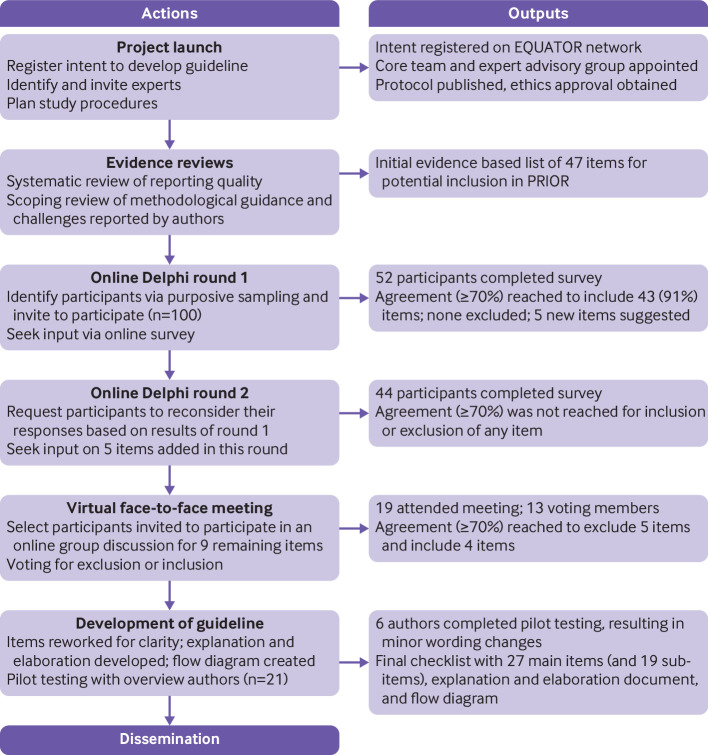
Objective: To develop a reporting guideline for overviews of reviews of healthcare interventions. Design: Development of the preferred reporting items for overviews of reviews (PRIOR) statement. Participants: Core team (seven individuals) led day-to-day operations, and an expert advisory group (three individuals) provided methodological advice. A panel of 100 experts (authors, editors, readers including members of the public or patients) was invited to participate in a modified Delphi exercise. 11 expert panellists (chosen on the basis of expertise, and representing relevant stakeholder groups) were invited to take part in a virtual face-to-face meeting to reach agreement (≥70%) on final checklist items. 21 authors of recently published overviews were invited to pilot test the checklist. Setting: International consensus. Intervention: Four stage process established by the EQUATOR Network for developing reporting guidelines in health research: project launch (establish a core team and expert advisory group, register intent), evidence reviews (systematic review of published overviews to describe reporting quality, scoping review of methodological guidance and author reported challenges related to undertaking overviews of reviews), modified Delphi exercise (two online Delphi surveys to reach agreement (≥70%) on relevant reporting items followed by a virtual face-to-face meeting), and development of the reporting guideline. Results: From the evidence reviews, we drafted an initial list of 47 potentially relevant reporting items. An international group of 52 experts participated in the first Delphi survey (52% participation rate); agreement was reached for inclusion of 43 (91%) items. 44 experts (85% retention rate) completed the second Delphi survey, which included the four items lacking agreement from the first survey and five new items based on respondent comments. During the second round, agreement was not reached for the inclusion or exclusion of the nine remaining items. 19 individuals (6 core team and 3 expert advisory group members, and 10 expert panellists) attended the virtual face-to-face meeting. Among the nine items discussed, high agreement was reached for the inclusion of three and exclusion of six. Six authors participated in pilot testing, resulting in minor wording changes. The final checklist includes 27 main items (with 19 sub-items) across all stages of an overview of reviews. Conclusions: PRIOR fills an important gap in reporting guidance for overviews of reviews of healthcare interventions. The checklist, along with rationale and example for each item, provides guidance for authors that will facilitate complete and transparent reporting. This will allow readers to assess the methods used in overviews of reviews of healthcare interventions and understand the trustworthiness and applicability of their findings.
Overview
CoChat Summary
TL;DR
The PRIOR statement is an evidence- and consensus-based reporting guideline for overviews of reviews of healthcare interventions, developed through a four-stage EQUATOR Network process. Its final checklist contains 27 main items with 19 sub-items, plus an explanation and elaboration document and flow diagram.
Key findings
Evidence reviews informed an initial list of 47 potential reporting items; in Delphi round 1, 52 experts participated and agreement (≥70%) was reached for inclusion of 43/47 (91%) items.
- In round 2, 44/52 (85%) round 1 participants responded, and agreement was not reached for inclusion or exclusion of any of the nine remaining items.
- In round 3, 19 individuals attended virtual meetings and 13 voted; agreement was reached to exclude five items (≥77%), retain three items (≥85% each), and for the final item, after near agreement (69%) for exclusion, 92% agreed to remove it and incorporate its content into item 8a.
- The final PRIOR checklist includes 27 main items with 19 sub-items; pilot testing involved 6 of 21 invited authors (29%) and resulted in minor wording changes but no content changes.
Methods
Development followed the EQUATOR Network’s four-stage process: project launch, evidence reviews (a systematic review of reporting quality and a scoping review of methodological guidance and author-reported challenges), a modified Delphi exercise, and guideline development.
- The modified Delphi used two online surveys and a virtual face-to-face meeting, with a prespecified ≥70% agreement threshold; 100 experts were invited, 52 completed round 1, 44 completed round 2, and 11 expert panellists were invited to round 3.
- Agreement was calculated as proportions agreeing/disagreeing, with Likert responses 1–2 treated as “disagree” and 3–4 as “agree”; “I don’t know” responses were included in the denominator but did not contribute to agreement or disagreement, and free-text comments were grouped to inform wording and additional items.
Limitations
Stated in the paper: the final guideline could differ with another participant set or a higher/lower agreement threshold; round 3 was held online rather than in person because of covid-19 travel restrictions, which might have reduced depth of discussion; panellists were not selected based on prior Delphi responses; pilot testing involved only six authors; no information was collected on participants’ clinical expertise or patient experience; representation of all relevant specialties was unlikely; PRIOR is intended for overviews of reviews of healthcare interventions and may not apply to other fields or overview types; some items lack methodological guidance, examples are sometimes imperfect, and periodic updates are expected.
- Evident from the text: the pilot test had a small sample (6/21 invited authors, 29%), limiting the generalisability of usability feedback; the paper also notes that impact on future reporting will need evaluation rather than being demonstrated here.
Model-written summary. Check it against the paper before relying on it.
Integrity signals
Registry
Cites
Statistics
Figures
Verification
Claims the paper makes
6 Valid · 0 Not valid · 31 Not checked · 64 Own results and interpretations
Every source the paper cites for this claim was checked and supports it.
In the paper
“Identifying and interpreting evidence from the growing number of sometimes redundant, misleading, or conflicting syntheses is an onerous task”
§ Reporting guideline for overviews of reviews of healthcare interventions: development of the PRIOR statement > Introduction
What the sources say
- Supportedcites [4] Ioannidis JP. The Mass Production of Redundant, Misleading, and Conflicted Systematic Reviews and Meta-analyses. Milbank Q 2016; 94: 485- 514. 10.1111/1468-0009.12210 27620683 PMC5020151 source
The Meta-analyses of Randomized Trials of Humans section (p. ~6) states that overlapping syntheses often reach different conclusions and that 'navigating through these discrepancies can be demanding even for investigators who are well trained in evidence-based medicine,' which is the substance of the claim's 'onerous task' of identifying and interpreting evidence. The Introduction (p. 1) and Abstract (p. 1) supply the other elements: rapid growth in publications (2,728% rise in systematic reviews 1991-2014) and reviews that 'suffer from extensive redundancy, little value, misleading claims, and/or vested interests.' (LLM, conf=0.88)
plain- Asserted: passes — The authors put it forward as true.
- Checkable: unclear — It is unclear whether it could be checked against evidence.
- Load-bearing: passes — The paper’s conclusions depend on it.
- Based: passes — The paper gives a reason why it holds.
- Supported
Every source the paper cites for this claim was checked and supports it.
In the paper
“We followed the methods suggested by the EQUATOR Network for developing reporting guidelines in health research.”
§ Reporting guideline for overviews of reviews of healthcare interventions: development of the PRIOR statement > Methods > Approach
What the sources say
- Supportedcites [28] Moher D Schulz KF Simera I Altman DG. Guidance for developers of health research reporting guidelines. PLoS Med 2010; 7: e1000217. 10.1371/journal.pmed.1000217 20169112 PMC2821895 source
Our copy of Moher et al. (2010) is precisely the EQUATOR-affiliated guidance the citing sentence refers to: the Abstract (p.1) states 'David Moher and colleagues from the EQUATOR network offer guidance and recommended steps for developing health research reporting guidelines,' and the Discussion (p.1) describes 'this guidance on how to develop a reporting guideline, including an 18-step checklist.' The Introduction (p.1) further situates it within the EQUATOR Network's role in assisting the development of reporting guidelines. So the cited work is the methods guidance for developing health research reporting guidelines associated with the EQUATOR Network; whether PRIOR's authors in fact followed every step is outside this source's scope. (LLM, conf=0.90)
plainstates a cause- Asserted: passes — The authors put it forward as true.
- Checkable: passes — It can be checked against evidence.
- Load-bearing: unclear — It is unclear whether the paper’s conclusions depend on it.
- Based: passes — The paper gives a reason why it holds.
- Supported
The cited sources support only part of this claim — read each source’s verdict below.
In the paper
“Although few published evaluations exist, evidence suggests that the endorsement of PRISMA by journals is associated with more complete reporting of systematic reviews than in journals not endorsing the reporting guideline.50 51 52”
§ Reporting guideline for overviews of reviews of healthcare interventions: development of the PRIOR statement > Discussion > Dissemination and evaluation
What the sources say
- Supportedcites [50] Stevens A Shamseer L Weinstein E. Relation of completeness of reporting of health research to journals’ endorsement of reporting guidelines: systematic review. BMJ 2014; 348: g3804. 10.1136/bmj.g3804 24965222 PMC4070413 source
In the Results section (Table 7; page not available in our copy), the PRISMA mean summed reporting score is higher for reviews in endorsing journals than in non-endorsing journals, with a standardized mean difference of 0.53 (99% CI 0.02 to 1.03). The paper notes that relatively few evaluations were available, consistent with the citing sentence’s cautious wording. (LLM, conf=0.94)
- Partly supportedcites [51] Page MJ Shamseer L Altman DG. Epidemiology and Reporting Characteristics of Systematic Reviews of Biomedical Research: A Cross-Sectional Study. PLoS Med 2016; 13: e1002028. 10.1371/journal.pmed.1002028 27218655 PMC4878797 sourceExperimental — accuracy not yet measured
The Results (page unavailable) associate more complete reporting with reviews that self-reported using PRISMA. The Discussion (page unavailable) notes that journal endorsement varies, but the paper does not compare reporting completeness in endorsing versus non-endorsing journals. (LLM, conf=0.88)
- Partly supportedcites [52] Veroniki AA Tsokani S Zevgiti S. Do reporting guidelines have an impact? Empirical assessment of changes in reporting before and after the PRISMA extension statement for network meta-analysis. Syst Rev 2021; 10: 246. 10.1186/s13643-021-01780-9 34507621 PMC8434710 sourceExperimental — accuracy not yet measured
The Results section (page not provided) reports higher reporting scores for network meta-analyses published in journals endorsing PRISMA than for those in journals not explicitly endorsing it, though the difference was described as not substantial. The claim extends that finding from reviews with network meta-analysis to systematic reviews generally. (LLM, conf=0.86)
hedgedstates an association- Asserted: passes — The authors put it forward as true.
- Checkable: passes — It can be checked against evidence.
- Load-bearing: unclear — It is unclear whether the paper’s conclusions depend on it.
- Based: passes — The paper gives a reason why it holds.
- Supported
Every source the paper cites for this claim was checked and supports it.
In the paper
“PRIOR is the first reporting guideline for overviews of reviews to be developed that adheres to the rigorous, systematic, and transparent methodology outlined by Moher et al.28”
§ Reporting guideline for overviews of reviews of healthcare interventions: development of the PRIOR statement > Discussion > Reporting guideline
What the sources say
- Supportedcites [28] Moher D Schulz KF Simera I Altman DG. Guidance for developers of health research reporting guidelines. PLoS Med 2010; 7: e1000217. 10.1371/journal.pmed.1000217 20169112 PMC2821895 source
The Introduction outlines a robust, explicit methodology for developing reporting guidelines, proposing 18 steps in five phases. That supports the citation’s attribution of the methodology to Moher et al.; the claim that PRIOR was the first guideline of its kind is the citing authors’ own characterization, not a finding attributed to this source. (LLM, conf=0.90)
plain- Asserted: passes — The authors put it forward as true.
- Checkable: passes — It can be checked against evidence.
- Load-bearing: passes — The paper’s conclusions depend on it.
- Based: passes — The paper gives a reason why it holds.
- Supported
A result the paper reports from its own data — it cites no other source for it, so there is none to check. The quote shows it is in the paper.
In the paper
“Agreement (≥70%) was not reached for the inclusion or exclusion of any of the nine items on the survey (four items that did not reach agreement in the first round, and five new items; appendix 4 in the supplementary materials).”
§ Reporting guideline for overviews of reviews of healthcare interventions: development of the PRIOR statement > Results > Round 2 results—online survey
plainn = 44- Asserted: passes — The authors put it forward as true.
- Checkable: passes — It can be checked against evidence.
- Load-bearing: unclear — It is unclear whether the paper’s conclusions depend on it.
- Based: passes — The paper gives a reason why it holds.
11 more claims
Create a free account to see all 101 claims and to verify the 37 references still open.
- Probably not a substantial claim. 70
- It may state two separate claims as one. 42
- The quote only partly states this claim. 1
Claims other papers make about this one
Each is checked against this paper’s own text: does it say what the citing paper says it does?
The cited source says what the claim attributes to it.
In the citing paper
“This review was prospectively registered on the International Platform of Registered Systematic Review and Meta-analysis Protocols (INPLASY202360071; https://inplasy.com/inplasy-2023-6-0071/) and conducted in alignment with the Preferred Reporting Items for Overviews of Reviews (PRIOR) (16).”
The cited source says what the claim attributes to it.
In the citing paper
“This umbrella review followed the Joanna Briggs Institute’s (JBI) methodology for umbrella reviews [21] and is reported in accordance with the Preferred Reporting Items for Overviews of Reviews (PRIOR) [22] (Supplementary file 1).”
From School-based healthy eating interventions for adolescents aged 10–19 years: an umbrella review (2024) · cites this paper as [22]
The cited source says what the claim attributes to it.
In the citing paper
“This overview was conducted in accordance with the PRIOR reporting guidelines.13”
From Acupuncture Therapy for Sciatica: An Overview of Systematic Reviews and Meta-Analysis (2025) · cites this paper as [13]
The cited source says what the claim attributes to it.
In the citing paper
“The reporting of this overview of reviews was guided by the standards of the Preferred Reporting Items for Overviews of Reviews (PRIOR) Statement (Gates et al., 2022).”
From Meta-analytic evidence on the efficacy of hypnosis for mental and somatic health issues: a 20-year perspective (2024) · cites this paper as Gates et al., 2022
The check wasn’t confident either way, so it gives no verdict — never disputed.
In the citing paper
“Previous meta-meta-analyses have been limited to adult populations 24 29 or included populations with confounding factors, such as chronic diseases 30 .”
From Effect of exercise on depression and anxiety symptoms: systematic umbrella review with meta-meta-analysis (2026) · cites this paper as [30]
Experimental — accuracy not yet measured
3 more claims about this paper
Create a free account to see every claim other papers make about this one.
Citations
Cites
RoB 2: a revised tool for assessing risk of bias in randomised trials
Sterne, J. A. C., Savović, J., Page, M. J., Elbers, R. G., Blencowe, N. S., Boutron, I., Cates, C. J., Cheng, H.-Y., Corbett, M. S., Eldridge, S. M., et al. (2019) · BMJ · doi:10.1136/bmj.l4898 · Cited by 34,787
Self-citationThe PRISMA 2020 statement: an updated guideline for reporting systematic reviews
Page, M. J., McKenzie, J. E., Bossuyt, P. M., Boutron, I., Hoffmann, T. C., Mulrow, C. D., Shamseer, L., Tetzlaff, J. M., Akl, E. A., Brennan, S. E., et al. (2021) · Systematic Reviews · doi:10.1186/s13643-021-01626-4 · Cited by 13,874
Self-citationA typology of reviews: an analysis of 14 review types and associated methodologies
Grant, M. J., & Booth, A. (2009) · Health Information & Libraries Journal · doi:10.1111/j.1471-1842.2009.00848.x · Cited by 10,817
Shea, B. J., Reeves, B. C., Wells, G., Thuku, M., Hamel, C., Moran, J., Moher, D., Tugwell, P., Welch, V., Kristjansson, E., et al. (2017) · BMJ · doi:10.1136/bmj.j4008 · Cited by 10,636
Self-citationThe PRISMA 2020 statement: an updated guideline for reporting systematic reviews
Page, M. J., McKenzie, J., Bossuyt, P., Boutron, I., Hoffmann, T., mulrow, C., Shamseer, L., Tetzlaff, J., Akl, E., Brennan, S. E., et al. (2020) · doi:10.31222/osf.io/v7gm2_v1 · Cited by 8,090
Self-citationResearch guidelines for the Delphi survey technique
Hasson, F. (2000) · Journal of Advanced Nursing · doi:10.1046/j.1365-2648.2000.01567.x · Cited by 5,951
The PRISMA 2020 statement: an updated guideline for reporting systematic reviews
Page, M. J., McKenzie, J., Bossuyt, P., Boutron, I., Hoffmann, T., mulrow, C., Shamseer, L., Tetzlaff, J., Akl, E., Brennan, S. E., et al. (2020) · doi:10.31222/osf.io/v7gm2 · Cited by 5,177
Self-citationThe Delphi Technique: Making Sense of Consensus
Hsu, C.-C., & Sandford, B. A. (2007) · University of Massachusetts Amherst · doi:10.7275/pdz9-th90 · Cited by 4,500
Diamond, I. R., Grant, R. C., Feldman, B. M., Pencharz, P. B., Ling, S. C., Moore, A. M., & Wales, P. W. (2014) · Journal of Clinical Epidemiology · doi:10.1016/j.jclinepi.2013.12.002 · Cited by 3,740
ROBIS: A new tool to assess risk of bias in systematic reviews was developed
Whiting, P., Savović, J., Higgins, J. P. T., Caldwell, D. M., Reeves, B. C., Shea, B., Davies, P., Kleijnen, J., & Churchill, R. (2016) · Journal of Clinical Epidemiology · doi:10.1016/j.jclinepi.2015.06.005 · Cited by 2,272
Self-citation
Research works printed but not linked: 2
- Dillman DA. Mail and Internet Surveys: The Tailored Design Method–2007 Update with New Internet, Visual, and Mixed-Mode Guide. John Wiley & Sons, 2011.
- Page MJ Shamseer L Altman DG. Epidemiology and Reporting Characteristics of Systematic Reviews of Biomedical Research: A Cross-Sectional Study. PLoS Med 2016; 13: e1002028. 10.1371/journal.pmed.1002028 27218655 PMC4878797 · DOI · Paper page
Cited by
Items 101–200 of 896
Elsman, E. B. M., Mokkink, L. B., Terwee, C. B., Beaton, D., Gagnier, J. J., Tricco, A. C., Baba, A., Butcher, N. J., Smith, M., Hofstetter, C., et al. (2024) · Health and Quality of Life Outcomes · doi:10.1186/s12955-024-02256-9 · Cited by 39
“A study design that uses explicit, systematic methods to collect data from primary studies, critically appraises the data, and synthesizes the findings descriptively or quantitatively in order to address a clearly formulated research question [65, 68, 69].”
Self-citationSydora, B. C., Whelan, L., Abelseth, B., Brar, G., Idris, S., Zhao, R., Leonard, A. J., Rosenbloom, B. N., Clarke, H. A., Katz, J. D., et al. (2024) · Journal of Pain Research · doi:10.2147/jpr.s466731 · Cited by 40
Moore, A., Bidonde, J., Fisher, E., Häuser, W., Bell, R. F., Perrot, S., Makri, S., & Straube, S. (2024) · Rheumatology · doi:10.1093/rheumatology/keae707 · Cited by 43
Shrestha, T., Chi, C. V. Y., Cassarino, M., Foley, S., & Blasi, Z. D. (2025) · Environment International · doi:10.1016/j.envint.2024.109217 · Cited by 40
Kiptulon, E. K., Elmadani, M., Szőllősi, A., Zrínyi, M., & Siket, A. U. (2025) · BMC Health Services Research · doi:10.1186/s12913-025-13365-6 · Cited by 44
Martínez-Calderón, J., Ho, E. K., Ferreira, P. H., García‐Muñoz, C., Villar-Alises, O., & Matias-Soto, J. (2023) · Journal of Orthopaedic and Sports Physical Therapy · doi:10.2519/jospt.2023.11833 · Cited by 35
Chatzidimitriou, K., Papaioannou, W., Seremidi, K., Bougioukas, K. I., & Haidich, A. (2023) · Journal of Dentistry · doi:10.1016/j.jdent.2023.104520 · Cited by 32
Self-citationGuidance to best tools and practices for systematic reviews1
Kolaski, K., Logan, L. R., & Ioannidis, J. P. A. (2023) · Journal of Pediatric Rehabilitation Medicine · doi:10.3233/prm-230019 · Cited by 52
Evidence-based surgical procedures to optimize caesarean outcomes: an overview of systematic reviews
Gialdini, C., Chamillard, M., Díaz, V., Pasquale, J., Thangaratinam, S., Abalos, E. J., Torloni, M. R., & Betrán, A. P. (2024) · EClinicalMedicine · doi:10.1016/j.eclinm.2024.102632 · Cited by 39
Safety of psychotropic medications in pregnancy: an umbrella review
Fabiano, N., Wong, S., Gupta, A. A., Tran, J., Bhambra, N., Min, K. K., Dragioti, E., Barbui, C., Fiedorowicz, J. G., Gosling, C. J., et al. (2024) · Molecular Psychiatry · doi:10.1038/s41380-024-02697-0 · Cited by 37
“We adhered to the Preferred Reporting Items for Overviews of Reviews (PRIOR) and PRISMA 2020 guidelines (adapting PRISMA to the abstract of an umbrella review; Supplementary Material 1, Supplementary eTables 1and 2) guidelines [21, 22].”
Zbukvic, I., McKay, S., Cooke, S., Anderson, R., Pilkington, V., McGillivray, L., Bailey, A. P., Purcell, R., & Tye, M. (2023) · Adolescent Research Review · doi:10.1007/s40894-023-00211-1 · Cited by 40
“This overview is presented using the preferred reporting items for overviews of reviews (PRIOR) (Gates et al., 2022).”
Poon, E. T.-C., Iu, J. C.-K., Sum, W. M.-K., Wong, P.-S., Lo, K. K.-H., Ali, A., Burns, S. F., & Trexler, E. T. (2025) · Sports Medicine · doi:10.1007/s40279-025-02194-6 · Cited by 28
“Our umbrella review of systematic reviews with meta-analyses followed the Preferred Reporting Items for Overviews of Reviews (PRIOR) statement [32].”
InfluentialArakelyan, S., Mikula-Noble, N., Ho, L., Lone, N., Anand, A., Lyall, M. J., Mercer, S. W., & Guthrie, B. (2023) · The Lancet Healthy Longevity · doi:10.1016/s2666-7568(23)00190-3 · Cited by 31
Miranda, A. R., Barral, P. E., Scotta, A. V., Cortez, M. V., & Soria, E. A. (2025) · Global Epidemiology · doi:10.1016/j.gloepi.2025.100192 · Cited by 47
“This overview of reviews was conducted in accordance with the PRIOR (Preferred Reporting Items for Overviews of Reviews) guidelines (Supplementary Materials 1) and the recommendations of the Joanna Briggs Institute (JBI) Umbrella Review Methodology Working Group [22,23].”
Bidonde, J., Fisher, E., Perrot, S., Moore, R. A., Bell, R. F., Makri, S., & Häuser, W. (2023) · Seminars in Arthritis and Rheumatism · doi:10.1016/j.semarthrit.2023.152248 · Cited by 27
Mason‐Jones, A. J., Freeman, M., Lorenc, T., Rawal, T., Bassi, S., & Arora, M. (2023) · Journal of Adolescent Health · doi:10.1016/j.jadohealth.2023.05.035 · Cited by 48
“…to explore the similarities, differences, and relationships between the reviews as suggested by other authors such as the synthesis without meta-analysis (SWiM) [24], guidance on the conduct of narrative syntheses [25], and the Preferred Reporting Items for Overviews of Reviews guidelines [26].”
Medication Adherence Among Patients With Kidney Disease: An Umbrella Review
Tesfaye, W. H., Parrish, N. F., Sud, K., Grandinetti, A., & Castelino, R. L. (2024) · Advances in Kidney Disease and Health · doi:10.1053/j.akdh.2023.08.003 · Cited by 40
Non-genetic factors and breast cancer: an umbrella review of meta-analyses
Yiallourou, A., Pantavou, K. G., Markozannes, G., Pilavas, A., Georgiou, A. N., Hadjikou, A., Economou, M., Christodoulou, N., Letsos, K., Khattab, E., et al. (2024) · BMC Cancer · doi:10.1186/s12885-024-12641-8 · Cited by 37
“The findings are reported according to the PRIOR [17] (Preferred Reporting Items for Over-views of Reviews) recommendations (Additional file 1 – PRIOR Checklist).”
MethodXie, B., Lei, S., Choi, N., Choi, S. M., Wang, X., & Chen, Y. (2025) · Journal of Exercise Science & Fitness · doi:10.1016/j.jesf.2025.06.008 · Cited by 29
“Reviews were included if they analysed athletic populations over the entire performance spectrum, from recreational to elite athletes, without constraints on age or gender.”
InfluentialGuidance to best tools and practices for systematic reviews
Kolaski, K., Logan, L. R., & Ioannidis, J. P. A. (2023) · British Journal of Pharmacology · doi:10.1111/bph.16100 · Cited by 33
Salins, N. S., Dhyani, V. S., Mathew, M., Prasad, A., Rao, A. P., Damani, A., Rao, K. S., Nair, S., Shanbhag, V., Rao, S., et al. (2024) · Intensive Care Medicine · doi:10.1007/s00134-024-07565-7 · Cited by 33
“The reporting adheres to PRIOR guidelines [101], but it should be noted that excluding non-English and grey literature, including policy documents, might be a limitation.”
MethodFortification of Staple Foods for Household Use with Vitamin D: An Overview of Systematic Reviews
Nyakundi, P. N., Kontár, Z. N., Kovács, A., Járomi, L., Zand, A., & Lohner, S. (2023) · Nutrients · doi:10.3390/nu15173742 · Cited by 33
“The report of this overview of reviews follows the PRIOR (preferred reporting items for overviews of review) recommendations [30].”
BackgroundArora, N. K., Donath, L., Owen, P. J., Miller, C. T., Saueressig, T., Winter, F., Hambloch, M., Neason, C., Karner, V., & Belavý, D. L. (2023) · Sports Medicine · doi:10.1007/s40279-023-01966-2 · Cited by 31
Clinical Phenotypes Associated With Cerebral Small Vessel Disease: An Overview of Systematic Reviews
Kancheva, A. K., Wardlaw, J. M., Lyall, D. M., & Quinn, T. J. (2024) · Neurology · doi:10.1212/wnl.0000000000209267 · Cited by 30
Patmisari, E., Huang, Y., Orr, M., Govindasamy, S., Hielscher, E., & McLaren, H. (2024) · PLoS ONE · doi:10.1371/journal.pone.0304527 · Cited by 33
Elsman, E. B. M., Mokkink, L. B., Terwee, C. B., Beaton, D., Gagnier, J. J., Tricco, A. C., Baba, A., Butcher, N. J., Smith, M., Hofstetter, C., et al. (2024) · Journal of Patient-Reported Outcomes · doi:10.1186/s41687-024-00727-7 · Cited by 31
“A study design that uses explicit, systematic methods to collect data from primary studies, critically appraises the data, and synthesizes the findings descriptively or quantitatively in order to address a clearly formulated research question [65, 68, 69].”
BackgroundMethodSelf-citationChatzi, C. A., Basios, A., Markozannes, G., Ntzani, E., Tsilidis, K. K., Kazakos, K., Agouridis, A. P., Barkas, F., Pappa, M. B., Katsiki, N., et al. (2024) · Nutrients · doi:10.3390/nu16223873 · Cited by 30
“This umbrella review is in accordance with the Preferred Reporting Items for Overviews of Reviews (PRIOR) statement [17], and the protocol has been registered in the Open Science Framework (OSF) (Registration DOI: https://doi.org/10.17605/OSF.IO/D9J8C, 25 October 2023).”
InfluentialKönig, L. M., Western, M. J., Denton, A. H., & Krukowski, R. A. (2025) · npj Digital Medicine · doi:10.1038/s41746-024-01405-0 · Cited by 34
Martínez-Calderón, J., Infante-Cano, M., Matias-Soto, J., Pérez‐Cabezas, V., Galán-Mercant, A., & García‐Muñoz, C. (2025) · Journal of Functional Morphology and Kinesiology · doi:10.3390/jfmk10020174 · Cited by 38
“Systematic reviews were included if reviews used systematic and reproducible methods to collect data on primary studies, critically analyze the evidence, and summarize the results quantitatively [16].”
Carregaro, R. L., Roscani, A. N. C. P., Raimundo, A. C. S., Ferreira, L., Vanni, T., Salomão, M. D. G., Probst, L. F., & Viscondi, J. Y. K. (2023) · BMC Infectious Diseases · doi:10.1186/s12879-023-08541-0 · Cited by 26
“The PRIOR (Preferred Reporting Items for Overviews of Reviews) statement was used to report this study [28]. the TIV, with no serious or systemic solicited or unsolicited adverse events; tough pain at the injection site was greater for QIV.”
MethodHaas, R., Brundisini, F. K., Barbara, A. M., Darvesh, N., Ritchie, L., MacDougall, D., Spry, C., Mason, J., Hall, J. N., Ma, W., et al. (2023) · Canadian Journal of Health Technologies · doi:10.51731/cjht.2023.786 · Cited by 32
Rogers, K., Hirzle, T., Karaosmanoglu, S., Palomino, P. T., Durmanova, E., Isotani, S., & Nacke, L. E. (2024) · ACM Transactions on Computer-Human Interaction · doi:10.1145/3685266 · Cited by 26
Kuijpers, S. M. E., Buis, D. T. P., Ziesemer, K. A., van Hest, R. M., Schade, R. P., Sigaloff, K., & Prins, J. M. (2024) · The Lancet Infectious Diseases · doi:10.1016/s1473-3099(24)00456-0 · Cited by 29
Poon, E. T., Sum, W. M.-K., Lubans, D. R., Wong, S. H., & Ho, R. S. T. (2024) · Journal of Sports Sciences · doi:10.1080/02640414.2024.2425910 · Cited by 33
“Our umbrella review of systematic reviews was performed in accordance with the Preferred Reporting Items for Overviews of Reviews (PRIOR) statement (Gates et al., 2022) and registered in the PROSPERO database (CRD42024506397).”
Nutrition Interventions for Pediatric Obesity Prevention: An Umbrella Review of Systematic Reviews
Rozga, M., & Handu, D. (2023) · Nutrients · doi:10.3390/nu15245097 · Cited by 29
“This umbrella review of SRs was designed using a social-ecological model [10], used methods described by the Cochrane Collaboration [11] and the Academy of Nutrition and Dietetics [12], and was reported according to the PRIOR checklist for overviews of SRs [13].”
MethodTan, L., Wang, Z., Okoth, K., Toulis, K. A., Denniston, A. K., Singh, B. M., Crowe, F. L., Sainsbury, C. A. R., Wang, J., & Nirantharakumar, K. (2024) · Frontiers in Endocrinology · doi:10.3389/fendo.2023.1303238 · Cited by 26
Shrestha, S., Iqbal, A., Teoh, S. L., Khanal, S., Gan, S. H., Lee, S. W. H., & Paudyal, V. (2024) · Research in Social and Administrative Pharmacy · doi:10.1016/j.sapharm.2024.03.005 · Cited by 25
Munro, N. R., Teague, S., Somoray, K., Simpson, A., Budden, T., Jackson, B., Rebar, A., & Dimmock, J. (2026) · British Journal of Sports Medicine · doi:10.1136/bjsports-2025-110301 · Cited by 23
“30 Our research distinguished itself by encompassing clinically diagnosed and non-clinical populations across diverse demographics, including children and young people, emerging adults, older adults and perinatal women.”
Kuper, P., Hasenpusch, C., Proebstl, S., Matterne, U., Hornung, C. J., Grätsch, E. I., Li, M., Sprenger, A. A., Pieper, D., Koplin, J. J., et al. (2023) · Clinical & Experimental Allergy · doi:10.1111/cea.14399 · Cited by 25
Self-citationFontaine, G., Poitras, M.-È., Sasseville, M., Pomey, M., Ouellet, J., Brahim, L. O., Wasserman, S., Bergeron, F., & Lambert, S. (2024) · Systematic Reviews · doi:10.1186/s13643-024-02512-5 · Cited by 28
“Reasons for excluding articles from full-text review onwards will be recorded in the PRIOR flow diagram (PRISMA-like flowchart) [38].”
BackgroundMethodDashti, M., Londono, J., Ghasemi, S., Zare, N., Samman, M., Ashi, H. M., Amirzade-Iranaq, M. H., Khosraviani, F., Sabeti, M. A., & Khurshid, Z. (2024) · PeerJ Computer Science · doi:10.7717/peerj-cs.2371 · Cited by 30
Guidance to best tools and practices for systematic reviews
Kolaski, K., Logan, L. R., & Ioannidis, J. P. A. (2023) · BMC Infectious Diseases · doi:10.1186/s12879-023-08304-x · Cited by 27
Liu, H., Li, J., Yuan, J., Huang, J., & Youqi, X. (2023) · BMC Microbiology · doi:10.1186/s12866-023-03107-1 · Cited by 24
“Compared to traditional SRs/MAs, an overview that minimizes duplication of information and presents findings from SRs/MAs in a uniform format could serve as a "friendly front end" for decision makers, healthcare professionals, and patients with UC [15].”
BackgroundResultInfluentialBansal, N., Ang, S., & Chen, L. (2023) · British Journal of Pain · doi:10.1177/20494637231204549 · Cited by 22
“33 The protocol was registered with PROS-PERO prospectively (CRD42022334418) to address the prevalence of chronic pain and persistent opioid use after major surgeries synthesised in systematic reviews or meta-analyses.”
MethodHealth effects of drinking 100% juice: an umbrella review of systematic reviews with meta-analyses
Beckett, E., Fayet‐Moore, F., Cassettari, T., Starck, C. S., Wright, J., & Blumfield, M. (2024) · Nutrition Reviews · doi:10.1093/nutrit/nuae036 · Cited by 26
Whitworth, A., Baxter, S. K., Cullingworth, J., & Clowes, M. (2024) · Preventive Medicine Reports · doi:10.1016/j.pmedr.2024.102786 · Cited by 26
“We follow PRISMA guidelines (Page et al., 2020) for the reporting of reviews and PRIOR guidelines (Gates et al., 2022) for the reporting of overview reviews.”
MethodUeshima, J., Nagano, F., Wakabayashi, H., Maeda, K., & Arai, H. (2024) · Archives of Gerontology and Geriatrics · doi:10.1016/j.archger.2024.105628 · Cited by 22
Lassner, A., Siafis, S., Wiese, E., Leucht, S., Metzner, S., Wagner, E. M., & Hasan, A. (2024) · BJPsych Open · doi:10.1192/bjo.2024.826 · Cited by 29
Yong, A. S. J., Bratuskins, S., Sultani, M. S., Blakeley, B., Davey, C. G., & Bell, J. S. (2025) · Australian & New Zealand Journal of Psychiatry · doi:10.1177/00048674251315642 · Cited by 22
“This overview was conducted according to the principles of Overview of Reviews in the Cochrane Handbook for Systematic Reviews of Interventions (Pollock et al., 2020) and reported according to the Preferred Reporting Items for Overviews of Reviews (PRIOR) statement (Gates et al., 2022).”
Torres‐Castro, R., Caicedo-Trujillo, S., Gimeno‐Santos, E., Gutiérrez-Arias, R. E., Alsina‐Restoy, X., Vasconcello‐Castillo, L., Serón, P., Spruit, M. A., Blanco, I., & Vilaró, J. (2025) · Frontiers in Sports and Active Living · doi:10.3389/fspor.2025.1549652 · Cited by 28
Reyneke, G. L., Lambert, K., & Beck, E. J. (2025) · Nutrition Reviews · doi:10.1093/nutrit/nuaf104 · Cited by 26
Dhyani, V. S., Krishnan, J. B., Mathias, E. G., Hossain, M. M., Price, C. L., Gudi, N., Pattanshetty, S. M., & ZODPEY, S. P. (2023) · BMJ Innovations · doi:10.1136/bmjinnov-2022-001062 · Cited by 27
Sikaroudi, M. K., Soltani, S., Ghoreishy, S. M., Ebrahimi, Z., Shidfar, F., & Dehnad, A. (2024) · Food & Function · doi:10.1039/d3fo03717g · Cited by 30
Interventions to increase vaccination in vulnerable groups: rapid overview of reviews
Norman, G., Kletter, M., & Dumville, J. C. (2024) · BMC Public Health · doi:10.1186/s12889-024-18713-5 · Cited by 24
Molla‐Esparza, C., Gómez‐Núñez, M. I., & García, F. J. G. (2025) · International Journal of Educational Research Open · doi:10.1016/j.ijedro.2024.100433 · Cited by 25
Zhao, H., Zheng, X., Guo, L., Wang, X., Lu, H., Xie, P., Jia, S., Shang, Y., Wang, Y., Bai, P., et al. (2025) · BMC Public Health · doi:10.1186/s12889-024-21257-3 · Cited by 22
“This umbrella review was conducted in accordance with the Preferred Reporting Items for Overviews of Reviews (PRIOR) guidelines [34] (Supplementary Table 1).”
Guidance to Best Tools and Practices for Systematic Reviews
Kolaski, K., Logan, L. R., & Ioannidis, J. P. A. (2023) · JBJS Reviews · doi:10.2106/jbjs.rvw.23.00077 · Cited by 28
Genetics and athletic performance: a systematic SWOT analysis of non-systematic reviews
Konopka, M. J., Sperlich, B., Rietjens, G. J., & Zeegers, M. P. (2023) · Frontiers in Genetics · doi:10.3389/fgene.2023.1232987 · Cited by 20
Elsman, E. B. M., Smith, M., Hofstetter, C., Gavin, F., Jobson, E., Markham, S., Ricketts, J., Baba, A., Butcher, N. J., & Offringa, M. (2024) · Research Involvement and Engagement · doi:10.1186/s40900-024-00563-5 · Cited by 15
“Recently, there has been interest in integrating patient and public involvement (PPI) in developing reporting guidelines by including patients and public members as stakeholders [3–5].”
BackgroundWang, H., Yang, R., Liu, D., & Li, W. (2024) · International Immunopharmacology · doi:10.1016/j.intimp.2024.111936 · Cited by 27
Rahman, E., Webb, W. R., Rao, P., Abu-Farsakh, H. N., Upton, A. E., Yu, N., Garcia, P. E., Ioannidis, S., Sayed, K., Philipp‐Dormston, W. G., et al. (2024) · Aesthetic Plastic Surgery · doi:10.1007/s00266-024-04276-8 · Cited by 22
“This overview systematic review adhered to the Cochrane guidelines for overview review guidelines [11] and Pre-ferred Reporting Items for Overviews of Reviews (PRIOR) statement [12].”
Metabolic risk factors of colorectal cancer: Umbrella review
Molla, M. D., Symonds, E. L., Winter, J. M., Debie, A., & Wassie, M. M. (2024) · Critical Reviews in Oncology/Hematology · doi:10.1016/j.critrevonc.2024.104502 · Cited by 25
Comprehensive geriatric assessment in nonhospitalized settings: An overview of systematic reviews
Kshatri, J. S., Janssen, D. J. A., Shenkin, S. D., Mansingh, A., Pati, S., Palo, S. K., & Pati, S. (2025) · Geriatrics and gerontology international/Geriatrics & gerontology international · doi:10.1111/ggi.70004 · Cited by 19
Rahmati, M., Smith, L., Lee, H., Boyer, L., Fond, G. B., Yon, D. K., Lee, H., Soysal, P., Udeh, R., Dolja‐Gore, X., et al. (2024) · Ageing Research Reviews · doi:10.1016/j.arr.2024.102523 · Cited by 22
Corrêa, H. D. L., Rosa, T. D. S., dos Santos, R. L., Mestrinho, V. M. D. M. V., Aquino, T. S., Santos, W. O., Neves, R. P., Deus, L. A., Reis, A. L., Barbosa, J. M. D. S., et al. (2025) · Frontiers in Physiology · doi:10.3389/fphys.2024.1444976 · Cited by 26
Bracchiglione, J., Meza, N., Pérez-Carrasco, I., Vergara‐Merino, L., Madrid, E., Urrútia, G., & Bonfill, X. (2023) · Journal of Clinical Epidemiology · doi:10.1016/j.jclinepi.2023.05.006 · Cited by 24
van Melick, N., Dietvorst, M., van Oort, M. I. A. M., Claessens, R. L. A., Janssen, R. P. A., Bogie, R., the Adolescent ACL Rehabilitation Group, Claussen, W., Greenberg, E. M., Grindem, H., et al. (2023) · Orthopaedic Journal of Sports Medicine · doi:10.1177/23259671231172454 · Cited by 22
“Profession Sports physical therapist 9 Sports physical therapist and junior researcher 6 Sports physical therapist and postdoctoral researcher 5 Work location Africa 0 Asia 1 Europe 6 North America 8 Oceania 3 South America 0 Work experience with adolescent athletes with ACL injuries, years 15 (7-30) The annual number…”
BackgroundSun, Q., Wang, K., Chen, Y., Peng, X., Jiang, X., & Peng, J. (2023) · Journal of Clinical Nursing · doi:10.1111/jocn.16890 · Cited by 20
A Primer on Systematic Review and Meta-analysis in Diabetes Research
Tobias, D. K., Papatheodorou, S., Yamamoto, J. M., & Hu, F. B. (2023) · Diabetes Care · doi:10.2337/dci23-0031 · Cited by 23
Trabelsi, K., Ammar, A., Boukhris, O. F., Boujelbane, M. A., Clark, C. C. T., Romdhani, M., Washif, J. A., Aziz, A. R., Bragazzi, N. L., Glenn, J. M., et al. (2023) · British Journal of Sports Medicine · doi:10.1136/bjsports-2023-106826 · Cited by 28
Solitano, V., Vuyyuru, S. K., Yuan, Y., Singh, S., Narula, N., Ma, C., Hanžel, J., Hutton, M., Koughnett, J. A. V., Rieder, F., et al. (2024) · International Journal of Colorectal Disease · doi:10.1007/s00384-024-04714-8 · Cited by 20
Infante-Cano, M., García‐Muñoz, C., Matias-Soto, J., Pineda-Escobar, S., Villar-Alises, O., & Martínez-Calderón, J. (2024) · Archives of Women s Mental Health · doi:10.1007/s00737-024-01526-1 · Cited by 24
“The Preferred Reporting Items for Overviews of Reviews (PRIOR) statement (Gates et al. 2022) and the Preferred Reporting Items for Systematic Reviews and Meta-Analyses (PRISMA) statement for abstracts were followed.”
Tannou, T., Lihoreau, T., Couture, M., Giroux, S., Wang, R. H., Spalla, G., Zarshenas, S., Gagnon‐Roy, M., Aboujaoudé, A., Yaddaden, A., et al. (2022) · Ageing Research Reviews · doi:10.1016/j.arr.2022.101830 · Cited by 20
Patient‐targeted interventions for opioid deprescribing: An overview of systematic reviews
Langford, A. V., Schneider, C. R., Lin, C. C., Bero, L. A., Collins, J. C., Suckling, B. M., & Gnjidic, D. (2023) · Basic & Clinical Pharmacology & Toxicology · doi:10.1111/bcpt.13844 · Cited by 20
“21 In light of the large volume of existing primary and synthesized evidence in the field, an overview approach was selected to facilitate a broader evidence synthesis, examine the effect of opioid deprescribing interventions across populations and identify relevant gaps in the opioid deprescribing…”
BackgroundBotwright, S., Sutawong, J., Kingkaew, P., Anothaisintawee, T., Dabak, S. V., Suwanpanich, C., Promchit, N., Kampang, R., & Isaranuwatchai, W. (2023) · BMC Public Health · doi:10.1186/s12889-023-15152-6 · Cited by 24
Lin, J. Y.-Y., Liu, J., O’Fee, A., Pandey, C., Benna-Doyle, S., Maunder, A., Rao, V. S., Alesi, S., Ng, B. C. K., & Ee, C. (2024) · Frontiers in Medicine · doi:10.3389/fmed.2024.1357914 · Cited by 21
“Our study was designed and reported in accordance with the PRIOR reporting guidelines (21).”
MethodWiecha, S., Posadzki, P., Prill, R., & Płaszewski, M. (2024) · Journal of Clinical Medicine · doi:10.3390/jcm13072006 · Cited by 24
“…evidence from SRs evaluating multiple treatments, umbrella reviews (URs) (or overviews of systematic reviews, or else overviews of reviews [31,32]) provide a useful source of information for researchers, athletic trainers, exercise physiologists, educators, policy-makers, and clinicians…”
BackgroundKardan, M., Jung, A., Iqbal, M., Keshtkar, S., Geidl, W., & Pfeifer, K. (2024) · BMC Digital Health · doi:10.1186/s44247-024-00097-6 · Cited by 22
“This overview of systematic reviews was conducted and reported in accordance with the Cochrane Systematic Review Handbook [62, 63] and Preferred Reporting Items for Overviews of Reviews (PRIOR) guidelines [64].”
MethodEffectiveness of Robotic Devices for Medical Rehabilitation: An Umbrella Review
Kiyono, K., Tanabe, S., Hirano, S., Ii, T., Nakagawa, Y., Tan, K., Saitoh, E., & Otaka, Y. (2024) · Journal of Clinical Medicine · doi:10.3390/jcm13216616 · Cited by 23
“The reporting of the key aspects of methods and results in this study adhered to the protocol for the Preferred Reporting Items for Overviews of Reviews (PRIOR) [11] guidelines.”
MethodPandey, C., Maunder, A., Liu, J., Vaddiparthi, V., Costello, M., Khomami, M. B., Mousa, A., & Ee, C. (2024) · Nutrients · doi:10.3390/nu17010057 · Cited by 21
Abate, B. B., Tusa, B. S., Sendekie, A. K., Araya, F. G., Azmeraw, M., Walle, G. T., Kitaw, T. A., Tilahun, B. D., Alamaw, A. W., Zemariam, A. B., et al. (2025) · International Breastfeeding Journal · doi:10.1186/s13006-025-00712-w · Cited by 24
Azargoonjahromi, A., & Bahrampour, Z. (2025) · Sleep Medicine · doi:10.1016/j.sleep.2025.106690 · Cited by 21
Nursing practice environment influences on retention and turnover intention: An umbrella review
Figueiredo, A. R., Baixinho, C. L., & Lucas, P. R. M. B. (2025) · Collegian Journal of the Royal College of Nursing Australia · doi:10.1016/j.colegn.2025.09.008 · Cited by 30
Umbrella Reviews: Concepts, Methodological Frameworks, and Step‐by‐Step Implementation
Liu, C., Zhou, D., Xu, W., Pan, H., Wang, X., Peng, J., Ji, X., Huang, J. H., & Zhu, Z. (2025) · Journal of Evidence-Based Medicine · doi:10.1111/jebm.70092 · Cited by 24
Inokuchi, R., Hanari, K., Shimada, K., Iwagami, M., Sakamoto, A., Sun, Y., Mayers, T., Sugiyama, T., & Tamiya, N. (2023) · BMJ Open · doi:10.1136/bmjopen-2023-075969 · Cited by 20
Chew, H. S. J., Soong, R. Y., Teo, Y. Q. J., Flølo, T. N., Chong, B., Yong, C. L., Ang, S. H., Ho, Y., Chew, N., So, J. B. Y., et al. (2024) · Nutrition Reviews · doi:10.1093/nutrit/nuad163 · Cited by 20
Palomba, S., Caserta, D., Levi-Setti, P. E., & Busnelli, A. (2024) · Journal of Ovarian Research · doi:10.1186/s13048-024-01372-w · Cited by 18
“Novel interventions, not still formally included in systematic reviews due to the paucity of data, also deserve to be mentioned and should not be underestimated [10].”
BackgroundKeogh, J. A. J., Keng, I., Dhillon, D., Bourgeault‐Gagnon, Y., Simunovic, N., & Ayeni, O. R. (2025) · Journal of Orthopaedic and Sports Physical Therapy · doi:10.2519/jospt.2025.13075 · Cited by 19
Daka, Q., Henein, C., Fang, C. E. H., Mustafa, R., Cocaj, E., Azuara‐Blanco, A., Willoughby, C. E., Bokre, D., & Nanavaty, M. A. (2025) · British Journal of Ophthalmology · doi:10.1136/bjo-2025-327363 · Cited by 20
“We conducted comprehensive searches in Ovid Medline, Ovid Embase, the Cochrane Database of Systematic Reviews, Web of Science and Scopus electronic databases.”
Carral, J. M. C., Vázquez, O. C., Ledesma, S. N., & Pruimboom, L. (2025) · Annals of Physical and Rehabilitation Medicine · doi:10.1016/j.rehab.2025.102020 · Cited by 21
Kundakci, B., Jones, K. L., Booth, A., Falzon, L., Pufulete, M., Gibbison, B., Rowan, K., Grocott, M. P. W., Smith, S. M., McKenzie, C., et al. (2025) · Critical Care · doi:10.1186/s13054-025-05726-8 · Cited by 32
“We applied guidance from Cochrane overviews [15], the Preferred Reporting Items for Overviews of Reviews (PRIOR [16] and PRISMA Extension for Scoping Reviews (PRISMA-ScR [17] to support standardised evidence synthesis methods in the conduct and the reporting of the meta-review.”
Farshad, S., & Fortin, C. (2026) · Educational Research Review · doi:10.1016/j.edurev.2026.100809 · Cited by 32
Khosroshahi, R. A., Zeraattalab-Motlagh, S., Sarsangi, P., Nielsen, S. M., & Mohammadi, H. (2023) · British Journal Of Nutrition · doi:10.1017/s0007114523000910 · Cited by 24
Prenatal exposure to ambient air pollutants and congenital heart defects: An umbrella review
Michel, S., Atmakuri, A., & Ehrenstein, O. S. V. (2023) · Environment International · doi:10.1016/j.envint.2023.108076 · Cited by 19
Salem, A., Trabelsi, K., Jahrami, H., Al-Rasheed, M. M., Boukhris, O. F., Puce, L., Bragazzi, N. L., Ammar, A., Glenn, J. M., & Chtourou, H. (2024) · Journal of the American Nutrition Association · doi:10.1080/27697061.2023.2297899 · Cited by 24
Mapping socioeconomic factors driving antimicrobial resistance in humans: An umbrella review
Ljungqvist, G. V., van Kessel, R., Mossialos, E. A., Saint, V., Schmidt, J., Mafi, A., Shutt, A., Chatterjee, A., Charani, E., & Anderson, M. (2025) · One Health · doi:10.1016/j.onehlt.2025.100986 · Cited by 19
“We reported the findings according to the Preferred Reporting Items for Overviews of Reviews (PRIOR) guidelines (Supplementary Table 1) [17].”
Faris, M. E., Abdelrahim, D. N., Herrag, S. E. E., Khaled, M. B., Shihab, K. A., Alkurd, R. A. F., & Madkour, M. (2025) · Clinical Nutrition ESPEN · doi:10.1016/j.clnesp.2025.03.006 · Cited by 17
Nardone, O. M., Noor, N. M., Prabhu, A., Lim, A., Krishnakumar, A., Alajmi, A. F., Yuan, Y., Jairath, V., Estevinho, M. M., & Solitano, V. (2025) · Alimentary Pharmacology & Therapeutics · doi:10.1111/apt.70181 · Cited by 16
Tahmasbi, F., Toni, E., Javanmard, Z., Kheradbin, N., Nasiri, S., & Sadoughi, F. (2025) · Archives of Public Health · doi:10.1186/s13690-025-01590-8 · Cited by 17
“The reporting guidelines employed in this overview were based on the fundamental principles out-lined in the Preferred Reporting Items for Overviews of Reviews (PRIOR) statement from the EQUATOR Network [18, 19].”
Ma, J., Hu, D., Li, D., Chen, Y., Chen, Q., Fan, Z., Wang, G., Xu, W., Zhu, G., Xin, Z., et al. (2025) · Trends in Food Science & Technology · doi:10.1016/j.tifs.2025.105002 · Cited by 18
Metadata
- Authors
- Gates, M., Gates, A., Pieper, D., Fernandes, R. M., Tricco, A. C., Moher, D., Brennan, S. E., Li, T., Pollock, M., Lunny, C., Sepúlveda, D., McKenzie, J. E., Scott, S. D., Robinson, K. A., Matthias, K., Bougioukas, K. I., Fusar-Poli, P., Whiting, P., Moss, S. J., & Hartling, L.
- Affiliations
- University of Alberta (CA)
- Witten/Herdecke University (DE)
- University of Lisbon (PT)
- St. Michael's Hospital (CA)
- University of Ottawa (CA)
- Monash University (AU)
- University of Colorado Anschutz (US)
- Institute of Health Economics (CA)
- Ministry of Health (CL)
- Johns Hopkins University (US)
- University of Applied Sciences Stralsund (DE)
- Aristotle University of Thessaloniki (GR)
- Early Psychosis: Interventions and Clinical-detection Laboratory, Department of Psychosis Studies, Institute of Psychiatry, Psychology, and Neuroscience, King’s Collect London, London, UK
- University of Bristol (GB)
- University of Calgary (CA)
- Corresponding author
- Li, Tianjing
- Hartling, Lisa
- ORCID
- Venue
- BMJ
- Publisher
- BMJ
- Published
- 2022-08-09
- Volume
- 378
- Pages
- e070849
- ISSN
- 1756-1833 (ISSN-L)
- PMC
- PMC9361065
- OpenAlex
- W4290769249
- Cited by
- 856
- References
- 44
- Citations by year
- 2026: 241 · 2025: 218 · 2024: 256 · 2023: 133 · 2022: 8
- FWCI
- 93.04
- Type
- journal article
- Language
- en
- Open access
- hybrid
- doi.org
- Licence
- Locations
- BMJ (publishedVersion, cc-by-nc)
- PubMed Central (publishedVersion, cc-by-nc)
- PubMed (publishedVersion)
- Research Portal (King's College London) (publishedVersion, cc-by-nc)
- Funders
- National Eye Institute (UG1EY020522)
- Topics
- Social Sciences › Decision Sciences › Statistics, Probability and Uncertainty › Meta-analysis and systematic reviews
- Social Sciences › Sociology and Political Science › Delphi Technique in Research
- Health Sciences › Medicine › Public Health, Environmental and Occupational Health › Clinical practice guidelines implementation
- Keywords
- overviews of reviews, reporting guidelines, health interventions, reporting checklist, transparency in research reporting, EQUATOR Network, Delphi consensus, reporting quality, stakeholder engagement, patient and public involvement, conflict of interest disclosure
- MeSH terms
- Delivery of Health Care, Delphi Technique, Health Facilities, Humans, Surveys and Questionnaires, Research Design, Consensus, Checklist
About these checks
Registry, retraction, Cites and statistics results are computed, not judged, with one exception: a printed reference that no index lists is read once by a model before it counts as a citation error. Claims are extracted by a model and kept only when their quote appears verbatim in the text; each cited source is then checked, with a model’s help, for whether it says what the claim relies on. Those verdicts can be wrong — read the claim’s quote and the cited source before relying on one.
The claim verdicts this report counts are experimental: their accuracy is not yet measured.
A language model drew the claims from the paper on 2026-10-05, under version 3 of the claim definition (model deepseek-v4.1-flash, prompt extract-v3).
A second model labelled each claim on 2026-10-05 (model jev-1.13-20260917, definition revision gold-guideline-v0.2).
Cited sources are checked with a language model’s help (qwen3.8-omni-flash and gpt-6-sol).
Statistics and arithmetic are recomputed, not judged.
Confidence bands are shown only for fields calibrated on our annotated test set. None is calibrated yet, so no band is shown.
What counts as a claim ›How we measure confidence ›How we check this ›
Are you an author, or do you see a problem with this page? Request a review
Data sources
Bibliographic data: Semantic Scholar, OpenAlex, Crossref.
Contains information from the Semantic Scholar Academic Graph Datasets, made available under the ODC Attribution License (ODC-BY 1.0).
Semantic Scholar’s data is described in: Kinney, R., et al. (2023). The Semantic Scholar Open Data Platform. arXiv:2301.10140.
