

Reporting guideline for overviews of reviews of healthcare interventions: development of the PRIOR statement.
Open accessThe DOI matches its Crossref record; 45 of the 45 references it cites were found in a registry or an index; 8 of the 45 sources its claims cite were checked for support.
Abstract
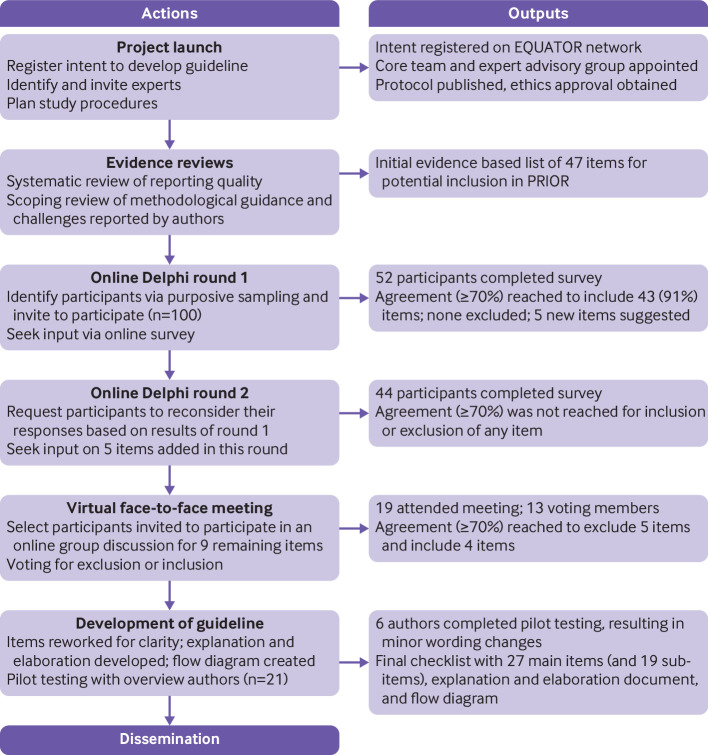
Objective: To develop a reporting guideline for overviews of reviews of healthcare interventions. Design: Development of the preferred reporting items for overviews of reviews (PRIOR) statement. Participants: Core team (seven individuals) led day-to-day operations, and an expert advisory group (three individuals) provided methodological advice. A panel of 100 experts (authors, editors, readers including members of the public or patients) was invited to participate in a modified Delphi exercise. 11 expert panellists (chosen on the basis of expertise, and representing relevant stakeholder groups) were invited to take part in a virtual face-to-face meeting to reach agreement (≥70%) on final checklist items. 21 authors of recently published overviews were invited to pilot test the checklist. Setting: International consensus. Intervention: Four stage process established by the EQUATOR Network for developing reporting guidelines in health research: project launch (establish a core team and expert advisory group, register intent), evidence reviews (systematic review of published overviews to describe reporting quality, scoping review of methodological guidance and author reported challenges related to undertaking overviews of reviews), modified Delphi exercise (two online Delphi surveys to reach agreement (≥70%) on relevant reporting items followed by a virtual face-to-face meeting), and development of the reporting guideline. Results: From the evidence reviews, we drafted an initial list of 47 potentially relevant reporting items. An international group of 52 experts participated in the first Delphi survey (52% participation rate); agreement was reached for inclusion of 43 (91%) items. 44 experts (85% retention rate) completed the second Delphi survey, which included the four items lacking agreement from the first survey and five new items based on respondent comments. During the second round, agreement was not reached for the inclusion or exclusion of the nine remaining items. 19 individuals (6 core team and 3 expert advisory group members, and 10 expert panellists) attended the virtual face-to-face meeting. Among the nine items discussed, high agreement was reached for the inclusion of three and exclusion of six. Six authors participated in pilot testing, resulting in minor wording changes. The final checklist includes 27 main items (with 19 sub-items) across all stages of an overview of reviews. Conclusions: PRIOR fills an important gap in reporting guidance for overviews of reviews of healthcare interventions. The checklist, along with rationale and example for each item, provides guidance for authors that will facilitate complete and transparent reporting. This will allow readers to assess the methods used in overviews of reviews of healthcare interventions and understand the trustworthiness and applicability of their findings.
Overview
CoChat Summary
TL;DR
The PRIOR statement is an evidence- and consensus-based reporting guideline for overviews of reviews of healthcare interventions, developed through a four-stage EQUATOR Network process. Its final checklist contains 27 main items with 19 sub-items, plus an explanation and elaboration document and flow diagram.
Key findings
Evidence reviews informed an initial list of 47 potential reporting items; in Delphi round 1, 52 experts participated and agreement (≥70%) was reached for inclusion of 43/47 (91%) items.
- In round 2, 44/52 (85%) round 1 participants responded, and agreement was not reached for inclusion or exclusion of any of the nine remaining items.
- In round 3, 19 individuals attended virtual meetings and 13 voted; agreement was reached to exclude five items (≥77%), retain three items (≥85% each), and for the final item, after near agreement (69%) for exclusion, 92% agreed to remove it and incorporate its content into item 8a.
- The final PRIOR checklist includes 27 main items with 19 sub-items; pilot testing involved 6 of 21 invited authors (29%) and resulted in minor wording changes but no content changes.
Methods
Development followed the EQUATOR Network’s four-stage process: project launch, evidence reviews (a systematic review of reporting quality and a scoping review of methodological guidance and author-reported challenges), a modified Delphi exercise, and guideline development.
- The modified Delphi used two online surveys and a virtual face-to-face meeting, with a prespecified ≥70% agreement threshold; 100 experts were invited, 52 completed round 1, 44 completed round 2, and 11 expert panellists were invited to round 3.
- Agreement was calculated as proportions agreeing/disagreeing, with Likert responses 1–2 treated as “disagree” and 3–4 as “agree”; “I don’t know” responses were included in the denominator but did not contribute to agreement or disagreement, and free-text comments were grouped to inform wording and additional items.
Limitations
Stated in the paper: the final guideline could differ with another participant set or a higher/lower agreement threshold; round 3 was held online rather than in person because of covid-19 travel restrictions, which might have reduced depth of discussion; panellists were not selected based on prior Delphi responses; pilot testing involved only six authors; no information was collected on participants’ clinical expertise or patient experience; representation of all relevant specialties was unlikely; PRIOR is intended for overviews of reviews of healthcare interventions and may not apply to other fields or overview types; some items lack methodological guidance, examples are sometimes imperfect, and periodic updates are expected.
- Evident from the text: the pilot test had a small sample (6/21 invited authors, 29%), limiting the generalisability of usability feedback; the paper also notes that impact on future reporting will need evaluation rather than being demonstrated here.
Model-written summary. Check it against the paper before relying on it.
Integrity signals
Registry
Cites
Statistics
Figures
Verification
Claims the paper makes
6 Valid · 0 Not valid · 31 Not checked · 64 Own results and interpretations
Every source the paper cites for this claim was checked and supports it.
In the paper
“Identifying and interpreting evidence from the growing number of sometimes redundant, misleading, or conflicting syntheses is an onerous task”
§ Reporting guideline for overviews of reviews of healthcare interventions: development of the PRIOR statement > Introduction
What the sources say
- Supportedcites [4] Ioannidis JP. The Mass Production of Redundant, Misleading, and Conflicted Systematic Reviews and Meta-analyses. Milbank Q 2016; 94: 485- 514. 10.1111/1468-0009.12210 27620683 PMC5020151 source
The Meta-analyses of Randomized Trials of Humans section (p. ~6) states that overlapping syntheses often reach different conclusions and that 'navigating through these discrepancies can be demanding even for investigators who are well trained in evidence-based medicine,' which is the substance of the claim's 'onerous task' of identifying and interpreting evidence. The Introduction (p. 1) and Abstract (p. 1) supply the other elements: rapid growth in publications (2,728% rise in systematic reviews 1991-2014) and reviews that 'suffer from extensive redundancy, little value, misleading claims, and/or vested interests.' (LLM, conf=0.88)
plain- Asserted: passes — The authors put it forward as true.
- Checkable: unclear — It is unclear whether it could be checked against evidence.
- Load-bearing: passes — The paper’s conclusions depend on it.
- Based: passes — The paper gives a reason why it holds.
- Supported
Every source the paper cites for this claim was checked and supports it.
In the paper
“We followed the methods suggested by the EQUATOR Network for developing reporting guidelines in health research.”
§ Reporting guideline for overviews of reviews of healthcare interventions: development of the PRIOR statement > Methods > Approach
What the sources say
- Supportedcites [28] Moher D Schulz KF Simera I Altman DG. Guidance for developers of health research reporting guidelines. PLoS Med 2010; 7: e1000217. 10.1371/journal.pmed.1000217 20169112 PMC2821895 source
Our copy of Moher et al. (2010) is precisely the EQUATOR-affiliated guidance the citing sentence refers to: the Abstract (p.1) states 'David Moher and colleagues from the EQUATOR network offer guidance and recommended steps for developing health research reporting guidelines,' and the Discussion (p.1) describes 'this guidance on how to develop a reporting guideline, including an 18-step checklist.' The Introduction (p.1) further situates it within the EQUATOR Network's role in assisting the development of reporting guidelines. So the cited work is the methods guidance for developing health research reporting guidelines associated with the EQUATOR Network; whether PRIOR's authors in fact followed every step is outside this source's scope. (LLM, conf=0.90)
plainstates a cause- Asserted: passes — The authors put it forward as true.
- Checkable: passes — It can be checked against evidence.
- Load-bearing: unclear — It is unclear whether the paper’s conclusions depend on it.
- Based: passes — The paper gives a reason why it holds.
- Supported
The cited sources support only part of this claim — read each source’s verdict below.
In the paper
“Although few published evaluations exist, evidence suggests that the endorsement of PRISMA by journals is associated with more complete reporting of systematic reviews than in journals not endorsing the reporting guideline.50 51 52”
§ Reporting guideline for overviews of reviews of healthcare interventions: development of the PRIOR statement > Discussion > Dissemination and evaluation
What the sources say
- Supportedcites [50] Stevens A Shamseer L Weinstein E. Relation of completeness of reporting of health research to journals’ endorsement of reporting guidelines: systematic review. BMJ 2014; 348: g3804. 10.1136/bmj.g3804 24965222 PMC4070413 source
In the Results section (Table 7; page not available in our copy), the PRISMA mean summed reporting score is higher for reviews in endorsing journals than in non-endorsing journals, with a standardized mean difference of 0.53 (99% CI 0.02 to 1.03). The paper notes that relatively few evaluations were available, consistent with the citing sentence’s cautious wording. (LLM, conf=0.94)
- Partly supportedcites [51] Page MJ Shamseer L Altman DG. Epidemiology and Reporting Characteristics of Systematic Reviews of Biomedical Research: A Cross-Sectional Study. PLoS Med 2016; 13: e1002028. 10.1371/journal.pmed.1002028 27218655 PMC4878797 sourceExperimental — accuracy not yet measured
The Results (page unavailable) associate more complete reporting with reviews that self-reported using PRISMA. The Discussion (page unavailable) notes that journal endorsement varies, but the paper does not compare reporting completeness in endorsing versus non-endorsing journals. (LLM, conf=0.88)
- Partly supportedcites [52] Veroniki AA Tsokani S Zevgiti S. Do reporting guidelines have an impact? Empirical assessment of changes in reporting before and after the PRISMA extension statement for network meta-analysis. Syst Rev 2021; 10: 246. 10.1186/s13643-021-01780-9 34507621 PMC8434710 sourceExperimental — accuracy not yet measured
The Results section (page not provided) reports higher reporting scores for network meta-analyses published in journals endorsing PRISMA than for those in journals not explicitly endorsing it, though the difference was described as not substantial. The claim extends that finding from reviews with network meta-analysis to systematic reviews generally. (LLM, conf=0.86)
hedgedstates an association- Asserted: passes — The authors put it forward as true.
- Checkable: passes — It can be checked against evidence.
- Load-bearing: unclear — It is unclear whether the paper’s conclusions depend on it.
- Based: passes — The paper gives a reason why it holds.
- Supported
Every source the paper cites for this claim was checked and supports it.
In the paper
“PRIOR is the first reporting guideline for overviews of reviews to be developed that adheres to the rigorous, systematic, and transparent methodology outlined by Moher et al.28”
§ Reporting guideline for overviews of reviews of healthcare interventions: development of the PRIOR statement > Discussion > Reporting guideline
What the sources say
- Supportedcites [28] Moher D Schulz KF Simera I Altman DG. Guidance for developers of health research reporting guidelines. PLoS Med 2010; 7: e1000217. 10.1371/journal.pmed.1000217 20169112 PMC2821895 source
The Introduction outlines a robust, explicit methodology for developing reporting guidelines, proposing 18 steps in five phases. That supports the citation’s attribution of the methodology to Moher et al.; the claim that PRIOR was the first guideline of its kind is the citing authors’ own characterization, not a finding attributed to this source. (LLM, conf=0.90)
plain- Asserted: passes — The authors put it forward as true.
- Checkable: passes — It can be checked against evidence.
- Load-bearing: passes — The paper’s conclusions depend on it.
- Based: passes — The paper gives a reason why it holds.
- Supported
A result the paper reports from its own data — it cites no other source for it, so there is none to check. The quote shows it is in the paper.
In the paper
“Agreement (≥70%) was not reached for the inclusion or exclusion of any of the nine items on the survey (four items that did not reach agreement in the first round, and five new items; appendix 4 in the supplementary materials).”
§ Reporting guideline for overviews of reviews of healthcare interventions: development of the PRIOR statement > Results > Round 2 results—online survey
plainn = 44- Asserted: passes — The authors put it forward as true.
- Checkable: passes — It can be checked against evidence.
- Load-bearing: unclear — It is unclear whether the paper’s conclusions depend on it.
- Based: passes — The paper gives a reason why it holds.
11 more claims
Create a free account to see all 101 claims and to verify the 37 references still open.
- Probably not a substantial claim. 70
- It may state two separate claims as one. 42
- The quote only partly states this claim. 1
Claims other papers make about this one
Each is checked against this paper’s own text: does it say what the citing paper says it does?
The cited source says what the claim attributes to it.
In the citing paper
“This review was prospectively registered on the International Platform of Registered Systematic Review and Meta-analysis Protocols (INPLASY202360071; https://inplasy.com/inplasy-2023-6-0071/) and conducted in alignment with the Preferred Reporting Items for Overviews of Reviews (PRIOR) (16).”
The cited source says what the claim attributes to it.
In the citing paper
“This umbrella review followed the Joanna Briggs Institute’s (JBI) methodology for umbrella reviews [21] and is reported in accordance with the Preferred Reporting Items for Overviews of Reviews (PRIOR) [22] (Supplementary file 1).”
From School-based healthy eating interventions for adolescents aged 10–19 years: an umbrella review (2024) · cites this paper as [22]
The cited source says what the claim attributes to it.
In the citing paper
“This overview was conducted in accordance with the PRIOR reporting guidelines.13”
From Acupuncture Therapy for Sciatica: An Overview of Systematic Reviews and Meta-Analysis (2025) · cites this paper as [13]
The cited source says what the claim attributes to it.
In the citing paper
“The reporting of this overview of reviews was guided by the standards of the Preferred Reporting Items for Overviews of Reviews (PRIOR) Statement (Gates et al., 2022).”
From Meta-analytic evidence on the efficacy of hypnosis for mental and somatic health issues: a 20-year perspective (2024) · cites this paper as Gates et al., 2022
The check wasn’t confident either way, so it gives no verdict — never disputed.
In the citing paper
“Previous meta-meta-analyses have been limited to adult populations 24 29 or included populations with confounding factors, such as chronic diseases 30 .”
From Effect of exercise on depression and anxiety symptoms: systematic umbrella review with meta-meta-analysis (2026) · cites this paper as [30]
Experimental — accuracy not yet measured
3 more claims about this paper
Create a free account to see every claim other papers make about this one.
Citations
Cites
RoB 2: a revised tool for assessing risk of bias in randomised trials
Sterne, J. A. C., Savović, J., Page, M. J., Elbers, R. G., Blencowe, N. S., Boutron, I., Cates, C. J., Cheng, H.-Y., Corbett, M. S., Eldridge, S. M., et al. (2019) · BMJ · doi:10.1136/bmj.l4898 · Cited by 34,787
Self-citationThe PRISMA 2020 statement: an updated guideline for reporting systematic reviews
Page, M. J., McKenzie, J. E., Bossuyt, P. M., Boutron, I., Hoffmann, T. C., Mulrow, C. D., Shamseer, L., Tetzlaff, J. M., Akl, E. A., Brennan, S. E., et al. (2021) · Systematic Reviews · doi:10.1186/s13643-021-01626-4 · Cited by 13,874
Self-citationA typology of reviews: an analysis of 14 review types and associated methodologies
Grant, M. J., & Booth, A. (2009) · Health Information & Libraries Journal · doi:10.1111/j.1471-1842.2009.00848.x · Cited by 10,817
Shea, B. J., Reeves, B. C., Wells, G., Thuku, M., Hamel, C., Moran, J., Moher, D., Tugwell, P., Welch, V., Kristjansson, E., et al. (2017) · BMJ · doi:10.1136/bmj.j4008 · Cited by 10,636
Self-citationThe PRISMA 2020 statement: an updated guideline for reporting systematic reviews
Page, M. J., McKenzie, J., Bossuyt, P., Boutron, I., Hoffmann, T., mulrow, C., Shamseer, L., Tetzlaff, J., Akl, E., Brennan, S. E., et al. (2020) · doi:10.31222/osf.io/v7gm2_v1 · Cited by 8,090
Self-citationResearch guidelines for the Delphi survey technique
Hasson, F. (2000) · Journal of Advanced Nursing · doi:10.1046/j.1365-2648.2000.01567.x · Cited by 5,951
The PRISMA 2020 statement: an updated guideline for reporting systematic reviews
Page, M. J., McKenzie, J., Bossuyt, P., Boutron, I., Hoffmann, T., mulrow, C., Shamseer, L., Tetzlaff, J., Akl, E., Brennan, S. E., et al. (2020) · doi:10.31222/osf.io/v7gm2 · Cited by 5,177
Self-citationThe Delphi Technique: Making Sense of Consensus
Hsu, C.-C., & Sandford, B. A. (2007) · University of Massachusetts Amherst · doi:10.7275/pdz9-th90 · Cited by 4,500
Diamond, I. R., Grant, R. C., Feldman, B. M., Pencharz, P. B., Ling, S. C., Moore, A. M., & Wales, P. W. (2014) · Journal of Clinical Epidemiology · doi:10.1016/j.jclinepi.2013.12.002 · Cited by 3,740
ROBIS: A new tool to assess risk of bias in systematic reviews was developed
Whiting, P., Savović, J., Higgins, J. P. T., Caldwell, D. M., Reeves, B. C., Shea, B., Davies, P., Kleijnen, J., & Churchill, R. (2016) · Journal of Clinical Epidemiology · doi:10.1016/j.jclinepi.2015.06.005 · Cited by 2,272
Self-citation
Research works printed but not linked: 2
- Dillman DA. Mail and Internet Surveys: The Tailored Design Method–2007 Update with New Internet, Visual, and Mixed-Mode Guide. John Wiley & Sons, 2011.
- Page MJ Shamseer L Altman DG. Epidemiology and Reporting Characteristics of Systematic Reviews of Biomedical Research: A Cross-Sectional Study. PLoS Med 2016; 13: e1002028. 10.1371/journal.pmed.1002028 27218655 PMC4878797 · DOI · Paper page
Cited by
Items 201–300 of 896
Han, M., Chesney, E., Ng, V., Bright, J. K., Sagar, Y. K., Baker, E., Meaney, M. J., & Law, E. C. N. (2025) · BMJ Mental Health · doi:10.1136/bmjment-2025-301613 · Cited by 19
Self‐Management Therapies for Temporomandibular Disorders—Evidence From Systematic Reviews
Bijelic, T., Michelotti, A., Bucci, R., Sorbo, D. D., Ekberg, E., & Häggman‐Henrikson, B. (2025) · Journal of Oral Rehabilitation · doi:10.1111/joor.70074 · Cited by 18
Hayre, J., Canning, E., Pearce, H., Khera, R., & Ford, J. A. (2026) · BMC Public Health · doi:10.1186/s12889-025-25876-2 · Cited by 15
“Additionally, this review followed the PRIOR statement checklist to ensure standardised reporting [82].”
Silverwood, V., Bullock, L., Jordan, J. L., Turner, K. M., Chew-Graham, C. A., Kingstone, T., & Dawson, S. (2023) · BJGP Open · doi:10.3399/bjgpo.2023.0022 · Cited by 19
“25 Patient and public involvement and engagement VS and TK met virtually with a PMH patient and public involvement and engagement (PPIE) group ( n = 4 experts by experience) twice.”
BackgroundMartínez-Calderón, J., Cano‐García, F. J., García‐Muñoz, C., Rufo-Barbero, C., Matias-Soto, J., & Infante-Cano, M. (2024) · Clinical Rheumatology · doi:10.1007/s10067-024-06943-2 · Cited by 15
Quan, Y., Lo, C. Y., Olsen, K. N., & Thompson, W. F. (2024) · International Review of Sport and Exercise Psychology · doi:10.1080/1750984x.2024.2332989 · Cited by 20
“The review was performed and reported following the Preferred Reporting Items for Over-views of Reviews (PRIOR) statement (Gates et al., 2022) and the Preferred Reporting Items for Systematic Reviews and Meta-analyses (PRISMA) statement (Page et al., 2021).”
Association of obesity or metabolic syndrome with various allergic diseases: An overview of reviews
Kuniyoshi, Y., Tsujimoto, Y., Banno, M., Taito, S., Ariie, T., & Kimoto, T. (2024) · Obesity Reviews · doi:10.1111/obr.13862 · Cited by 15
Bougioukas, K. I., Pamporis, K., Vounzoulaki, E., Karagiannis, T., & Haidich, A. (2022) · Journal of Clinical Epidemiology · doi:10.1016/j.jclinepi.2022.11.003 · Cited by 16
Self-citationXu, C., Zhang, F., Doi, S. A. R., Furuya‐Kanamori, L., Lin, L., Chu, H., Yang, X., Li, S., Zorzela, L., Golder, S., et al. (2024) · BMC Medicine · doi:10.1186/s12916-024-03300-7 · Cited by 17
“We have formatted and reported our study in accordance with the Preferred Reporting Items for Overviews of Reviews (PRIOR) checklist where applicable, as this tool is the “up-to-date” version of all related guidelines [22].”
MethodWeighted corrected covered area (wCCA): A measure of informational overlap among reviews
Ying, X., Bougioukas, K. I., Pieper, D., & Mayo‐Wilson, E. (2025) · Research Synthesis Methods · doi:10.1017/rsm.2025.19 · Cited by 17
Self-citationMurtaugh, B., Morrissey, A., Fager, S. K., Knight, H. E., Rushing, J., & Weaver, J. (2024) · Neurorehabilitation · doi:10.3233/nre-230149 · Cited by 14
“The umbrella review methodology is reported according to the PRIOR guidance (Gates et al., 2022).”
Perioperative pain management interventions in opioid user patients: an overview of reviews
Vadeghani, A. T., Grant, M., & Forget, P. (2024) · BMC Anesthesiology · doi:10.1186/s12871-024-02703-6 · Cited by 21
“This overview of reviews was conducted based on the Reporting guideline for overviews of healthcare interventions: the Preferred Reporting Items for Overviews of Reviews (PRIOR) statement [15].”
MethodKaitatzidou, A., Chalazoniti, A., Faggion, C. M., Bakopoulou, A., Barbosa-Liz, D. M., & Giannakopoulos, N. N. (2024) · Journal of Prosthetic Dentistry · doi:10.1016/j.prosdent.2024.11.002 · Cited by 14
Bodnaruc, A. M., Khan, H., Shaver, N., Bennett, A., Wong, Y. L., Gracey, C., Ly, V., Shea, B., Little, J., Brouwers, M. C., et al. (2024) · American Journal of Clinical Nutrition · doi:10.1016/j.ajcnut.2024.10.013 · Cited by 16
“Several reporting guidelines have been established to ensure trans-parency and reproducibility, enabling others to reproduce or update previous SRs and aiding decision makers in evaluating the credibility of the SRs ’ fi ndings [4 – 13].”
Self-citationBotulinum Toxin for Bruxism: An Overview
Coelho, M. S., de Oliveira, J. M. D., Polmann, H., Pauletto, P., Stefani, C. M., Maciel, L. C. D. L., & Canto, G. D. L. (2025) · Toxins · doi:10.3390/toxins17050249 · Cited by 25
“Figure 4 outlines the structuring of PICOS used in addressing the review question: “Is Botulinum Toxin Type A effective for bruxism management in adults?”.”
Traditional Chinese medicine therapies for insomnia: An umbrella review and evidence map
Wang, J., Bai, B., Zhu, R., Yu, X., Xu, X., Sang, Z., Liu, S., Zhenrui, L., Guo, C., Tu, X., et al. (2025) · Integrative Medicine Research · doi:10.1016/j.imr.2025.101176 · Cited by 14
“19 , 20 The protocol of this study was registered on the International Prospective Register of Systematic Reviews (PROSPERO): CRD42022347769.”
Identifying spin bias of nonsignificant findings in biomedical studies
O’Leary, R., Rosa, G. R. M. L., Vernooij, R. W. M., & Polosa, R. (2023) · BMC Research Notes · doi:10.1186/s13104-023-06321-2 · Cited by 14
“PRIOR (Preferred Reporting Items for Overviews of Reviews) [28] is another recently published tool with checks for reporting bias and data discrepancies.”
MethodKnapp, P., Bower, P., Lidster, A., O'Hare, H., Sol, L. F., Golder, S., Keyworth, C., Parker, A., & Sheridan, R. (2025) · Trials · doi:10.1186/s13063-025-08850-6 · Cited by 21
“ID = CRD42 01706 2738) and has been reported in accordance with PRISMA and PRIOR guidelines [17, 18].”
Forero, D. A., Abreu, S. E., Tovar, B. E., & Oermann, M. H. (2025) · Journal of Medical Systems · doi:10.1007/s10916-025-02212-0 · Cited by 13
Li, E., Maunder, A., Liu, J., Pandey, C., Cave, A. E., O’Fee, A., & Ee, C. (2025) · BMC Complementary Medicine and Therapies · doi:10.1186/s12906-025-05059-7 · Cited by 19
“Our protocol was developed a priori adhering to PRIOR guidelines [21] and was prospectively registered on Open Science Framework ( h t t p s : / / o s f . i o / n v e d x , 29 August 2023).”
Sweetened beverages and cardiovascular outcomes: an umbrella review of mortality and health outcomes
Jamali, M., Anvarifard, P., Hosseini, B., Razaghi, M., Khorraminezhad, L., Alvandi, E., Albadawy, M., Zarezadeh, M., & Saedisomeolia, A. (2025) · Nutrition Journal · doi:10.1186/s12937-025-01242-1 · Cited by 14
“This umbrella meta-analysis adhered to the PRIOR (Pre-ferred Reporting Items for Overviews of Reviews) guidelines [12], which are specifically developed for reporting overviews of reviews of healthcare interventions (Supplementary file 1).”
Bruyère, O., Alokail, M. S., Al‐Daghri, N. M., Reginster, J.-Y., & Sabico, S. (2025) · Maturitas · doi:10.1016/j.maturitas.2025.108779 · Cited by 18
Warm needle acupuncture for osteoarthritis: An overview of systematic reviews and meta-analysis
Jun, J. H., Choi, T., Park, S., & Lee, M. S. (2023) · Frontiers in Medicine · doi:10.3389/fmed.2023.971147 · Cited by 14
Xiong, X., Zhang, S., Liao, X., Du, J., Zheng, W., Hu, S., Wei, Q., & Yang, L. (2024) · Environmental Pollution · doi:10.1016/j.envpol.2024.123531 · Cited by 16
Salins, N. S., Rao, A. P., Dhyani, V. S., Prasad, A., Mathew, M., Damani, A., Rao, K. S., Nair, S., Shanbhag, V., Rao, S., et al. (2024) · Palliative & Supportive Care · doi:10.1017/s1478951524000130 · Cited by 14
Ambient air pollution and Children's health: An umbrella review
Liu, K.-Y., Zhang, H., Bo, Y., Chen, Y., Zhang, P., Huang, C., Yu, Z., & Gao, Z. (2024) · Atmospheric Pollution Research · doi:10.1016/j.apr.2024.102108 · Cited by 15
Jung, A., Geidl, W., Matting, L., Hoessel, L.-M., Siemens, W., Sudeck, G., & Pfeifer, K. (2024) · Physical Therapy · doi:10.1093/ptj/pzae053 · Cited by 14
Flølo, T. N., Tørris, C., Riiser, K., Almendingen, K., Chew, H. S. J., Fosså, A., Früh, E. A., Hennessy, E., Leung, M. M., Misvær, N., et al. (2025) · Obesity Reviews · doi:10.1111/obr.13905 · Cited by 14
“23,24 The protocol was registered in PROSPERO (CDR42023480487) in November 2023.”
Selvaraj, M., Nivethitha, B., & Madhan, B. (2025) · Journal of Oral Biology and Craniofacial Research · doi:10.1016/j.jobcr.2025.06.011 · Cited by 13
Kitagawa, T., Isaji, Y., Sasaki, D., Onishi, K., Hayashi, M., & Okuyama, W. (2025) · BMJ Open · doi:10.1136/bmjopen-2024-093163 · Cited by 16
Pask, S., Okwuosa, C., Mohamed, A. A., Price, R., Young, J., Curtis, T., Henderson, S., Winter-Luke, I., Sunny, A., Chambers, R. L., et al. (2025) · Palliative Medicine · doi:10.1177/02692163251362567 · Cited by 16
“Reporting adheres to the Preferred Reporting Items for Systematic Reviews and Meta-Analysis (PRISMA) 2020 statement 18 and the Prognostic factor Review Outcomes in Systematic reviews (PRIOR) checklist 19 (see Supplemental Material 1).”
Wang, Z., Lu, C., Wang, Y., Fenfen, E., Mentis, A. A., Li, X., & Yang, K. (2023) · Hellenic Journal of Cardiology · doi:10.1016/j.hjc.2023.07.010 · Cited by 16
Chen, G., Lu, J., Li, B., Zhao, M., Liu, D., Yang, Z., & Liu, F. (2023) · Phytomedicine · doi:10.1016/j.phymed.2023.155293 · Cited by 13
Jung, A., Braun, T., Armijo-Olivo, S. L., Challoumas, D., & Luedtke, K. (2023) · Research Synthesis Methods · doi:10.1002/jrsm.1688 · Cited by 15
“However, as suggested by other authors, 51 the results might have differed if a different subset of the invited participants had participated, as some of those who did not participate may have different opinions.”
ResultFadlallah, R., El‐Jardali, F., Bou-Karroum, L., Kalach, N., Hoteit, R., Aoun, A., Al‐Hakim, L., Verdugo‐Paiva, F., Rada, G., Fretheim, A., et al. (2024) · Cochrane Evidence Synthesis and Methods · doi:10.1002/cesm.12055 · Cited by 18
Social Networks as a Tool for Evidence-Based Health Education: Umbrella Review
Sufrate‐Sorzano, T., Corton-Carrasco, O., Garrote‐Cámara, M. E., Navas-Echazarreta, N., del Pozo-Herce, P., Nitto, M. D., Juárez‐Vela, R., & Santolalla‐Arnedo, I. (2024) · Nursing Reports · doi:10.3390/nursrep14030168 · Cited by 12
“…protocol is registered in the International Prospective Register of Systematic Reviews (PROSPERO) with registration code CRD42023407249 and the report was written according to the Pre-ferred Reporting Items for Overviews of Reviews (PRIOR) statement [22] as can be seen in Supplementary File S1.”
MethodObeid, R., Mohr, L., White, B. A., Heine, G. H., Emrich, I. E., Geisel, J., & Carter, R. C. (2025) · Nutrition Metabolism and Cardiovascular Diseases · doi:10.1016/j.numecd.2025.103908 · Cited by 17
Gao, Y., Liang, F., Tian, X., Zhang, G., & Zhang, H. (2025) · Abdominal Radiology · doi:10.1007/s00261-025-05005-8 · Cited by 12
“This systematic review and meta-analysis were carried out according to the Preferred Reporting Items for Systematic Reviews and Meta-analysis (PRISMA) guidelines [23].”
Artificial Intelligence in Digital Self-Diagnosis Tools: A Narrative Overview of Reviews
Mentzou, A., Rogers, A., Carvalho, E., Daly, A., Malone, M., & Kerasidou, X. (2025) · Mayo Clinic Proceedings Digital Health · doi:10.1016/j.mcpdig.2025.100242 · Cited by 19
Structured approach with primary and secondary survey for major trauma care: an overview of reviews
Gianola, S., Bargeri, S., Biffi, A., Cimbanassi, S., D’Angelo, D., Coclite, D., Facchinetti, G., Fauci, A. J., Ferrara, C., Nitto, M. D., et al. (2023) · World Journal of Emergency Surgery · doi:10.1186/s13017-022-00472-6 · Cited by 12
“Pollock M, Fernandes RM, Pieper D, Tricco AC, Gates M, Gates A, et al. Preferred reporting items for overviews of reviews (PRIOR): a protocol for development of a reporting guideline for overviews of reviews of healthcare interventions.”
MethodKaczorowski, S., Donath, L., Owen, P. J., Saueressig, T., Mundell, N. L., Topp, M., Samanna, C. L., Döding, R., & Belavý, D. L. (2024) · Telemedicine Journal and e-Health · doi:10.1089/tmj.2023.0255 · Cited by 16
Péntek, M., Zrubka, Z., Gulàcsi, L., Weszl, M., Czere, J. T., & Haidegger, T. P. (2023) · Acta Polytechnica Hungarica · doi:10.12700/aph.20.8.2023.8.15 · Cited by 20
“Moreover, PRIOR statement guides the reporting of overviews of systematic reviews [75] .”
Sescu, D., Dahiya, D., Scaramuzzo, L., Ćorluka, S., Muthu, S., Cho, S. K.-W., Buser, Z., Yoon, S. T., & Demetriades, A. K. (2025) · British Journal of Anaesthesia · doi:10.1016/j.bja.2025.08.037 · Cited by 17
“16 Interest in ERAS for spinal procedures has grown substantially, as reflected in recent literature.”
Figard, C., Messaoud, R. B., Baillieul, S., Joyeux‐Faure, M., Destors, M., Tamisier, R., Khouri, C., & Pépin, J. (2025) · EClinicalMedicine · doi:10.1016/j.eclinm.2025.103529 · Cited by 16
“30 No ethical approval was required for this meta-analysis because it involved the collection and synthesis of data from previously conducted clinical trials where informed consent had already been obtained by the original investigators.”
Żerdziński, K., Janiec, J., Jóźwik, K., Łajczak, P., & Krzych, Ł. J. (2025) · Journal of Clinical Medicine · doi:10.3390/jcm15010185 · Cited by 11
“Methods and reporting followed the Preferred Reporting Items for Overviews of Re-views (PRIOR) statement [7], with explicit attention to overlapping and discordant findings.”
Harnessing AI in prosthodontics and implant dentistry: An umbrella review of systematic evidence
Alfaraj, A., Limones, Á., Ahmad, S., Aljubairah, F. A., Albalaw, S., Albesher, M., Alghamdei, B., & Lin, W. (2026) · Journal of Prosthodontics · doi:10.1111/jopr.70091 · Cited by 11
Can virtual reality have effects on cardiac rehabilitation? An overview of systematic reviews
Jia, Y., Song, J. P., & Yang, L. (2023) · Current Problems in Cardiology · doi:10.1016/j.cpcardiol.2023.102231 · Cited by 11
Greenwood, H., Davidson, A. R., Thomas, R., & Albarqouni, L. (2024) · BMC Family Practice · doi:10.1186/s12875-024-02321-8 · Cited by 15
“The Cochrane Handbook on Systematic Reviews of Interventions guided the study methods (“Overview of Reviews” chapter V) [22], and we reported results according to Pre-ferred Reporting Items for Overview of Reviews (PRIOR) guidelines (see Additional File 1) [23].”
MethodNine quick tips for open meta-analyses
Moreau, D., & Wiebels, K. (2024) · PLoS Computational Biology · doi:10.1371/journal.pcbi.1012252 · Cited by 13
Examining e-cigarettes as a smoking cessation treatment: A critical umbrella review analysis
O’Leary, R., Rosa, G. R. M. L., & Polosa, R. (2024) · Drug and Alcohol Dependence · doi:10.1016/j.drugalcdep.2024.112520 · Cited by 15
Sheng, Y., Wang, C., Wang, Y., Pan, L., Zhang, M., Liu, D., & Gao, W. (2025) · Frontiers in Public Health · doi:10.3389/fpubh.2024.1498451 · Cited by 15
Norouzzadeh, M., Rashedi, M. H., Azizi, M. H., Teymoori, F., Maghsoomi, Z., & Shidfar, F. (2025) · Complementary Therapies in Medicine · doi:10.1016/j.ctim.2025.103135 · Cited by 13
Papanikolaou, P., Theodoridis, X., Papaemmanouil, A., Papageorgiou, N. N., Tsankof, A., Haidich, A., Savopoulos, C. G., & Τζιόμαλος, Κ. (2025) · Journal of Clinical Medicine · doi:10.3390/jcm14030991 · Cited by 13
“The present overview of systematic reviews follows the Preferred Reporting Items for Overviews of Reviews (PRIOR) guidelines (Supplementary Table S1) [30], while the meta-analysis is by the Items for Systematic Reviews and Meta-Analyses (PRISMA) guidelines (Supplementary Table S2) [31].”
Conte, D., Roman, A., Beorchia, Y., Pinzini, C., Castriotta, L., & Valente, M. (2025) · Neurological Sciences · doi:10.1007/s10072-025-08189-5 · Cited by 15
“The present study was conducted in accordance with the Cochrane guidelines for overview of reviews [15] and adhered to the Preferred Reporting Items for Overviews of Reviews (PRIOR) guidelines of healthcare interventions [16, 17].”
Trauma and eating disorders: an integrated umbrella and scoping review
Moroshko, I., Raspovic, A., Liu, J., & Brennan, L. (2025) · Clinical Psychology Review · doi:10.1016/j.cpr.2025.102592 · Cited by 15
Rithiely, B., Shirahige, L., Lima, P., Souza, M., Marques, D., Brito, R. D. M., Baltar, A., Moreira, R. J. D., Antonino, G. B., Andrade, R., et al. (2025) · Frontiers in Neuroscience · doi:10.3389/fnins.2025.1633986 · Cited by 11
Belbasis, L., Brooker, R. D., Zavalis, E. A., Pezzullo, A. M., Axfors, C., & Ioannidis, J. P. A. (2023) · Systematic Reviews · doi:10.1186/s13643-023-02265-7 · Cited by 11
“Data extraction To facilitate the data extraction process, we will consider the PRIOR checklist [5], and two researchers (LB, JPAI) will construct a data extraction form.”
MethodInfluentialSafouris, A., Palaiodimou, L., Katsanos, A. H., Kargiotis, O., Bougioukas, K. I., Psychogios, K., Sidiropoulou, T., Spiliοpoulos, S., Psychogios, M., Magoufis, G., et al. (2024) · Therapeutic Advances in Neurological Disorders · doi:10.1177/17562864241246938 · Cited by 11
Self-citationGuidance to best tools and practices for systematic reviews
Kolaski, K., Logan, L. R., & Ioannidis, J. P. A. (2023) · Acta Anaesthesiologica Scandinavica · doi:10.1111/aas.14295 · Cited by 11
Exercise training in metabolic and bariatric surgery: An overview of systematic reviews
Hussien, J., Asselin, M., Bond, D. S., Wu, Y., Ly, V., Creel, D. B., Papasavas, P. K., Goodpaster, B. H., & Baillot, A. (2025) · Obesity Reviews · doi:10.1111/obr.13920 · Cited by 13
Gosling, C. J., Boisseleau, L., Solmi, M., Sandbank, M. P., Jurek, L., Nourredine, M., Porcu, G., Murgia, E., Raduà, J., Fusar‐Poli, P., et al. (2025) · Nature Human Behaviour · doi:10.1038/s41562-025-02256-9 · Cited by 10
“…umbrella review, based on a publicly available protocol (PROSPERO CRD42022296284), was conducted and reported according to relevant guidelines 16,17,36 , including the U-REACH methodological guidelines 18 and the Preferred Reporting Items for Overviews of Reviews (PRIOR) reporting guidelines 37 .”
Self-citationEffectiveness of suicide means restriction: an overview of systematic reviews
Steeg, S., Ledden, S., Marzano, L., Dutta, R., Quinlivan, L. M., Kapur, N., John, A. M., & Webb, R. T. (2025) · BMJ Mental Health · doi:10.1136/bmjment-2025-302069 · Cited by 15
Robot-Assisted Therapy for Upper Limb Rehabilitation After Stroke: Umbrella Review
Liu, S., Zhang, X., Zhou, L., Zhang, J., Liu, J., & He, C. (2026) · Journal of Medical Internet Research · doi:10.2196/79363 · Cited by 11
“Additionally, we adhered to the PRIOR (Preferred Reporting Items for Overviews of Reviews) checklist (Multimedia Appendix 3) to ensure comprehensive reporting [26].”
Mediterranean diet for cardiovascular disease: an evidence mapping study
Cai, Z.-L., Wang, L.-Y., Zhang, B., & Zhu, A. (2024) · Public Health Nutrition · doi:10.1017/s1368980024000776 · Cited by 12
“This review was registered on PROSPERO (CRD42023416139) and followed the guidance from the Preferred Reporting Items for Overviews of Reviews (PRIOR) statement (19) .”
MethodHernández‐Rodríguez, J., Infante-Cano, M., García‐Muñoz, C., Matias-Soto, J., & Martínez-Calderón, J. (2024) · Rheumatology International · doi:10.1007/s00296-024-05617-1 · Cited by 10
“The Preferred Reporting Items for Overviews of Reviews (PRIOR) statement [22] and the Preferred Reporting Items for Systematic Reviews and Meta-Analyses (PRISMA) statement for abstracts [23] were followed.”
Elsman, E. B. M., Mokkink, L. B., Abma, I. L., Aiyegbusi, O. L., Chiarotto, A., Haywood, K. L., Matvienko‐Sikar, K., Oosterveer, D. M., Pool, J. J. M., Swinkels-Meewisse, I., et al. (2024) · Quality of Life Research · doi:10.1007/s11136-024-03706-z · Cited by 13
“The study was reported according to the preferred reporting items for overviews of reviews (PRIOR) statement [19].”
MethodMartínez-Calderon, J. (2023) · British Journal of Sports Medicine · doi:10.1136/bjsports-2022-106635 · Cited by 9
Alizadeh, A. H., Nurchis, M. C., Garlasco, J., Mara, A., Pascucci, D., Damiani, G., & Gianino, M. M. (2024) · European Journal of Public Health · doi:10.1093/eurpub/ckae033 · Cited by 13
Dennis, S. M., Kwok, W. S., Alison, J. A., Hassett, L. M., Nisbet, G., Refshauge, K. M., Sherrington, C., & Williams, A. (2024) · BMC Family Practice · doi:10.1186/s12875-024-02570-7 · Cited by 9
“The review was commenced prior to the publication of the Preferred Reporting Items for Overviews of Reviews (PRIOR) statement [14] and was informed by the Pre-ferred Reporting Items for Systematic reviews and Meta-Analyses (PRISMA) guidelines [15].”
MethodPaleg, G., Hidalgo‐Robles, Á., Govender, P., & Livingstone, R. (2025) · Disabilities · doi:10.3390/disabilities5010014 · Cited by 9
Wulandari, N., Lamuri, A., van Hasselt, F. M., Feenstra, T., & Taxis, K. (2025) · Journal of Diabetes and its Complications · doi:10.1016/j.jdiacomp.2025.109004 · Cited by 10
Wang, J., Li, J., Zhang, J., Liu, A., Yang, W., Zhai, X., Teng, W., Li, Y., & Shan, Z. (2025) · Human Reproduction Open · doi:10.1093/hropen/hoaf036 · Cited by 10
“The Preferred Reporting Items for Systematic Reviews and Meta-Analyses (PRISMA) guidelines (Moher et al. , 2009; Shamseer et al. , 2015; Gates et al. , 2022) were followed to ensure the transparent and comprehensive reporting of the results of our UR.”
Duarte-Anselmi, G., Barbosa, A. A. D. O., Ferrari, G., Pinheiro, A. C., Araneda‐Flores, J., Arancibia, D., & Pizarro-Quevedo, T. (2025) · Scientific Reports · doi:10.1038/s41598-025-19332-9 · Cited by 13
Enhancing the quality of systematic reviews and meta-analyses
Strawbridge, R., Sharma, D., Kisely, S. R., Cristea, I. A., Young, A. H., & Kaufman, K. R. (2025) · BJPsych Open · doi:10.1192/bjo.2025.10876 · Cited by 11
“…are relevant also to other types of systematic reviews and guidelines exist for different types (including PRISMA extensions for different review types), e.g. pre-clinical questions, 86 overviews of reviews (also termed meta-reviews or umbrella reviews) 87,88 or ‘ living ’ systematic reviews.”
Prates, R. A. C. S., Kaczmarska, M., Senger, D., Piña‐Escudero, S. D., Weiner‐Light, S., Pintado‐Caipa, M., Battista, P., Tahir, P., Pitsch, E. A., Allen, I. E., et al. (2025) · BMC Geriatrics · doi:10.1186/s12877-025-06483-7 · Cited by 12
“This umbrella review adhered to the Preferred Reporting Items for Systematic Reviews and Meta-Analyses (PRISMA) and the Preferred Reporting Items for Over-views of Reviews (PRIOR) [23].”
D’Amico, F., Turi, S., Manazza, M., Bianco, G. L., Monti, G., Zangrillo, A., Landoni, G., & Beretta, L. (2025) · Anaesthesia · doi:10.1111/anae.70061 · Cited by 10
“This umbrella review was conducted and reported according to the PRIOR statement [12 Studies that were network meta-analysis, meta-analysis including observational studies, narrative or systematic reviews without meta-analysis and editorials were not included.”
Health inequalities among people with disabilities: an umbrella review and evidence synthesis
Smythe, T., Rotenberg, S., Moyo, M., Wilbur, J., & Kuper, H. (2025) · EClinicalMedicine · doi:10.1016/j.eclinm.2025.103675 · Cited by 18
Schleimer, T., Teichert, F., Henriksen, M., Döding, R., Innocenti, T., Brisby, H., Klotz, M. C. M., Korinth, M., Owen, P. J., Pieper, D., et al. (2026) · RMD Open · doi:10.1136/rmdopen-2025-006275 · Cited by 11
“Exercise probably results in little to no difference in pain (high certainty) and function (low certainty) in the long term.”
InfluentialSelf-citationZheng, J., Zhang, Z., Han, R., Zhang, H., Deng, J., & Chai, M. (2022) · PLoS ONE · doi:10.1371/journal.pone.0277632 · Cited by 10
“We followed the PRISMA statement [21], the Cochrane Handbook [22], and the PRIOR statement [23].”
MethodMartínez-Calderón, J., Villar-Alises, O., García‐Muñoz, C., & Matias-Soto, J. (2023) · Mental health and physical activity · doi:10.1016/j.mhpa.2023.100519 · Cited by 10
Fernandes, T. D. O., Carvalho, P. A., de Abreu, F. V., Kirschneck, C., Küchler, É. C., Antunes, L. S., & Antunes, L. A. A. (2023) · Journal of Applied Oral Science · doi:10.1590/1678-7757-2023-0138 · Cited by 10
Volume replacement in the resuscitation of trauma patients with acute hemorrhage: an umbrella review
Gianola, S., Castellini, G., Biffi, A., Porcu, G., Napoletano, A., Coclite, D., D’Angelo, D., Nitto, M. D., Fauci, A. J., Punzo, O., et al. (2023) · International Journal of Emergency Medicine · doi:10.1186/s12245-023-00563-4 · Cited by 9
“The report has been written according to the Preferred Reporting Items for Overviews of Reviews (PRIOR) [18].”
MethodSeretis, K. G., Bounas, N., & Sioka, C. (2023) · Medicina · doi:10.3390/medicina59122130 · Cited by 10
Cumpston, M., McKenzie, J. E., Ryan, R. E., Flemyng, E., Thomas, J., & Brennan, S. (2023) · Cochrane Evidence Synthesis and Methods · doi:10.1002/cesm.12036 · Cited by 11
“…within Cochrane (MC, JM, RR), past editorial roles at Systematic Reviews (JM, SB), authored the Cochrane Handbook guidance on which InSynQ is based [3, 6, 16] (JM, SB, RR) and coauthored reporting guidelines for evidence synthesis, including PRISMA [11], SWiM [14], and PRIOR [21] (JM, SB, RR).”
Self-citationMichel, S., Atmakuri, A., & Ehrenstein, O. S. V. (2024) · Environmental Health · doi:10.1186/s12940-024-01069-z · Cited by 11
“As the unit of analysis of this work was systematic reviews, we adhered to the Preferred Reporting Items for Overviews of Reviews (PRIOR) guidelines (Supple-mental Material S1, PRIOR checklist) [46], and further relevant guidance [47–51].”
MethodAn umbrella review of the diagnostic value of next-generation sequencing in infectious diseases
Cao, H., Chen, Y., Ge, L., Kwong, J. S. W., Lai, H., Hu, F., Zhang, R., Zhao, H., Hu, L., He, R., et al. (2024) · International Journal of Clinical Pharmacy · doi:10.1007/s11096-024-01704-2 · Cited by 10
The impact of loneliness on mental and physical health outcomes: An umbrella review
Molinera, V. G., Khan, K. S., Núñez‐Núñez, M., & Kouiti, M. (2024) · Medicina de Familia SEMERGEN · doi:10.1016/j.semerg.2024.102261 · Cited by 11
Paper 5: a methodological overview of methods and interventions
Welch, V. A., Dewidar, O., Rizvi, A., Bondok, M., Pan, Y., Sabri, H., Irefin, A., Ghogomu, E. T., Terhune, E., Francis, D., et al. (2024) · Journal of Clinical Epidemiology · doi:10.1016/j.jclinepi.2024.111576 · Cited by 9
“The reporting of this study adheres to the preferred reporting items for over-views of reviews guidelines [52] and the Preferred Reporting Items for Systematic Reviews and Meta-Analyses (PRISMA) e Equity reporting guidelines [17] (supplementary appendix II and III).”
Arakelyan, S., Lone, N., Anand, A., Mikula-Noble, N., Lyall, M. J., Ferrari, L. D., Mercer, S. W., & Guthrie, B. (2023) · JBI Evidence Synthesis · doi:10.11124/jbies-22-00406 · Cited by 12
de Witte, M., Bradt, J., Aithal, S., Flynn, L. M., Karkou, V., Koch, S. C., Orkibi, H., Sajnani, N. L., Berberian, M., Fietje, N., et al. (2025) · Research Square · doi:10.21203/rs.3.rs-5961850/v1 · Cited by 12
Stem Cell Therapy for Diabetic Foot: An Umbrella Review of Systematic Reviews and Meta-Analyses
Shi, H., Yuan, X., Fan, W., Yang, X., & Liu, G. (2024) · Advances in Wound Care · doi:10.1089/wound.2023.0136 · Cited by 8
“The methodology of this study followed the preferred reporting items for overviews of reviews (PRIOR) statement, 14 and we followed the methods of Li et al. 15 and Poprom et al. 16 The research protocol for our current umbrella review has been published in the INPLASY database and is registered…”
Patient‐reported outcome measures in pediatrics: An overview of reviews
Lei, R., Xiong, J., Wang, H., Li, Y., Estill, J. A. M., Li, Q., & Chen, Y. (2024) · Pediatric Discovery · doi:10.1002/pdi3.77 · Cited by 8
Hao, J., He, Z., Li, Y., Huang, B., Remis, A., Yao, Z., & Zhu, D. (2024) · Supportive Care in Cancer · doi:10.1007/s00520-024-08813-8 · Cited by 13
Wiecha, S., Cieśliński, I., Wiśniowski, P., Cieśliński, M., Pawliczek, W., Posadzki, P., Prill, R., Zając, J., & Płaszewski, M. (2025) · Sports Medicine · doi:10.1007/s40279-025-02187-5 · Cited by 9
“These inconsistencies can be addressed in an umbrella review (UR) by performing an overlap analysis, which helps to verify the comprehensiveness of publication coverage across the reviews [20, 21].”
InfluentialUmbrella review of nonpharmacological interventions for intrinsic capacity in older adults
Lo, Y., Su, H., Chuenchomnoy, C., Liao, T.-W., Wu, Y., Tam, S.-H., Liu, C.-H., Chou, C.-W., Yang, Y., Chen, Y., et al. (2025) · Ageing Research Reviews · doi:10.1016/j.arr.2025.102742 · Cited by 11
Quan, Y., Lo, C. Y., Wolff, L., Wang, J., Olsen, K. N., & Thompson, W. F. (2025) · Archives of Gerontology and Geriatrics · doi:10.1016/j.archger.2025.105848 · Cited by 8
Scerri, A., Schou‐Juul, F., da Silva, R. C. G., Serrat, R., Grech, A., Jarašiūnaitė–Fedosejeva, G., Celdrán, M., Trypka, E., Xuereb, C. B., Yaylagül, N. K., et al. (2025) · Dementia · doi:10.1177/14713012251341374 · Cited by 12
“To ensure transparency and replicability, the search strategy followed the structured guidance provided by the PRIOR statement (Gates et al., 2022).”
InfluentialHawkes, R. E., Sugavanam, T., Benton, J. S., Thurley, N., Kyle, S. D., Ray, D. W., & French, D. (2025) · Sleep Medicine Reviews · doi:10.1016/j.smrv.2025.102110 · Cited by 10
Chhabra, A., Prathap, B. S., Ramya, K. P., Yadav, P., Himani, Parvathy, S. J., & Chhabra, V. (2025) · Science Progress · doi:10.1177/00368504251346677 · Cited by 9
“15”
Systemic medications and dementia risk: a systematic umbrella review
Belessiotis‐Richards, C., Hayes, J., Yap, Y. F., Talwar, S., Eskinazi, M., Li, W., Ward, H., Letrondo, P. A., Morelli‐Batters, M., Bruun, A., et al. (2025) · Molecular Psychiatry · doi:10.1038/s41380-025-03129-3 · Cited by 11
Metadata
- Authors
- Gates, M., Gates, A., Pieper, D., Fernandes, R. M., Tricco, A. C., Moher, D., Brennan, S. E., Li, T., Pollock, M., Lunny, C., Sepúlveda, D., McKenzie, J. E., Scott, S. D., Robinson, K. A., Matthias, K., Bougioukas, K. I., Fusar-Poli, P., Whiting, P., Moss, S. J., & Hartling, L.
- Affiliations
- University of Alberta (CA)
- Witten/Herdecke University (DE)
- University of Lisbon (PT)
- St. Michael's Hospital (CA)
- University of Ottawa (CA)
- Monash University (AU)
- University of Colorado Anschutz (US)
- Institute of Health Economics (CA)
- Ministry of Health (CL)
- Johns Hopkins University (US)
- University of Applied Sciences Stralsund (DE)
- Aristotle University of Thessaloniki (GR)
- Early Psychosis: Interventions and Clinical-detection Laboratory, Department of Psychosis Studies, Institute of Psychiatry, Psychology, and Neuroscience, King’s Collect London, London, UK
- University of Bristol (GB)
- University of Calgary (CA)
- Corresponding author
- Li, Tianjing
- Hartling, Lisa
- ORCID
- Venue
- BMJ
- Publisher
- BMJ
- Published
- 2022-08-09
- Volume
- 378
- Pages
- e070849
- ISSN
- 1756-1833 (ISSN-L)
- PMC
- PMC9361065
- OpenAlex
- W4290769249
- Cited by
- 856
- References
- 44
- Citations by year
- 2026: 241 · 2025: 218 · 2024: 256 · 2023: 133 · 2022: 8
- FWCI
- 93.04
- Type
- journal article
- Language
- en
- Open access
- hybrid
- doi.org
- Licence
- Locations
- BMJ (publishedVersion, cc-by-nc)
- PubMed Central (publishedVersion, cc-by-nc)
- PubMed (publishedVersion)
- Research Portal (King's College London) (publishedVersion, cc-by-nc)
- Funders
- National Eye Institute (UG1EY020522)
- Topics
- Social Sciences › Decision Sciences › Statistics, Probability and Uncertainty › Meta-analysis and systematic reviews
- Social Sciences › Sociology and Political Science › Delphi Technique in Research
- Health Sciences › Medicine › Public Health, Environmental and Occupational Health › Clinical practice guidelines implementation
- Keywords
- overviews of reviews, reporting guidelines, health interventions, reporting checklist, transparency in research reporting, EQUATOR Network, Delphi consensus, reporting quality, stakeholder engagement, patient and public involvement, conflict of interest disclosure
- MeSH terms
- Delivery of Health Care, Delphi Technique, Health Facilities, Humans, Surveys and Questionnaires, Research Design, Consensus, Checklist
About these checks
Registry, retraction, Cites and statistics results are computed, not judged, with one exception: a printed reference that no index lists is read once by a model before it counts as a citation error. Claims are extracted by a model and kept only when their quote appears verbatim in the text; each cited source is then checked, with a model’s help, for whether it says what the claim relies on. Those verdicts can be wrong — read the claim’s quote and the cited source before relying on one.
The claim verdicts this report counts are experimental: their accuracy is not yet measured.
A language model drew the claims from the paper on 2026-10-05, under version 3 of the claim definition (model deepseek-v4.1-flash, prompt extract-v3).
A second model labelled each claim on 2026-10-05 (model jev-1.13-20260917, definition revision gold-guideline-v0.2).
Cited sources are checked with a language model’s help (qwen3.8-omni-flash and gpt-6-sol).
Statistics and arithmetic are recomputed, not judged.
Confidence bands are shown only for fields calibrated on our annotated test set. None is calibrated yet, so no band is shown.
What counts as a claim ›How we measure confidence ›How we check this ›
Are you an author, or do you see a problem with this page? Request a review
Data sources
Bibliographic data: Semantic Scholar, OpenAlex, Crossref.
Contains information from the Semantic Scholar Academic Graph Datasets, made available under the ODC Attribution License (ODC-BY 1.0).
Semantic Scholar’s data is described in: Kinney, R., et al. (2023). The Semantic Scholar Open Data Platform. arXiv:2301.10140.
