

Reporting guideline for overviews of reviews of healthcare interventions: development of the PRIOR statement.
Open accessThe DOI matches its Crossref record; 45 of the 45 references it cites were found in a registry or an index; 8 of the 45 sources its claims cite were checked for support.
Abstract
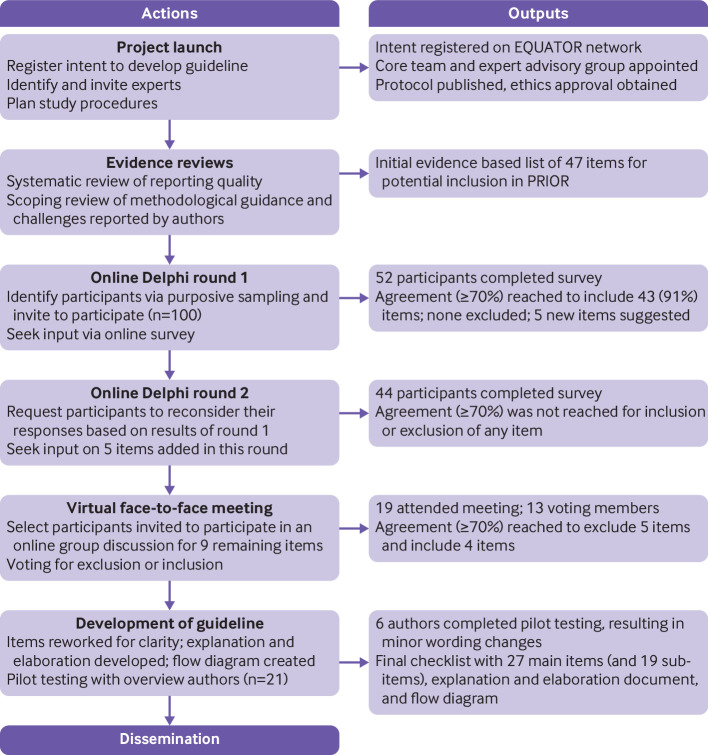
Objective: To develop a reporting guideline for overviews of reviews of healthcare interventions. Design: Development of the preferred reporting items for overviews of reviews (PRIOR) statement. Participants: Core team (seven individuals) led day-to-day operations, and an expert advisory group (three individuals) provided methodological advice. A panel of 100 experts (authors, editors, readers including members of the public or patients) was invited to participate in a modified Delphi exercise. 11 expert panellists (chosen on the basis of expertise, and representing relevant stakeholder groups) were invited to take part in a virtual face-to-face meeting to reach agreement (≥70%) on final checklist items. 21 authors of recently published overviews were invited to pilot test the checklist. Setting: International consensus. Intervention: Four stage process established by the EQUATOR Network for developing reporting guidelines in health research: project launch (establish a core team and expert advisory group, register intent), evidence reviews (systematic review of published overviews to describe reporting quality, scoping review of methodological guidance and author reported challenges related to undertaking overviews of reviews), modified Delphi exercise (two online Delphi surveys to reach agreement (≥70%) on relevant reporting items followed by a virtual face-to-face meeting), and development of the reporting guideline. Results: From the evidence reviews, we drafted an initial list of 47 potentially relevant reporting items. An international group of 52 experts participated in the first Delphi survey (52% participation rate); agreement was reached for inclusion of 43 (91%) items. 44 experts (85% retention rate) completed the second Delphi survey, which included the four items lacking agreement from the first survey and five new items based on respondent comments. During the second round, agreement was not reached for the inclusion or exclusion of the nine remaining items. 19 individuals (6 core team and 3 expert advisory group members, and 10 expert panellists) attended the virtual face-to-face meeting. Among the nine items discussed, high agreement was reached for the inclusion of three and exclusion of six. Six authors participated in pilot testing, resulting in minor wording changes. The final checklist includes 27 main items (with 19 sub-items) across all stages of an overview of reviews. Conclusions: PRIOR fills an important gap in reporting guidance for overviews of reviews of healthcare interventions. The checklist, along with rationale and example for each item, provides guidance for authors that will facilitate complete and transparent reporting. This will allow readers to assess the methods used in overviews of reviews of healthcare interventions and understand the trustworthiness and applicability of their findings.
Overview
CoChat Summary
TL;DR
The PRIOR statement is an evidence- and consensus-based reporting guideline for overviews of reviews of healthcare interventions, developed through a four-stage EQUATOR Network process. Its final checklist contains 27 main items with 19 sub-items, plus an explanation and elaboration document and flow diagram.
Key findings
Evidence reviews informed an initial list of 47 potential reporting items; in Delphi round 1, 52 experts participated and agreement (≥70%) was reached for inclusion of 43/47 (91%) items.
- In round 2, 44/52 (85%) round 1 participants responded, and agreement was not reached for inclusion or exclusion of any of the nine remaining items.
- In round 3, 19 individuals attended virtual meetings and 13 voted; agreement was reached to exclude five items (≥77%), retain three items (≥85% each), and for the final item, after near agreement (69%) for exclusion, 92% agreed to remove it and incorporate its content into item 8a.
- The final PRIOR checklist includes 27 main items with 19 sub-items; pilot testing involved 6 of 21 invited authors (29%) and resulted in minor wording changes but no content changes.
Methods
Development followed the EQUATOR Network’s four-stage process: project launch, evidence reviews (a systematic review of reporting quality and a scoping review of methodological guidance and author-reported challenges), a modified Delphi exercise, and guideline development.
- The modified Delphi used two online surveys and a virtual face-to-face meeting, with a prespecified ≥70% agreement threshold; 100 experts were invited, 52 completed round 1, 44 completed round 2, and 11 expert panellists were invited to round 3.
- Agreement was calculated as proportions agreeing/disagreeing, with Likert responses 1–2 treated as “disagree” and 3–4 as “agree”; “I don’t know” responses were included in the denominator but did not contribute to agreement or disagreement, and free-text comments were grouped to inform wording and additional items.
Limitations
Stated in the paper: the final guideline could differ with another participant set or a higher/lower agreement threshold; round 3 was held online rather than in person because of covid-19 travel restrictions, which might have reduced depth of discussion; panellists were not selected based on prior Delphi responses; pilot testing involved only six authors; no information was collected on participants’ clinical expertise or patient experience; representation of all relevant specialties was unlikely; PRIOR is intended for overviews of reviews of healthcare interventions and may not apply to other fields or overview types; some items lack methodological guidance, examples are sometimes imperfect, and periodic updates are expected.
- Evident from the text: the pilot test had a small sample (6/21 invited authors, 29%), limiting the generalisability of usability feedback; the paper also notes that impact on future reporting will need evaluation rather than being demonstrated here.
Model-written summary. Check it against the paper before relying on it.
Integrity signals
Registry
Cites
Statistics
Figures
Verification
Claims the paper makes
6 Valid · 0 Not valid · 31 Not checked · 64 Own results and interpretations
Every source the paper cites for this claim was checked and supports it.
In the paper
“Identifying and interpreting evidence from the growing number of sometimes redundant, misleading, or conflicting syntheses is an onerous task”
§ Reporting guideline for overviews of reviews of healthcare interventions: development of the PRIOR statement > Introduction
What the sources say
- Supportedcites [4] Ioannidis JP. The Mass Production of Redundant, Misleading, and Conflicted Systematic Reviews and Meta-analyses. Milbank Q 2016; 94: 485- 514. 10.1111/1468-0009.12210 27620683 PMC5020151 source
The Meta-analyses of Randomized Trials of Humans section (p. ~6) states that overlapping syntheses often reach different conclusions and that 'navigating through these discrepancies can be demanding even for investigators who are well trained in evidence-based medicine,' which is the substance of the claim's 'onerous task' of identifying and interpreting evidence. The Introduction (p. 1) and Abstract (p. 1) supply the other elements: rapid growth in publications (2,728% rise in systematic reviews 1991-2014) and reviews that 'suffer from extensive redundancy, little value, misleading claims, and/or vested interests.' (LLM, conf=0.88)
plain- Asserted: passes — The authors put it forward as true.
- Checkable: unclear — It is unclear whether it could be checked against evidence.
- Load-bearing: passes — The paper’s conclusions depend on it.
- Based: passes — The paper gives a reason why it holds.
- Supported
Every source the paper cites for this claim was checked and supports it.
In the paper
“We followed the methods suggested by the EQUATOR Network for developing reporting guidelines in health research.”
§ Reporting guideline for overviews of reviews of healthcare interventions: development of the PRIOR statement > Methods > Approach
What the sources say
- Supportedcites [28] Moher D Schulz KF Simera I Altman DG. Guidance for developers of health research reporting guidelines. PLoS Med 2010; 7: e1000217. 10.1371/journal.pmed.1000217 20169112 PMC2821895 source
Our copy of Moher et al. (2010) is precisely the EQUATOR-affiliated guidance the citing sentence refers to: the Abstract (p.1) states 'David Moher and colleagues from the EQUATOR network offer guidance and recommended steps for developing health research reporting guidelines,' and the Discussion (p.1) describes 'this guidance on how to develop a reporting guideline, including an 18-step checklist.' The Introduction (p.1) further situates it within the EQUATOR Network's role in assisting the development of reporting guidelines. So the cited work is the methods guidance for developing health research reporting guidelines associated with the EQUATOR Network; whether PRIOR's authors in fact followed every step is outside this source's scope. (LLM, conf=0.90)
plainstates a cause- Asserted: passes — The authors put it forward as true.
- Checkable: passes — It can be checked against evidence.
- Load-bearing: unclear — It is unclear whether the paper’s conclusions depend on it.
- Based: passes — The paper gives a reason why it holds.
- Supported
The cited sources support only part of this claim — read each source’s verdict below.
In the paper
“Although few published evaluations exist, evidence suggests that the endorsement of PRISMA by journals is associated with more complete reporting of systematic reviews than in journals not endorsing the reporting guideline.50 51 52”
§ Reporting guideline for overviews of reviews of healthcare interventions: development of the PRIOR statement > Discussion > Dissemination and evaluation
What the sources say
- Supportedcites [50] Stevens A Shamseer L Weinstein E. Relation of completeness of reporting of health research to journals’ endorsement of reporting guidelines: systematic review. BMJ 2014; 348: g3804. 10.1136/bmj.g3804 24965222 PMC4070413 source
In the Results section (Table 7; page not available in our copy), the PRISMA mean summed reporting score is higher for reviews in endorsing journals than in non-endorsing journals, with a standardized mean difference of 0.53 (99% CI 0.02 to 1.03). The paper notes that relatively few evaluations were available, consistent with the citing sentence’s cautious wording. (LLM, conf=0.94)
- Partly supportedcites [51] Page MJ Shamseer L Altman DG. Epidemiology and Reporting Characteristics of Systematic Reviews of Biomedical Research: A Cross-Sectional Study. PLoS Med 2016; 13: e1002028. 10.1371/journal.pmed.1002028 27218655 PMC4878797 sourceExperimental — accuracy not yet measured
The Results (page unavailable) associate more complete reporting with reviews that self-reported using PRISMA. The Discussion (page unavailable) notes that journal endorsement varies, but the paper does not compare reporting completeness in endorsing versus non-endorsing journals. (LLM, conf=0.88)
- Partly supportedcites [52] Veroniki AA Tsokani S Zevgiti S. Do reporting guidelines have an impact? Empirical assessment of changes in reporting before and after the PRISMA extension statement for network meta-analysis. Syst Rev 2021; 10: 246. 10.1186/s13643-021-01780-9 34507621 PMC8434710 sourceExperimental — accuracy not yet measured
The Results section (page not provided) reports higher reporting scores for network meta-analyses published in journals endorsing PRISMA than for those in journals not explicitly endorsing it, though the difference was described as not substantial. The claim extends that finding from reviews with network meta-analysis to systematic reviews generally. (LLM, conf=0.86)
hedgedstates an association- Asserted: passes — The authors put it forward as true.
- Checkable: passes — It can be checked against evidence.
- Load-bearing: unclear — It is unclear whether the paper’s conclusions depend on it.
- Based: passes — The paper gives a reason why it holds.
- Supported
Every source the paper cites for this claim was checked and supports it.
In the paper
“PRIOR is the first reporting guideline for overviews of reviews to be developed that adheres to the rigorous, systematic, and transparent methodology outlined by Moher et al.28”
§ Reporting guideline for overviews of reviews of healthcare interventions: development of the PRIOR statement > Discussion > Reporting guideline
What the sources say
- Supportedcites [28] Moher D Schulz KF Simera I Altman DG. Guidance for developers of health research reporting guidelines. PLoS Med 2010; 7: e1000217. 10.1371/journal.pmed.1000217 20169112 PMC2821895 source
The Introduction outlines a robust, explicit methodology for developing reporting guidelines, proposing 18 steps in five phases. That supports the citation’s attribution of the methodology to Moher et al.; the claim that PRIOR was the first guideline of its kind is the citing authors’ own characterization, not a finding attributed to this source. (LLM, conf=0.90)
plain- Asserted: passes — The authors put it forward as true.
- Checkable: passes — It can be checked against evidence.
- Load-bearing: passes — The paper’s conclusions depend on it.
- Based: passes — The paper gives a reason why it holds.
- Supported
A result the paper reports from its own data — it cites no other source for it, so there is none to check. The quote shows it is in the paper.
In the paper
“Agreement (≥70%) was not reached for the inclusion or exclusion of any of the nine items on the survey (four items that did not reach agreement in the first round, and five new items; appendix 4 in the supplementary materials).”
§ Reporting guideline for overviews of reviews of healthcare interventions: development of the PRIOR statement > Results > Round 2 results—online survey
plainn = 44- Asserted: passes — The authors put it forward as true.
- Checkable: passes — It can be checked against evidence.
- Load-bearing: unclear — It is unclear whether the paper’s conclusions depend on it.
- Based: passes — The paper gives a reason why it holds.
11 more claims
Create a free account to see all 101 claims and to verify the 37 references still open.
- Probably not a substantial claim. 70
- It may state two separate claims as one. 42
- The quote only partly states this claim. 1
Claims other papers make about this one
Each is checked against this paper’s own text: does it say what the citing paper says it does?
The cited source says what the claim attributes to it.
In the citing paper
“This review was prospectively registered on the International Platform of Registered Systematic Review and Meta-analysis Protocols (INPLASY202360071; https://inplasy.com/inplasy-2023-6-0071/) and conducted in alignment with the Preferred Reporting Items for Overviews of Reviews (PRIOR) (16).”
The cited source says what the claim attributes to it.
In the citing paper
“This umbrella review followed the Joanna Briggs Institute’s (JBI) methodology for umbrella reviews [21] and is reported in accordance with the Preferred Reporting Items for Overviews of Reviews (PRIOR) [22] (Supplementary file 1).”
From School-based healthy eating interventions for adolescents aged 10–19 years: an umbrella review (2024) · cites this paper as [22]
The cited source says what the claim attributes to it.
In the citing paper
“This overview was conducted in accordance with the PRIOR reporting guidelines.13”
From Acupuncture Therapy for Sciatica: An Overview of Systematic Reviews and Meta-Analysis (2025) · cites this paper as [13]
The cited source says what the claim attributes to it.
In the citing paper
“The reporting of this overview of reviews was guided by the standards of the Preferred Reporting Items for Overviews of Reviews (PRIOR) Statement (Gates et al., 2022).”
From Meta-analytic evidence on the efficacy of hypnosis for mental and somatic health issues: a 20-year perspective (2024) · cites this paper as Gates et al., 2022
The check wasn’t confident either way, so it gives no verdict — never disputed.
In the citing paper
“Previous meta-meta-analyses have been limited to adult populations 24 29 or included populations with confounding factors, such as chronic diseases 30 .”
From Effect of exercise on depression and anxiety symptoms: systematic umbrella review with meta-meta-analysis (2026) · cites this paper as [30]
Experimental — accuracy not yet measured
3 more claims about this paper
Create a free account to see every claim other papers make about this one.
Citations
Cites
RoB 2: a revised tool for assessing risk of bias in randomised trials
Sterne, J. A. C., Savović, J., Page, M. J., Elbers, R. G., Blencowe, N. S., Boutron, I., Cates, C. J., Cheng, H.-Y., Corbett, M. S., Eldridge, S. M., et al. (2019) · BMJ · doi:10.1136/bmj.l4898 · Cited by 34,787
Self-citationThe PRISMA 2020 statement: an updated guideline for reporting systematic reviews
Page, M. J., McKenzie, J. E., Bossuyt, P. M., Boutron, I., Hoffmann, T. C., Mulrow, C. D., Shamseer, L., Tetzlaff, J. M., Akl, E. A., Brennan, S. E., et al. (2021) · Systematic Reviews · doi:10.1186/s13643-021-01626-4 · Cited by 13,874
Self-citationA typology of reviews: an analysis of 14 review types and associated methodologies
Grant, M. J., & Booth, A. (2009) · Health Information & Libraries Journal · doi:10.1111/j.1471-1842.2009.00848.x · Cited by 10,817
Shea, B. J., Reeves, B. C., Wells, G., Thuku, M., Hamel, C., Moran, J., Moher, D., Tugwell, P., Welch, V., Kristjansson, E., et al. (2017) · BMJ · doi:10.1136/bmj.j4008 · Cited by 10,636
Self-citationThe PRISMA 2020 statement: an updated guideline for reporting systematic reviews
Page, M. J., McKenzie, J., Bossuyt, P., Boutron, I., Hoffmann, T., mulrow, C., Shamseer, L., Tetzlaff, J., Akl, E., Brennan, S. E., et al. (2020) · doi:10.31222/osf.io/v7gm2_v1 · Cited by 8,090
Self-citationResearch guidelines for the Delphi survey technique
Hasson, F. (2000) · Journal of Advanced Nursing · doi:10.1046/j.1365-2648.2000.01567.x · Cited by 5,951
The PRISMA 2020 statement: an updated guideline for reporting systematic reviews
Page, M. J., McKenzie, J., Bossuyt, P., Boutron, I., Hoffmann, T., mulrow, C., Shamseer, L., Tetzlaff, J., Akl, E., Brennan, S. E., et al. (2020) · doi:10.31222/osf.io/v7gm2 · Cited by 5,177
Self-citationThe Delphi Technique: Making Sense of Consensus
Hsu, C.-C., & Sandford, B. A. (2007) · University of Massachusetts Amherst · doi:10.7275/pdz9-th90 · Cited by 4,500
Diamond, I. R., Grant, R. C., Feldman, B. M., Pencharz, P. B., Ling, S. C., Moore, A. M., & Wales, P. W. (2014) · Journal of Clinical Epidemiology · doi:10.1016/j.jclinepi.2013.12.002 · Cited by 3,740
ROBIS: A new tool to assess risk of bias in systematic reviews was developed
Whiting, P., Savović, J., Higgins, J. P. T., Caldwell, D. M., Reeves, B. C., Shea, B., Davies, P., Kleijnen, J., & Churchill, R. (2016) · Journal of Clinical Epidemiology · doi:10.1016/j.jclinepi.2015.06.005 · Cited by 2,272
Self-citation
Research works printed but not linked: 2
- Dillman DA. Mail and Internet Surveys: The Tailored Design Method–2007 Update with New Internet, Visual, and Mixed-Mode Guide. John Wiley & Sons, 2011.
- Page MJ Shamseer L Altman DG. Epidemiology and Reporting Characteristics of Systematic Reviews of Biomedical Research: A Cross-Sectional Study. PLoS Med 2016; 13: e1002028. 10.1371/journal.pmed.1002028 27218655 PMC4878797 · DOI · Paper page
Cited by
Items 801–896 of 896
Amini, F., & Kazemi, S. S. (2026) · BMC Nursing · doi:10.1186/s12912-026-05086-w · Cited by 1
“The methodology was guided by the JBI Manual for Evidence Synthesis [25] and reported in accordance with the PRISMA 2020 statement [26].”
NSAID Use and Bone Healing: An Umbrella Review with a Reconstructed Meta-Analysis
Komargodski, R., Kittany, S., Abu‐Kishk, I., Berkowiz, R. B., Epstein, D., & Matok, I. (2026) · Journal of the American Academy of Orthopaedic Surgeons · doi:10.5435/jaaos-d-25-01579
Schneider, C., Frei, N., Fernandez, A., Frei, C., Wahedi, K., Husarek, J., Karrer, T., Aubert, C. E., Lehmann, B., & Müller, M. (2026) · BMC Medicine · doi:10.1186/s12916-026-05094-2
“This umbrella review or overview of reviews is structured according to the Cochrane recommendations [27] and is reported in accordance with the Preferred Reporting Items for Overviews of Reviews (PRIOR) statement [28].”
Ramzy, D., Isshak, R., Patel, D., Masry, M. E., Shri, N., Romero, J. E., Paromita, P., Nazmee, T., & Shamoon, F. E. (2026) · Cureus · doi:10.7759/cureus.113641
Câmara, L. C., Ferreira, M. H. L., & Khan, Z. U. (2026) · SN Comprehensive Clinical Medicine · doi:10.1007/s42399-026-02529-y
“…in accordance with the methodological guidance of the Cochrane Handbook for Systematic Reviews of Interventions [21 ], specifically the chapter dedicated to overviews of reviews, and was reported in compliance with the Preferred Reporting Items for Over-views of Reviews (PRIOR) guideline [22].”
Tandoğan, Ö., Ak, E. Y., & Ogul, Z. (2026) · Journal of Sex & Marital Therapy · doi:10.1080/0092623x.2026.2710319
Fraser, B. J., Gower, B., Stanesby, O., Magnussen, C. G., Cadenas‐Sánchez, C., Chaput, J., Manyanga, T., McGrath, R. P., Merucci, K., MYERS, J. N., et al. (2026) · Sports Medicine · doi:10.1007/s40279-026-02503-7
Altayó, M., Philippi, R., Villalón, F., Navarro-Ovando, V., Zumaeta, A., & Decebal-Cuza, F. (2026) · Qeios · doi:10.32388/2l8mzg
Chen, J., Leung, Y. Y., & Wang, F. (2026) · Journal of Evidence Based Dental Practice · doi:10.1016/j.jebdp.2026.102334
Prehabilitation in adult cancer patients: an overview of systematic reviews
Xiong, Z., Fu, Z.-R., Chen, J., Chen, T., & Yang, S. (2026) · BMJ Open · doi:10.1136/bmjopen-2025-116006 · Cited by 1
Li, H., Sun, C., Zhou, Q., & Du, G. (2026) · Frontiers in Medicine · doi:10.3389/fmed.2026.1877844
Gaston, S. A., Zhou, W., Singh, R., Shields, T. C., Livinski, A. A., Redline, S. S., Chaput, J., Spruyt, K., Han, F., Owens, J. A., et al. (2026) · Sleep Medicine Reviews · doi:10.1016/j.smrv.2026.102350 · Cited by 1
Gazula, S., & Cant, R. (2026) · Nurse Education Today · doi:10.1016/j.nedt.2026.107331
Drivers of academic dishonesty and multi-level prevention strategies: an umbrella review
Estrella-Bote, V. D. R., Vallespir-Adillón, M., Julián, M., & Comas-Forgas, R. (2026) · Revista Digital de Investigación en Docencia Universitaria · doi:10.19083/ridu.2026.2492
“Umbrella reviews are appropriate when a topic has generated multiple secondary syntheses that vary in scope and method, and where decision-makers require an integrated, practice-facing synthesis across review types and subtopics (Aromataris et al., 2015; Gates et al., 2022).”
Jones, N., Taylor, O., Reid, S., & Clarke, D. (2025) · Pharmacophore · doi:10.51847/wnbjf8t1p5
O PARADOXO DA OBESIDADE NO TRAUMA E NA CIRURGIA DE EMERGÊNCIA: UMBRELLA REVIEW DAS EVIDÊNCIAS
de Sousa, D. F., Neto, A. C. F., de Oliveira, K. G. L. G., Marques, C. S. M., de Menezes, R. N., Vieira, M. E. N. P., Ramos, P. A. T., Carvalho, P. C., & Vieira, N. B. (2026) · Editora Humanize eBooks · doi:10.29327/5901805.1-7
Prisco, M. D., Oliva, V., Miola, A., Fornaro, M., Dragioti, E., Croatto, G., Carvalho, A. F., Berk, M., Nikolitch, K., Saraf, G., et al. (2026) · BMJ · doi:10.1136/bmj-2026-100216
Self-citationTiga-Loza, D. C., Urrea-Vega, E. A., Rivera-Carvajal, R., Álvarez-Anaya, W. A., Buitrago-Buitrago, J. A., Hernández-Martínez, A. M., & Camacho-López, P. (2026) · BMC Geriatrics · doi:10.1186/s12877-026-07933-6
“This umbrella review was conducted in accordance with the Preferred Reporting Items for Overviews of Reviews (PRIOR) statement [30], as well as the Joanna Briggs Institute (JBI) methodology for overviews of reviews [31].”
Behavioural change interventions to promote climate action: An umbrella review protocol
Surendran, A., Christodoulou, V., Mercan, M. N., Öztürk, G., Aksoy, Y. E., Ristevska-Dimitrovska, G., Theofanidis, D., Demetrovics, Z., Burkauskas, J., Cadeddu, C., et al. (2026) · Open Research Europe · doi:10.12688/openreseurope.24178.1
Nkosi, T., Molefe, L., Dlamini, S., Mokoena, A., & Ndlovu, K. (2026) · Pharmacophore · doi:10.51847/hxsioqastj
Thompson, D., Mitchell, S., Adams, R., Brown, J., & Lee, M. (2026) · Archives of Pharmacy Practice · doi:10.51847/yymc77qbbs
Chen, W.-X., Li, Y.-Z., Kang, L.-D., Jiang, X., Chen, Y.-H., Yang, D., Wang, Y., Zhao, Y., Liu, F.-H., Liu, J.-X., et al. (2026) · British Journal of Sports Medicine · doi:10.1136/bjsports-2026-111792
Kshatri, A. H. S., Saif, M., Saleem, S., Habib, M., Malik, M. Z., Hussain, A., & Arif, S. (2026) · Cureus · doi:10.7759/cureus.114745
“This umbrella review was conducted in accordance with the Preferred Reporting Items for Systematic Reviews and Meta-Analyses (PRISMA) 2020 guidelines and the PRIOR (Preferred Reporting Items for Overviews of Reviews) statement [10,11].”
Es-Saad, O., Ech-Chaqrouni, L., Motiaa, Y., Lamzouri, O., Berdaï, M. A., Sbaï, H., & Labib, S. (2026) · Renal Replacement Therapy · doi:10.1186/s41100-026-00751-x
“This umbrella review is reported according to the Preferred Reporting Items for Overviews of Reviews (PRIOR) [15] and the Preferred Reporting Items Statement for Systematic Reviews and Meta-Anal-yses (PRISMA) 2020 Guidelines [16].”
Responding to the challenges of evidence synthesis: Some lessons from healthcare
Bastounis, A., Kundakci, B., & Booth, A. (2026) · Research methods in applied linguistics · doi:10.1075/rmal.17.18bas
Hernández‐Rodríguez, J., Bueno‐Molina, R. C., García‐Muñoz, C., Sendín‐Martín, M., Rodríguez, J., Rodríguez-Luna, A., & Martínez-Calderón, J. (2026) · Archives of Dermatological Research · doi:10.1007/s00403-026-04846-7
Јаnkovic, S., Milosavljević, M. N., Stević, I., Ašić, A., Jusić, A., Devaux, Y., Belančić, A., Bektay, M. Y., & Pejčić, A. V. (2026) · Pharmacogenomics and Personalized Medicine · doi:10.2147/pgpm.s613319
Clinical outcomes of clear aligners in growing children: An umbrella review
Mathew, M. G., Jose, S., Cherian, J. M., & Lepcha, O. P. (2026) · Journal of Indian Society of Pedodontics and Preventive Dentistry · doi:10.4103/jisppd.jisppd_225_26
Immediate versus delayed dental implant placement: an umbrella review protocol
Ron, M., Miranda, N. D. O., Balseca, J. P. S., Benfatti, C. A. M., Strauss, F., Ruales‐Carrera, E., Pauletto, P., & Magrin, G. L. (2026) · BMJ Open · doi:10.1136/bmjopen-2026-119635
“Figure 1 represents the PICOS structure used in the review question: ‘What is the current body of evidence regarding the comparative clinical performance of immediate and delayed implant placement, and which clinical or methodological characteristics may explain variations in reported outcomes…”
Qiao, C., Yang, C., Yang, S., & Wang, Y. (2026) · Metabolites · doi:10.3390/metabo16090635
“The protocol was prospectively registered in PROSPERO (CRD420261460040), and reporting followed PRIOR, PRISMA 2020, and PRISMA-S [21–23].”
Early Versus Late Tracheostomy: An Umbrella Review and Meta-Analysis
Mostberger, S., Glišić, M., Gamba, M., Perret, C., & Mueller, G. (2026) · Journal of Clinical Medicine · doi:10.3390/jcm15176685
“The results of this umbrella review have been reported in accordance with previously published guidelines on umbrella reviews [14,15], and following the PRIOR statement.”
Süleymanoğulları, M., Eyipınar, C. D., Muntean, R. I., & Ceylan, H. İ. (2026) · Journal of Clinical Medicine · doi:10.3390/jcm15176733
“Guidance for overviews of reviews therefore recommends explicit assessment and management of primary-study overlap [8,9].”
de Toledo, J. O., Ferreira, C. D. C., da Silva, C. P., de David, F., de Castro, L. C., Vilarino, M. T., Zani, M. D., Ferreira, M. S., Teles, T. K. B., & Nogueira, A. D. S. (2026) · Revista fisio&terapia. · doi:10.69849/6tp4j418
Neurodiversidade e Trabalho: Uma Revisão Guarda-Chuva
Trombeta, G., Ferreira, A. C. M., & Bernardes, I. A. F. (2026) · Revista Psicologia Organizações e Trabalho · doi:10.5935/rpot/e26816
Abdo, N. M., Xie, Z., Al-Samawi, H. H., Al-Azzani, H., & Xie, Q. (2026) · Heart Rhythm O2 · doi:10.1016/j.hroo.2026.08.149
Tsagli, D. D., Twene, E. B., Gilbert, A. S., Gacad, A., Parrish, L. J., Saseetharran, A., Gyapong, N. A., Nguyen, O. T., Turner, K., Tarver, W. L., et al. (2026) · International Journal of Medical Informatics · doi:10.1016/j.ijmedinf.2026.106703
Biofeedback‐Based Therapy in Patients With Myofascial Orofacial Pain and Bruxism: An Umbrella Review
Beriger, C., Kohout, K., Wojczyńska, A. Z., Ruales‐Carrera, E., Eyüboğlu, T. F., & Özcan, M. (2026) · Journal of Oral Rehabilitation · doi:10.1111/joor.70303
Narratives of medical tourists travelling for Dental Treatment: A case of India
Varshney, S., Jangra, T., & Kashyap, P. (2026) · International Journal of Versatile Research and Analysis · doi:10.56975/ijvra.v4i9.710636
Smith, K., Siafis, S., McCutcheon, R. A., Pillinger, T., Upthegrove, R., Downs, J. L., Seedat, S., Lawrance, E. L., Salanti, G., Gureje, O., et al. (2026) · The Lancet Psychiatry · doi:10.1016/s2215-0366(26)00228-2
Castillo-Daza, C. A., & Rodríguez-Cheu, L. E. (2026) · Retos · doi:10.47197/retos.v83.119619
“Esta revisión de revisiones, diseñada de acuerdo con las guías PRISMA 2020 (Page et al., 2021) y la De-claración PRIOR para revisiones de revisiones (Gates et al., 2022), con evaluación de la calidad metodo-lógica mediante la herramienta AMSTAR-2 (Shea et al., 2017), se llevó a cabo para abordar…”
Bradt, J., de Witte, M., Aithal, S., Flynn, L. M., Karkou, V., Koch, S. C., Orkibi, H., Sajnani, N. L., Berberian, M., Fietje, N., et al. (2026) · Research Square · doi:10.21203/rs.3.rs-5961850/v2 · Cited by 1
Mairghani, M., Baker, J., Basa, M., Brannigan, R., Ramkaran, A., Murphy, A., Stanistreet, D., & Sharp, M. K. (2026) · Reviews on Environmental Health · doi:10.1515/reveh-2026-0061
“The conduct and reporting of this umbrella review adhered to the Preferred Reporting Items for Overviews of Reviews (PRIOR) statement [36].”
Zhang, M., Xia, Y., Mo, H., Zhu, Y., Fang, L., Xiang, Q., Shen, J., Wang, L., & Lou, J. (2026) · Epidemiologic Reviews · doi:10.1093/epirev/mxag013
Fornaro, M., Lorenzo, C. D., Monaco, F., Vignapiano, A., & Steardo, L. (2026) · Journal of Psychosomatic Research · doi:10.1016/j.jpsychores.2026.112997 · Cited by 1
Ovčariček, P. P., Campennì, A., Ruggeri, R. M., Punda, M., Gregov, A., Bejuk, A., Campennì, A. F., Huellner, M. W., & Giovanella, L. (2026) · Journal of Clinical Medicine · doi:10.3390/jcm15218255
Fang, J., Ma, X., Sun, M., Chen, S., Ma, Z., & Liang, W. (2026) · Frontiers in Immunology · doi:10.3389/fimmu.2026.1925582
“…established guidance for umbrella reviews and overviews of reviews (9, 10), and reporting follows the Preferred Reporting Items for Systematic Reviews and Meta-Analyses (PRISMA) 2020 statement together with the PRIOR (Preferred Reporting Items for Overviews of Reviews) reporting guideline (11, 12).”
Oliveira, H. R. M. D. A. (2026) · Health and Society · doi:10.51249/hs.v6i04.3213
Nagy, P., Clarke, A., & Nair, R. (2023) · Annals of Pharmacy Practice and Pharmacotherapy · doi:10.51847/ithecxx0qy
Semalulu, T., Anderson, M. A., Schafer, Z., Kharouf, F., Neary, E., Essa, A., Al-Matar, S., AlFraih, S., Abarza, V. C., Saka, A. K., et al. (2026) · Journal of Clinical Epidemiology · doi:10.1016/j.jclinepi.2026.112503
Geltore, T. E., Bekele, M., Sileshi, E., Ersado, T. L., Angelo, A. T., Anshebo, A. A., Hadaro, T. S., & Foto, L. L. (2026) · Breastfeeding Medicine · doi:10.1177/15568253261490308
Vera-Ponce, V. J., & Ballena-Caicedo, J. (2026) · Diagnostics · doi:10.3390/diagnostics16193069
“This umbrella review was conducted and reported in accordance with the PRIOR statement [9].”
Wang, W., Li, Y., Liu, C., Chen, C., Chen, M., Thabane, L., Sun, X., & Tan, J. (2026) · iMetaMed · doi:10.1002/imm3.70060
Weber, T., Menon, P., & Al-Hassan, M. (2026) · Annals of Pharmacy Education, Safety, and Public Health Advocacy · doi:10.51847/qjgbf3cmr3
Gómez‐Gómez, I., Caffieri, A., Barquero‐Jimenez, C., de-Juan-Iglesias, P., Cáceres, I., Goossens, L., Miguel, C., Maio, N. D., Harrer, M., Cuijpers, P. J., et al. (2026) · Open Research Europe · doi:10.12688/openreseurope.24134.1
Turri, G., & de Oliveira, J. C. (2026) · Revista Brasileira de Medicina de Família e Comunidade · doi:10.5712/rbmfc21(48)3695
Kamarova, S., Davidson, S. R. E., Bogard, I., Williams, C. M., Shaheed, C. A., Wand, T., & Kamper, S. J. (2026) · General Hospital Psychiatry · doi:10.1016/j.genhosppsych.2026.09.011
Umbrella review protocol of meta-analyses on intraoperative protective ventilation
Song, F., 王, 明., Song, S., & Wan, P. (2026) · BMJ Open · doi:10.1136/bmjopen-2026-121689
“16 It can not only comprehensively synthe-sise the existing evidence on intraoperative protective ventilation, but also systematically evaluate the quality of that evidence.”
AI-Enabled Digital Health Tool Implementation in Clinical Practice Settings: Umbrella Review
Gilbert, A. S., Gacad, A., Parrish, L. J., Nguyen, O. T., Turner, K. L., Tarver, W. L., Jonnalagadda, P., Tsagli, D. D., Wu, B., Lu, C., et al. (2026) · JMIR AI · doi:10.2196/101509
Nagata, J. M., Helmer, C. K., Huang, O. H., Nayak, S., Bao, K., Zhang, S., Handoko, K., Li, E. J., Moreno, M. A., & Lavender, J. M. (2026) · EClinicalMedicine · doi:10.1016/j.eclinm.2026.104195 · Cited by 1
“18 A formal protocol was retrospectively registered with the International Plat-form of Registered Systematic Review and Meta-analysis Protocols (INPLASY; INPLASY202670067; https://doi.org/10.37766/inplasy2026.7.0067).”
InfluentialYao, Y.-X., Huang, S., Liu, K., Gao, S.-S., & Yao, Y.-T. (2026) · Journal of Dental Anesthesia and Pain Medicine · doi:10.17245/jdapm.2026.26.128
“The manuscript follows the Preferred Reporting Items for Overviews of Reviews (PRIOR) statement and PRISMA 2020 principles where applicable [15,16].”
Chai, G., Xue, J., & Xie, B. (2026) · Frontiers in Immunology · doi:10.3389/fimmu.2026.1931607
Acupuncture and Related Therapies for Breast Cancer-Related Symptoms: An Evidence Map
Ang, L., Jun, J. H., Yang, C., Myeong Soo, L. E. E., & Choi, T. (2026) · Integrative Cancer Therapies · doi:10.1177/15347354261490583
Reichow, B., Barton, E. E., & Song, J. (2026) · Journal of Autism and Developmental Disorders · doi:10.1007/s10803-026-07551-6
Bruno, J., Montoro-Bombú, R., Thapa, R. K., & Sarmento, H. (2026) · Sports Medicine · doi:10.1007/s40279-026-02538-w
The effectiveness of serious games in healthcare education: An umbrella review
Binladen, B. S., Porter, S., & Wilson, C. B. (2026) · Nurse Education Today · doi:10.1016/j.nedt.2026.107458
Cobo, V. T., Yánez, C., Tapia-Tapia, M., Lopez, A. C., Muñoz, C., Taberner, M. R., Zalabardo, D. S., López, B. M., & García, J. E. R. (2026) · The Journal of Sexual Medicine · doi:10.1093/jsxmed/qdag311
Sugino, R. L., Pokorny, G. H. D. O., Pokorny, J., & Mizael, W. (2026) · European Spine Journal · doi:10.1007/s00586-026-10375-8
Eisa, N., & Khoury, M. (2026) · Journal of Diabetes & Metabolic Disorders · doi:10.1007/s40200-026-02097-x
Lyu, Z., Ma, J., Ma, C., Tian, X., Liu, L., Zhang, J., & Gao, Y. (2026) · Frontiers in Immunology · doi:10.3389/fimmu.2026.1921728
“Overall con fi dence re fl ects the 16 AMSTAR 2 items and the seven critical domains (items 2, 4, 7, 9, 11, 13, and 15): one critical weakness lowers con fi dence to Low and more than one lowers it to Critically Low.”
Sezer, E., & GÜR, G. (2026) · Frontiers in Public Health · doi:10.3389/fpubh.2026.1948010
Mehta, V., Patil, S., Dash, K. S., & Mathur, A. (2026) · BDJ Open · doi:10.1038/s41405-026-00503-3
“Strongly in fl uenced by oral-hygiene instruction, adherence and co-interventions.”
Zeng, L.-X., Jiang, Y.-C., Wang, Y.-Q., Ye, F., Ouyang, Y., Zhao, Z., Wu, Q.-B., & Cheng, H.-B. (2026) · World Journal of Gastroenterology · doi:10.3748/wjg.124236
Min, S. K., Lee, M. A., Kim, Y., Choi, K. K., Yu, B., Lee, G. J., & Kang, W. S. (2026) · Journal of Clinical Medicine · doi:10.3390/jcm15207865
“…was conducted in accordance with the Preferred Reporting Items for Systematic Reviews and Meta-Analyses (PRISMA) 2020 guidelines [12] (Supplementary Table S1) and reported in accordance with the Preferred Reporting Items for Overviews of Reviews (PRIOR) statement [10] (Supplementary Table S2).”
de Sousa, R. R., Silva, A. C. D. C., de Castro, J. A., Lourenzo, G. A., Mesquita, D. E., Matter, L. P. S., Fernandes, A. C., Ferreira, L. F. B., Clutterbuck, G. L., de Carvalho, C. N., et al. (2026) · Physical & Occupational Therapy In Pediatrics · doi:10.1080/01942638.2026.2740564
Farronato, M., Giannini, L., Farronato, D., Iasio, G. D., & Maspero, C. M. N. (2026) · Journal of Dentistry · doi:10.1016/j.jdent.2026.107107
Oyolola, O., Daley, A., McLaughlin, J., Murphy, G. J., Slade, K., Graham, H., Abbott, T., Issa, A., & Madigan, C. D. (2026) · Ethnicity and Health · doi:10.1080/13557858.2026.2733954
Yang, Q., Sun, Q., Hu, J., Yan, P., Chen, S., & Ren, Z. (2026) · Research Square · doi:10.21203/rs.3.rs-11129034/v1
Umbrella review of low-level light therapy: evidence across clinical conditions
Song, E., Ang, L., Yim, M. H., Choi, S., & Kim., J. (2026) · Lasers in Medical Science · doi:10.1007/s10103-026-05064-3
Robot-assisted training for post-stroke lower-limb dysfunction: an umbrella review
Wang, L., Wang, C., Cao, Q., Yin, K., Ding, L., & Chen, A. (2026) · Frontiers in Public Health · doi:10.3389/fpubh.2026.1969488
“The present umbrella review was reported in accordance with the PRIOR guideline (8), which promotes transparent reporting of the objectives, methods, results, and limitations of overviews of reviews.”
InfluentialBaduanjin Exercise Across Clinical Conditions: An Umbrella Review
Yuan, D., Xu, B., Zhao, R., 崔永胜, 杨克新, 金哲锋, Sun, K., Wei, J., Zhu, L., Qin, X., et al. (2026) · Journal of Evidence-Based Medicine · doi:10.1111/jebm.70196
Hao, Z., Liu, K., & Yang, G. (2026) · medRxiv · doi:10.64898/2026.10.16.26365512
Han, S., Huang, F., Bai, Z., Zhao, X., Chan, A. H. S., & Chen, K. (2026) · Disability and Rehabilitation Assistive Technology · doi:10.1080/17483107.2026.2748806
Bharali, K., Hazarika, K., & Deuri, N. (2026) · Digital Dentistry Journal · doi:10.1016/j.ddj.2026.100132
Climate Change and Workers’ Health and Safety: An Umbrella Review
Borghi, F., Ciaccio, L., Decataldo, F., Violante, F., & Negri, E. (2026) · La Medicina del Lavoro · doi:10.23749/mdl.2026.18722
“This umbrella review was conducted following the PRIOR (Preferred Reporting Items for Overviews of Reviews) statement [7] and in accordance with the Preferred Reporting Items for Systematic Reviews and Meta-Analyses (PRISMA) guidelines [8].”
Cold-Water Immersion for Post-exercise Recovery: An Overlap-Aware Umbrella Review
Liang, W., Ma, X., Sun, G., Liu, C., & Yan, X. (2026) · Sports Medicine - Open · doi:10.1186/s40798-026-01132-8
“This umbrella review was reported in accordance with PRISMA 2020 and with consideration of the PRIOR statement for overviews of reviews [15, 16].”
The Association Between Sleep and Obesity in Adults: An Umbrella Review of Meta‐Analyses
Malasevskaia, I. A., Rebellow, D., Tarar, P., & Soliman, E. M. (2026) · Health Science Reports · doi:10.1002/hsr2.73449
Sethi, Y., Kaka, N., Singhal, S., Vasudev, M., Biondi‐Zoccai, G., & Misra, A. (2026) · Journal of Vascular Diseases · doi:10.3390/jvd5060046
Xi, F., Xu, C., Li, P., Zhou, S., Liu, J., Zhou, S., Wang, Y., & Yu, J. (2026) · Frontiers in Nutrition · doi:10.3389/fnut.2026.1994645
Lin, H., & Zhao, H. (2026) · Frontiers in Public Health · doi:10.3389/fpubh.2026.1934173
Enteric infections as HIV indicator conditions for HIV testing: An umbrella review
Rabuszko, L., Crossman, J., Casey, T., Parvin, J., Fitzpatrick, C., Williams, D., Clutterbuck, D., White, J. A., Underwood, J., & Richardson, D. (2026) · HIV Medicine · doi:10.1111/hiv.70327
Data Extraction Errors and Diagnostic Conclusions of Meta-Analyses
Huang, Z., Tian, Y., Gong, P., Zhang, T., & Tang, H. (2026) · JAMA Network Open · doi:10.1001/jamanetworkopen.2026.40850
Diagnosing Misalignment in Review-Based Research: A Framework for Editors, Reviewers, and Authors
Raitskaya, L., & Tikhonova, E. A. (2026) · Journal of language and Education · doi:10.17323/jle.2026.38640
Lloyd, E. C., Calderón, P. D. S., Morales, C., Lee, E., Maharajh, S., Moorman, B., Grange, D. L., Hagan, K. E., & Gorrell, S. (2026) · Nutrients · doi:10.3390/nu18213650
Sirago, G., Sebastiani, N., Dell'Erba, A., & Ferorelli, D. (2026) · Science & Justice · doi:10.1016/j.scijus.2026.101544
Metadata
- Authors
- Gates, M., Gates, A., Pieper, D., Fernandes, R. M., Tricco, A. C., Moher, D., Brennan, S. E., Li, T., Pollock, M., Lunny, C., Sepúlveda, D., McKenzie, J. E., Scott, S. D., Robinson, K. A., Matthias, K., Bougioukas, K. I., Fusar-Poli, P., Whiting, P., Moss, S. J., & Hartling, L.
- Affiliations
- University of Alberta (CA)
- Witten/Herdecke University (DE)
- University of Lisbon (PT)
- St. Michael's Hospital (CA)
- University of Ottawa (CA)
- Monash University (AU)
- University of Colorado Anschutz (US)
- Institute of Health Economics (CA)
- Ministry of Health (CL)
- Johns Hopkins University (US)
- University of Applied Sciences Stralsund (DE)
- Aristotle University of Thessaloniki (GR)
- Early Psychosis: Interventions and Clinical-detection Laboratory, Department of Psychosis Studies, Institute of Psychiatry, Psychology, and Neuroscience, King’s Collect London, London, UK
- University of Bristol (GB)
- University of Calgary (CA)
- Corresponding author
- Li, Tianjing
- Hartling, Lisa
- ORCID
- Venue
- BMJ
- Publisher
- BMJ
- Published
- 2022-08-09
- Volume
- 378
- Pages
- e070849
- ISSN
- 1756-1833 (ISSN-L)
- PMC
- PMC9361065
- OpenAlex
- W4290769249
- Cited by
- 856
- References
- 44
- Citations by year
- 2026: 241 · 2025: 218 · 2024: 256 · 2023: 133 · 2022: 8
- FWCI
- 93.04
- Type
- journal article
- Language
- en
- Open access
- hybrid
- doi.org
- Licence
- Locations
- BMJ (publishedVersion, cc-by-nc)
- PubMed Central (publishedVersion, cc-by-nc)
- PubMed (publishedVersion)
- Research Portal (King's College London) (publishedVersion, cc-by-nc)
- Funders
- National Eye Institute (UG1EY020522)
- Topics
- Social Sciences › Decision Sciences › Statistics, Probability and Uncertainty › Meta-analysis and systematic reviews
- Social Sciences › Sociology and Political Science › Delphi Technique in Research
- Health Sciences › Medicine › Public Health, Environmental and Occupational Health › Clinical practice guidelines implementation
- Keywords
- overviews of reviews, reporting guidelines, health interventions, reporting checklist, transparency in research reporting, EQUATOR Network, Delphi consensus, reporting quality, stakeholder engagement, patient and public involvement, conflict of interest disclosure
- MeSH terms
- Delivery of Health Care, Delphi Technique, Health Facilities, Humans, Surveys and Questionnaires, Research Design, Consensus, Checklist
About these checks
Registry, retraction, Cites and statistics results are computed, not judged, with one exception: a printed reference that no index lists is read once by a model before it counts as a citation error. Claims are extracted by a model and kept only when their quote appears verbatim in the text; each cited source is then checked, with a model’s help, for whether it says what the claim relies on. Those verdicts can be wrong — read the claim’s quote and the cited source before relying on one.
The claim verdicts this report counts are experimental: their accuracy is not yet measured.
A language model drew the claims from the paper on 2026-10-05, under version 3 of the claim definition (model deepseek-v4.1-flash, prompt extract-v3).
A second model labelled each claim on 2026-10-05 (model jev-1.13-20260917, definition revision gold-guideline-v0.2).
Cited sources are checked with a language model’s help (qwen3.8-omni-flash and gpt-6-sol).
Statistics and arithmetic are recomputed, not judged.
Confidence bands are shown only for fields calibrated on our annotated test set. None is calibrated yet, so no band is shown.
What counts as a claim ›How we measure confidence ›How we check this ›
Are you an author, or do you see a problem with this page? Request a review
Data sources
Bibliographic data: Semantic Scholar, OpenAlex, Crossref.
Contains information from the Semantic Scholar Academic Graph Datasets, made available under the ODC Attribution License (ODC-BY 1.0).
Semantic Scholar’s data is described in: Kinney, R., et al. (2023). The Semantic Scholar Open Data Platform. arXiv:2301.10140.
