

Reporting guideline for overviews of reviews of healthcare interventions: development of the PRIOR statement.
Open accessThe DOI matches its Crossref record; 45 of the 45 references it cites were found in a registry or an index; 8 of the 45 sources its claims cite were checked for support.
Abstract
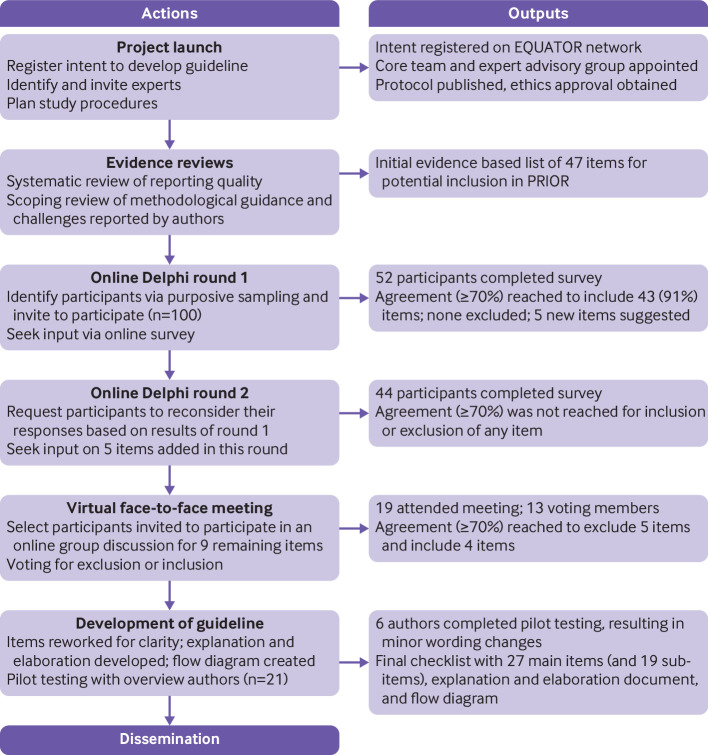
Objective: To develop a reporting guideline for overviews of reviews of healthcare interventions. Design: Development of the preferred reporting items for overviews of reviews (PRIOR) statement. Participants: Core team (seven individuals) led day-to-day operations, and an expert advisory group (three individuals) provided methodological advice. A panel of 100 experts (authors, editors, readers including members of the public or patients) was invited to participate in a modified Delphi exercise. 11 expert panellists (chosen on the basis of expertise, and representing relevant stakeholder groups) were invited to take part in a virtual face-to-face meeting to reach agreement (≥70%) on final checklist items. 21 authors of recently published overviews were invited to pilot test the checklist. Setting: International consensus. Intervention: Four stage process established by the EQUATOR Network for developing reporting guidelines in health research: project launch (establish a core team and expert advisory group, register intent), evidence reviews (systematic review of published overviews to describe reporting quality, scoping review of methodological guidance and author reported challenges related to undertaking overviews of reviews), modified Delphi exercise (two online Delphi surveys to reach agreement (≥70%) on relevant reporting items followed by a virtual face-to-face meeting), and development of the reporting guideline. Results: From the evidence reviews, we drafted an initial list of 47 potentially relevant reporting items. An international group of 52 experts participated in the first Delphi survey (52% participation rate); agreement was reached for inclusion of 43 (91%) items. 44 experts (85% retention rate) completed the second Delphi survey, which included the four items lacking agreement from the first survey and five new items based on respondent comments. During the second round, agreement was not reached for the inclusion or exclusion of the nine remaining items. 19 individuals (6 core team and 3 expert advisory group members, and 10 expert panellists) attended the virtual face-to-face meeting. Among the nine items discussed, high agreement was reached for the inclusion of three and exclusion of six. Six authors participated in pilot testing, resulting in minor wording changes. The final checklist includes 27 main items (with 19 sub-items) across all stages of an overview of reviews. Conclusions: PRIOR fills an important gap in reporting guidance for overviews of reviews of healthcare interventions. The checklist, along with rationale and example for each item, provides guidance for authors that will facilitate complete and transparent reporting. This will allow readers to assess the methods used in overviews of reviews of healthcare interventions and understand the trustworthiness and applicability of their findings.
Overview
CoChat Summary
TL;DR
The PRIOR statement is an evidence- and consensus-based reporting guideline for overviews of reviews of healthcare interventions, developed through a four-stage EQUATOR Network process. Its final checklist contains 27 main items with 19 sub-items, plus an explanation and elaboration document and flow diagram.
Key findings
Evidence reviews informed an initial list of 47 potential reporting items; in Delphi round 1, 52 experts participated and agreement (≥70%) was reached for inclusion of 43/47 (91%) items.
- In round 2, 44/52 (85%) round 1 participants responded, and agreement was not reached for inclusion or exclusion of any of the nine remaining items.
- In round 3, 19 individuals attended virtual meetings and 13 voted; agreement was reached to exclude five items (≥77%), retain three items (≥85% each), and for the final item, after near agreement (69%) for exclusion, 92% agreed to remove it and incorporate its content into item 8a.
- The final PRIOR checklist includes 27 main items with 19 sub-items; pilot testing involved 6 of 21 invited authors (29%) and resulted in minor wording changes but no content changes.
Methods
Development followed the EQUATOR Network’s four-stage process: project launch, evidence reviews (a systematic review of reporting quality and a scoping review of methodological guidance and author-reported challenges), a modified Delphi exercise, and guideline development.
- The modified Delphi used two online surveys and a virtual face-to-face meeting, with a prespecified ≥70% agreement threshold; 100 experts were invited, 52 completed round 1, 44 completed round 2, and 11 expert panellists were invited to round 3.
- Agreement was calculated as proportions agreeing/disagreeing, with Likert responses 1–2 treated as “disagree” and 3–4 as “agree”; “I don’t know” responses were included in the denominator but did not contribute to agreement or disagreement, and free-text comments were grouped to inform wording and additional items.
Limitations
Stated in the paper: the final guideline could differ with another participant set or a higher/lower agreement threshold; round 3 was held online rather than in person because of covid-19 travel restrictions, which might have reduced depth of discussion; panellists were not selected based on prior Delphi responses; pilot testing involved only six authors; no information was collected on participants’ clinical expertise or patient experience; representation of all relevant specialties was unlikely; PRIOR is intended for overviews of reviews of healthcare interventions and may not apply to other fields or overview types; some items lack methodological guidance, examples are sometimes imperfect, and periodic updates are expected.
- Evident from the text: the pilot test had a small sample (6/21 invited authors, 29%), limiting the generalisability of usability feedback; the paper also notes that impact on future reporting will need evaluation rather than being demonstrated here.
Model-written summary. Check it against the paper before relying on it.
Integrity signals
Registry
Cites
Statistics
Figures
Verification
Claims the paper makes
6 Valid · 0 Not valid · 31 Not checked · 64 Own results and interpretations
Every source the paper cites for this claim was checked and supports it.
In the paper
“Identifying and interpreting evidence from the growing number of sometimes redundant, misleading, or conflicting syntheses is an onerous task”
§ Reporting guideline for overviews of reviews of healthcare interventions: development of the PRIOR statement > Introduction
What the sources say
- Supportedcites [4] Ioannidis JP. The Mass Production of Redundant, Misleading, and Conflicted Systematic Reviews and Meta-analyses. Milbank Q 2016; 94: 485- 514. 10.1111/1468-0009.12210 27620683 PMC5020151 source
The Meta-analyses of Randomized Trials of Humans section (p. ~6) states that overlapping syntheses often reach different conclusions and that 'navigating through these discrepancies can be demanding even for investigators who are well trained in evidence-based medicine,' which is the substance of the claim's 'onerous task' of identifying and interpreting evidence. The Introduction (p. 1) and Abstract (p. 1) supply the other elements: rapid growth in publications (2,728% rise in systematic reviews 1991-2014) and reviews that 'suffer from extensive redundancy, little value, misleading claims, and/or vested interests.' (LLM, conf=0.88)
plain- Asserted: passes — The authors put it forward as true.
- Checkable: unclear — It is unclear whether it could be checked against evidence.
- Load-bearing: passes — The paper’s conclusions depend on it.
- Based: passes — The paper gives a reason why it holds.
- Supported
Every source the paper cites for this claim was checked and supports it.
In the paper
“We followed the methods suggested by the EQUATOR Network for developing reporting guidelines in health research.”
§ Reporting guideline for overviews of reviews of healthcare interventions: development of the PRIOR statement > Methods > Approach
What the sources say
- Supportedcites [28] Moher D Schulz KF Simera I Altman DG. Guidance for developers of health research reporting guidelines. PLoS Med 2010; 7: e1000217. 10.1371/journal.pmed.1000217 20169112 PMC2821895 source
Our copy of Moher et al. (2010) is precisely the EQUATOR-affiliated guidance the citing sentence refers to: the Abstract (p.1) states 'David Moher and colleagues from the EQUATOR network offer guidance and recommended steps for developing health research reporting guidelines,' and the Discussion (p.1) describes 'this guidance on how to develop a reporting guideline, including an 18-step checklist.' The Introduction (p.1) further situates it within the EQUATOR Network's role in assisting the development of reporting guidelines. So the cited work is the methods guidance for developing health research reporting guidelines associated with the EQUATOR Network; whether PRIOR's authors in fact followed every step is outside this source's scope. (LLM, conf=0.90)
plainstates a cause- Asserted: passes — The authors put it forward as true.
- Checkable: passes — It can be checked against evidence.
- Load-bearing: unclear — It is unclear whether the paper’s conclusions depend on it.
- Based: passes — The paper gives a reason why it holds.
- Supported
The cited sources support only part of this claim — read each source’s verdict below.
In the paper
“Although few published evaluations exist, evidence suggests that the endorsement of PRISMA by journals is associated with more complete reporting of systematic reviews than in journals not endorsing the reporting guideline.50 51 52”
§ Reporting guideline for overviews of reviews of healthcare interventions: development of the PRIOR statement > Discussion > Dissemination and evaluation
What the sources say
- Supportedcites [50] Stevens A Shamseer L Weinstein E. Relation of completeness of reporting of health research to journals’ endorsement of reporting guidelines: systematic review. BMJ 2014; 348: g3804. 10.1136/bmj.g3804 24965222 PMC4070413 source
In the Results section (Table 7; page not available in our copy), the PRISMA mean summed reporting score is higher for reviews in endorsing journals than in non-endorsing journals, with a standardized mean difference of 0.53 (99% CI 0.02 to 1.03). The paper notes that relatively few evaluations were available, consistent with the citing sentence’s cautious wording. (LLM, conf=0.94)
- Partly supportedcites [51] Page MJ Shamseer L Altman DG. Epidemiology and Reporting Characteristics of Systematic Reviews of Biomedical Research: A Cross-Sectional Study. PLoS Med 2016; 13: e1002028. 10.1371/journal.pmed.1002028 27218655 PMC4878797 sourceExperimental — accuracy not yet measured
The Results (page unavailable) associate more complete reporting with reviews that self-reported using PRISMA. The Discussion (page unavailable) notes that journal endorsement varies, but the paper does not compare reporting completeness in endorsing versus non-endorsing journals. (LLM, conf=0.88)
- Partly supportedcites [52] Veroniki AA Tsokani S Zevgiti S. Do reporting guidelines have an impact? Empirical assessment of changes in reporting before and after the PRISMA extension statement for network meta-analysis. Syst Rev 2021; 10: 246. 10.1186/s13643-021-01780-9 34507621 PMC8434710 sourceExperimental — accuracy not yet measured
The Results section (page not provided) reports higher reporting scores for network meta-analyses published in journals endorsing PRISMA than for those in journals not explicitly endorsing it, though the difference was described as not substantial. The claim extends that finding from reviews with network meta-analysis to systematic reviews generally. (LLM, conf=0.86)
hedgedstates an association- Asserted: passes — The authors put it forward as true.
- Checkable: passes — It can be checked against evidence.
- Load-bearing: unclear — It is unclear whether the paper’s conclusions depend on it.
- Based: passes — The paper gives a reason why it holds.
- Supported
Every source the paper cites for this claim was checked and supports it.
In the paper
“PRIOR is the first reporting guideline for overviews of reviews to be developed that adheres to the rigorous, systematic, and transparent methodology outlined by Moher et al.28”
§ Reporting guideline for overviews of reviews of healthcare interventions: development of the PRIOR statement > Discussion > Reporting guideline
What the sources say
- Supportedcites [28] Moher D Schulz KF Simera I Altman DG. Guidance for developers of health research reporting guidelines. PLoS Med 2010; 7: e1000217. 10.1371/journal.pmed.1000217 20169112 PMC2821895 source
The Introduction outlines a robust, explicit methodology for developing reporting guidelines, proposing 18 steps in five phases. That supports the citation’s attribution of the methodology to Moher et al.; the claim that PRIOR was the first guideline of its kind is the citing authors’ own characterization, not a finding attributed to this source. (LLM, conf=0.90)
plain- Asserted: passes — The authors put it forward as true.
- Checkable: passes — It can be checked against evidence.
- Load-bearing: passes — The paper’s conclusions depend on it.
- Based: passes — The paper gives a reason why it holds.
- Supported
A result the paper reports from its own data — it cites no other source for it, so there is none to check. The quote shows it is in the paper.
In the paper
“Agreement (≥70%) was not reached for the inclusion or exclusion of any of the nine items on the survey (four items that did not reach agreement in the first round, and five new items; appendix 4 in the supplementary materials).”
§ Reporting guideline for overviews of reviews of healthcare interventions: development of the PRIOR statement > Results > Round 2 results—online survey
plainn = 44- Asserted: passes — The authors put it forward as true.
- Checkable: passes — It can be checked against evidence.
- Load-bearing: unclear — It is unclear whether the paper’s conclusions depend on it.
- Based: passes — The paper gives a reason why it holds.
11 more claims
Create a free account to see all 101 claims and to verify the 37 references still open.
- Probably not a substantial claim. 70
- It may state two separate claims as one. 42
- The quote only partly states this claim. 1
Claims other papers make about this one
Each is checked against this paper’s own text: does it say what the citing paper says it does?
The cited source says what the claim attributes to it.
In the citing paper
“This review was prospectively registered on the International Platform of Registered Systematic Review and Meta-analysis Protocols (INPLASY202360071; https://inplasy.com/inplasy-2023-6-0071/) and conducted in alignment with the Preferred Reporting Items for Overviews of Reviews (PRIOR) (16).”
The cited source says what the claim attributes to it.
In the citing paper
“This umbrella review followed the Joanna Briggs Institute’s (JBI) methodology for umbrella reviews [21] and is reported in accordance with the Preferred Reporting Items for Overviews of Reviews (PRIOR) [22] (Supplementary file 1).”
From School-based healthy eating interventions for adolescents aged 10–19 years: an umbrella review (2024) · cites this paper as [22]
The cited source says what the claim attributes to it.
In the citing paper
“This overview was conducted in accordance with the PRIOR reporting guidelines.13”
From Acupuncture Therapy for Sciatica: An Overview of Systematic Reviews and Meta-Analysis (2025) · cites this paper as [13]
The cited source says what the claim attributes to it.
In the citing paper
“The reporting of this overview of reviews was guided by the standards of the Preferred Reporting Items for Overviews of Reviews (PRIOR) Statement (Gates et al., 2022).”
From Meta-analytic evidence on the efficacy of hypnosis for mental and somatic health issues: a 20-year perspective (2024) · cites this paper as Gates et al., 2022
The check wasn’t confident either way, so it gives no verdict — never disputed.
In the citing paper
“Previous meta-meta-analyses have been limited to adult populations 24 29 or included populations with confounding factors, such as chronic diseases 30 .”
From Effect of exercise on depression and anxiety symptoms: systematic umbrella review with meta-meta-analysis (2026) · cites this paper as [30]
Experimental — accuracy not yet measured
3 more claims about this paper
Create a free account to see every claim other papers make about this one.
Citations
Cites
RoB 2: a revised tool for assessing risk of bias in randomised trials
Sterne, J. A. C., Savović, J., Page, M. J., Elbers, R. G., Blencowe, N. S., Boutron, I., Cates, C. J., Cheng, H.-Y., Corbett, M. S., Eldridge, S. M., et al. (2019) · BMJ · doi:10.1136/bmj.l4898 · Cited by 34,787
Self-citationThe PRISMA 2020 statement: an updated guideline for reporting systematic reviews
Page, M. J., McKenzie, J. E., Bossuyt, P. M., Boutron, I., Hoffmann, T. C., Mulrow, C. D., Shamseer, L., Tetzlaff, J. M., Akl, E. A., Brennan, S. E., et al. (2021) · Systematic Reviews · doi:10.1186/s13643-021-01626-4 · Cited by 13,874
Self-citationA typology of reviews: an analysis of 14 review types and associated methodologies
Grant, M. J., & Booth, A. (2009) · Health Information & Libraries Journal · doi:10.1111/j.1471-1842.2009.00848.x · Cited by 10,817
Shea, B. J., Reeves, B. C., Wells, G., Thuku, M., Hamel, C., Moran, J., Moher, D., Tugwell, P., Welch, V., Kristjansson, E., et al. (2017) · BMJ · doi:10.1136/bmj.j4008 · Cited by 10,636
Self-citationThe PRISMA 2020 statement: an updated guideline for reporting systematic reviews
Page, M. J., McKenzie, J., Bossuyt, P., Boutron, I., Hoffmann, T., mulrow, C., Shamseer, L., Tetzlaff, J., Akl, E., Brennan, S. E., et al. (2020) · doi:10.31222/osf.io/v7gm2_v1 · Cited by 8,090
Self-citationResearch guidelines for the Delphi survey technique
Hasson, F. (2000) · Journal of Advanced Nursing · doi:10.1046/j.1365-2648.2000.01567.x · Cited by 5,951
The PRISMA 2020 statement: an updated guideline for reporting systematic reviews
Page, M. J., McKenzie, J., Bossuyt, P., Boutron, I., Hoffmann, T., mulrow, C., Shamseer, L., Tetzlaff, J., Akl, E., Brennan, S. E., et al. (2020) · doi:10.31222/osf.io/v7gm2 · Cited by 5,177
Self-citationThe Delphi Technique: Making Sense of Consensus
Hsu, C.-C., & Sandford, B. A. (2007) · University of Massachusetts Amherst · doi:10.7275/pdz9-th90 · Cited by 4,500
Diamond, I. R., Grant, R. C., Feldman, B. M., Pencharz, P. B., Ling, S. C., Moore, A. M., & Wales, P. W. (2014) · Journal of Clinical Epidemiology · doi:10.1016/j.jclinepi.2013.12.002 · Cited by 3,740
ROBIS: A new tool to assess risk of bias in systematic reviews was developed
Whiting, P., Savović, J., Higgins, J. P. T., Caldwell, D. M., Reeves, B. C., Shea, B., Davies, P., Kleijnen, J., & Churchill, R. (2016) · Journal of Clinical Epidemiology · doi:10.1016/j.jclinepi.2015.06.005 · Cited by 2,272
Self-citation
Research works printed but not linked: 2
- Dillman DA. Mail and Internet Surveys: The Tailored Design Method–2007 Update with New Internet, Visual, and Mixed-Mode Guide. John Wiley & Sons, 2011.
- Page MJ Shamseer L Altman DG. Epidemiology and Reporting Characteristics of Systematic Reviews of Biomedical Research: A Cross-Sectional Study. PLoS Med 2016; 13: e1002028. 10.1371/journal.pmed.1002028 27218655 PMC4878797 · DOI · Paper page
Cited by
Items 701–800 of 896
Baumeister, M., & Meyer, M. A. (2024) · Figshare · doi:10.6084/m9.figshare.26728792
Carregaro, R. L., Roscani, A. N. C. P., Raimundo, A. C. S., Ferreira, L., Vanni, T., da Graça Salomão, M., Probst, L. F., & Viscondi, J. Y. K. (2023) · Figshare · doi:10.6084/m9.figshare.24054265
Fontaine, G., Poitras, M.-È., Sasseville, M., Pomey, M., Ouellet, J., Brahim, L. O., Wasserman, S., Bergeron, F., & Lambert, S. D. (2024) · Figshare · doi:10.6084/m9.figshare.26698061
Elsman, E. B. M., Smith, M., Hofstetter, C., Gavin, F., Jobson, E., Markham, S., Ricketts, J., Baba, A., Butcher, N. J., & Offringa, M. (2024) · Figshare · doi:10.6084/m9.figshare.25459660
Samadbeik, M., Staib, A. N., Boyle, J., Khanna, S., Bosley, E., Bodnar, D., Lind, J., Austin, J. A., Tanner, S., Meshkat, Y., et al. (2024) · Figshare · doi:10.6084/m9.figshare.25347202
Norman, G., Kletter, M., & Dumville, J. C. (2024) · Figshare · doi:10.6084/m9.figshare.25963147
Botwright, S., Sutawong, J., Kingkaew, P., Anothaisintawee, T., Dabak, S. V., Suwanpanich, C., Promchit, N., Kampang, R., & Isaranuwatchai, W. (2023) · Figshare · doi:10.6084/m9.figshare.22611601
Longhini, J., Marzaro, C., Bargeri, S., Palese, A., Dell’Isola, A., Turolla, A., Pillastrini, P., Battista, S., Castellini, G., Cook, C., et al. (2024) · Figshare · doi:10.6084/m9.figshare.24997198
Gianola, S., Castellini, G., Biffi, A., Porcu, G., Napoletano, A., Coclite, D., D’Angelo, D., Nitto, M. D., Fauci, A. J., Punzo, O., et al. (2024) · Figshare · doi:10.6084/m9.figshare.26647707
Samadbeik, M., Staib, A. N., Boyle, J., Khanna, S., Bosley, E., Bodnar, D., Lind, J., Austin, J. A., Tanner, S., Meshkat, Y., et al. (2024) · Figshare · doi:10.6084/m9.figshare.25347068
Greenwood, H., Davidson, A. R., Thomas, R., & Albarqouni, L. (2024) · Figshare · doi:10.6084/m9.figshare.26703007
Greenwood, H., Davidson, A. R., Thomas, R., & Albarqouni, L. (2024) · Figshare · doi:10.6084/m9.figshare.26702995
Kaurani, P., Kakodkar, P., Bhowmick, A., Samra, R. K., & Bansal, V. (2024) · Figshare · doi:10.6084/m9.figshare.26753236
Kowal, M. R., Nicholls, A. G., Jayne, D. G., & Chapman, S. J. (2026) · ANZ Journal of Surgery · doi:10.1111/ans.70468
Cousiño, L. A. J., & Andrade-Abilleira, Á. (2025) · Revista Andaluza de Medicina del Deporte · doi:10.33155/ramd.v18i2.1207
Effectiveness of biofeedback therapies in pediatric populations: An umbrella reviewPreprint
Maanya, V., Dhananjaya, G., John, D., & Debur, R. (2026) · Research Square · doi:10.21203/rs.3.rs-8594886/v1
Aoun, A., Bou-Karroum, L., Chidiac, N., Idriss-Wheeler, D., & El‐Jardali, F. (2026) · BMC Public Health · doi:10.1186/s12889-026-26299-3
“We also followed the Preferred Reporting Items for Overviews of Reviews (PRIOR) [17].”
Ribeiro, R., Calvi, I. P., Ferreira, F., Lima, V., Bernardi, F. A., Conceição, L., Marreiros, G., & Freitas, A. (2026) · doi:10.2196/preprints.91812
Pacheco, J. P. R., Silva, H. V. C., Siqueira, D. D. O., Lunardi, A. C., & dos Santos, E. D. C. (2025) · Brazilian Journal of Respiratory Cardiovascular and Critical Care Physiotherapy · doi:10.47066/2966-4837.e00592024pt
Chatzi, C. A., Markozannes, G., Ntzani, E., Rizzo, M., Basios, A., Kalampoki, A., Tsilidis, K. K., Makrilakis, K., Milionis, H. J., Rapti, I., et al. (2026) · Journal of Diabetes and its Complications · doi:10.1016/j.jdiacomp.2026.109305 · Cited by 1
Mathieson, S., Zadro, J. R., Narayan, S. W., McLachlan, A. J., Ballantyne, J. C., Blyth, F., Day, R. O., Maher, C. G., McLachlan, H., Lin, C. C., et al. (2026) · Drugs · doi:10.1007/s40265-026-02284-3
Malyshev, V. V., Rodomanova, L. A., Tsybul, E. S., & Mironov, A. R. (2026) · Traumatology and Orthopedics of Russia · doi:10.17816/2311-2905-17810
Effects of physical exercise on cancer-related cognitive impairment
Gómez-Almeida, F., González-Devesa, D., Gacparski, C., Nombela, C., & Veiga, Ó. (2026) · Physical Activity Exercise and Cancer · doi:10.55860/bkgg5228
Operationalizing and Measuring Informed Choice in Health Care: An Umbrella Review
Sprosen, H., Re, C., Stewart, G. D., & Usher-Smith, J. (2026) · Medical Decision Making · doi:10.1177/0272989x251413276
“…for example, the aim is to evaluate interventions or experiences D – Design Systematic reviews, as defined by the PRIOR guidelines, will be included 53 ; meta-analyses and qualitative evidence synthesis included Reviews can include primary study design of all must be published in English language…”
InfluentialVilaplana, E. G., Galera, A. V., Amezcua‐Prieto, C., Khan, K. S., Bueno‐Cavanillas, A., de Tejada, B. M., & Ibáñez, N. C. (2026) · International Journal of Gynecology & Obstetrics · doi:10.1002/ijgo.70978
Methodological Quality of Umbrella Reviews in Paediatric Dentistry: A Cross-Sectional Study
Gopinath, V. K., Govindaraju, L., Pulikkotil, S. J., Narasimhan, S., Shetty, R. M., Faggion, C. M., Dummer, P. M. H., & Nagendrababu, V. (2026) · International Dental Journal · doi:10.1016/j.identj.2026.109502 · Cited by 1
Hubbell, A. M., Sender, J. S., Fogg, L., Garland, M., & Buchholz, S. W. (2026) · BMJ Open · doi:10.1136/bmjopen-2025-112344
Khan, K. S., Fawzy, M. M., Juhász, B., CHIEN, P. F. W., Martín-Díaz, M., Zamora, J., Ruano‐Raviña, A., Núñez‐Núñez, M., Prieto, M. D. C. A., Martínez‐Vázquez, S., et al. (2026) · Accountability in Research · doi:10.1080/08989621.2026.2647346
“The results of the umbrella analysis of scoping reviews, reported according to the PRIOR guideline (Gates et al. 2022), are detailed in a separate paper (Juhász et al. 2025).”
Koç, İ., Goodwin, J., & Hegarty, J. M. (2026) · Cancer Medicine · doi:10.1002/cam4.71708 · Cited by 1
“We summarized the details of the included publications using an umbrella review of umbrella review approach [14].”
Loveys, K., Borland, M. L., Oakley, E. A., Babl, F. E., Cotterell, E., Harrison, G., Haskell, L., O’Brien, S., Tavender, E. J., Wilson, C. L., et al. (2026) · Pediatric Pulmonology · doi:10.1002/ppul.71582
“The Preferred Reporting Items for Overviews of Reviews (PRIOR), and the 2020 Preferred Reporting Items for Systematic reviews and Meta‐Analyses (PRISMA) and abstract extension were adhered to (Supporting Information S1: Appendix 1) [28, 29].”
Mahfouz, M., & Alzaben, E. (2026) · Research Square · doi:10.21203/rs.3.rs-9096833/v1
Effects of correcting metabolic acidosis in chronic kidney disease patients: An umbrella review
Herrera‐Añazco, P., Huayta-Cortez, M. A., Ulloque‐Badaracco, J. R., Rojas, C. N., Altamirano-Cabezas, N., & Benites-Zapata, V. A. (2026) · Sage Open Chronic Disease · doi:10.1177/27558428251411463
“11 The protocol for this review was registered in the International Prospective Register of Systematic Reviews (PROSPERO) under the code CRD42024548458.”
Interventions to Reduce Child Poverty and Its Determinants: A Rapid Overview of Reviews
Dewidar, O., Dawit, H., Sabri, H., Chan, A., Turko, R., Lane, T., Rizvi, A., Ghogomu, E. T., Funnell, S., & Welch, V. A. (2026) · Poverty & Public Policy · doi:10.1002/pop4.70058
“We reported the overview according to the preferred reporting items for overviews of reviews (PRIOR) statement (completed checklist in Supporting Information S1: Appendix I) (Gates et al. 2022).”
An overview of reviews of Angiotensin II in distributive shock
Desfosses, M., & Røislien, J. (2026) · BMC Anesthesiology · doi:10.1186/s12871-026-03797-w
“This overview of reviews was conducted following the Preferred Reporting Items for Overviews of Reviews (PRIOR) statement [6].”
Pandolphi, R., Marques, B. R., Signori, P. M., & de Oliveira, G. M. C. (2026) · Cognitus Interdisciplinary Journal · doi:10.71248/t5yyce95
Healey, J., Singh, M., Richards, C., Plachcinski, R., Moss, N., Ghalichi, L., Lee, S. I., Hanley, S. J., Vowles, Z., Crowe, F. L., et al. (2026) · BMC Medicine · doi:10.1186/s12916-026-04844-6
“The Preferred Reporting Items for Overviews of Reviews (PRIOR) checklist was used to report the review (Additional file 1: Table 1) [12].”
Ventura-García, M. Á., Parrón-Carreño, T., Lozano‐Paniagua, D., Soriano, B. J. N., Murillo-Cancho, A. F., Aguilera, E. M. G., & Cañadas, D. C. (2026) · Clinics and Practice · doi:10.3390/clinpract16040075
Bhavsar, H. (2026) · Surgical and Experimental Pathology · doi:10.1186/s42047-026-00236-5
Tang, R., Yu, E., Saeed, F., Wang, B., Nair, S., Rahaman, K. S., Ekanayake, K., Uthurralt, N., & Arora, A. (2026) · Journal of Dentistry · doi:10.1016/j.jdent.2026.106708
Yisha, Z., Fan, Z., Furuya‐Kanamori, L., Tian, Y., Loke, Y. K., Peng, Z., Lin, L., Golder, S., Chu, H., Vohra, S., et al. (2026) · Journal of Clinical Epidemiology · doi:10.1016/j.jclinepi.2026.112276
Bandeira, T. F. G. D. S., Aguiar, P. M., Vianna, C. M. D. M., Mosegui, G. B. G., & Lima, T. D. M. (2026) · International Journal of Rheumatic Diseases · doi:10.1111/1756-185x.70658
PRIOR ‒ A guide for developing and reporting overviews
Fuentes-Barría, H., & Aguilera-Eguía, R. A. (2026) · Nutrición Hospitalaria · doi:10.20960/nh.06692
Zhang, Y., Tang, L., Chong, M.-C., Sun, X., & Jiang, M. (2026) · Frontiers in Medicine · doi:10.3389/fmed.2026.1791714
“Reporting followed the PRISMA 2020 statement, adapted for umbrella reviews (17).”
Martínez-Calderón, J., García‐Muñoz, C., Villar-Alises, O., Heredia‐Rizo, A. M., & Matias-Soto, J. (2026) · European Spine Journal · doi:10.1007/s00586-026-09975-1
“The PRIOR statement and the PRISMA 2020 statement for abstracts were followed [15, 16].”
O’Malley, R., Madden, C., O'Connor, P. E., Reilly, W., Toomey, E., Reader, T., Fitzsimons, J., Mahon, R., & Lydon, S. (2026) · HRB Open Research · doi:10.12688/hrbopenres.14428.1
Wang, X., Zhao, H., Yu, H., Liu, J. Q., Zhang, Y., Chen, J., & Qi, X. (2026) · Therapeutic Advances in Gastroenterology · doi:10.1177/17562848261444293
“This umbrella review was conducted in accordance with the Preferred Reporting Items for Overviews of Reviews (PRIOR) reporting guidelines 31 (Supplemental Table 1), and the protocol was prospectively registered with the PROSPERO database (CRD42024559958).”
Hendawy, M., Abouzid, M., Alnajjar, A. Z., Elnagar, M., Rzk, F. M., Daniel, J. M., Elshazly, H. M., & Saad, M. M. (2026) · Journal of Medical Science · doi:10.20883/medical.e1320
How we Learn in Extended Reality: A Systematic Look at Learning Frameworks in XR Education
Muniz, J., & Bruder, G. (2026) · IEEE Conference on Virtual Reality and 3D User Interfaces Abstracts and Workshops (VRW) · doi:10.1109/vrw70859.2026.00080
“We aligned our approach with the Preferred Reporting Items for Overviews of Reviews (PRIOR) framework [9].”
Boering, P., & Hemelaar, J. (2026) · EClinicalMedicine · doi:10.1016/j.eclinm.2026.103919
“35,36 A comprehensive literature search strategy was developed and adapted to three electronic literature databases (Medline (Ovid), Global Health (Ovid), Embase (Ovid)) to search for studies published between 1 January 1980 and 5 March 2025.”
West, K. P., Tighankpa, K. T., Fang, Z., Ndiaye, M. M., Zhang, N., Chu, S., Li, S., Shiach, A., Dettmar, N. S., Drewnowski, A., et al. (2026) · medRxiv · doi:10.64898/2026.05.06.26352501 · Cited by 1
Li, F., Li, Q., Huang, J., Li, X., & Lu, Z. (2026) · Frontiers in Psychology · doi:10.3389/fpsyg.2026.1806563
COVID-19, climate change, and air pollution: a syndemic umbrella review
Jung, E., Lee, E.-Y., & Shin, H. H. (2026) · City and Environment Interactions · doi:10.1016/j.cacint.2026.100381 · Cited by 1
Vitamin D Supplementation in Children with Asthma: An Umbrella Review
Liu, J., Long, Y., & Yang, Z. (2026) · Nutrients · doi:10.3390/nu18101560 · Cited by 3
“This umbrella review was reported following the Preferred Reporting Items for Overviews of Reviews (PRIOR) statement for healthcare interventions [11].”
Cardoso, N. L., Santos, I. P., Mendes, L., Torres‐Castro, R., Vilaró, J., Gimeno‐Santos, E., Blanco, I., Fregonezi, G., & Resqueti, V. (2026) · Expert Review of Respiratory Medicine · doi:10.1080/17476348.2026.2675630
Fornaro, M., Lorenzo, C. D., Berardis, D. D., Stubbs, B., Veronese, N., Calati, R., Primavera, D., Carta, M. G., & Solmi, M. (2026) · Psychiatry Research · doi:10.1016/j.psychres.2026.117228
Curcumin in the Management of Oral Lichen Planus: An Umbrella Review of Systematic Reviews
Vellmurugan, N., & Sekizhar, V. (2026) · Journal of Advanced Oral Research · doi:10.1177/23202068261445169
“13 The protocol was registered with the registration number CRD420251071547.”
Concerns of Using Large Language Models in Health Care Research and Practice: Umbrella Review
Yarar, F., Addis, P., Fairweather, M., Craig, D., & O’Keefe, H. (2026) · Journal of Medical Internet Research · doi:10.2196/87804 · Cited by 1
Li, C., Hu, W., Cai, H., Wang, B., tong, Y., Zou, Y., & Liu, F. (2026) · Journal of Hazardous Materials Advances · doi:10.1016/j.hazadv.2026.101240
Oriquat, G., Abdulsahib, W. K., Mustafa, W. W., Patel, J. R., Jamuna, K. V., Tripathi, V., Sahoo, S., Bainsal, N., & Khalikova, N. (2026) · Current Psychology · doi:10.1007/s12144-026-09539-y
“This present umbrella review was conducted in accordance with the PRIOR (Preferred Reporting Items for Overviews of Reviews) guidelines (Michelle et al. 2022 ).”
Zhu, J., Lin, Y., Chen, Y. Y., & Zhao, B. (2026) · Frontiers in Psychiatry · doi:10.3389/fpsyt.2026.1857226
“Regarding reporting standards, we will follow the PRIOR statement (Preferred Reporting Items for Overviews of Reviews) (23), a reporting guideline speci fi cally developed for overviews of reviews (including umbrella reviews), which comprises 27 items covering the title, abstract, introduction,…”
InfluentialArriazu-Domínguez, M., Martínez-Calderón, J., Matias-Soto, J., & Cano‐García, F. J. (2026) · European Journal of Trauma & Dissociation · doi:10.1016/j.ejtd.2026.100704
Quality of Evidence for Prenatal Down Syndrome Screening: An Umbrella Review
Zhang, Y., Wang, Y., Wang, X., Liu, L., & Wang, K. (2026) · Prenatal Diagnosis · doi:10.1002/pd.70191
“Beyond a mere comparison of accuracy estimates, this study aims to identify the quality evidence, examine the robustness of findings through sensitivity analyses, and provide a graded evidence map [7].”
Prehabilitation and postoperative outcomes in colorectal surgery: an umbrella review
Tadesse, M. A., Alimawu, A. A., Matrisch, L., Abebe, M. M., Techale, K., Bekele, Z., & Alemu, E. A. (2026) · Journal of Anesthesia Analgesia and Critical Care · doi:10.1186/s44158-026-00418-3 · Cited by 1
“The umbrella review was conducted in accordance with the Preferred Reporting Items for Overviews of Reviews (PRIOR) [32].”
Ribeiro, M. A. F., Possiedi, R. D., Khan, S., Pacheco, L. S., Umar, R., Albeez, S. F., Thalib, H. I., de Albuquerque, K. M., & Filho, M. A. F. (2026) · World Journal of Methodology · doi:10.5662/wjm.120387
Yang, X., Guo, J., Wei, T., Liu, P., Cai, Q., Wang, R., & Hu, Y. (2026) · Diabetes Research and Clinical Practice · doi:10.1016/j.diabres.2026.113353
Elbiss, H. M., Shehzad, S., & Khan, K. S. (2026) · Reproductive Female and Child Health · doi:10.1002/rfc2.70085
Pappa, A., Koromantzos, P. A., Seremidi, K., Liakos, A., & Nikolakopoulou, A. (2026) · European Archives of Paediatric Dentistry · doi:10.1007/s40368-026-01224-9
“This umbrella review was performed in accordance with the Preferred Reporting Items for overviews of reviews (PRIOR) statement (Gates et al. 2022) and the protocol was prospectively registered in the PROSPERO international prospective register of systematic reviews (Registra-tion number:…”
Iron intake and cancer risk: an umbrella review with causal methods audit
Vera-Ponce, V. J., Ballena-Caicedo, J., Valladolid-Sandoval, L. A. M., & Zuzunaga-Montoya, F. E. (2026) · Precision Nutrition · doi:10.1097/pn9.0000000000000141
Epidemiology, Risk Factors, Diagnosis, and Comorbidities of Endometriosis: An Umbrella Review
Urazbayeva, G., Amirtayeva, S., Kurmanova, А., Salimbayeva, D., Khalmirzaeva, M., Kurmanova, G., Kypshakbayeva, Z., Veliyeva, A., & Nurmakova, A. (2026) · Journal of Clinical Medicine · doi:10.3390/jcm15124583
Aldakhil, S., Mubarak, M., BaHammam, F. A., & de Vasconcellos, A. B. (2026) · Journal of Dentistry · doi:10.1016/j.jdent.2026.106844
Health Information Systems (HIS) in Home Care: A Rapid Review of Reviews on Benefit Dimensions
Yousefi, F., Mansouri, H., Motulsky, A., Paré, G., Naye, F., & Gagnon, M. (2026) · Nursing Research and Reviews · doi:10.2147/nrr.s592998
Implementation of healthcare guidelines in public health: an umbrella review
Ivanova, H. I., Deurloo, J. A., & Lanting, C. I. (2026) · BMC Public Health · doi:10.1186/s12889-026-28065-x
“This review was conducted following the Preferred Reporting Items for Overviews of Reviews (PRIOR) methodology [21] (see Supplementary file 1).”
Wynne, R. M., Dharmalingam, R., Omarit, R., Eastwood, G. M., & Matthews, S. (2026) · Australian Critical Care · doi:10.1016/j.aucc.2026.101631
Turkar, A., Aggarwal, S., Purkayastha, K., Kumar, R. S., Agarwal, P., Dhiman, V., Naaz, F., Agnihotri, I., & Pati, S. (2026) · Environmental Research · doi:10.1016/j.envres.2026.125055
Höfels, S., Frost, E., Prestwich, A., & O'Connor, D. B. (2026) · Neuroscience & Biobehavioral Reviews · doi:10.1016/j.neubiorev.2026.106818 · Cited by 2
Mello, A. T., Scandolara, D. H., de Oliveira, J. M. D., Rampinelli, V. P. C., Pompermaier, J. P. L., Hoffmann, F. M., Fantonelli, M. D. S., Celuppi, I. C., Hammes, J. F., Cunha, C. L., et al. (2026) · JAMIA Open · doi:10.1093/jamiaopen/ooag100
“22 All data associated with this project are available at the Open Science Framework project page (https://doi.org/10.17605/OSF.IO/QS2GT).”
InfluentialJahn, A., Kjærgaard, C., Evanoff, B., Larsen, F. K., Descatha, A., Andersen, J. H., & Dalbøge, A. (2026) · Annals of Work Exposures and Health · doi:10.1093/annweh/wxag045
Ece, B., Miller, C. H., Liu, X., Bucko, P., Vorland, C. J., Shen, C., & Roberson, L. (2026) · Systematic Reviews · doi:10.1186/s13643-026-03250-6
“…Briggs Institute (JBI) methodology [24] and results will be reported in adherence to the Preferred Reporting Items for Over-views of Reviews (PRIOR) [25] guidelines to ensure transparency, reproducibility, and methodological rigor (see Supplementary material 1 for the completed PRIOR checklist).”
Owen, J., Edwardson, C., Oliver, E., Lamb, D., Bodycot, J., Goss, C., Papineni, P., Woolf, K., & Pareek, M. (2026) · Research Square · doi:10.21203/rs.3.rs-10125144/v1 · Cited by 1
Ribeiro, M. C., Peña, C., Nóbrega, T. D. R., Visacri, M. B., & Orsi, F. A. (2026) · Thrombosis Research · doi:10.1016/j.thromres.2026.109767
Aguilera-Eguía, R. A., Zaror, C., Gutiérrez-Arias, R. E., Fuentes-Barría, H., Soto, O. P. L., Flores-Fernández, C., Alarcón-Rivera, M., Roco-Videla, Á., Burgos-Mansilla, B., Ulloa, C., et al. (2026) · Journal of Clinical Medicine · doi:10.3390/jcm15135001
Trowbridge, J., Lasher, E. G., Gao, X., Chartres, N., Joglekar, R., Morello-Frosch, R. A., Fox, M. A., Payne-Sturges, D., Buckley, J. P., & Woodruff, T. J. (2026) · Journal of Exposure Science & Environmental Epidemiology · doi:10.1038/s41370-026-00862-x · Cited by 2
“This overview adheres to the PRIOR checklist for overview of reviews (Table S1) [28].”
Vera-Ponce, V. J., Ballena-Caicedo, J., Valladolid-Sandoval, L. A. M., Zuzunaga-Montoya, F. E., Acosta-Porzoliz, R. P. E., Rivera-Lozada, O., & Valladares-Garrido, M. J. (2026) · PLoS ONE · doi:10.1371/journal.pone.0351072
Pachiou, A., Strauß, F. J., Pagkalidou, E., Liakos, A., Ioannidis, A., Jung, R. E., & Haidich, A. (2026) · Journal of Prosthetic Dentistry · doi:10.1016/j.prosdent.2026.06.009
Yang, J., Akafekwa, T., Williams, G., Elliott, J. C., Verma, A., & Greenhalgh, C. A. (2026) · Environmental Research · doi:10.1016/j.envres.2026.125141
Barboza, J. J., Rivera-Lozada, O., Bonilla-Asalde, C., Esquivel, D. Y. C., Calzada-Gonzales, N., Montecino-Rojas, F., Jorge-Zapata, O. J., & Ramírez, M. R. H. B. (2026) · Systematic Reviews · doi:10.1186/s13643-026-03239-1
“…following the methodological guidance from the Joanna Briggs Institute (JBI) for umbrella reviews [33] and reported in accordance with the Preferred Reporting Items for Systematic Reviews and Meta-Analyses (PRISMA) 2020 statement [34] and its extension for overviews of reviews (PRIOR) [35].”
Bludau, A., Naim, J., Marquet, M., Boenniger, M. M., Schiller, N. R., Misailovski, M., Geisler, R., Eckmanns, T., Marschollek, M., Pletz, M. W., et al. (2026) · Journal of Hospital Infection · doi:10.1016/j.jhin.2026.06.020
Nair, A. S., Mistry, T., & Borkar, N. B. (2026) · Saudi Journal of Anaesthesia · doi:10.4103/sja.sja_998_25
“[23,24] Ethical approval was not required as this study synthesized data from previously published literature.”
Rahim, F., & ATASEVER, Ü. (2026) · Human Vaccines & Immunotherapeutics · doi:10.1080/21645515.2026.2699584
Golob, M. M., Leinberger‐Jabari, A., Loufek, B. T., Livingstone‐Banks, J., Roberts, N. W., & Nunan, D. (2026) · Systematic Reviews · doi:10.1186/s13643-026-03209-7
“This review was prospectively registered in June 2022 and followed the Preferred Reporting Items for Overviews of Reviews (PRIOR) statement, a checklist specific for over-views of SRs [13, 14].”
Gkesou, V., Theodoridis, X., Papaemmanouil, A., Papageorgiou, N., Chourdakis, M., Michaelidou, A.-M., Kokkali, S., & Haidich, A. (2026) · Clinical Nutrition ESPEN · doi:10.1016/j.clnesp.2026.103590
Lewis, S. R., Walsh, T., Glenny, A., Banerjee, A., Boyers, D., Hatton, P. V., Mackie, C., Martin, N., Palin, W. M., Pritchard, M. W., et al. (2026) · Cochrane Database of Systematic Reviews · doi:10.1002/14651858.cd016279
Riegel, M., Ranse, K., Butler, A. E., Ekanayake, K., & Buckley, T. A. (2026) · Journal of Clinical Nursing · doi:10.1111/jocn.70438
“Reporting was conducted in accordance with the Preferred Reporting Items for Overviews of Reviews (PRIOR) checklist (Gates et al. 2022; see Supporting Information S1).”
Relationship Between Floppy Eyelid Syndrome and Obstructive Sleep Apnea Syndrome: An Umbrella Review
Napoli, G. T. O., Lobato, D. M., Albertini, F. R., & Júnior, A. J. M. (2026) · Journal of Ophthalmology · doi:10.1155/joph/6084912
“The study was registered in PROSPERO under the identifer CRD42023430098 [20, 21].”
Vera-Ponce, V. J., & Ballena-Caicedo, J. (2026) · Frontiers in Nephrology · doi:10.3389/fneph.2026.1883351 · Cited by 1
“…was structured according to the Preferred Reporting Items for Systematic Reviews and Meta-Analyses 2020 (PRISMA 2020) recommendations for general systematic review components (12) and the Preferred Reporting Items for Overviews of Reviews (PRIOR) recommendations for overviews of reviews (13).”
Barca, A., Martínez, B. O., & Barca, J. A. (2026) · International Urogynecology Journal · doi:10.1007/s00192-026-06816-z
Yuan, Y., Lei, S., Duan, A., & Li, J. (2026) · Renal Failure · doi:10.1080/0886022x.2026.2698155 · Cited by 1
“…to synthesizing evidence across multiple reviews, particularly when the evidence base is rapidly expanding and conclusions are inconsistent [14]. in addition to summarizing effect estimates, umbrella reviews can appraise methodological quality and risk of bias across reviews, evaluate the…”
Howard, C., Fernández‐Sanlés, A., Abukar, N., Davis, D. H. J., Goodman, C. M., Gupta, S., Handley, M., Mukadam, N., Riddington, C., Walters, K. R., et al. (2026) · Alzheimer s & Dementia · doi:10.1002/alz.71323 · Cited by 1
“We registered our umbrella review in PROSPERO and report our umbrella review according to Preferred Reporting Items for Overviews of Reviews (PRIOR) guidelines 27 (Table S1).”
Mohr, E., Ludwig‐Walz, H., Pieper, D., Guthold, R., Kaus, M., Pachanov, A., & Bujard, M. (2026) · EClinicalMedicine · doi:10.1016/j.eclinm.2026.104054
“…on PROSPERO (CRD42024538941) and followed the Preferred Reporting Items for Overviews of Reviews (PRIOR) checklist for overviews of reviews 23 (Supplementary Table S4), guidance by Fusar-Poli and Radua 24 (Supplementary Table S5) and The Cochrane Handbook for Systematic Reviews and…”
Self-citationPrévenir la violence en milieu scolaire : une analyse logique du programme La Cour d’école
Savornin, L., Poirier, R., & Blais, É. (2026) · Criminologie · doi:10.7202/1126696ar
Metadata
- Authors
- Gates, M., Gates, A., Pieper, D., Fernandes, R. M., Tricco, A. C., Moher, D., Brennan, S. E., Li, T., Pollock, M., Lunny, C., Sepúlveda, D., McKenzie, J. E., Scott, S. D., Robinson, K. A., Matthias, K., Bougioukas, K. I., Fusar-Poli, P., Whiting, P., Moss, S. J., & Hartling, L.
- Affiliations
- University of Alberta (CA)
- Witten/Herdecke University (DE)
- University of Lisbon (PT)
- St. Michael's Hospital (CA)
- University of Ottawa (CA)
- Monash University (AU)
- University of Colorado Anschutz (US)
- Institute of Health Economics (CA)
- Ministry of Health (CL)
- Johns Hopkins University (US)
- University of Applied Sciences Stralsund (DE)
- Aristotle University of Thessaloniki (GR)
- Early Psychosis: Interventions and Clinical-detection Laboratory, Department of Psychosis Studies, Institute of Psychiatry, Psychology, and Neuroscience, King’s Collect London, London, UK
- University of Bristol (GB)
- University of Calgary (CA)
- Corresponding author
- Li, Tianjing
- Hartling, Lisa
- ORCID
- Venue
- BMJ
- Publisher
- BMJ
- Published
- 2022-08-09
- Volume
- 378
- Pages
- e070849
- ISSN
- 1756-1833 (ISSN-L)
- PMC
- PMC9361065
- OpenAlex
- W4290769249
- Cited by
- 856
- References
- 44
- Citations by year
- 2026: 241 · 2025: 218 · 2024: 256 · 2023: 133 · 2022: 8
- FWCI
- 93.04
- Type
- journal article
- Language
- en
- Open access
- hybrid
- doi.org
- Licence
- Locations
- BMJ (publishedVersion, cc-by-nc)
- PubMed Central (publishedVersion, cc-by-nc)
- PubMed (publishedVersion)
- Research Portal (King's College London) (publishedVersion, cc-by-nc)
- Funders
- National Eye Institute (UG1EY020522)
- Topics
- Social Sciences › Decision Sciences › Statistics, Probability and Uncertainty › Meta-analysis and systematic reviews
- Social Sciences › Sociology and Political Science › Delphi Technique in Research
- Health Sciences › Medicine › Public Health, Environmental and Occupational Health › Clinical practice guidelines implementation
- Keywords
- overviews of reviews, reporting guidelines, health interventions, reporting checklist, transparency in research reporting, EQUATOR Network, Delphi consensus, reporting quality, stakeholder engagement, patient and public involvement, conflict of interest disclosure
- MeSH terms
- Delivery of Health Care, Delphi Technique, Health Facilities, Humans, Surveys and Questionnaires, Research Design, Consensus, Checklist
About these checks
Registry, retraction, Cites and statistics results are computed, not judged, with one exception: a printed reference that no index lists is read once by a model before it counts as a citation error. Claims are extracted by a model and kept only when their quote appears verbatim in the text; each cited source is then checked, with a model’s help, for whether it says what the claim relies on. Those verdicts can be wrong — read the claim’s quote and the cited source before relying on one.
The claim verdicts this report counts are experimental: their accuracy is not yet measured.
A language model drew the claims from the paper on 2026-10-05, under version 3 of the claim definition (model deepseek-v4.1-flash, prompt extract-v3).
A second model labelled each claim on 2026-10-05 (model jev-1.13-20260917, definition revision gold-guideline-v0.2).
Cited sources are checked with a language model’s help (qwen3.8-omni-flash and gpt-6-sol).
Statistics and arithmetic are recomputed, not judged.
Confidence bands are shown only for fields calibrated on our annotated test set. None is calibrated yet, so no band is shown.
What counts as a claim ›How we measure confidence ›How we check this ›
Are you an author, or do you see a problem with this page? Request a review
Data sources
Bibliographic data: Semantic Scholar, OpenAlex, Crossref.
Contains information from the Semantic Scholar Academic Graph Datasets, made available under the ODC Attribution License (ODC-BY 1.0).
Semantic Scholar’s data is described in: Kinney, R., et al. (2023). The Semantic Scholar Open Data Platform. arXiv:2301.10140.
