

The DOI matches its Crossref record; 30 of the 30 references it cites were found in a registry or an index.
Waning of vaccine effectiveness against moderate and severe covid-19 among adults in the US from the VISION network: test negative, case-control study
Open accessAbstract
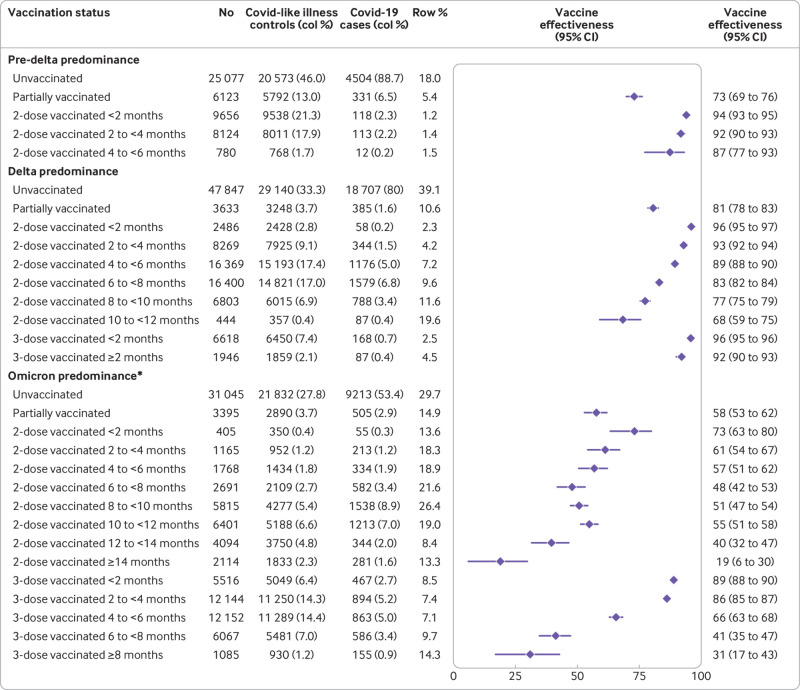
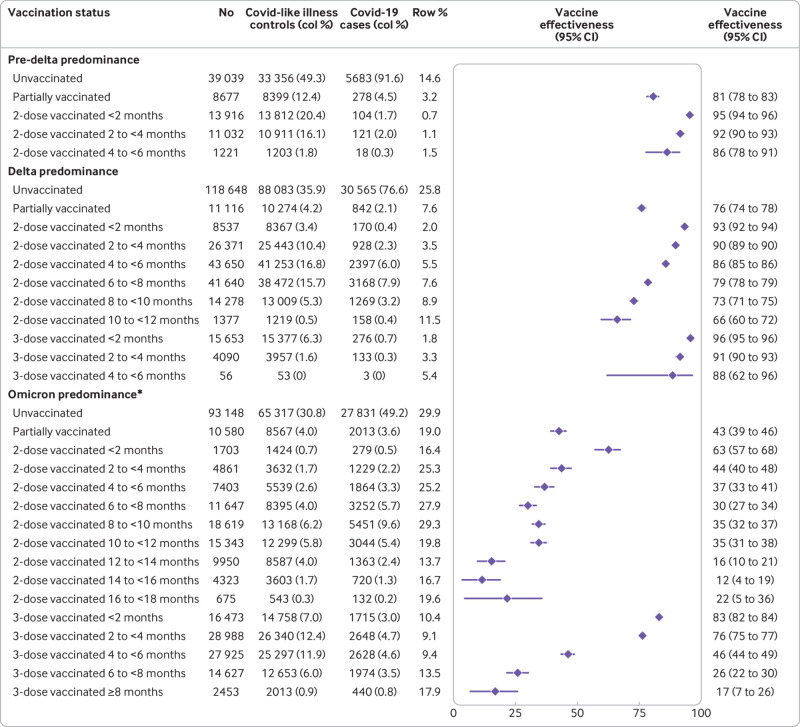
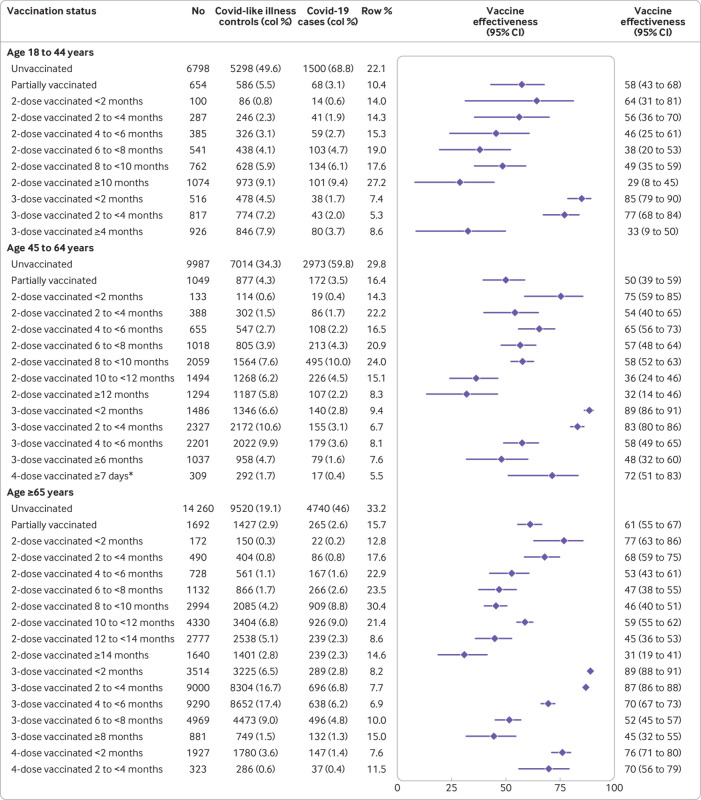
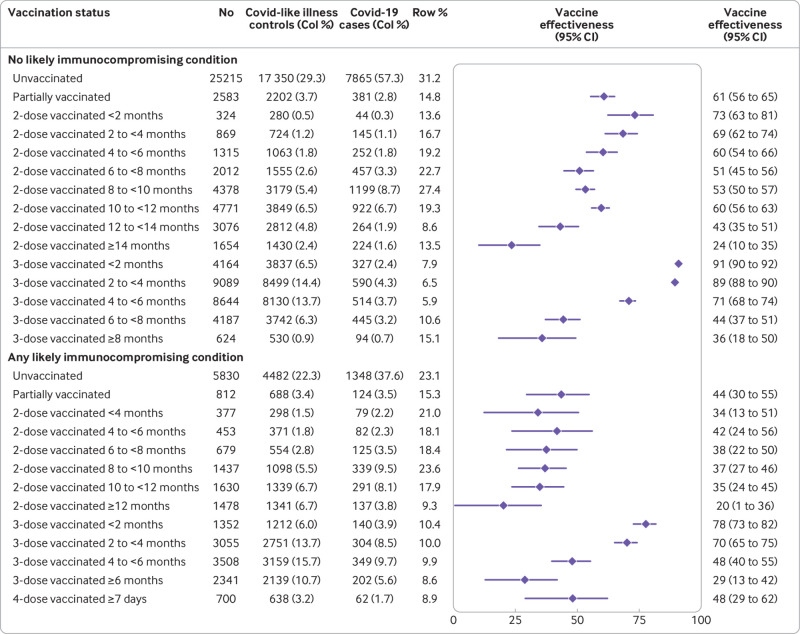
Objective: To estimate the effectiveness of mRNA vaccines against moderate and severe covid-19 in adults by time since second, third, or fourth doses, and by age and immunocompromised status. Design: Test negative case-control study. Setting: Hospitals, emergency departments, and urgent care clinics in 10 US states, 17 January 2021 to 12 July 2022. Participants: 893 461 adults (≥18 years) admitted to one of 261 hospitals or to one of 272 emergency department or 119 urgent care centers for covid-like illness tested for SARS-CoV-2. Main outcome measures: The main outcome was waning of vaccine effectiveness with BNT162b2 (Pfizer-BioNTech) or mRNA-1273 (Moderna) vaccine during the omicron and delta periods, and the period before delta was dominant using logistic regression conditioned on calendar week and geographic area while adjusting for age, race, ethnicity, local virus circulation, immunocompromised status, and likelihood of being vaccinated. Results: 45 903 people admitted to hospital with covid-19 (cases) were compared with 213 103 people with covid-like illness who tested negative for SARS-CoV-2 (controls), and 103 287 people admitted to emergency department or urgent care with covid-19 (cases) were compared with 531 168 people with covid-like illness who tested negative for SARS-CoV-2. In the omicron period, vaccine effectiveness against covid-19 requiring admission to hospital was 89% (95% confidence interval 88% to 90%) within two months after dose 3 but waned to 66% (63% to 68%) by four to five months. Vaccine effectiveness of three doses against emergency department or urgent care visits was 83% (82% to 84%) initially but waned to 46% (44% to 49%) by four to five months. Waning was evident in all subgroups, including young adults and individuals who were not immunocompromised; although waning was morein people who were immunocompromised. Vaccine effectiveness increased among most groups after a fourth dose in whom this booster was recommended. Conclusions: Effectiveness of mRNA vaccines against moderate and severe covid-19 waned with time after vaccination. The findings support recommendations for a booster dose after a primary series and consideration of additional booster doses.
Overview
The claims and statistics of this paper haven’t been checked yet.
Run the check — free, no account needed. It reads the open-access text and checks the sources it cites.
Integrity signals
Registry
Cites
Statistics
Figures
Verification
Claims the paper makes
The claims and statistics of this paper haven’t been checked yet.
Run the check — free, no account needed. It reads the open-access text and checks the sources it cites.
Claims other papers make about this one
Each is checked against this paper’s own text: does it say what the citing paper says it does?
The source backs part of the claim, not all of it — or backs it for a different population, condition or comparison.
In the citing paper
“Further, although boosting by BNT162b2 or CoronaVac restores strong protection against hospitalization and death33–35, the incremental effectiveness of BNT162b2 boosters against such outcomes waned over the course of 4–6 months34 for both adults and the elderly36.”
From Real-world COVID-19 vaccine effectiveness against the Omicron BA.2 variant in a SARS-CoV-2 infection-naive population (2023) · cites this paper as [36]
Experimental — accuracy not yet measuredThe cited source says what the claim attributes to it.
In the citing paper
“This led to a decline in vaccine effectiveness (VE) over time, as shown in several observational studies [2, 3].”
Self-check
Percentages, sums and reported differences re-computed from the paper’s own numbers.
The self-check needs the paper’s full text.
Citations
Cites
Safety and Efficacy of the BNT162b2 mRNA Covid-19 Vaccine
Polack, F. P., Thomas, S. J., Kitchin, N., Absalon, J., Gurtman, A., Lockhart, S., Perez, J. L., Pérez Marc, G., Moreira, E. D., Zerbini, C., et al. (2020) · New England Journal of Medicine · doi:10.1056/nejmoa2034577 · Cited by 14,592
Efficacy and Safety of the mRNA-1273 SARS-CoV-2 Vaccine
Baden, L. R., El Sahly, H. M., Essink, B., Kotloff, K., Frey, S., Novak, R., Diemert, D., Spector, S. A., Rouphael, N., Creech, C. B., et al. (2021) · New England Journal of Medicine · doi:10.1056/nejmoa2035389 · Cited by 10,119
Negative Controls: A Tool for Detecting Confounding and Bias in Observational Studies
Lipsitch, M., Tchetgen Tchetgen, E., & Cohen, T. (2010) · Epidemiology · doi:10.1097/ede.0b013e3181d61eeb · Cited by 1,583
Feikin, D. R., Higdon, M. M., Abu-Raddad, L. J., Andrews, N., Araos, R., Goldberg, Y., Groome, M. J., Huppert, A., O'Brien, K. L., Smith, P. G., et al. (2022) · The Lancet · doi:10.1016/s0140-6736(22)00152-0 · Cited by 1,237
Protection of BNT162b2 Vaccine Booster against Covid-19 in Israel
Bar-On, Y. M., Goldberg, Y., Mandel, M., Bodenheimer, O., Freedman, L., Kalkstein, N., Mizrahi, B., Alroy-Preis, S., Ash, N., Milo, R., et al. (2021) · New England Journal of Medicine · doi:10.1056/nejmoa2114255 · Cited by 1,169
Tartof, S. Y., Slezak, J. M., Fischer, H., Hong, V., Ackerson, B. K., Ranasinghe, O. N., Frankland, T. B., Ogun, O. A., Zamparo, J. M., Gray, S., et al. (2021) · The Lancet · doi:10.1016/s0140-6736(21)02183-8 · Cited by 1,167
Waning Immunity after the BNT162b2 Vaccine in Israel
Goldberg, Y., Mandel, M., Bar-On, Y. M., Bodenheimer, O., Freedman, L., Haas, E. J., Milo, R., Alroy-Preis, S., Ash, N., & Huppert, A. (2021) · New England Journal of Medicine · doi:10.1056/nejmoa2114228 · Cited by 1,034
Barda, N., Dagan, N., Cohen, C., Hernán, M. A., Lipsitch, M., Kohane, I. S., Reis, B. Y., & Balicer, R. D. (2021) · The Lancet · doi:10.1016/s0140-6736(21)02249-2 · Cited by 860
Waning of BNT162b2 Vaccine Protection against SARS-CoV-2 Infection in Qatar
Chemaitelly, H., Tang, P., Hasan, M. R., AlMukdad, S., Yassine, H. M., Benslimane, F. M., Al Khatib, H. A., Coyle, P., Ayoub, H. H., Al Kanaani, Z., et al. (2021) · New England Journal of Medicine · doi:10.1056/nejmoa2114114 · Cited by 831
Duration of Protection against Mild and Severe Disease by Covid-19 Vaccines
Andrews, N., Tessier, E., Stowe, J., Gower, C., Kirsebom, F., Simmons, R., Gallagher, E., Thelwall, S., Groves, N., Dabrera, G., et al. (2022) · New England Journal of Medicine · doi:10.1056/nejmoa2115481 · Cited by 807
Cited by
Sorted by citations
Lau, J. J., Cheng, S. M. S., Leung, K., Lee, C. K., Hachim, A., Tsang, L. C. H., Yam, K. W. H., Chaothai, S., Kwan, K. K. H., Chai, Z. Y. H., et al. (2023) · Nature Medicine · doi:10.1038/s41591-023-02219-5 · Cited by 198
“Further, although boosting by BNT162b2 or CoronaVac restores strong protection against hospitalization and death 33–35 , the incremental effectiveness of BNT162b2 boosters against such outcomes waned over the course of 4–6 months 34 for both adults and the elderly 36 .”
BackgroundEvans, R. A., Dube, S., Lu, Y., Yates, M., Arnetorp, S., Barnes, E. J., Bell, S., Carty, L., Evans, K., Graham, S., et al. (2023) · The Lancet Regional Health - Europe · doi:10.1016/j.lanepe.2023.100747 · Cited by 206
“42,43 These initial results focused on COVID-19 hospitalisation, ICU admissions, and deaths and therefore do not capture the full extent of the impact COVID has on immunocompromised patients, which can include negative consequences related to underlying disease progression, interrupted treatment…”
BackgroundTartof, S. Y., Slezak, J. M., Puzniak, L., Hong, V. X., Frankland, T. B., Ackerson, B. K., Xie, F., Takhar, H. S., Ogun, O. A., Simmons, S. R., et al. (2023) · The Lancet Respiratory Medicine · doi:10.1016/s2213-2600(23)00306-5 · Cited by 71
Upper respiratory tract mucosal immunity for SARS-CoV-2 vaccines
Fraser, R., Resendiz, A. O., Mazein, A., & Dockrell, D. H. (2023) · Trends in Molecular Medicine · doi:10.1016/j.molmed.2023.01.003 · Cited by 61
“infection rapidly wanes within 3–6 months [43-51].”
BackgroundMozaffari, E., Chandak, A. N., Gottlieb, R., Chima-Melton, C., Read, S. H., Jiang, H., Chiang, M., Lee, E., Gupta, R. S., Berry, M., et al. (2023) · Clinical Infectious Diseases · doi:10.1093/cid/ciad460 · Cited by 65
“With reduced vaccine efficacy and ongoing viral evolution leading to immune evasiveness, there remains an ongoing need for effective therapeutics to treat COVID-19 in immunocompromised patients [5–8].”
Background
Metadata
- Authors
- Ferdinands, J. M., Rao, S., Dixon, B. E., Mitchell, P. K., DeSilva, M. B., Irving, S. A., Lewis, N., Natarajan, K., Stenehjem, E., Grannis, S. J., Han, J., McEvoy, C., Ong, T. C., Naleway, A. L., Reese, S. E., Embi, P. J., Dascomb, K., Klein, N. P., Griggs, E. P., Liao, I.-C., Yang, D.-H., Fadel, W. F., Grisel, N., Goddard, K., Patel, P., Murthy, K., Birch, R., Valvi, N. R., Arndorfer, J., Zerbo, O., Dickerson, M., Raiyani, C., Williams, J., Bozio, C. H., Blanton, L., Link-Gelles, R., Barron, M. A., Gaglani, M., Thompson, M. G., & Fireman, B.
- Affiliations
- Centers for Disease Control and Prevention (US)
- University of Colorado Anschutz (US)
- Regenstrief Institute (US)
- Westat (United States) (US)
- HealthPartners (US)
- Kaiser Permanente (US)
- NewYork–Presbyterian Hospital (US)
- Intermountain Healthcare (US)
- Columbia University Irving Medical Center (US)
- Baylor Scott & White Medical Center - Temple (US)
- Corresponding author
- Ferdinands, Jill M
- ORCID
- Ferdinands, Jill M
- Rao, Suchitra
- Dixon, Brian E
- Mitchell, Patrick K
- DeSilva, Malini B
- Irving, Stephanie A
- Lewis, Ned
- Natarajan, Karthik
- Stenehjem, Edward
- Grannis, Shaun J
- McEvoy, Charlene
- Ong, Toan C
- Naleway, Allison L
- Reese, Sarah E
- Dascomb, Kristin
- Klein, Nicola P
- Griggs, Eric P
- Liao, I-Chia
- Yang, Duck-Hye
- Fadel, William F
- Goddard, Kristin
- Patel, Palak
- Murthy, Kempapura
- Valvi, Nimish R
- Zerbo, Ousseny
- Dickerson, Monica
- Raiyani, Chandni
- Bozio, Catherine H
- Blanton, Lenee
- Barron, Michelle A
- Gaglani, Manjusha
- Thompson, Mark G
- Fireman, Bruce
- Venue
- BMJ
- Publisher
- BMJ
- Published
- 2022-10-03
- Volume
- 379
- Pages
- e072141
- ISSN
- 1756-1833 (ISSN-L)
- PMC
- PMC9527398
- OpenAlex
- W4300863078
- Cited by
- 185
- References
- 30
- Citations by year
- 2026: 5 · 2025: 23 · 2024: 63 · 2023: 88 · 2022: 5
- FWCI
- 21.96
- Type
- journal article
- Language
- en
- Open access
- hybrid
- doi.org
- Licence
- Locations
- BMJ (publishedVersion, cc-by-nc)
- PubMed Central (publishedVersion, cc-by-nc)
- PubMed (publishedVersion)
- IUScholarWorks (Indiana University) (submittedVersion, cc-by-nc)
- Funders
- National Center for Immunization and Respiratory Diseases
- Topics
- Health Sciences › Medicine › Infectious Diseases › SARS-CoV-2 and COVID-19 Research
- Social Sciences › Health › Vaccine Coverage and Hesitancy
- Physical Sciences › Mathematics › Modeling and Simulation › COVID-19 epidemiological studies
- Keywords
- waning vaccine effectiveness, COVID-19 pandemic, SARS-CoV-2, mRNA vaccines, BNT162b2, mRNA-1273, booster vaccination, immunocompromised patients, hospitalization, emergency department visits, Omicron variant, Delta variant, adults, test-negative case-control, COVID-19 vaccination
- MeSH terms
- COVID-19, SARS-CoV-2, Vaccine Efficacy, BNT162 Vaccine, Humans, Case-Control Studies, Young Adult
About these checks
Registry, retraction, Cites and statistics results are computed, not judged, with one exception: a printed reference that no index lists is read once by a model before it counts as a citation error. Claims are extracted by a model and kept only when their quote appears verbatim in the text; each cited source is then checked, with a model’s help, for whether it says what the claim relies on. Those verdicts can be wrong — read the claim’s quote and the cited source before relying on one.
Statistics and arithmetic are recomputed, not judged.
Confidence bands are shown only for fields calibrated on our annotated test set. None is calibrated yet, so no band is shown.
What counts as a claim ›How we measure confidence ›How we check this ›
Are you an author, or do you see a problem with this page? Request a review
