

The DOI matches its Crossref record; 49 of the 49 references it cites were found in a registry or an index.
Association between changes in carbohydrate intake and long term weight changes: prospective cohort study
Open accessAbstract
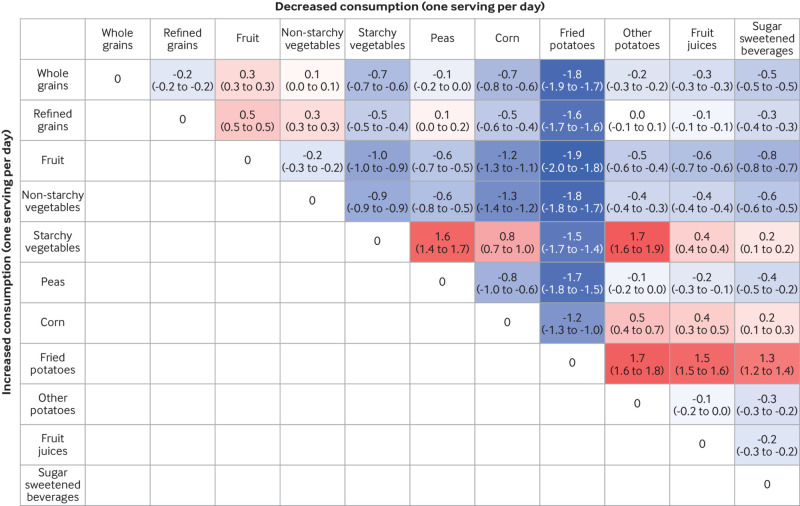
Objective: To comprehensively examine the associations between changes in carbohydrate intake and weight change at four year intervals. Design: Prospective cohort study. Setting: Nurses’ Health Study (1986-2010), Nurses’ Health Study II (1991-2015), and Health Professionals Follow-Up Study (1986-2014). Participants: 136 432 men and women aged 65 years or younger and free of diabetes, cancer, cardiovascular disease, respiratory disease, neurodegenerative disorders, gastric conditions, chronic kidney disease, and systemic lupus erythematosus before baseline. Main outcome measure: Weight change within a four year period. Results: The final analyses included 46 722 women in the Nurses’ Health Study, 67 186 women in the Nurses’ Health Study II, and 22 524 men in the Health Professionals Follow-up Study. On average, participants gained 1.5 kg (5th to 95th centile −6.8 to 10.0) every four years, amounting to 8.8 kg on average over 24 years. Among men and women, increases in glycemic index and glycemic load were positively associated with weight gain. For example, a 100 g/day increase in starch or added sugar was associated with 1.5 kg and 0.9 kg greater weight gain over four years, respectively, whereas a 10 g/day increase in fiber was associated with 0.8 kg less weight gain. Increased carbohydrate intake from whole grains (0.4 kg less weight gain per 100 g/day increase), fruit (1.6 kg less weight gain per 100 g/day increase), and non-starchy vegetables (3.0 kg less weight gain per 100 g/day increase) was inversely associated with weight gain, whereas increased intake from refined grains (0.8 kg more weight gain per 100 g/day increase) and starchy vegetables (peas, corn, and potatoes) (2.6 kg more weight gain per 100 g/day increase) was positively associated with weight gain. In substitution analyses, replacing refined grains, starchy vegetables, and sugar sweetened beverages with equal servings of whole grains, fruit, and non-starchy vegetables was associated with less weight gain. The magnitude of these associations was stronger among participants with overweight or obesity compared with those with normal weight (P<0.001 for interaction). Most of these associations were also stronger among women. Conclusions: The findings of this study highlight the potential importance of carbohydrate quality and source for long term weight management, especially for people with excessive body weight. Limiting added sugar, sugar sweetened beverages, refined grains, and starchy vegetables in favor of whole grains, fruit, and non-starchy vegetables may support efforts to control weight.
Overview
The claims and statistics of this paper haven’t been checked yet.
Free: it reads the open-access text and checks the first 5 claims that cite a source we can check. Create a free account to check every claim.
Integrity signals
Registry
Cites
Statistics
Figures


Verification
Claims the paper makes
The claims and statistics of this paper haven’t been checked yet.
Free: it reads the open-access text and checks the first 5 claims that cite a source we can check. Create a free account to check every claim.
Claims other papers make about this one
Each is checked against this paper’s own text: does it say what the citing paper says it does?
The check wasn’t confident either way, so it gives no verdict — never disputed.
In the citing paper
“DNL is an efficient biochemical pathway and plays a key role in explaining the metabolic benefits of low-carbohydrate diets, including improved insulin sensitivity, lipid profiles, and reduced hepatic steatosis in individuals with obesity, diabetes, or MASLD [76,115-117].”
From Hepatic Insulin Resistance and Steatosis in Metabolic Dysfunction-Associated Steatotic Liver Disease: New Insights into Mechanisms and Clinical Implications (2025) · cites this paper as [116]
Experimental — accuracy not yet measured
Self-check
Percentages, sums and reported differences re-computed from the paper’s own numbers.
The self-check needs the paper’s full text.
Citations
Cites
Health effects of overweight and obesity in 195 countries over 25 years
Collaborators, T. G. 2. O. (2017) · New England Journal of Medicine · doi:10.1056/nejmoa1614362 · Cited by 7,918
Redefine statistical significance
Benjamin, D. J., Berger, J. O., Johannesson, M., Nosek, B. A., Wagenmakers, E.-J., Berk, R., Bollen, K. A., Brembs, B., Brown, L., Camerer, C., et al. (2017) · Nature Human Behaviour · doi:10.1038/s41562-017-0189-z · Cited by 2,772
Changes in diet and lifestyle and long-term weight gain in women and men
Mozaffarian, D., Hao, T., Rimm, E. B., Willett, W. C., & Hu, F. B. (2011) · New England Journal of Medicine · doi:10.1056/nejmoa1014296 · Cited by 2,527 · cited 1×
“45 Consistent with our previous reports, 14 15 we also observed that women and men who increased their intakes of whole grains, fruit, and non-starchy vegetables concurrently gained less weight over time, and those who increased their intakes of refined grains and starchy vegetables (including…”
Self-citationDietary Fiber, Glycemic Load, and Risk of Non—insulin-dependent Diabetes Mellitus in Women
Salmerón, J. (1997) · JAMA: The Journal of the American Medical Association · doi:10.1001/jama.1997.03540300040031 · Cited by 1,804
Carbohydrate quality and human health: a series of systematic reviews and meta-analyses
Reynolds, A., Mann, J., Cummings, J., Winter, N., Mete, E., & Te Morenga, L. (2019) · The Lancet · doi:10.1016/s0140-6736(18)31809-9 · Cited by 1,630 · cited 1×
“Findings for all carbohydrate variables were generally similar in analyses stratified by smoking status and race or ethnicity (see supplementary tables 12 and 13).”
The glycemic index: methodology and clinical implications
Wolever, T., Jenkins, D., Jenkins, A., & Josse, R. (1991) · The American Journal of Clinical Nutrition · doi:10.1093/ajcn/54.5.846 · Cited by 1,168
The role of sugar-sweetened beverages in the global epidemics of obesity and chronic diseases
Malik, V. S., & Hu, F. B. (2022) · Nature Reviews Endocrinology · doi:10.1038/s41574-021-00627-6 · Cited by 854
Self-citationDiets with high or low protein content and glycemic index for weight-loss maintenance
Larsen, T. M., Dalskov, S.-M., van Baak, M., Jebb, S. A., Papadaki, A., Pfeiffer, A. F. H., Martinez, J. A., Handjieva-Darlenska, T., Kunešová, M., Pihlsgård, M., et al. (2010) · New England Journal of Medicine · doi:10.1056/nejmoa1007137 · Cited by 843 · cited 1×
“…increment), and carbohydrates (per 100 g increment) and weight changes (kg) according to body mass index at beginning of each four year period* 33 However, dietary glycemic index and glycemic load were not clearly related to BMI in studies that were cross sectional or had single dietary…”
Liu, S., Willett, W. C., Manson, J. E., Hu, F. B., Rosner, B., & Colditz, G. (2003) · The American Journal of Clinical Nutrition · doi:10.1093/ajcn/78.5.920 · Cited by 787
Self-citationDietary Fiber, Weight Gain, and Cardiovascular Disease Risk Factors in Young Adults
Ludwig, D. S. (1999) · JAMA · doi:10.1001/jama.282.16.1539 · Cited by 722
Self-citation
Cited by
The EAT–Lancet Commission on healthy, sustainable, and just food systems
Rockström, J., Thilsted, S. H., Willett, W. C., Gordon, L. J., Herrero, M., Hicks, C. C., Mason-D'Croz, D., Rao, N., Springmann, M., Wright, E. C., et al. (2025) · The Lancet · doi:10.1016/s0140-6736(25)01201-2 · Cited by 475
Self-citationDiet strategies for promoting healthy aging and longevity: An epidemiological perspective
Hu, F. B. (2024) · Journal of Internal Medicine · doi:10.1111/joim.13728 · Cited by 216
Self-citationTruong, X. T., & Lee, D. H. (2025) · Diabetes & Metabolism Journal · doi:10.4093/dmj.2025.0644 · Cited by 84
Gilden, A. H., Catenacci, V. A., & Taormina, J. M. (2024) · Annals of Internal Medicine · doi:10.7326/aitc202405210 · Cited by 60
Volek, J. S., Yancy, W. S., Gower, B. A., Phinney, S. D., Slavin, J. L., Koutnik, A. P., Hurn, M., Spinner, J. R., Cucuzzella, M. T., & Hecht, F. M. (2024) · Frontiers in Nutrition · doi:10.3389/fnut.2024.1376098 · Cited by 45
Metadata
- Authors
- Wan, Y., Tobias, D. K., Dennis, K. K., Guasch-Ferré, M., Sun, Q., Rimm, E. B., Hu, F. B., Ludwig, D. S., Devinsky, O., & Willett, W. C.
- Affiliations
- Harvard University (US)
- Brigham and Women's Hospital (US)
- Department of Nutrition, Harvard T.H. Chan School of Public Health, Boston, MA, 02115, USA
- Boston Children's Hospital (US)
- New York University (US)
- Corresponding author
- Willett, Walter C
- ORCID
- Venue
- BMJ
- Publisher
- BMJ
- Published
- 2023-09-27
- Volume
- 382
- Pages
- e073939
- ISSN
- 1756-1833 (ISSN-L)
- PMC
- PMC10523278
- OpenAlex
- W4387081884
- Cited by
- 64
- References
- 49
- Citations by year
- 2026: 12 · 2025: 29 · 2024: 20 · 2023: 3
- FWCI
- 16.38
- Type
- journal article
- Language
- en
- Open access
- hybrid
- doi.org
- Licence
- Locations
- BMJ (publishedVersion, cc-by-nc)
- PubMed Central (publishedVersion, cc-by-nc)
- PubMed (publishedVersion)
- HighWire Press Open Archive (submittedVersion)
- Funders
- National Institutes of Health (CA176726, CA-167552, CA186107)
- National Cancer Institute (UM1CA186107, U01CA176726, U01CA167552)
- Topics
- Health Sciences › Medicine › Public Health, Environmental and Occupational Health › Nutritional Studies and Diet
- Health Sciences › Medicine › Endocrinology, Diabetes and Metabolism › Diet, Metabolism, and Disease
- Health Sciences › Nursing › Nutrition and Dietetics › Food composition and properties
- Keywords
- carbohydrate intake, weight gain, weight change, dietary glycemic index, glycemic load, added sugars, starch, dietary fiber, whole grains, fruits, non-starchy vegetables, refined grains, starchy vegetables, sugar-sweetened beverages, dietary substitution, obesity, overweight, Nurses' Health Study, Health Professionals Follow-up Study, dietary habits
- MeSH terms
- Sugars, Carbohydrates, Diet, Female, Follow-Up Studies, Humans, Male, Prospective Studies, Vegetables, Weight Gain
About these checks
Registry, retraction, Cites and statistics results are computed, not judged, with one exception: a printed reference that no index lists is read once by a model before it counts as a citation error. Claims are extracted by a model and kept only when their quote appears verbatim in the text; each cited source is then checked, with a model’s help, for whether it says what the claim relies on. Those verdicts can be wrong — read the claim’s quote and the cited source before relying on one.
Statistics and arithmetic are recomputed, not judged.
Confidence bands are shown only for fields calibrated on our annotated test set. None is calibrated yet, so no band is shown.
What counts as a claim ›How we measure confidence ›How we check this ›
Are you an author, or do you see a problem with this page? Request a review
How to cite
Cite CoChat for the checks on this page, and the paper for its own findings.
- This page
- CoChat. (2026). Citation check: Association between changes in carbohydrate intake and long term weight changes: prospective cohort study. https://app.cochat.ai/papers/10.1136/bmj-2022-073939
- The paper
- Wan, Y., Tobias, D. K., Dennis, K. K., Guasch-Ferré, M., Sun, Q., Rimm, E. B., Hu, F. B., Ludwig, D. S., Devinsky, O., & Willett, W. C. (2023). Association between changes in carbohydrate intake and long term weight changes: prospective cohort study. BMJ. https://doi.org/10.1136/bmj-2022-073939
Data sources
Bibliographic data: Semantic Scholar, OpenAlex, Crossref.
Contains information from the Semantic Scholar Academic Graph Datasets, made available under the ODC Attribution License (ODC-BY 1.0).
Semantic Scholar’s data is described in: Kinney, R., et al. (2023). The Semantic Scholar Open Data Platform. arXiv:2301.10140.
