

Perinatal depression and risk of mortality: Nationwide, register-based study in Sweden
Open accessThe DOI matches its Crossref record; 38 of the 38 references it cites were found in a registry or an index.
Abstract
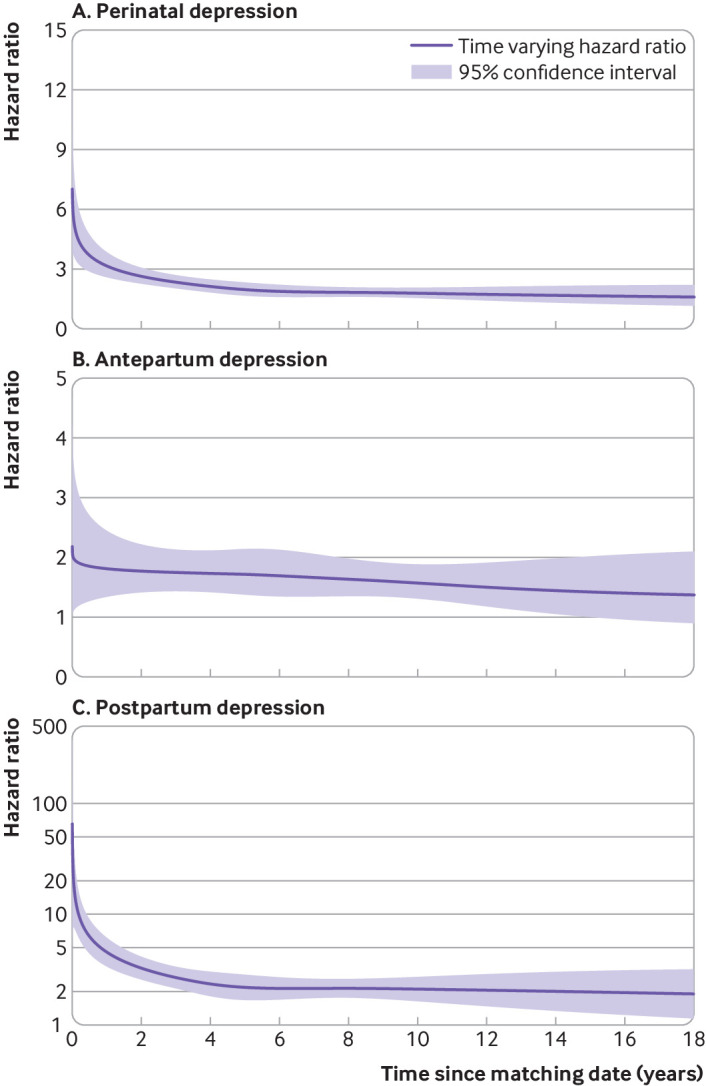
Objective: To determine whether women with perinatal depression are at an increased risk of death compared with women who did not develop the disorder, and compared with full sisters. Design: Nationwide, register based study. Setting: Swedish national registers, 1 January 2001 to 31 December 2018. Participants: 86 551 women with a first ever diagnosis of perinatal depression ascertained through specialised care and use of antidepressants, and 865 510 women who did not have perinatal depression were identified and matched based on age and calendar year at delivery. To address familial confounding factors, comparisons were made between 270 586 full sisters (women with perinatal depression (n=24 473) and full sisters who did not have this disorder (n=246 113)), who gave at least one singleton birth during the study period. Main outcome measures: Primary outcome was death due to any cause. Secondary outcome was cause specific deaths (ie, unnatural and natural causes). Multivariable Cox regression was used to estimate hazard ratios of mortality comparing women with perinatal depression to unaffected women and sisters, taking into account several confounders. The temporal patterns of perinatal depression and differences between antepartum and postpartum onset of perinatal depression were also studied. Results: 522 deaths (0.82 per 1000 person years) were reported among women with perinatal depression diagnosed at a median age of 31.0 years (interquartile range 27.0 to 35.0) over up to 18 years of follow-up. Compared with women who did not have perinatal depression, women with perinatal depression were associated with an increased risk of death (adjusted hazard ratio 2.11 (95% confidence interval 1.86 to 2.40)); similar associations were reported among women who had and did not have pre-existing psychiatric disorder. Risk of death seemed to be increased for postpartum than for antepartum depression (hazard ratio 2.71 (95% confidence interval 2.26 to 3.26) v 1.62 (1.34 to 1.94)). A similar association was noted for perinatal depression in the sibling comparison (2.12 (1.16 to 3.88)). The association was most pronounced within the first year after perinatal depression but remained up to 18 years after start of follow up. An increased risk was associated with both unnatural and natural causes of death among women with perinatal depression (4.28 (3.44 to 5.32) v (1.38 (1.16 to 1.64)), with the strongest association noted for suicide (6.34 (4.62 to 8.71)), although suicide was rare (0.23 per 1000 person years). Conclusions: Even when accounting for familial factors, women with clinically diagnosed perinatal depression were associated with an increased risk of death, particularly during the first year after diagnosis and because of suicide. Women who are affected, their families, and health professionals should be aware of these severe health hazards after perinatal depression.
Overview
The claims and statistics of this paper haven’t been checked yet.
Free: it reads the open-access text and checks the first 5 claims that cite a source we can check. Create a free account to check every claim.
Integrity signals
Registry
Cites
Statistics
Figures
Verification
Claims the paper makes
The claims and statistics of this paper haven’t been checked yet.
Free: it reads the open-access text and checks the first 5 claims that cite a source we can check. Create a free account to check every claim.
Self-check
Percentages, sums and reported differences re-computed from the paper’s own numbers.
The self-check needs the paper’s full text.
Citations
Cites
External review and validation of the Swedish national inpatient register
Ludvigsson, J. F., Andersson, E., Ekbom, A., Feychting, M., Kim, J.-L., Reuterwall, C., Heurgren, M., & Olausson, P. O. (2011) · BMC Public Health · doi:10.1186/1471-2458-11-450 · Cited by 5,055
Perinatal Depression: A Systematic Review of Prevalence and Incidence
Gavin, N. I., Gaynes, B. N., Lohr, K. N., Meltzer-Brody, S., Gartlehner, G., & Swinson, T. (2005) · Obstetrics & Gynecology · doi:10.1097/01.aog.0000183597.31630.db · Cited by 3,282
Walker, E. R., McGee, R. E., & Druss, B. G. (2015) · JAMA Psychiatry · doi:10.1001/jamapsychiatry.2014.2502 · Cited by 2,976
Wettermark, B., Hammar, N., MichaelFored, C., Leimanis, A., Otterblad Olausson, P., Bergman, U., Persson, I., Sundström, A., Westerholm, B., & Rosén, M. (2007) · Pharmacoepidemiology and Drug Safety · doi:10.1002/pds.1294 · Cited by 1,887
The Swedish cause of death register
Brooke, H. L., Talbäck, M., Hörnblad, J., Johansson, L. A., Ludvigsson, J. F., Druid, H., Feychting, M., & Ljung, R. (2017) · European Journal of Epidemiology · doi:10.1007/s10654-017-0316-1 · Cited by 1,280 · cited 1×
“19 Additionally, the hazard ratio derived from Cox regression is an average estimate over time since perinatal depression.”
MethodRisk factors for depressive symptoms during pregnancy: a systematic review
Lancaster, C. A., Gold, K. J., Flynn, H. A., Yoo, H., Marcus, S. M., & Davis, M. M. (2010) · American Journal of Obstetrics and Gynecology · doi:10.1016/j.ajog.2009.09.007 · Cited by 1,208 · cited 1×
“2526 Some characteristics specific to pregnancy, and pre-existing psychiatric disorders (any time before pregnancy) are putative risk factors for both perinatal depression and mortality, 27-29 and were extracted from the medical birth register and national patient register.”
Depression and cancer mortality: a meta-analysis
Pinquart, M., & Duberstein, P. R. (2010) · Psychological Medicine · doi:10.1017/s0033291709992285 · Cited by 1,083 · cited 1×
“Cancer mortality has been linked to depression occurring at any time in life 37 and to postpartum psychiatric disorders.”
BackgroundPerinatal mental illness: Definition, description and aetiology
O'Hara, M. W., & Wisner, K. L. (2014) · Best Practice & Research Clinical Obstetrics & Gynaecology · doi:10.1016/j.bpobgyn.2013.09.002 · Cited by 986
A quality study of a medical birth registry
Cnattingius, S., Ericson, A., Gunnarskog, J., & Källén, B. (1990) · Scandinavian Journal of Social Medicine · doi:10.1177/140349489001800209 · Cited by 972
Further Development of Flexible Parametric Models for Survival Analysis
Lambert, P. C., & Royston, P. (2009) · The Stata Journal: Promoting communications on statistics and Stata · doi:10.1177/1536867x0900900206 · Cited by 814 · cited 1×
“32 The models were adjusted for matching variables (maternal age and calendar year at delivery) and the aforementioned covariates.”
Prevalence of suicidality during pregnancy and the postpartum
Lindahl, V., Pearson, J. L., & Colpe, L. (2005) · Archives of Women’s Mental Health · doi:10.1007/s00737-005-0080-1 · Cited by 795 · cited 1×
“…be explained by differences in suicidal behaviour, of which the risks are greater in the postpartum period compared with the antepartum period, 5 11 possibly due to decreased mental health treatment options for pregnant women, 34 which may not result in a live birth to be studied in research.”
BackgroundMaternal death in the 21st century: causes, prevention, and relationship to cesarean delivery
Clark, S. L., Belfort, M. A., Dildy, G. A., Herbst, M. A., Meyers, J. A., & Hankins, G. D. (2008) · American Journal of Obstetrics and Gynecology · doi:10.1016/j.ajog.2008.03.007 · Cited by 627
Grandi, S. M., Filion, K. B., Yoon, S., Ayele, H. T., Doyle, C. M., Hutcheon, J. A., Smith, G. N., Gore, G. C., Ray, J. G., Nerenberg, K., et al. (2019) · Circulation · doi:10.1161/circulationaha.118.036748 · Cited by 610 · cited 1×
“2526 Some characteristics specific to pregnancy, and pre-existing psychiatric disorders (any time before pregnancy) are putative risk factors for both perinatal depression and mortality, 27-29 and were extracted from the medical birth register and national patient register.”
The Swedish Multi-Generation Register
Ekbom, A. (2011) · Methods in molecular biology · doi:10.1007/978-1-59745-423-0_10 · Cited by 553 · cited 1×
“21 We included all women with at least one full sister and who give live birth during the study period (ie, not only families that have sisters affected by perinatal depression).”
BackgroundNoble, R. E. (2005) · Metabolism · doi:10.1016/j.metabol.2005.01.014 · Cited by 458
Wang, E., Glazer, K. B., Howell, E. A., & Janevic, T. M. (2020) · Obstetrics & Gynecology · doi:10.1097/aog.0000000000003762 · Cited by 353
Qin, P., Agerbo, E., & Mortensen, P. B. (2002) · The Lancet · doi:10.1016/s0140-6736(02)11197-4 · Cited by 352
Putnam, K. T., Wilcox, M., Robertson-Blackmore, E., Sharkey, K., Bergink, V., Munk-Olsen, T., Deligiannidis, K. M., Payne, J., Altemus, M., Newport, J., et al. (2017) · The Lancet Psychiatry · doi:10.1016/s2215-0366(17)30136-0 · Cited by 308
Adaptation of the Charlson Comorbidity Index for Register-Based Research in Sweden
Ludvigsson, J. F., Appelros, P., Askling, J., Byberg, L., Carrero, J.-J., Ekström, A. M., Ekström, M., Smedby, K. E., Hagström, H., James, S., et al. (2021) · Clinical Epidemiology · doi:10.2147/clep.s282475 · Cited by 284 · cited 1×
“33 Additionally, we estimated the association by time since pregnancy for antepartum depression (within 13 weeks or 14 weeks onwards) and by time since delivery for postpartum depression (within six months or 7-12 months).”
MethodDepression and violence: a Swedish population study
Fazel, S., Wolf, A., Chang, Z., Larsson, H., Goodwin, G. M., & Lichtenstein, P. (2015) · The Lancet Psychiatry · doi:10.1016/s2215-0366(14)00128-x · Cited by 245 · cited 1×
“24 We also identified use of antidepressant medication in the medical birth register and dispensations in the prescribed drug register using the anatomical therapeutic chemical code as a proxy for perinatal depression.”
MethodAn incidence density sampling program for nested case-control analyses
Richardson, D. B. (2004) · Occupational and Environmental Medicine · doi:10.1136/oem.2004.014472 · Cited by 239
Lu, D., Andersson, T. M. L., Fall, K., Hultman, C. M., Czene, K., Valdimarsdóttir, U., & Fang, F. (2016) · JAMA Oncology · doi:10.1001/jamaoncol.2016.0483 · Cited by 224
Self-citationKhalifeh, H., Hunt, I. M., Appleby, L., & Howard, L. M. (2016) · The Lancet Psychiatry · doi:10.1016/s2215-0366(16)00003-1 · Cited by 221 · cited 1×
“2-4 Nearly half of the cases were of women who had a depression diagnosis, 35 although the measurement on suicide remains less accurate 34 and often is studied with other outcomes (eg, accident) together.”
BackgroundSuicide and other causes of mortality after post-partum psychiatric admission
Appleby, L., Mortensen, P. B., & Faragher, E. B. (1998) · British Journal of Psychiatry · doi:10.1192/bjp.173.3.209 · Cited by 192 · cited 1×
“Building on previous findings, 7 we further show that risk of mortality was about twice as high 18 years after postpartum depression in women with this disorder.”
Suicide and Maternal Mortality
Chin, K., Wendt, A., Bennett, I. M., & Bhat, A. (2022) · Current Psychiatry Reports · doi:10.1007/s11920-022-01334-3 · Cited by 178 · cited 2×
“…be explained by differences in suicidal behaviour, of which the risks are greater in the postpartum period compared with the antepartum period, 5 11 possibly due to decreased mental health treatment options for pregnant women, 34 which may not result in a live birth to be studied in research.”
BackgroundEarly dating by ultrasound and perinatal outcome
Høgberg, U., & Larsson, N. (1997) · Acta Obstetricia et Gynecologica Scandinavica · doi:10.3109/00016349709034900 · Cited by 159
Childhood Maltreatment and Perinatal Mood and Anxiety Disorders: A Systematic Review
Choi, K. W., & Sikkema, K. J. (2016) · Trauma, Violence, & Abuse · doi:10.1177/1524838015584369 · Cited by 152
Heritability of Perinatal Depression and Genetic Overlap With Nonperinatal Depression
Viktorin, A., Meltzer-Brody, S., Kuja-Halkola, R., Sullivan, P. F., Landén, M., Lichtenstein, P., & Magnusson, P. K. E. (2016) · American Journal of Psychiatry · doi:10.1176/appi.ajp.2015.15010085 · Cited by 152 · cited 1×
“Perinatal depression was defined as any diagnosis of depression through specialised care or dispensation of antidepressants during pregnancy and up to one year after delivery, 22 recorded in the medical birth register, national patient register, or prescribed drug register.”
MethodSuicides during pregnancy and 1 year postpartum in Sweden, 1980–2007
Esscher, A., Essén, B., Innala, E., Papadopoulos, F. C., Skalkidou, A., Sundström-Poromaa, I., & Högberg, U. (2016) · British Journal of Psychiatry · doi:10.1192/bjp.bp.114.161711 · Cited by 134 · cited 2×
“11 Such misclassification should have attenuated the association for antepartum depression and not affect the results for postpartum depression.”
BackgroundAll-cause mortality in women with severe postpartum psychiatric disorders
Johannsen, B. M. W., Larsen, J. T., Laursen, T. M., Bergink, V., Meltzer-Brody, S., & Munk-Olsen, T. (2016) · American Journal of Psychiatry · doi:10.1176/appi.ajp.2015.14121510 · Cited by 110
Perinatal Depression and Risk of Suicidal Behavior
Yu, H., Shen, Q., Bränn, E., Yang, Y., Öberg, A. S., Valdimarsdóttir, U. A., & Lu, D. (2024) · JAMA Network Open · doi:10.1001/jamanetworkopen.2023.50897 · Cited by 91 · cited 1×
“36 6-8 Our data are the first, to our knowledge, to show that women with perinatal depression were at an increased risk of death due to accidents alone.”
BackgroundSelf-citationChild Maltreatment and Mortality in Young Adults
Segal, L., Armfield, J. M., Gnanamanickam, E. S., Preen, D. B., Brown, D. S., Doidge, J., & Nguyen, H. (2021) · PEDIATRICS · doi:10.1542/peds.2020-023416 · Cited by 77 · cited 1×
“9 Increased relative risks remained from the sibling comparison, indicating that factors shared by sisters, such as potential childhood maltreatment 13 15 and parental psychiatric morbidity, 12 14 are unlikely to explain the observed association.”
BackgroundDepression During Pregnancy and Postpartum
Toohey, J. S. (2012) · Clinical Obstetrics & Gynecology · doi:10.1097/grf.0b013e318253b2b4 · Cited by 63
Association of Postpartum Depression with Maternal Suicide: A Nationwide Population-Based Study
Lee, Y.-L., Tien, Y., Bai, Y.-S., Lin, C.-K., Yin, C.-S., Chung, C.-H., Sun, C.-A., Huang, S.-H., Huang, Y.-C., Chien, W.-C., et al. (2022) · International Journal of Environmental Research and Public Health · doi:10.3390/ijerph19095118 · Cited by 61
Bauer, A. E., Mægbæk, M. L., Liu, X., Wray, N. R., Sullivan, P. F., Miller, W. C., Meltzer-Brody, S. E., & Munk‐Olsen, T. (2018) · American Journal of Psychiatry · doi:10.1176/appi.ajp.2018.17111184 · Cited by 45
Experience of pregnancy and delivery as predictors of postpartum depression
Tuohy, A., & McVey, C. (2008) · Psychology, Health & Medicine · doi:10.1080/13548500701294531 · Cited by 39 · cited 1×
“Adverse birth outcomes could affect the risk of postpartum depression 30 and maternal death, 31 hence, information about mode of delivery, gestational age, birth weight, and stillbirth was obtained from the medical birth register.”
MethodBränn, E., Chen, Y., Song, H., László, K. D., D'Onofrio, B. M., Hysaj, E., Almqvist, C., Larsson, H., Lichtenstein, P., Valdimarsdóttir, U. A., et al. (2024) · Molecular Psychiatry · doi:10.1038/s41380-023-02351-1 · Cited by 24 · cited 1×
“39 Future studies on deaths due to other less common natural causes are warranted.”
BackgroundSelf-citationGeneral medical conditions and mortality in women with postpartum psychiatric disorders
Johannsen, B. M. W., Laursen, T. M., Bech, B. H., & Munk‐Olsen, T. (2020) · Acta Psychiatrica Scandinavica · doi:10.1111/acps.13232 · Cited by 12
Cited by
Perinatal Depression and Risk of Suicidal Behavior
Yu, H., Shen, Q., Bränn, E., Yang, Y., Öberg, A. S., Valdimarsdóttir, U. A., & Lu, D. (2024) · JAMA Network Open · doi:10.1001/jamanetworkopen.2023.50897 · Cited by 91
Self-citationYang, Q., Bränn, E., Johnson, E., Sjölander, A., Fang, F., Öberg, A. S., Valdimarsdóttir, U. A., & Lu, D. (2024) · PLoS Medicine · doi:10.1371/journal.pmed.1004363 · Cited by 23
Self-citationPerinatal depression and its health impact
Bränn, E., Shen, Q., & Lu, D. (2024) · BMJ · doi:10.1136/bmj.p2777 · Cited by 19
Self-citationStratifying Risk for Postpartum Depression at Time of Hospital Discharge
Clapp, M. A., Castro, V. M., Verhaak, P., McCoy, T. H., Shook, L. L., Edlow, A. G., & Perlis, R. H. (2025) · American Journal of Psychiatry · doi:10.1176/appi.ajp.20240381 · Cited by 16
Association of General Anesthesia for Cesarean Delivery with Postpartum Depression and Suicidality
Guglielminotti, J. R., Monk, C. E., Russell, M. T., & Li, G. (2024) · Anesthesia & Analgesia · doi:10.1213/ane.0000000000007314 · Cited by 22
Metadata
- Authors
- Hagatulah, N., Bränn, E., Oberg, A. S., Valdimarsdóttir, U. A., Shen, Q., & Lu, D.
- Affiliations
- Karolinska Institutet (SE)
- Harvard University (US)
- Tongji University (CN)
- Corresponding author
- Shen, Qing
- Venue
- BMJ
- Publisher
- BMJ
- Published
- 2024-01-10
- Volume
- 384
- Pages
- e075462
- ISSN
- 1756-1833 (ISSN-L)
- PMC
- PMC10777893
- OpenAlex
- W4390719251
- Cited by
- 72
- References
- 38
- Citations by year
- 2026: 22 · 2025: 29 · 2024: 21
- FWCI
- 29.70
- Type
- journal article
- Language
- en
- Open access
- hybrid
- doi.org
- Licence
- Locations
- BMJ (publishedVersion, cc-by-nc)
- PubMed Central (publishedVersion, cc-by)
- PubMed (publishedVersion)
- HighWire Press Open Archive (submittedVersion)
- Funders
- Fundamental Research Funds for the Central Universities
- Topics
- Health Sciences › Medicine › Public Health, Environmental and Occupational Health › Maternal Mental Health During Pregnancy and Postpartum
- Health Sciences › Medicine › Pediatrics, Perinatology and Child Health › Maternal and Neonatal Healthcare
- Social Sciences › Sociology and Political Science › Homicide, Infanticide, and Child Abuse
- Keywords
- perinatal depression, maternal mortality, postpartum depression, antenatal depression, cause-specific mortality, sibling comparison, familial confounding, antidepressant use, psychiatric comorbidity, maternal mental health, Sweden, national registry, cohort studies, hazard ratio, postpartum period
- MeSH terms
- Adult, Awareness, Depression, Depressive Disorder, Female, Humans, Pregnancy, Suicide, Sweden
About these checks
Registry, retraction, Cites and statistics results are computed, not judged, with one exception: a printed reference that no index lists is read once by a model before it counts as a citation error. Claims are extracted by a model and kept only when their quote appears verbatim in the text; each cited source is then checked, with a model’s help, for whether it says what the claim relies on. Those verdicts can be wrong — read the claim’s quote and the cited source before relying on one.
Statistics and arithmetic are recomputed, not judged.
Confidence bands are shown only for fields calibrated on our annotated test set. None is calibrated yet, so no band is shown.
What counts as a claim ›How we measure confidence ›How we check this ›
Are you an author, or do you see a problem with this page? Request a review
Data sources
Bibliographic data: Semantic Scholar, OpenAlex, Crossref.
Contains information from the Semantic Scholar Academic Graph Datasets, made available under the ODC Attribution License (ODC-BY 1.0).
Semantic Scholar’s data is described in: Kinney, R., et al. (2023). The Semantic Scholar Open Data Platform. arXiv:2301.10140.
