

The DOI matches its Crossref record; 88 of the 89 references it cites were found in a registry or an index.
Early detection and intervention evaluation for people at risk of psychosis: multisite randomised controlled trial
Open accessAbstract
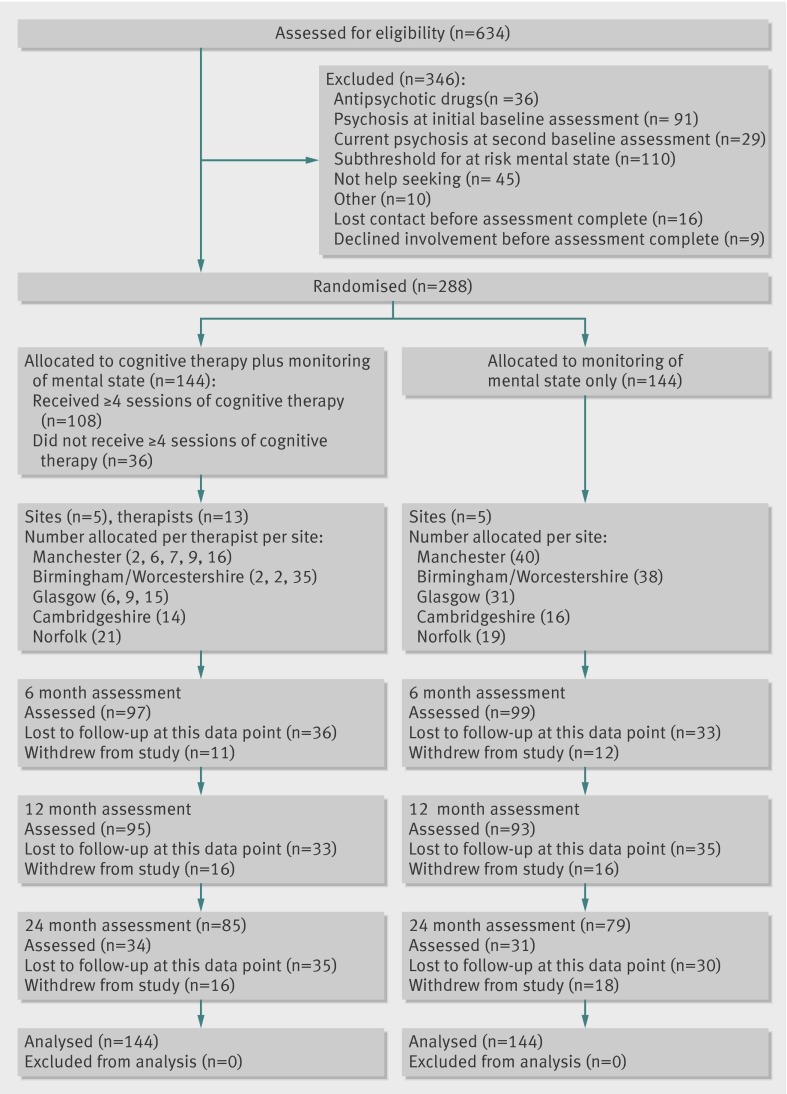
OBJECTIVE: To determine whether cognitive therapy is effective in preventing the worsening of emerging psychotic symptoms experienced by help seeking young people deemed to be at risk for serious conditions such as schizophrenia. DESIGN: Multisite single blind randomised controlled trial. SETTING: Diverse services at five UK sites. PARTICIPANTS: 288 participants aged 14-35 years (mean 20.74, SD 4.34 years) at high risk of psychosis: 144 were assigned to cognitive therapy plus monitoring of mental state and 144 to monitoring of mental state only. Participants were followed-up for a minimum of 12 months and a maximum of 24 months. INTERVENTION: Cognitive therapy (up to 26 (mean 9.1) sessions over six months) plus monitoring of mental state compared with monitoring of mental state only. MAIN OUTCOME MEASURES: Primary outcome was scores on the comprehensive assessment of at risk mental states (CAARMS), which provides a dichotomous transition to psychosis score and ordinal scores for severity of psychotic symptoms and distress. Secondary outcomes included emotional dysfunction and quality of life. RESULTS: Transition to psychosis based on intention to treat was analysed using discrete time survival models. Overall, the prevalence of transition was lower than expected (23/288; 8%), with no significant difference between the two groups (proportional odds ratio 0.73, 95% confidence interval 0.32 to 1.68). Changes in severity of symptoms and distress, as well as secondary outcomes, were analysed using random effects regression (analysis of covariance) adjusted for site and baseline symptoms. Distress from psychotic symptoms did not differ (estimated difference at 12 months -3.00, 95% confidence interval -6.95 to 0.94) but their severity was significantly reduced in the group assigned to cognitive therapy (estimated between group effect size at 12 months -3.67, -6.71 to -0.64, P=0.018). CONCLUSIONS: Cognitive therapy plus monitoring did not significantly reduce transition to psychosis or symptom related distress but reduced the severity of psychotic symptoms in young people at high risk. Most participants in both groups improved over time. The results have important implications for the at risk mental state concept. TRIAL REGISTRATION: Current Controlled Trials ISRCTN56283883.
Overview
The claims and statistics of this paper haven’t been checked yet.
Run the check — free, no account needed. It reads the open-access text and checks the sources it cites.
Integrity signals
Registry
Cites
Statistics
Figures
Verification
Claims the paper makes
The claims and statistics of this paper haven’t been checked yet.
Run the check — free, no account needed. It reads the open-access text and checks the sources it cites.
Claims other papers make about this one
Each is checked against this paper’s own text: does it say what the citing paper says it does?
In the citing paper
“Only two studies had an overall low risk of bias 33,79 ; five had unclear risk [72][73][74][75][76] , and nine had high risk 30,31,36,37,39,41,77,78,81 .”
From Lack of evidence to favor specific preventive interventions in psychosis: a network meta‐analysis (2018) · cites this paper as [77]
In the citing paper
“the largest CBT-F trial to date provided non-significant results 77”
From Lack of evidence to favor specific preventive interventions in psychosis: a network meta‐analysis (2018) · cites this paper as [77]
In the citing paper
“EDIE-2 was a multi-site randomised controlled trial of a psychological intervention aiming to reduce transition to psychosis (Morrison et al., 2011, Morrison et al., 2012).”
From Sleep duration and psychotic experiences in patients at risk of psychosis: a secondary analysis of the EDIE-2 trial (2019) · cites this paper as Morrison et al., 2012
In the citing paper
“The cognitive therapy based intervention plus monitoring was significantly better than monitoring only in reducing severity of psychotic experiences, but not in reducing distress or transition to psychosis over 12 to 24 months (Morrison et al., 2012).”
From Sleep duration and psychotic experiences in patients at risk of psychosis: a secondary analysis of the EDIE-2 trial (2019) · cites this paper as Morrison et al., 2012
Self-check
Percentages, sums and reported differences re-computed from the paper’s own numbers.
The self-check needs the paper’s full text.
Citations
Cites
Specification Tests in Econometrics
Hausman, J. A. (1978) · Econometrica · doi:10.2307/1913827 · Cited by 18,820
Statistical Analysis With Missing Data
Lahiff, M., Little, R. J. A., & Rubin, D. B. (1989) · Journal of the American Statistical Association · doi:10.2307/2289883 · Cited by 17,385
The Structured Clinical Interview for DSM-III-R (SCID): I: History, Rationale, and Description
Spitzer, R. L. (1992) · Archives of General Psychiatry · doi:10.1001/archpsyc.1992.01820080032005 · Cited by 4,336
Mattick, R. P., & Clarke, J. C. (1998) · Behaviour Research and Therapy · doi:10.1016/s0005-7967(97)10031-6 · Cited by 3,367
van Os, J., Linscott, R. J., Myin-Germeys, I., Delespaul, P., & Krabbendam, L. (2009) · Psychological Medicine · doi:10.1017/s0033291708003814 · Cited by 2,343
Mapping the Onset of Psychosis: The Comprehensive Assessment of At-Risk Mental States
Yung, A. R., Yung, A. R., Yuen, H. P., McGorry, P. D., Phillips, L., Kelly, D., Dell’Olio, M., Francey, S. M., Cosgrave, E., Killackey, E. J., et al. (2005) · Australian & New Zealand Journal of Psychiatry · doi:10.1080/j.1440-1614.2005.01714.x · Cited by 2,284
Applied Multivariate Data Analysis
Jobson, J. D. (1992) · Springer texts in statistics · doi:10.1007/978-1-4612-0921-8 · Cited by 1,851
Miller, T. J., McGlashan, T. H., Rosen, J. L., Cadenhead, K. S., Ventura, J., McFarlane, W. R., Perkins, D. O., Pearlson, G. D., & Woods, S. W. (2003) · Schizophrenia Bulletin · doi:10.1093/oxfordjournals.schbul.a007040 · Cited by 1,800
Cannon, T. D., Cadenhead, K., Cornblatt, B., Woods, S. W., Addington, J., Walker, E., Seidman, L. J., Perkins, D., Tsuang, M., McGlashan, T., et al. (2008) · Archives of General Psychiatry · doi:10.1001/archgenpsychiatry.2007.3 · Cited by 1,269
Psychosis prediction: 12-month follow up of a high-risk ("prodromal") group
Yung, A. R., Phillips, L. J., Yuen, H. P., Francey, S. M., McFarlane, C. A., Hallgren, M., & McGorry, P. D. (2003) · Schizophrenia Research · doi:10.1016/s0920-9964(02)00167-6 · Cited by 1,136
Research works printed but not linked: 1
- [10]Cognitive behaviour therapy for acute schizophrenia: a controlled trial. British Psychological Society Annual Conference; 1994; Brighton, UK.
Cited by
Sorted by citations
Hoffmann, T. C., Glasziou, P. P., Boutron, I., Milne, R., Perera, R., Moher, D., Altman, D. G., Barbour, V., Macdonald, H., Johnston, M., et al. (2014) · BMJ · doi:10.1136/bmj.g1687 · Cited by 10,548
Rasic, D., Hajek, T., Alda, M., & Uher, R. (2014) · Schizophrenia Bulletin · doi:10.1093/schbul/sbt114 · Cited by 758
The Lancet Psychiatry Commission on psychological treatments research in tomorrow's science
Holmes, E. A., Ghaderi, A., Harmer, C. J., Ramchandani, P. G., Cuijpers, P., Morrison, A. P., Roiser, J. P., Bockting, C. L. H., O'Connor, R. C., Shafran, R., et al. (2018) · The Lancet Psychiatry · doi:10.1016/s2215-0366(17)30513-8 · Cited by 624
Self-citationBarnes, T. R. E., Drake, R., Paton, C., Cooper, S. J., Deakin, J. F. W., Ferrier, I. N., Gregory, C. J., Haddad, P. M., Howes, O. D., Jones, I. R., et al. (2019) · Journal of Psychopharmacology · doi:10.1177/0269881119889296 · Cited by 615
Self-citationEPA guidance on the early intervention in clinical high risk states of psychoses
Schmidt, S. J., Schultze-Lutter, F., Schimmelmann, B. G., Maric, N. P., Salokangas, R. K. R., Riecher-Rössler, A., van der Gaag, M., Meneghelli, A., Nordentoft, M., Marshall, M., et al. (2015) · European Psychiatry · doi:10.1016/j.eurpsy.2015.01.013 · Cited by 585
Self-citation
Metadata
- Authors
- Morrison, A. P., French, P., Stewart, S. L. K., Birchwood, M., Fowler, D., Gumley, A. I., Jones, P. B., Bentall, R. P., Lewis, S. W., Murray, G. K., Patterson, P., Brunet, K., Conroy, J., Parker, S., Reilly, T., Byrne, R., Davies, L. M., & Dunn, G.
- Affiliations
- Greater Manchester Mental Health NHS Foundation Trust (GB)
- University of Manchester (GB)
- University of Birmingham (GB)
- University of East Anglia (GB)
- University of Glasgow (GB)
- University of Cambridge (GB)
- University of Liverpool (GB)
- Birmingham and Solihull Mental Health NHS Foundation Trust (GB)
- Cambridgeshire and Peterborough NHS Foundation Trust (GB)
- Corresponding author
- Morrison, A. P.
- ORCID
- Venue
- BMJ
- Publisher
- BMJ
- Published
- 2012-04-05
- Volume
- 344
- Issue
- apr05 1
- Pages
- e2233-e2233
- ISSN
- 1756-1833 (ISSN-L)
- PMC
- PMC3320714
- OpenAlex
- W2095692398
- Cited by
- 332
- References
- 89
- Citations by year
- 2026: 3 · 2025: 8 · 2024: 11 · 2023: 15 · 2022: 14 · 2021: 21 · 2020: 23 · 2019: 47 · 2018: 27 · 2017: 25 · 2016: 21 · 2015: 29 · 2014: 19 · 2013: 45 · 2012: 23
- FWCI
- 26.41
- Type
- journal article
- Language
- en
- Open access
- hybrid
- doi.org
- Licence
- cc-by-nc
- Locations
- BMJ (publishedVersion, cc-by-nc)
- Europe PMC (PubMed Central) (publishedVersion, cc-by-nc)
- PubMed Central (publishedVersion, cc-by-nc)
- PubMed (publishedVersion)
- Research Explorer (The University of Manchester) (publishedVersion)
- edoc (University of Basel) (acceptedVersion, other-oa)
- ENLIGHTEN (Jurnal Bimbingan dan Konseling Islam) (acceptedVersion)
- Figshare (submittedVersion, cc-by)
- University of Birmingham Research Portal (University of Birmingham) (submittedVersion)
- University of Warwick (cc-by)
- Funders
- National Institute for Health and Care Research
- Medical Research Council (G0500264)
- Topics
- Health Sciences › Medicine › Psychiatry and Mental health › Schizophrenia research and treatment
- Social Sciences › Psychology › Clinical Psychology › Psychotherapy Techniques and Applications
- Health Sciences › Medicine › Psychiatry and Mental health › Bipolar Disorder and Treatment
- Keywords
- psychosis prevention, clinical high risk for psychosis, cognitive therapy, transition to psychosis, youth, mental state monitoring, psychotic symptom severity, distress, schizophrenia, early intervention
- MeSH terms
- Adolescent, Adult, Mental Disorders, Humans, Psychotic Disorders, Cognitive Behavioral Therapy, Single-Blind Method, Treatment Outcome, Early Diagnosis, Young Adult
About these checks
Registry, retraction, Cites and statistics results are computed, not judged, with one exception: a printed reference that no index lists is read once by a model before it counts as a citation error. Claims are extracted by a model and kept only when their quote appears verbatim in the text; each cited source is then checked, with a model’s help, for whether it says what the claim relies on. Those verdicts can be wrong — read the claim’s quote and the cited source before relying on one.
Statistics and arithmetic are recomputed, not judged.
Confidence bands are shown only for fields calibrated on our annotated test set. None is calibrated yet, so no band is shown.
What counts as a claim ›How we measure confidence ›How we check this ›
Are you an author, or do you see a problem with this page? Request a review
