

The DOI matches its Crossref record; 35 of the 35 references it cites were found in a registry or an index.
Effect of pelvic floor muscle training compared with watchful waiting in older women with symptomatic mild pelvic organ prolapse: randomised controlled trial in primary care
Open accessAbstract
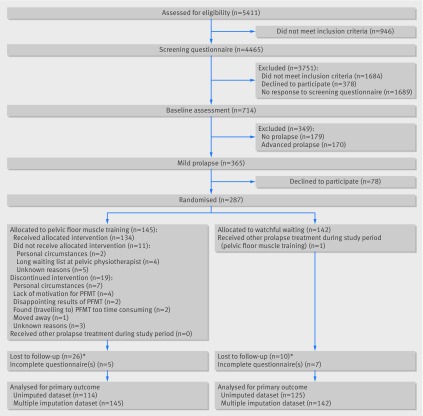
OBJECTIVE: To compare the effects of pelvic floor muscle training and watchful waiting on pelvic floor symptoms in a primary care population of women aged 55 years and over with symptomatic mild pelvic organ prolapse. DESIGN: Randomised controlled trial. SETTING: Dutch primary care. PARTICIPANTS: Women aged 55 years or over with symptomatic mild prolapse (leading edge above the hymen) were identified by screening. Exclusion criteria were current prolapse treatment or treatment in the previous year, malignancy of pelvic organs, current treatment for another gynaecological disorder, severe/terminal illness, impaired mobility, cognitive impairment, and insufficient command of the Dutch language. INTERVENTIONS: Pelvic floor muscle training versus watchful waiting. MAIN OUTCOME MEASURES: The primary outcome was change in bladder, bowel, and pelvic floor symptoms measured with the Pelvic Floor Distress Inventory-20 (PFDI-20), three months after the start of treatment. Secondary outcomes were changes in condition specific and general quality of life, sexual function, degree of prolapse, pelvic floor muscle function, and patients' perceived change in symptoms. RESULTS: Of the 287 women who were randomised to pelvic floor muscle training (n=145) or watchful waiting (n=142), 250 (87%) completed follow-up. Participants in the intervention group improved by (on average) 9.1 (95% confidence interval 2.8 to 15.4) points more on the PFDI-20 than did participants in the watchful waiting group (P=0.005). Of women in the pelvic floor muscle training group, 57% (82/145) reported an improvement in overall symptoms from the start of the study compared with 13% (18/142) in the watchful waiting group (P<0.001). Other secondary outcomes showed no significant difference between the groups. CONCLUSIONS: Although pelvic floor muscle training led to a significantly greater improvement in PFDI-20 score, the difference between the groups was below the presumed level of clinical relevance (15 points). Nevertheless, 57% of the participants in the intervention group reported an improvement of overall symptoms. More studies are needed to identify factors related to success of pelvic floor muscle training and to investigate long term effects.Trial registration Dutch Trial Register (www.trialregister.nl) identifier: NTR2047.
Overview
The claims and statistics of this paper haven’t been checked yet.
Run the check — free, no account needed. It reads the open-access text and checks the sources it cites.
Integrity signals
Registry
Cites
Statistics
Figures
Verification
Claims the paper makes
The claims and statistics of this paper haven’t been checked yet.
Run the check — free, no account needed. It reads the open-access text and checks the sources it cites.
Claims other papers make about this one
Each is checked against this paper’s own text: does it say what the citing paper says it does?
The source backs part of the claim, not all of it — or backs it for a different population, condition or comparison.
In the citing paper
“In the study of Wiegersma et al. (2014) [38], the participants did strength training, but also many other exercise modalities and the chosen exercise program was up to the physical therapist with no standardization of the training protocol.”
From International urogynecology consultation chapter 3 committee 2; conservative treatment of patient with pelvic organ prolapse: Pelvic floor muscle training (2022) · cites this paper as [38]
Experimental — accuracy not yet measuredThe source backs part of the claim, not all of it — or backs it for a different population, condition or comparison.
In the citing paper
“Eight studies found that PFMT improved bladder symptoms [38, 39, 43, 44, 47, 60, 61, 74] and five studies found improvement of anorectal symptoms [39, 43, 44, 47, 61, 74].”
From International urogynecology consultation chapter 3 committee 2; conservative treatment of patient with pelvic organ prolapse: Pelvic floor muscle training (2022) · cites this paper as [38]
Experimental — accuracy not yet measuredThe cited source says what the claim attributes to it.
In the citing paper
“two studies focused on secondary prevention, as they included women who had not sought health care for assessment or treatment of the condition [37, 38]”
From International urogynecology consultation chapter 3 committee 2; conservative treatment of patient with pelvic organ prolapse: Pelvic floor muscle training (2022) · cites this paper as [38]
The cited source says what the claim attributes to it.
In the citing paper
“Both studies found statistically significant positive short-term effects on symptoms of POP, but not on POP-Q stage.”
From International urogynecology consultation chapter 3 committee 2; conservative treatment of patient with pelvic organ prolapse: Pelvic floor muscle training (2022) · cites this paper as [38]
The cited source says what the claim attributes to it.
In the citing paper
“No difference in POP-Q. Significant improvement in PFDI-20 in PFMT vs control; 57% in PFMT vs 13% in control reported overall improvement in symptoms”
From International urogynecology consultation chapter 3 committee 2; conservative treatment of patient with pelvic organ prolapse: Pelvic floor muscle training (2022) · cites this paper as [38]
The cited source says what the claim attributes to it.
In the citing paper
“The results of these RCTs showed some benefit, but the effects were not that convincing [37, 38].”
From International urogynecology consultation chapter 3 committee 2; conservative treatment of patient with pelvic organ prolapse: Pelvic floor muscle training (2022) · cites this paper as [38]
Self-check
Percentages, sums and reported differences re-computed from the paper’s own numbers.
The self-check needs the paper’s full text.
Citations
Cites
WARE, J. E., KOSINSKI, M., & KELLER, S. D. (1996) · Medical Care · doi:10.1097/00005650-199603000-00003 · Cited by 17,392
The standardization of terminology of female pelvic organ prolapse and pelvic floor dysfunction
Bump, R. C., Mattiasson, A., Bø, K., Brubaker, L. P., DeLancey, J. O. L., Klarskov, P., Shull, B. L., & Smith, A. R. B. (1996) · American Journal of Obstetrics and Gynecology · doi:10.1016/s0002-9378(96)70243-0 · Cited by 4,275
Haylen, B. T., Ridder, D. J. M. K. D., Freeman, R. M., Swift, S., Berghmans, B. C. M., Lee, J., Monga, A. K., Petri, E., Rizk, D. E. E., Sand, P. K., et al. (2009) · Neurourology and Urodynamics · doi:10.1002/nau.20798 · Cited by 3,090
Revicki, D. A., Hays, R. D., Cella, D. F., & Sloan, J. A. (2007) · Journal of Clinical Epidemiology · doi:10.1016/j.jclinepi.2007.03.012 · Cited by 2,384
Haylen, B. T., de Ridder, D., Freeman, R. M., Swift, S. E., Berghmans, B., Lee, J., Monga, A., Petri, E., Rizk, D. E., Sand, P. K., et al. (2010) · International Urogynecology Journal · doi:10.1007/s00192-009-0976-9 · Cited by 2,237
Analysing controlled trials with baseline and follow up measurements
Vickers, A. J., & Altman, D. G. (2001) · BMJ · doi:10.1136/bmj.323.7321.1123 · Cited by 2,116
Prevalence of symptomatic pelvic floor disorders in US women
Nygaard, I. (2008) · JAMA · doi:10.1001/jama.300.11.1311 · Cited by 1,869
Barber, M. D., Walters, M. D., & Bump, R. C. (2005) · American Journal of Obstetrics and Gynecology · doi:10.1016/j.ajog.2004.12.025 · Cited by 1,357
A short form of the Pelvic Organ Prolapse/Urinary Incontinence Sexual Questionnaire (PISQ-12)
Rogers, R. G., Coates, K. W., KAMMERER-DOAK, D. N., Khalsa, S., & Qualls, C. (2003) · International Urogynecology Journal · doi:10.1007/s00192-003-1063-2 · Cited by 754
Swift, S., Woodman, P., O'Boyle, A., Kahn, M., Valley, M., Bland, D., Wang, W., & Schaffer, J. (2005) · American Journal of Obstetrics and Gynecology · doi:10.1016/j.ajog.2004.10.602 · Cited by 752
Research works printed but not linked: 1
- [29]Hagen S, Glazener C, Cook J, Herbison P, Toosz-Hobson P. Further properties of the pelvic prolapse symptom score: minimally important change and test-retest reliability. Neurol Urodyn 2010; 29: 1055-6.
Cited by
Sorted by citations
Boutron, I., Altman, D. G., Moher, D., Schulz, K. F., Ravaud, P., & for the CONSORT NPT Group* (2017) · Annals of Internal Medicine · doi:10.7326/m17-0046 · Cited by 1,538
Barber, M. D. (2016) · BMJ · doi:10.1136/bmj.i3853 · Cited by 234
Li, C., Gong, Y., & Wang, B. (2016) · International Urogynecology Journal · doi:10.1007/s00192-015-2846-y · Cited by 154
Ferreira, C. H. J., Bø, K., Catai, C. C., Brito, L. G. O., Driusso, P., & Tennfjord, M. K. (2024) · American Journal of Obstetrics and Gynecology · doi:10.1016/j.ajog.2024.01.001 · Cited by 97
Pharmacologic and Nonpharmacologic Treatments for Urinary Incontinence in Women
Balk, E. M., Rofeberg, V., Adam, G. P., Kimmel, H. J., Trikalinos, T. A., & Jeppson, P. C. (2019) · Annals of Internal Medicine · doi:10.7326/m18-3227 · Cited by 88
Tennfjord, M. K., Hilde, G., Stær-Jensen, J. E., Siafarikas, F., Engh, M. E., & Bø, K. (2015) · BJOG An International Journal of Obstetrics & Gynaecology · doi:10.1111/1471-0528.13823 · Cited by 85
Vaginal Pessary in Women With Symptomatic Pelvic Organ Prolapse: A Randomized Controlled Trial
Cheung, R. Y. K., Lee, J. H. S., Lee, L. L., Chung, T. K. H., & Chan, S. S. C. (2016) · Obstetrics & Gynecology · doi:10.1097/aog.0000000000001489 · Cited by 77
Bø, K., Anglès-Acedo, S., Batra, A., Brækken, I. H., Chan, Y. L., Jorge, C. H., Kruger, J., Yadav, M., & Dumoulin, C. (2022) · International Urogynecology Journal · doi:10.1007/s00192-022-05324-0 · Cited by 64
“The two included studies on secondary prevention in our review [37, 38] could have been classified as treatment as some of the included women had symptoms of POP, but as the participants had not sought help for POP, we chose to classify them as preventive studies.”
BackgroundMethodInfluentialPanman, C. M. C. R., Wiegersma, M., Kollen, B. J., Berger, M. Y., Lisman-van Leeuwen, Y., Vermeulen, K. M., & Dekker, J. H. (2016) · Menopause · doi:10.1097/gme.0000000000000706 · Cited by 61
Self-citationPanman, C., Wiegersma, M., Kollen, B., Berger, M., Lisman‐Van Leeuwen, Y., Vermeulen, K., & Dekker, J. (2017) · BJOG: An International Journal of Obstetrics & Gynaecology · doi:10.1111/1471-0528.13992 · Cited by 57
Self-citationNavarro-Brazález, B., Prieto-Gómez, V., Prieto‐Merino, D., Sánchez-Sánchez, B., McLean, L., & Torres-Lacomba, M. (2020) · Journal of Clinical Medicine · doi:10.3390/jcm9041149 · Cited by 55
Araujo, J. E. L. D., Santos, S. S. D., & Postol, M. K. (2020) · Fisioterapia Brasil · doi:10.33233/fb.v21i4.1462 · Cited by 54
Management of female pelvic organ prolapse—Summary of the 2021 HAS guidelines
Pizzoferrato, A., Thuillier, C., Venara, A., Bornsztein, N., Bouquet, S., Cayrac, M., Cornillet-Bernard, M., Cotelle, O., Cour, F., Cretinon, S., et al. (2023) · Journal of Gynecology Obstetrics and Human Reproduction · doi:10.1016/j.jogoh.2023.102535 · Cited by 49
Navarro-Brazález, B., Sánchez, B. S., Prieto-Gómez, V., de la Villa, P., McLean, L., & Torres-Lacomba, M. (2020) · Neurourology and Urodynamics · doi:10.1002/nau.24284 · Cited by 44
Wiegersma, M., Panman, C. M. C. R., Berger, M. Y., de Vet, H. C. W., Kollen, B. J., & Dekker, J. H. (2016) · American Journal of Obstetrics and Gynecology · doi:10.1016/j.ajog.2016.10.010 · Cited by 43
Self-citationDue, U., Brostrøm, S., & Lose, G. (2016) · International Urogynecology Journal · doi:10.1007/s00192-015-2852-0 · Cited by 36
Min, L., Chunxue, Y., Lv, Q., Dong, X., Zhang, Y., Guifang, Z., Kejia, H., Gai, T., & Feng, Q. (2022) · Trials · doi:10.1186/s13063-022-06051-z · Cited by 31
Epidemiology of Pelvic Organ Prolapse
Wilkins, M. F., & Wu, J. M. (2016) · Current Obstetrics and Gynecology Reports · doi:10.1007/s13669-016-0149-z · Cited by 31
Widdison, R., Rashidi, A., & Whitehead, L. (2022) · BMC Nursing · doi:10.1186/s12912-022-00812-6 · Cited by 29
Espiño-Albela, A., Castaño-García, C., Díaz-Mohedo, E., & Ibáñez-Vera, A. J. (2022) · Journal of Personalized Medicine · doi:10.3390/jpm12050806 · Cited by 28
“Five studies [14,18,19,21,24] with 451 patients in the control group and 466 in the PMSC group reported changes in sexual function using the PISQ-12 questionnaire [14,18,19,21], while Braekken, et al.”
BackgroundMethodResultInfluentialThe effect of pelvic floor muscle training for women with pelvic organ prolapse: A meta-analysis
Wang, T., Wen, Z., & Li, M. (2022) · International Urogynecology Journal · doi:10.1007/s00192-022-05139-z · Cited by 24
Laparoscopic vaginal lateral suspension: technical aspects and initial experience
Barbato, G., ROLLO, S., BORRI, A., Staderini, F., Cianchi, F., & Coratti, F. (2021) · Minerva Surgery · doi:10.23736/s2724-5691.20.08414-x · Cited by 23
Díaz-Álvarez, L., Lorenzo-Gallego, L., Romay‐Barrero, H., Prieto-Gómez, V., Torres-Lacomba, M., & Navarro-Brazález, B. (2022) · International Journal of Environmental Research and Public Health · doi:10.3390/ijerph19159308 · Cited by 26
Sun, Z., Zhu, L., Xu, T., Shi, X., & Lang, J. (2016) · Menopause The Journal of The North American Menopause Society · doi:10.1097/gme.0000000000000614 · Cited by 23
Siyoum, M., Nardos, R., Sirak, B., Spitznagle, T. M., Teklesilasie, W., & Astatkie, A. (2025) · PLoS Medicine · doi:10.1371/journal.pmed.1004468 · Cited by 22
Gu, X., Yang, M., Liu, F., Liu, D., & Shi, F. (2022) · Contrast Media & Molecular Imaging · doi:10.1155/2022/4818011 · Cited by 22
RetractedRééducation pelvi-périnéale et troubles de la statique pelvienne de la femme
Thubert, T., Bakker, E., & Fritel, X. (2015) · Gynécologie Obstétrique & Fertilité · doi:10.1016/j.gyobfe.2015.03.026 · Cited by 21
Giagio, S., Innocenti, T., Salvioli, S., Lami, A., Meriggiola, M. C., Pillastrini, P., & Gava, G. (2021) · Neurourology and Urodynamics · doi:10.1002/nau.24712 · Cited by 19
Miao, Y., Wen, J., Wang, L., Wen, Q., Cheng, J., Zhao, Z., & Wu, J. (2023) · Frontiers in Immunology · doi:10.3389/fimmu.2023.1084516 · Cited by 20
Predictors of Success for Pelvic Floor Muscle Training in Pelvic Organ Prolapse
Wiegersma, M., Panman, C. M. C. R., Hesselink, L. C., Malmberg, A. G. A., Berger, M. Y., Kollen, B. J., & Dekker, J. H. (2019) · Physical Therapy · doi:10.1093/ptj/pzy114 · Cited by 17
Self-citationGe, J., Wei, X. J., Zhang, H. Z., & Fang, G. Y. (2021) · Actas Urológicas Españolas · doi:10.1016/j.acuro.2020.01.012 · Cited by 16
Nonoperative Management of Pelvic Organ Prolapse
Sung, V. W., Jeppson, P. C., & Madsen, A. M. (2023) · Obstetrics and Gynecology · doi:10.1097/aog.0000000000005121 · Cited by 16
Dou, C., Li, Q., Ying, T., Yan, Y., Wang, X., & Hu, B. Q. (2017) · Frontiers of Medicine · doi:10.1007/s11684-017-0561-4 · Cited by 16
Impact of pelvic floor muscle training in pelvic organ prolapse
Basnet, R. (2021) · International Urogynecology Journal · doi:10.1007/s00192-020-04613-w · Cited by 15
Pereira, A. P. D., Janela, D., Areias, A. C., Molinos, M., Tong, X., Bento, V., Yanamadala, V., Atherton, J., Correia, F. D., & Costa, F. M. T. A. (2025) · JMIR mhealth and uhealth · doi:10.2196/68242 · Cited by 15
Generic Health-Related Quality of Life in Patients Seeking Care for Pelvic Organ Prolapse
Bradley, C. S., Brown, H. W., Shippey, S. H., Gutman, R. E., Andy, U. U., Yurteri-Kaplan, L. A., Kudish, B., Mehr, A. A., O’Boyle, A. L., Foster, R. T., et al. (2021) · Urogynecology · doi:10.1097/spv.0000000000001069 · Cited by 14
Long-term pelvic floor symptoms and urogenital prolapse after hysterectomy
Vermeulen, C. K. M., Veen, J., Adang, C., Coolen, A. L. W. M., van Leijsen, S. A. L., & Bongers, M. Y. (2023) · BMC Women s Health · doi:10.1186/s12905-023-02286-3 · Cited by 14
An update of a former FIGO Working Group Report on Management of Posterior Compartment Prolapse
Doumouchtsis, S. K., Raheem, A. A., Haddad, J. M., Betschart, C., Ortiz, O. C., Nygaard, C. C., Medina, C. A., Torre, F. L., Iancu, G., Cervigni, M., et al. (2019) · International Journal of Gynecology & Obstetrics · doi:10.1002/ijgo.13006 · Cited by 14
Hagen, S., Kearney, R., Goodman, K., Melone, L., Elders, A., Manoukian, S., Agur, W., Best, C., Breeman, S., Dembinsky, M., et al. (2020) · Trials · doi:10.1186/s13063-020-04738-9 · Cited by 14
Balk, E. M., Adam, G. P., Corsi, K., Mogul, A., Trikalinos, T. A., & Jeppson, P. C. (2019) · Journal of General Internal Medicine · doi:10.1007/s11606-019-05028-0 · Cited by 12
Prolapse Repair Using Non-synthetic Material: What is the Current Standard?
Palmerola, R., & Rosenblum, N. (2019) · Current Urology Reports · doi:10.1007/s11934-019-0939-8 · Cited by 11
International Urogynecology Consultation Chapter 3 Committee 1 – Pessary Management
Rantell, A., Abdool, Z., Fullerton, M. E., Gedefaw, A., Lough, K., Miotła, P., Mukhtarova, N., Neumann, P., Spencer, J., Warner, K. J., et al. (2025) · International Urogynecology Journal · doi:10.1007/s00192-024-06020-x · Cited by 10
Sicilia, G., Vitale, S. G., D’Alterio, M. N., Saponara, S., Scicchitano, F., Fulghesu, A. M., Nappi, R. E., & Angioni, S. L. (2025) · BJOG An International Journal of Obstetrics & Gynaecology · doi:10.1111/1471-0528.18260 · Cited by 10
Ge, J., Wei, X. J., Zhang, H. Z., & Fang, G. Y. (2020) · Actas Urológicas Españolas (English Edition) · doi:10.1016/j.acuroe.2020.12.002 · Cited by 9
Bugge, C., Hagen, S., Elders, A., Mason, H., Goodman, K., Dembinsky, M., Melone, L., Best, C. S., Manoukian, S., Dwyer, L., et al. (2023) · Health Technology Assessment · doi:10.3310/nwtb5403 · Cited by 8
Randomised controlled trials: the importance of sample size
Sedgwick, P. M. (2015) · BMJ · doi:10.1136/bmj.h1586 · Cited by 8
Information Priorities for Deciding on Treatment of Pelvic Organ Prolapse
Gerjevic, K. A., Erekson, E. A., Strohbehn, K., Jacobs, K. A., Hanissian, P. D., & Aarts, J. W. M. (2018) · Urogynecology · doi:10.1097/spv.0000000000000572 · Cited by 8
Zhao, B., Hu, M., Wu, H., Ren, C., Chen, J., Zhang, X., & Cui, S. (2018) · International Journal of Molecular Medicine · doi:10.3892/ijmm.2018.3578 · Cited by 8
Apical Prolapse Surgical Treatment Outcomes: Transabdominal Versus Transvaginal Approach
Eftekhar, T., Forooghifar, T., Alizadeh, S., Shabihkhani, S., Forooghifar, T., & Hajhashemy, M. (2018) · Journal of Gynecologic Surgery · doi:10.1089/gyn.2017.0045 · Cited by 7
de Carvalho, M. L. A. S., Bezerra, L. O., de Oliveira, J. M. P., de Oliveira, M. C. E., & Micussi, M. T. A. B. C. (2024) · PLoS ONE · doi:10.1371/journal.pone.0308701 · Cited by 7
Impact of a Digital Therapeutic Device on Pelvic Floor Symptoms
Weinstein, M. M., Dunivan, G. C., Guaderrama, N. M., & Richter, H. E. (2025) · Urogynecology · doi:10.1097/spv.0000000000001674 · Cited by 6
Kurt, K. T., Çetin, S. Y., & Ayan, A. (2023) · International Journal of Rheumatic Diseases · doi:10.1111/1756-185x.14790 · Cited by 6
Page, A., Borowski, E., Bauters, E., Housmans, S., der Aa, F. V., & Deprest, J. A. (2024) · European Journal of Obstetrics & Gynecology and Reproductive Biology · doi:10.1016/j.ejogrb.2024.10.042 · Cited by 6
Wen, X., Tian, H., Yan, X., Sun, Q., Du, Y., Wen, D., & Yang, Y. (2021) · Frontiers in Medicine · doi:10.3389/fmed.2021.727711 · Cited by 6
Saus‐Ortega, C., Sierra-García, E., Martínez‐Sabater, A., Chover‐Sierra, E., & Ballestar‐Tarín, M. L. (2023) · Nursing Open · doi:10.1002/nop2.1826 · Cited by 5
Pelvic organ prolapse: prevention by training?
Dekker, J. H. (2016) · The Lancet · doi:10.1016/s0140-6736(16)32108-0 · Cited by 5
Self-citationZhao, B., Hu, M., Wu, H., Ren, C., Wang, J., & Cui, S. (2017) · Molecular Medicine Reports · doi:10.3892/mmr.2017.6329 · Cited by 5
Mitchell, J. R., Brancaccio, H. E., Blusewicz Spt, M., Lo, D. F., Goodwin, B., & Carey, D. (2025) · The American Journal of Surgery · doi:10.1016/j.amjsurg.2024.116111 · Cited by 4
The Pros and Cons of Hystero-preservation on Pelvic Reconstructive Surgery
Chen, C.-C., Peng, I., & Wu, M. (2023) · Gynecology and Minimally Invasive Therapy · doi:10.4103/gmit.gmit_21_23 · Cited by 4
Walgren, L., Wade, C. E., Dessaulles, M., Ginis, K. A. M., & Locke, J. A. (2024) · Post Reproductive Health · doi:10.1177/20533691241272830 · Cited by 4
Sedgwick, P. M. (2015) · BMJ · doi:10.1136/bmj.h3475 · Cited by 4
Effect of pelvic floor muscle training on improving prolapse-related symptoms after surgery
Liang, Y., Li, X., Wang, J., Liu, Y., Yang, Y., & Dong, M. (2019) · The Journal for Nurse Practitioners · doi:10.1016/j.nurpra.2019.06.002 · Cited by 3
Pereira, A. P., Seet, A. M., Domingues, B., Janela, D., Pradhan, A., Areias, A. C., Tong, X., Bento, V., Yanamadala, V., Cohen, S., et al. (2026) · Journal of Medical Economics · doi:10.1080/13696998.2026.2627835 · Cited by 3
Non-surgical and Surgical Management of Pelvic Organ Prolapse in the Older Woman
Sultana, C. J. (2017) · Current Geriatrics Reports · doi:10.1007/s13670-017-0203-3 · Cited by 3
Kolumbán, S., Kovács, K. A., Majoros, A., Németh, Z., Bódis, J., & Farkas, B. (2022) · Orvosi Hetilap · doi:10.1556/650.2022.32681 · Cited by 3
Factors Associated With Pelvic Organ Prolapse in Postmenopausal South Korean Women
Kim, T.-R., Jung, H.-Y., Kim, M., & Yuk, J. (2024) · Urogynecology · doi:10.1097/spv.0000000000001535 · Cited by 3
Efficacy of vaginal weights in pelvic floor dysfunction: A systematic review and meta-analysis
Ganesan, D., Prathap, L., Ling, L. Z., ChyeWah, Y., Suganthirababu, P., Pandian, S. K., & Ramalingam, V. (2022) · International Journal of Health Sciences · doi:10.53730/ijhs.v6ns3.5324 · Cited by 3
Pelvic organ prolapse in women: how is it diagnosed and treated currently?
Milart, P., Woźniakowska, E., Czuczwar, P., & Woźniak, S. (2015) · Menopause Review/Przegląd Menopauzalny · doi:10.5114/pm.2015.54338 · Cited by 3
Evaluation and Management of Recurrent Pelvic Organ Prolapse
Rickey, L., & Markowitz, M. A. (2025) · Current Urology Reports · doi:10.1007/s11934-025-01291-3 · Cited by 2
Wijesinghe, V., Amaradivakara, P., & Farukan, R. (2021) · International Urogynecology Journal · doi:10.1007/s00192-021-04695-0 · Cited by 2
Effect of Hypopressive exercise in women with Pelvic Organ Prolapse
Parle, J., Shahmalak, S., & Irkar, D. (2021) · Nepal Journal of Obstetrics and Gynaecology · doi:10.3126/njog.v16i1.37517 · Cited by 2
Managing mild, symptomatic pelvic organ prolapse
Dru, C. J., & Anger, J. T. (2014) · BMJ · doi:10.1136/bmj.g7698 · Cited by 2
Crowley, H., & Brennen, R. (2024) · Physical Therapy Reviews · doi:10.1080/10833196.2024.2433348 · Cited by 1
Prasong, N., & Sugkaroek, P. (2025) · Journal of Current Science and Technology · doi:10.59796/jcst.v15n3.2025.113 · Cited by 1
Pelvic organ prolapse, abdominal hernias, and inguinal hernias
Kirby, A. C., & Lentz, G. M. (2021) · Elsevier eBooks · doi:10.1016/b978-0-323-65399-2.00029-2 · Cited by 1
Saldanha, C. (2022) · Physician Assistant Clinics · doi:10.1016/j.cpha.2022.03.003 · Cited by 1
Dadkhah, N., & Nadi, M. (2022) · Transactions on Data Analysis in Social Science · doi:10.47176/tdass/2023.87 · Cited by 1
Pelvic Floor Muscle Training and Prolapse: Prevention or Treatment?
Biroli, A., & Lamberti, G. (2018) · Urodynamics, neurourology and pelvic floor dysfunctions · doi:10.1007/978-3-319-59195-7_6 · Cited by 1
Cordeiro, A. L. L., Pedra, A. C., Brasileiro, P., & Silva, T. (2020) · Ciência em Movimento · doi:10.15602/1983-9480/cm.v22n44p21-29 · Cited by 1
Panman, C. M. C. R., Wiegersma, M., & Dekker, J. H. (2015) · Bijblijven · doi:10.1007/s12414-015-0087-0 · Cited by 1
Self-citationEverts-Panman, C. M. C. R., & Wiegersma, M. (2019) · Praktische huisartsgeneeskunde · doi:10.1007/978-90-368-2409-5_23 · Cited by 1
Self-citationBillecocq, S., Cornillet-Bernard, M., Valancogne, G., & Deffieux, X. (2020) · EMC - AKOS - Trattato di Medicina · doi:10.1016/s1634-7358(20)43341-8 · Cited by 1
Vermeulen, C. K. M., Tunnissen, W., Coolen, A.-L. W. M., Veen, J., Dietz, V., van Leijsen, S. A. L., & Bongers, M. Y. (2024) · International Urogynecology Journal · doi:10.1007/s00192-023-05697-w · Cited by 1
Clinical Commentary: Pelvic Organ Prolapse and Incontinence
Hulme, J. A. (2016) · Topics in Geriatric Rehabilitation · doi:10.1097/tgr.0000000000000124 · Cited by 1
Bonacin, M. A. P. (2017) · Digital Library of Theses and Dissertations (Universidade de São Paulo) · doi:10.11606/d.17.2017.tde-06012017-143045 · Cited by 1
Bekkenbodemspiertraining mogelijk effectief bij verzakking
van der Wouden, H. (2015) · Huisarts en Wetenschap · doi:10.1007/s12445-015-0071-z
Does Pelvic Floor Muscle Training Work for Symptomatic Mild Prolapse
Mueller, P. S., & FACP., F. (2015) · Journal watch · doi:10.1056/nejm-jw.na36729
Beckenbodentraining hilft bei Prolaps-Symptomen
Füeßl, H. S. (2015) · MMW - Fortschritte der Medizin · doi:10.1007/s15006-015-3411-9
Bekkenbodemfysiotherapie bij urogenitale prolaps
Panman, C. M. C. R., Wiegersma, M., Kollen, B. J., Berger, M. Y., van Leeuwen, Y., Vermeulen, K. M., & Dekker, J. H. (2017) · Huisarts en Wetenschap · doi:10.1007/s12445-017-0036-5
Self-citationRole of Physical Therapy in the Treatment of Female Dysfunction
Tennfjord, M. K., Engh, M. E., & Bø, K. (2017) · Springer eBooks · doi:10.1007/978-3-319-41716-5_17
Duarte, T. B. (2017) · Digital Library of Theses and Dissertations (Universidade de São Paulo) · doi:10.11606/t.17.2017.tde-08062017-102357
Role of Central Sensitivity Syndromes in women with pelvic organ prolapse
Vij, M. (2020) · PEARL (University of Plymouth) · doi:10.24382/805
Crowle, A., & Harley, C. (2021) · Journal of Womenʼs Health Physical Therapy · doi:10.1097/jwh.0000000000000210
Escobar, C. M., & Pape, D. M. (2021) · Springer eBooks · doi:10.1007/978-3-030-59058-1_9
The surgical management of uterine prolapse and the role of mesh
Izett-Kay, M. L. (2021) · UCL Discovery (University College London)
Billecocq, S., Cornillet-Bernard, M., Valancogne, G., & Deffieux, X. (2020) · EMC - Tratado de Medicina · doi:10.1016/s1636-5410(20)43330-6
Section on Women's Health Combined Sections Meeting Posters
(2019) · Journal of Womenʼs Health Physical Therapy · doi:10.1097/jwh.0000000000000127
Chen, H., Liu, X., Yan, Y., Shi, H., & Liu, Z. (2022) · BMJ Open · doi:10.1136/bmjopen-2021-051249
FATORES DE RISCO AO DESENVOLVIMENTO DA ENDOMETRIOSE
Silva, A. L. F. E., Loss, A. M. R., dos Santos, M. A., de Oliveira, V. E., Álvares, V. G., & de Aquino, É. C. (2023) · doi:10.56161/sci.ed.20230917c11
A IMPORTÂNCIA DA HIGIENE MENSTRUAL NA PROMOÇÃO DA SAÚDE, UMA REVISÃO DE LITERATURA
Mendonça, C. C. C., da Silva, G. G. B., Pinto, J. M. P., Santos, J. S., Daniel, M. H. B., & de Aquino, É. C. (2023) · doi:10.56161/sci.ed.20230917c2
Metadata
- Authors
- Wiegersma, M., Panman, C. M. C. R., Kollen, B. J., Berger, M. Y., Lisman-Van Leeuwen, Y., & Dekker, J. H.
- Affiliations
- University Medical Center Groningen (NL)
- Corresponding author
- Dekker, J. H.
- Venue
- BMJ
- Publisher
- BMJ
- Published
- 2014-12-22
- Volume
- 349
- Issue
- dec22 1
- Pages
- g7378-g7378
- ISSN
- 1756-1833 (ISSN-L)
- PMC
- PMC4273538
- OpenAlex
- W2157103386
- Cited by
- 122
- References
- 34
- Citations by year
- 2026: 6 · 2025: 8 · 2024: 12 · 2023: 22 · 2022: 11 · 2021: 11 · 2020: 11 · 2019: 7 · 2018: 5 · 2017: 8 · 2016: 9 · 2015: 11 · 2014: 1
- FWCI
- 8.02
- Type
- journal article
- Language
- en
- Open access
- hybrid
- doi.org
- Licence
- cc-by-nc
- Locations
- BMJ (publishedVersion, cc-by-nc)
- Europe PMC (PubMed Central) (publishedVersion, cc-by-nc)
- PubMed Central (publishedVersion, cc-by-nc)
- PubMed (publishedVersion)
- University of Groningen research database (University of Groningen / Centre for Information Technology) (publishedVersion, other-oa)
- HighWire Press Open Archive (submittedVersion)
- University of Groningen research database (University of Groningen / Centre for Information Technology) (submittedVersion)
- University of Groningen research database (University of Groningen / Centre for Information Technology) (submittedVersion, other-oa)
- Funders
- ZonMw (4201.1001)
- Topics
- Health Sciences › Medicine › Urology › Pelvic floor disorders treatments
- Health Sciences › Medicine › Psychiatry and Mental health › Sexual function and dysfunction studies
- Health Sciences › Medicine › Urology › Urinary Bladder and Prostate Research
- Keywords
- pelvic floor muscle training, expectant management, pelvic organ prolapse, older women, pelvic floor symptoms, bladder symptoms, bowel symptoms, quality of life, sexual function, pelvic floor muscle function, primary care, non-surgical management
- MeSH terms
- Aged, Female, Humans, Middle Aged, Netherlands, Primary Health Care, Surveys and Questionnaires, Treatment Outcome, Pelvic Floor, Physical Therapy Modalities, Pelvic Organ Prolapse, Watchful Waiting
About these checks
Registry, retraction, Cites and statistics results are computed, not judged, with one exception: a printed reference that no index lists is read once by a model before it counts as a citation error. Claims are extracted by a model and kept only when their quote appears verbatim in the text; each cited source is then checked, with a model’s help, for whether it says what the claim relies on. Those verdicts can be wrong — read the claim’s quote and the cited source before relying on one.
Statistics and arithmetic are recomputed, not judged.
Confidence bands are shown only for fields calibrated on our annotated test set. None is calibrated yet, so no band is shown.
What counts as a claim ›How we measure confidence ›How we check this ›
Are you an author, or do you see a problem with this page? Request a review
