

The DOI matches its Crossref record; 35 of the 35 references it cites were found in a registry or an index.
Effect of pelvic floor muscle training compared with watchful waiting in older women with symptomatic mild pelvic organ prolapse: randomised controlled trial in primary care
Open accessAbstract
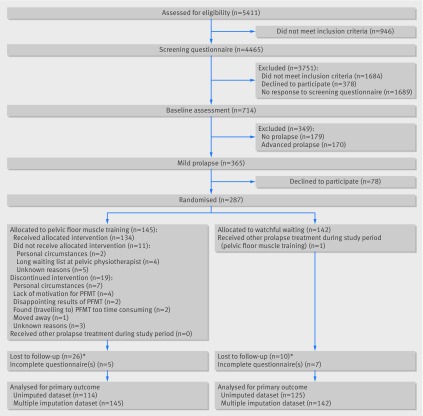
OBJECTIVE: To compare the effects of pelvic floor muscle training and watchful waiting on pelvic floor symptoms in a primary care population of women aged 55 years and over with symptomatic mild pelvic organ prolapse. DESIGN: Randomised controlled trial. SETTING: Dutch primary care. PARTICIPANTS: Women aged 55 years or over with symptomatic mild prolapse (leading edge above the hymen) were identified by screening. Exclusion criteria were current prolapse treatment or treatment in the previous year, malignancy of pelvic organs, current treatment for another gynaecological disorder, severe/terminal illness, impaired mobility, cognitive impairment, and insufficient command of the Dutch language. INTERVENTIONS: Pelvic floor muscle training versus watchful waiting. MAIN OUTCOME MEASURES: The primary outcome was change in bladder, bowel, and pelvic floor symptoms measured with the Pelvic Floor Distress Inventory-20 (PFDI-20), three months after the start of treatment. Secondary outcomes were changes in condition specific and general quality of life, sexual function, degree of prolapse, pelvic floor muscle function, and patients' perceived change in symptoms. RESULTS: Of the 287 women who were randomised to pelvic floor muscle training (n=145) or watchful waiting (n=142), 250 (87%) completed follow-up. Participants in the intervention group improved by (on average) 9.1 (95% confidence interval 2.8 to 15.4) points more on the PFDI-20 than did participants in the watchful waiting group (P=0.005). Of women in the pelvic floor muscle training group, 57% (82/145) reported an improvement in overall symptoms from the start of the study compared with 13% (18/142) in the watchful waiting group (P<0.001). Other secondary outcomes showed no significant difference between the groups. CONCLUSIONS: Although pelvic floor muscle training led to a significantly greater improvement in PFDI-20 score, the difference between the groups was below the presumed level of clinical relevance (15 points). Nevertheless, 57% of the participants in the intervention group reported an improvement of overall symptoms. More studies are needed to identify factors related to success of pelvic floor muscle training and to investigate long term effects.Trial registration Dutch Trial Register (www.trialregister.nl) identifier: NTR2047.
Overview
The claims and statistics of this paper haven’t been checked yet.
Run the check — free, no account needed. It reads the open-access text and checks the sources it cites.
Integrity signals
Registry
Cites
Statistics
Figures
Verification
Claims the paper makes
The claims and statistics of this paper haven’t been checked yet.
Run the check — free, no account needed. It reads the open-access text and checks the sources it cites.
Claims other papers make about this one
Each is checked against this paper’s own text: does it say what the citing paper says it does?
The source backs part of the claim, not all of it — or backs it for a different population, condition or comparison.
In the citing paper
“In the study of Wiegersma et al. (2014) [38], the participants did strength training, but also many other exercise modalities and the chosen exercise program was up to the physical therapist with no standardization of the training protocol.”
From International urogynecology consultation chapter 3 committee 2; conservative treatment of patient with pelvic organ prolapse: Pelvic floor muscle training (2022) · cites this paper as [38]
Experimental — accuracy not yet measuredThe source backs part of the claim, not all of it — or backs it for a different population, condition or comparison.
In the citing paper
“Eight studies found that PFMT improved bladder symptoms [38, 39, 43, 44, 47, 60, 61, 74] and five studies found improvement of anorectal symptoms [39, 43, 44, 47, 61, 74].”
From International urogynecology consultation chapter 3 committee 2; conservative treatment of patient with pelvic organ prolapse: Pelvic floor muscle training (2022) · cites this paper as [38]
Experimental — accuracy not yet measuredThe cited source says what the claim attributes to it.
In the citing paper
“two studies focused on secondary prevention, as they included women who had not sought health care for assessment or treatment of the condition [37, 38]”
From International urogynecology consultation chapter 3 committee 2; conservative treatment of patient with pelvic organ prolapse: Pelvic floor muscle training (2022) · cites this paper as [38]
The cited source says what the claim attributes to it.
In the citing paper
“Both studies found statistically significant positive short-term effects on symptoms of POP, but not on POP-Q stage.”
From International urogynecology consultation chapter 3 committee 2; conservative treatment of patient with pelvic organ prolapse: Pelvic floor muscle training (2022) · cites this paper as [38]
The cited source says what the claim attributes to it.
In the citing paper
“No difference in POP-Q. Significant improvement in PFDI-20 in PFMT vs control; 57% in PFMT vs 13% in control reported overall improvement in symptoms”
From International urogynecology consultation chapter 3 committee 2; conservative treatment of patient with pelvic organ prolapse: Pelvic floor muscle training (2022) · cites this paper as [38]
The cited source says what the claim attributes to it.
In the citing paper
“The results of these RCTs showed some benefit, but the effects were not that convincing [37, 38].”
From International urogynecology consultation chapter 3 committee 2; conservative treatment of patient with pelvic organ prolapse: Pelvic floor muscle training (2022) · cites this paper as [38]
Self-check
Percentages, sums and reported differences re-computed from the paper’s own numbers.
The self-check needs the paper’s full text.
Citations
Cites
WARE, J. E., KOSINSKI, M., & KELLER, S. D. (1996) · Medical Care · doi:10.1097/00005650-199603000-00003 · Cited by 17,392
The standardization of terminology of female pelvic organ prolapse and pelvic floor dysfunction
Bump, R. C., Mattiasson, A., Bø, K., Brubaker, L. P., DeLancey, J. O. L., Klarskov, P., Shull, B. L., & Smith, A. R. B. (1996) · American Journal of Obstetrics and Gynecology · doi:10.1016/s0002-9378(96)70243-0 · Cited by 4,275
Haylen, B. T., Ridder, D. J. M. K. D., Freeman, R. M., Swift, S., Berghmans, B. C. M., Lee, J., Monga, A. K., Petri, E., Rizk, D. E. E., Sand, P. K., et al. (2009) · Neurourology and Urodynamics · doi:10.1002/nau.20798 · Cited by 3,090
Revicki, D. A., Hays, R. D., Cella, D. F., & Sloan, J. A. (2007) · Journal of Clinical Epidemiology · doi:10.1016/j.jclinepi.2007.03.012 · Cited by 2,384
Haylen, B. T., de Ridder, D., Freeman, R. M., Swift, S. E., Berghmans, B., Lee, J., Monga, A., Petri, E., Rizk, D. E., Sand, P. K., et al. (2010) · International Urogynecology Journal · doi:10.1007/s00192-009-0976-9 · Cited by 2,237
Analysing controlled trials with baseline and follow up measurements
Vickers, A. J., & Altman, D. G. (2001) · BMJ · doi:10.1136/bmj.323.7321.1123 · Cited by 2,116
Prevalence of symptomatic pelvic floor disorders in US women
Nygaard, I. (2008) · JAMA · doi:10.1001/jama.300.11.1311 · Cited by 1,869
Barber, M. D., Walters, M. D., & Bump, R. C. (2005) · American Journal of Obstetrics and Gynecology · doi:10.1016/j.ajog.2004.12.025 · Cited by 1,357
A short form of the Pelvic Organ Prolapse/Urinary Incontinence Sexual Questionnaire (PISQ-12)
Rogers, R. G., Coates, K. W., KAMMERER-DOAK, D. N., Khalsa, S., & Qualls, C. (2003) · International Urogynecology Journal · doi:10.1007/s00192-003-1063-2 · Cited by 754
Swift, S., Woodman, P., O'Boyle, A., Kahn, M., Valley, M., Bland, D., Wang, W., & Schaffer, J. (2005) · American Journal of Obstetrics and Gynecology · doi:10.1016/j.ajog.2004.10.602 · Cited by 752
Messelink, B., Benson, T., Berghmans, B. C. M., Bø, K., Corcos, J., Fowler, C. J., Laycock, J., Lim, P. H., van Lunsen, R. H. W., Nijeholt, G. A. B. L. À., et al. (2005) · Neurourology and Urodynamics · doi:10.1002/nau.20144 · Cited by 545
Haylen, B. T., Ridder, D. J. M. K. D., Freeman, R. M., Swift, S., Berghmans, B. C. M., Lee, J. J., Monga, A. K., Petri, E., Rizk, D. E. E., Sand, P. K., et al. (2010) · CRC Press eBooks · doi:10.3109/9781439807217-111 · Cited by 400
Predicting the number of women who will undergo incontinence and prolapse surgery, 2010 to 2050
Wu, J. M., Kawasaki, A., Hundley, A. F., Dieter, A. A., Myers, E. R., & Sung, V. W. (2011) · American Journal of Obstetrics and Gynecology · doi:10.1016/j.ajog.2011.03.046 · Cited by 353
THE EFFECT OF GENITAL PROLAPSE ON VOIDING
Romanzi, L. J., CHAIKIN, D. C., & Blaivas, J. G. (1999) · The Journal of Urology · doi:10.1016/s0022-5347(01)61957-8 · Cited by 293
Hove, M. C. P. S., Pool‐Goudzwaard, A., Eijkemans, M. J. C., Steegers‐Theunissen, R. P. M., Burger, C. W., & Vierhout, M. E. (2009) · International Urogynecology Journal · doi:10.1007/s00192-009-0902-1 · Cited by 266
Hagen, S., Stark, D., Glazener, C., Dickson, S., Barry, S., Elders, A., Frawley, H., Galea, M. P., Logan, J., McDonald, A., et al. (2014) · The Lancet · doi:10.1016/s0140-6736(13)61977-7 · Cited by 258
Brækken, I. H., Majida, M., Engh, M. E., & Bø, K. (2010) · American Journal of Obstetrics and Gynecology · doi:10.1016/j.ajog.2010.02.037 · Cited by 241
Pelvic Symptoms in Women With Pelvic Organ Prolapse
Burrows, L. J., Meyn, L. A., Walters, M. D., & Weber, A. M. (2004) · Obstetrics and Gynecology · doi:10.1097/01.aog.0000142708.61298.be · Cited by 207
Pelvic organ prolapse and overactive bladder
de Boer, T. A., Salvatore, S., Cardozo, L., Chapple, C. R., Kelleher, C. J., Kerrebroeck, P. V., Kirby, M. G., Koelbl, H., Espuña‐Pons, M., Milsom, I., et al. (2009) · Neurourology and Urodynamics · doi:10.1002/nau.20858 · Cited by 190
The Standardization of Terminology of Female Pelvic Organ Prolapse and Pelvic Floor Dysfunction
Bump, R. C., Mattiasson, A., Bø, K., Brubaker, L. T., DeLancey, J. O. L., Klarskov, P., Shull, B. L., & Smith, A. R. B. (2010) · CRC Press eBooks · doi:10.3109/9781439807217-113 · Cited by 180
Is there a pelvic organ prolapse threshold that predicts pelvic floor symptoms?
Gutman, R. E., Ford, D. E., Quiroz, L. H., Shippey, S. H., & Handa, V. L. (2008) · American Journal of Obstetrics and Gynecology · doi:10.1016/j.ajog.2008.07.028 · Cited by 152
Management of genital prolapse
Thakar, R., & Stanton, S. (2002) · BMJ · doi:10.1136/bmj.324.7348.1258 · Cited by 142
Culligan, P. J., Scherer, J., Dyer, K. Y., Priestley, J., Guingon-White, G., Delvecchio, D., & Vangeli, M. (2010) · International Urogynecology Journal · doi:10.1007/s00192-009-1046-z · Cited by 140
Hagen, S., Stark, D., Glazener, C., Sinclair, L., & Ramsay, I. (2009) · International Urogynecology Journal · doi:10.1007/s00192-008-0726-4 · Cited by 116
Utomo, E., Blok, B. F. M., Steensma, A. B., & Korfage, I. J. (2014) · International Urogynecology Journal · doi:10.1007/s00192-013-2263-z · Cited by 98
Stüpp, L., Resende, A. P. M., Oliveira, E., Castro, R. A., Girão, M. J. B. C., & Sartori, M. G. F. (2011) · International Urogynecology Journal · doi:10.1007/s00192-011-1428-x · Cited by 85
Can pelvic floor muscle training prevent and treat pelvic organ prolapse?
Bø, K. (2006) · Acta Obstetricia Et Gynecologica Scandinavica · doi:10.1080/00016340500486800 · Cited by 78
(2003) · PubMed · Cited by 61
Kashyap, R., Jain, V., & Singh, A. (2013) · International Journal of Gynecology & Obstetrics · doi:10.1016/j.ijgo.2012.11.012 · Cited by 53
Ghroubi, S., Kharrat, O., Chaari, M., Ben Ayed, B., Guermazi, M., & Elleuch, M. H. (2008) · Annales de Réadaptation et de Médecine Physique · doi:10.1016/j.annrmp.2007.11.002 · Cited by 46
Wiegersma, M., Panman, C. M. C. R., Kollen, B. J., Vermeulen, K. M., Schram, A. J., Messelink, E. J., Berger, M. Y., van Leeuwen, Y., & Dekker, J. H. (2013) · Maturitas · doi:10.1016/j.maturitas.2013.10.014 · Cited by 33
Self-citationTHE EFFECT OF GENITAL PROLAPSE ON VOIDING
Romanzi, L. J., CHAIKIN, D. C., & Blaivas, J. G. (1999) · The Journal of Urology · doi:10.1097/00005392-199902000-00062 · Cited by 25
Gelhorn, H. L., Coyne, K. S., Sikirica, V., Gauld, J. M., & Murphy, M. (2012) · Urogynecology · doi:10.1097/spv.0b013e31825e6707 · Cited by 24
Smith, P. P., & Appell, R. A. (2005) · Current Urology Reports · doi:10.1007/s11934-005-0050-1 · Cited by 20
Management of genital prolapse
DAVILA, D. B. A. G. W. (2006) · CRC Press eBooks · doi:10.1201/b14471-17 · Cited by 19
Research works printed but not linked: 1
- [29]Hagen S, Glazener C, Cook J, Herbison P, Toosz-Hobson P. Further properties of the pelvic prolapse symptom score: minimally important change and test-retest reliability. Neurol Urodyn 2010; 29: 1055-6.
Cited by
Sorted by citations
Boutron, I., Altman, D. G., Moher, D., Schulz, K. F., Ravaud, P., & for the CONSORT NPT Group* (2017) · Annals of Internal Medicine · doi:10.7326/m17-0046 · Cited by 1,538
Barber, M. D. (2016) · BMJ · doi:10.1136/bmj.i3853 · Cited by 234
Li, C., Gong, Y., & Wang, B. (2016) · International Urogynecology Journal · doi:10.1007/s00192-015-2846-y · Cited by 154
Ferreira, C. H. J., Bø, K., Catai, C. C., Brito, L. G. O., Driusso, P., & Tennfjord, M. K. (2024) · American Journal of Obstetrics and Gynecology · doi:10.1016/j.ajog.2024.01.001 · Cited by 97
Pharmacologic and Nonpharmacologic Treatments for Urinary Incontinence in Women
Balk, E. M., Rofeberg, V., Adam, G. P., Kimmel, H. J., Trikalinos, T. A., & Jeppson, P. C. (2019) · Annals of Internal Medicine · doi:10.7326/m18-3227 · Cited by 88
Metadata
- Authors
- Wiegersma, M., Panman, C. M. C. R., Kollen, B. J., Berger, M. Y., Lisman-Van Leeuwen, Y., & Dekker, J. H.
- Affiliations
- University Medical Center Groningen (NL)
- Corresponding author
- Dekker, J. H.
- Venue
- BMJ
- Publisher
- BMJ
- Published
- 2014-12-22
- Volume
- 349
- Issue
- dec22 1
- Pages
- g7378-g7378
- ISSN
- 1756-1833 (ISSN-L)
- PMC
- PMC4273538
- OpenAlex
- W2157103386
- Cited by
- 122
- References
- 34
- Citations by year
- 2026: 6 · 2025: 8 · 2024: 12 · 2023: 22 · 2022: 11 · 2021: 11 · 2020: 11 · 2019: 7 · 2018: 5 · 2017: 8 · 2016: 9 · 2015: 11 · 2014: 1
- FWCI
- 8.02
- Type
- journal article
- Language
- en
- Open access
- hybrid
- doi.org
- Licence
- cc-by-nc
- Locations
- BMJ (publishedVersion, cc-by-nc)
- Europe PMC (PubMed Central) (publishedVersion, cc-by-nc)
- PubMed Central (publishedVersion, cc-by-nc)
- PubMed (publishedVersion)
- University of Groningen research database (University of Groningen / Centre for Information Technology) (publishedVersion, other-oa)
- HighWire Press Open Archive (submittedVersion)
- University of Groningen research database (University of Groningen / Centre for Information Technology) (submittedVersion)
- University of Groningen research database (University of Groningen / Centre for Information Technology) (submittedVersion, other-oa)
- Funders
- ZonMw (4201.1001)
- Topics
- Health Sciences › Medicine › Urology › Pelvic floor disorders treatments
- Health Sciences › Medicine › Psychiatry and Mental health › Sexual function and dysfunction studies
- Health Sciences › Medicine › Urology › Urinary Bladder and Prostate Research
- Keywords
- pelvic floor muscle training, expectant management, pelvic organ prolapse, older women, pelvic floor symptoms, bladder symptoms, bowel symptoms, quality of life, sexual function, pelvic floor muscle function, primary care, non-surgical management
- MeSH terms
- Aged, Female, Humans, Middle Aged, Netherlands, Primary Health Care, Surveys and Questionnaires, Treatment Outcome, Pelvic Floor, Physical Therapy Modalities, Pelvic Organ Prolapse, Watchful Waiting
About these checks
Registry, retraction, Cites and statistics results are computed, not judged, with one exception: a printed reference that no index lists is read once by a model before it counts as a citation error. Claims are extracted by a model and kept only when their quote appears verbatim in the text; each cited source is then checked, with a model’s help, for whether it says what the claim relies on. Those verdicts can be wrong — read the claim’s quote and the cited source before relying on one.
Statistics and arithmetic are recomputed, not judged.
Confidence bands are shown only for fields calibrated on our annotated test set. None is calibrated yet, so no band is shown.
What counts as a claim ›How we measure confidence ›How we check this ›
Are you an author, or do you see a problem with this page? Request a review
