

ROBINS-I: a tool for assessing risk of bias in non-randomised studies of interventions
Open accessThe DOI matches its Crossref record; 27 of the 27 references it cites were found in a registry or an index; none of the 8 sources its claims cite is checked for support yet.
Abstract
Non-randomised studies of the effects of interventions are critical to many areas of healthcare evaluation, but their results may be biased. It is therefore important to understand and appraise their strengths and weaknesses. We developed ROBINS-I (“Risk Of Bias In Non-randomised Studies - of Interventions”), a new tool for evaluating risk of bias in estimates of the comparative effectiveness (harm or benefit) of interventions from studies that did not use randomisation to allocate units (individuals or clusters of individuals) to comparison groups. The tool will be particularly useful to those undertaking systematic reviews that include non-randomised studies.
Overview
CoChat Summary
TL;DR
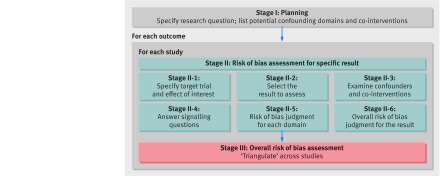
The authors developed ROBINS-I, a consensus-based tool for assessing risk of bias in non-randomised studies of interventions by comparing each study with a hypothetical pragmatic randomised “target” trial. It assesses seven bias domains using signalling questions and produces domain-level and overall risk-of-bias judgements.
Key findings
- ROBINS-I was developed over three years by expert consensus, with piloting and user feedback, and covers seven distinct bias domains: confounding, selection of participants, classification of interventions, deviations from intended interventions, missing data, measurement of outcomes, and selection of the reported result.
- The tool uses signalling questions with response options “Yes,” “Probably yes,” “Probably no,” “No,” and “No information” to inform domain-level judgements.
- Risk-of-bias judgements are categorised as “Low risk,” “Moderate risk,” “Serious risk,” and “Critical risk”; “Low risk” corresponds to the risk of bias in a high quality randomised trial.
- The authors recommend against including studies assessed as at “Critical risk” of bias in any meta-analysis and advocate caution for studies assessed as at “Serious risk” of bias.
Methods
- Development was largely by expert consensus, following seven principles previously described for assessing risk of bias in clinical trials; a core group coordinated recruitment, documents, and administrative support.
- Development activities included an initial scoping meeting in October 2011, a survey of Cochrane Review Groups in March 2012, a meeting in April 2012 to identify bias domains and working groups, a two-day face-to-face meeting in March 2013, piloting within working groups between September 2013 and March 2014, substantial revisions in June 2014, posting of version 1.0.0 in September 2014, and a three-day workshop in December 2014 where the tool was applied to six papers reporting NRSI.
- The paper describes the tool and its conceptual basis rather than reporting a quantitative validation study; no statistical analysis of reliability or validity is presented.
Limitations
- The paper states that the technical difficulty in making risk of bias judgements is expected to limit reliability, despite explicit links between signalling questions and judgements.
- The paper states that ROBINS-I focuses specifically on bias and does not address problems related to imprecision of results, such as when statistical analyses fail to account for clustering or matching of participants.
- The paper states that use of ROBINS-I requires review groups to include members with substantial methodological expertise and familiarity with modern epidemiological thinking; it also notes planned future consideration of specific NRSI types such as self-controlled designs, controlled before-and-after studies, interrupted time series, regression discontinuity, and instrumental variable analyses.
Model-written summary. Check it against the paper before relying on it.
Integrity signals
Registry
Cites
Statistics
Figures
Verification
Claims the paper makes
0 Valid · 0 Not valid · 8 Not checked · 21 Own results and interpretations
What the paper did — it cites no source for this, so there is none to check. The quote shows it is in the paper.
In the paper
“The tool views each study as an attempt to emulate (mimic) a hypothetical pragmatic randomised trial, and covers seven distinct domains through which bias might be introduced”
- Also stated in: § Domains of bias · plain
“We achieved consensus on seven domains through which bias might be introduced into a NRSI (see table 1 and appendix in supplementary data).”
§ ROBINS-I: a tool for assessing risk of bias in non-randomised studies of interventions > Summary points
plain- Asserted: passes — The authors put it forward as true.
- Checkable: passes — It can be checked against evidence.
- Load-bearing: passes — The paper’s conclusions depend on it.
- Based: passes — The paper gives a reason why it holds.
- Also stated in: § Domains of bias · plain
A conclusion the paper draws from its own results — it cites no other source for it, so there is none to check. The quote shows it is in the paper.
In the paper
“Therefore, there is substantial overlap for the last four domains between bias assessments in NRSI and randomised trials.”
§ ROBINS-I: a tool for assessing risk of bias in non-randomised studies of interventions > Methodological issues in assessing risk of bias in non-randomised studies > Domains of bias
plainstates an association- Asserted: passes — The authors put it forward as true.
- Checkable: passes — It can be checked against evidence.
- Load-bearing: unclear — It is unclear whether the paper’s conclusions depend on it.
- Based: passes — The paper gives a reason why it holds.
- Rests on 2 assumptions not shown here.
In the paper
“The tool views each study as an attempt to emulate (mimic) a hypothetical pragmatic randomised trial, and covers seven distinct domains through which bias might be introduced”
- Also stated in: § The target trial · plain
“Evaluations of risk of bias in the results of NRSI are facilitated by considering each NRSI as an attempt to emulate (mimic) a “target” trial.”
§ ROBINS-I: a tool for assessing risk of bias in non-randomised studies of interventions > Summary points
What the sources say
- Not matchedcites 11 12
This doesn’t read as a citation we can look up.
plain- Asserted: passes — The authors put it forward as true.
- Checkable: passes — It can be checked against evidence.
- Load-bearing: passes — The paper’s conclusions depend on it.
- Based: passes — The paper gives a reason why it holds.
- Also stated in: § The target trial · plain
In the paper
“We developed a tool for assessing risk of bias in the results of non-randomised studies of interventions that addresses weaknesses in previously available approaches.4”
§ ROBINS-I: a tool for assessing risk of bias in non-randomised studies of interventions > Discussion
What the sources say
- Not matchedcites [4] Sanderson S, Tatt ID, Higgins JPT. Tools for assessing quality and susceptibility to bias in observational studies in epidemiology: a systematic review and annotated bibliography. Int J Epidemiol 2007; 36: 666- 76. 10.1093/ije/dym018 pmid:17470488. 17470488
We don’t have this paper’s reference list.
plainstates a cause- Asserted: passes — The authors put it forward as true.
- Checkable: passes — It can be checked against evidence.
- Load-bearing: passes — The paper’s conclusions depend on it.
- Based: passes — The paper gives a reason why it holds.
- Not matched
A statement the paper makes itself — it cites no source for it, so there is none to check. The quote shows it is in the paper.
In the paper
“By contrast, unbiased estimation of the effect of starting and adhering to intervention requires consideration of both adherence and differences in additional interventions (“co-interventions”) between intervention groups.”
§ ROBINS-I: a tool for assessing risk of bias in non-randomised studies of interventions > Methodological issues in assessing risk of bias in non-randomised studies > The effect of interest
plain- Asserted: passes — The authors put it forward as true.
- Checkable: passes — It can be checked against evidence.
- Load-bearing: passes — The paper’s conclusions depend on it.
- Based: passes — The paper gives a reason why it holds.
9 more claims
Create a free account to see all 29 claims and every source verdict.
- Probably not a substantial claim. 14
- It may state two separate claims as one. 4
Claims other papers make about this one
Each is checked against this paper’s own text: does it say what the citing paper says it does?
The cited source doesn’t support the claim as written.
In the citing paper
“Quality assessment of RCTs was performed using the Cochrane Collaboration’s tool for assessing risk of bias in randomized trials (RoB-2) by two independent authors (M.A.C.C.A. and M.S.) [14].”
From Efficacy and safety of obicetrapib in patients with dyslipidemia: An updated meta-analysis of randomized controlled trials (2025) · cites this paper as [14]
Checked by a reasoning model — may be wrong.
Experimental — accuracy not yet measuredThe source backs part of the claim, not all of it — or backs it for a different population, condition or comparison.
In the citing paper
“we excluded studies rated to be at critical risk of bias (n = 19) from all of our analyses and figures, except for Fig. 2a”
From A systematic review and meta-analysis of the evidence on learning during the COVID-19 pandemic (2023) · cites this paper as [9]
Experimental — accuracy not yet measuredThe source backs part of the claim, not all of it — or backs it for a different population, condition or comparison.
In the citing paper
“When assessing the risk of bias, seven general principles are relevant, based on theoretical considerations, empirical work, and the experience with assessing risk of bias in RCTs and other studies [55–57].”
From COSMOS-E: Guidance on conducting systematic reviews and meta-analyses of observational studies of etiology (2019) · cites this paper as [56]
Experimental — accuracy not yet measuredThe source backs part of the claim, not all of it — or backs it for a different population, condition or comparison.
In the citing paper
“Relevant domains of risk of bias that should be considered include (i) bias due to (time-dependent) confounding, (ii) bias in selection of participants into the study (selection bias), (iii) bias in measurement of exposures or outcomes (information bias), (iv) bias due to missing data (selection bias), and (v) bias in selection of studies or reported outcomes (selection bias) [56].”
From COSMOS-E: Guidance on conducting systematic reviews and meta-analyses of observational studies of etiology (2019) · cites this paper as [56]
Experimental — accuracy not yet measuredThe source backs part of the claim, not all of it — or backs it for a different population, condition or comparison.
In the citing paper
“A modified Cochrane Collaboration's Risk of Bias in Non-Randomized Studies of Interventions was used to evaluate the risk of bias in selected studies as low, moderate, serious, and critical based on 6 domains (Table 3) (29,30).”
From Alterations in Heart Rate Variability Associated With Irritable Bowel Syndrome or Inflammatory Bowel Disease: A Systematic Review and Meta-Analysis (2021) · cites this paper as [29]
Experimental — accuracy not yet measured
64 more claims about this paper
Create a free account to see every claim other papers make about this one.
Citations
Cites
Yaşlı Kadınlarda Üreme Sağlığı
Kokanalı, D., & Engin Üstün, Y. (n.d.) · DergiPark (Istanbul University) · Cited by 170,090
The Cochrane Collaboration's tool for assessing risk of bias in randomised trials
Higgins, J. P. T., Altman, D. G., Gotzsche, P. C., Juni, P., Moher, D., Oxman, A. D., Savovic, J., Schulz, K. F., Weeks, L., Sterne, J. A. C., et al. (2011) · BMJ · doi:10.1136/bmj.d5928 · Cited by 33,817
Self-citationDermyshi, E., Wang, Y., Yan, C., Hong, W., Qiu, G., Gong, X., & Zhang, T. (2017) · Neonatology · doi:10.1159/000454668 · Cited by 24,451
Two new Later Stone Age sites from the Final Pleistocene in the Falémé Valley, eastern Senegal
Ndiaye, M., Lespez, L., Tribolo, C., Rassé, M., Hadjas, I., Davidoux, S., Huysecom, É., & Douze, K. (2024) · Monash University Research Portal (Monash University) · doi:10.3929/ethz-b-000667478 · Cited by 23,868
(2014) · Medical Entomology and Zoology · Cited by 17,633
Self-citationQUADAS-2: a revised tool for the quality assessment of diagnostic accuracy studies
Whiting, P. F., Rutjes, A. W. S., Westwood, M. E., Mallett, S., Deeks, J. J., Reitsma, J. B., Leeflang, M. M. G., Sterne, J. A. C., Bossuyt, P. M. M., & the QUADAS-2 Group* (2011) · Annals of Internal Medicine · doi:10.7326/0003-4819-155-8-201110180-00009 · Cited by 14,199
Self-citationDowns, S. H., & Black, N. (1998) · Journal of Epidemiology and Community Health · doi:10.1136/jech.52.6.377 · Cited by 8,252
Using Big Data to Emulate a Target Trial When a Randomized Trial Is Not Available: Table 1.
Hernán, M. A., & Robins, J. M. (2016) · American Journal of Epidemiology · doi:10.1093/aje/kwv254 · Cited by 3,115 · cited 1×
“11 12 Such a “target” trial need not be feasible or ethical: for example, it could compare individuals who were and were not assigned to start smoking.”
BackgroundSelf-citationGRADE guidelines: a new series of articles in the Journal of Clinical Epidemiology
Guyatt, G. H., Oxman, A. D., Schünemann, H. J., Tugwell, P., & Knottnerus, A. (2011) · Journal of Clinical Epidemiology · doi:10.1016/j.jclinepi.2010.09.011 · Cited by 3,094
Self-citationEvaluating non-randomised intervention studies
Deeks, J., Dinnes, J., D'Amico, R., Sowden, A., Sakarovitch, C., Song, F., Petticrew, M., & Altman, D. (2003) · Health Technology Assessment · doi:10.3310/hta7270 · Cited by 2,907
Self-citation
Cited by
Items 19,201–19,300 of 19,837
Cueva-Cañola, L. E., Fuente, A. C. B.-D. L., Navarro, D. I. R., et al. (2026) · Medicina Clínica · doi:10.1016/j.medcli.2026.107545
Chang, H.-J., Chen, K., Sun, C., et al. (2026) · Journal of Reconstructive Microsurgery · doi:10.1055/a-2943-3724
Hydrotherapy for Overweight and Obesity: A Systematic Review of Anthropometric and Lipid Outcomes
Mohanakrishnan, B., Barakoti, A., Prasad, A., Arora, R., Narayanan, R., & Adhikary, A. D. (2026) · Cureus · doi:10.7759/cureus.115048
“Risk Of Bias In Non-randomized Studies-of Interventions (ROBINS-I) was used to assess non-randomized comparative intervention studies [15], and Joanna Briggs Institute critical appraisal criteria were used for pre-post intervention studies [16].”
Catao, M., Mamede, I., Filho, R. B. S., Carvalhal, G., Arêa, L., & Pinto, M. (2026) · Journal of Diabetes and its Complications · doi:10.1016/j.jdiacomp.2026.109393 · Cited by 1
Yu, X., Wang, S., Lin, K., & Guan, J. (2026) · European Spine Journal · doi:10.1007/s00586-026-10293-9
Seok, H.-G., Park, J.-J., & Park, S. (2026) · Arthroscopy The Journal of Arthroscopic and Related Surgery · doi:10.1002/arj.70463
Agentic Intelligent Systems for Personalized Adaptive Learning: A Systematic Review
ACHENGLI, R., Gouraguine, S., Salhi, I., Riad, M., & Qbadou, M. (2026) · International Conference on Circuit, Systems and Communication (ICCSC) · doi:10.1109/iccsc71566.2026.11650570
“…from intended interventions, missing outcome data, outcome measurement, and selective reporting; (ii) for non-randomized studies, ROBINS-I [19] evaluating confounding, participant selection, classification of interventions, deviations, missing data, measurement of outcomes, and selective…”
Diet and risk of bladder cancer: a systematic review of epidemiological evidence
Miyajima, K., Miszczyk, M., Roessler, N., et al. (2026) · British Journal of Urology · doi:10.1111/bju.70435
Chen, Y., Zhang, B., Zhang, J., Wong, S. H.-S., & Poon, E. T. (2026) · Journal of sport and health science/Journal of Sport and Health Science · doi:10.1016/j.jshs.2026.101168
Quality of Life in Autism: A Systematic Review and Meta‐Analysis of Patients and Caregivers
Grokoski, K. C., Duarte, C. K., Silva, E. D. S., Hoffmann, L. V., Borchardt, J. L., Costa, L. P., Luçardo, J. D. C., Lapschies, M., Cascaes, A. M., Vilela, A. A. F., et al. (2026) · Autism Research · doi:10.1002/aur.70348
Sleep deprivation as a modulator of thyroid function: a systematic review and meta-analysis
Jain, S. P., Santoso, L. F. A. S., Ikkurthy, N., Jain, S. P., & Silven, G. (2026) · Journal of Endocrinological Investigation · doi:10.1007/s40618-026-03029-5
Rizwan, Z. M., Brown, D., Barry, S. E., Guppy, K. H., Gerberi, D., Gajic, O., & Herasevich, S. (2026) · Pharmacotherapy The Journal of Human Pharmacology and Drug Therapy · doi:10.1002/phar.70197 · Cited by 2
Thamrongskulsiri, N., Moews, L. D., Morgan, J. T., et al. (2026) · Arthroscopy The Journal of Arthroscopic and Related Surgery · doi:10.1002/arj.70451
Gebiru, A. M., Gebeyehu, S. B., Mamaye, Y., et al. (2026) · doi:10.2196/preprints.107916
Gonzalez, A., Paz, H. D. M. D. L., Cuevas, P. A. C., et al. (2026) · Cureus · doi:10.7759/cureus.115109
Effectiveness of aligners to correct vertical malocclusions in adult patients
Mohimd, H. B., Neani, H., Zaoui, F., et al. (2026) · Journal of Orofacial Orthopedics / Fortschritte der Kieferorthopädie · doi:10.1007/s00056-026-00687-1
Putri, A. M. R. Y., & Mariana, N. (2026) · Pediatric Surgery International · doi:10.1007/s00383-026-06571-8
Vega-Fernández, G., Valenzuela‐Fuenzalida, J. J., Jeria-Pizarro, Y., Oyanedel-Amaro, G., Orellana-Donoso, M., Cifuentes-Suazo, G., Cabezas-Salgado, J. J., Blackwood-Espinoza, C., León-Rojas, J. E., Sanchis‐Gimeno, J. A., et al. (2026) · Children · doi:10.3390/children13091134 · Cited by 3
Effects of AI-Supported Education on Academic Achievement : A Meta-Analysis
Kwak, S.-H., & Gyun, H. E. O. (2026) · Journal of Fisheries and Marine Sciences Education · doi:10.13000/jfmse.2026.8.38.4.686
Roessler, N., Vetterlein, M. W., Ludwig, T. A., Dahlem, R., Fisch, P. M., & Janisch, F. (2026) · The Journal of Sexual Medicine · doi:10.1093/jsxmed/qdag261 · Cited by 1
de Amorim, S. O., Ferreira, M. D. S., Soares, C., Pereira, F. H. L., da Silva, N. F. C., do Nascimento, L. R., Neto, J. A., AlQudah, A., de Sousa, J. R., & Honorato, M. M. (2026) · Neurological Sciences · doi:10.1007/s10072-026-09236-5
“I) tool for observational studies [21].”
Gou, X., Zhu, J., Feng, X., Li, D., Gao, Q., & Ruan, B. (2026) · Frontiers in Medicine · doi:10.3389/fmed.2026.1938860
“Randomized controlled trials were evaluated using the Cochrane Risk of Bias 2 (RoB 2) tool, covering bias arising from the randomization process, deviations from intended interventions, missing outcome data, measurement of the outcome, and selection of the reported result (41) (42).”
Cardoso, J. H. C. O., de Vasconcelos, C. A. M., Caldas, G. D. C., et al. (2026) · Hernia · doi:10.1007/s10029-026-03833-1
Wang, Y., Qu, H., Zhou, X., Li, J., & Zhang, Z. (2026) · Critical Reviews in Oncology/Hematology · doi:10.1016/j.critrevonc.2026.105565
Majambu, N. B., Lukovi, M. M., MONGA, M. S., Basosila, N., MASENGO, C. A., Iteku, J. B., Masens, D. M. Y., Mudogo, V., MPIANA, P. T., & Ngbolua, J.-P. K.-T.-N. (2026) · REVUE DES SCIENCES DE LA SANTE · doi:10.71004/rss.026.v5.i2.130
Sadek, K., Alizada, A., Al-Burak, S. A., et al. (2026) · AJO International · doi:10.1016/j.ajoint.2026.100304
Wang, L., Chen, J., & Talib, O. (2026) · Home Health Care Management & Practice · doi:10.1177/10848223261478584
Patel, R., Kokori, E., Trivedi, K., et al. (2026) · Current Problems in Cardiology · doi:10.1016/j.cpcardiol.2026.103429
Pereira, B. M. D. S., Alencar, V. B., Azi, L. M. T. D. A., Kraychete, D. C., & Alves, R. L. (2026) · Revista Brasileira Ginecologia e Obstetrícia · doi:10.61622/rbgo/2026rbgo49
Vennam, K., Ji, E., & Sharma, A. K. (2026) · CardioVascular and Interventional Radiology · doi:10.1007/s00270-026-04587-0
Vidal-Valderrama, C., Pérez, R. A., Davalos, R. A. M., et al. (2026) · Research Square · doi:10.21203/rs.3.rs-10745425/v1
Stamati, A., Sotiriou, G., Emmanouilidou-Fotoulaki, E., Printza, N. G., Maria, K., & Christoforidis, A. (2026) · Diabetes/Metabolism Research and Reviews · doi:10.1002/dmrr.70220
“I V2 tool was used to assess risk of bias across six domains, including confounding, participant selection, classification of exposures, missing data, measurement of outcomes and selection of the reported result [16, 17].”
Lino, G. M., Galvão, P. V. M., Luna, V. L. M., & Conrado, G. A. M. (2026) · Revista Brasileira Ginecologia e Obstetrícia · doi:10.61622/rbgo/2026rbgo45
Eryadana, A. R., Nugroho, E. A., Ibrahim, M. K. T., et al. (2026) · OBM Transplantation · doi:10.21926/obm.transplant.2603274
Liu, C., Hu, T., Wu, X., et al. (2026) · Journal of Neurology · doi:10.1007/s00415-026-14075-7
“[23] Treatment decision studies were assessed with a ROBINS-I-informed framework focused on confounding by indication, selection, treatment classification, crossover, rescue therapy, missing data, and outcome measurement [24].”
Hemavathi, R., Ozukum, S. T., Smita, T., Londhe, S. R., Rathore, M. I., Vedavathi, N., Koley, T., Beaulah Mercy Mary, T., Balamurugan, E., Sowmiya, V., et al. (2026) · International Journal of Contemporary Pediatrics · doi:10.18203/2349-3291.ijcp20262973
Torzsa, T., Cseh, R., Futó, J., & Balázs, J. (2026) · Frontiers in Sports and Active Living · doi:10.3389/fspor.2026.1840595
“Pre-post studies without a control group were assessed using the ROBINS-I tool (37), which evaluates bias across domains including confounding, selection of participants, classification of interventions, deviations from intended interventions, measurement of outcomes, and selection of reported…”
Kaushik, V., Haider, D. A., Jain, D. P., et al. (2026) · PAIN JOINTS SPINE · doi:10.1922/pjs.16.7s.2026.1134
Li, Y., Xie, R., Lei, L., li, Y., liu, Q., zhang, H., & Sun, X. (2026) · Research Square · doi:10.21203/rs.3.rs-10584098/v1
Boutros, M., Awad, G., Asmar, C., et al. (2026) · Journal of the American Academy of Orthopaedic Surgeons · doi:10.5435/jaaos-d-25-01514
Kasicki, K., Błażejewski, G., Rydzik, Ł., Wróbel, P., Nowak, M., & Ambroży, T. (2026) · Journal of Clinical Medicine · doi:10.3390/jcm15176588 · Cited by 1
“The Risk Of Bias In Non-randomised Studies of Interventions (ROBINS-I), version 2 [15], was used; it analyses six domains: confounding, classification of interventions, selection of participants, missing data, measurement of outcomes and selection of the reported result.”
Hickson, S., Atinga, A., Mustapha, A., Shettima, A., Abdulrahim, A., & Eze, U. A. (2026) · Frontiers in Microbiology · doi:10.3389/fmicb.2026.1878395
Makwarela, T. G., Seoraj-Pillai, N., & Nangammbi, T. C. (2026) · Veterinary Research Communications · doi:10.1007/s11259-026-11475-y · Cited by 1
“…for case series/reports; QUADAS-2 for diag - nostic test accuracy studies (Whiting et al. 2011); RoB 2 for randomised trials; ROBINS-I for non-randomised intervention studies (Sterne et al. 2016); SYRCLE for animal experiments; and PROBAST for prediction modelling studies (Wolff et al. 2019).”
Buitrago, J. A. R., Tobón, N. C., Mesa, E. E. P., & Suárez, C. A. R. (2026) · European Spine Journal · doi:10.1007/s00586-026-10257-z
Hou, T., Yin, X., & Lu, K. (2026) · Frontiers in Bioengineering and Biotechnology · doi:10.3389/fbioe.2026.1915266
“Non-randomized comparative studies were assessed using the Risk Of Bias In Non-randomized Studies of Interventions (ROBINS-I) tool (Sterne et al., 2016).”
Sirilertmekasakul, C., Jindasakchai, P., Sorasuchart, S., et al. (2026) · Frontiers in Medicine · doi:10.3389/fmed.2026.1857125
“The overall risk of bias is rated as “low,” “moderate,” “serious,” or “critical” (14).”
InfluentialFocal Muscle Vibration for Upper Limb Spasticity After Stroke: A Systematic Review and Meta-Analysis
Yang, M., Zhou, D., Wu, F., Li, Y., & Meng, D. (2026) · Archives of Physical Medicine and Rehabilitation · doi:10.1016/j.apmr.2026.08.011
Bach, C., Schiebel, C. S., Braga, L. L. V. D. M., Fernandes, A. C. V. U., Avancini, M., Fernandes, G. F., Zaleski, J., D'Agostin, J. B., & Ferreira, D. M. (2026) · Frontiers in Pharmacology · doi:10.3389/fphar.2026.1810632 · Cited by 1
Megantara, H. P., Anjanie, N., & Soelistyaningroem, J. (2026) · Lipids · doi:10.1002/lipd.70082
Samanta, D., Ramani, P. K., Abel, T. J., & Albert, G. W. (2026) · Epilepsy Research · doi:10.1016/j.eplepsyres.2026.107902 · Cited by 1
PPV23 Vaccination and Risk of Cardiovascular Events
Pinilla, J., Coy, Z., Baral, B., de Lucena, L. A., Samad, N. S., Khairallah, T. T., Dandamudi, M., Howick, J. F., Vergara‐Sanchez, C., & Gharacholou, S. M. (2026) · JACC Advances · doi:10.1016/j.jacadv.2026.103134
Park, J., Ghazanfar, Z., Ali, S. G., et al. (2026) · Sensors · doi:10.3390/s26175381
“…intervention and quasi-experimental studies were assessed using the Risk Of Bias In Non-randomized Studies of Interventions (ROBINS-I) tool [32], covering confounding, participant selection, intervention classification, deviations from intended interventions, missing data, outcome…”
Douillard, T., Hennèquin, M., Nicolas, E., & Osta, N. E. (2026) · Journal of Oral Rehabilitation · doi:10.1111/joor.70295
Shankar, R., Devi, F., Qian, X., & Lim, A. (2026) · Campbell Systematic Reviews · doi:10.1177/18911803261482112
Wu, Z.-J., Long, J.-X., Wang, B., & Yang, Z.-L. (2026) · Pediatric Surgery International · doi:10.1007/s00383-026-06602-4
Li, L., Zhao, Z., Li, X., & Yi, Y. (2026) · BMC Sports Science Medicine and Rehabilitation · doi:10.1186/s13102-026-01888-2
“…In Non-randomised Studies of Interventions tool (ROBINS-I V2), which evaluates bias across six domains: confounding, classification of interventions, selection of participants into the study (or into the analysis), missing data, measurement of outcomes, and selection of the reported result [36].”
The effect of the respiratory rate on mechanical power and patient outcomes – a systematic review
Geerts, J., Bosman, B., Papenhuijzen, M. H. G., Ferreira, J. C., van Meenen, D. V., Paulus, F., Schultz, M. J., Sodhi, K., Urlings-Strop, L., & Buiteman-Kruizinga, L. (2026) · Expert Review of Respiratory Medicine · doi:10.1080/17476348.2026.2724585 · Cited by 1
Azevedo, M. F. D., Brito, P. H. S., Kallas-Silva, L., et al. (2026) · Journal of Surgical Oncology · doi:10.1002/jso.70334
Butt, A. B., Bilgasem, A., Huang, R. S., et al. (2026) · Neuro-Ophthalmology · doi:10.1080/01658107.2026.2709778
Mangkuliguna, G., HANDISURYA, I. W. A., & Adrianto, N. (2026) · Annals of Pediatric Endocrinology & Metabolism · doi:10.6065/apem.2550364.182
“The methodological quality of included studies was assessed using the ROBINS-I (Risk of Bias in Non-rando-mized Studies of Interventions) tool [18].”
Psychological interventions for death anxiety and distress: Systematic review and meta-analysis
Yazd, S. A. R. (2026) · Death Studies · doi:10.1080/07481187.2026.2724107
He, D., Lv, D., Tang, J., Liao, X., Mao, P., & Tian, Z. (2026) · Frontiers in Cardiovascular Medicine · doi:10.3389/fcvm.2026.1868320
Nejad, A. S., Keyhani, S., Soleymanha, M., et al. (2026) · Journal of Experimental Orthopaedics · doi:10.1002/jeo2.70854
Jang, J., Zheng, D., Nold, T. M., et al. (2026) · Blood Vessels Thrombosis & Hemostasis · doi:10.1016/j.bvth.2026.100206
Rakab, M. S., Alzahrani, Y. M. S., Alotaibi, A. M., et al. (2026) · Clinical Otolaryngology · doi:10.1111/coa.70155
Albazee, E., Alasade, A. A., Alnajdi, S., Almutairi, F., Almutairi, Y., Alenezi, K., Alkandari, H., & Taleb, A. H. (2026) · Ear Nose & Throat Journal · doi:10.1177/01455613261484203
Alzahrani, M., Alabbasi, A. A., & Alzahrani, Z. (2026) · Journal of Palliative Medicine · doi:10.1177/10966218261455971
Desai, M. G., Candiotti, K., Pinkhasov, A., Hunter, R. B., Chopra, H., Gorski, L., & Shenoy, S. (2026) · Drug Delivery · doi:10.1080/10717544.2026.2719057
“…risk-of-bias tool for randomised trials (RoB 2), (Sterne et al. 2019) the Risk Of Bias In Non-randomised Studies - of Interventions (ROBINS-I) (Sterne et al. 2016) tool for non-randomised interventional studies, the Newcastle-Ottawa Scale (NOS) (Wells et al. 2013) for cohort and case-control…”
Syam, H. H., Bayuaji, H., Tjahyadi, D., et al. (2026) · Gynecologic and Obstetric Investigation · doi:10.1159/goi/aczag007
Herner, A., Nennstiel, S., Schlag, C., Kremer, A. E., Biedermann, L., Rogler, G., & Doulberis, M. (2026) · Journal of Clinical Medicine · doi:10.3390/jcm15176633
“Risk of bias was assessed with the Risk Of Bias In Non-randomised Studies of Interventions (ROBINS-I) tool for non-randomised studies and the Risk of Bias 2 (RoB 2) tool for randomised trials [25,26].”
Ensuring trustworthy AI assisted guideline development for clinical practice
Zhang, Q., & Fu, Y. (2026) · npj Digital Medicine · doi:10.1038/s41746-026-03098-z
Abaszadeh, F., Boldaji, M. R., AMIRZADEH, S., Hayat, A. A., Zare, S., & Mottahedi, M. (2026) · Discover Education · doi:10.1007/s44217-026-02080-x · Cited by 2
“…quality and risk of bias of each included study were independently assessed by two reviewers (R1, R2) using the Revised Cochrane Risk of Bias tool for randomized trials (RoB 2) [30] and the Risk of Bias In Non-randomized Studies - of Interventions (ROBINS-I) tool [31] for non-randomized designs.”
Implications of Mobile Applications for Breast Surgery: A Systematic Review
Duah-Asante, K. A., Sivakanthan, T., Oledajo, I., Balogun, A., Arif, T., Mehta, S., & Kankam, H. K. N. (2026) · Clinical Breast Cancer · doi:10.1016/j.clbc.2026.08.019
Ahmed, A., Gonçalves, O. R., Łajczak, P., et al. (2026) · Medicine · doi:10.1097/md.0000000000050462
“Risk of bias in non-randomized studies was evaluated using the ROBINS-I tool, [13] which assesses bias arising from confounding, participant selection, classification of interventions, deviation from intended interventions, missing outcome data, outcome measurement, and selective outcome reporting.”
Giani, M., Tucci, C., Manzi, V., Campatelli, C., Vannuccini, S., & Petraglia, F. (2026) · Expert Opinion on Pharmacotherapy · doi:10.1080/14656566.2026.2726518
Tenaya, W. J., Nugraha, M., Susanto, J. V., Liu, A. F., Wijaya, S. R., & Pramono, L. A. (2026) · Journal of the ASEAN Federation of Endocrine Societies · doi:10.15605/jafes.041.02.6237
A Systematic Review of Malyugin Rings in Cataract Surgery: Surgical Outcomes, Efficacy and Safety
Al-Burak, S. A., Butt, F., Wang, J. B., et al. (2026) · The Open Ophthalmology Journal · doi:10.2174/0118743641513562260825080417
Abhishek, A., Carroll, C., Essat, M., Leaviss, J., Nakafero, G., Fuller, A., Grainge, M. J., Hancox, J. E., Williams, H. C., Card, T. R., et al. (2026) · Health Technology Assessment · doi:10.3310/plrf8845
Alkuwaiti, M. A., Al-Harbi, F. A., Alkuwaiti, F. A., Alsaif, A. K., & Ashraf, H. (2026) · American Journal of Therapeutics · doi:10.1097/mjt.0000000000002213
Revisiting the Incidence and Risk Factors for Cervical Postlaminectomy Kyphosis: A Systematic Review
Hirase, T., Rowan, C., Jacob, T., Sadlowski, M., Vemu, S. M., Nguyen, A. Q., Kazarian, G. S., DiSilvestro, K. J., Marco, R. A. W., Albert, T. J., et al. (2026) · Clinical Spine Surgery A Spine Publication · doi:10.1097/bsd.0000000000002146
Guan, Y., Xu, J., Liu, Z., Qin, Q., Wang, X., An, C., Wang, G., Zhang, Z., Gong, M., & Bin, Z. (2026) · Journal of Medical Internet Research · doi:10.2196/91461 · Cited by 2
“For nonrandomized studies, the Risk of Bias in Nonrandomized Studies of Interventions (ROB-INS-I) tool [29] was used to assess 7 domains, including confounding, participant selection, classification of interventions, deviation from the intended intervention, missing data, outcome measurement, and…”
Yang, L., Tang, M., Chen, W., et al. (2026) · Medicine · doi:10.1097/md.0000000000050532
Hamza, M., Shah, S. O. O., Saqib, H. W., et al. (2026) · The Cardiothoracic Surgeon · doi:10.1186/s43057-026-00218-z
“…quality of the included observational studies was assessed using Cochrane’s ROBINs-I tool, based on seven domains: confounding, participant selection, classification of interventions, deviations from intended interventions, missing data, outcome measurements and selective reporting of results [11].”
Shehzad, M. M., Mustehsan, M. A., Tariq, U., Ali, H., Anas, M., & Shehzad, I. (2026) · Nefrología · doi:10.1016/j.nefro.2026.501643
Transcatheter Atrial Shunting in Patients With Heart Failure: A Systematic Review and Meta-Analysis
Pyrpyris, N., Dimitriadis, K. P., Beneki, E., Dris, E., Iliakis, P., Papanikolaou, A., Klettas, D., Antonopoulos, A., Farmakis, D. T., Aznaouridis, K. A., et al. (2026) · Cardiology in Review · doi:10.1097/crd.0000000000001444
Hobson, D., Meriwether, K. V., Pincus, J. B., DiCarlo-Meacham, A. M., Welch, E. K., Balk, E. M., Miranne, J. M., Lipetskaia, L., Halder, G. E., Parker‐Autry, C., et al. (2026) · Journal of Minimally Invasive Gynecology · doi:10.1016/j.jmig.2026.08.022
Donnermeyer, D., Ingold, O., Meyer‐Lueckel, H., Wolf, T. G., Wierichs, R. J., & Husain, N. A.-H. (2026) · Journal of Dentistry · doi:10.1016/j.jdent.2026.107002 · Cited by 1
Marupanthorn, K., Wattanakul, W., Sringarm, K., et al. (2026) · Veterinary World · doi:10.14202/vetworld.2026.3683-3700
“Table 4 reports the studies that directly contribute to the quantitative synthesis, while the supplementary ROBINS-I summary reports the broader qualitative evidence base [18, 19].”
Straum, O. K., Brox, H. T., Hesse, J., Schmalfuss, A., & Bugge, E. (2026) · European Journal Of Oral Sciences · doi:10.1111/eos.70136
Chua, K. R., Ghotmi, M., Vankayalapati, D. K., et al. (2026) · Australasian Journal of Dermatology · doi:10.1111/ajd.70203
Jiang, H., Zhou, Y., Zheng, P., et al. (2026) · Cell investigation. · doi:10.1016/j.clnves.2026.100091
Retinal Microvascular Effects of Internal Limiting Membrane Peeling: A Meta-Analysis
Chontos, T., Arsoudi, V., Kandarakis, S., Voutsas, S., Petrou, P., Vakalopoulos, D. G., Tsagkogiannis, V. A., Tyrlis, K., Kottaridou, E. E., Zisis, V., et al. (2026) · Seminars in Ophthalmology · doi:10.1080/08820538.2026.2724322
TEO, C. Y. Q., NG, S., Lee, C. K. J., & Yong, C. W. (2026) · Journal of Stomatology Oral and Maxillofacial Surgery · doi:10.1016/j.jormas.2026.102968
Wiernik, A., Alfonso, J. C. M., Garnier, H., et al. (2026) · European Journal of Pediatric Surgery · doi:10.1055/a-2947-1085
Gijsen, C. E. W., Mottaghy, F. M., Tawakol, A. A., Wildberger, J. E., & Bucerius, J. A. (2026) · EJNMMI Research · doi:10.1186/s13550-026-01489-7
“The open-label non-randomized studies were assessed using the Risk Of Bias In Non-Randomized Studies or Interventions (ROBINS-I) [28].”
Ghannam, M., Abomohsen, M., Idries, I. Y., et al. (2026) · Research Square · doi:10.21203/rs.3.rs-10372219/v1
Suruagy-Motta, R. F. O., Calheiros, C. D. O. S., Silva, J. A., Borges, M. C. M., Freitas, D. E. S., Vieira, L. L. P., Aguiar-Barros, A. B. P., Firmino, M. M. R., de Moraes, S. R. R., Filho, A. A. M. R., et al. (2026) · Cardiovascular revascularization medicine · doi:10.1016/j.carrev.2026.08.020
Shivanesh, D. S. K., Sridhar, P. D. J., Dhinesh Kumar, M., et al. (2026) · PAIN JOINTS SPINE · doi:10.1922/pjs.16.5s.2026.762
“For comparative cohort studies, ROBINS-I was used alongside the Newcastle-Ottawa Scale [26,27].”
Merdin, Z. M., & Bulut, H. (2026) · Journal of Gazi University Health Sciences Institute · doi:10.59124/guhes.1972332
Simulation‐Based Education in Traumatic Dental Injuries: A Systematic Review
Prud’homme, T., Bouillaud, I., Boëffard, C., Gaudin, A., & Clouet, R. (2026) · Dental Traumatology · doi:10.1111/edt.70124
Metadata
- Authors
- Sterne, J. A., Hernán, M. A., Reeves, B. C., Savović, J., Berkman, N. D., Viswanathan, M., Henry, D., Altman, D. G., Ansari, M. T., Boutron, I., Carpenter, J. R., Chan, A.-W., Churchill, R., Deeks, J. J., Hróbjartsson, A., Kirkham, J., Jüni, P., Loke, Y. K., Pigott, T. D., Ramsay, C. R., Regidor, D., Rothstein, H. R., Sandhu, L., Santaguida, P. L., Schünemann, H. J., Shea, B., Shrier, I., Tugwell, P., Turner, L., Valentine, J. C., Waddington, H., Waters, E., Wells, G. A., Whiting, P. F., & Higgins, J. P.
- Affiliations
- University of Bristol (GB)
- University Hospitals Bristol NHS Foundation Trust (GB)
- RTI International (US)
- University of Toronto (CA)
- University of Oxford (GB)
- University of Ottawa (CA)
- Inserm (FR)
- London School of Hygiene & Tropical Medicine (GB)
- University of York (GB)
- University of Birmingham (GB)
- University of Southern Denmark (DK)
- University of Liverpool (GB)
- St. Michael's Hospital (CA)
- University of East Anglia (GB)
- Loyola University Chicago (US)
- University of Aberdeen (GB)
- Kaiser Permanente (US)
- Baruch College (US)
- McMaster University (CA)
- Cochrane Canada (CA)
- Jewish General Hospital (CA)
- Ottawa Hospital Research Institute (CA)
- University of Louisville (US)
- London International Development Centre (GB)
- The University of Melbourne (AU)
- Ottawa Heart Institute (CA)
- Corresponding author
- Sterne, Jonathan AC
- ORCID
- Sterne, Jonathan AC
- Reeves, Barnaby C
- Savović, Jelena
- Berkman, Nancy D
- Viswanathan, Meera
- Henry, David
- Altman, Douglas G
- Boutron, Isabelle
- Carpenter, James R
- Chan, An-Wen
- Churchill, Rachel
- Deeks, Jonathan J
- Hróbjartsson, Asbjørn
- Kirkham, Jamie
- Jüni, Peter
- Loke, Yoon K
- Ramsay, Craig R
- Rothstein, Hannah R
- Santaguida, Pasqualina L
- Schünemann, Holger J
- Shrier, Ian
- Tugwell, Peter
- Valentine, Jeffrey C
- Waddington, Hugh
- Wells, George A
- Whiting, Penny F
- Higgins, Julian PT
- Venue
- BMJ
- Publisher
- BMJ
- Published
- 2016-10-12
- Volume
- 355
- Pages
- i4919
- ISSN
- 1756-1833 (ISSN-L)
- PMC
- PMC5062054
- OpenAlex
- W2531269403
- Cited by
- 20,329
- References
- 26
- Citations by year
- 2026: 3595 · 2025: 3693 · 2024: 3237 · 2023: 2484 · 2022: 2425 · 2021: 2040 · 2020: 1386 · 2019: 771 · 2018: 459 · 2017: 197 · 2016: 15
- FWCI
- 446.93
- Type
- journal article
- Language
- en
- Open access
- hybrid
- doi.org
- Licence
- cc-by-nc
- www.bmj.org/licenses/tdm/1.0/terms-and-conditions.html (tdm)
- Locations
- BMJ (publishedVersion, cc-by-nc)
- Europe PMC (PubMed Central) (publishedVersion, cc-by-nc)
- PubMed Central (publishedVersion, cc-by-nc)
- PubMed (publishedVersion)
- Bristol Research (University of Bristol) (publishedVersion, cc-by-nc)
- University of Southern Denmark Research Portal (University of Southern Denmark) (publishedVersion, cc-by-nc)
- White Rose Research Online (University of Leeds, The University of Sheffield, University of York) (acceptedVersion)
- UEA Digital Repository (University of East Anglia) (acceptedVersion, other-oa)
- LSHTM Research Online (London School of Hygiene and Tropical Medicine) (acceptedVersion)
- Aberdeen University Research Archive (Aberdeen University) (submittedVersion, other-oa)
- CUNY Academic Works (City University of New York) (submittedVersion, cc-by-nc)
- DSpace@MIT (Massachusetts Institute of Technology) (submittedVersion, cc-by-nc)
- eScholarship@McGill (McGill) (submittedVersion, cc-by)
- eScholarship (California Digital Library) (submittedVersion, cc-by)
- HighWire Press Open Archive (submittedVersion)
- Research Explorer (The University of Manchester) (submittedVersion, other-oa)
- Funders
- Cancer Research UK (16895)
- National Institute for Health and Care Research (NF-SI-0611-10168)
- University of Bristol
- National Institutes of Health (CA134294)
- Medical Research Council (MR/M025209/1, MC_UU_12023/21, MR/J004855/1, MC_UU_12023/24)
- National Cancer Institute (P01CA134294, R35CA197449)
- Topics
- Social Sciences › Decision Sciences › Statistics, Probability and Uncertainty › Meta-analysis and systematic reviews
- Physical Sciences › Mathematics › Statistics and Probability › Advanced Causal Inference Techniques
- Physical Sciences › Mathematics › Statistics and Probability › Statistical Methods in Epidemiology
- Keywords
- ROBINS-I, risk of bias assessment, non-randomized studies, observational studies, comparative effectiveness, systematic reviews, allocation bias, confounding, attrition bias, reporting bias, selection bias
- MeSH terms
- Clinical Trials as Topic, Humans, Pilot Projects, Risk, Statistics as Topic, Bias, Confounding Factors, Epidemiologic, Observational Studies as Topic
About these checks
Registry, retraction, Cites and statistics results are computed, not judged, with one exception: a printed reference that no index lists is read once by a model before it counts as a citation error. Claims are extracted by a model and kept only when their quote appears verbatim in the text; each cited source is then checked, with a model’s help, for whether it says what the claim relies on. Those verdicts can be wrong — read the claim’s quote and the cited source before relying on one.
A language model drew the claims from the paper on 2026-09-29, under version 3 of the claim definition (model deepseek-v4.1-flash, prompt extract-v3).
A second model labelled each claim on 2026-09-29 (model jev-1.13-20260917, definition revision gold-guideline-v0.2).
Statistics and arithmetic are recomputed, not judged.
Confidence bands are shown only for fields calibrated on our annotated test set. None is calibrated yet, so no band is shown.
What counts as a claim ›How we measure confidence ›How we check this ›
Are you an author, or do you see a problem with this page? Request a review
Data sources
Bibliographic data: Semantic Scholar, OpenAlex, Crossref.
Contains information from the Semantic Scholar Academic Graph Datasets, made available under the ODC Attribution License (ODC-BY 1.0).
Semantic Scholar’s data is described in: Kinney, R., et al. (2023). The Semantic Scholar Open Data Platform. arXiv:2301.10140.
