

Effects of a multifactorial ecosustainable isocaloric diet on liver fat in patients with type 2 diabetes: randomized clinical trial
Open accessThe DOI matches its Crossref record; 36 of the 37 references it cites were found in a registry or an index.
Abstract
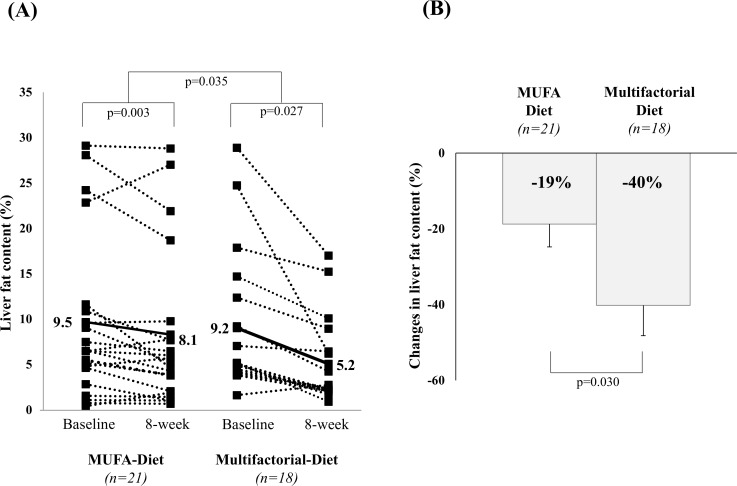
Introduction: Treatment options for non-alcoholic fatty liver disease (NAFLD) in patients with type 2 diabetes (T2D) are still a matter of debate. We compared the effects of a diet including different components versus a proven beneficial diet rich in monounsaturated fatty acids (MUFAs) on liver fat in T2D. Research design and methods: According to a parallel design, 49 individuals with T2D, overweight/obese, with high waist circumference, 35–75 years-old, in satisfactory blood glucose control with diet or drugs not affecting liver fat content, were randomly assigned to an 8-week isocaloric intervention with a MUFA diet (n=26) or a multifactorial diet rich in fiber, MUFA, n-6 and n-3 polyunsaturated fatty acids, polyphenols, and vitamins D, E, and C (n=23). Before and after the intervention, liver fat content was evaluated by proton magnetic resonance spectroscopy (1 H-MRS). 1 H-MRS complete data were available for n=21 (MUFA diet) and n=18 (multifactorial diet) participants. Results: Adherence to dietary interventions was optimal. No significant differences between groups in body weight reduction, plasma glycated hemoglobin, insulin, glucose, lipids and liver enzymes were observed. Liver fat significantly decreased after both the multifactorial diet (9.18%±7.78% vs 5.22%±4.80%, p=0.003) and the MUFA diet (9.47%±8.89% vs 8.07%±8.52%, p=0.027) with a statistically significant difference between changes either in absolute terms (−4.0%±4.5% vs −1.4%±2.7%, p=0.035) or percent (−40%±33% vs −19%±25%, p=0.030). Conclusions: An isocaloric multifactorial diet including several beneficial dietary components induced a clinically relevant reduction of liver fat in patients with T2D, more pronounced than that induced by simply replacing saturated fat with MUFA. This suggests that the ‘optimal diet’ for NAFLD treatment in T2D should be based on synergic actions of different dietary components on multiple pathophysiological pathways. Trial registration number: NCT03380416.
Overview
The claims and statistics of this paper haven’t been checked yet.
Free: it reads the open-access text and checks the first 5 claims that cite a source we can check. Create a free account to check every claim.
Integrity signals
Registry
Cites
Statistics
Figures
Verification
Claims the paper makes
The claims and statistics of this paper haven’t been checked yet.
Free: it reads the open-access text and checks the first 5 claims that cite a source we can check. Create a free account to check every claim.
Claims other papers make about this one
Each is checked against this paper’s own text: does it say what the citing paper says it does?
The source backs part of the claim, not all of it — or backs it for a different population, condition or comparison.
In the citing paper
“Another critical source of fatty acids is DNL from non-lipid nutrients,17,18 e.g. carbohydrates, which occurs primarily in the liver and possibly the intestine19 and adipose tissue.20”
From Lipid metabolism in MASLD and MASH: From mechanism to the clinic (2024) · cites this paper as [18]
Experimental — accuracy not yet measuredThe cited source says what the claim attributes to it.
In the citing paper
“The Mediterranean diet, food with low-glycaemic index and fibre-rich foods have a protective effect against steatosis, while high intake of refined sugars, in particular fructose, promotes MASLD.17,18”
From Lipid metabolism in MASLD and MASH: From mechanism to the clinic (2024) · cites this paper as [18]
Self-check
Percentages, sums and reported differences re-computed from the paper’s own numbers.
The self-check needs the paper’s full text.
Citations
Cites
Food in the Anthropocene: the EAT–Lancet Commission on healthy diets from sustainable food systems
Willett, W., Rockström, J., Loken, B., Springmann, M., Lang, T., Vermeulen, S., Garnett, T., Tilman, D., DeClerck, F., Wood, A., et al. (2019) · The Lancet · doi:10.1016/s0140-6736(18)31788-4 · Cited by 10,880
Anthropometric Standardization Reference Manual
Lohman, T. J., Roache, A. F., & Martorell, R. (1992) · Medicine & Science in Sports & Exercise · doi:10.1249/00005768-199208000-00020 · Cited by 2,764
Vilar-Gomez, E., Martinez-Perez, Y., Calzadilla-Bertot, L., Torres-Gonzalez, A., Gra-Oramas, B., Gonzalez-Fabian, L., Friedman, S. L., Diago, M., & Romero-Gomez, M. (2015) · Gastroenterology · doi:10.1053/j.gastro.2015.04.005 · Cited by 2,492
Updated definitions of healthy ranges for serum alanine aminotransferase levels
Prati, D., Taioli, E., Zanella, A., Torre, E. D., Butelli, S., Del Vecchio, E., Vianello, L., Zanuso, F., Mozzi, F., Milani, S., et al. (2002) · Annals of Internal Medicine · doi:10.7326/0003-4819-137-1-200207020-00006 · Cited by 1,445
Randomized controlled trial testing the effects of weight loss on nonalcoholic steatohepatitis
Promrat, K., Kleiner, D. E., Niemeier, H. M., Jackvony, E., Kearns, M., Wands, J. R., Fava, J. L., & Wing, R. R. (2010) · Hepatology · doi:10.1002/hep.23276 · Cited by 1,330
Regulation of inflammation and redox signaling by dietary polyphenols
Rahman, I., Biswas, S. K., & Kirkham, P. A. (2006) · Biochemical Pharmacology · doi:10.1016/j.bcp.2006.07.004 · Cited by 991 · cited 1×
“16 In addition, trials in people at high cardiovascular risk have shown that diets naturally rich in polyphenols are able to beneficially affect some of the metabolic pathways involved in the pathogenesis of NAFLD, such as postprandial lipemia, oxidative stress, and glucose metabolism.”
Stefan, N., Häring, H.-U., & Cusi, K. (2019) · The Lancet Diabetes & Endocrinology · doi:10.1016/s2213-8587(18)30154-2 · Cited by 837
Ryan, M. C., Itsiopoulos, C., Thodis, T., Ward, G., Trost, N., Hofferberth, S., O’Dea, K., Desmond, P. V., Johnson, N. A., & Wilson, A. M. (2013) · Journal of Hepatology · doi:10.1016/j.jhep.2013.02.012 · Cited by 778
Ferraioli, G., Wong, V. W.-S., Castera, L., Berzigotti, A., Sporea, I., Dietrich, C. F., Choi, B. I., Wilson, S. R., Kudo, M., & Barr, R. G. (2018) · Ultrasound in Medicine & Biology · doi:10.1016/j.ultrasmedbio.2018.07.008 · Cited by 574
Bjermo, H., Iggman, D., Kullberg, J., Dahlman, I., Johansson, L., Persson, L., Berglund, J., Pulkki, K., Basu, S., Uusitupa, M., et al. (2012) · The American Journal of Clinical Nutrition · doi:10.3945/ajcn.111.030114 · Cited by 490
Mardinoglu, A., Wu, H., Bjornson, E., Zhang, C., Hakkarainen, A., Räsänen, S. M., Lee, S., Mancina, R. M., Bergentall, M., Pietiläinen, K. H., et al. (2018) · Cell Metabolism · doi:10.1016/j.cmet.2018.01.005 · Cited by 453
Dietary fat content modifies liver fat in overweight nondiabetic subjects
Westerbacka, J., Lammi, K., Häkkinen, A.-M., Rissanen, A., Salminen, I., Aro, A., & Yki-Järvinen, H. (2005) · The Journal of Clinical Endocrinology & Metabolism · doi:10.1210/jc.2004-1983 · Cited by 379
Management of nonalcoholic fatty liver disease in patients with type 2 diabetes: a call to action
Bril, F., & Cusi, K. (2017) · Diabetes Care · doi:10.2337/dc16-1787 · Cited by 341
The regulation of hepatic fatty acid synthesis and partitioning: the effect of nutritional state
Hodson, L., & Gunn, P. J. (2019) · Nature Reviews Endocrinology · doi:10.1038/s41574-019-0256-9 · Cited by 309
Zelber‐Sagi, S., Salomone, F., & Mlynarsky, L. (2017) · Liver International · doi:10.1111/liv.13435 · Cited by 273
Schwimmer, J. B., Ugalde-Nicalo, P., Welsh, J. A., Angeles, J. E., Cordero, M., Harlow, K. E., Alazraki, A., Durelle, J., Knight-Scott, J., Newton, K. P., et al. (2019) · JAMA · doi:10.1001/jama.2018.20579 · Cited by 262 · cited 1×
“11 As for carbohydrate quality, epidemiological evidence and intervention trials highlight the detrimental effects of simple sugars, 12 in particular fructose, 13 while epidemiological data show a protective action of low-glycemic index, fiber-rich foods on liver fat accumulation.”
How different is the dietary pattern in non-alcoholic steatohepatitis patients?
Cortez-Pinto, H., Jesus, L., Barros, H., Lopes, C., Moura, M. C., & Camilo, M. E. (2006) · Clinical Nutrition · doi:10.1016/j.clnu.2006.01.027 · Cited by 247
Gepner, Y., Shelef, I., Komy, O., Cohen, N., Schwarzfuchs, D., Bril, N., Rein, M., Serfaty, D., Kenigsbuch, S., Zelicha, H., et al. (2019) · Journal of Hepatology · doi:10.1016/j.jhep.2019.04.013 · Cited by 236
Vincent, M. A., Montagnani, M., & Quon, M. J. (2003) · Current Diabetes Reports · doi:10.1007/s11892-003-0018-9 · Cited by 231
Bozzetto, L., Prinster, A., Annuzzi, G., Costagliola, L., Mangione, A., Vitelli, A., Mazzarella, R., Longobardo, M., Mancini, M., Vigorito, C., et al. (2012) · Diabetes Care · doi:10.2337/dc12-0033 · Cited by 227 · cited 1×
“9 ReseaRCH desIgn and meTHods Participants Eligible patients at screening were men and postmenopausal women (35–75 years) with T2D, overweight/ obesity (body mass index (BMI) 27–35 kg/m 2 ), high waist circumference (men: ≥ 102 cm, women: ≥ 88 cm), good metabolic control (glycated hemoglobin A 1c…”
Self-citationProperzi, C., O'Sullivan, T. A., Sherriff, J. L., Ching, H. L., Jeffrey, G. P., Buckley, R. F., Tibballs, J., MacQuillan, G. C., Garas, G., & Adams, L. A. (2018) · Hepatology · doi:10.1002/hep.30076 · Cited by 227
Annuzzi, G., Bozzetto, L., Costabile, G., Giacco, R., Mangione, A., Anniballi, G., Vitale, M., Vetrani, C., Cipriano, P., Corte, G. D., et al. (2013) · American Journal of Clinical Nutrition · doi:10.3945/ajcn.113.073445 · Cited by 165 · cited 1×
“17 18 However, trials exploring the effects on liver steatosis and fibrosis of supplementation with polyphenols and different vitamins have provided non-conclusive results, 5 with no studies specifically evaluating vitamins and polyphenols coming from natural foods.”
Self-citationNutritional Modulation of Non-Alcoholic Fatty Liver Disease and Insulin Resistance
Yki-Järvinen, H. (2015) · Nutrients · doi:10.3390/nu7115454 · Cited by 154
Most, J., Timmers, S., Warnke, I., Jocken, J. W. E., Boekschoten, M. V., de Groot, P., Bendik, I., Schrauwen, P., Goossens, G. H., & Blaak, E. E. (2016) · American Journal of Clinical Nutrition · doi:10.3945/ajcn.115.122937 · Cited by 130
Dietary glycemic index and liver steatosis
Valtueña, S., Pellegrini, N., Ardigò, D., Rio, D. D., Numeroso, F., Scazzina, F., Monti, L. D., Zavaroni, I., & Brighenti, F. (2006) · American Journal of Clinical Nutrition · doi:10.1093/ajcn/84.1.136 · Cited by 129 · cited 1×
“14 15 Other dietary components, such as polyphenols, vitamins C, E and D, and n-3 PUFA, are supposed to improve NAFLD because of their antioxidant and anti-inflammatory properties, both shown in in vitro and in animal studies.”
Taskinen, M. ‐., Söderlund, S., Bogl, L. H., Hakkarainen, A., Matikainen, N., Pietiläinen, K. H., Räsänen, S., Lundbom, N., Björnson, E., Eliasson, B., et al. (2017) · Journal of Internal Medicine · doi:10.1111/joim.12632 · Cited by 117
Self-citationBozzetto, L., Annuzzi, G., Pacini, G., Costabile, G., Vetrani, C., Vitale, M., Griffo, E., Giacco, A., Natale, C. D., Cocozza, S., et al. (2015) · Diabetologia · doi:10.1007/s00125-015-3592-x · Cited by 111 · cited 1×
“17 18 However, trials exploring the effects on liver steatosis and fibrosis of supplementation with polyphenols and different vitamins have provided non-conclusive results, 5 with no studies specifically evaluating vitamins and polyphenols coming from natural foods.”
Self-citationThe relationship between vitamin C status, the gut-liver axis, and metabolic syndrome
Traber, M. G., Buettner, G. R., & Bruno, R. S. (2018) · Redox Biology · doi:10.1016/j.redox.2018.101091 · Cited by 90
Randomized Controlled Trial of a MUFA or Fiber-Rich Diet on Hepatic Fat in Prediabetes
Errazuriz, I., Dube, S., Slama, M., Visentin, R., Nayar, S., O’Connor, H., Cobelli, C., Das, S. K., Basu, A., Kremers, W. K., et al. (2017) · The Journal of Clinical Endocrinology & Metabolism · doi:10.1210/jc.2016-3722 · Cited by 76
Vitale, M., Masulli, M., Cocozza, S., Anichini, R., Babini, A. C., Boemi, M., Bonora, E., Buzzetti, R., Carpinteri, R., Caselli, C., et al. (2016) · Nutrition Metabolism and Cardiovascular Diseases · doi:10.1016/j.numecd.2016.04.006 · Cited by 72
Self-citationDella Pepa, G., Vetrani, C., Lombardi, G., Bozzetto, L., Annuzzi, G., & Rivellese, A. (2017) · Nutrients · doi:10.3390/nu9101065 · Cited by 68
Self-citationFerraioli, G., Maiocchi, L., Lissandrin, R., Tinelli, C., SILVESTRI, A. D., & Fìlice, C. (2016) · Journal of Gastrointestinal and Liver Diseases · doi:10.15403/jgld.2014.1121.253.epq · Cited by 59
Reproducibility of shear wave elastography (SWE) in patients with chronic liver disease
Mancini, M., Megna, M., Ragucci, M., Luca, M. D., Marsilia, G. M., Nardone, G., Coccoli, P., Prinster, A., Mannelli, L., Vergara, E., et al. (2017) · PLoS ONE · doi:10.1371/journal.pone.0185391 · Cited by 51
Self-citationBozzetto, L., Costabile, G., Luongo, D., Naviglio, D., Cicala, V., Piantadosi, C., Patti, L., Cipriano, P., Annuzzi, G., & Rivellese, A. A. (2016) · Diabetologia · doi:10.1007/s00125-016-4110-5 · Cited by 35
Self-citationWeis, J., Kullberg, J., & Ahlström, H. K. (2017) · Journal of Magnetic Resonance Imaging · doi:10.1002/jmri.25734 · Cited by 21
Meisinger, C., Rospleszcz, S., Wintermeyer, E., Lorbeer, R., Thorand, B., Bamberg, F., Peters, A., Schlett, C. L., & Linseisen, J. (2019) · Nutrients · doi:10.3390/nu11051151 · Cited by 21
Cited by
Lipid metabolism in MASLD and MASH: From mechanism to the clinic
Carli, F., Della Pepa, G., Sabatini, S., Vidal Puig, A., & Gastaldelli, A. (2024) · JHEP Reports · doi:10.1016/j.jhepr.2024.101185 · Cited by 147
Chooi, Y. C., Zhang, Q. A., Magkos, F., Ng, M., Michael, N., Wu, X., Volchanskaya, V. S. B., Lai, X., Wanjaya, E. R., Elejalde, U., et al. (2024) · The American Journal of Clinical Nutrition · doi:10.1016/j.ajcnut.2023.11.013 · Cited by 69
Carbohydrates deteriorate fatty liver by activating the inflammatory response
Gao, Y., Hua, R., Hu, K., & Wang, Z. (2021) · Nutrition Research Reviews · doi:10.1017/s0954422421000202 · Cited by 37
“(95) 22 63 (5) 10/12 31 (3) 23 (11) 28 (13) N.”
Obesity Management in the Primary Prevention of Hepatocellular Carcinoma
Zunica, E. R. M., Heintz, E. C., Axelrod, C. L., & Kirwan, J. P. (2022) · Cancers · doi:10.3390/cancers14164051 · Cited by 33
Costabile, G., Della Pepa, G., Salamone, D., Luongo, D., Naviglio, D., Brancato, V., Cavaliere, C., Salvatore, M., Cipriano, P., Vitale, M., et al. (2022) · Nutrients · doi:10.3390/nu14102178 · Cited by 27
Self-citation
Metadata
- Authors
- Della Pepa, G., Vetrani, C., Brancato, V., Vitale, M., Monti, S., Annuzzi, G., Lombardi, G., Izzo, A., Tommasone, M., Cipriano, P., Clemente, G., Mirabelli, P., Mancini, M., Salvatore, M., Riccardi, G., Rivellese, A. A., & Bozzetto, L.
- Affiliations
- Department of Clinical Medicine and Surgery, University of Naples Federico II School of Medicine and Surgery, Napoli, Campania, Italy
- Federico II University Hospital (IT)
- IRCCS SDN, Napoli, Campania, Italy
- Institute of Biostructure and Bioimaging (IT)
- Institute for Research on Population and Social Policies (IT)
- Corresponding author
- Rivellese, Angela Albarosa
- ORCID
- Venue
- BMJ Open Diabetes Research & Care
- Publisher
- BMJ
- Published
- 2020-05
- Volume
- 8
- Issue
- 1
- Pages
- e001342
- ISSN
- 2052-4897 (ISSN-L)
- PMC
- PMC7252961
- OpenAlex
- W3027286679
- Cited by
- 22
- References
- 37
- Citations by year
- 2026: 3 · 2025: 2 · 2024: 3 · 2023: 4 · 2022: 5 · 2021: 4 · 2020: 1
- FWCI
- 2.51
- Type
- journal article
- Language
- en
- Open access
- gold
- doi.org
- Licence
- Locations
- BMJ Open Diabetes Research & Care (publishedVersion, cc-by-nc)
- PubMed Central (publishedVersion, cc-by-nc)
- PubMed (publishedVersion)
- DOAJ (DOAJ: Directory of Open Access Journals) (submittedVersion, cc-by-sa)
- Topics
- Health Sciences › Medicine › Hepatology › Liver Disease Diagnosis and Treatment
- Health Sciences › Medicine › Public Health, Environmental and Occupational Health › Nutritional Studies and Diet
- Health Sciences › Medicine › Endocrinology, Diabetes and Metabolism › Diet, Metabolism, and Disease
- Keywords
- non-alcoholic fatty liver disease, liver fat, isocaloric diet, monounsaturated fatty acids, dietary fiber, polyunsaturated fatty acids, polyphenols, vitamin D, vitamin E, vitamin C, 1H NMR, dietary intervention, obesity, weight loss, HbA1c
- MeSH terms
- Adult, Aged, Diabetes Mellitus, Type 2, Diet, Fatty Acids, Monounsaturated, Humans, Insulin, Liver, Middle Aged
About these checks
Registry, retraction, Cites and statistics results are computed, not judged, with one exception: a printed reference that no index lists is read once by a model before it counts as a citation error. Claims are extracted by a model and kept only when their quote appears verbatim in the text; each cited source is then checked, with a model’s help, for whether it says what the claim relies on. Those verdicts can be wrong — read the claim’s quote and the cited source before relying on one.
Statistics and arithmetic are recomputed, not judged.
Confidence bands are shown only for fields calibrated on our annotated test set. None is calibrated yet, so no band is shown.
What counts as a claim ›How we measure confidence ›How we check this ›
Are you an author, or do you see a problem with this page? Request a review
Data sources
Bibliographic data: Semantic Scholar, OpenAlex, Crossref.
Contains information from the Semantic Scholar Academic Graph Datasets, made available under the ODC Attribution License (ODC-BY 1.0).
Semantic Scholar’s data is described in: Kinney, R., et al. (2023). The Semantic Scholar Open Data Platform. arXiv:2301.10140.
