

Do changes to supply chains and procurement processes yield cost savings and improve availability of pharmaceuticals, vaccines or health products? A systematic review of evidence from low-income and middle-income countries
Open accessThe DOI matches its Crossref record; 48 of the 52 references it cites were found in a registry or an index; 6 of the 17 sources its claims cite were checked for support.
Abstract
Systematic review of 38 studies on whether procurement and supply chain changes achieve cost savings and improve availability of health products in LMICs.
Overview
CoChat Summary
TL;DR
This systematic review found that changes to supply chains and procurement processes in low- and middle-income countries often reduce costs and sometimes improve availability of pharmaceuticals, vaccines, and other health products. Centralised procurement/tendering showed cost savings across many contexts, while supply chain management programmes often reduced stock-outs and increased availability.
Key findings
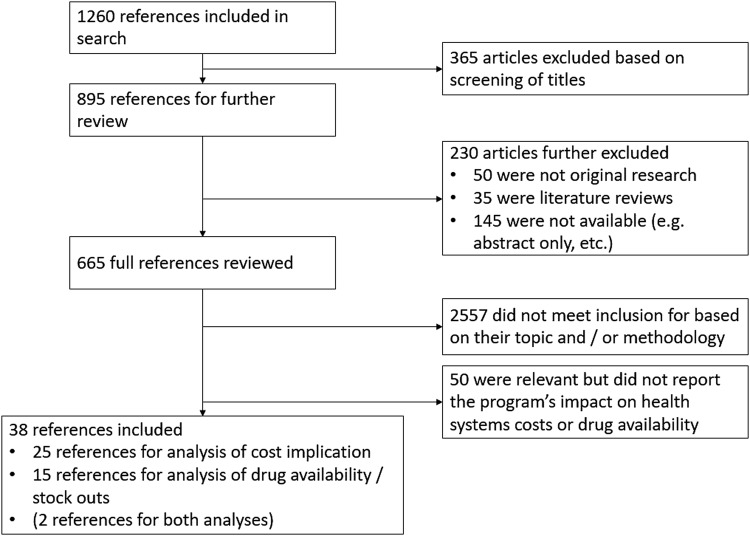
- The review screened 1,264 articles and included 38 studies: 25 on cost implications and 15 on availability, with 2 studies contributing to both groups.
- Of the 25 references analysing cost implications, 23 found a reduction in costs to the health system; 12 of these focused on centralised procurement or tendering.
- Centralised procurement produced reported savings such as 5.2–17% cost savings on drugs in Jordan, US$52.1 million–US$121.8 million in savings in Mexico over the first 4 years, and a 79% reduction in annual ARV cost per person in Brazil over 6 years (1997 to 2003).
- Of the 15 references analysing availability, 13 found improvements; supply chain management programmes were linked to reduced stock-outs and increased availability, including increases from 40% to 70% before implementation to >90% after implementation in Delhi, India.
Methods
- Systematic review conducted using PRISMA guidelines.
- Searched PubMed, Embase, CINAHL, and the Health Economic Evaluation Database; included original peer-reviewed studies in English reporting actual interventions in LMICs.
- Included studies had to evaluate an intervention changing procurement or supply chains and report cost changes or product availability; the review used comparative outcome measures and excluded baseline costing studies and non-intervention reports.
Limitations
- The paper states that studies used many different metrics, making it hard to compare or synthesise findings across studies.
- It states that many studies did not use experimental designs, and there is likely publication bias toward positive results; very few studies reported negative outcomes.
- Evident from the text: the review’s conclusions are constrained by context-specific interventions, so effects may not generalise well across settings; the paper explicitly says one cannot predict the impact of a specific programme in another context.
Model-written summary. Check it against the paper before relying on it.
Integrity signals
Registry
Cites
Statistics
Figures
Verification
Claims the paper makes
6 Valid · 1 Not valid · 8 Not checked · 16 Own results and interpretations
Every source the paper cites for this claim was checked and supports it.
In the paper
“and a 48.4% reduction in cost of drugs needed to treat gastroenteritis (statistical significance not reported).”
§ Do changes to supply chains and procurement processes yield cost savings and improve availability of pharmaceuticals, vaccines or health products? A systematic review of evidence from low-income and middle-income countries > Results > Comprehensive drug system policies
What the sources say
- Supportedcites [14] Li Y, Ying C, Sufang G Evaluation, in three provinces, of the introduction and impact of China's National Essential Medicines Scheme. Bull World Health Organ 2013; 91: 184– 94. 10.2471/BLT.11.097998 23476091 PMC3590616 source
The “Reduced charges for patients” section reports 48.4% lower drug costs for inpatients admitted with gastroenteritis after local implementation of the scheme in the three study provinces. It does not report statistical significance for that figure. (LLM, conf=0.92)
plainstates a cause- Asserted: passes — The authors put it forward as true.
- Checkable: passes — It can be checked against evidence.
- Load-bearing: unclear — It is unclear whether the paper’s conclusions depend on it.
- Based: passes — The paper gives a reason why it holds.
- Supported
The cited sources support only part of this claim — read each source’s verdict below.
In the paper
“One reference about a centralised procurement process for antimalarials in Kenya found that a delay in the process, and the awarding of the tender to a relatively new, unknown company, resulted in a nationwide increase in stock outs.12”
§ Do changes to supply chains and procurement processes yield cost savings and improve availability of pharmaceuticals, vaccines or health products? A systematic review of evidence from low-income and middle-income countries > Results > Study selection
What the sources say
- Partly supportedcites [12] Tren R, Hess K, Bate R Drug procurement, the Global Fund and misguided competition policies. Malar J 2009; 8: 305 10.1186/1475-2875-8-305 20028536 PMC2804689 sourceExperimental — accuracy not yet measured
In 'The Kenya case' (page unavailable), the paper says Kenya awarded the antimalarial tender to a relatively unknown company and that delays and the company's failure to supply sufficient medicine exacerbated widespread stock-outs. It does not describe the company as relatively new or establish a nationwide increase in stock-outs; it says the stock-outs were already widespread and were prolonged. (LLM, conf=0.84)
plainstates a causeSingle case- Asserted: passes — The authors put it forward as true.
- Checkable: passes — It can be checked against evidence.
- Load-bearing: unclear — It is unclear whether the paper’s conclusions depend on it.
- Based: passes — The paper gives a reason why it holds.
- Partly supported
Every source the paper cites for this claim was checked and supports it.
In the paper
“An evaluation of this scheme in three provinces found that it resulted in a 17.5% reduction in cost of drugs needed to treat pneumonia or bronchitis (p<0.05)”
§ Do changes to supply chains and procurement processes yield cost savings and improve availability of pharmaceuticals, vaccines or health products? A systematic review of evidence from low-income and middle-income countries > Results > Comprehensive drug system policies
What the sources say
- Supportedcites [14] Li Y, Ying C, Sufang G Evaluation, in three provinces, of the introduction and impact of China's National Essential Medicines Scheme. Bull World Health Organ 2013; 91: 184– 94. 10.2471/BLT.11.097998 23476091 PMC3590616 source
The ‘Reduced charges for patients’ section reports that drug expenses for inpatients with pneumonia or bronchitis were 17.5% lower after implementation of the scheme. Table 3 identifies this as the combined result for adult inpatients in the three provinces and marks it as statistically significant (P < 0.05). (LLM, conf=0.93)
plainstates a cause- Asserted: passes — The authors put it forward as true.
- Checkable: passes — It can be checked against evidence.
- Load-bearing: unclear — It is unclear whether the paper’s conclusions depend on it.
- Based: passes — The paper gives a reason why it holds.
- Supported
The cited sources support only part of this claim — read each source’s verdict below.
In the paper
“one programme in Senegal used an informed Push Model, in which projected demand dictates quantities of drug orders, to reduce stock outs for contraceptives,32”
§ Do changes to supply chains and procurement processes yield cost savings and improve availability of pharmaceuticals, vaccines or health products? A systematic review of evidence from low-income and middle-income countries > Results > Supply chain/cold chain management
What the sources say
- Partly supportedcites [32] Daff BM, Seck C, Belkhayat H Informed push distribution of contraceptives in Senegal reduces stockouts and improves quality of family planning services. Glob Health Sci Pract 2014; 2: 245– 52. 10.9745/GHSP-D-13-00171 25276582 PMC4168620 sourceExperimental — accuracy not yet measured
The Conclusion says the informed push model was an effective solution to contraceptive stockouts in Senegal. The Strategy for Change says logisticians restocked facilities to maintain about two months of estimated supply needs, but it also says the model eliminated facility orders. Thus the stockout claim is supported, while the citing sentence’s description of projected demand dictating drug orders is not. (LLM, conf=0.84)
plainstates a causeSingle case- Asserted: passes — The authors put it forward as true.
- Checkable: passes — It can be checked against evidence.
- Load-bearing: unclear — It is unclear whether the paper’s conclusions depend on it.
- Based: passes — The paper gives a reason why it holds.
- Partly supported
The cited sources support only part of this claim — read each source’s verdict below.
In the paper
“and increased availability of ACTs in various countries in Sub-Saharan Africa.36 37”
§ Do changes to supply chains and procurement processes yield cost savings and improve availability of pharmaceuticals, vaccines or health products? A systematic review of evidence from low-income and middle-income countries > Results > Other types of programmes
What the sources say
- Not checked — no full text of the sourcecites [36] Tougher S, Ye Y, Amuasi JH Effect of the Affordable Medicines Facility-malaria (AMFm) on the availability, price, and market share of quality-assured artemisinin-based combination therapies in seven countries: a before-and-after analysis of outlet survey data. Lancet 2012; 380: 1916– 26. 10.1016/S0140-6736(12)61732-2 23122217 source
- Partly supportedcites [37] Sabot OJ, Mwita A, Cohen JM Piloting the global subsidy: the impact of subsidized artemisinin-based combination therapies distributed through private drug shops in rural Tanzania. PLoS One 2009; 4: e6857 10.1371/journal.pone.0006857 19724644 PMC2730578 sourceExperimental — accuracy not yet measured
The Results (Stocking; page not provided) show that ACT availability increased in shops in two intervention districts in Tanzania. The Introduction identifies this as a pilot of the AMFm model, not evidence that the AMFm increased availability in various Sub-Saharan African countries. (LLM, conf=0.88)
plainstates a cause- Asserted: passes — The authors put it forward as true.
- Checkable: passes — It can be checked against evidence.
- Load-bearing: unclear — It is unclear whether the paper’s conclusions depend on it.
- Based: passes — The paper gives a reason why it holds.
21 more claims
Create a free account to see all 31 claims and to verify the 2 references still open.
- It may state two separate claims as one. 5
- Probably not a substantial claim. 1
Citations
Cites
Getting Health Reform Right: A Guide to Improving Performance and Equity
Roberts, M., Hsiao, W., Berman, P., & Reich, M. (2008) · doi:10.1093/acprof:oso/9780195371505.001.0001 · Cited by 444
Bossert, T. J. (2002) · Health Policy and Planning · doi:10.1093/heapol/17.1.14 · Cited by 396 · cited 1×
“Handling editor Seye Abimbola.”
Countering the Problem of Falsified and Substandard Drugs
Committee on Understanding the Global Public Health Implications of Substandard, F., Board on Global Health, & Institute of Medicine (2013) · National Academies Press eBooks · doi:10.17226/18272 · Cited by 209
Tougher, S., Ye, Y., Amuasi, J. H., Kourgueni, I. A., Thomson, R., Goodman, C., Mann, A. G., Ren, R., Willey, B. A., Adegoke, C. A., et al. (2012) · The Lancet · doi:10.1016/s0140-6736(12)61732-2 · Cited by 173
Pharmaceutical Pricing in Emerging Markets: Effects of Income, Competition, and Procurement
Danzon, P. M., Mulcahy, A. W., & Towse, A. (2013) · Health Economics · doi:10.1002/hec.3013 · Cited by 172
Assessing Public Expenditure on Health from a Fiscal Space Perspective
Tandon, A., & Cashin, C. (2010) · World Bank, Washington, DC eBooks · doi:10.1596/13613 · Cited by 158
Essential medicines are more available than other medicines around the globe
Bazargani, Y. T., Ewen, M., de Boer, A., Leufkens, H. G. M., & Mantel-Teeuwisse, A. K. (2014) · PLoS ONE · doi:10.1371/journal.pone.0087576 · Cited by 126
DeRoeck, D., Bawazir, S. A., Carrasco, P., Kaddar, M., Brooks, A., Fitzsimmons, J., & Andrus, J. (2006) · The International Journal of Health Planning and Management · doi:10.1002/hpm.822 · Cited by 106 · cited 1×
“Of these three references, one programme in Nigeria aimed at strengthening laboratory services in hospitals reduced the costs of conducting laboratory tests by increasing the total volume of tests and then purchasing reagents in bulk at reduced”
BackgroundSabot, O. J., Mwita, A., Cohen, J. M., Ipuge, Y., Gordon, M., Bishop, D., Odhiambo, M., Ward, L., & Goodman, C. (2009) · PLoS ONE · doi:10.1371/journal.pone.0006857 · Cited by 105
Li, Y., Ying, C., Sufang, G., Brant, P., Bin, L., & Hipgrave, D. (2013) · Bulletin of the World Health Organization · doi:10.2471/blt.11.097998 · Cited by 93 · cited 1×
“In China, the National Essential Medicines Scheme, established in 2009 as part of broader health sector reform, included four components: a National Essential Drugs List, a zero-mark-up policy, reimbursement for drugs on the Essential Drugs List and public procurement of drugs.(14) An evaluation of this scheme in thre…”
Background
Research works printed but not linked: 2
- Embrey M Chapter 13: Revolving drug funds and user fees. In: Management Sciences for Health, eds MDS-3: managing access to medicines and health technologies. Arlington (VA): Management Sciences for Health, 2012.
- Barraclough A, Clark M Chapter 18: managing procurement. In: Management Sciences for Health, eds MSD-3 managing access to medicines and health technologies. Arlington (VA): Management Sciences for Health, 2012.
Cited by
(2009) · OECD health policy studies · doi:10.1787/2074319x · Cited by 221
Kohler, J. C., & Dimancesco, D. (2020) · Global Health Action · doi:10.1080/16549716.2019.1694745 · Cited by 128
“The health system as a whole may become less effective and equitable [14].”
BackgroundVledder, M., Friedman, J. A., Sjöblom, M., Brown, T., & Yadav, P. (2019) · Health Systems & Reform · doi:10.1080/23288604.2019.1596050 · Cited by 140
“Despite the increasing awareness about the importance of efficient logistics systems for attainment of health outcomes, systematic analysis of essential drugs distribution system and their impact on stockout rates at the point of service delivery and priority health outcomes remains limited.(5) Few studies have invest…”
BackgroundChen, L., Yang, Y., Luo, M. Y., Hu, B., Yin, S., & Mao, Z. (2020) · International Journal of Environmental Research and Public Health · doi:10.3390/ijerph17249415 · Cited by 107
“Globally, centralized drug procurement successfully saves drug costs [10,11].”
BackgroundA systematic review of pooled procurement of medicines and vaccines: identifying elements of success
Parmaksiz, K., Pisani, E., Bal, R. A., & Kok, M. O. (2022) · Globalization and Health · doi:10.1186/s12992-022-00847-z · Cited by 101
“Similar to Seidman and Atun’s [19] observations, we noticed that the majority of the studies included provided examples of pooled procurement mechanisms that have been set up successfully.”
BackgroundResultInfluentialMackey, T. K., & Cuomo, R. E. (2020) · Global Health Action · doi:10.1080/16549716.2019.1695241 · Cited by 87
“Seidman and Atun 2017 Do changes to supply chains and procurement processes yield cost savings and improve availability of pharmaceuticals, vaccines or health products?”
BackgroundWang, N., Yang, Y., Xu, L., Mao, Z., & Cui, D. (2021) · BMC Public Health · doi:10.1186/s12889-021-11882-7 · Cited by 92
Pooled procurement of drugs in low and middle income countries
Dubois, P., Lefouili, Y., & Straub, S. (2021) · European Economic Review · doi:10.1016/j.euroecorev.2021.103655 · Cited by 118
“Seidman and Atun (2017) provide a literature review of thirty-eight papers tracked through PubMed, Embase, CINAHL and the Health Economic Evaluation Database and provide several examples of contributions concluding to cost savings from pooled procurement.”
BackgroundEffective Demand Forecasting in Health Supply Chains: Emerging Trend, Enablers, and Blockers
Subramanian, L. (2021) · Logistics · doi:10.3390/logistics5010012 · Cited by 97
“Wang and Disney (2016) prodded the bullwhip effect and Seidman and Atun (2017) tried to answer Figure 2.”
BackgroundInfluentialStrategies to achieve fairer prices for generic and biosimilar medicines
Ferrario, A., Dedet, G., Humbert, T., et al. (2020) · BMJ · doi:10.1136/bmj.l5444 · Cited by 68
Hamill, H., Hampshire, K., Mariwah, S., Amoako-Sakyi, D., Kyei, A. A., & Castelli, M. (2019) · Social Science & Medicine · doi:10.1016/j.socscimed.2019.112369 · Cited by 54
“Medicine shortages and stock-outs at government health facilities mean that even those covered by NHIS have to resort to private-sector outlets for essential medicines, where availability tends to be better (Mackintosh and Mujinja, 2010; Palafox et al., 2014; Nicholson, 2013; Seidman and Atun, 2017).”
BackgroundOldfield, L., Penm, J. H.-D., Mirzaei, A., & Moles, R. J. (2024) · The Lancet Global Health · doi:10.1016/s2214-109x(24)00442-x · Cited by 66
PETER, T. F., Zeh, C. E., Katz, Z., Elbireer, A., Alemayehu, B., Vojnov, L., Costa, A. F., Doi, N., & Jani, I. V. (2017) · Journal of the International AIDS Society · doi:10.1002/jia2.25008 · Cited by 46
“Supply chain initiatives can have significant impact, reducing costs and increasing health product availability [41].”
BackgroundChen, Y., Ji, X., Xiao, H., Unger, J. M., Cai, Y., Mao, Z., & Yeung, K. (2021) · Frontiers in Pharmacology · doi:10.3389/fphar.2021.804237 · Cited by 43
Henry, R., Nantongo, L., Wagner, A. K., et al. (2017) · Journal of Pharmaceutical Policy and Practice · doi:10.1186/s40545-017-0121-y · Cited by 45
“SPARS’ medicines management supervisors (MMS) visit health facilities to build health workers’ capacity to improve the availability, supply chain management, and use of essential medicines and health supplies, which are essential to health system performance [4].”
BackgroundSunyoto, T., Potet, J., den Boer, M., Ritmeijer, K., Ruiz-Postigo, J. A., Ravinetto, R., Alves, F. P., Picado, A., & Boelaert, M. (2019) · BMJ Open · doi:10.1136/bmjopen-2019-029141 · Cited by 40
Saeed, G., Kohler, J. C., Cuomo, R. E., & Mackey, T. K. (2022) · Expert Opinion on Drug Safety · doi:10.1080/14740338.2022.2091543 · Cited by 33
“For example, Seidman & Atun [48] described a mHealth application to improve data systems or processes to track and monitor drug inventory.”
MethodWang, X., He, X. M., Zhang, P., Zhang, M., Ma, R., Dai, R., & Li, X. (2023) · International Journal for Equity in Health · doi:10.1186/s12939-023-02006-1 · Cited by 36
“This reflects the direct price reduction effect of centralized procurement and echoes other research which has reported distinct results on the cost-saving effects of drug policies in different countries [26].”
ResultCentralised Pharmaceutical Procurement: Learnings from Six European Countries
Vogler, S., Bauer, E., & Habimana, K. (2022) · Applied Health Economics and Health Policy · doi:10.1007/s40258-022-00729-w · Cited by 32
Cancer control in small island nations: from local challenges to global action
Sarfati, D., Dyer, R., Vivili, P., Herman, J., Spence, D., Sullivan, R. J., Weller, D., Bray, F., Hill, S. E., Bates, C., et al. (2019) · The Lancet Oncology · doi:10.1016/s1470-2045(19)30511-x · Cited by 29
Liu, Y., Yi, H., Fang, K., Bao, Y., & Li, X. (2022) · Frontiers in Public Health · doi:10.3389/fpubh.2022.942638 · Cited by 25
Hua, Y.-F., Lu, J., Bai, B., & Han-qing, Z. (2022) · Frontiers in Public Health · doi:10.3389/fpubh.2021.809453 · Cited by 31
“(10) established a game model to predict the optimal bidding price of enterprises based on the results of “4 + 7” centralized procurement and the assumption of triangular probability density.”
BackgroundFrom the first mile to the last: Challenges of the global surgical supply chain
Nazir, A., Vervoort, D., & Reddy, C. L. (2021) · The American Journal of Surgery · doi:10.1016/j.amjsurg.2021.03.033 · Cited by 22
Adhikari, B., Ranabhat, K., Khanal, P., Poudel, M., Marahatta, S. B., Khanal, S., Paudyal, V., & Shrestha, S. (2024) · PLOS Global Public Health · doi:10.1371/journal.pgph.0003128 · Cited by 37
Gu, Y., & Zhuang, Q. (2023) · Frontiers in Pharmacology · doi:10.3389/fphar.2023.1192423 · Cited by 27
“Gabriel and Rifat argued that procurement organizations need to consider the reputation of drug suppliers and drug quality and avoid relying exclusively on a single drug supplier, thereby reducing the incentive for that drug supplier to innovate (Seidman and Atun, 2017).”
BackgroundMultimorbidity and out-of-pocket expenditure for medicines in China and India
La, D. T. V., Zhao, Y. W., Perianayagam, A., Atun, R. A., Mercer, S. W., Marthias, T., McPake, B., Pati, S., Palladino, R., & Lee, J. T. (2022) · BMJ Global Health · doi:10.1136/bmjgh-2021-007724 · Cited by 24
Self-citationPotentials of Blockchain for Healthcare: Case of TunisiaPreprint
Rejeb, A., & Bell, L. (2019) · SSRN Electronic Journal · doi:10.2139/ssrn.3475246 · Cited by 21
Huang, A., Wang, X., Tao, Y., et al. (2022) · Frontiers in Pharmacology · doi:10.3389/fphar.2022.996824 · Cited by 18
Boateng, R., Petricca, K., Tang, B., Parikh, S., Quee-Brown, C. S., Alexis, C., Browne-Farmer, C., Reece-Mills, M., Salmon, S. M., Bodkyn, C., et al. (2021) · The Lancet Global Health · doi:10.1016/s2214-109x(21)00287-4 · Cited by 24
Xing, Q., Tang, W., Li, M., & Li, S. (2022) · International Journal of Environmental Research and Public Health · doi:10.3390/ijerph19074285 · Cited by 24
“Drug supply disruption not only affects treatment effectiveness, cure rate, and druguse safety among patients, but may also exacerbate conflicts between doctors and patients, as well as between the government and companies [60].”
BackgroundGlobal Impact of COVID-19 Pandemic on Public Health Supply Chains
Okafor, U. G., Olaleye, M. A., Asobara, H. C., & Umeodinka, E. F. (2021) · IntechOpen eBooks · doi:10.5772/intechopen.97454 · Cited by 17
“• We also found evidence that centralized procurement and tendering can achieve direct cost savings, while supply chain management program can reduce drug stock outs and increase drug availability for populations [34].”
BackgroundLuiza, V. L., Chaves, L. A., Campos, M. R., Bertoldi, A. D., da Silva, R. M., Bigdeli, M., Ross‐Degnan, D., & Emmerick, I. C. M. (2018) · BMJ Global Health · doi:10.1136/bmjgh-2017-000547 · Cited by 21
Acceptability of a Prime Vendor System in Public Healthcare Facilities in Tanzania
Kuwawenaruwa, A., Tediosi, F., Metta, E. O., Obrist, B., Wiedenmayer, K., Msamba, V.-S., & Wyss, K. (2020) · International Journal of Health Policy and Management · doi:10.34172/ijhpm.2020.90 · Cited by 17
Ansbro, É., Garry, S., Karir, V., Reddy, A., Jobanputra, K., Fardous, T., & Sadique, Z. (2020) · Health Policy and Planning · doi:10.1093/heapol/czaa050 · Cited by 17
“In the review described earlier, UNRWA concluded that cost savings could be made through regular review of medication prices, competitive negotiation with a larger list of pre-qualified suppliers from a greater number of regions and via selective participation in Jordan’s Joint Procurement Department or the Gulf Coope…”
BackgroundWang, J., Zhang, S., Wang, C., Li, J., Wang, R., & Zhu, L. (2024) · BMC Health Services Research · doi:10.1186/s12913-024-11217-3 · Cited by 16
“Studies have reported that drug bidding can efficiently control the unreasonable rise of drug prices in many countries, thus acting as a robust and sustainable solution [2–4].”
BackgroundFan, Y., Xu, Q., Jin, G., Jiang, L., & Wang, C. (2024) · Frontiers in Public Health · doi:10.3389/fpubh.2024.1383308 · Cited by 18
Jian, W., Zhou, W., & Zhang, L. (2023) · Frontiers in Public Health · doi:10.3389/fpubh.2023.1285558 · Cited by 12
Malik, M., Arshad, Z., Hussain, A., Jamshed, S. Q., Othman, N., Alolayan, S. O., Gajdács, M., Barrak, I., Alahmadi, Y. M., Aslam, A., et al. (2022) · Healthcare · doi:10.3390/healthcare10091738 · Cited by 17
“Moreover, a systematic review of evidence from low-income and middle-income countries also confirmed the current study findings [26].”
BackgroundWen, X., Wang, Z., Xu, L., Luo, J., Geng, X., Chen, X., Yang, Y., Cui, D., & Mao, Z. (2022) · Frontiers in Pharmacology · doi:10.3389/fphar.2022.829660 · Cited by 12
“The volume-based procurement policy is aimed at reducing pharmaceutical expenditures by creating economies of scale and improving purchasing power (Seidman and Atun, 2017).”
BackgroundPentrakan, A., Yang, C., & Wong, W. (2021) · International Journal of Environmental Research and Public Health · doi:10.3390/ijerph18115523 · Cited by 12
“It is important for operational performance [13].”
Qiu, F., Chen, S., Li, Y., Wang, X., & Zhu, M. (2025) · PLoS ONE · doi:10.1371/journal.pone.0315811 · Cited by 20
Factors Affecting the Pharmaceutical Supply Chain: A Systematic Review
Bahadori, M., Teymourzadeh, E., Bahariniya, S., Tahernezhad, A., & Poorheidari, G. (2024) · Health Scope · doi:10.5812/healthscope-140816 · Cited by 12
The impact of anti-malarial markets on artemisinin resistance: perspectives from Burkina Faso
Guissou, R. M., Amaratunga, C., de Haan, F., Tou, F., Cheah, P. Y., Yerbanga, R. S., Moors, E. H. M., Dhorda, M., Tindana, P. O., Boon, W., et al. (2023) · Malaria Journal · doi:10.1186/s12936-023-04705-0 · Cited by 13
“Weaknesses in purchasing and/or supply management processes and inadequate funding systems generally explain disruptions in the public health sector [45, 48, 49].”
BackgroundDong, J., Gao, Y., Liu, Y., & Yang, X. (2023) · PLoS ONE · doi:10.1371/journal.pone.0284528 · Cited by 16
Medicine Across Borders: Exploration of Grey Zones
Liu, R., Lundin, S. M., Smith, A., Gosa, T., Roviss Khambule, P., & Muller, E. (2023) · African Sun Media eBooks · doi:10.52779/9781991260314 · Cited by 10
Evidence review of what works for health systems strengthening, where and when?
Witter, S., Palmer, N., Balabanova, D., Mounier‐Jack, S., Martineau, T., Klicpera, A., Jensen, C., Garcia, M. P., & Gilson, L. (2019) · LSTM Online Archive (Liverpool School of Tropical Medicine) · Cited by 16
Procurement institutions and essential drug supply in low and middle-income countries
Wang, L. X., & Zahur, N. B. (2025) · Journal of Health Economics · doi:10.1016/j.jhealeco.2025.102996 · Cited by 19
Lesego, A., Were, L. P. O., Tsegaye, T., Idris, R., Morrison, L., Peterson, T., Elhussein, S., Antonio, E., Magwindiri, G., Dumba, I., et al. (2024) · BMC Health Services Research · doi:10.1186/s12913-024-11028-6 · Cited by 13
“Therefore, the focus of the Global Fund support was to retool the Zimbabwean PSCM system to be efficient, cost-effective and responsive to the population’s health needs, particularly in the face of global epidemics and pandemics such as HIV/ AIDS and COVID-19 [14–18].”
BackgroundProcurement Institutions and Essential Drug Supply in Low and Middle-Income CountriesPreprint
Wang, L. X., & Zahur, N. B. (2021) · SSRN Electronic Journal · doi:10.2139/ssrn.3926761 · Cited by 8
“review of 38 studies, most qualitative, reveals that pooled procurement tend to lower drug prices (Seidman and Atun, 2017), but offers few results regarding other outcomes or heterogeneity.”
Editorial: Medicines pricing, access and safety in Morocco
Tuck, C. Z., Mâamri, A., Chan, A. H. Y., et al. (2018) · Tropical Medicine & International Health · doi:10.1111/tmi.13191 · Cited by 7
“Such supply chain issues can contribute to low medicines availability in the public sector [31].”
BackgroundHybrid model: a promising type of public procurement in the healthcare sector of the European Union
Geropoulos, N., Voultsos, P. P., Geropoulos, M., Tsolaki-Tagaraki, F., & Tagarakis, G. I. (2024) · Frontiers in Public Health · doi:10.3389/fpubh.2024.1359155 · Cited by 15
Antiviral treatment in outpatients with herps zoster in six major areas of China, 2010–2019
Yu, Z., Zhao, Y., Jin, J., Zhu, J., Yu, L., & Han, G. (2022) · Frontiers in Public Health · doi:10.3389/fpubh.2022.942377 · Cited by 8
van Gurp, M., Alba, S., Ammiwala, M., Arab, S. R., Sadaat, S., Hanifi, F., Safi, S., Ansari, N., Ponce, M. C., & Kok, M. O. (2024) · Health Policy and Planning · doi:10.1093/heapol/czae121 · Cited by 7
“Geographical and political factors like rurality, distance to distribution points, insecurity, and conflict are known barriers to ensuring continuous medicine availability (Moye-Holz et al. 2017, Ranghieri et al. 2017, Seidman and Atun 2017).”
Zhang, Q., Wang, R., Chen, L., & Chen, W. (2024) · Frontiers in Pharmacology · doi:10.3389/fphar.2024.1365142 · Cited by 5
Pharmaceuticals in Latin America and the Caribbean
Vargas, V., Rama, M., & Singh, R. (2022) · World Bank, Washington, DC eBooks · doi:10.1596/36871 · Cited by 7
Afzal, S., Bajwa, M., Ahmed, N., Jabeen, J., Haroon, M. S., Mushtaq, R. M. Z., & Saleem, Z. (2025) · Antimicrobial Resistance and Infection Control · doi:10.1186/s13756-025-01521-w · Cited by 7
Bangladesh should engage the private sector for malaria elimination by 2030
McArdle, R. P., Phru, C. S., Hossain, M. S., et al. (2024) · The Lancet Regional Health - Southeast Asia · doi:10.1016/j.lansea.2024.100487 · Cited by 4
Lesego, A., Tsegaye, T., Were, L. P. O., Sakvarelidze, G., Garg, S., Morrison, L., NIGUSSIE, S., Githendu, P., & Achoki, T. (2023) · BMJ Open · doi:10.1136/bmjopen-2023-073390 · Cited by 8
Satibi, S., Faradiba, F., Aditama, H., & Prasetyo, S. D. (2022) · INDONESIAN JOURNAL OF PHARMACY · doi:10.22146/ijp.2519 · Cited by 8
“Previous review studies imply that the procurement process has a significant impact on the optimization of financial and operational management in health facilities (Bastani et al., 2019; Latifah et al., 2018; Seidman & Atun, 2017).”
BackgroundLu, J., Yang, Y., Wen, X., Wang, J. Y., Shen, Y., Mao, L., Cui, D., Mao, Z., & Li, J. (2021) · Research Square · doi:10.21203/rs.3.rs-805352/v1 · Cited by 4
Wang, N., Yang, Y., Xu, L., Mao, Z., & Cui, D. (2021) · Research Square · doi:10.21203/rs.3.rs-403627/v1 · Cited by 4
Kwesiga, B., Wagner, A. K., Seru, M., Ross‐Degnan, D., & Trap, B. (2019) · Journal of Pharmaceutical Policy and Practice · doi:10.1186/s40545-019-0196-8 · Cited by 3
“While this study does not directly link better medicines management with savings from reduced waste and better health outcomes, others have shown that supply chain strengthening can reduce stock outs and increase medicines availability [19].”
BackgroundKwesiga, B., Wagner, A. K., Seru, M., & Trap, B. (2018) · Elsevier eBooks · doi:10.1016/b978-0-12-811945-7.00008-7 · Cited by 5
Guissou, R. M., Kaboré, J. M. T., Soulama, I., Hien, D., Nombré, Y., Tiono, A. B., Burri, C., & Sirima, S. B. (2025) · Malaria Journal · doi:10.1186/s12936-025-05493-5 · Cited by 4
Vitti, M., Facchini, F., & Sassanelli, C. (2025) · Computers & Industrial Engineering · doi:10.1016/j.cie.2025.111249 · Cited by 7
Zhao, D., & Zhou, Z. (2025) · Healthcare · doi:10.3390/healthcare13060686 · Cited by 4
“Volume-based drug procurement is a global common practice to lower pharmaceutical prices by creating economies of scale and improving purchasing power [10].”
Medicine availability and affordability for paediatric cancers, China
Bai, L., Huang, T., Li, H., et al. (2025) · Bulletin of the World Health Organization · doi:10.2471/blt.24.291640 · Cited by 3
“10,39 The inequalities in access to essential anticancer medicines for children we observed across regions could be explained by regional imbalances in economic development and in the allocation of health-care resources.”
Li, Y., Li, R., Han, Y. L., Zhou, N., & Yang, H. (2024) · Computers & Industrial Engineering · doi:10.1016/j.cie.2024.110741 · Cited by 5
Domfeh, K. A. (2021) · Journal of Pharmaceutical Health Services Research · doi:10.1093/jphsr/rmab062 · Cited by 5
Novel policy options for reimbursement, pricing and procurement of AMR health technologies
Vogler, S., Fischer, S., Habimana, K., GmbH, G. Ö., & Haasis, M. A. (2021) · Informationszentrum Lebenswissenschaften (ZB MED) · doi:10.4126/frl01-006427715 · Cited by 9
Wang, N., Yang, Y., Xu, L., Mao, Z., & Cui, D. (2021) · Preprints.org · doi:10.20944/preprints202104.0157.v1 · Cited by 3
Kuwawenaruwa, A., Wyss, K., Wiedenmayer, K., & Tediosi, F. (2020) · BMJ Global Health · doi:10.1136/bmjgh-2020-002681 · Cited by 6
Sharma, R. K., Kumari, M., & Baxi, R. (2026) · Journal of Public Health Research · doi:10.1177/22799036261418439 · Cited by 3
Shen, Q., Kang, L., Ye, D., Li, Y., & Zhang, K. (2025) · Frontiers in Public Health · doi:10.3389/fpubh.2025.1616534 · Cited by 2
Prompt payment enforcement on framework agreements for public hospitals: evidence from Chile
Jordán, F. (2025) · Fiscal Studies · doi:10.1111/1475-5890.12402 · Cited by 3
“The health literature has found consistent savings from pooling procurement (Seidman and Atun, 2017).”
BackgroundJiménez-Delgado, G. I., Aslan, İ., Palma, H. H., et al. (2024) · Lecture notes in computer science · doi:10.1007/978-3-031-76809-5_6 · Cited by 2
Kasim, F. M., Hatah, E., Osman, L. H., Ali, A. M., & Babar, Z.-U.-D. (2024) · Saudi Pharmaceutical Journal · doi:10.1016/j.jsps.2024.102214 · Cited by 4
“A majority of the study ’ s findings suggest that procuring drugs through centralized contracts or tendering can result in favorable pricing outcomes, contributing to cost-efficiency in the public healthcare system (Seidman and Atun, 2017, Wouters et al., 2019, Dubois et al., 2021, Li et al., 2021).”
Wu, J., Qiu, L., Li, J., Zhou, Q., Xie, W., & Shen, Y. (2024) · BMC Psychiatry · doi:10.1186/s12888-024-06026-1 · Cited by 2
“This policy involves purchasing high-quality generic drugs, evaluated by national consistency, in large quantities through strong political commitment [17].”
BackgroundZou, Y., Mao, J., Dong, Y., Yang, L., Dong, W., & Yan, H. (2024) · International Journal of Clinical Practice · doi:10.1155/ijcp/4355310 · Cited by 2
Osman, A., Johnson, F. A., Mariwah, S., Amoako-Sakyi, D., Owusu, S. A., Ekor, M., Hamill, H., & Hampshire, K. (2023) · BMJ Global Health · doi:10.1136/bmjgh-2023-013426 · Cited by 2
Ferraris, K. P., Golidtum, J. P., Palabyab, E. P. M., Salloman, A. J., Alcazaren, J. C., Seng, K., Navarro, J. E., & Reyes, K. D. L. (2023) · Research Square · doi:10.21203/rs.3.rs-405670/v2 · Cited by 2
Yagudina, R. I., Kulikov, A. Y., Serpik, V. G., Borodin, A., & Vygodchikova, I. Y. (2021) · ClinicoEconomics and Outcomes Research · doi:10.2147/ceor.s312986 · Cited by 4
A Rapid Cost Modeling Tool for Evaluating and Improving Public Health Supply Chain Designs
Krautmann, M., Zameer, M., Thomas, D., Phillips-White, N., Costache, A., & Leroueil, P. R. (2020) · Global Health Science and Practice · doi:10.9745/ghsp-d-20-00227 · Cited by 4
Liang, S., Zhang, S., Li, L., Luo, J., Jiang, L., & Xian, J. (2026) · Frontiers in Pharmacology · doi:10.3389/fphar.2026.1810714 · Cited by 1
Kasim, F. M., Hatah, E., Osman, L. H., et al. (2026) · PLoS ONE · doi:10.1371/journal.pone.0322604 · Cited by 1
“Despite the generally positive outcomes observed in many studies after the implementation of pooled or centralized procurement, it was observed that there is a potential bias in the existing literature [9,10].”
Zheng, S., Babu, M. M., Metreveli, A., Dey, B. L., & Koufopoulos, D. N. (2025) · Technological Forecasting and Social Change · doi:10.1016/j.techfore.2025.124500 · Cited by 2
Afzal, S., Bajwa, M., Haroon, M. S., Arooj, H., Mushtaq, R. M. Z., & Saleem, Z. (2025) · Archives of Public Health · doi:10.1186/s13690-025-01720-2 · Cited by 4
Uahupirapi, K., Shifotoka, S., & Nangombe, V. (2025) · Tropical Medicine and Health · doi:10.1186/s41182-025-00799-1 · Cited by 5
“While centralised procurement approaches have been found to reduce costs and stockouts, their success hinges on effective implementation and oversight [69].”
Su, X., Qiu, M., Liu, H., Xu, K., Wang, X., Li, J., Li, Y., & Yaling, H. (2025) · International Journal of Cardiology · doi:10.1016/j.ijcard.2025.133636 · Cited by 1
Barbosa, K. D. S., & Fiuza, E. P. S. (2025) · The Quarterly Review of Economics and Finance · doi:10.1016/j.qref.2025.102011 · Cited by 4
Getahun, K. T., Bilal, A. I., & Cho, D. J. (2025) · BMC Health Services Research · doi:10.1186/s12913-025-12404-6 · Cited by 8
“Addressing these issues necessitates improved procurement and supply chain management, the utilization of accurate demand data, and prioritizing the purchase of products with longer shelf lives [64].”
Pricing Certainty: Experimental Evidence on Consumer Trade-offs Between Drug Quality and CostPreprint
Merkel, L., Bocoum, F. Y., & Hartwig, R. (2025) · SSRN Electronic Journal · doi:10.2139/ssrn.5731342 · Cited by 1
Lean management in public hospital medicines supply chain: a literature review
Bouterfas, B., & Farouk, I. I. E. (2024) · International Colloquium on Logistics and Supply Chain Management (LOGISTIQUA) · doi:10.1109/logistiqua61063.2024.10571492 · Cited by 1
“…According to a study done in countries with low and middle income, the results show that improving health systems performance should be prioritized through changing supply chains and procurement processes into a cost-saving and available supply chain, with a successful service delivery [47].”
BackgroundNduhura, A., Hofisi, C., Tshombe, L. M., Molokwane, T., Settumba, J. P., & Wanume, P. (2024) · Journal of African Development · doi:10.5325/jafrideve.25.1.0075 · Cited by 1
Optimizing Health Supply Chains in LMICs with Machine Learning: A Case Study in Sierra Leone
Bastani, H., Bastani, O., & Chung, T.-H. (2024) · Springer series in supply chain management · doi:10.1007/978-3-031-60867-4_12 · Cited by 3
Takawira, B., & Mutambara, E. (2023) · International Journal of Research in Business and Social Science (2147-4478) · doi:10.20525/ijrbs.v12i8.2487 · Cited by 2
“According to Seidman and Atun (2017), pharmaceutical supply-chain disruptions can hugely hamper drug availability.”
Background(2023) · Journal of Logistics Informatics and Service Science · doi:10.33168/jliss.2023.0106 · Cited by 2
Lesego, A., Were, L. P. O., Tsegaye, T., et al. (2023) · Research Square · doi:10.21203/rs.3.rs-2662781/v1 · Cited by 1
Assuring health commodity security in resource-poor settings
Tetteh, E. K. (2021) · Research in Social and Administrative Pharmacy · doi:10.1016/j.sapharm.2021.04.005 · Cited by 2
Chen, Y., Xu, J. R., Xiao, H., et al. (2021) · SSRN Electronic Journal · doi:10.2139/ssrn.3901776 · Cited by 1
Metadata
- Authors
- Seidman, G., & Atun, R.
- Affiliations
- Harvard University (US)
- Corresponding author
- Seidman, Gabriel
- Venue
- BMJ Global Health
- Publisher
- BMJ
- Published
- 2017-04
- Volume
- 2
- Issue
- 2
- Pages
- e000243
- ISSN
- 2059-7908 (ISSN-L)
- PMC
- PMC5435270
- OpenAlex
- W2607163485
- Cited by
- 133
- References
- 52
- Citations by year
- 2026: 14 · 2025: 21 · 2024: 26 · 2023: 15 · 2022: 15 · 2021: 19 · 2020: 9 · 2019: 8 · 2018: 3 · 2017: 2
- FWCI
- 2.11
- Type
- journal article
- Language
- en
- Open access
- gold
- doi.org
- Licence
- cc-by-nc
- Locations
- BMJ Global Health (publishedVersion, cc-by-nc)
- Europe PMC (PubMed Central) (publishedVersion, other-oa)
- PubMed Central (publishedVersion, cc-by-nc)
- PubMed (publishedVersion)
- Digital Access to Scholarship at Harvard (DASH) (Harvard University) (submittedVersion, cc-by)
- Funders
- Bill and Melinda Gates Foundation
- Rockefeller Foundation
- Harvard T.H. Chan School of Public Health
- Bloomberg Philanthropies
- GE Foundation
- Harvard Kennedy School
- Harvard Graduate School of Education
- Topics
- Social Sciences › Economics, Econometrics and Finance › Economics and Econometrics › Pharmaceutical Economics and Policy
- Health Sciences › Medicine › Public Health, Environmental and Occupational Health › Healthcare Systems and Reforms
- Social Sciences › Decision Sciences › Management Science and Operations Research › Supply Chain and Inventory Management
- Keywords
- pharmaceutical supply chain, tendering, drug stock-outs, drug availability, cost reduction, health system efficiency, vaccines, low- and middle-income countries, health system performance
About these checks
Registry, retraction, Cites and statistics results are computed, not judged, with one exception: a printed reference that no index lists is read once by a model before it counts as a citation error. Claims are extracted by a model and kept only when their quote appears verbatim in the text; each cited source is then checked, with a model’s help, for whether it says what the claim relies on. Those verdicts can be wrong — read the claim’s quote and the cited source before relying on one.
The claim verdicts this report counts are experimental: their accuracy is not yet measured.
A language model drew the claims from the paper on 2026-10-10, under version 3 of the claim definition (model deepseek-v4.1-flash, prompt extract-v3).
A second model labelled each claim on 2026-10-10 (model jev-1.13-20260917, definition revision gold-guideline-v0.2).
Cited sources are checked with a language model’s help (gpt-6-sol).
Statistics and arithmetic are recomputed, not judged.
Confidence bands are shown only for fields calibrated on our annotated test set. None is calibrated yet, so no band is shown.
What counts as a claim ›How we measure confidence ›How we check this ›
Are you an author, or do you see a problem with this page? Request a review
Data sources
Bibliographic data: Semantic Scholar, OpenAlex, Crossref.
Contains information from the Semantic Scholar Academic Graph Datasets, made available under the ODC Attribution License (ODC-BY 1.0).
Semantic Scholar’s data is described in: Kinney, R., et al. (2023). The Semantic Scholar Open Data Platform. arXiv:2301.10140.
