

Do changes to supply chains and procurement processes yield cost savings and improve availability of pharmaceuticals, vaccines or health products? A systematic review of evidence from low-income and middle-income countries
Open accessThe DOI matches its Crossref record; 48 of the 52 references it cites were found in a registry or an index; 6 of the 17 sources its claims cite were checked for support.
Abstract
Systematic review of 38 studies on whether procurement and supply chain changes achieve cost savings and improve availability of health products in LMICs.
Overview
CoChat Summary
TL;DR
This systematic review found that changes to supply chains and procurement processes in low- and middle-income countries often reduce costs and sometimes improve availability of pharmaceuticals, vaccines, and other health products. Centralised procurement/tendering showed cost savings across many contexts, while supply chain management programmes often reduced stock-outs and increased availability.
Key findings
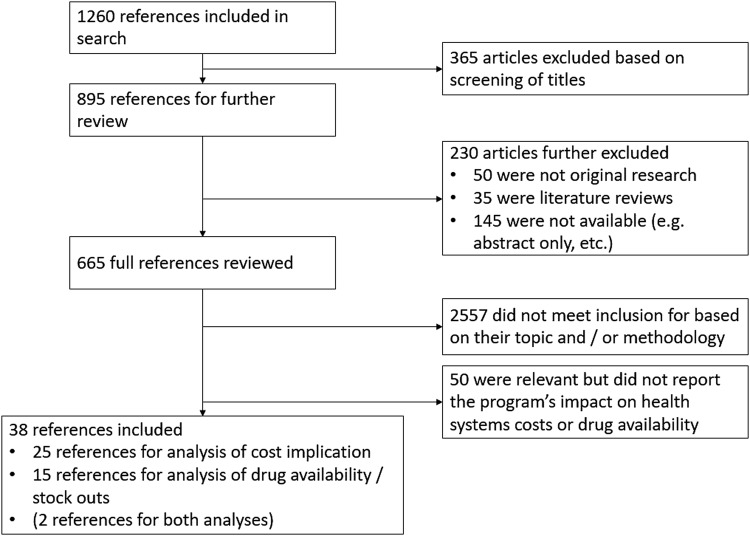
- The review screened 1,264 articles and included 38 studies: 25 on cost implications and 15 on availability, with 2 studies contributing to both groups.
- Of the 25 references analysing cost implications, 23 found a reduction in costs to the health system; 12 of these focused on centralised procurement or tendering.
- Centralised procurement produced reported savings such as 5.2–17% cost savings on drugs in Jordan, US$52.1 million–US$121.8 million in savings in Mexico over the first 4 years, and a 79% reduction in annual ARV cost per person in Brazil over 6 years (1997 to 2003).
- Of the 15 references analysing availability, 13 found improvements; supply chain management programmes were linked to reduced stock-outs and increased availability, including increases from 40% to 70% before implementation to >90% after implementation in Delhi, India.
Methods
- Systematic review conducted using PRISMA guidelines.
- Searched PubMed, Embase, CINAHL, and the Health Economic Evaluation Database; included original peer-reviewed studies in English reporting actual interventions in LMICs.
- Included studies had to evaluate an intervention changing procurement or supply chains and report cost changes or product availability; the review used comparative outcome measures and excluded baseline costing studies and non-intervention reports.
Limitations
- The paper states that studies used many different metrics, making it hard to compare or synthesise findings across studies.
- It states that many studies did not use experimental designs, and there is likely publication bias toward positive results; very few studies reported negative outcomes.
- Evident from the text: the review’s conclusions are constrained by context-specific interventions, so effects may not generalise well across settings; the paper explicitly says one cannot predict the impact of a specific programme in another context.
Model-written summary. Check it against the paper before relying on it.
Integrity signals
Registry
Cites
Statistics
Figures
Verification
Claims the paper makes
6 Valid · 1 Not valid · 8 Not checked · 16 Own results and interpretations
Every source the paper cites for this claim was checked and supports it.
In the paper
“and a 48.4% reduction in cost of drugs needed to treat gastroenteritis (statistical significance not reported).”
§ Do changes to supply chains and procurement processes yield cost savings and improve availability of pharmaceuticals, vaccines or health products? A systematic review of evidence from low-income and middle-income countries > Results > Comprehensive drug system policies
What the sources say
- Supportedcites [14] Li Y, Ying C, Sufang G Evaluation, in three provinces, of the introduction and impact of China's National Essential Medicines Scheme. Bull World Health Organ 2013; 91: 184– 94. 10.2471/BLT.11.097998 23476091 PMC3590616 source
The “Reduced charges for patients” section reports 48.4% lower drug costs for inpatients admitted with gastroenteritis after local implementation of the scheme in the three study provinces. It does not report statistical significance for that figure. (LLM, conf=0.92)
plainstates a cause- Asserted: passes — The authors put it forward as true.
- Checkable: passes — It can be checked against evidence.
- Load-bearing: unclear — It is unclear whether the paper’s conclusions depend on it.
- Based: passes — The paper gives a reason why it holds.
- Supported
The cited sources support only part of this claim — read each source’s verdict below.
In the paper
“One reference about a centralised procurement process for antimalarials in Kenya found that a delay in the process, and the awarding of the tender to a relatively new, unknown company, resulted in a nationwide increase in stock outs.12”
§ Do changes to supply chains and procurement processes yield cost savings and improve availability of pharmaceuticals, vaccines or health products? A systematic review of evidence from low-income and middle-income countries > Results > Study selection
What the sources say
- Partly supportedcites [12] Tren R, Hess K, Bate R Drug procurement, the Global Fund and misguided competition policies. Malar J 2009; 8: 305 10.1186/1475-2875-8-305 20028536 PMC2804689 sourceExperimental — accuracy not yet measured
In 'The Kenya case' (page unavailable), the paper says Kenya awarded the antimalarial tender to a relatively unknown company and that delays and the company's failure to supply sufficient medicine exacerbated widespread stock-outs. It does not describe the company as relatively new or establish a nationwide increase in stock-outs; it says the stock-outs were already widespread and were prolonged. (LLM, conf=0.84)
plainstates a causeSingle case- Asserted: passes — The authors put it forward as true.
- Checkable: passes — It can be checked against evidence.
- Load-bearing: unclear — It is unclear whether the paper’s conclusions depend on it.
- Based: passes — The paper gives a reason why it holds.
- Partly supported
Every source the paper cites for this claim was checked and supports it.
In the paper
“An evaluation of this scheme in three provinces found that it resulted in a 17.5% reduction in cost of drugs needed to treat pneumonia or bronchitis (p<0.05)”
§ Do changes to supply chains and procurement processes yield cost savings and improve availability of pharmaceuticals, vaccines or health products? A systematic review of evidence from low-income and middle-income countries > Results > Comprehensive drug system policies
What the sources say
- Supportedcites [14] Li Y, Ying C, Sufang G Evaluation, in three provinces, of the introduction and impact of China's National Essential Medicines Scheme. Bull World Health Organ 2013; 91: 184– 94. 10.2471/BLT.11.097998 23476091 PMC3590616 source
The ‘Reduced charges for patients’ section reports that drug expenses for inpatients with pneumonia or bronchitis were 17.5% lower after implementation of the scheme. Table 3 identifies this as the combined result for adult inpatients in the three provinces and marks it as statistically significant (P < 0.05). (LLM, conf=0.93)
plainstates a cause- Asserted: passes — The authors put it forward as true.
- Checkable: passes — It can be checked against evidence.
- Load-bearing: unclear — It is unclear whether the paper’s conclusions depend on it.
- Based: passes — The paper gives a reason why it holds.
- Supported
The cited sources support only part of this claim — read each source’s verdict below.
In the paper
“one programme in Senegal used an informed Push Model, in which projected demand dictates quantities of drug orders, to reduce stock outs for contraceptives,32”
§ Do changes to supply chains and procurement processes yield cost savings and improve availability of pharmaceuticals, vaccines or health products? A systematic review of evidence from low-income and middle-income countries > Results > Supply chain/cold chain management
What the sources say
- Partly supportedcites [32] Daff BM, Seck C, Belkhayat H Informed push distribution of contraceptives in Senegal reduces stockouts and improves quality of family planning services. Glob Health Sci Pract 2014; 2: 245– 52. 10.9745/GHSP-D-13-00171 25276582 PMC4168620 sourceExperimental — accuracy not yet measured
The Conclusion says the informed push model was an effective solution to contraceptive stockouts in Senegal. The Strategy for Change says logisticians restocked facilities to maintain about two months of estimated supply needs, but it also says the model eliminated facility orders. Thus the stockout claim is supported, while the citing sentence’s description of projected demand dictating drug orders is not. (LLM, conf=0.84)
plainstates a causeSingle case- Asserted: passes — The authors put it forward as true.
- Checkable: passes — It can be checked against evidence.
- Load-bearing: unclear — It is unclear whether the paper’s conclusions depend on it.
- Based: passes — The paper gives a reason why it holds.
- Partly supported
The cited sources support only part of this claim — read each source’s verdict below.
In the paper
“and increased availability of ACTs in various countries in Sub-Saharan Africa.36 37”
§ Do changes to supply chains and procurement processes yield cost savings and improve availability of pharmaceuticals, vaccines or health products? A systematic review of evidence from low-income and middle-income countries > Results > Other types of programmes
What the sources say
- Not checked — no full text of the sourcecites [36] Tougher S, Ye Y, Amuasi JH Effect of the Affordable Medicines Facility-malaria (AMFm) on the availability, price, and market share of quality-assured artemisinin-based combination therapies in seven countries: a before-and-after analysis of outlet survey data. Lancet 2012; 380: 1916– 26. 10.1016/S0140-6736(12)61732-2 23122217 source
- Partly supportedcites [37] Sabot OJ, Mwita A, Cohen JM Piloting the global subsidy: the impact of subsidized artemisinin-based combination therapies distributed through private drug shops in rural Tanzania. PLoS One 2009; 4: e6857 10.1371/journal.pone.0006857 19724644 PMC2730578 sourceExperimental — accuracy not yet measured
The Results (Stocking; page not provided) show that ACT availability increased in shops in two intervention districts in Tanzania. The Introduction identifies this as a pilot of the AMFm model, not evidence that the AMFm increased availability in various Sub-Saharan African countries. (LLM, conf=0.88)
plainstates a cause- Asserted: passes — The authors put it forward as true.
- Checkable: passes — It can be checked against evidence.
- Load-bearing: unclear — It is unclear whether the paper’s conclusions depend on it.
- Based: passes — The paper gives a reason why it holds.
21 more claims
Create a free account to see all 31 claims and to verify the 3 references still open.
- It may state two separate claims as one. 5
- Probably not a substantial claim. 1
Citations
Cites
Getting Health Reform Right: A Guide to Improving Performance and Equity
Roberts, M., Hsiao, W., Berman, P., & Reich, M. (2008) · doi:10.1093/acprof:oso/9780195371505.001.0001 · Cited by 444
Bossert, T. J. (2002) · Health Policy and Planning · doi:10.1093/heapol/17.1.14 · Cited by 396 · cited 1×
“Handling editor Seye Abimbola.”
Countering the Problem of Falsified and Substandard Drugs
Committee on Understanding the Global Public Health Implications of Substandard, F., Board on Global Health, & Institute of Medicine (2013) · National Academies Press eBooks · doi:10.17226/18272 · Cited by 209
Tougher, S., Ye, Y., Amuasi, J. H., Kourgueni, I. A., Thomson, R., Goodman, C., Mann, A. G., Ren, R., Willey, B. A., Adegoke, C. A., et al. (2012) · The Lancet · doi:10.1016/s0140-6736(12)61732-2 · Cited by 173
Pharmaceutical Pricing in Emerging Markets: Effects of Income, Competition, and Procurement
Danzon, P. M., Mulcahy, A. W., & Towse, A. (2013) · Health Economics · doi:10.1002/hec.3013 · Cited by 172
Assessing Public Expenditure on Health from a Fiscal Space Perspective
Tandon, A., & Cashin, C. (2010) · World Bank, Washington, DC eBooks · doi:10.1596/13613 · Cited by 158
Essential medicines are more available than other medicines around the globe
Bazargani, Y. T., Ewen, M., de Boer, A., Leufkens, H. G. M., & Mantel-Teeuwisse, A. K. (2014) · PLoS ONE · doi:10.1371/journal.pone.0087576 · Cited by 126
DeRoeck, D., Bawazir, S. A., Carrasco, P., Kaddar, M., Brooks, A., Fitzsimmons, J., & Andrus, J. (2006) · The International Journal of Health Planning and Management · doi:10.1002/hpm.822 · Cited by 106 · cited 1×
“Of these three references, one programme in Nigeria aimed at strengthening laboratory services in hospitals reduced the costs of conducting laboratory tests by increasing the total volume of tests and then purchasing reagents in bulk at reduced”
BackgroundSabot, O. J., Mwita, A., Cohen, J. M., Ipuge, Y., Gordon, M., Bishop, D., Odhiambo, M., Ward, L., & Goodman, C. (2009) · PLoS ONE · doi:10.1371/journal.pone.0006857 · Cited by 105
Li, Y., Ying, C., Sufang, G., Brant, P., Bin, L., & Hipgrave, D. (2013) · Bulletin of the World Health Organization · doi:10.2471/blt.11.097998 · Cited by 93 · cited 1×
“In China, the National Essential Medicines Scheme, established in 2009 as part of broader health sector reform, included four components: a National Essential Drugs List, a zero-mark-up policy, reimbursement for drugs on the Essential Drugs List and public procurement of drugs.(14) An evaluation of this scheme in thre…”
BackgroundUzochukwu, B. S. (2002) · Health Policy and Planning · doi:10.1093/heapol/17.4.378 · Cited by 88 · cited 2×
“One reference found that in South Sudan, drug prices were 40% cheaper in the RDF than those purchased by the Central Medical Supplies Public Organisation, and two references found increased availability of vaccines or essential drugs in RDFs in Guinea 34 and Nigeria.”
BackgroundQuality medicines for the poor: experience of the Delhi programme on rational use of drugs
Roy Chaudhury, R., Parameswar, R., Gupta, U., Sharma, S., Tekur, U., & Bapna, J. (2005) · Health Policy and Planning · doi:10.1093/heapol/czi015 · Cited by 81 · cited 1×
“In Delhi, India, a 1997 comprehensive drug policy included the development of an Essential Drugs List, a central pooled procurement system and programmatic activities to promote rational drug use.(15) This policy was found to result in 30% savings on the cost of drugs to the Government of Delhi and to increase the ava…”
BackgroundVendor managed inventory (VMI): evidences from lean deployment in healthcare
Guimarães, C. M., de Carvalho, J. C., & Maia, A. L. M. D. (2013) · Strategic Outsourcing An International Journal · doi:10.1108/17538291311316045 · Cited by 80
Bossert, T. J., Bowser, D. M., & Amenyah, J. K. (2007) · Health Policy and Planning · doi:10.1093/heapol/czl041 · Cited by 79 · cited 1×
“Handling editor Seye Abimbola.”
Consórcio intermunicipal para a aquisição de medicamentos: impacto no desabastecimento e no custo
do Amaral, S. M. S., & Blatt, C. R. (2011) · Revista de Saúde Pública · doi:10.1590/s0034-89102011005000016 · Cited by 73
Daff, B. M., Seck, C., Belkhayat, H., & Sutton, P. (2014) · Global Health: Science and Practice · doi:10.9745/ghsp-d-13-00171 · Cited by 70
Implementation of the Bamako Initiative: strategies in Benin and Guinea
Knippenberg, R., Alihonou, E., Soucat, A. L. B., Oyegbite, K., Calivis, M., Hopwood, I., Niimi, R., Diallo, M. P., Conde, M., & Ofosu-Amaah, S. (1997) · The International Journal of Health Planning and Management · doi:10.1002/(sici)1099-1751(199706)12:1+<s29::aid-hpm465>3.0.co;2-u · Cited by 62 · cited 1×
“Therefore, we believe that policymakers should use a problem-driven approach to understanding and addressing the root causes of problems in their drug procurement and supply systems.”
BackgroundShieshia, M., Noel, M., Andersson, S., Felling, B., Alva, S., Agarwal, S., Lefevre, A., Misomali, A., Chimphanga, B., Nsona, H., et al. (2014) · Journal of Global Health · doi:10.7189/jogh.04.020406 · Cited by 61 · cited 1×
“Our review also included examples of national programmes to improve drug supply, such as those in China, Brazil and Mexico, and initiatives all the way down to the clinic and community levels.”
BackgroundCOST CONTAINMENT THROUGH PHARMACEUTICAL PROCUREMENT: A CARIBBEAN CASE STUDY
Huff‐Rousselle, M., & BURNETT, F. (1996) · The International Journal of Health Planning and Management · doi:10.1002/(sici)1099-1751(199604)11:2<135::aid-hpm422>3.0.co;2-1 · Cited by 59 · cited 1×
“These references included joint procurement across multiple countries, including the Gulf Cooperation Council (GCC) of Bahrain, Kuwait, Oman, Qatar, Saudi Arabia and UAE,(16) 17 the PAHO Expanded Program on Immunisation (EPI) which included many Latin American countries(16) and the Eastern Caribbean Drug Service (ECDS…”
BackgroundImproving access to pharmaceuticals in Brazil and Argentina
Homedes, N., & Ugalde, A. (2006) · Health Policy and Planning · doi:10.1093/heapol/czj011 · Cited by 47 · cited 1×
“In Brazil, a series of policies by the Ministry of Health aimed to promote the use of multisource drugs (those which can be purchased from multiple manufacturers or distributors), development of the national pharmaceutical industry and aggressive price bargaining for select drugs, such as antiretroviral treatments (AR…”
BackgroundPublic and private sector responses to essential drugs policies:
Maïga, F. I., Haddad, S. H. S., Fournier, P. F., & Gauvin, L. I. (2003) · Social Science & Medicine · doi:10.1016/s0277-9536(02)00462-8 · Cited by 42
Tumwine, Y., Kutyabami, P., Adome, R. O., & Kalyango, J. N. (2011) · Tropical Journal of Pharmaceutical Research · doi:10.4314/tjpr.v9i6.63555 · Cited by 41 · cited 1×
“Therefore, we believe that policymakers should use a problem-driven approach to understanding and addressing the root causes of problems in their drug procurement and supply systems.”
BackgroundNamisango, E., Ntege, C., Luyirika, E. B. K., Kiyange, F., & Allsop, M. J. (2016) · BMC Palliative Care · doi:10.1186/s12904-016-0092-9 · Cited by 40 · cited 1×
“Our review also included examples of national programmes to improve drug supply, such as those in China, Brazil and Mexico, and initiatives all the way down to the clinic and community levels.”
BackgroundA new entity for the negotiation of public procurement prices for patented medicines in Mexico
Gómez-Dantés, O., Wirtz, V., Reich, M., Terrazas, P., & Ortiz, M. (2012) · Bulletin of the World Health Organization · doi:10.2471/blt.12.106633 · Cited by 37 · cited 1×
“Of these three references, one programme in Nigeria aimed at strengthening laboratory services in hospitals reduced the costs of conducting laboratory tests by increasing the total volume of tests and then purchasing reagents in bulk at reduced”
Essential medicines in Tanzania: does the new delivery system improve supply and accountability?
Mikkelsen-Lopez, I., Cowley, P., Kasale, H., Mbuya, C., Reid, G., & de Savigny, D. (2014) · Health Systems · doi:10.1057/hs.2013.14 · Cited by 35 · cited 1×
“Therefore, we believe that policymakers should use a problem-driven approach to understanding and addressing the root causes of problems in their drug procurement and supply systems.”
BackgroundReforming antiretroviral price negotiations and public procurement: the Mexican experience
Adesina, A., Wirtz, V. J., & Dratler, S. (2013) · Health Policy and Planning · doi:10.1093/heapol/czs015 · Cited by 32
Drug procurement, the Global Fund and misguided competition policies
Tren, R., Hess, K., & Bate, R. (2009) · Malaria Journal · doi:10.1186/1475-2875-8-305 · Cited by 31 · cited 1×
“One reference about a centralised procurement process for antimalarials in Kenya found that a delay in the process, and the awarding of the tender to a relatively new, unknown company, resulted in a nationwide increase in stock outs.(12) The full list of references meeting inclusion criteria can be found in tables 1 a…”
BackgroundSteyn, F., Schneider, H. M., Engelbrecht, M., van Rensburg-Bonthuyzen, E. J., Jacobs, N., & van Rensburg, D. H. (2008) · AIDS Care · doi:10.1080/09540120802032635 · Cited by 31
Consórcio intermunicipal para a aquisição de medicamentos: impacto no desabastecimento e no custo
do Amaral, S. M. S., & Blatt, C. R. (2011) · Redalyc (Universidad Autónoma del Estado de México) · Cited by 30
One-Year assessment of joint procurement of pharmaceuticals in the public health sector in Jordan
Al-Abbadi, I., Qawwas, A., Jaafreh, M., Abosamen, T., & Saket, M. (2009) · Clinical Therapeutics · doi:10.1016/j.clinthera.2009.05.021 · Cited by 30
Milovanovic, D. R., Pavlovic, R., Folić, M., & Јаnkovic, S. (2004) · European Journal of Clinical Pharmacology · doi:10.1007/s00228-004-0736-1 · Cited by 29 · cited 1×
“Of these three references, one programme in Nigeria aimed at strengthening laboratory services in hospitals reduced the costs of conducting laboratory tests by increasing the total volume of tests and then purchasing reagents in bulk at reduced”
BackgroundOptimizing national immunization program supply chain management in Thailand: an economic analysis
Riewpaiboon, A., Sooksriwong, C., Chaiyakunapruk, N., Tharmaphornpilas, P., Techathawat, S., Rookkapan, K., Rasdjarmrearnsook, A., & Suraratdecha, C. (2015) · Public Health · doi:10.1016/j.puhe.2015.04.016 · Cited by 28 · cited 1×
“A third reference found that transitioning to a vendor-managed inventory (VMI) system, in which customers automatically send inventory information to the supplier who then creates and fills order to replenish the inventory, resulted in an increase in unit costs per vaccine, but reductions in total logistics costs and…”
BackgroundOptimizing energy for a ‘green’ vaccine supply chain
Lloyd, J., McCarney, S., Ouhichi, R., Lydon, P., & Zaffran, M. (2014) · Vaccine · doi:10.1016/j.vaccine.2014.10.053 · Cited by 26
Building laboratory capacity to support HIV care in Nigeria: Harvard/APIN PEPFAR, 2004–2012
Hamel, D. J., Sankalé, J.-L., Samuels, J. O., Sarr, A. D., Chaplin, B., Ofuche, E., Meloni, S., Okonkwo, P., & Kanki, P. J. (2015) · African Journal of Laboratory Medicine · doi:10.4102/ajlm.v4i1.190 · Cited by 26
Aquisição de medicamentos genéricos em município de médio porte
Bevilacqua, G., Farías, M. R., & Blatt, C. R. (2011) · Revista de Saúde Pública · doi:10.1590/s0034-89102011005000020 · Cited by 23
Sigulem, F., & Zucchi, P. (2009) · PubMed · doi:10.1590/s1020-49892009001100007 · Cited by 22 · cited 1×
“Of these three references, one programme in Nigeria aimed at strengthening laboratory services in hospitals reduced the costs of conducting laboratory tests by increasing the total volume of tests and then purchasing reagents in bulk at reduced”
BackgroundGroup purchasing of pharmaceuticals and medical supplies by the Gulf Cooperation Council states.
Khoja, T. A. M., & Bawazir, S. A. (2005) · PubMed · Cited by 20
Implementation of the Bamako Initiative: strategies in Benin and Guinea
Knippenberg, R., Alihonou, E., Soucat, A., Oyegbite, K., Calivis, M., Hopwood, I., NiImi, R., Diallo, M. P., Conde, M., & Ofosu‐Amaah, S. (1997) · The International Journal of Health Planning and Management · doi:10.1002/(sici)1099-1751(199706)12:1+<s29::aid-hpm465>3.3.co;2-l · Cited by 20
Ewen, M., Al Sakit, M., Saadeh, R., Laing, R., Vialle-Valentin, C., Seita, A., & Bunders, J. (2014) · Journal of Pharmaceutical Policy and Practice · doi:10.1186/2052-3211-7-13 · Cited by 18 · cited 1×
“Of the two references that did not exclusively demonstrate savings, one reference analysed centralised procurement processes in multiple Middle Eastern countries and found that some countries achieved cost savings compared to local procurement, while other countries experienced cost increases.(9) One reference that st…”
ResultVéronique Chaumont, C. G., Bautista-Arredondo, S., Calva, J. J., Bahena-González, R. I., Sánchez-Juárez, G. H., González de Araujo-Muriel, A., Magis-Rodríguez, C., & Hernández-Ávila, M. (2015) · Salud Pública de México · doi:10.21149/spm.v57s2.7606 · Cited by 17
Essential medicines management during emergencies in Pakistan
Bukhari, S. K. S., Qureshi, J. A. R. H., Jooma, R., Bile, K. M., Kazi, G. N., Zaibi, W. A., & Zafar, A. (2010) · Eastern Mediterranean Health Journal · doi:10.26719/2010.16.supp.106 · Cited by 17
Implementation and evaluation of a web based system for pharmacy stock management in rural Haiti.
Berger, E. J., Jazayeri, D. G., Sauveur, M., Manasse, J. J., Plancher, I., Fiefe, M., Laurat, G., Joseph, S., Kempton, K., & Fraser, H. (2007) · PubMed Central · Cited by 16
Establishing a cost recovery system for drugs, Bo, Sierra Leone
Thuray, H., Samai, O., Fofana, P., Sengeh, P., & (The Bo PMM Team) (1997) · International Journal of Gynecology & Obstetrics · doi:10.1016/s0020-7292(97)00159-8 · Cited by 16 · cited 2×
“37 Other references reported cost savings from public procurement of drugs (compared to private sector only) in Mali,(38) the implementation of an IT system to purchase hospital supplies in India(39) and the direct purchase of drugs from commercial suppliers rather than through government channels in Sierra Leone.(40)…”
BackgroundManaging hospital supplies: process reengineering at Gujarat Cancer Research Institute, India
Ramani, K. V. (2006) · Journal of Health Organization and Management · doi:10.1108/14777260610662744 · Cited by 16 · cited 1×
“Therefore, we believe that policymakers should use a problem-driven approach to understanding and addressing the root causes of problems in their drug procurement and supply systems.”
BackgroundMidwives as drivers of reproductive health commodity security in Kaduna State, Nigeria
Alayande, A., Mamman-Daura, F., Adedeji, O., & Muhammad, A. Z. (2016) · The European Journal of Contraception & Reproductive Health Care · doi:10.3109/13625187.2015.1137280 · Cited by 14 · cited 1×
“Our review also included examples of national programmes to improve drug supply, such as those in China, Brazil and Mexico, and initiatives all the way down to the clinic and community levels.”
BackgroundAligning values and outcomes in priority–setting for health
Seidman, G., & Atun, R. A. (2016) · Journal of Global Health · doi:10.7189/jogh.06.020308 · Cited by 14 · cited 1×
“INTRODUCTION Health systems performance along key outputs, such as equity, efficiency, effectiveness and responsiveness, has important implications for population health.(1) 2 Specifically, maximising ‘technical efficiency’ of the health system, or the amount of outputs generated by a given cost (or other input), can…”
BackgroundSelf-citationWitter, S. (2007) · Eastern Mediterranean Health Journal · doi:10.26719/2007.13.6.1476 · Cited by 10
(2011) · Cited by 8
Research works printed but not linked: 2
- Embrey M Chapter 13: Revolving drug funds and user fees. In: Management Sciences for Health, eds MDS-3: managing access to medicines and health technologies. Arlington (VA): Management Sciences for Health, 2012.
- Barraclough A, Clark M Chapter 18: managing procurement. In: Management Sciences for Health, eds MSD-3 managing access to medicines and health technologies. Arlington (VA): Management Sciences for Health, 2012.
Cited by
(2009) · OECD health policy studies · doi:10.1787/2074319x · Cited by 221
Kohler, J. C., & Dimancesco, D. (2020) · Global Health Action · doi:10.1080/16549716.2019.1694745 · Cited by 128
“The health system as a whole may become less effective and equitable [14].”
BackgroundVledder, M., Friedman, J. A., Sjöblom, M., Brown, T., & Yadav, P. (2019) · Health Systems & Reform · doi:10.1080/23288604.2019.1596050 · Cited by 140
“Despite the increasing awareness about the importance of efficient logistics systems for attainment of health outcomes, systematic analysis of essential drugs distribution system and their impact on stockout rates at the point of service delivery and priority health outcomes remains limited.(5) Few studies have invest…”
BackgroundChen, L., Yang, Y., Luo, M. Y., Hu, B., Yin, S., & Mao, Z. (2020) · International Journal of Environmental Research and Public Health · doi:10.3390/ijerph17249415 · Cited by 107
“Globally, centralized drug procurement successfully saves drug costs [10,11].”
BackgroundA systematic review of pooled procurement of medicines and vaccines: identifying elements of success
Parmaksiz, K., Pisani, E., Bal, R. A., & Kok, M. O. (2022) · Globalization and Health · doi:10.1186/s12992-022-00847-z · Cited by 101
“Similar to Seidman and Atun’s [19] observations, we noticed that the majority of the studies included provided examples of pooled procurement mechanisms that have been set up successfully.”
BackgroundResultInfluential
Metadata
- Authors
- Seidman, G., & Atun, R.
- Affiliations
- Harvard University (US)
- Corresponding author
- Seidman, Gabriel
- Venue
- BMJ Global Health
- Publisher
- BMJ
- Published
- 2017-04
- Volume
- 2
- Issue
- 2
- Pages
- e000243
- ISSN
- 2059-7908 (ISSN-L)
- PMC
- PMC5435270
- OpenAlex
- W2607163485
- Cited by
- 133
- References
- 52
- Citations by year
- 2026: 14 · 2025: 21 · 2024: 26 · 2023: 15 · 2022: 15 · 2021: 19 · 2020: 9 · 2019: 8 · 2018: 3 · 2017: 2
- FWCI
- 2.11
- Type
- journal article
- Language
- en
- Open access
- gold
- doi.org
- Licence
- cc-by-nc
- Locations
- BMJ Global Health (publishedVersion, cc-by-nc)
- Europe PMC (PubMed Central) (publishedVersion, other-oa)
- PubMed Central (publishedVersion, cc-by-nc)
- PubMed (publishedVersion)
- Digital Access to Scholarship at Harvard (DASH) (Harvard University) (submittedVersion, cc-by)
- Funders
- Bill and Melinda Gates Foundation
- Rockefeller Foundation
- Harvard T.H. Chan School of Public Health
- Bloomberg Philanthropies
- GE Foundation
- Harvard Kennedy School
- Harvard Graduate School of Education
- Topics
- Social Sciences › Economics, Econometrics and Finance › Economics and Econometrics › Pharmaceutical Economics and Policy
- Health Sciences › Medicine › Public Health, Environmental and Occupational Health › Healthcare Systems and Reforms
- Social Sciences › Decision Sciences › Management Science and Operations Research › Supply Chain and Inventory Management
- Keywords
- pharmaceutical supply chain, tendering, drug stock-outs, drug availability, cost reduction, health system efficiency, vaccines, low- and middle-income countries, health system performance
About these checks
Registry, retraction, Cites and statistics results are computed, not judged, with one exception: a printed reference that no index lists is read once by a model before it counts as a citation error. Claims are extracted by a model and kept only when their quote appears verbatim in the text; each cited source is then checked, with a model’s help, for whether it says what the claim relies on. Those verdicts can be wrong — read the claim’s quote and the cited source before relying on one.
The claim verdicts this report counts are experimental: their accuracy is not yet measured.
A language model drew the claims from the paper on 2026-10-10, under version 3 of the claim definition (model deepseek-v4.1-flash, prompt extract-v3).
A second model labelled each claim on 2026-10-10 (model jev-1.13-20260917, definition revision gold-guideline-v0.2).
Cited sources are checked with a language model’s help (gpt-6-sol).
Statistics and arithmetic are recomputed, not judged.
Confidence bands are shown only for fields calibrated on our annotated test set. None is calibrated yet, so no band is shown.
What counts as a claim ›How we measure confidence ›How we check this ›
Are you an author, or do you see a problem with this page? Request a review
Data sources
Bibliographic data: Semantic Scholar, OpenAlex, Crossref.
Contains information from the Semantic Scholar Academic Graph Datasets, made available under the ODC Attribution License (ODC-BY 1.0).
Semantic Scholar’s data is described in: Kinney, R., et al. (2023). The Semantic Scholar Open Data Platform. arXiv:2301.10140.
