

The DOI matches its Crossref record; 41 of the 41 references it cites were found in a registry or an index; 3 of the 8 sources its claims cite were checked for support.
Efficacy of iron supplementation on fatigue and physical capacity in non-anaemic iron-deficient adults: a systematic review of randomised controlled trials
Open accessAbstract
Objective Iron supplementation in iron-deficiency anaemia is standard practice, but the benefits of iron supplementation in iron-deficient non-anaemic (IDNA) individuals remains controversial. Our objective is to identify the effects of iron therapy on fatigue and physical capacity in IDNA adults. Design Systematic review and meta-analysis of randomised controlled trials (RCTs). Setting Primary care. Participants Adults (≥18 years) who were iron deficient but non-anaemic. Interventions Oral, intramuscular or intravenous iron supplementation; all therapy doses, frequencies and durations were included. Comparators Placebo or active therapy. Results We identified RCTs in Medline, Embase, Cochrane Central Register of Controlled Trials, Cumulative Index of Nursing and Allied Health, SportDiscus and CAB Abstracts from inception to 31 October 2016. We searched the WHO’s International Clinical Trials Registry Platform for relevant ongoing trials and performed forward searches of included trials and relevant reviews in Web of Science. We assessed internal validity of included trials using the Cochrane Risk of Bias tool and the external validity using the Grading of Recommendations Assessment, Development and Evaluation methodology. From 11 580 citations, we included 18 unique trials and 2 companion papers enrolling 1170 patients. Using a Mantel-Haenszel random-effects model, iron supplementation was associated with reduced self-reported fatigue (standardised mean difference (SMD) −0.38; 95% CI −0.52 to −0.23; I 2 0%; 4 trials; 714 participants) but was not associated with differences in objective measures of physical capacity, including maximal oxygen consumption (SMD 0.11; 95% CI −0.15 to 0.37; I 2 0%; 9 trials; 235 participants) and timed methods of exercise testing. Iron supplementation significantly increased serum haemoglobin concentration (MD 4.01 g/L; 95% CI 1.22 to 6.81; I 2 48%; 12 trials; 298 participants) and serum ferritin (MD 9.23 µmol/L; 95% CI 6.48 to 11.97; I 2 58%; 14 trials; 616 participants). Conclusion In IDNA adults, iron supplementation is associated with reduced subjective measures of fatigue but not with objective improvements in physical capacity. Given the global prevalence of both iron deficiency and fatigue, patients and practitioners could consider consumption of iron-rich foods or iron supplementation to improve symptoms of fatigue in the absence of documented anaemia. PROSPERO registration number CRD42014007085 .
Overview
AI snapshot
Written from the paper’s full text.
TL;DR
In non-anaemic iron-deficient adults, iron supplementation reduced self-reported fatigue but did not improve objective physical capacity. It increased haemoglobin and ferritin, with evidence graded moderate for fatigue and low for physical capacity.
Key findings
- From 11,580 citations, the review included 18 unique trials and 2 companion papers enrolling 1170 patients. Iron supplementation reduced self-reported fatigue (SMD −0.38; 95% CI −0.52 to −0.23; I² 0%; 4 trials; 714 participants).
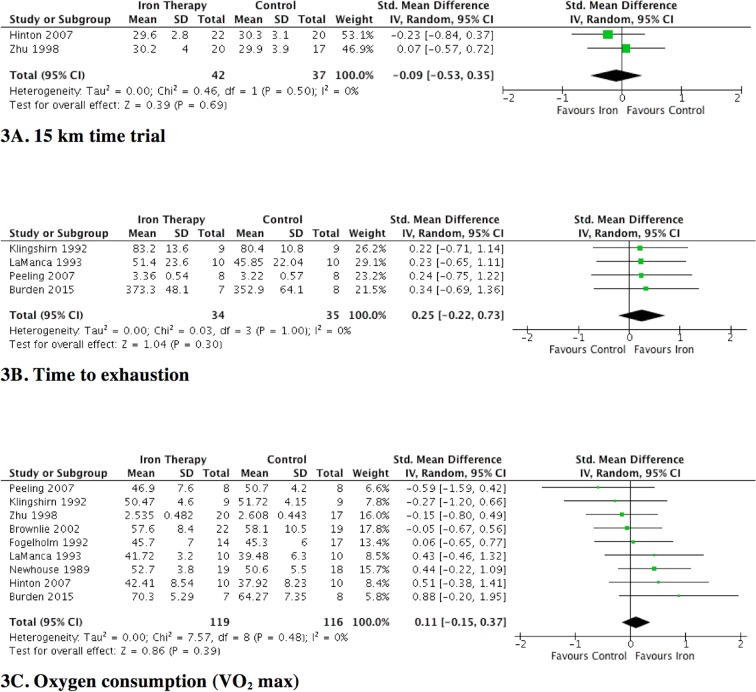
- Iron did not significantly improve objective physical capacity: VO₂ max (SMD 0.11; 95% CI −0.15 to 0.37; I² 0%; 9 trials; 235 participants), 15 km time trial (SMD −0.09; 95% CI −0.53 to 0.35; I² 0%; 2 trials; 79 participants), or time to exhaustion (SMD 0.25; 95% CI −0.22 to 0.73; I² 0%; 4 trials; 69 participants).
- Iron significantly increased serum haemoglobin (MD 4.01 g/L; 95% CI 1.22 to 6.81; I² 48%; 12 trials; 298 participants) and serum ferritin (MD 9.23 µmol/L; 95% CI 6.48 to 11.97; I² 58%; 14 trials; 616 participants). Adverse events were sparsely reported; adherence did not differ (RR 1.0; 95% CI 0.99 to 1.01; I² 0%; 12 trials; 958 participants).
Methods
- Systematic review and meta-analysis of randomised controlled trials in adults (≥18 years) who were iron deficient but non-anaemic, comparing oral, intramuscular, or intravenous iron with placebo or active therapy; outcomes assessed at least 28 days after starting therapy.
- Searched Medline, Embase, Cochrane Central Register of Controlled Trials, Cumulative Index of Nursing and Allied Health, SportDiscus, and CAB Abstracts from inception to 31 October 2016, plus trial registries and forward searches.
- Used Mantel-Haenszel random-effects meta-analysis, mean difference or standardised mean difference for continuous outcomes, I² for heterogeneity, Cochrane Risk of Bias tool, and GRADE; PROSPERO registration CRD42014007085.
Limitations
- Stated by the paper: search was limited to English studies; dietary iron fortification studies were excluded; masking oral iron was difficult due to predictable gastrointestinal side effects and stool colour changes; healthy women comprised the population in 15 of 18 trials; follow-up was relatively short (mean 57 days; range 28–112 days); adverse events were sparsely reported; most trials were at unclear risk of bias; publication bias could not be assessed for fatigue because of the low number of included trials.
- Evident from the text: subgroup analyses for biological sex, athletic status, and risk of bias were often unevaluable because contributing trials enrolled women of uncharacterised athletic status and were of unclear risk of bias; the fatigue outcome was subjective and potentially vulnerable to imperfect blinding.
Model-written summary. Check it against the paper before relying on it.
Integrity signals
Registry
Cites
Statistics
Figures

Verification
Claims the paper makes
22 Own result · 11 Own method · 7 Own interpretation · 4 Not checked yet · 3 No basis given · 2 Partly supported · 1 Supported so far · 1 No full text of the sources · accuracy not yet measured
The sources with a verdict support this claim; the rest weren’t checked yet, have no full text we could read, or their verdicts aren’t rated yet.
In the paper
“In trials where a proportion of participants were anaemic at enrolment and with the knowledge that anaemia results in decreased physical capacity, iron supplementation has previously been associated with improved maximal and submaximal exercise performance.5–8”
§ Efficacy of iron supplementation on fatigue and physical capacity in non-anaemic iron-deficient adults: a systematic review of randomised controlled trials > Discussion
What the sources say
- Not checked — no full text of the sourcecites [5] source
- Not checked — no full text of the sourcecites [6] Eichner, 2001, Fatigue of anemia, Nutr Rev source
- Not checked — no full text of the sourcecites [7] source
- Supportedcites [8] Haas, 2001, Iron deficiency and reduced work capacity: a critical review of the research to determine a causal relationship, J Nutr source
Table 4 (p. 690S) reports improved maximal oxygen uptake after iron supplementation in a trial that included participants with anemia. The Energetic efficiency section reports improved efficiency across five cycle-ergometer workloads in the same trial and notes that this analysis did not separate anemic from nonanemic participants. The submaximal finding concerns exercise efficiency, not endurance time. (LLM, conf=0.87)
plaincorrelational- Asserted: passes — The authors put it forward as true.
- Checkable: passes — It can be checked against evidence.
- Load-bearing: unclear — It is unclear whether the paper’s conclusions depend on it.
- Based: passes — The paper gives a reason why it holds.
A result the paper reports from its own data — it cites no other source for it, so there is none to check. The quote shows it is in the paper.
In the paper
“In four trials23 26 27 34 (69 participants) that used time-to-exhaustion tests, iron supplementation did not significantly improve physical capacity (SMD 0.25; 95% CI −0.22 to 0.73; I2 0%) (figure 3B).”
§ Efficacy of iron supplementation on fatigue and physical capacity in non-anaemic iron-deficient adults: a systematic review of randomised controlled trials > Results > Primary outcomes
plainn = 69- Asserted: passes — The authors put it forward as true.
- Checkable: passes — It can be checked against evidence.
- Load-bearing: passes — The paper’s conclusions depend on it.
- Based: passes — The paper gives a reason why it holds.
A result the paper reports from its own data — it cites no other source for it, so there is none to check. The quote shows it is in the paper.
In the paper
“Using a Mantel-Haenszel random-effects model, iron supplementation was associated with reduced self-reported fatigue (standardised mean difference (SMD) −0.38; 95% CI −0.52 to −0.23; I2 0%; 4 trials; 714 participants)”
- Also stated in: § Primary outcomes · plain
“Iron supplementation was associated with a reduction in subjective measures of fatigue when assessed by either the Piper Fatigue Scale,28 the Current and Past Psychological State scale,32 visual analogue scale33 or Brief Fatigue Inventory questionnaire (BFI)31 (SMD −0.38; 95% CI −0.52 to −0.23; I2 0%) (figure 2).”
- Also stated in: § Conclusion · plain
“In IDNA adults, iron supplementation is associated with reduced subjective measures of fatigue but not with objective improvements in physical capacity.”
§ Efficacy of iron supplementation on fatigue and physical capacity in non-anaemic iron-deficient adults: a systematic review of randomised controlled trials > Abstract > Results
plaincorrelationaln = 714- Asserted: passes — The authors put it forward as true.
- Checkable: passes — It can be checked against evidence.
- Load-bearing: passes — The paper’s conclusions depend on it.
- Based: passes — The paper gives a reason why it holds.
- Also stated in: § Primary outcomes · plain
A result the paper reports from its own data — it cites no other source for it, so there is none to check. The quote shows it is in the paper.
In the paper
“In two trials (79 participants) that used 15 km time trials,22 25 iron supplementation was not associated with improved exercise capacity (SMD −0.09; 95% CI −0.53 to 0.35; I2 0%) (figure 3A).”
§ Efficacy of iron supplementation on fatigue and physical capacity in non-anaemic iron-deficient adults: a systematic review of randomised controlled trials > Results > Primary outcomes
plaincorrelationaln = 79- Asserted: passes — The authors put it forward as true.
- Checkable: passes — It can be checked against evidence.
- Load-bearing: passes — The paper’s conclusions depend on it.
- Based: passes — The paper gives a reason why it holds.
A result the paper reports from its own data — it cites no other source for it, so there is none to check. The quote shows it is in the paper.
In the paper
“Subgroup analyses based on method of iron administration and duration of follow-up demonstrated no statistically significant differences in subjective fatigue (see online supplementary appendix 6).”
§ Efficacy of iron supplementation on fatigue and physical capacity in non-anaemic iron-deficient adults: a systematic review of randomised controlled trials > Results > Primary outcomes
boosted- Asserted: passes — The authors put it forward as true.
- Checkable: passes — It can be checked against evidence.
- Load-bearing: unclear — It is unclear whether the paper’s conclusions depend on it.
- Based: passes — The paper gives a reason why it holds.
The paper states this without a source or data behind it here, so there is nothing to check it against. The quote shows it is in the paper.
In the paper
“However, despite this, fatigue was consistently reduced in trials evaluating both oral (n=2) and intravenous (n=2) iron preparations.”
§ Efficacy of iron supplementation on fatigue and physical capacity in non-anaemic iron-deficient adults: a systematic review of randomised controlled trials > Discussion
plaindirectn = 2- Asserted: passes — The authors put it forward as true.
- Checkable: passes — It can be checked against evidence.
- Load-bearing: passes — The paper’s conclusions depend on it.
- Based: passes — The paper gives a reason why it holds.
The paper states this without a source or data behind it here, so there is nothing to check it against. The quote shows it is in the paper.
In the paper
“Healthy women comprised the study population in 15 of 18 included trials”
§ Efficacy of iron supplementation on fatigue and physical capacity in non-anaemic iron-deficient adults: a systematic review of randomised controlled trials > Discussion
plain- Asserted: passes — The authors put it forward as true.
- Checkable: passes — It can be checked against evidence.
- Load-bearing: passes — The paper’s conclusions depend on it.
- Based: passes — The paper gives a reason why it holds.
None of the sources cited for this claim have been checked yet.
In the paper
“In this trial, the decline in maximum voluntary contraction after 6 min of exercise was significantly less in participants randomised to receive iron.”
§ Efficacy of iron supplementation on fatigue and physical capacity in non-anaemic iron-deficient adults: a systematic review of randomised controlled trials > Results > Primary outcomes
plaindirectn = 20 ·- Asserted: passes — The authors put it forward as true.
- Checkable: passes — It can be checked against evidence.
- Load-bearing: unclear — It is unclear whether the paper’s conclusions depend on it.
- Based: passes — The paper gives a reason why it holds.
A result the paper reports from its own data — it cites no other source for it, so there is none to check. The quote shows it is in the paper.
In the paper
“Among 16 other unique measures of physical capacity, 19% (3 of 16) found statistically significant increases in measures of physical capacity with iron supplementation (see online supplementary appendix 5).”
§ Efficacy of iron supplementation on fatigue and physical capacity in non-anaemic iron-deficient adults: a systematic review of randomised controlled trials > Results > Primary outcomes
plaindirect- Asserted: passes — The authors put it forward as true.
- Checkable: passes — It can be checked against evidence.
- Load-bearing: unclear — It is unclear whether the paper’s conclusions depend on it.
- Based: passes — The paper gives a reason why it holds.
A result the paper reports from its own data — it cites no other source for it, so there is none to check. The quote shows it is in the paper.
In the paper
“Iron supplementation significantly increased serum haemoglobin concentration (MD 4.01 g/L; 95% CI 1.22 to 6.81; I2 48%; 12 trials; 298 participants)”
- Also stated in: § Secondary outcomes and adverse events · plain
“Despite the absence of baseline anaemia, iron supplementation significantly increased serum haemoglobin concentration (MD 4.01 g/L; 95% CI 1.22 to 6.81; I2 48%; 12 trials; 298 participants)18–27 30 34 (see online supplementary appendix 8).”
§ Efficacy of iron supplementation on fatigue and physical capacity in non-anaemic iron-deficient adults: a systematic review of randomised controlled trials > Abstract > Results
plaindirectn = 298- Asserted: passes — The authors put it forward as true.
- Checkable: passes — It can be checked against evidence.
- Load-bearing: unclear — It is unclear whether the paper’s conclusions depend on it.
- Based: passes — The paper gives a reason why it holds.
- Also stated in: § Secondary outcomes and adverse events · plain
None of the sources cited for this claim have been checked yet.
In the paper
“In two trials,25 28 reporting incident anaemia, a new diagnosis of anaemia at trial completion was less common in patients randomised to receive iron supplementation.”
§ Efficacy of iron supplementation on fatigue and physical capacity in non-anaemic iron-deficient adults: a systematic review of randomised controlled trials > Results > Secondary outcomes and adverse events
plaindirect- Asserted: passes — The authors put it forward as true.
- Checkable: passes — It can be checked against evidence.
- Load-bearing: unclear — It is unclear whether the paper’s conclusions depend on it.
- Based: passes — The paper gives a reason why it holds.
A result the paper reports from its own data — it cites no other source for it, so there is none to check. The quote shows it is in the paper.
In the paper
“and serum ferritin (MD 9.23 µmol/L; 95% CI 6.48 to 11.97; I2 58%; 14 trials; 616 participants).”
- Also stated in: § Secondary outcomes and adverse events · plain
“Iron supplementation also significantly increased serum ferritin (MD 9.23 µmol/L; 95% CI 6.48 to 11.97; I2 58%; 14 trials; 616 participants) (see online supplementary appendix 9).”
§ Efficacy of iron supplementation on fatigue and physical capacity in non-anaemic iron-deficient adults: a systematic review of randomised controlled trials > Abstract > Results
plaindirectn = 616- Asserted: passes — The authors put it forward as true.
- Checkable: passes — It can be checked against evidence.
- Load-bearing: unclear — It is unclear whether the paper’s conclusions depend on it.
- Based: passes — The paper gives a reason why it holds.
- Also stated in: § Secondary outcomes and adverse events · plain
A result the paper reports from its own data — it cites no other source for it, so there is none to check. The quote shows it is in the paper.
In the paper
“The route of administration of the study intervention was also not associated with differences in adherence (see online supplementary appendix 11).”
§ Efficacy of iron supplementation on fatigue and physical capacity in non-anaemic iron-deficient adults: a systematic review of randomised controlled trials > Results > Secondary outcomes and adverse events
plain- Asserted: passes — The authors put it forward as true.
- Checkable: passes — It can be checked against evidence.
- Load-bearing: unclear — It is unclear whether the paper’s conclusions depend on it.
- Based: passes — The paper gives a reason why it holds.
A result the paper reports from its own data — it cites no other source for it, so there is none to check. The quote shows it is in the paper.
In the paper
“Subgroup analyses evaluating athletic status and method of iron administration demonstrated no statistically significant differences in objective physical capacity (see online supplementary appendix 7).”
§ Efficacy of iron supplementation on fatigue and physical capacity in non-anaemic iron-deficient adults: a systematic review of randomised controlled trials > Results > Primary outcomes
boosted- Asserted: passes — The authors put it forward as true.
- Checkable: passes — It can be checked against evidence.
- Load-bearing: unclear — It is unclear whether the paper’s conclusions depend on it.
- Based: passes — The paper gives a reason why it holds.
A result the paper reports from its own data — it cites no other source for it, so there is none to check. The quote shows it is in the paper.
In the paper
“Iron supplementation was not associated with differential rates of medication adherence (RR 1.0; CI 95% 0.99 to 1.01; I2 0%; 12 trials; 958 participants).”
§ Efficacy of iron supplementation on fatigue and physical capacity in non-anaemic iron-deficient adults: a systematic review of randomised controlled trials > Results > Secondary outcomes and adverse events
plainn = 958- Asserted: passes — The authors put it forward as true.
- Checkable: passes — It can be checked against evidence.
- Load-bearing: unclear — It is unclear whether the paper’s conclusions depend on it.
- Based: passes — The paper gives a reason why it holds.
A result the paper reports from its own data — it cites no other source for it, so there is none to check. The quote shows it is in the paper.
In the paper
“Nine trials19 22–27 30 34 (235 participants) reported VO2 max as a surrogate measure of physical capacity. Iron supplementation did not increase VO2 max (SMD 0.11; 95% CI −0.15 to 0.37; I2 0%) (figure 3C).”
§ Efficacy of iron supplementation on fatigue and physical capacity in non-anaemic iron-deficient adults: a systematic review of randomised controlled trials > Results > Primary outcomes
plainn = 235- Asserted: passes — The authors put it forward as true.
- Checkable: passes — It can be checked against evidence.
- Load-bearing: passes — The paper’s conclusions depend on it.
- Based: passes — The paper gives a reason why it holds.
A conclusion the paper draws from its own results — it cites no other source for it, so there is none to check. The quote shows it is in the paper.
In the paper
“but was not associated with differences in objective measures of physical capacity, including maximal oxygen consumption (SMD 0.11; 95% CI −0.15 to 0.37; I2 0%; 9 trials; 235 participants) and timed methods of exercise testing.”
- Also stated in: § Conclusion · plain
“In IDNA adults, iron supplementation is associated with reduced subjective measures of fatigue but not with objective improvements in physical capacity.”
§ Efficacy of iron supplementation on fatigue and physical capacity in non-anaemic iron-deficient adults: a systematic review of randomised controlled trials > Abstract > Results
plainn = 235- Asserted: passes — The authors put it forward as true.
- Checkable: passes — It can be checked against evidence.
- Load-bearing: passes — The paper’s conclusions depend on it.
- Based: passes — The paper gives a reason why it holds.
- Also stated in: § Conclusion · plain
A conclusion the paper draws from its own results — it cites no other source for it, so there is none to check. The quote shows it is in the paper.
In the paper
“While cut-offs for anaemia varied slightly among included trials, this important inclusion criteria reduces (but may not eliminate) the probability that changes in fatigue or muscle function are due to correction of anaemia.”
§ Efficacy of iron supplementation on fatigue and physical capacity in non-anaemic iron-deficient adults: a systematic review of randomised controlled trials > Discussion
hedgedconditional- Asserted: passes — The authors put it forward as true.
- Checkable: passes — It can be checked against evidence.
- Load-bearing: passes — The paper’s conclusions depend on it.
- Based: passes — The paper gives a reason why it holds.
A conclusion the paper draws from its own results — it cites no other source for it, so there is none to check. The quote shows it is in the paper.
In the paper
“Finally, the lack of systematic reporting of adverse events impairs our ability to draw conclusions regarding the incidence of these events and tolerability of iron therapy.”
§ Efficacy of iron supplementation on fatigue and physical capacity in non-anaemic iron-deficient adults: a systematic review of randomised controlled trials > Discussion
plaindirect- Asserted: passes — The authors put it forward as true.
- Checkable: passes — It can be checked against evidence.
- Load-bearing: passes — The paper’s conclusions depend on it.
- Based: passes — The paper gives a reason why it holds.
What the paper did — it cites no source for this, so there is none to check. The quote shows it is in the paper.
In the paper
“We found no evidence of funnel plot asymmetry to suggest publication bias for this outcome (see online supplementary appendix 4).”
§ Efficacy of iron supplementation on fatigue and physical capacity in non-anaemic iron-deficient adults: a systematic review of randomised controlled trials > Results > Primary outcomes
plainn = 291- Asserted: passes — The authors put it forward as true.
- Checkable: passes — It can be checked against evidence.
- Load-bearing: unclear — It is unclear whether the paper’s conclusions depend on it.
- Based: passes — The paper gives a reason why it holds.
What the paper did — it cites no source for this, so there is none to check. The quote shows it is in the paper.
In the paper
“The overall strength of the evidence for time trial, time to exhaustion and VO2 max outcomes were low, given the imprecision of effect estimates and that the majority of trials were of unclear risk of bias.”
§ Efficacy of iron supplementation on fatigue and physical capacity in non-anaemic iron-deficient adults: a systematic review of randomised controlled trials > Results > Primary outcomes
plainn = 291- Asserted: passes — The authors put it forward as true.
- Checkable: passes — It can be checked against evidence.
- Load-bearing: passes — The paper’s conclusions depend on it.
- Based: passes — The paper gives a reason why it holds.
A conclusion the paper draws from its own results — it cites no other source for it, so there is none to check. The quote shows it is in the paper.
In the paper
“We found insufficient evidence to suggest that iron supplementation improves exercise capacity in iron-depleted non-anaemic adults, differing from the results of physiological experiments that describe VO2 max improvements with iron supplementation, independent of haemoglobin.40”
§ Efficacy of iron supplementation on fatigue and physical capacity in non-anaemic iron-deficient adults: a systematic review of randomised controlled trials > Discussion
hedged- Asserted: passes — The authors put it forward as true.
- Checkable: passes — It can be checked against evidence.
- Load-bearing: passes — The paper’s conclusions depend on it.
- Based: passes — The paper gives a reason why it holds.
What the paper did — it cites no source for this, so there is none to check. The quote shows it is in the paper.
In the paper
“Given that the majority of trials were of unclear risk of bias, we graded the overall strength of evidence as moderate.”
§ Efficacy of iron supplementation on fatigue and physical capacity in non-anaemic iron-deficient adults: a systematic review of randomised controlled trials > Results > Primary outcomes
plainn = 714- Asserted: passes — The authors put it forward as true.
- Checkable: passes — It can be checked against evidence.
- Load-bearing: passes — The paper’s conclusions depend on it.
- Based: passes — The paper gives a reason why it holds.
A conclusion the paper draws from its own results — it cites no other source for it, so there is none to check. The quote shows it is in the paper.
In the paper
“Given iron deficiency is the most prevalent micronutrient deficiency worldwide,2 there is a discrepant lack of robust evidence evaluating iron supplementation in the absence of anaemia across important patient populations.”
§ Efficacy of iron supplementation on fatigue and physical capacity in non-anaemic iron-deficient adults: a systematic review of randomised controlled trials > Discussion
plainn = 1,170- Asserted: passes — The authors put it forward as true.
- Checkable: passes — It can be checked against evidence.
- Load-bearing: passes — The paper’s conclusions depend on it.
- Based: passes — The paper gives a reason why it holds.
What the paper did — it cites no source for this, so there is none to check. The quote shows it is in the paper.
In the paper
“In contrast to the systematic review of Low et al,37 we excluded studies that enrolled patients with anaemia at baseline.37”
§ Efficacy of iron supplementation on fatigue and physical capacity in non-anaemic iron-deficient adults: a systematic review of randomised controlled trials > Discussion
plain- Asserted: passes — The authors put it forward as true.
- Checkable: passes — It can be checked against evidence.
- Load-bearing: passes — The paper’s conclusions depend on it.
- Based: passes — The paper gives a reason why it holds.
A conclusion the paper draws from its own results — it cites no other source for it, so there is none to check. The quote shows it is in the paper.
In the paper
“subjective measures of fatigue may not consistently apply to other at-risk populations.”
§ Efficacy of iron supplementation on fatigue and physical capacity in non-anaemic iron-deficient adults: a systematic review of randomised controlled trials > Discussion
hedged- Asserted: passes — The authors put it forward as true.
- Checkable: passes — It can be checked against evidence.
- Load-bearing: unclear — It is unclear whether the paper’s conclusions depend on it.
- Based: passes — The paper gives a reason why it holds.
- It may state two separate claims as one. 16
- Probably not a substantial claim. 16
The cited sources support only part of this claim — read each source’s verdict below.
In the paper
“Two systematic reviews included studies of pregnant women, blood donors and children and included data from both randomised and non-randomised trials.38 39 These studies concluded benefit of iron supplementation, although in the review by Yokoi and Konomi39, the benefit was limited to randomised controlled trials.”
§ Efficacy of iron supplementation on fatigue and physical capacity in non-anaemic iron-deficient adults: a systematic review of randomised controlled trials > Discussion
What the sources say
- Not checked — no full text of the sourcecites [38] Pratt, 2016, Non-anaemic iron deficiency—a disease looking for recognition of diagnosis: a systematic review, Eur J Haematol source
- Partly supportedcites [39] Yokoi, 2017, Iron deficiency without anaemia is a potential cause of fatigue: meta-analyses of randomised controlled trials and cross-sectional studies, Br J Nutr sourceExperimental — accuracy not yet measured
The Study selection and characteristics section reports six randomised controlled trials and six cross-sectional studies, including an RCT involving blood donors. The Meta-analysis section reports a significant benefit of iron treatment for fatigue in the RCTs. This paper does not establish that its included studies involved pregnant women or children, and its cross-sectional studies were observational studies, not non-randomised trials. (LLM, conf=0.85)
plaindirect- Asserted: passes — The authors put it forward as true.
- Checkable: passes — It can be checked against evidence.
- Load-bearing: unclear — It is unclear whether the paper’s conclusions depend on it.
- Based: passes — The paper gives a reason why it holds.
It may state two separate claims as one.
The cited sources support only part of this claim — read each source’s verdict below.
In the paper
“In a systematic review of healthy menstruating women, iron supplementation, irrespective of iron status or anaemia, improved haemoglobin and measures of iron stores.37”
§ Efficacy of iron supplementation on fatigue and physical capacity in non-anaemic iron-deficient adults: a systematic review of randomised controlled trials > Discussion
What the sources say
- Partly supportedcites [37] Low, 2016, Daily iron supplementation for improving anaemia, iron status and health in menstruating women, Cochrane Database Syst Rev sourceExperimental — accuracy not yet measured
The Discussion (Summary of main results; page unavailable) reports increased haemoglobin and iron stores among women receiving iron. But the Subgroup analysis (page unavailable) says iron did not improve haemoglobin in iron-replete women, so the claim's ‘irrespective of iron status’ qualification is not supported. (LLM, conf=0.88)
plaindirect- Asserted: passes — The authors put it forward as true.
- Checkable: passes — It can be checked against evidence.
- Load-bearing: fails — The paper’s conclusions may not depend on it.
- Based: passes — The paper gives a reason why it holds.
Probably not a substantial claim. The paper’s conclusions may not depend on it. It may state two separate claims as one.
- Partly supported
A result the paper reports from its own data — it cites no other source for it, so there is none to check. The quote shows it is in the paper.
In the paper
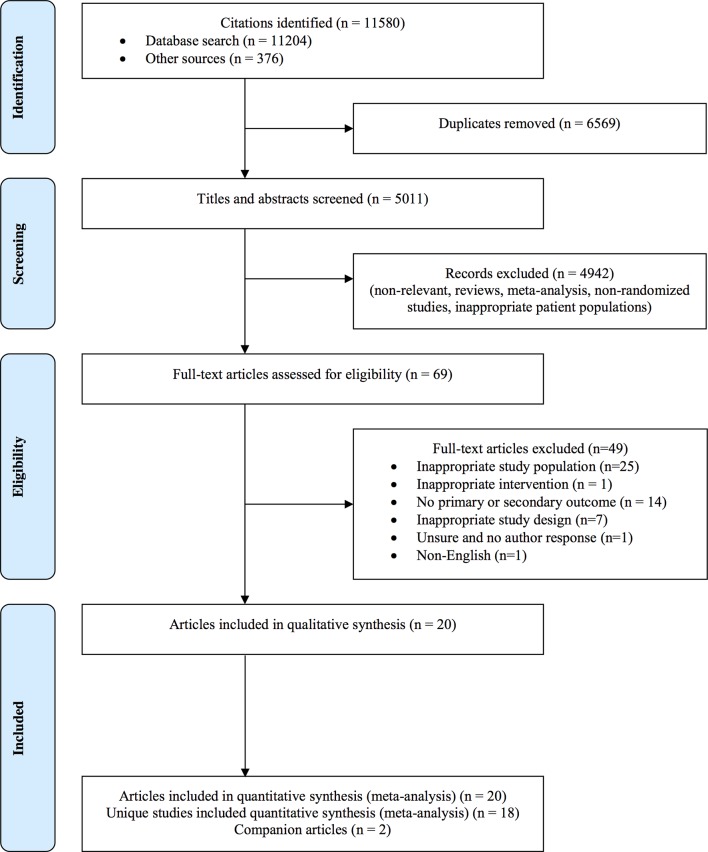
“From 11 580 citations, we included 18 unique trials and 2 companion papers enrolling 1170 patients.”
- Also stated in: § Trial characteristics and study populations · plain
“Of the 11 580 citations identified, we included 18 unique trials and 2 companion papers,17 18 enrolling 1170 subjects (figure 1; table 1).”
§ Efficacy of iron supplementation on fatigue and physical capacity in non-anaemic iron-deficient adults: a systematic review of randomised controlled trials > Abstract > Results
plainn = 1,170- Asserted: passes — The authors put it forward as true.
- Checkable: passes — It can be checked against evidence.
- Load-bearing: fails — The paper’s conclusions may not depend on it.
- Based: passes — The paper gives a reason why it holds.
Probably not a substantial claim. The paper’s conclusions may not depend on it. It may state two separate claims as one.
- Also stated in: § Trial characteristics and study populations · plain
None of the sources cited for this claim have been checked yet.
In the paper
“In one trial using the BFI score, fatigue was not significantly different between groups after 12 weeks, although it was improved in the subgroup of participants with the lowest iron stores (ferritin ≤15 ng/mL or transferrin saturation ≤20%).31”
§ Efficacy of iron supplementation on fatigue and physical capacity in non-anaemic iron-deficient adults: a systematic review of randomised controlled trials > Results > Primary outcomes
plain- Asserted: passes — The authors put it forward as true.
- Checkable: passes — It can be checked against evidence.
- Load-bearing: unclear — It is unclear whether the paper’s conclusions depend on it.
- Based: passes — The paper gives a reason why it holds.
It may state two separate claims as one.
The paper states this without a source or data behind it here, so there is nothing to check it against. The quote shows it is in the paper.
In the paper
“All trials were placebo controlled.”
§ Efficacy of iron supplementation on fatigue and physical capacity in non-anaemic iron-deficient adults: a systematic review of randomised controlled trials > Results > Trial characteristics and study populations
plain- Asserted: passes — The authors put it forward as true.
- Checkable: passes — It can be checked against evidence.
- Load-bearing: fails — The paper’s conclusions may not depend on it.
- Based: passes — The paper gives a reason why it holds.
Probably not a substantial claim. The paper’s conclusions may not depend on it.
A result the paper reports from its own data — it cites no other source for it, so there is none to check. The quote shows it is in the paper.
In the paper
“Among all studies, the mean duration of iron therapy was 46 days (±30 days; range 1–112 days), and mean duration of follow-up was 57 days (±24 days; range 28–112 days).”
§ Efficacy of iron supplementation on fatigue and physical capacity in non-anaemic iron-deficient adults: a systematic review of randomised controlled trials > Results > Interventions
plain- Asserted: passes — The authors put it forward as true.
- Checkable: passes — It can be checked against evidence.
- Load-bearing: fails — The paper’s conclusions may not depend on it.
- Based: passes — The paper gives a reason why it holds.
Probably not a substantial claim. The paper’s conclusions may not depend on it. It may state two separate claims as one.
A result the paper reports from its own data — it cites no other source for it, so there is none to check. The quote shows it is in the paper.
In the paper
“Physical capacity was reported in 10 trials19 20 22–27 30 34 (291 participants)”
§ Efficacy of iron supplementation on fatigue and physical capacity in non-anaemic iron-deficient adults: a systematic review of randomised controlled trials > Results > Primary outcomes
plainn = 291- Asserted: passes — The authors put it forward as true.
- Checkable: passes — It can be checked against evidence.
- Load-bearing: passes — The paper’s conclusions depend on it.
- Based: passes — The paper gives a reason why it holds.
Probably not a substantial claim.
A result the paper reports from its own data — it cites no other source for it, so there is none to check. The quote shows it is in the paper.
In the paper
“Despite rigorous and systematic methodology, we were only able to identify 18 trials enrolling 1170 adults, representing a minute fraction of affected individuals.”
§ Efficacy of iron supplementation on fatigue and physical capacity in non-anaemic iron-deficient adults: a systematic review of randomised controlled trials > Discussion
plainn = 1,170- Asserted: passes — The authors put it forward as true.
- Checkable: passes — It can be checked against evidence.
- Load-bearing: passes — The paper’s conclusions depend on it.
- Based: passes — The paper gives a reason why it holds.
It may state two separate claims as one.
A result the paper reports from its own data — it cites no other source for it, so there is none to check. The quote shows it is in the paper.
In the paper
“Biological sex, athletic status (athlete vs non-athlete) and risk of bias could not be evaluated as all trials contributing data to the meta-analyses enrolled women of uncharacterised athletic status and were of unclear risk of bias.28 31–33”
§ Efficacy of iron supplementation on fatigue and physical capacity in non-anaemic iron-deficient adults: a systematic review of randomised controlled trials > Results > Primary outcomes
plain- Asserted: passes — The authors put it forward as true.
- Checkable: passes — It can be checked against evidence.
- Load-bearing: unclear — It is unclear whether the paper’s conclusions depend on it.
- Based: passes — The paper gives a reason why it holds.
It may state two separate claims as one.
A result the paper reports from its own data — it cites no other source for it, so there is none to check. The quote shows it is in the paper.
In the paper
“Biological sex, duration of follow-up and risk of bias were unevaluable as all trials enrolled women with follow-up of less than 2 months and all were of unclear risk of bias.19 22–27 30 34”
§ Efficacy of iron supplementation on fatigue and physical capacity in non-anaemic iron-deficient adults: a systematic review of randomised controlled trials > Results > Primary outcomes
plain- Asserted: passes — The authors put it forward as true.
- Checkable: passes — It can be checked against evidence.
- Load-bearing: unclear — It is unclear whether the paper’s conclusions depend on it.
- Based: passes — The paper gives a reason why it holds.
It may state two separate claims as one.
A result the paper reports from its own data — it cites no other source for it, so there is none to check. The quote shows it is in the paper.
In the paper
“In trials using oral iron,19–26 29 30 32 33 35 36 the mean daily elemental iron dose was 86.9 mg (±49.1 mg; range: 16–200 mg).”
§ Efficacy of iron supplementation on fatigue and physical capacity in non-anaemic iron-deficient adults: a systematic review of randomised controlled trials > Results > Interventions
plainn = 713- Asserted: passes — The authors put it forward as true.
- Checkable: passes — It can be checked against evidence.
- Load-bearing: fails — The paper’s conclusions may not depend on it.
- Based: passes — The paper gives a reason why it holds.
Probably not a substantial claim. The paper’s conclusions may not depend on it.
None of the sources cited for this claim have been checked yet.
In the paper
“Constipation was reported in one trial18 and diarrhoea in two trials18 31 (see online supplementary appendix 10).”
§ Efficacy of iron supplementation on fatigue and physical capacity in non-anaemic iron-deficient adults: a systematic review of randomised controlled trials > Results > Secondary outcomes and adverse events
plain- Asserted: passes — The authors put it forward as true.
- Checkable: passes — It can be checked against evidence.
- Load-bearing: fails — The paper’s conclusions may not depend on it.
- Based: passes — The paper gives a reason why it holds.
Probably not a substantial claim. The paper’s conclusions may not depend on it. It may state two separate claims as one.
A result the paper reports from its own data — it cites no other source for it, so there is none to check. The quote shows it is in the paper.
In the paper
“The WHO cut-off for anaemia (haemoglobin concentration > 130 g/L (males) and > 120 g/L (females)) was used by nine studies,19 22–25 30–32 35 whereas seven studies used lower values ranging from > 110 to <120 g/L,20 21 27 28 33 34 36 and baseline haemoglobin concentration was not provided in two trial reports.26 29”
§ Efficacy of iron supplementation on fatigue and physical capacity in non-anaemic iron-deficient adults: a systematic review of randomised controlled trials > Results > Trial characteristics and study populations
plain- Asserted: passes — The authors put it forward as true.
- Checkable: passes — It can be checked against evidence.
- Load-bearing: fails — The paper’s conclusions may not depend on it.
- Based: passes — The paper gives a reason why it holds.
Probably not a substantial claim. The paper’s conclusions may not depend on it. It may state two separate claims as one.
A result the paper reports from its own data — it cites no other source for it, so there is none to check. The quote shows it is in the paper.
In the paper
“Nausea was reported in four trials18 28 31 33; two trials28 31 using intravenous administration of iron reported significantly increased nausea, whereas nausea was not increased in patients who received iron by oral administration.18 33”
§ Efficacy of iron supplementation on fatigue and physical capacity in non-anaemic iron-deficient adults: a systematic review of randomised controlled trials > Results > Secondary outcomes and adverse events
plaindirect- Asserted: passes — The authors put it forward as true.
- Checkable: passes — It can be checked against evidence.
- Load-bearing: unclear — It is unclear whether the paper’s conclusions depend on it.
- Based: passes — The paper gives a reason why it holds.
It may state two separate claims as one.
A result the paper reports from its own data — it cites no other source for it, so there is none to check. The quote shows it is in the paper.
In the paper
“Adherence with the study intervention was reported in 13 trials.18 19 22–29 32 33 35”
§ Efficacy of iron supplementation on fatigue and physical capacity in non-anaemic iron-deficient adults: a systematic review of randomised controlled trials > Results > Secondary outcomes and adverse events
plain- Asserted: passes — The authors put it forward as true.
- Checkable: passes — It can be checked against evidence.
- Load-bearing: fails — The paper’s conclusions may not depend on it.
- Based: passes — The paper gives a reason why it holds.
Probably not a substantial claim. The paper’s conclusions may not depend on it.
A result the paper reports from its own data — it cites no other source for it, so there is none to check. The quote shows it is in the paper.
In the paper
“Gastrointestinal intolerance was reported in three trials23 29 32 and was significantly increased in one trial29 using intramuscular iron administration but not in the two trials23 32 that used oral administration.”
§ Efficacy of iron supplementation on fatigue and physical capacity in non-anaemic iron-deficient adults: a systematic review of randomised controlled trials > Results > Secondary outcomes and adverse events
plaindirect- Asserted: passes — The authors put it forward as true.
- Checkable: passes — It can be checked against evidence.
- Load-bearing: unclear — It is unclear whether the paper’s conclusions depend on it.
- Based: passes — The paper gives a reason why it holds.
It may state two separate claims as one.
What the paper did — it cites no source for this, so there is none to check. The quote shows it is in the paper.
In the paper
“Likewise, 10 trials (55%) adequately incorporated blinded outcome assessment.”
§ Efficacy of iron supplementation on fatigue and physical capacity in non-anaemic iron-deficient adults: a systematic review of randomised controlled trials > Results > Trial characteristics and study populations
plain- Asserted: passes — The authors put it forward as true.
- Checkable: passes — It can be checked against evidence.
- Load-bearing: fails — The paper’s conclusions may not depend on it.
- Based: passes — The paper gives a reason why it holds.
Probably not a substantial claim. The paper’s conclusions may not depend on it.
What the paper did — it cites no source for this, so there is none to check. The quote shows it is in the paper.
In the paper
“In 13 of 18 trials (72%), we considered the blinding of participants and personnel to be adequate.”
§ Efficacy of iron supplementation on fatigue and physical capacity in non-anaemic iron-deficient adults: a systematic review of randomised controlled trials > Results > Trial characteristics and study populations
plain- Asserted: passes — The authors put it forward as true.
- Checkable: passes — It can be checked against evidence.
- Load-bearing: fails — The paper’s conclusions may not depend on it.
- Based: passes — The paper gives a reason why it holds.
Probably not a substantial claim. The paper’s conclusions may not depend on it.
In the paper
“While the duration of follow-up in most studies was modest, the mean daily elemental iron dose (86.9±49.1 mg) reflects a recommended ‘treatment’ for patients with iron-deficiency anaemia.41”
§ Efficacy of iron supplementation on fatigue and physical capacity in non-anaemic iron-deficient adults: a systematic review of randomised controlled trials > Discussion
What the sources say
- Not checked — no full text of the sourcecites [41] source
plain- Asserted: passes — The authors put it forward as true.
- Checkable: passes — It can be checked against evidence.
- Load-bearing: fails — The paper’s conclusions may not depend on it.
- Based: passes — The paper gives a reason why it holds.
Probably not a substantial claim. The paper’s conclusions may not depend on it.
What the paper did — it cites no source for this, so there is none to check. The quote shows it is in the paper.
In the paper
“One trial29 was considered to have a low risk of bias (table 2).”
§ Efficacy of iron supplementation on fatigue and physical capacity in non-anaemic iron-deficient adults: a systematic review of randomised controlled trials > Results > Trial characteristics and study populations
plain- Asserted: passes — The authors put it forward as true.
- Checkable: passes — It can be checked against evidence.
- Load-bearing: fails — The paper’s conclusions may not depend on it.
- Based: passes — The paper gives a reason why it holds.
Probably not a substantial claim. The paper’s conclusions may not depend on it.
What the paper did — it cites no source for this, so there is none to check. The quote shows it is in the paper.
In the paper
“The strengths of this review include the comprehensiveness of the search strategy, which included electronic databases, trial registries and forward searches.”
§ Efficacy of iron supplementation on fatigue and physical capacity in non-anaemic iron-deficient adults: a systematic review of randomised controlled trials > Discussion
plain- Asserted: passes — The authors put it forward as true.
- Checkable: passes — It can be checked against evidence.
- Load-bearing: fails — The paper’s conclusions may not depend on it.
- Based: passes — The paper gives a reason why it holds.
Probably not a substantial claim. The paper’s conclusions may not depend on it.
What the paper did — it cites no source for this, so there is none to check. The quote shows it is in the paper.
In the paper
“We used a comprehensive search strategy, an a priori protocol and adhered to established methodological (eg, Preferred Reporting Items for Systematic Reviews and Meta-Analyses, Grading of Recommendations Assessment, Development and Evaluation) guidelines.”
- Also stated in: § Discussion · plain
“We used an a priori published protocol and followed established methodological guidelines concerning the conduct and reporting of this review.”
§ Efficacy of iron supplementation on fatigue and physical capacity in non-anaemic iron-deficient adults: a systematic review of randomised controlled trials > Abstract > PROSPERO registration number
plain- Asserted: passes — The authors put it forward as true.
- Checkable: passes — It can be checked against evidence.
- Load-bearing: fails — The paper’s conclusions may not depend on it.
- Based: passes — The paper gives a reason why it holds.
Probably not a substantial claim. The paper’s conclusions may not depend on it. It may state two separate claims as one.
- Also stated in: § Discussion · plain
What the paper did — it cites no source for this, so there is none to check. The quote shows it is in the paper.
In the paper
“The remainder of the trials were considered unclear risk of bias due to unclear processes of randomisation (12 trials19–27 30 33 34) or allocation concealment (13 trials19–27 30 31 34 35).”
§ Efficacy of iron supplementation on fatigue and physical capacity in non-anaemic iron-deficient adults: a systematic review of randomised controlled trials > Results > Trial characteristics and study populations
plain- Asserted: passes — The authors put it forward as true.
- Checkable: passes — It can be checked against evidence.
- Load-bearing: fails — The paper’s conclusions may not depend on it.
- Based: passes — The paper gives a reason why it holds.
Probably not a substantial claim. The paper’s conclusions may not depend on it. It may state two separate claims as one.
What the paper did — it cites no source for this, so there is none to check. The quote shows it is in the paper.
In the paper
“A potential weakness our systematic review is the difficulty masking oral iron due to predictable gastrointestinal side effects and changes in stool colour and the impact of imperfect blinding on subjective measures of fatigue.”
§ Efficacy of iron supplementation on fatigue and physical capacity in non-anaemic iron-deficient adults: a systematic review of randomised controlled trials > Discussion
hedged- Asserted: passes — The authors put it forward as true.
- Checkable: passes — It can be checked against evidence.
- Load-bearing: unclear — It is unclear whether the paper’s conclusions depend on it.
- Based: passes — The paper gives a reason why it holds.
It may state two separate claims as one.
A conclusion the paper draws from its own results — it cites no other source for it, so there is none to check. The quote shows it is in the paper.
In the paper
“The duration of follow-up was relatively short (57 days; range 28–112 days) and perhaps too brief to expect significant changes in muscle metabolism or function.”
§ Efficacy of iron supplementation on fatigue and physical capacity in non-anaemic iron-deficient adults: a systematic review of randomised controlled trials > Discussion
hedged- Asserted: passes — The authors put it forward as true.
- Checkable: passes — It can be checked against evidence.
- Load-bearing: passes — The paper’s conclusions depend on it.
- Based: passes — The paper gives a reason why it holds.
It may state two separate claims as one.
The paper relies on this without support.
It is unclear whether iron supplementation affects fatigue and physical capacity in iron-deficient but non-anaemic individuals.
“While iron replacement can normalise haemoglobin concentration, restore work capacity and improve fatigue in iron-deficiency anaemia, it is unclear if supplementation affects fatigue and physical capacity in iron-deficient but non-anaemic (IDNA) individuals.”
The paper relies on this without support.
The use of iron supplements is common in the general population and routinely recommended to high performance athletes to enhance performance.
“In the absence of compelling efficacy data on well-being or muscle function, the use of iron supplements is common in the general population and are routinely recommended to high performance athletes to enhance performance.”
Claims other papers make about this one
Each is checked against this paper’s own text: does it say what the citing paper says it does?
In the citing paper
“Iron supplementation thus helps in recovery from perceived fatigue above the placebo effect.”
From Vitamins and Minerals for Energy, Fatigue and Cognition: A Narrative Review of the Biochemical and Clinical Evidence (2020) · cites this paper as [128]
Self-check
Percentages, sums and reported differences re-computed from the paper’s own numbers.
Each contradiction between two passages listed here was confirmed by an independent check.
Rated major: it would touch a result — a value a result rests on, reported and recomputed p-values on opposite sides of the significance level, two passages that conflict with no sign which is right, or a cited work retracted before this paper was published.
In the paper
§ Efficacy of iron supplementation on fatigue and physical capacity in non-anaemic iron-deficient adults: a systematic review of randomised controlled trials > Results > Secondary outcomes and adverse events
“one trial29 using intramuscular iron administration”
§ Efficacy of iron supplementation on fatigue and physical capacity in non-anaemic iron-deficient adults: a systematic review of randomised controlled trials > Results > Trial characteristics and study populations
“| 6 | Flink et al 29 | Individuals with low unstimulated salivary flow | 25 | 21 | Placebo | 15–46 | | 30 (F); 50 (M) | Ferrous fumarate | 120 | PO | 90 | 90 |”
Rated minor: it would not touch a result — a value no result rests on, a p-value that stays on the same side of the significance level, or a conflict that is clerical, resolved elsewhere in the paper, or outside its own findings.
In the paper
§ Efficacy of iron supplementation on fatigue and physical capacity in non-anaemic iron-deficient adults: a systematic review of randomised controlled trials > Results > Trial characteristics and study populations
“All trials were placebo controlled.”
§ Efficacy of iron supplementation on fatigue and physical capacity in non-anaemic iron-deficient adults: a systematic review of randomised controlled trials > Results > Trial characteristics and study populations
“| 4 | Donangelo et al 21 | Young women | 12 | 11 | Zinc gluconate | 20–28 | 110 | 20 | Ferrous sulfate | 100 | PO | 56 | 70 |”
Citations
Cites
Quantifying heterogeneity in a meta‐analysis
Higgins, J. P. T., & Thompson, S. G. (2002) · Statistics in Medicine · doi:10.1002/sim.1186 · Cited by 36,763
Liberati, A., Altman, D. G., Tetzlaff, J., Mulrow, C., Gøtzsche, P. C., Ioannidis, J. P. A., Clarke, M., Devereaux, P. J., Kleijnen, J., & Moher, D. (2009) · PLoS Medicine · doi:10.1371/journal.pmed.1000100 · Cited by 28,164
Liberati, A., Altman, D. G., Tetzlaff, J., Mulrow, C., Gotzsche, P. C., Ioannidis, J. P. A., Clarke, M., Devereaux, P. J., Kleijnen, J., & Moher, D. (2009) · BMJ · doi:10.1136/bmj.b2700 · Cited by 17,648
Worldwide prevalence of anaemia, WHO Vitamin and Mineral Nutrition Information System, 1993–2005
McLean, E., Cogswell, M., Egli, I., Wojdyla, D., & de Benoist, B. (2009) · Public Health Nutrition · doi:10.1017/s1368980008002401 · Cited by 2,734
Investigating and dealing with publication and other biases in meta-analysis
Sterne, J. A. C., Egger, M., & Smith, G. D. (2001) · BMJ · doi:10.1136/bmj.323.7304.101 · Cited by 2,225 · cited 1×
“For the primary outcomes of fatigue and work capacity, we evaluated potential publication bias using funnel plot analysis.(16) All tests of statistical inference reflect a two-sided alpha of 0.”
MethodA systematic analysis of global anemia burden from 1990 to 2010
Kassebaum, N. J., Jasrasaria, R., Naghavi, M., Wulf, S. K., Johns, N. E., Lozano, R., Regan, M. C., Weatherall, D. J., Chou, D. P., Eisele, T. P., et al. (2013) · Blood · doi:10.1182/blood-2013-06-508325 · Cited by 2,115
Camaschella, C. (2015) · New England Journal of Medicine · doi:10.1056/nejmra1401038 · Cited by 1,678
Haas, J. D., & Brownlie, T. (2001) · The Journal of Nutrition · doi:10.1093/jn/131.2.676s · Cited by 1,186
Vitamin and mineral status: effects on physical performance
Lukaski, H. C. (2004) · Nutrition · doi:10.1016/j.nut.2004.04.001 · Cited by 587
The epidemiology of fatigue: more questions than answers.
Lewis, G., & Wessely, S. C. (1992) · Journal of Epidemiology & Community Health · doi:10.1136/jech.46.2.92 · Cited by 498 · cited 1×
“Unfortunately, patient-reported fatigue is common in community and primary care settings with a prevalence ranging from 7% to 45%.(10) It is estimated that the indirect annual economic consequence of chronic fatigue in the USA is 9.”
Background
Research works printed but not linked: 1
- Hurrie D , Graham J , Rimmer E , et al . Efficacy of iron replacement therapy on fatigue and work capacity in non-anemic adults with iron depletion: a systematic review of randomized controlled trials. PROSPERO International prospective register of systematic reviews, 2014.
Cited by
Sorted by citations
Pasricha, S.-R., Tye-Din, J., Muckenthaler, M. U., & Swinkels, D. W. (2021) · The Lancet · doi:10.1016/s0140-6736(20)32594-0 · Cited by 1,069
Camaschella, C. (2019) · Blood · doi:10.1182/blood-2018-05-815944 · Cited by 702
Tardy, A.-L., Pouteau, E., Marquez, D., Yilmaz, C., & Scholey, A. (2020) · Nutrients · doi:10.3390/nu12010228 · Cited by 541
Snook, J. A., Bhala, N. B., Beales, I., Cannings, D., Kightley, C., Logan, R. P., Pritchard, D. M., Sidhu, R., Surgenor, S., Thomas, W., et al. (2021) · Gut · doi:10.1136/gutjnl-2021-325210 · Cited by 348
Iron considerations for the athlete: a narrative review
Sim, M., Garvican-Lewis, L. A., Cox, G. R., Govus, A., McKay, A. K. A., Stellingwerff, T., & Peeling, P. (2019) · European Journal of Applied Physiology · doi:10.1007/s00421-019-04157-y · Cited by 274
Metadata
- Authors
- Houston, B. L., Hurrie, D., Graham, J., Perija, B., Rimmer, E., Rabbani, R., Bernstein, C. N., Turgeon, A. F., Fergusson, D. A., Houston, D. S., Abou-Setta, A. M., & Zarychanski, R.
- Affiliations
- CancerCare Manitoba (CA)
- University of Manitoba (CA)
- Winnipeg Regional Health Authority (CA)
- Université Laval (CA)
- University of Ottawa (CA)
- Corresponding author
- Zarychanski, Ryan
- ORCID
- Venue
- BMJ Open
- Publisher
- BMJ
- Published
- 2018-04
- Volume
- 8
- Issue
- 4
- Pages
- e019240
- ISSN
- 2044-6055 (ISSN-L)
- PMC
- PMC5892776
- OpenAlex
- W2796265630
- Semantic Scholar
- 8c1c95bc5457146c9432f1a5ac8b1bb28520eeaa
- Cited by
- 126
- References
- 41
- Citations by year
- 2026: 12 · 2025: 16 · 2024: 20 · 2023: 13 · 2022: 16 · 2021: 17 · 2020: 15 · 2019: 13 · 2018: 4
- FWCI
- 2.89
- Type
- journal article
- Language
- en
- Open access
- gold
- doi.org
- Licence
- cc-by-nc
- Locations
- BMJ Open (publishedVersion, cc-by-nc)
- PubMed (publishedVersion)
- Europe PMC (PubMed Central) (submittedVersion, other-oa)
- PubMed Central (submittedVersion, cc-by-nc)
- Topics
- Health Sciences › Medicine › Hematology › Iron Metabolism and Disorders
- Health Sciences › Medicine › Hematology › Erythropoietin and Anemia Treatment
- Health Sciences › Medicine › Genetics (clinical) › Hemoglobinopathies and Related Disorders
- Keywords
- iron supplementation, iron deficiency anemia, fatigue, physical capacity, VO2max, exercise testing, serum ferritin, oral iron, intramuscular iron, intravenous iron, adverse effects, iron deficiency in pregnancy, iron deficiency in children
- MeSH terms
- Iron Deficiencies, Adult, Fatigue, Female, Ferritins, Humans, Iron, Male, Randomized Controlled Trials as Topic
About these checks
Registry, retraction, Cites and statistics results are computed, not judged, with one exception: a printed reference that no index lists is read once by a model before it counts as a citation error. Claims are extracted by a model and kept only when their quote appears verbatim in the text; each cited source is then checked, with a model’s help, for whether it says what the claim relies on. Those verdicts can be wrong — read the claim’s quote and the cited source before relying on one.
A language model drew the claims from the paper on 2026-10-17, under version 3 of the claim definition (model deepseek-v4.1-flash, prompt extract-v3).
A second model labelled each claim on 2026-10-17 (model jev-1.13-20260917, definition revision gold-guideline-v0.2).
Cited sources are checked with a language model’s help (gpt-6-sol).
Statistics and arithmetic are recomputed, not judged.
Confidence bands are shown only for fields calibrated on our annotated test set. None is calibrated yet, so no band is shown.
What counts as a claim ›How we measure confidence ›How we check this ›
Are you an author, or do you see a problem with this page? Request a review
