

Comparative safety of the sodium glucose co-transporter 2 (SGLT2) inhibitors: a systematic review and meta-analysis
Open accessThe DOI matches its Crossref record; 144 of the 145 references it cites were found in a registry or an index.
Abstract
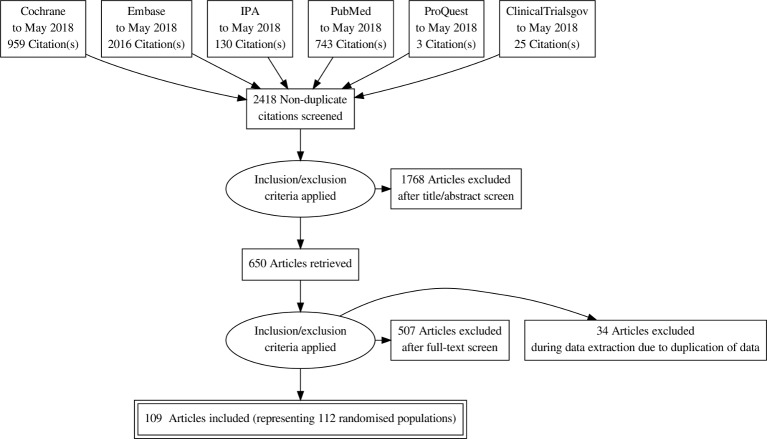
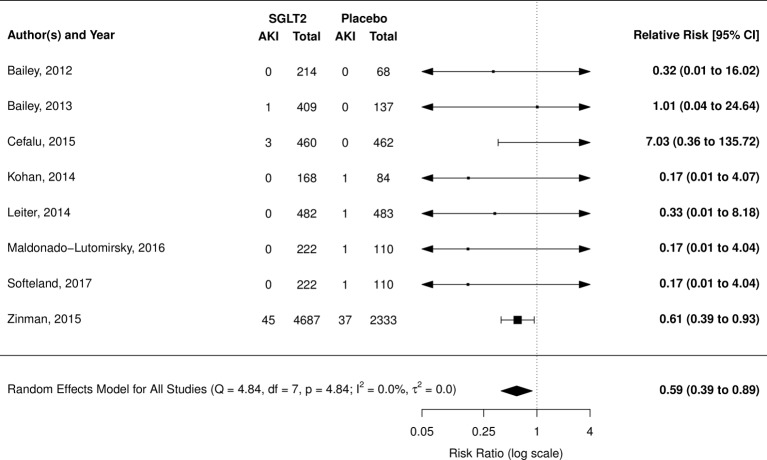
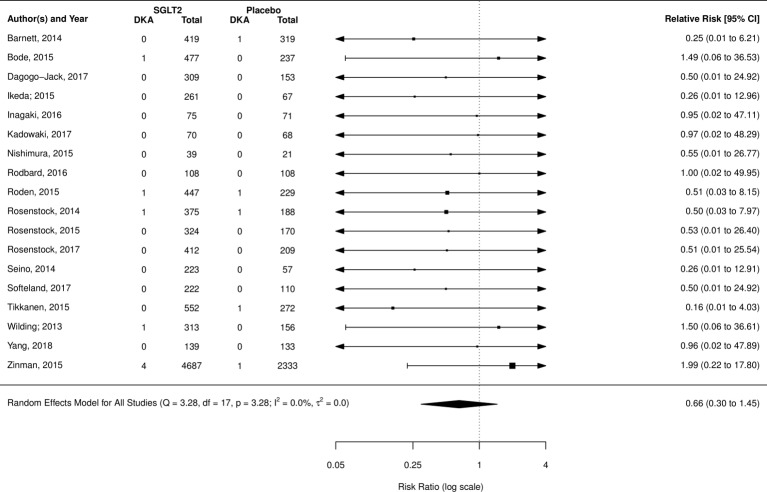
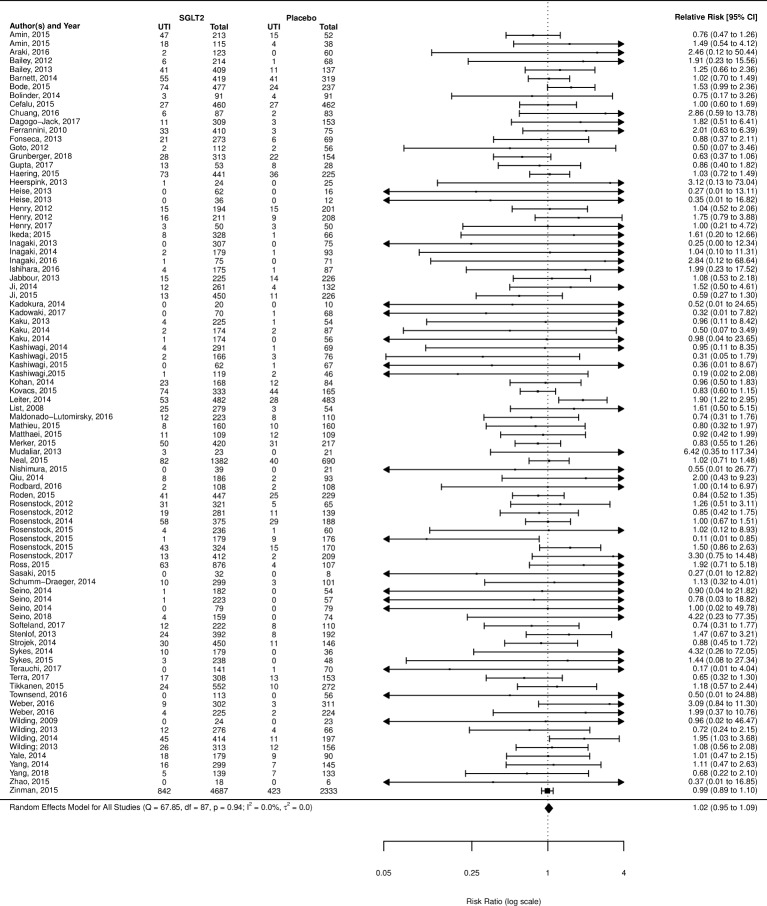
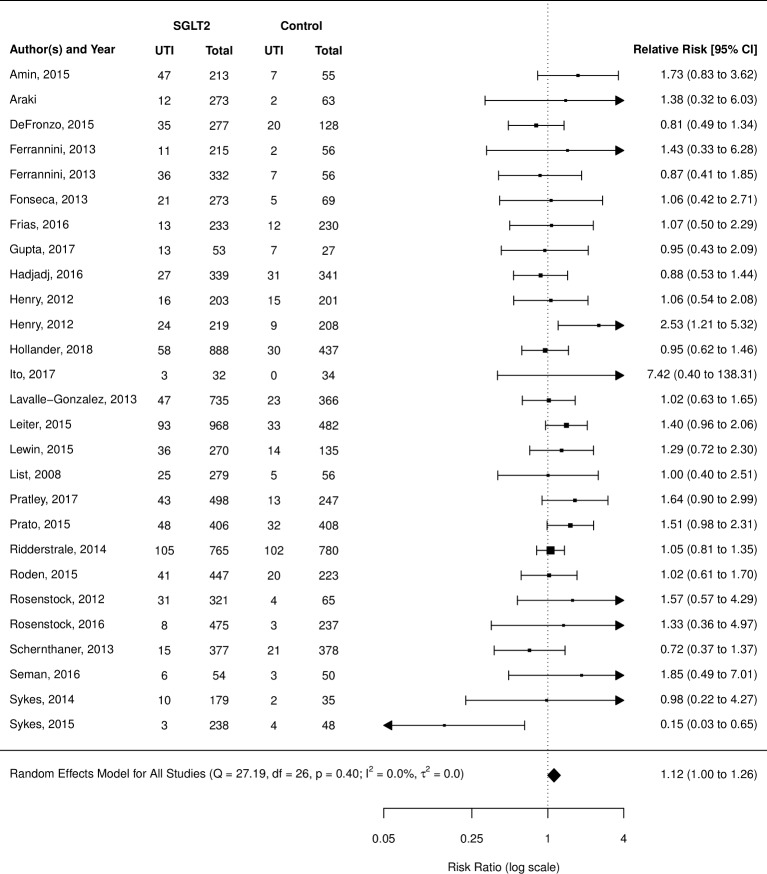
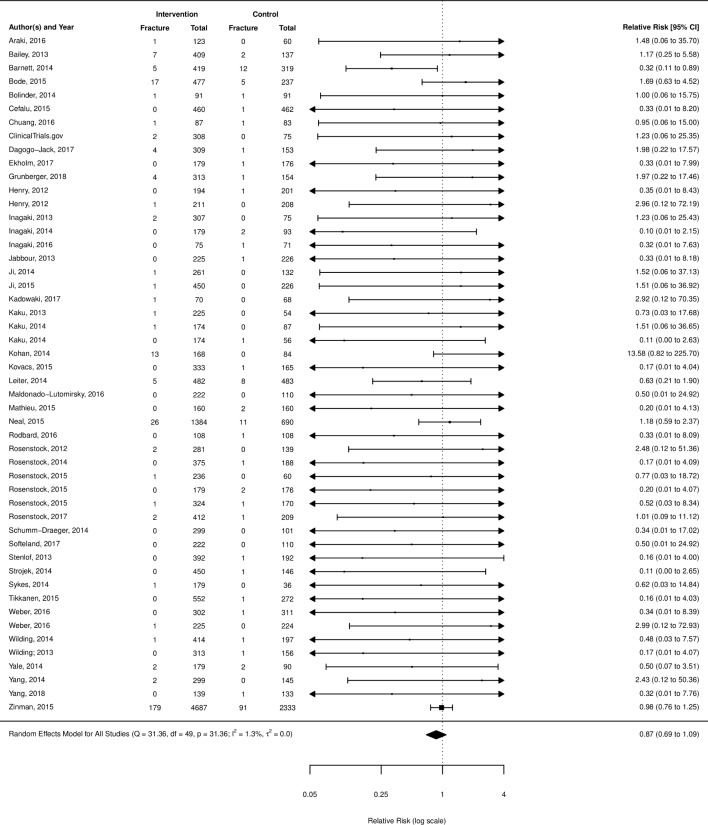
Objective: To estimate the association between the use of sodium glucose co-transporter-2 (SGLT2) inhibitors and postmarket harms as identified by drug regulatory agencies. Design: We conducted a systematic review and meta-analysis of randomised controlled trials (RCT). Six large databases were searched from inception to May 2018. Random effects models were used to estimate pooled relative risks (RRs). Intervention: SGLT2 inhibitors, compared with placebo or active comparators. Primary outcomes: Acute kidney injury (AKI), diabetic ketoacidosis (DKA), urinary tract infections (UTI), bone fractures and lower limb amputations. Results: We screened 2418 citations of which 109 were included. Most studies included one of four SGLT2 inhibitors, dapagliflozin, canagliflozin, empagliflozin and ipragliflozin. When compared with placebo, SGLT2 inhibitors were found to be significantly protective against AKI (RR=0.59; 95% CI 0.39 to 0.89; I 2=0.0%), while no difference was found for DKA (RR 0.66; 95% CI 0.30 to 1.45, I 2=0.0%), UTI (RR 1.02; 95% CI 0.95 to 1.09, I 2=0.0%) or bone fracture (RR 0.87; 95% CI 0.69 to 1.09, I 2=1.3%). Three studies reported on amputation, with one finding a significant increase risk. No increased risk for either outcome was found when compared with active controls. Subgroup analysis did show an increased risk of UTI with dapagliflozin only (RR 1.21; 95% CI 1.02 to 1.43, I 2=0.0%), but no other analysis supported an increased risk of AKI, DKA, UTI or fracture. Conclusions: Current evidence from RCTs does not suggest an increased risk of harm with SGLT2 inhibitors as a class over placebo or active comparators with respect to AKI, DKA, UTI or fracture. However, wide CIs for many comparisons suggest limited precision, and therefore clinically important adverse events cannot be ruled out. Dapagliflozin, appears to independently increase the risk of UTI, although the mechanism for this intraclass variation in risk is unclear. PROSPERO registration number: CRD42016038715.
Overview
The claims and statistics of this paper haven’t been checked yet.
Free: it reads the open-access text and checks the first 5 claims that cite a source we can check. Create a free account to check every claim.
Integrity signals
Registry
Cites
Statistics
Figures
Verification
Claims the paper makes
The claims and statistics of this paper haven’t been checked yet.
Free: it reads the open-access text and checks the first 5 claims that cite a source we can check. Create a free account to check every claim.
Claims other papers make about this one
Each is checked against this paper’s own text: does it say what the citing paper says it does?
The source backs part of the claim, not all of it — or backs it for a different population, condition or comparison.
In the citing paper
“Despite theoretical concerns for acute kidney injury and urinary tract infection, SGLT2 inhibitors do not increase these risks and acute kidney injury is less common (69,95).”
From SGLT2 inhibition for CKD and cardiovascular disease in type 2 diabetes: report of a scientific workshop sponsored by the National Kidney Foundation (2021) · cites this paper as [95]
Experimental — accuracy not yet measuredIn the citing paper
“Higher risks for amputation and fracture were not observed in CVOTs of other SGLT2 inhibitors or with canagliflozin in the CREDENCE trial (14,69,95).”
From SGLT2 inhibition for CKD and cardiovascular disease in type 2 diabetes: report of a scientific workshop sponsored by the National Kidney Foundation (2021) · cites this paper as [95]
Self-check
Percentages, sums and reported differences re-computed from the paper’s own numbers.
The self-check needs the paper’s full text.
Citations
Cites
Preferred Reporting Items for Systematic Reviews and Meta-Analyses: the PRISMA statement
Moher, D., Liberati, A., Tetzlaff, J., Altman, D. G., & for the PRISMA Group (2009) · BMJ · doi:10.1136/bmj.b2535 · Cited by 83,823
Measuring inconsistency in meta-analyses
Higgins, J. P. T., Thompson, S. G., Deeks, J. J., & Altman, D. G. (2003) · BMJ · doi:10.1136/bmj.327.7414.557 · Cited by 63,139 · cited 2×
“Statistical heterogeneity was evaluated using the I(2) statistic, with significant heterogeneity defined as an I(2)>50%.(34) To explore treatment effect heterogeneity, we conducted numerous subgroup analyses according to individual”
MethodPreferred reporting items for systematic reviews and meta-analyses: the PRISMA Statement.
(2009) · PubMed Central · Cited by 44,859
Preferred reporting items for systematic reviews and meta-analyses: The PRISMA statement
Moher, D., Liberati, A., Tetzlaff, J., Altman, D. G., & the PRISMA Group* (2009) · Annals of Internal Medicine · doi:10.7326/0003-4819-151-4-200908180-00135 · Cited by 37,554
The Cochrane Collaboration's tool for assessing risk of bias in randomised trials
Higgins, J. P. T., Altman, D. G., Gotzsche, P. C., Juni, P., Moher, D., Oxman, A. D., Savovic, J., Schulz, K. F., Weeks, L., Sterne, J. A. C., et al. (2011) · BMJ · doi:10.1136/bmj.d5928 · Cited by 33,817 · cited 4×
“risk of bias assessment Each included study was critically appraised using the Cochrane Collaboration domain-based tool for assessing the risk of bias for RCTs.(32) This tool captures six main sources of bias, including: randomisation sequence, allocation concealment, blinding of participant and researcher, blinded ou…”
InfluentialDermyshi, E., Wang, Y., Yan, C., Hong, W., Qiu, G., Gong, X., & Zhang, T. (2017) · Neonatology · doi:10.1159/000454668 · Cited by 24,451
Empagliflozin, Cardiovascular Outcomes, and Mortality in Type 2 Diabetes
Zinman, B., Wanner, C., Lachin, J. M., Fitchett, D., Bluhmki, E., Hantel, S., Mattheus, M., Devins, T., Johansen, O. E., Woerle, H. J., et al. (2015) · New England Journal of Medicine · doi:10.1056/nejmoa1504720 · Cited by 12,315 · cited 1×
“large study.(142) When the analyses were re-run using a fixed-effects model, the risk estimates remained the same or had slightly smaller CIs.”
MethodCanagliflozin and Cardiovascular and Renal Events in Type 2 Diabetes
Neal, B., Perkovic, V., Mahaffey, K. W., de Zeeuw, D., Fulcher, G., Erondu, N., Shaw, W., Law, G., Desai, M., & Matthews, D. R. (2017) · New England Journal of Medicine · doi:10.1056/nejmoa1611925 · Cited by 7,830 · cited 2×
“Data were identified on amputation for three studies.(23) 46 107 One case of amputation was found in the ClinicalTrials.”
BackgroundLiraglutide and Cardiovascular Outcomes in Type 2 Diabetes
Marso, S. P., Daniels, G. H., Brown-Frandsen, K., Kristensen, P., Mann, J. F. E., Nauck, M. A., Nissen, S. E., Pocock, S., Poulter, N. R., Ravn, L. S., et al. (2016) · New England Journal of Medicine · doi:10.1056/nejmoa1603827 · Cited by 7,629 · cited 1×
“The Canagliflozin Cardiovascular Assessment Study (CANVAS), Liraglutide Effect and Action in Diabetes: Evaluation of Cardiovascular Outcome Results (LEADER) trial and the Trial to Evaluate Cardiovascular and Other Long-term Outcomes with Semaglutide in Subjects with Type 2 Diabetes (SUSTAIN-6) have also demonstrated s…”
BackgroundSemaglutide and Cardiovascular Outcomes in Patients with Type 2 Diabetes
Marso, S. P., Bain, S. C., Consoli, A., Eliaschewitz, F. G., Jódar, E., Leiter, L. A., Lingvay, I., Rosenstock, J., Seufert, J., Warren, M. L., et al. (2016) · New England Journal of Medicine · doi:10.1056/nejmoa1607141 · Cited by 6,900
Research works printed but not linked: 5
- Health Canada. Summary Safety Review - Sodium Glucose Cotransporter 2 (SGLT2) Inhibitors INVOKANA (canagliflozin) and FORXIGA (dapagliflozin) - Evaluation of a Potential Risk of Acute Kidney Injury. 2015 http://www.hc-sc.gc.ca/dhp-mps/medeff/reviews-examens/sglt2-eng.php (Accessed 10 Dec 2015).
- Health Canada Forxiga, Invokana. Health Canada begins safety review of diabetes drugs known as SGLT2 inhibitors and risk of ketoacidosis. http://healthycanadians.gc.ca/recall-alert-rappel-avis/hc-sc/2015/53892a-eng.php (Accessed 10 Dec 2015).
- Donnan J, Marra C, Aubrey Bassler K, et al Comparative safety of the sodium glucose co-transporter 2 (SGLT2) inhibitors: a systematic review and network meta-analysis. 2017 PROSPERO 2016:CRD42016038715 Available from http://www.crd.york.ac.uk/PROSPERO_REBRANDING/display_record.asp?ID=CRD42016038715 PMC6361337 30813108
- Maldonado-Lutomirsky M, Søfteland E, Meier J, et al Empagliflozin (EMPA) as add-on to linagliptin (LINA) and metformin in patients with type 2 diabetes (T2DM): A 24-week randomised, double-blind, parallel-group trial. Diabetologia 2016; 59: S93.
- Zinman B, Wanner C, Lachin JM, et al Empagliflozin, cardiovascular outcomes, and mortality in Type 2 diabetes. N Engl J Med 2015; 373: 2117– 28. 10.1056/NEJMoa1504720 26378978 · DOI · Paper page
Cited by
Items 201–220 of 220
Prevalence of genitourinary symptoms in people with type 2 diabetes initiated with SGLT2 inhibitors
Viswanathan, V., Samraj, D., Baid, L., & Kumpatla, S. (2024) · International Journal of Diabetes in Developing Countries · doi:10.1007/s13410-024-01364-y
“These findings are consistent with recent meta-analysis [26].”
Pickthorn, S., Thorne, P. E., & Klomjit, N. (2024) · Polskie Archiwum Medycyny Wewnętrznej · doi:10.20452/pamw.16780 · Cited by 1
How Did the GLP-1RA and SGLT-2i Affect Serum Uric Acid in Diabetic Patients?
李, 白. (2024) · Advances in Clinical Medicine · doi:10.12677/acm.2024.1482223
Abdullah, K., Elsharkawy, M. M., Issak, E. R., ElSerafy, A. S., Idris, S., Bendary, A., Badr, H. R., Shehata, M., & Reda, A. (2024) · International Journal of Clinical Medicine · doi:10.4236/ijcm.2024.159026
Nandave, M. (2024) · Springer eBooks · doi:10.1007/978-981-97-7568-2_3
Hussien, D. N., & Ali, S. M. (2024) · F1000Research · doi:10.12688/f1000research.158805.1
Haddad, T. A., Fahmawi, A., Ghanayem, H., Toubasi, A. A., Mhaidat, Y. A., Kota, A., & Alhawari, H. H. (2025) · Research Square · doi:10.21203/rs.3.rs-6623295/v1
Zheng, C., Lin, M., Chen, Y., Xu, H., Yan, L., & Dai, H. (2021) · Figshare · doi:10.6084/m9.figshare.14471505
Šaler, F., Paladin, I., Blažeković, I., Boras, E., Tokalić, R., Viđak, M., & Puljak, L. (2026) · Journal of Clinical Epidemiology · doi:10.1016/j.jclinepi.2026.112227
Selected 2025 Highlights in Congenital Cardiac Anesthesia
Patel, M., Flannery, K. M., Kuntz, M. T., Grant, S. N., Mossad, E. B., Mittnacht, A. J. C., & Nasr, V. G. (2026) · Journal of Cardiothoracic and Vascular Anesthesia · doi:10.1053/j.jvca.2026.03.037
Chen, H., Lin, Z., Liu, Z., Li, S., Xue, P., Wei, K., Zhang, M., Cui, J., Liu, W., & Wang, N. (2026) · PeerJ · doi:10.7717/peerj.21087
Differential Acute Kidney Injury Profiles of GLP-1RAs and SGLT2is: A Network Meta-Analysis
Liang, C.-S., Hsu, C.-C., Chen, J.-J., Hung, C.-M., Zeng, B., Yang, W.-C., Suen, M., Wang, H.-Y., Carvalho, A. F., Stubbs, B., et al. (2026) · International Journal of Molecular Sciences · doi:10.3390/ijms27094137 · Cited by 2
“Additional studies were identified by manually screening the reference lists of existing systematic reviews [33,45,101,125,129,171], meta-analyses [9,10,26,32,36,38,39,41,43,54,55,63,67,70,72,78,79,83,92,95,99,100,103,108,113– 115, 121”
Ambalavanan, J., Bhasin, K., & Shah, V. N. (2026) · Endocrinology and Metabolism Clinics of North America · doi:10.1016/j.ecl.2026.04.013
SGLT2 Inhibitors in the Modern Cardiology Era: Mechanisms, Outcomes, and Clinical Applications
Neshat, N., Daneii, P., Neshat, S., Mojahedi, A., Frishman, W. H., & Aronow, W. S. (2026) · Cardiology in Review · doi:10.1097/crd.0000000000001420
前川, 智., NAKAMURA, I., Maegawa, H., Tobe, K., & Uno, S. (2021) · Institutional Repositories DataBase (IRDB)
Vega, D. S., Oskoui, E., & Siskind, L. J. (2026) · Handbook of experimental pharmacology · doi:10.1007/164_2026_853
Masuzaki, T., Suehiro, F., Komabashiri, N., Shimizu, T., & Nishimura, M. (2026) · Bio-Medical Materials and Engineering · doi:10.1177/09592989261481043
“18 By contrast, other studies report that SGLT2 inhibitors do not affect bone density 17,19 – 21 and there are no research reports on whether SGLT2 inhibitors affect bone healing in situations involving direct bone invasion, such as implant placement.”
Cozma, D. C., Tudoran, C., & Văcărescu, C. (2026) · Current Issues in Molecular Biology · doi:10.3390/cimb48101008
“Genitourinary candidal infections affect 5–10% of women and are less common in men (balanitis); these are generally manageable with hygiene measures and antifungals [84].”
Eisa, N., & Khoury, M. (2026) · Journal of Diabetes & Metabolic Disorders · doi:10.1007/s40200-026-02097-x
Akute diabetische Stoffwechselentgleisung
Mertens, M., Dauben, L., Roden, M., & Müssig, K. (2026) · Diabetologie und Stoffwechsel · doi:10.1055/a-2769-4961
Metadata
- Authors
- Donnan, J. R., Grandy, C. A., Chibrikov, E., Marra, C. A., Aubrey-Bassler, K., Johnston, K., Swab, M., Hache, J., Curnew, D., Nguyen, H., & Gamble, J.-M.
- Affiliations
- Memorial University of Newfoundland (CA)
- Corresponding author
- Gamble, John-Michael
- Venue
- BMJ Open
- Publisher
- BMJ
- Published
- 2019-01
- Volume
- 9
- Issue
- 1
- Pages
- e022577
- ISSN
- 2044-6055 (ISSN-L)
- PMC
- PMC6361337
- OpenAlex
- W2913306188
- Cited by
- 222
- References
- 145
- Citations by year
- 2026: 17 · 2025: 15 · 2024: 35 · 2023: 33 · 2022: 34 · 2021: 37 · 2020: 36 · 2019: 14
- FWCI
- 4.64
- Type
- journal article
- Language
- en
- Open access
- gold
- doi.org
- Licence
- cc-by-nc
- Locations
- BMJ Open (publishedVersion, cc-by-nc)
- Europe PMC (PubMed Central) (publishedVersion, other-oa)
- PubMed Central (publishedVersion, cc-by-nc)
- PubMed (publishedVersion)
- DOAJ (DOAJ: Directory of Open Access Journals) (submittedVersion)
- Funders
- Canadian Diabetes Association
- Newfoundland and Labrador Centre for Applied Health Research
- Topics
- Health Sciences › Medicine › Endocrinology, Diabetes and Metabolism › Diabetes Treatment and Management
- Life Sciences › Pharmacology, Toxicology and Pharmaceutics › Toxicology › Pharmacovigilance and Adverse Drug Reactions
- Health Sciences › Medicine › Pharmacology (medical) › Pharmacology and Obesity Treatment
- Keywords
- SGLT2 inhibitors, dapagliflozin, canagliflozin, empagliflozin, ipragliflozin, acute kidney injury, diabetic ketoacidosis, urinary tract infection, bone fractures, lower limb amputation, drug safety, adverse drug reactions, type 2 diabetes
- MeSH terms
- Canagliflozin, Sodium-Glucose Transporter 2 Inhibitors, Amputation, Surgical, Benzhydryl Compounds, Glucosides, Humans, Thiophenes, Urinary Tract Infections, Randomized Controlled Trials as Topic, Diabetic Ketoacidosis, Fractures, Bone, Acute Kidney Injury
About these checks
Registry, retraction, Cites and statistics results are computed, not judged, with one exception: a printed reference that no index lists is read once by a model before it counts as a citation error. Claims are extracted by a model and kept only when their quote appears verbatim in the text; each cited source is then checked, with a model’s help, for whether it says what the claim relies on. Those verdicts can be wrong — read the claim’s quote and the cited source before relying on one.
Statistics and arithmetic are recomputed, not judged.
Confidence bands are shown only for fields calibrated on our annotated test set. None is calibrated yet, so no band is shown.
What counts as a claim ›How we measure confidence ›How we check this ›
Are you an author, or do you see a problem with this page? Request a review
Data sources
Bibliographic data: Semantic Scholar, OpenAlex, Crossref.
Contains information from the Semantic Scholar Academic Graph Datasets, made available under the ODC Attribution License (ODC-BY 1.0).
Semantic Scholar’s data is described in: Kinney, R., et al. (2023). The Semantic Scholar Open Data Platform. arXiv:2301.10140.
