

Usual care and a self-management support programme versus usual care and a relaxation programme for people living with chronic headache disorders: A randomised controlled trial protocol (CHESS)
Open accessThe DOI matches its Crossref record; 50 of the 51 references it cites were found in a registry or an index; 23 of the 35 sources its claims cite were checked for support.
Abstract
Introduction Chronic headaches are poorly diagnosed and managed and can be exacerbated by medication overuse. There is insufficient evidence on the non-pharmacological approaches to helping people living with chronic headaches. Methods and analysis Chronic Headache Education and Self-management Study is a pragmatic randomised controlled trial to test the effectiveness and cost-effectiveness of a self-management education support programme on top of usual care for patients with chronic headaches against a control of usual care and relaxation. The intervention is a 2-day group course based on education, personal reflection and a cognitive behavioural approach, plus a nurse-led one-to-one consultation and follow-up over 8 weeks. We aim to recruit 689 participants (356 to the intervention arm and 333 to the control) from primary care and self-referral in London and the Midlands. The trial is powered to show a difference of 2.0 points on the Headache Impact Test, a patient-reported outcome measure at 12 months post randomisation. Secondary outcomes include health related quality of life, self-efficacy, social activation and engagement, anxiety and depression and healthcare utilisation. Outcomes are being measured at 4, 8 and 12 months. Cost-effectiveness will be expressed in terms of incremental cost per quality-adjusted life year gained. Ethics and dissemination This trial will provide data on effectiveness and cost-effectiveness of a self-management support programme for chronic headaches. The results will inform commissioning of services and clinical practice. North West - Greater Manchester East Research Ethics Committee have approved the trial. The current protocol version is 3.6 date 7 March 2019. Trial registration number ISRCTN79708100. © Author(s) (or their employer(s)) 2020. Re-use permitted under CC BY. Published by BMJ.
Overview
CoChat Summary
## TL;DR
This is a protocol for the CHESS pragmatic randomised controlled trial, designed to test whether a 2-day group self-management education/support programme plus nurse follow-up is more effective and cost-effective than usual care plus relaxation for adults living with chronic headache disorders. The protocol also lays out a mixed-methods process evaluation, health economic evaluation, and follow-up of outcomes at 4, 8, and 12 months.
## Key findings
- Not stated in the paper.
- The trial is powered to detect a 2.0-point difference on the Headache Impact Test (HIT-6) at 12 months; the sample size target is 689 participants (356 intervention, 333 control).
- At the time of writing (8 August 2019), 736 participants had already been randomised (380 intervention, 356 control).
- Recruitment sources include primary care and self-referral, with the study aiming to recruit from around 100 general practices with a combined list size of around 700,000.
## Methods
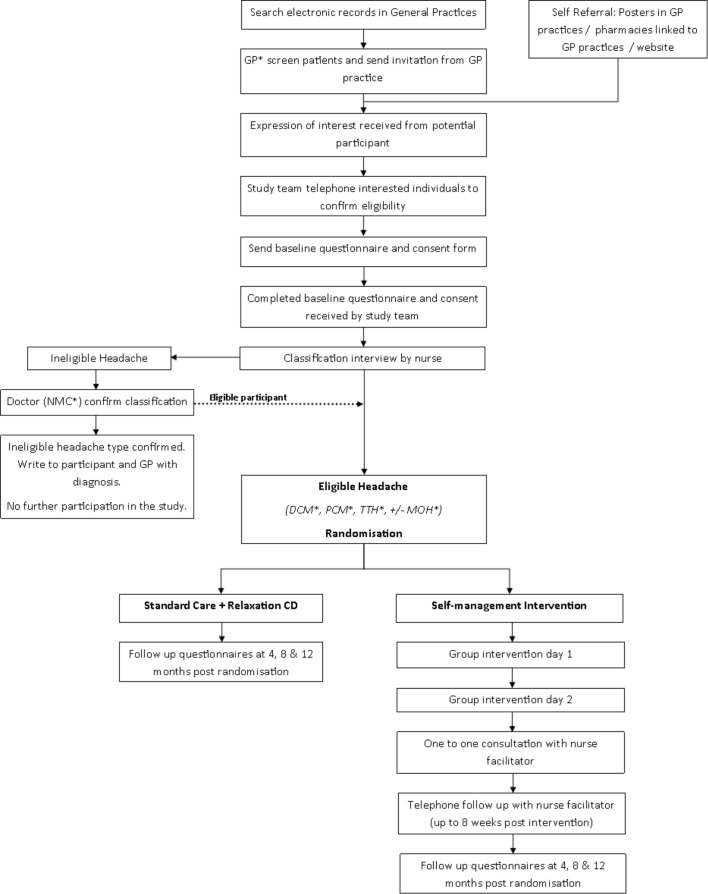
- Pragmatic randomised controlled trial comparing usual care + self-management education/support versus usual care + relaxation in adults with chronic migraine or chronic tension type headache, with or without medication overuse; study settings are primary care in London and the Midlands.
- Intervention: a 2-day group course (around 10 participants per group, target 6–12) plus an 8-week paper diary, one-to-one nurse-led consultation, and follow-up calls for up to 8 weeks; control: usual care plus a 17-minute relaxation audio used over the study period.
- Main analysis: intention-to-treat, with a multilevel model accounting for clustering; primary endpoint is HIT-6 at 12 months, with follow-ups at 4, 8, and 12 months, plus planned economic evaluation using incremental cost per QALY gained.
## Limitations
- The paper is a protocol, so it reports planned methods and expected outcomes rather than trial results; this is explicit in the text.
- The paper states that blinding will be impossible for participants, facilitators and the central co-ordinating team; this is explicit in the text.
- Evident from the protocol: the intervention is a complex group programme, and the paper notes the trial’s success will depend on being able to deliver it faithfully and obtain follow-up data in this population.
Model-written summary. Check it against the paper before relying on it.
Integrity signals
Registry
Cites
Statistics
Figures
Verification
Claims the paper makes
17 Valid · 3 Not valid · 6 Not checked · 25 Own results and interpretations
The cited sources that could be checked couldn’t confirm or dispute this claim.
In the paper
“Previous studies of this nature have reported that a usual care control arm was not an incentive to join the study.15”
§ Usual care and a self-management support programme versus usual care and a relaxation programme for people living with chronic headache disorders: a randomised controlled trial protocol (CHESS) > Methods and analysis > Participants, interventions and outcomes
What the sources say
- Could not verifycites [15] Carnes D, Homer K, Underwood M, et al Pain management for chronic musculoskeletal conditions: the development of an evidence-based and theory-informed pain self-management course. BMJ Open 2013; 3: e003534 10.1136/bmjopen-2013-003534 PMC3831098 24231458 sourceExperimental — accuracy not yet measured
The Results section reports difficult recruitment and suggests participation might be higher outside a research study, but does not link this to a usual-care control arm. The Phase III methods describe an uncontrolled pilot; the paper’s mention of usual care concerns treatment effectiveness, not an incentive to join. Searches for a usual-care control arm and recruitment incentives found no supporting passage. (LLM, conf=0.77)
plain- Asserted: passes — The authors put it forward as true.
- Checkable: passes — It can be checked against evidence.
- Load-bearing: passes — The paper’s conclusions depend on it.
- Based: passes — The paper gives a reason why it holds.
- Could not verify
Every source the paper cites for this claim was checked and supports it.
In the paper
“Group interventions using a cognitive behavioural approach, mindfulness and educational components may be more effective than alternative interventions.14”
§ Usual care and a self-management support programme versus usual care and a relaxation programme for people living with chronic headache disorders: a randomised controlled trial protocol (CHESS) > Introduction
What the sources say
- Supportedcites [14] Probyn K, Bowers H, Mistry D, et al Non-pharmacological self-management for people living with migraine or tension-type headache: a systematic review including analysis of intervention components. BMJ Open 2017; 7: e016670 10.1136/bmjopen-2017-016670 PMC5629643 28801425 source
The Conclusions (page not available in our copy) say there is preliminary evidence that group delivery and the inclusion of CBT, educational, and mindfulness components are associated with larger effects than interventions without those features. The claim’s “may be more effective” reflects that cautious conclusion. (LLM, conf=0.93)
hedgedstates a possible cause- Asserted: passes — The authors put it forward as true.
- Checkable: passes — It can be checked against evidence.
- Load-bearing: passes — The paper’s conclusions depend on it.
- Based: passes — The paper gives a reason why it holds.
- Supported
The cited sources support only part of this claim — read each source’s verdict below.
In the paper
“In our feasibility study (n=114), the SD of the HIT-6 score at baseline was 6.87.44”
§ Usual care and a self-management support programme versus usual care and a relaxation programme for people living with chronic headache disorders: a randomised controlled trial protocol (CHESS) > Methods and analysis > Participants, interventions and outcomes
What the sources say
- Partly supportedcites [44] White K, Potter R, Patel S, et al Chronic headache education and self-management study (chess) – a mixed method feasibility study to inform the design of a randomised controlled trial. BMC Med Res Methodol 2019; 19 10.1186/s12874-019-0672-5 PMC6371558 30744571 sourceExperimental — accuracy not yet measured
The Methods section says the feasibility study collected HIT-6 scores at baseline, and the Results section reports 131 returned baseline questionnaires. Neither section reports a baseline HIT-6 standard deviation of 6.87 or identifies an n=114 sample for that calculation; the 131 questionnaires do not rule out a smaller subset. (LLM, conf=0.82)
plainn = 114- Asserted: passes — The authors put it forward as true.
- Checkable: passes — It can be checked against evidence.
- Load-bearing: passes — The paper’s conclusions depend on it.
- Based: passes — The paper gives a reason why it holds.
- Partly supported
The sources with a verdict support this claim; the rest weren’t checked yet, have no full text we could read, or their verdicts aren’t rated yet.
In the paper
“The MSQv2.1 has acceptable evidence of psychometric properties following completion in a migraine population.27–30”
§ Usual care and a self-management support programme versus usual care and a relaxation programme for people living with chronic headache disorders: a randomised controlled trial protocol (CHESS) > Methods and analysis > Participants, interventions and outcomes
What the sources say
- Supportedcites [27] Haywood KL, Mars TS, Potter R, et al Assessing the impact of headaches and the outcomes of treatment: a systematic review of patient-reported outcome measures (PROMs). Cephalalgia 2018; 38: 1374– 86. 10.1177/0333102417731348 28920448 PMC6024352 source
The Discussion states that MSQv2.1 has acceptable, often strong evidence of reliability and validity following completion by patients with migraine. Table 1 also rates its internal consistency and structural validity as strong. The claim does not imply that every psychometric property was established. (LLM, conf=0.94)
- Not checked — no full text of the sourcecites [28] Jhingran P, Osterhaus JT, Miller DW, et al Development and validation of the migraine-specific quality of life questionnaire. Headache 1998; 38: 295– 302. 10.1046/j.1526-4610.1998.3804295.x 9595870 source
- Not checked — no full text of the sourcecites [29] Martin BC, Pathak DS, Sharfman MI, et al Validity and reliability of the migraine-specific quality of life questionnaire (MSQ version 2.1). Headache 2000; 40: 204– 16. 10.1046/j.1526-4610.2000.00030.x 10759923 source
- Not checked — no full text of the sourcecites [30] McKenna SP, Doward LC, Davey KM The development and psychometric properties of the MSQOL: a migraine-specific quality-of-life instrument. Clin Drug Investig 1998; 15: 413– 23. 10.2165/00044011-199815050-00006 18370497 source
plain- Asserted: passes — The authors put it forward as true.
- Checkable: passes — It can be checked against evidence.
- Load-bearing: passes — The paper’s conclusions depend on it.
- Based: passes — The paper gives a reason why it holds.
- Supported
Every source the paper cites for this claim was checked and supports it.
In the paper
“We, therefore, developed and validated a logic model for use in a telephone interview by a nurse (non-headache expert) that would allow us to identify and classify people meeting our entry criteria while also excluding people with secondary headaches, other than medication overuse and other causes of primary headaches (table 1).21”
§ Usual care and a self-management support programme versus usual care and a relaxation programme for people living with chronic headache disorders: a randomised controlled trial protocol (CHESS) > Methods and analysis > Participants, interventions and outcomes
What the sources say
- Supportedcites [21] Potter R, Hee SW, Griffiths F, et al Development and validation of a telephone classification interview for common chronic headache disorders. J Headache Pain 2019; 20: 2 10.1186/s10194-018-0954-z 30621592 PMC6734413 source
Split into 2 atoms — 2 confirmed, 0 partially supported, 0 disputed, 0 misattributed, 0 unverifiable. Expand the claim to see per-atom verdicts.
hedged- Asserted: passes — The authors put it forward as true.
- Checkable: passes — It can be checked against evidence.
- Load-bearing: passes — The paper’s conclusions depend on it.
- Based: passes — The paper gives a reason why it holds.
- Supported
16 more claims · 8 with their cited sources checked
Create a free account to see all 51 claims and to verify the 1 reference still open.
- It may state two separate claims as one. 13
- Probably not a substantial claim. 22
Citations
Cites
The Hospital Anxiety and Depression Scale
Zigmond, A. S., & Snaith, R. P. (1983) · Acta Psychiatrica Scandinavica · doi:10.1111/j.1600-0447.1983.tb09716.x · Cited by 47,139 · cited 1×
“22 34 6.”
Depression and quality of life in older persons: A review
Sivertsen, H., Bjørkløf, G. H., Engedal, K., Selbæk, G., & Helvik, A.-S. (2015) · Dementia and Geriatric Cognitive Disorders · doi:10.1159/000437299 · Cited by 14,152
Development and preliminary testing of the new five-level version of EQ-5D (EQ-5D-5L)
Herdman, M., Gudex, C., Lloyd, A., Janssen, M., Kind, P., Parkin, D., Bonsel, G., & Badia, X. (2011) · Quality of Life Research · doi:10.1007/s11136-011-9903-x · Cited by 9,795 · cited 1×
“32”
SPIRIT 2013 Statement: Defining Standard Protocol Items for Clinical Trials
Chan, A.-W., Tetzlaff, J. M., Altman, D. G., Laupacis, A., Gøtzsche, P. C., Krleža-Jerić, K., Hróbjartsson, A., Mann, H., Dickersin, K., Berlin, J. A., et al. (2013) · Annals of Internal Medicine · doi:10.7326/0003-4819-158-3-201302050-00583 · Cited by 7,363
Feigin, V. L., Nichols, E., Alam, T., Bannick, M. S., Beghi, E., Blake, N., Culpepper, W. J., Dorsey, E. R., Elbaz, A., Ellenbogen, R. G., et al. (2019) · The Lancet Neurology · doi:10.1016/s1474-4422(18)30499-x · Cited by 5,644
Cross-Validation of Item Selection and Scoring for the SF-12 Health Survey in Nine Countries
Gandek, B., Ware, J. E., Aaronson, N. K., Apolone, G., Bjorner, J. B., Brazier, J. E., Bullinger, M., Kaasa, S., Leplege, A., Prieto, L., et al. (1998) · Journal of Clinical Epidemiology · doi:10.1016/s0895-4356(98)00109-7 · Cited by 2,907
The global burden of headache: A documentation of headache prevalence and disability worldwide
Stovner, L., Hagen, K., Jensen, R., Katsarava, Z., Lipton, R., Scher, A., Steiner, T., & Zwart, J.-A. (2007) · Cephalalgia · doi:10.1111/j.1468-2982.2007.01288.x · Cited by 2,444
Feigin, V. L., Abajobir, A. A., Abate, K. H., Abd-Allah, F., Abdulle, A. M., Abera, S. F., Abyu, G. Y., Ahmed, M. B., Aichour, A. N., Aichour, I., et al. (2017) · The Lancet Neurology · doi:10.1016/s1474-4422(17)30299-5 · Cited by 2,275
Interim scoring for the EQ-5D-5L: mapping the EQ-5D-5L to EQ-5D-3L value sets
van Hout, B., Janssen, M. F., Feng, Y.-S., Kohlmann, T., Busschbach, J., Golicki, D., Lloyd, A., Scalone, L., Kind, P., & Pickard, A. S. (2012) · Value in Health · doi:10.1016/j.jval.2012.02.008 · Cited by 2,153
The pain self-efficacy questionnaire: Taking pain into account
Nicholas, M. K. (2007) · European Journal of Pain · doi:10.1016/j.ejpain.2005.12.008 · Cited by 1,656 · cited 1×
“35 We have previously reviewed measures of self-efficacy and concluded that PSEQ is the most appropriate choice for studies of this nature; although all current measures have limitations.”
A six-item short-form survey for measuring headache impact: The HIT-6™
Kosinski, M., Bayliss, M. S., Bjorner, J. B., Ware, J. E., Garber, W. H., Batenhorst, A., Cady, R., Dahlöf, C. G. H., Dowson, A., & Tepper, S. (2003) · Quality of Life Research · doi:10.1023/a:1026119331193 · Cited by 1,376 · cited 1×
“26 The HIT-6 provides a short overall assessment of headache impact – with items assessing fatigue, pain, social functioning, emotional well-being and cognition.”
BackgroundSubgroup analyses in randomized trials: risks of subgroup-specific analyses;
Brookes, S. T., Whitely, E., Egger, M., Smith, G. D., Mulheran, P. A., & Peters, T. J. (2004) · Journal of Clinical Epidemiology · doi:10.1016/j.jclinepi.2003.08.009 · Cited by 775 · cited 1×
“46 We will assess the level of missingness in the primary outcome, and if required, we will use appropriate multiple imputation techniques to impute data and estimate the treatment effect as a form of sensitivity analysis.”
MethodEpidemiology of Chronic Daily Headache in the General Population
Castillo, J., Muñoz, P., Guitera, V., & Pascual, J. (1999) · Headache: The Journal of Head and Face Pain · doi:10.1046/j.1526-4610.1999.3903190.x · Cited by 714
Osborne, R. H., Elsworth, G. R., & Whitfield, K. (2007) · Patient Education and Counseling · doi:10.1016/j.pec.2006.12.002 · Cited by 556 · cited 1×
“37 41 The CHESS intervention might affect the troublesomeness of other bodily pains.”
Steiner, T., Scher, A., Stewart, W., Kolodner, K., Liberman, J., & Lipton, R. (2003) · Cephalalgia · doi:10.1046/j.1468-2982.2003.00568.x · Cited by 433
Taylor, S. J., Pinnock, H., Epiphaniou, E., Pearce, G., Parke, H. L., Schwappach, A., Purushotham, N., Jacob, S., Griffiths, C. J., Greenhalgh, T., et al. (2014) · Health Services and Delivery Research · doi:10.3310/hsdr02530 · Cited by 431
Self-citationValidity and Reliability of the Migraine‐Specific Quality of Life Questionnaire (MSQ Version 2.1)
Martin, B. C., Pathak, D. S., Sharfman, M. I., Adelman, J. U., Taylor, F., Kwong, W. J., & Jhingran, P. (2000) · Headache: The Journal of Head and Face Pain · doi:10.1046/j.1526-4610.2000.00030.x · Cited by 299
Systematic meta-review of supported self-management for asthma: a healthcare perspective
groups, F. T. P. A. R., Pinnock, H., Parke, H. L., Panagioti, M., Daines, L., Pearce, G., Epiphaniou, E., Bower, P., Sheikh, A., Griffiths, C. J., et al. (2017) · BMC Medicine · doi:10.1186/s12916-017-0823-7 · Cited by 291
Self-citationChronic daily headache in Chinese elderly: Prevalence, risk factors, and biannual follow-up
Wang, S.-J., Fuh, J.-L., Lu, S.-R., Liu, C.-Y., Hsu, L.-C., Wang, P.-N., & Liu, H.-C. (2000) · Neurology · doi:10.1212/wnl.54.2.314 · Cited by 271
Chronic Daily Headache in Taipei, Taiwan: Prevalence, Follow-Up and Outcome Predictors
Lu, S.-R., Fuh, J.-L., Chen, W.-T., Juang, K.-D., & Wang, S.-J. (2001) · Cephalalgia · doi:10.1046/j.1468-2982.2001.00294.x · Cited by 254
Development and Validation of the Migraine‐Specific Quality of Life Questionnaire
Jhingran, P., Osterhaus, J. T., Miller, D. W., Lee, J. T., & Kirchdoerfer, L. (1998) · Headache: The Journal of Head and Face Pain · doi:10.1046/j.1526-4610.1998.3804295.x · Cited by 252
Health Services and Delivery Research
(2021) · Health Services and Delivery Research · doi:10.3310/hs-dr · Cited by 236
Miles, C. L., Pincus, T., Carnes, D., Taylor, S. J. C., & Underwood, M. (2011) · The Clinical Journal of Pain · doi:10.1097/ajp.0b013e318208c8a2 · Cited by 163
Self-citationProbyn, K., Bowers, H., Mistry, D., Caldwell, F., Underwood, M., Patel, S., Sandhu, H. K., Matharu, M., & Pincus, T. (2017) · BMJ Open · doi:10.1136/bmjopen-2017-016670 · Cited by 149
Self-citationPrognostic factors for chronic headache: A systematic review
Probyn, K., Bowers, H., Caldwell, F., Mistry, D., Underwood, M., Matharu, M., Pincus, T., & On behalf of the CHESS Team (2017) · Neurology · doi:10.1212/wnl.0000000000004112 · Cited by 129
Haywood, K. L., Mars, T. S., Potter, R., Patel, S., Matharu, M., & Underwood, M. (2018) · Cephalalgia · doi:10.1177/0333102417731348 · Cited by 113 · cited 5×
“27 30 To inform our selection of outcome measures, we undertook interviews (n=14) with people with chronic headache.”
InfluentialSample size formulae for trials comparing group and individual treatments in a multilevel model
Moerbeek, M., & Wong, W. K. (2008) · Statistics in Medicine · doi:10.1002/sim.3115 · Cited by 92
Jenkinson, C., Layte, R., & Lawrence, K. (1997) · Medical Care · doi:10.1097/00005650-199704000-00010 · Cited by 80
Self‐medication of regular headache: a community pharmacy‐based survey
Mehuys, E., Paemeleire, K., Van Hees, T., Christiaens, T., Van Bortel, L. M., Van Tongelen, I., De Bolle, L., Remon, J. ‐., & Boussery, K. (2012) · European Journal of Neurology · doi:10.1111/j.1468-1331.2012.03681.x · Cited by 77
Yoon, M.-S., Manack, A., Schramm, S., Fritsche, G., Obermann, M., Diener, H.-C., Moebus, S., & Katsarava, Z. (2013) · Pain · doi:10.1016/j.pain.2012.12.010 · Cited by 76 · cited 1×
“37 41 The CHESS intervention might affect the troublesomeness of other bodily pains.”
BackgroundDiagnosis and management of headaches in young people and adults: summary of NICE guidance
Carville, S., Padhi, S., Reason, T., Underwood, M., & on behalf of the Guideline Development Group (2012) · BMJ · doi:10.1136/bmj.e5765 · Cited by 74 · cited 1×
“18 We describe here the protocol for a randomised controlled trial (RCT) to estimate the effectiveness and cost-effectiveness of a group self-management support programme for adults with chronic headaches arising from migraine or tension type headache, with or without medication overuse.”
Self-citationNichols, V. P., Ellard, D. R., Griffiths, F. E., Kamal, A., Underwood, M., & Taylor, S. J. C. (2017) · BMJ Open · doi:10.1136/bmjopen-2017-019929 · Cited by 73 · cited 1×
“13 20 For this trial, it is important that we are able to define our participants’ headache type, or types, accurately and exclude those with non-eligible headache types.”
Self-citationSelf‐Reported Comorbid Pains in Severe Headaches or Migraines in a US National Sample
Plesh, O., Adams, S. H., & Gansky, S. A. (2012) · Headache: The Journal of Head and Face Pain · doi:10.1111/j.1526-4610.2012.02155.x · Cited by 70
Taylor, S. J. C., Carnes, D., Homer, K., Kahan, B. C., Hounsome, N., Eldridge, S., Spencer, A., Pincus, T., Rahman, A., & Underwood, M. (2016) · PLoS Medicine · doi:10.1371/journal.pmed.1002040 · Cited by 63 · cited 1×
“24 The aim of the course is to encourage and enable those with chronic headaches to recognise unhelpful thought patterns and behaviours that contribute to their headache burden and to do something about them.”
BackgroundJiménez-Sánchez, S., Fernández-de-las-Peñas, C., Carrasco-Garrido, P., Hernández-Barrera, V., Alonso-Blanco, C., Palacios-Ceña, D., & Jiménez-García, R. (2012) · Gaceta Sanitaria · doi:10.1016/j.gaceta.2011.10.012 · Cited by 59
Measuring troublesomeness of chronic pain by location
Parsons, S., Carnes, D., Pincus, T., Foster, N., Breen, A., Vogel, S., & Underwood, M. (2006) · BMC Musculoskeletal Disorders · doi:10.1186/1471-2474-7-34 · Cited by 48 · cited 1×
“42 At baseline we also collect data on age, gender, ethnic group, age at leaving full-time education and current work status.”
McKenna, S. P., Doward, L. C., & Davey, K. M. (1998) · Clinical Drug Investigation · doi:10.2165/00044011-199815050-00006 · Cited by 48 · cited 1×
“27 30 To inform our selection of outcome measures, we undertook interviews (n=14) with people with chronic headache.”
MethodTaylor, S. J., Carnes, D., Homer, K., Pincus, T., Kahan, B. C., Hounsome, N., Eldridge, S., Spencer, A., Diaz-Ordaz, K., Rahman, A., et al. (2016) · Programme Grants for Applied Research · doi:10.3310/pgfar04140 · Cited by 44
Self-citationMonitoring chronic headache and medication-overuse headache prevalence in Denmark
Westergaard, M. L., Lau, C. J., Allesøe, K., Gjendal, S. T., & Jensen, R. H. (2020) · Cephalalgia · doi:10.1177/0333102419876909 · Cited by 44
On behalf of the CHESS team, Patel, S., Potter, R. C., Matharu, M. S., Carnes, D., Taylor, S. J., Nichols, V. P., Pincus, T., Underwood, M. R., & Sandhu, H. K. (2019) · The Journal of Headache and Pain · doi:10.1186/s10194-019-0980-5 · Cited by 39 · cited 1×
“23”
Self-citationCousins, S., Ridsdale, L., Goldstein, L. H., Noble, A. J., Moorey, S., & Seed, P. (2015) · Journal of Neurology · doi:10.1007/s00415-015-7916-z · Cited by 38 · cited 1×
“27 43 In our feasibility study (n=114), the SD of the HIT-6 score at baseline was 6.87.”
InfluentialIllness perception in people with primary and secondary chronic headache in the general population
Kristoffersen, E. S., Lundqvist, C., & Russell, M. B. (2019) · Journal of Psychosomatic Research · doi:10.1016/j.jpsychores.2018.12.001 · Cited by 29
Carnes, D., Homer, K., Underwood, M., Pincus, T., Rahman, A., & Taylor, S. J. C. (2013) · BMJ Open · doi:10.1136/bmjopen-2013-003534 · Cited by 26
Self-citationHagen, K., Linde, M., Steiner, T. J., Zwart, J. ‐., & Stovner, L. J. (2012) · European Journal of Neurology · doi:10.1111/j.1468-1331.2012.03725.x · Cited by 25
Henning, V., Katsarava, Z., Obermann, M., Moebus, S., & Schramm, S. (2018) · Cephalalgia · doi:10.1177/0333102417699180 · Cited by 19
on behalf of the CHESS team, White, K., Potter, R., Patel, S., Nichols, V. P., Haywood, K. L., Hee, S. W., Mistry, D., Carnes, D., Taylor, S. J. C., et al. (2019) · BMC Medical Research Methodology · doi:10.1186/s12874-019-0672-5 · Cited by 18
Self-citationPotter, R., Hee, S. W., Griffiths, F., Dodd, K., Hoverd, E., Underwood, M., & Matharu, M. (2019) · The Journal of Headache and Pain · doi:10.1186/s10194-018-0954-z · Cited by 18
and on behalf of the CHESS team, Nichols, V. P., Ellard, D. R., Griffiths, F. E., Underwood, M. R., Taylor, S. J., & Patel, S. (2019) · Trials · doi:10.1186/s13063-019-3372-x · Cited by 16
Self-citationThe classification of chronic headache: Room for further improvement?
Ss, S., Wöber, C., & Guidetti, V. (2010) · Cephalalgia · doi:10.1177/0333102410374143 · Cited by 15
Chronic headache: What's in a name?
Louter, M. A., Ward, T. N., & Terwindt, G. M. (2017) · Neurology · doi:10.1212/wnl.0000000000004124 · Cited by 2 · cited 1×
“13 20 For this trial, it is important that we are able to define our participants’ headache type, or types, accurately and exclude those with non-eligible headache types.”
Cited by
On behalf of the CHESS team, Patel, S., Potter, R. C., Matharu, M. S., Carnes, D., Taylor, S. J., Nichols, V. P., Pincus, T., Underwood, M. R., & Sandhu, H. K. (2019) · The Journal of Headache and Pain · doi:10.1186/s10194-019-0980-5 · Cited by 39
Self-citationD’Amico, D., Tepper, S. J., Guastafierro, E., Toppo, C., Leonardi, M., Grazzi, L., Martelletti, P., & Raggi, A. (2020) · International Journal of Environmental Research and Public Health · doi:10.3390/ijerph18010246 · Cited by 34
“SF-36; SF-12; SF-8 N = 10 [34,42,60,97,121,122], [134,145,154,158] N = 4 [97,112,120,122] N = 4 [61,87,128,135]”
Underwood, M. R., Achana, F. A., Carnes, D., Eldridge, S. M., Ellard, D. R., Griffiths, F. E., Haywood, K. L., Hee, S. W., Higgins, H. B., Mistry, D., et al. (2022) · Neurology · doi:10.1212/wnl.0000000000201518 · Cited by 36
“The protocol for this trial has been published.(14)”
MethodSelf-citationHaywood, K. L., Achana, F. A., Nichols, V. P., Pearce, G., Box, B., Muldoon, L., Patel, S., Griffiths, F. E., Stewart, K., Underwood, M. R., et al. (2021) · Cephalalgia · doi:10.1177/03331024211006045 · Cited by 31
“The Chronic Headache Education and Self-Management Study (CHESS) is a programme grant funded by the UK’s National Institute for Health Research (RP-PG-1212-20018) to test the effectiveness of a supportive self-management intervention for people living with chronic headache disorders (11).”
BackgroundSelf-citationPoor social support and loneliness in chronic headache: Prevalence and effect modifiers
Westergaard, M. L., Lau, C. J., Allesøe, K., Andreasen, A. H., & Jensen, R. (2021) · Cephalalgia · doi:10.1177/03331024211020392 · Cited by 26
“trials such as the CHESS trial (79) can shed more light in this area.”
Background
Metadata
- Authors
- Patel, S., Achana, F., Carnes, D., Eldridge, S., Ellard, D. R., Griffiths, F., Haywood, K., Hee, S. W., Mistry, D., Mistry, H., Nichols, V. P., Petrou, S., Pincus, T., Potter, R., Sandhu, H. K., Stewart, K., Taylor, S., Underwood, M., & Matharu, M.
- Affiliations
- University of Warwick (GB)
- Queen Mary University of London (GB)
- Royal Holloway University of London (GB)
- National Hospital for Neurology and Neurosurgery (GB)
- Corresponding author
- Patel, Shilpa
- ORCID
- Venue
- BMJ Open
- Publisher
- BMJ
- Published
- 2020-04
- Volume
- 10
- Issue
- 4
- Pages
- e033520
- ISSN
- 2044-6055 (ISSN-L)
- PMC
- PMC7200026
- OpenAlex
- W3015709960
- Cited by
- 24
- References
- 51
- Citations by year
- 2025: 1 · 2024: 5 · 2023: 9 · 2022: 3 · 2021: 4 · 2020: 1
- FWCI
- 3.10
- Type
- journal article
- Language
- en
- Open access
- gold
- doi.org
- Locations
- BMJ Open (publishedVersion, cc-by)
- PubMed Central (publishedVersion, cc-by)
- PubMed (publishedVersion)
- Warwick Research Archive Portal (University of Warwick) (acceptedVersion)
- DOAJ (DOAJ: Directory of Open Access Journals) (submittedVersion)
- ePrints Soton (University of Southampton) (submittedVersion)
- UCL Discovery (University College London) (submittedVersion)
- HighWire Press Open Archive (submittedVersion)
- Queen Mary Research Online (Queen Mary University of London) (submittedVersion, cc-by)
- Funders
- Programme Grants for Applied Research (RP-PG-1212-20018)
- Topics
- Health Sciences › Medicine › Clinical Neurology › Migraine and Headache Studies
- Health Sciences › Health Professions › Physical Therapy, Sports Therapy and Rehabilitation › Musculoskeletal pain and rehabilitation
- Health Sciences › Dentistry › Oral Surgery › Temporomandibular Joint Disorders
- Keywords
- chronic headache, self-management, relaxation, cognitive behavioral therapy, nurse-led consultations, non-pharmacological treatment, medication overuse, Headache Impact Test, health-related quality of life, self-efficacy, cost-effectiveness, primary care
- MeSH terms
- Patient Reported Outcome Measures, Self-Management, Anxiety, Chronic Disease, Depression, Follow-Up Studies, Humans, Patient Acceptance of Health Care, Patient Education as Topic, Quality of Life, Relaxation Therapy, Cognitive Behavioral Therapy, Program Development, Sample Size, Patient Selection, Self Efficacy, Headache Disorders, Practice Patterns, Nurses', Social Participation, Pragmatic Clinical Trials as Topic
About these checks
Registry, retraction, Cites and statistics results are computed, not judged, with one exception: a printed reference that no index lists is read once by a model before it counts as a citation error. Claims are extracted by a model and kept only when their quote appears verbatim in the text; each cited source is then checked, with a model’s help, for whether it says what the claim relies on. Those verdicts can be wrong — read the claim’s quote and the cited source before relying on one.
The claim verdicts this report counts are experimental: their accuracy is not yet measured.
A language model drew the claims from the paper on 2026-10-11, under version 3 of the claim definition (model deepseek-v4.1-flash, prompt extract-v3).
A second model labelled each claim on 2026-10-11 (model jev-1.13-20260917, definition revision gold-guideline-v0.2).
Cited sources are checked with a language model’s help (gpt-6-sol).
Statistics and arithmetic are recomputed, not judged.
Confidence bands are shown only for fields calibrated on our annotated test set. None is calibrated yet, so no band is shown.
What counts as a claim ›How we measure confidence ›How we check this ›
Are you an author, or do you see a problem with this page? Request a review
Data sources
Bibliographic data: Semantic Scholar, OpenAlex, Crossref.
Contains information from the Semantic Scholar Academic Graph Datasets, made available under the ODC Attribution License (ODC-BY 1.0).
Semantic Scholar’s data is described in: Kinney, R., et al. (2023). The Semantic Scholar Open Data Platform. arXiv:2301.10140.
