

Ways Ahead: developing a supported self-management programme for people living with low- and intermediate-grade gliomas - a protocol for a multi-method study
Open accessThe DOI matches its Crossref record; 62 of the 62 references it cites were found in a registry or an index.
Abstract
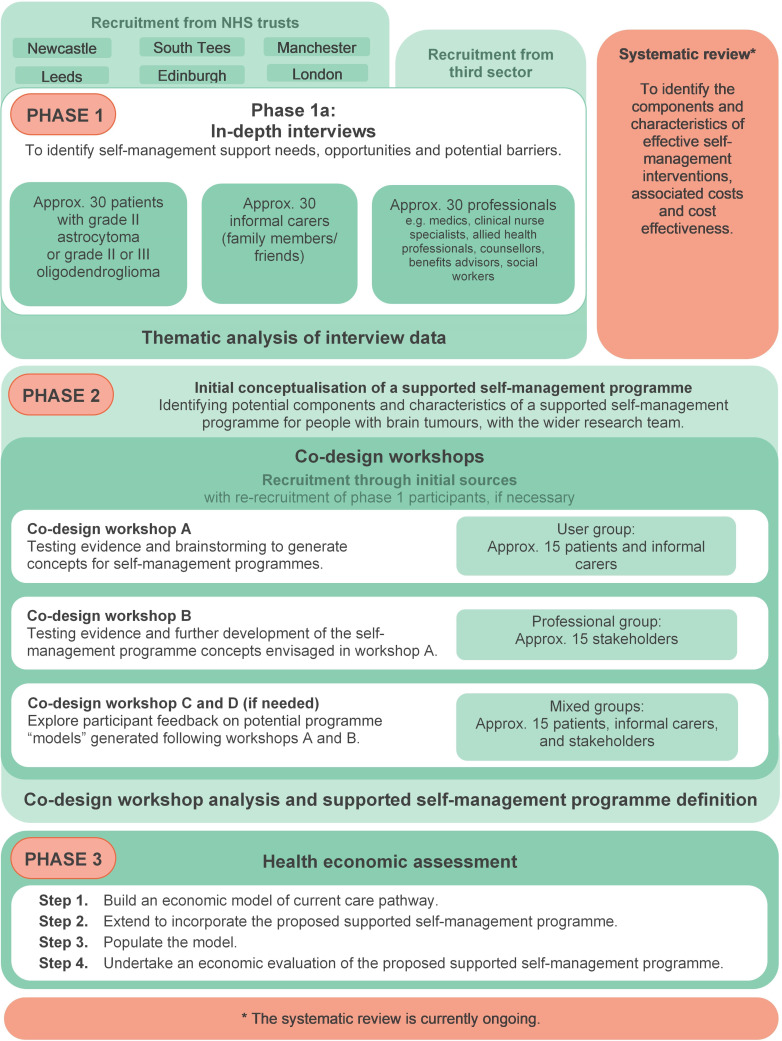
Introduction: Living with and beyond a diagnosis of a low- and intermediate-grade glioma (LIGG) can adversely impact many aspects of people’s lives and their quality of life (QoL). In people with chronic conditions, self-management can improve QoL. This is especially true if people are supported to self-manage. Supported self-management programmes have been developed for several cancers, but the unique challenges experienced by LIGG survivors mean these programmes may not be readily transferable to this group. The Ways Ahead study aims to address this gap by exploring the needs of LIGG survivors to develop a prototype for a supported self-management programme tailored to this group. Methods and analysis: Ways Ahead will follow three sequential phases, underpinned by a systematic review of self-management interventions in cancer. In phase 1, qualitative methods will be used to explore and understand the issues faced by LIGG survivors, as well as the barriers and facilitators to self-management. Three sets of interviews will be conducted with LIGG survivors, their informal carers and professionals. Thematic analysis will be conducted with reference to the Theoretical Domains Framework and Normalisation Process Theory. Phase 2 will involve co-production workshops to generate ideas for the design of a supported self-management programme. Workshop outputs will be translated into a design specification for a prototype programme. Finally, phase 3 will involve a health economic assessment to examine the feasibility and benefits of incorporating the proposed programme into the current survivorship care pathway. This prototype will then be ready for testing in a subsequent trial. Ethics and dissemination: The study has been reviewed and approved by an National Health Service Research Ethics Committee (REC ref: 20/WA/0118). The findings will be disseminated through peer-reviewed journals, conference presentations, broadcast media, the study website, The Brain Tumour Charity and stakeholder engagement activities.
Overview
The claims and statistics of this paper haven’t been checked yet.
Free: it reads the open-access text and checks the first 5 claims that cite a source we can check. Create a free account to check every claim.
Integrity signals
Registry
Cites
Statistics
Figures
Verification
Claims the paper makes
The claims and statistics of this paper haven’t been checked yet.
Free: it reads the open-access text and checks the first 5 claims that cite a source we can check. Create a free account to check every claim.
Claims other papers make about this one
Each is checked against this paper’s own text: does it say what the citing paper says it does?
The source backs part of the claim, not all of it — or backs it for a different population, condition or comparison.
In the citing paper
“Personas also helped to reflect on concepts by taking the patient perspective (Elbers et al., 2021), discuss potential possibilities or barriers of the intervention (Ledel Solem et al., 2020), or consider what the intervention might involve for the specific Personas (Rimmer et al., 2020).”
From Using Personas in the development of eHealth interventions for chronic pain: A scoping review and narrative synthesis (2023) · cites this paper as Rimmer et al., 2020
Experimental — accuracy not yet measuredThe cited source says what the claim attributes to it.
In the citing paper
“In one project, authors described planing to create Personas, but no characteristics were mentioned in the study protocol paper (Rimmer et al., 2020).”
From Using Personas in the development of eHealth interventions for chronic pain: A scoping review and narrative synthesis (2023) · cites this paper as Rimmer et al., 2020
The cited source says what the claim attributes to it.
In the citing paper
“The study of Rimmer et al. (2020) is ongoing and will generate Personas, but no information on the methodology was presented in the study protocol.”
From Using Personas in the development of eHealth interventions for chronic pain: A scoping review and narrative synthesis (2023) · cites this paper as Rimmer et al., 2020
Self-check
Percentages, sums and reported differences re-computed from the paper’s own numbers.
The self-check needs the paper’s full text.
Citations
Cites
Using thematic analysis in psychology
Braun, V., & Clarke, V. (2006) · Qualitative Research in Psychology · doi:10.1191/1478088706qp063oa · Cited by 194,414
Preferred Reporting Items for Systematic Reviews and Meta-Analyses: the PRISMA statement
Moher, D., Liberati, A., Tetzlaff, J., Altman, D. G., & for the PRISMA Group (2009) · BMJ · doi:10.1136/bmj.b2535 · Cited by 83,823
Preferred Reporting Items for Systematic Reviews and Meta-Analyses: The PRISMA Statement
Moher, D., Liberati, A., Tetzlaff, J., Altman, D. G., & The PRISMA Group (2009) · PLoS Medicine · doi:10.1371/journal.pmed.1000097 · Cited by 64,042
Preferred reporting items for systematic reviews and meta-analyses: the PRISMA Statement.
(2009) · PubMed Central · Cited by 44,859
Reflecting on reflexive thematic analysis
Braun, V., & Clarke, V. (2019) · Qualitative Research in Sport, Exercise and Health · doi:10.1080/2159676x.2019.1628806 · Cited by 19,677
Michie, S., van Stralen, M. M., & West, R. (2011) · Implementation Science · doi:10.1186/1748-5908-6-42 · Cited by 13,697
Developing and evaluating complex interventions: the new Medical Research Council guidance
Craig, P., Dieppe, P., Macintyre, S., Michie, S., Nazareth, I., & Petticrew, M. (2008) · BMJ · doi:10.1136/bmj.a1655 · Cited by 10,995
Hoffmann, T. C., Glasziou, P. P., Boutron, I., Milne, R., Perera, R., Moher, D., Altman, D. G., Barbour, V., Macdonald, H., Johnston, M., et al. (2014) · BMJ · doi:10.1136/bmj.g1687 · Cited by 10,548
Qualitative research practice: a guide for social science students and researchers
(2003) · Choice Reviews Online · doi:10.5860/choice.41-1319 · Cited by 10,543
Michie, S., Richardson, M., Johnston, M., Abraham, C., Francis, J., Hardeman, W., Eccles, M. P., Cane, J., & Wood, C. E. (2013) · Annals of Behavioral Medicine · doi:10.1007/s12160-013-9486-6 · Cited by 7,629 · cited 1×
“Associated behaviour change techniques (BCT) will be identified from the BCT taxonomy, 51 that is, the techniques that can be used to overcome barriers to, and enhance enablers of, self-management.”
Cane, J., O’Connor, D., & Michie, S. (2012) · Implementation Science · doi:10.1186/1748-5908-7-37 · Cited by 4,888 · cited 3×
“The behaviour change wheel (BCW) 50 will be used to map the TDF domains within the theoretical model onto intervention functions that might be effective in changing self-management behaviours.”
Braun, V., & Clarke, V. (2021) · Qualitative Research in Sport, Exercise and Health · doi:10.1080/2159676x.2019.1704846 · Cited by 4,776
Self-management approaches for people with chronic conditions: a review
Barlow, J., Wright, C., Sheasby, J., Turner, A., & Hainsworth, J. (2002) · Patient Education and Counseling · doi:10.1016/s0738-3991(02)00032-0 · Cited by 2,800
Planning health promotion programs an intervention mapping approach
Bartholomew, L. K., Parcel, G. S., Kok, G., & Gottlieb, N. (2006) · Research Publications (Maastricht University) · Cited by 2,317
The epidemiology of glioma in adults: a "state of the science" review
Ostrom, Q. T., Bauchet, L., Davis, F. G., Deltour, I., Fisher, J. L., Langer, C. E., Pekmezci, M., Schwartzbaum, J. A., Turner, M. C., Walsh, K. M., et al. (2014) · Neuro-Oncology · doi:10.1093/neuonc/nou087 · Cited by 2,220
Developing and evaluating complex interventions: the new Medical Research Council guidance
Craig, P., Dieppe, P., Macintyre, S., Michie, S., Nazareth, I., & Petticrew, M. (2013) · International Journal of Nursing Studies · doi:10.1016/j.ijnurstu.2012.09.010 · Cited by 1,658 · cited 2×
“27 28 In the first phase, three sets of semi-structured interviews will be conducted with patients, informal carers and professionals.”
Guidance on how to develop complex interventions to improve health and healthcare
O"Cathain, A., Croot, L., Duncan, E., Rousseau, N., Sworn, K., Turner, K. M., Yardley, L., & Hoddinott, P. (2019) · BMJ Open · doi:10.1136/bmjopen-2019-029954 · Cited by 1,591
Murray, E., Treweek, S., Pope, C., MacFarlane, A., Ballini, L., Dowrick, C., Finch, T., Kennedy, A., Mair, F., O'Donnell, C., et al. (2010) · BMC Medicine · doi:10.1186/1741-7015-8-63 · Cited by 1,478
Self-citationSample Size Policy for Qualitative Studies Using In-Depth Interviews
Dworkin, S. L. (2012) · Archives of Sexual Behavior · doi:10.1007/s10508-012-0016-6 · Cited by 1,390
Epidemiology and etiology of gliomas
Ohgaki, H., & Kleihues, P. (2005) · Acta Neuropathologica · doi:10.1007/s00401-005-0991-y · Cited by 1,252
Survival and low-grade glioma: the emergence of genetic information
Claus, E. B., Walsh, K. M., Wiencke, J. K., Molinaro, A. M., Wiemels, J. L., Schildkraut, J. M., Bondy, M. L., Berger, M., Jenkins, R., & Wrensch, M. (2015) · Neurosurgical Focus · doi:10.3171/2014.10.focus12367 · Cited by 445
Pelletier, G., Verhoef, M. J., Khatri, N., & Hagen, N. (2002) · Journal of Neuro-Oncology · doi:10.1023/a:1015728825642 · Cited by 362
Ginsburg, H., & Baldwin, A. L. (1969) · American Educational Research Journal · doi:10.2307/1162104 · Cited by 356
Ginsburg, H. P., & Baldwin, A. L. (1969) · American Educational Research Journal · doi:10.3102/00028312006001123 · Cited by 356
Dwarswaard, J., Bakker, E. J. M., van Staa, A., & Boeije, H. R. (2016) · Health Expectations · doi:10.1111/hex.12346 · Cited by 261
Forst, D. A., Nahed, B. V., Loeffler, J. S., & Batchelor, T. T. (2014) · The Oncologist · doi:10.1634/theoncologist.2013-0345 · Cited by 253
Quality of life in adults with brain tumors: Current knowledge and future directions
Liu, R., Page, M., Solheim, K., Fox, S., & Chang, S. M. (2009) · Neuro-Oncology · doi:10.1215/15228517-2008-093 · Cited by 252
Langbecker, D., & Janda, M. (2015) · Frontiers in Oncology · doi:10.3389/fonc.2015.00001 · Cited by 228
Spiritual thoughts, coping and ‘sense of coherence’ in brain tumour patients and their spouses
Strang, S., & Strang, P. (2001) · Palliative Medicine · doi:10.1191/026921601670322085 · Cited by 227
Systematic review of supportive care needs in patients with primary malignant brain tumors
Ford, E., Catt, S., Chalmers, A., & Fallowfield, L. (2012) · Neuro-Oncology · doi:10.1093/neuonc/nor229 · Cited by 219
The influence of social networks on self-management support: a metasynthesis
Vassilev, I., Rogers, A., Kennedy, A., & Koetsenruijter, J. (2014) · BMC Public Health · doi:10.1186/1471-2458-14-719 · Cited by 215
van den Berg, S. W., Gielissen, M. F. M., Custers, J. A. E., van der Graaf, W. T. A., Ottevanger, P. B., & Prins, J. B. (2015) · Journal of Clinical Oncology · doi:10.1200/jco.2013.54.9386 · Cited by 201
Advancing complexity science in healthcare research: the logic of logic models
Mills, T., Lawton, R., & Sheard, L. (2019) · BMC Medical Research Methodology · doi:10.1186/s12874-019-0701-4 · Cited by 190
Psychosocial and supportive-care needs in high-grade glioma
Catt, S., Chalmers, A., & Fallowfield, L. (2008) · The Lancet Oncology · doi:10.1016/s1470-2045(08)70230-4 · Cited by 183
Pearce, G., Parke, H. L., Pinnock, H., Epiphaniou, E., Bourne, C. L., Sheikh, A., & Taylor, S. J. (2016) · Journal of Health Services Research & Policy · doi:10.1177/1355819615602725 · Cited by 181 · cited 1×
“18 They need support from a network of health professionals, family and friends, and fellow patients.”
Quality of life among patients with a brain tumor and their carers.
Janda, M., Steginga, S., Langbecker, D., Dunn, J., Walker, D., & Eakin, E. (2007) · Journal of Psychosomatic Research · doi:10.1016/j.jpsychores.2007.06.018 · Cited by 176
Quality of Life Among Patients with a Brain Tumour and their Carers
Janda, M., Steginga, S. K., Langbecker, D., Dunn, J. C., Walker, D., & Eakin, E. (2007) · QUT ePrints (Queensland University of Technology) · Cited by 174
Mackworth, N. H., Fobair, P., & Prados, M. (1992) · Journal of Neuro-Oncology · doi:10.1007/bf00172600 · Cited by 162
Supportive care needs of people with brain tumours and their carers
Janda, M., Eakin, E., Bailey, L., Walker, D., & Troy, K. (2006) · Supportive Care in Cancer · doi:10.1007/s00520-006-0074-1 · Cited by 159
Symptom Clusters in Patients With High‐Grade Glioma
Fox, S. W., Lyon, D., & Farace, E. (2007) · Journal of Nursing Scholarship · doi:10.1111/j.1547-5069.2007.00144.x · Cited by 157
A chronic care ostomy self‐management program for cancer survivors
Krouse, R. S., GRANT, M. M., McCorkle, R. C., Wendel, C. S., Cobb, M. D., Tallman, N. J., Ercolano, E. A., Sun, V. C.-Y., Hibbard, J. H., & Hornbrook, M. C. (2016) · Psycho-Oncology · doi:10.1002/pon.4078 · Cited by 145
Cavers, D., Hacking, B., Erridge, S. E., Kendall, M., Morris, P. G., & Murray, S. A. (2012) · Canadian Medical Association Journal · doi:10.1503/cmaj.111622 · Cited by 138
O'Brien, N., Heaven, B., Teal, G., Evans, E. H., Cleland, C., Moffatt, S., Sniehotta, F. F., White, M., Mathers, J. C., & Moynihan, P. (2016) · Journal of Medical Internet Research · doi:10.2196/jmir.5790 · Cited by 135 · cited 1×
“29 These workshops will integrate evidence, expert knowledge and experience, and stakeholder involvement to develop a prototype for a supported self-management programme.”
Self-management interventions for cancer survivors: a systematic review
Boland, L., Bennett, K., & Connolly, D. (2017) · Supportive Care in Cancer · doi:10.1007/s00520-017-3999-7 · Cited by 119
Symptom management and quality of life in glioma patients
Boele, F. W., Klein, M., Reijneveld, J. C., Verdonck-de Leeuw, I. M., & Heimans, J. J. (2014) · CNS Oncology · doi:10.2217/cns.13.65 · Cited by 107
Kim, S., Kim, K., & Mayer, D. (2017) · Oncology Nursing Forum · doi:10.1188/17.onf.719-728 · Cited by 96
Screening for distress in patients with brain cancer using the NCCN's rapid screening measure
Keir, S. T., Calhoun‐Eagan, R. D., Swartz, J. J., Saleh, O. A., & Friedman, H. S. (2008) · Psycho-Oncology · doi:10.1002/pon.1271 · Cited by 87
Adjustment and support needs of glioma patients and their relatives: serial interviews
Cavers, D., Hacking, B., Erridge, S. C., Morris, P. G., Kendall, M., & Murray, S. A. (2013) · Psycho-Oncology · doi:10.1002/pon.3136 · Cited by 76
Ran, K. A., & Hyeoun-Ae, P. (2015) · Studies in Health Technology and Informatics · doi:10.3233/978-1-61499-564-7-142 · Cited by 71
Khan, F., & Amatya, B. (2013) · Journal of Neuro-Oncology · doi:10.1007/s11060-012-1024-z · Cited by 65
Functional outcomes and quality of life in patients with brain tumours: a review of the literature
Huang, M. E., Wartella, J. E., Kreutzer, J. S., Broaddus, W. C., & Lyckholm, L. (2001) · Brain Injury · doi:10.1080/02699050010013653 · Cited by 57
Valaitis, R. K., Longaphy, J., Ploeg, J., Agarwal, G., Oliver, D., Nair, K., Kastner, M., Avilla, E., & Dolovich, L. R. (2019) · BMC Family Practice · doi:10.1186/s12875-019-1013-9 · Cited by 55
Ownsworth, T., Chambers, S. K., Hawkes, A. L., Walker, D., & Shum, D. (2010) · Neuropsychological Rehabilitation · doi:10.1080/09602011.2010.537073 · Cited by 48
Dunne, S. K., Mooney, O., Coffey, L., Sharp, L., Timmons, A., Desmond, D. M., Gooberman‐Hill, R., O’Sullivan, E. M., Keogh, I. J., Timon, C. V. I., et al. (2017) · Psycho-Oncology · doi:10.1002/pon.4447 · Cited by 35
Self-citationSchulman‐Green, D., & Jeon, S. (2017) · Psycho-Oncology · doi:10.1002/pon.4013 · Cited by 34
Yun, Y. H., Jung, J. Y., Sim, J.-A., Choi, H. P., Lee, J. M., Noh, D., Han, W., Park, K. J., Jeong, S., Park, J., et al. (2015) · Psycho-Oncology · doi:10.1002/pon.3839 · Cited by 32
Newer Strategies for the Management of Low-Grade Gliomas.
Dixit, K., & Raizer, J. J. (2017) · PubMed · Cited by 30
Epidemiology of Diffuse Low Grade Gliomas
Bauchet, L. (2017) · Springer eBooks · doi:10.1007/978-3-319-55466-2_2 · Cited by 30
Foster, C., Calman, L., Grimmett, C., Breckons, M., Cotterell, P., Yardley, L., Joseph, J., Hughes, S., Jones, R., Leonidou, C., et al. (2015) · Psycho-Oncology · doi:10.1002/pon.3747 · Cited by 26
Affronti, M. L., Randazzo, D. M., Lipp, E., Peters, K. B., Herndon, S. C., Woodring, S., Healy, P. N., Cone, C., Herndon, J. E., & Schneider, S. M. (2018) · Seminars in Oncology Nursing · doi:10.1016/j.soncn.2018.10.006 · Cited by 11
Miller, M., Zrim, S., Lawn, S., Woodman, R. J., Leggett, S., Jones, L. M., Karapetis, C. S., Kichenadasse, G., Sukumaran, S., Roy, A. C., et al. (2016) · Nutrition and Cancer · doi:10.1080/01635581.2016.1170169 · Cited by 7
Cavers, D. (2010) · ERA · Cited by 2
Research works printed but not linked: 1
- de Silva D Helping people help themselves: a review of the evidence considering whether it is worthwhile to support self-management. Health Foundation, 2011.
Cited by
Bartels, S. L., Taygar, A. S., Johnsson, S. I., Petersson, S., Flink, I., Boersma, K., McCracken, L. M., & Wicksell, R. K. (2023) · Internet Interventions · doi:10.1016/j.invent.2023.100619 · Cited by 46
Rimmer, B., Balla, M., Dutton, L., Williams, S., Lewis, J., Gallagher, P., Finch, T. L., Burns, R., Araújo‐Soares, V., Menger, F., et al. (2024) · Neuro-Oncology Practice · doi:10.1093/nop/npae006 · Cited by 29
Self-citationRimmer, B., Balla, M., Dutton, L., Lewis, J., Burns, R., Gallagher, P., Williams, S., Araújo‐Soares, V., Finch, T. L., & Sharp, L. (2023) · Qualitative Health Research · doi:10.1177/10497323231204740 · Cited by 18
Self-citationIdentifying and understanding how people living with a lower-grade glioma engage in self-management
Rimmer, B., Balla, M., Dutton, L., Lewis, J., Brown, M. C., Burns, R., Gallagher, P., Williams, S., Araújo‐Soares, V., Finch, T. L., et al. (2023) · Journal of Cancer Survivorship · doi:10.1007/s11764-023-01425-x · Cited by 17
Self-citationWalker, H., Rimmer, B., Dutton, L., Finch, T. L., Gallagher, P., Lewis, J., Burns, R., Araújo‐Soares, V., Williams, S., & Sharp, L. (2023) · BMJ Open · doi:10.1136/bmjopen-2023-074151 · Cited by 9
Self-citation
Metadata
- Authors
- Rimmer, B., Dutton, L., Lewis, J., Burns, R., Gallagher, P., Williams, S., Araujo-Soares, V., Finch, T., & Sharp, L.
- Affiliations
- Newcastle University (GB)
- Newcastle upon Tyne Hospitals NHS Foundation Trust (GB)
- Institute of Technology Sligo (IE)
- Dublin City University (IE)
- Population Health Sciences Institute, Newcastle University Centre for Cancer, Newcastle University, Newcastle upon Tyne, UK
- Northumbria University (GB)
- Corresponding author
- Rimmer, Ben
- ORCID
- Venue
- BMJ Open
- Publisher
- BMJ
- Published
- 2020-07
- Volume
- 10
- Issue
- 7
- Pages
- e041465
- ISSN
- 2044-6055 (ISSN-L)
- PMC
- PMC7394298
- OpenAlex
- W3045582657
- Cited by
- 12
- References
- 61
- Citations by year
- 2024: 5 · 2023: 5 · 2022: 1
- FWCI
- 0.54
- Type
- journal article
- Language
- en
- Open access
- gold
- doi.org
- Licence
- Locations
- BMJ Open (publishedVersion, cc-by-nc)
- PubMed Central (publishedVersion, cc-by-nc)
- PubMed (publishedVersion)
- Northumbria Research Link (Northumbria University) (acceptedVersion)
- HighWire Press Open Archive (acceptedVersion)
- Dublin City University Open Access Institutional Repository (Dublin City University) (submittedVersion, cc-by)
- Lenus, The Irish Health Repository (Dr Steevens Hospital Library) (submittedVersion, cc-by-nc)
- DOAJ (DOAJ: Directory of Open Access Journals) (submittedVersion, cc-by-sa)
- Newcastle University ePrints (Newcastle Univesity) (cc-by-nc)
- Funders
- Brain Tumour Charity (GN-000435)
- Topics
- Health Sciences › Medicine › Oncology › Cancer survivorship and care
- Health Sciences › Health Professions › General Health Professions › Health Policy Implementation Science
- Health Sciences › Medicine › Oncology › Glioma Diagnosis and Treatment
- Keywords
- self-management support, quality of life, self-management interventions, barriers and facilitators, informal caregivers, co-production, program design, health economic evaluation, survivorship care, Theoretical Domains Framework, Normalisation Process Theory
- MeSH terms
- Self-Management, Systematic Reviews as Topic, Glioma, Humans, Quality of Life, Research Design, State Medicine
About these checks
Registry, retraction, Cites and statistics results are computed, not judged, with one exception: a printed reference that no index lists is read once by a model before it counts as a citation error. Claims are extracted by a model and kept only when their quote appears verbatim in the text; each cited source is then checked, with a model’s help, for whether it says what the claim relies on. Those verdicts can be wrong — read the claim’s quote and the cited source before relying on one.
Statistics and arithmetic are recomputed, not judged.
Confidence bands are shown only for fields calibrated on our annotated test set. None is calibrated yet, so no band is shown.
What counts as a claim ›How we measure confidence ›How we check this ›
Are you an author, or do you see a problem with this page? Request a review
Data sources
Bibliographic data: Semantic Scholar, OpenAlex, Crossref.
Contains information from the Semantic Scholar Academic Graph Datasets, made available under the ODC Attribution License (ODC-BY 1.0).
Semantic Scholar’s data is described in: Kinney, R., et al. (2023). The Semantic Scholar Open Data Platform. arXiv:2301.10140.
