

Code status documentation at admission in COVID-19 patients: a descriptive cohort study
Open accessThe DOI matches its Crossref record; 31 of the 31 references it cites were found in a registry or an index.
Abstract
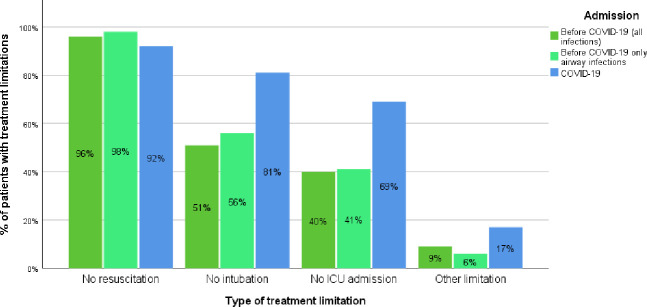
Objectives: The COVID-19 pandemic pressurised healthcare with increased shortage of care. This resulted in an increase of awareness for code status documentation (ie, whether limitations to specific life-sustaining treatments are in place), both in the medical field and in public media. However, it is unknown whether the increased awareness changed the prevalence and content of code status documentation for COVID-19 patients. We aim to describe differences in code status documentation between infectious patients before the pandemic and COVID-19 patients. Setting: University Medical Centre of Utrecht, a tertiary care teaching academic hospital in the Netherlands. Participants: A total of 1715 patients were included, 129 in the COVID-19 cohort (a cohort of COVID-19 patients, admitted from March 2020 to June 2020) and 1586 in the pre-COVID-19 cohort (a cohort of patients with (suspected) infections admitted between September 2016 to September 2018). Primary and secondary outcome measures: We described frequency of code status documentation, frequency of discussion of this code status with patient and/or family, and content of code status. Results: Frequencies of code status documentation (69.8% vs 72.7%, respectively) and discussion (75.6% vs 73.3%, respectively) were similar in both cohorts. More patients in the COVID-19 cohort than in the before COVID-19 cohort had any treatment limitation as opposed to full code (40% vs 25%). Within the treatment limitations, ‘no intensive care admission’ (81% vs 51%) and ‘no intubation’ (69% vs 40%) were more frequently documented in the COVID-19 cohort. A smaller difference was seen in ‘other limitation’ (17% vs 9%), while ‘no resuscitation’ (96% vs 92%) was comparable between both periods. Conclusion: We observed no difference in the frequency of code status documentation or discussion in COVID-19 patients opposed to a pre-COVID-19 cohort. However, treatment limitations were more prevalent in patients with COVID-19, especially ‘no intubation’ and ‘no intensive care admission’.
Overview
The claims and statistics of this paper haven’t been checked yet.
Free: it reads the open-access text and checks the first 5 claims that cite a source we can check. Create a free account to check every claim.
Integrity signals
Registry
Cites
Statistics
Figures
Verification
Claims the paper makes
The claims and statistics of this paper haven’t been checked yet.
Free: it reads the open-access text and checks the first 5 claims that cite a source we can check. Create a free account to check every claim.
Claims other papers make about this one
Each is checked against this paper’s own text: does it say what the citing paper says it does?
The source backs part of the claim, not all of it — or backs it for a different population, condition or comparison.
In the citing paper
“Proper code status documentation is associated with improved patient care, reduced health care costs, shortened ICU stays, lower readmission rates, and increased patient satisfaction.8”
From In-Hospital Code Status Updates: Trends Over Time and the Impact of COVID-19 (2024) · cites this paper as [8]
Experimental — accuracy not yet measured
Self-check
Percentages, sums and reported differences re-computed from the paper’s own numbers.
The self-check needs the paper’s full text.
Citations
Cites
The psychological impact of quarantine and how to reduce it: Rapid review of the evidence
Brooks, S. K., Webster, R. K., Smith, L. E., Woodland, L., Wessely, S., Greenberg, N., & Rubin, G. J. (2020) · The Lancet · doi:10.1016/s0140-6736(20)30460-8 · Cited by 16,378
Quan, H., Li, B., Couris, C. M., Fushimi, K., Graham, P., Hider, P., Januel, J.-M., & Sundararajan, V. (2011) · American Journal of Epidemiology · doi:10.1093/aje/kwq433 · Cited by 5,843
Wiersinga, W. J., Rhodes, A., Cheng, A. C., Peacock, S. J., & Prescott, H. C. (2020) · JAMA · doi:10.1001/jama.2020.12839 · Cited by 4,609
Pappa, S., Ntella, V., Giannakas, T., Giannakoulis, V. G., Papoutsi, E., & Katsaounou, P. (2020) · Brain Behavior and Immunity · doi:10.1016/j.bbi.2020.05.026 · Cited by 3,617
Maunder, R., Hunter, J., Vincent, L. H., Bennett, J. P., Peladeau, N., Leszcz, M., Sadavoy, J., Verhaeghe, L. M., Steinberg, R. J., & Mazzulli, T. (2003) · Europe PMC (PubMed Central) · Cited by 1,781
Validation of a modified Early Warning Score in medical admissions
Subbe, C. P. (2001) · QJM · doi:10.1093/qjmed/94.10.521 · Cited by 1,762
COVID‐19 diagnosis and management: a comprehensive review
Pascarella, G., Strumia, A., Piliego, C., Bruno, F., Del Buono, R., Costa, F., Scarlata, S., & Agrò, F. E. (2020) · Journal of Internal Medicine · doi:10.1111/joim.13091 · Cited by 1,369
Riou, J., & Althaus, C. L. (2020) · Eurosurveillance · doi:10.2807/1560-7917.es.2020.25.4.2000058 · Cited by 1,297
Curtis, J. R., Kross, E. K., & Stapleton, R. D. (2020) · JAMA · doi:10.1001/jama.2020.4894 · Cited by 349
Khandelwal, N., Kross, E. K., Engelberg, R. A., Coe, N. B., Long, A. C., & Curtis, J. R. (2015) · Critical Care Medicine · doi:10.1097/ccm.0000000000000852 · Cited by 317
Verelst, F., Kuylen, E., & Beutels, P. (2020) · Eurosurveillance · doi:10.2807/1560-7917.es.2020.25.13.2000323 · Cited by 205
COVID-19 and primary care in six countries
Huston, P., Campbell, J., Russell, G., Goodyear-Smith, F., Phillips, R. L., van Weel, C., & Hogg, W. (2020) · BJGP Open · doi:10.3399/bjgpopen20x101128 · Cited by 164
Assessing the impact of non-pharmaceutical interventions on SARS-CoV-2 transmission in Switzerland
Lemaitre, J. C., Perez‐Saez, J., Azman, A. S., Rinaldo, A., & Fellay, J. (2020) · Swiss Medical Weekly · doi:10.4414/smw.2020.20295 · Cited by 76
The good, the bad and the ugly: pandemic priority decisions and triage
Flaatten, H., Van Heerden, V., Jung, C., Beil, M., Leaver, S., Rhodes, A., Guidet, B., & deLange, D. W. (2021) · Journal of Medical Ethics · doi:10.1136/medethics-2020-106489 · Cited by 71
Problems faced by Syrian refugees and asylum seekers in Switzerland
Kiselev, N., Pfaltz, M. C., Schick, M., Bird, M., Hansen, P., Sijbrandij, M., de Graaff, A. M., Schnyder, U., & Morina, N. (2020) · Swiss Medical Weekly · doi:10.4414/smw.2020.20381 · Cited by 65
Do not resuscitate orders and aging: Impact of multimorbidity on the decision-making process
De Decker, L., Annweiler, C., Launay, C., Fantino, B., & Beauchet, O. (2014) · The Journal of nutrition, health and aging · doi:10.1007/s12603-014-0023-5 · Cited by 64
Ocular Pathology; Ocular Pathology (CD-ROM)
Perlman, J. I. (2003) · JAMA · doi:10.1001/jama.289.18.2432 · Cited by 52
Resident Approaches to Advance Care Planning on the Day of Hospital Admission
Smith, A. K., Ries, A. P., Zhang, B., Tulsky, J. A., Prigerson, H. G., & Block, S. D. (2006) · Archives of Internal Medicine · doi:10.1001/archinte.166.15.1597 · Cited by 52
Uffen, J. W., Oomen, P. G. A., de Regt, M. J. A., Oosterheert, J. J., & Kaasjager, K. A. H. (2019) · BMC Emergency Medicine · doi:10.1186/s12873-019-0293-7 · Cited by 49
Self-citationAuerbach, A. D., Katz, R., Pantilat, S. Z., Bernacki, R., Schnipper, J., Kaboli, P., Wetterneck, T., Gonzales, D., Arora, V., Zhang, J., et al. (2008) · Journal of Hospital Medicine · doi:10.1002/jhm.369 · Cited by 46
Kim, Y. S., Escobar, G. J., Halpern, S. D., Greene, J. D., Kipnis, P., & Liu, V. (2016) · Journal of the American Geriatrics Society · doi:10.1111/jgs.14048 · Cited by 41
Bringing into focus treatment limitation and DNACPR decisions: How COVID-19 has changed practice
Coleman, J. J., Botkai, A., Marson, E. J., Evison, F., Atia, J., Wang, J., Gallier, S., Speakman, J., & Pankhurst, T. (2020) · Resuscitation · doi:10.1016/j.resuscitation.2020.08.006 · Cited by 39
The Triad That Matters: Palliative Medicine, Code Status, and Health Care Costs
Celso, B. G., & Meenrajan, S. R. (2010) · American Journal of Hospice and Palliative Medicine® · doi:10.1177/1049909110363806 · Cited by 33
Richardson, D. K., Zive, D. M., & Newgard, C. D. (2013) · Academic Emergency Medicine · doi:10.1111/acem.12112 · Cited by 29
Gupta, A., Bahl, B., Rabadi, S., Mebane, A., Levey, R., & Vasudevan, V. P. (2020) · American Journal of Hospice and Palliative Medicine® · doi:10.1177/1049909120963698 · Cited by 27
Code status discussions in medical inpatients: results of a survey of patients and physicians
Becker, C., Kuenzli, N., Perrig, S., Beck, K., Vincent, A., Widmer, M., Thommen, E., Schaefert, R., Bassetti, S., & Hunziker, S. (2020) · Swiss Medical Weekly · doi:10.4414/smw.2020.20194 · Cited by 26
Stream, S., Nolan, A., Kwon, S., & Constable, C. (2018) · Resuscitation · doi:10.1016/j.resuscitation.2018.06.020 · Cited by 24
Anderson, W. G., Pantilat, S. Z., Meltzer, D. O., Schnipper, J. L., Kaboli, P. J., Wetterneck, T. B., Gonzales, D. V., Arora, V. M., Zhang, J., & Auerbach, A. D. (2010) · American Journal of Hospice and Palliative Medicine® · doi:10.1177/1049909110374352 · Cited by 15
End-of-life decisions in emergency patients: prevalence, outcome and physician effect
Siegrist, V., Eken, C., Nickel, C. H., Mata, R., Hertwig, R., & Bingisser, R. M. (2018) · QJM · doi:10.1093/qjmed/hcy112 · Cited by 11
Jain, V. G., Greco, P. J., & Kaelber, D. C. (2017) · Applied Clinical Informatics · doi:10.4338/aci-2016-08-ra-0133 · Cited by 10
Switzer, B., Jazieh, K., Bernstein, E. Y., & Harris, D. (2019) · JCO Oncology Practice · doi:10.1200/jop.19.00408 · Cited by 10
Research works printed but not linked: 3
- 10.1001/jama.2020.4894.1771-1772 · doi:10.1001/jama.2020.4894.1771-1772
- 10.1001/jama.2020.12839.e4 · doi:10.1001/jama.2020.12839.e4
- Briede S, de Hond T, van Goor H. Data from: code status documentation at admission in COVID-19 patients and a cohort of patient with infections before the pandemic. DataverseNL, V1 2021. PMC8587534 34758991
Cited by
Amacher, S. A., Blatter, R., Briel, M., Appenzeller‐Herzog, C., Bohren, C., Becker, C., Beck, K., Groß, S., Tisljar, K., Sutter, R., et al. (2022) · Critical Care · doi:10.1186/s13054-022-04263-y · Cited by 36
Hendriks, V. J. J., Faes, M. C., van der Meer, J. B. L., Janse, E. S., van der Meer, N. J. M., & van der Linden, C. M. J. (2022) · Aging Clinical and Experimental Research · doi:10.1007/s40520-022-02281-y · Cited by 5
Jacobson, E., Troost, J. P., Epler, K., Lenhan, B., Rodgers, L., O'Callaghan, T., Painter, N., & Barrett, J. (2023) · Journal of Palliative Medicine · doi:10.1089/jpm.2022.0578 · Cited by 4
Retrospective review of the code status of individuals with Down syndrome during the COVID‐19 era
Jett, J., Fossi, A., Blonsky, H., Ross, W. J., Townsend, S., Stephens, M., Chicoine, B. A., & Santoro, S. L. (2023) · American Journal of Medical Genetics Part C Seminars in Medical Genetics · doi:10.1002/ajmg.c.32080 · Cited by 4
Olds, P., Musinguzi, N., Geisler, B. P., Sarin, P., & Haberer, J. E. (2023) · Medicine · doi:10.1097/md.0000000000034447 · Cited by 4
Metadata
- Authors
- Briedé, S., van Goor, H. M. R., de Hond, T. A. P., van Roeden, S. E., Staats, J. M., Oosterheert, J. J., van den Bos, F., & Kaasjager, K. A. H.
- Affiliations
- University Medical Center Utrecht (NL)
- Internal Medicine and Dermatology, University Medical Centre Utrecht, Utrecht, The Netherlands
- Department of Internal Medicine, Section of Gerontology and Geriatrics, Leiden University Medical Center, Leiden, The Netherlands
- Corresponding author
- Briedé, Saskia
- Venue
- BMJ Open
- Publisher
- BMJ
- Published
- 2021-11
- Volume
- 11
- Issue
- 11
- Pages
- e050268
- ISSN
- 2044-6055 (ISSN-L)
- PMC
- PMC8587534
- OpenAlex
- W3211578534
- Cited by
- 10
- References
- 31
- Citations by year
- 2024: 2 · 2023: 6 · 2022: 2
- FWCI
- 2.15
- Type
- journal article
- Language
- en
- Open access
- gold
- doi.org
- Licence
- Locations
- BMJ Open (publishedVersion, cc-by-nc)
- PubMed Central (publishedVersion, cc-by-nc)
- PubMed (publishedVersion)
- Leiden Repository (Leiden University) (submittedVersion, cc-by-nc)
- Data Archiving and Networked Services (DANS) (submittedVersion, cc-by-nc)
- DOAJ (DOAJ: Directory of Open Access Journals) (submittedVersion, cc-by-sa)
- Utrecht University Repository (Utrecht University) (submittedVersion, other-oa)
- Topics
- Health Sciences › Medicine › Public Health, Environmental and Occupational Health › Palliative Care and End-of-Life Issues
- Health Sciences › Medicine › Public Health, Environmental and Occupational Health › Ethics and bioethics in healthcare
- Health Sciences › Health Professions › General Health Professions › Ethics in medical practice
- Keywords
- COVID-19 pandemic, advance care planning, end-of-life discussions, pre-COVID-19 comparison, infectious disease patients
- MeSH terms
- COVID-19, SARS-CoV-2, Documentation, Humans, Cohort Studies, Pandemics
About these checks
Registry, retraction, Cites and statistics results are computed, not judged, with one exception: a printed reference that no index lists is read once by a model before it counts as a citation error. Claims are extracted by a model and kept only when their quote appears verbatim in the text; each cited source is then checked, with a model’s help, for whether it says what the claim relies on. Those verdicts can be wrong — read the claim’s quote and the cited source before relying on one.
Statistics and arithmetic are recomputed, not judged.
Confidence bands are shown only for fields calibrated on our annotated test set. None is calibrated yet, so no band is shown.
What counts as a claim ›How we measure confidence ›How we check this ›
Are you an author, or do you see a problem with this page? Request a review
Data sources
Bibliographic data: Semantic Scholar, OpenAlex, Crossref.
Contains information from the Semantic Scholar Academic Graph Datasets, made available under the ODC Attribution License (ODC-BY 1.0).
Semantic Scholar’s data is described in: Kinney, R., et al. (2023). The Semantic Scholar Open Data Platform. arXiv:2301.10140.
