

Feasibility randomised controlled trial of online group Acceptance and Commitment Therapy for Functional Cognitive Disorder (ACT4FCD)
Open accessPublished version of a preprint
The DOI matches its Crossref record; 37 of the 37 references it cites were found in a registry or an index; 22 of the 43 sources its claims cite were checked for support.
Abstract
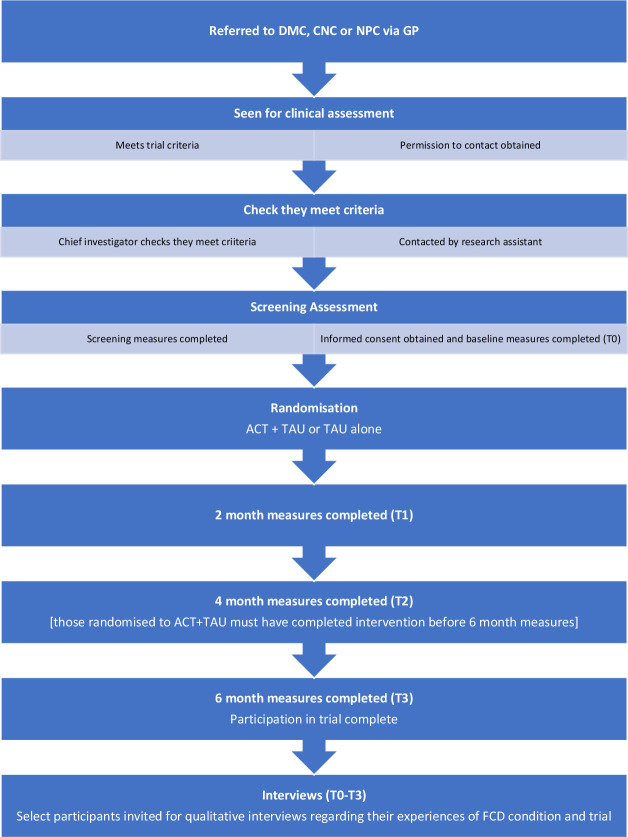
Introduction Functional cognitive disorder (FCD) is seen increasingly in clinics commissioned to assess cognitive disorders. Patients report frequent cognitive, especially memory, failures. The diagnosis can be made clinically, and unnecessary investigations avoided. While there is some evidence that psychological treatments can be helpful, they are not routinely available. Therefore, we have developed a brief psychological intervention using the principles of acceptance and commitment therapy (ACT) that can be delivered in groups and online. We are conducting a feasibility study to assess whether the intervention can be delivered within a randomised controlled trial. We aim to study the feasibility of recruitment, willingness to be randomised to intervention or control condition, adherence to the intervention, completion of outcome measures and acceptability of treatment. Methods and analysis We aim to recruit 48 participants randomised 50:50 to either the ACT intervention and treatment as usual (TAU), or TAU alone. ACT will be provided to participants in the treatment arm following completion of baseline outcome measures. Completion of these outcome measures will be repeated at 8, 16 and 26 weeks. The measures will assess several domains including psychological flexibility, subjective cognitive symptoms, mood and anxiety, health-related quality of life and functioning, healthcare utilisation, and satisfaction with care and participant-rated improvement. Fifteen participants will be selected for in-depth qualitative interviews about their experiences of living with FCD and of the ACT intervention. Ethics and dissemination The study received a favourable opinion from the South East Scotland Research Ethics Committee 02 on 30 September 2022 (REC reference: 22/SS/0059). HRA approval was received on 1 November 2022 (IRAS 313730). The results will be published in full in an open-access journal. © The Author(s)
Overview
CoChat Summary
## TL;DR
This is a feasibility, single-blind randomized controlled trial protocol testing whether a 5-session online group Acceptance and Commitment Therapy (ACT) program for functional cognitive disorder (FCD) can be delivered and evaluated against treatment as usual (TAU). The study is designed to recruit 48 participants and assess feasibility outcomes such as recruitment, adherence, acceptability, retention, and signals of efficacy.
## Key findings
- The planned sample is 48 participants randomized 50:50 to ACT+TAU vs TAU; the trial will follow outcomes at 8, 16, and 26 weeks.
- Primary feasibility targets are ≥70% recruitment, ≥75% of ACT participants attending 4 or more sessions, and ≥75% rating the intervention as satisfied/very satisfied on a 5-point scale.
- The intervention is a five-session group ACT program, delivered online and focused on increasing psychological flexibility; the paper identifies AAQ-II as the proposed primary clinical outcome for a future definitive RCT.
- The protocol notes FCD prevalence estimates from prior literature: 30% cognitive symptoms in community populations (245,654 subjects) and 24% of diagnostic memory clinic attendees may have FCD or a synonym (range 12%–56%).
## Methods
- Design: Parallel-group, single-blind RCT feasibility study of online group ACT + TAU vs TAU alone, with embedded qualitative interviews and repeated measures over time.
- Sample/data: Planned recruitment of 48 adults with an established FCD diagnosis from diagnostic memory clinics, cognitive neurology clinics, and neuropsychiatry clinics in London; 15 participants will be selected for in-depth qualitative interviews.
- Analysis: Feasibility outcomes will be summarized descriptively with 95% CIs; planned exploratory analyses use linear/logistic mixed-effects models on an intention-to-treat basis, with effect sizes (e.g., Hedges’ g, relative risk) and a conservative last-observation-carried-forward approach for missing data.
## Limitations
- The paper explicitly states this is a feasibility trial, so “a power calculation is neither possible nor necessary” and hypothesis testing is reserved for a future main trial.
- Participants cannot be blinded to treatment allocation; the paper lists this as a limitation, and it is also evident from the nature of the intervention.
- The paper states recruitment may need expansion beyond the initial London sites if targets are not met; more generally, the protocol is limited by being conducted in a specific clinic network and by excluding people with severe psychiatric comorbidity, dementia, learning disability, or insufficient English.
Model-written summary. Check it against the paper before relying on it.
Integrity signals
Registry
Cites
Statistics
Figures
Verification
Claims the paper makes
20 Valid · 1 Not valid · 12 Not checked · 15 Own results and interpretations
The cited sources support only part of this claim — read each source’s verdict below.
In the paper
“A recent meta-analysis of treatment studies to date found that group interventions involving both cognitive-training and expectancy-modification significantly improved psychological well-being.”
§ Feasibility randomised controlled trial of online group Acceptance and Commitment Therapy for Functional Cognitive Disorder (ACT4FCD) > Introduction
What the sources say
- Partly supportedcites [11] Bhome R, Berry AJ, Huntley JD, et al. Interventions for subjective cognitive decline: systematic review and meta-analysis. BMJ Open 2018; 8: e021610. 10.1136/bmjopen-2018-021610 PMC6059327 30030318 sourceExperimental — accuracy not yet measured
The Results section (Group psychological interventions; page unavailable) reports a significant improvement in psychological well-being after group interventions. But the Discussion (Main findings; page unavailable) says only one of those interventions also included cognitive training, and the paper does not establish that the effective group interventions combined cognitive training with expectancy modification. (LLM, conf=0.88)
plainstates a cause- Asserted: passes — The authors put it forward as true.
- Checkable: passes — It can be checked against evidence.
- Load-bearing: unclear — It is unclear whether the paper’s conclusions depend on it.
- Based: passes — The paper gives a reason why it holds.
- Partly supported
The cited sources support only part of this claim — read each source’s verdict below.
In the paper
“There is now preliminary evidence that strategies focused on expectations, cognitive restructuring and psychoeducation can be helpful.10 11”
§ Feasibility randomised controlled trial of online group Acceptance and Commitment Therapy for Functional Cognitive Disorder (ACT4FCD) > Introduction
What the sources say
- Not checked — no full text of the sourcecites [10] Metternich B, Kosch D, Kriston L, et al. The effects of nonpharmacological interventions on subjective memory complaints: a systematic review and meta-analysis. Psychother Psychosom 2010; 79: 6– 19. 10.1159/000254901 19887887 source
- Partly supportedcites [11] Bhome R, Berry AJ, Huntley JD, et al. Interventions for subjective cognitive decline: systematic review and meta-analysis. BMJ Open 2018; 8: e021610. 10.1136/bmjopen-2018-021610 PMC6059327 30030318 sourceExperimental — accuracy not yet measured
The Introduction reports evidence that expectancy-change interventions, including cognitive restructuring and psychoeducation, improved metacognition; the Discussion reports promising effects of group psychoeducation on psychological well-being. However, the review studies subjective cognitive decline, not FCD specifically, so it does not establish that these strategies help people with FCD. (LLM, conf=0.86)
plainstates a possible causen = 18- Asserted: passes — The authors put it forward as true.
- Checkable: passes — It can be checked against evidence.
- Load-bearing: passes — The paper’s conclusions depend on it.
- Based: passes — The paper gives a reason why it holds.
The cited sources support only part of this claim — read each source’s verdict below.
In the paper
“Perceived threat is thought to be a maintenance factor for FND.”
§ Feasibility randomised controlled trial of online group Acceptance and Commitment Therapy for Functional Cognitive Disorder (ACT4FCD) > Introduction
What the sources say
- Partly supportedcites [5] Edwards MJ, Adams RA, Brown H, et al. A Bayesian account of "hysteria.'' Brain 2012; 135(Pt 11): 3495– 512. 10.1093/brain/aws129 22641838 PMC3501967 sourceExperimental — accuracy not yet measured
In ‘How pathological expectations and attention might originate’ (page unavailable), the paper says conscious attention is important for maintaining functional motor and sensory symptoms. It also discusses anxiety, panic-related symptoms and catastrophic thinking, but does not identify perceived threat itself as a maintenance factor. (LLM, conf=0.76)
- Not checked — no full text of the sourcecites [16] Brown RJ, Reuber M. Towards an integrative theory of psychogenic non-epileptic seizures (pnes). Clin Psychol Rev 2016; 47: 55– 70. 10.1016/j.cpr.2016.06.003 27340856 source
hedgedstates a possible cause- Asserted: passes — The authors put it forward as true.
- Checkable: passes — It can be checked against evidence.
- Load-bearing: passes — The paper’s conclusions depend on it.
- Based: passes — The paper gives a reason why it holds.
- Partly supported
Every source the paper cites for this claim was checked and supports it.
In the paper
“While expectancy-change interventions had little effect on objective measures of cognitive functioning,”
§ Feasibility randomised controlled trial of online group Acceptance and Commitment Therapy for Functional Cognitive Disorder (ACT4FCD) > Introduction
What the sources say
- Supportedcites [11] Bhome R, Berry AJ, Huntley JD, et al. Interventions for subjective cognitive decline: systematic review and meta-analysis. BMJ Open 2018; 8: e021610. 10.1136/bmjopen-2018-021610 PMC6059327 30030318 source
The Results section (Group psychological interventions; page not available) describes interventions involving psychoeducation and strategies to change beliefs about cognition. Of the three studies measuring objective cognitive performance, two found no effect; a third, which also included cognitive training, found a significant improvement. This supports the qualified claim that these interventions had little effect overall. (LLM, conf=0.85)
plain- Asserted: passes — The authors put it forward as true.
- Checkable: passes — It can be checked against evidence.
- Load-bearing: passes — The paper’s conclusions depend on it.
- Based: passes — The paper gives a reason why it holds.
- Supported
The cited sources support only part of this claim — read each source’s verdict below.
In the paper
“Symptoms are, therefore, experienced in a ‘top-down’ manner—influenced by cognitive and neurobiological processes of expectations and predictions of illness.5 16”
§ Feasibility randomised controlled trial of online group Acceptance and Commitment Therapy for Functional Cognitive Disorder (ACT4FCD) > Introduction
What the sources say
- Partly supportedcites [5] Edwards MJ, Adams RA, Brown H, et al. A Bayesian account of "hysteria.'' Brain 2012; 135(Pt 11): 3495– 512. 10.1093/brain/aws129 22641838 PMC3501967 sourceExperimental — accuracy not yet measured
The section ‘Functional motor and sensory symptoms as a disorder of abnormal expectations and misdirected attention’ proposes that prior beliefs and attention shape functional motor and sensory symptoms. The paper does not establish this account specifically for functional cognitive disorder (FCD); in ‘Expectations, attention and the misattribution of agency,’ it also clarifies that top-down attention changes the precision of prior beliefs rather than predicting symptom content. Page numbers were not supplied in our copy. (LLM, conf=0.82)
- Not checked — no full text of the sourcecites [16] Brown RJ, Reuber M. Towards an integrative theory of psychogenic non-epileptic seizures (pnes). Clin Psychol Rev 2016; 47: 55– 70. 10.1016/j.cpr.2016.06.003 27340856 source
plainstates a cause- Asserted: passes — The authors put it forward as true.
- Checkable: passes — It can be checked against evidence.
- Load-bearing: passes — The paper’s conclusions depend on it.
- Based: passes — The paper gives a reason why it holds.
- Partly supported
8 more claims · 1 with their cited sources checked
Create a free account to see all 48 claims and every source verdict.
- It may state two separate claims as one. 22
- Probably not a substantial claim. 23
Citations
Cites
Using thematic analysis in psychology
Braun, V., & Clarke, V. (2006) · Qualitative Research in Psychology · doi:10.1191/1478088706qp063oa · Cited by 194,414
The PHQ-9: Validity of a brief depression severity measure
Kroenke, K., Spitzer, R. L., & Williams, J. B. W. (2001) · Journal of General Internal Medicine · doi:10.1046/j.1525-1497.2001.016009606.x · Cited by 44,910
A Brief Measure for Assessing Generalized Anxiety Disorder: The GAD-7
Spitzer, R. L., Kroenke, K., Williams, J. B. W., & Löwe, B. (2006) · Archives of Internal Medicine · doi:10.1001/archinte.166.10.1092 · Cited by 31,765 · cited 2×
“Depression and anxiety • 9-question Patient Health Questionnaire (PHQ-9) [27] • Generalized Anxiety Disorder 7 (GAD-7) [28]”
BackgroundDevelopment and preliminary testing of the new five-level version of EQ-5D (EQ-5D-5L)
Herdman, M., Gudex, C., Lloyd, A., Janssen, M., Kind, P., Parkin, D., Bonsel, G., & Badia, X. (2011) · Quality of Life Research · doi:10.1007/s11136-011-9903-x · Cited by 9,795 · cited 1×
“0) [23] • EuroQol 5-Dimension, 5-Level Health Scale (EQ-5D-5L) [24] • ICEpop CAPability measure for Adults (ICECAP-A) [25] .”
BackgroundAcceptance and commitment therapy: model, processes and outcomes
Hayes, S. C., Luoma, J. B., Bond, F. W., Masuda, A., & Lillis, J. (2006) · Behaviour Research and Therapy · doi:10.1016/j.brat.2005.06.006 · Cited by 6,587
Bond, F. W., Hayes, S. C., Baer, R. A., Carpenter, K. M., Guenole, N., Orcutt, H. K., Waltz, T., & Zettle, R. D. (2011) · Behavior Therapy · doi:10.1016/j.beth.2011.03.007 · Cited by 3,950 · cited 3×
“ACT specific measure of change • Acceptance and Action Questionnaire II (AAQ-II) [29] is a measure of psychological flexibility/inflexibility widely used in ACT.”
MethodInfluentialCONSORT 2010 statement: extension to randomised pilot and feasibility trials.
Eldridge, S. M., Chan, C. L., Campbell, M. J., Bond, C. M., Hopewell, S., Thabane, L., & Lancaster, G. A. (2016) · BMJ · doi:10.1136/bmj.i5239 · Cited by 3,404 · cited 1×
“Please refer to data management plan (see online supplemental appendix 5), for details regarding confidentiality, data collection, data handling and data transfer.”
Sample size of 12 per group rule of thumb for a pilot study
Julious, S. A. (2005) · Pharmaceutical Statistics · doi:10.1002/pst.185 · Cited by 3,068 · cited 1×
“[33, 34, 35] If it proves challenging to recruit participants via these routes alone then we .”
BackgroundCONSORT 2010 statement: extension to randomised pilot and feasibility trials
on behalf of the PAFS consensus group, Eldridge, S. M., Chan, C. L., Campbell, M. J., Bond, C. M., Hopewell, S., Thabane, L., & Lancaster, G. A. (2016) · Pilot and Feasibility Studies · doi:10.1186/s40814-016-0105-8 · Cited by 2,843
Design and analysis of pilot studies: recommendations for good practice
Lancaster, G. A., Dodd, S., & Williamson, P. R. (2004) · Journal of Evaluation in Clinical Practice · doi:10.1111/j..2002.384.doc.x · Cited by 2,572 · cited 1×
“[33, 34, 35] If it proves challenging to recruit participants via these routes alone then we .”
Background(2010) · Virtual Defense Library (Ministerio de Defensa) · Cited by 1,530
How to Select, Calculate, and Interpret Effect Sizes
Durlak, J. A. (2009) · Journal of Pediatric Psychology · doi:10.1093/jpepsy/jsp004 · Cited by 1,446
Sim, J., & Lewis, M. (2012) · Journal of Clinical Epidemiology · doi:10.1016/j.jclinepi.2011.07.011 · Cited by 1,036
A Bayesian account of ‘hysteria’
Edwards, M. J., Adams, R. A., Brown, H., Parees, I., & Friston, K. J. (2012) · Brain · doi:10.1093/brain/aws129 · Cited by 825
Self-citationDevelopment of a self-report measure of capability wellbeing for adults: the ICECAP-A
Al-Janabi, H., N Flynn, T., & Coast, J. (2012) · Quality of Life Research · doi:10.1007/s11136-011-9927-2 · Cited by 666
The empirical status of acceptance and commitment therapy: A review of meta-analyses
Gloster, A. T., Walder, N., Levin, M. E., Twohig, M. P., & Karekla, M. (2020) · Journal of Contextual Behavioral Science · doi:10.1016/j.jcbs.2020.09.009 · Cited by 622
Graham, C. D., Gouick, J., Krahé, C., & Gillanders, D. (2016) · Clinical Psychology Review · doi:10.1016/j.cpr.2016.04.009 · Cited by 476
Examining psychological inflexibility as a transdiagnostic process across psychological disorders
Levin, M. E., MacLane, C., Daflos, S., Seeley, J. R., Hayes, S. C., Biglan, A., & Pistorello, J. (2014) · Journal of Contextual Behavioral Science · doi:10.1016/j.jcbs.2014.06.003 · Cited by 400
Psychometric Properties of a New Metamemory Questionnaire for Older Adults
Troyer, A. K., & Rich, J. B. (2002) · The Journals of Gerontology Series B: Psychological Sciences and Social Sciences · doi:10.1093/geronb/57.1.p19 · Cited by 369 · cited 1×
“Subjective cognitive symptoms • Multifactorial Memory Questionnaire (MMQ) [26]”
BackgroundSystematic review of misdiagnosis of conversion symptoms and “hysteria”
Stone, J., Smyth, R., Carson, A., Lewis, S., Prescott, R., Warlow, C., & Sharpe, M. (2005) · BMJ · doi:10.1136/bmj.38628.466898.55 · Cited by 358
Buhrman, M., Skoglund, A., Husell, J., Bergström, K., Gordh, T., Hursti, T., Bendelin, N., Furmark, T., & Andersson, G. (2013) · Behaviour Research and Therapy · doi:10.1016/j.brat.2013.02.010 · Cited by 285
Towards an integrative theory of psychogenic non-epileptic seizures (PNES)
Brown, R. J., & Reuber, M. (2016) · Clinical Psychology Review · doi:10.1016/j.cpr.2016.06.003 · Cited by 279
Teodoro, T., Edwards, M. J., & Isaacs, J. D. (2018) · Journal of Neurology, Neurosurgery & Psychiatry · doi:10.1136/jnnp-2017-317823 · Cited by 241 · cited 1×
“[3] Disturbance of attention is thought to be responsible for the symptoms,[4] as with other functional neurological disorders,[5] although the underlying pathophysiological mechanisms remain unknown.”
BackgroundSelf-citationFunctional cognitive disorders: a systematic review
McWhirter, L., Ritchie, C., Stone, J., & Carson, A. (2020) · The Lancet Psychiatry · doi:10.1016/s2215-0366(19)30405-5 · Cited by 240 · cited 3×
“Patients who experience FCD tend to perform as well or a little worse on neuropsychological tests as healthy controls but better than those with mild cognitive impairment and early Alzheimer's disease.[3] Disturbance of attention is thought to be responsible for the symptoms,[4] as with other functional neurological d…”
BackgroundInfluentialFunctional cognitive disorder: dementia’s blind spot
Ball, H. A., McWhirter, L., Ballard, C., Bhome, R., Blackburn, D. J., Edwards, M. J., Fleming, S. M., Fox, N. C., Howard, R., Huntley, J., et al. (2020) · Brain · doi:10.1093/brain/awaa224 · Cited by 203 · cited 1×
“Functional Cognitive Disorder (FCD) is defined as a complaint about memory function or other cognitive process in the absence of relevant neuropathology and with evidence of inconsistency between symptoms reported, objective signs, and known phenomenology of dementia syndromes.[1] Typical complaints include forgetting…”
BackgroundSelf-citationThompson, E. M., Destree, L., Albertella, L., & Fontenelle, L. F. (2021) · Behavior Therapy · doi:10.1016/j.beth.2020.07.002 · Cited by 177 · cited 1×
“It is feasible and acceptable to deliver to patients with psychosis in a brief group format [21] and can be effectively delivered online through guided and unguided modules of learning.[22]”
BackgroundTyrer, P., Cooper, S., Salkovskis, P., Tyrer, H., Crawford, M., Byford, S., Dupont, S., Finnis, S., Green, J., McLaren, E., et al. (2014) · The Lancet · doi:10.1016/s0140-6736(13)61905-4 · Cited by 167 · cited 3×
“The AD-SUS was developed by the study economist for previous work in similar populations and has been adapted for the needs of this study so that participants can complete this without assistance.”
BackgroundInfluentialSelf-citationInterventions for subjective cognitive decline: systematic review and meta-analysis
Bhome, R., Berry, A. J., Huntley, J. D., & Howard, R. J. (2018) · BMJ Open · doi:10.1136/bmjopen-2018-021610 · Cited by 123 · cited 2×
“There is now preliminary evidence that strategies focused on expectations, cognitive restructuring and psychoeducation can be helpful.[10, 11] A recent meta-analysis of treatment studies to date found that group interventions involving both cognitive-training and expectancy-modification significantly improved psycholo…”
BackgroundSelf-citationJohns, L. C., Oliver, J. E., Khondoker, M., Byrne, M., Jolley, S., Wykes, T., Joseph, C., Butler, L., Craig, T., & Morris, E. M. J. (2016) · Journal of Behavior Therapy and Experimental Psychiatry · doi:10.1016/j.jbtep.2015.10.001 · Cited by 97 · cited 1×
“It is feasible and acceptable to deliver to patients with psychosis in a brief group format [21] and can be effectively delivered online through guided and unguided modules of learning.”
BackgroundThe Syndrome of Functional Memory Disorder: Definition, Etiology, and Natural Course
Schmidtke, K., Pohlmann, S., & Metternich, B. (2008) · The American Journal of Geriatric Psychiatry · doi:10.1097/jgp.0b013e318187ddf9 · Cited by 91 · cited 1×
“Schmidtke and colleagues [7] found that cognitive symptoms persisted in 85% of those followed-up for an average of 20 months.”
BackgroundMetternich, B., Kosch, D., Kriston, L., Härter, M., & Hüll, M. (2010) · Psychotherapy and Psychosomatics · doi:10.1159/000254901 · Cited by 62 · cited 2×
“There is now preliminary evidence that strategies focused on expectations, cognitive restructuring and psychoeducation can be helpful.[10, 11] A recent meta-analysis of treatment studies to date found that group interventions involving both cognitive-training and expectancy-modification significantly improved psycholo…”
BackgroundDu, S., Dong, J., Jin, S., Zhang, H., & Zhang, Y. (2021) · Neuroscience & Biobehavioral Reviews · doi:10.1016/j.neubiorev.2021.09.022 · Cited by 48
Impact of the National dementia strategy in a neurology-led memory clinic: 5-year data
Larner, A. (2014) · Clinical Medicine · doi:10.7861/clinmedicine.14-2-216 · Cited by 30
Graham, C. D., O'Hara, D. J., & Kemp, S. (2018) · Clinical Psychology & Psychotherapy · doi:10.1002/cpp.2174 · Cited by 24
How the UK describes functional memory symptoms
Bailey, C., Bell, S. M., & Blackburn, D. M. (2017) · Psychogeriatrics · doi:10.1111/psyg.12232 · Cited by 20 · cited 1×
“A recent survey of DMCs found 73% immediately discharged them to primary care and treatments offered ranged from simple reassurance to referral to a community mental health team.[9] As they receive little explanation for their symptoms, patients are liable to present to their GP requesting further referrals and invest…”
BackgroundTreating functional non-epileptic attacks – should we consider acceptance and commitment therapy?
Cope, S. R., Poole, N., & Agrawal, N. (2017) · Epilepsy & Behavior · doi:10.1016/j.yebeh.2017.06.003 · Cited by 18
Self-citationFunctional cognitive disorders: identification and management
Poole, N. A., Cope, S. R., Bailey, C., & Isaacs, J. D. (2019) · BJPsych Advances · doi:10.1192/bja.2019.38 · Cited by 15 · cited 1×
“[2] While anxiety and depression are common co-morbidities, they are generally mild and do not account for the severity or nature of the symptoms reported.”
BackgroundSelf-citation
Research works printed but not linked: 2
- Hayes SC, Luoma JB, Bond FW, et al. Acceptance and commitment therapy: model, processes and outcomes. Behav Res Ther 2006; 44: 1– 25. 10.1016/j.brat.2005.06.006 16300724 · DOI · Paper page
- Guy W. Clinical global impressions (cGI) scale, modified. In: Rush JA, ed. Task Force for the Handbook of Psychiatric Measures (eds.). Handbook of Psychiatric Measures. 1st ed. Washington, DC: American Psychiatric Association, 2000.
Cited by
Cabreira, V., Alty, J., Antic, S., Araújo, R., Aybek, S., Ball, H. A., Baslet, G., Bhome, R., Coebergh, J., Dubois, B., et al. (2025) · European Journal of Neurology · doi:10.1111/ene.16318 · Cited by 24
Self-citationCabreira, V., Alty, J., Antić, S., Araújo, R., Aybek, S., Ball, H. A., Baslet, G. C., Bhome, R., Coebergh, J. A., Dubois, B., et al. (2025) · BMJ Neurology Open · doi:10.1136/bmjno-2024-000918 · Cited by 15
Self-citationThe neuropsychology of functional neurological disorders
Patten, R. V., & Bellone, J. A. (2023) · Journal of Clinical and Experimental Neuropsychology · doi:10.1080/13803395.2024.2322798 · Cited by 14
“(6) Current treatment options are scarce (Metternich et al., 2010; Poole et al., 2023).”
Rioux, M., Mamman, R., Byworth, M., Panenka, W. J., Howard, A. K., Perez, D. L., Schmidt, J., Courchesne, C., LeMoult, J., Heran, M. K. S., et al. (2024) · BMJ Neurology Open · doi:10.1136/bmjno-2024-000666 · Cited by 17
“Future research should also investigate whether or not patients with a favourable treatment response continued to meet diagnostic criteria for FCD.”
BackgroundThe role of neuropsychology in the care of patients with functional neurological symptom disorder
Patten, R. V., Mordecai, K. L., & LaFrance, W. C., Jr. (2024) · Journal of the International Neuropsychological Society · doi:10.1017/s1355617724000249 · Cited by 10
“…characteristics of all FNSD (e.g., functional connectivity abnormalities; Drane et al., 2021; Pick et al., 2019) and additional complementary investigations highlighting nonshared symptoms and treatment approaches (e.g., response to interventions; Goldstein et al., 2020; Poole et al., 2023).”
Metadata
- Authors
- Poole, N., Cope, S., Vanzan, S., Duffus, A., Mantovani, N., Smith, J., Barrett, B. M., Tokley, M., Scicluna, M., Beardmore, S., Turner, K., Edwards, M., & Howard, R.
- Affiliations
- St George's, University of London (GB)
- South West London and St George's Mental Health NHS Trust (GB)
- King's College London (GB)
- South Australian Water Corporation (AU)
- University College London (GB)
- Corresponding author
- Poole, Norman
- ORCID
- Venue
- BMJ Open
- Publisher
- BMJ
- Published
- 2023-05
- Volume
- 13
- Issue
- 5
- Pages
- e072366
- ISSN
- 2044-6055 (ISSN-L)
- PMC
- PMC10186420
- OpenAlex
- W4376223850
- Cited by
- 14
- References
- 36
- Citations by year
- 2026: 3 · 2025: 7 · 2024: 3 · 2023: 1
- FWCI
- 4.07
- Type
- journal article
- Language
- en
- Open access
- gold
- doi.org
- Locations
- BMJ Open (publishedVersion, cc-by)
- medRxiv (acceptedVersion, cc-by-nc-nd)
- PubMed Central (publishedVersion, cc-by)
- PubMed (publishedVersion)
- Research Portal (King's College London) (publishedVersion, cc-by)
- St George's Online Research Archive (St George's University of London) (acceptedVersion)
- UCL Discovery (University College London) (submittedVersion, cc-by)
- DOAJ (DOAJ: Directory of Open Access Journals) (submittedVersion, cc-by-sa)
- Funders
- NIHR (NIHR202743)
- Topics
- Social Sciences › Psychology › Clinical Psychology › Mindfulness and Compassion Interventions
- Social Sciences › Psychology › Applied Psychology › Digital Mental Health Interventions
- Health Sciences › Medicine › Psychiatry and Mental health › Psychosomatic Disorders and Their Treatments
- Keywords
- functional cognitive disorder, acceptance and commitment therapy, online group therapy, feasibility study, psychological flexibility, memory impairment, brief psychological intervention, treatment acceptability, health care utilization, health-related quality of life
- MeSH terms
- Feasibility Studies, Humans, Quality of Life, Outcome Assessment, Health Care, Cognitive Dysfunction, Acceptance and Commitment Therapy
About these checks
Registry, retraction, Cites and statistics results are computed, not judged, with one exception: a printed reference that no index lists is read once by a model before it counts as a citation error. Claims are extracted by a model and kept only when their quote appears verbatim in the text; each cited source is then checked, with a model’s help, for whether it says what the claim relies on. Those verdicts can be wrong — read the claim’s quote and the cited source before relying on one.
The claim verdicts this report counts are experimental: their accuracy is not yet measured.
A language model drew the claims from the paper on 2026-10-11, under version 3 of the claim definition (model deepseek-v4.1-flash, prompt extract-v3).
A second model labelled each claim on 2026-10-11 (model jev-1.13-20260917, definition revision gold-guideline-v0.2).
Cited sources are checked with a language model’s help (gpt-6-sol).
Statistics and arithmetic are recomputed, not judged.
Confidence bands are shown only for fields calibrated on our annotated test set. None is calibrated yet, so no band is shown.
What counts as a claim ›How we measure confidence ›How we check this ›
Are you an author, or do you see a problem with this page? Request a review
Data sources
Bibliographic data: Semantic Scholar, OpenAlex, Crossref.
Contains information from the Semantic Scholar Academic Graph Datasets, made available under the ODC Attribution License (ODC-BY 1.0).
Semantic Scholar’s data is described in: Kinney, R., et al. (2023). The Semantic Scholar Open Data Platform. arXiv:2301.10140.
