

A unifying theory for cognitive abnormalities in functional neurological disorders, fibromyalgia and chronic fatigue syndrome: systematic review
Open accessThe DOI matches its Crossref record; 189 of the 189 references it cites were found in a registry or an index.
Abstract
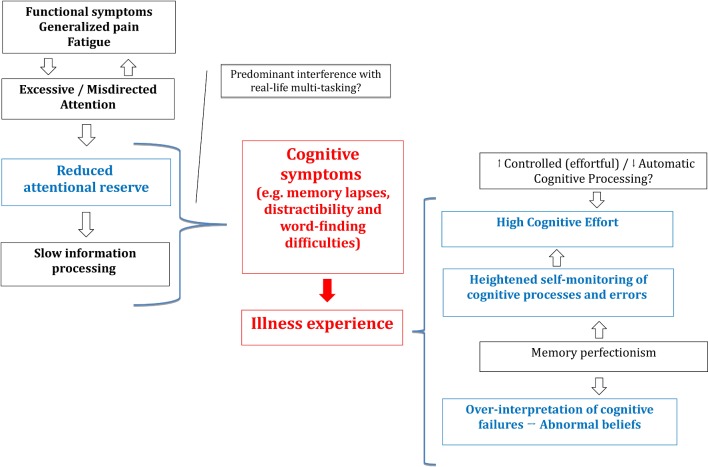
Background: Functional cognitive disorder (FCD) describes cognitive dysfunction in the absence of an organic cause. It is increasingly prevalent in healthcare settings yet its key neuropsychological features have not been reported in large patient cohorts. We hypothesised that cognitive profiles in fibromyalgia (FM), chronic fatigue syndrome (CFS) and functional neurological disorders (FNDs) would provide a template for characterising FCD. Methods: We conducted a systematic review of studies with cognition-related outcomes in FM, CFS and FND. Results: We selected 52 studies on FM, 95 on CFS and 39 on FND. We found a general discordance between high rates of subjective cognitive symptoms, including forgetfulness, distractibility and word-finding difficulties, and inconsistent objective neuropsychological deficits. Objective deficits were reported, including poor selective and divided attention, slow information processing and vulnerability to distraction. In some studies, cognitive performance was inversely correlated with pain, exertion and fatigue. Performance validity testing demonstrated poor effort in only a minority of subjects, and patients with CFS showed a heightened perception of effort. Discussion: The cognitive profiles of FM, CFS and non-cognitive FND are similar to the proposed features of FCD, suggesting common mechanistic underpinnings. Similar findings have been reported in patients with mild traumatic brain injury and whiplash. We hypothesise that pain, fatigue and excessive interoceptive monitoring produce a decrease in externally directed attention. This increases susceptibility to distraction and slows information processing, interfering with cognitive function, in particular multitasking. Routine cognitive processes are experienced as unduly effortful. This may reflect a switch from an automatic to a less efficient controlled or explicit cognitive mode, a mechanism that has also been proposed for impaired motor control in FND. These experiences might then be overinterpreted due to memory perfectionism and heightened self-monitoring of cognitive performance.
Overview
The claims and statistics of this paper haven’t been checked yet.
Free: it reads the open-access text and checks the first 5 claims that cite a source we can check. Create a free account to check every claim.
Integrity signals
Registry
Cites
Statistics
Figures
Verification
Claims the paper makes
The claims and statistics of this paper haven’t been checked yet.
Free: it reads the open-access text and checks the first 5 claims that cite a source we can check. Create a free account to check every claim.
Claims other papers make about this one
Each is checked against this paper’s own text: does it say what the citing paper says it does?
The cited source says what the claim attributes to it.
In the citing paper
“Disturbance of attention is thought to be responsible for the symptoms,4 as with other functional neurological disorders,5 although the underlying pathophysiological mechanisms remain unknown.”
From Feasibility randomised controlled trial of online group Acceptance and Commitment Therapy for Functional Cognitive Disorder (ACT4FCD) (2023) · cites this paper as [4]
Self-check
Percentages, sums and reported differences re-computed from the paper’s own numbers.
The self-check needs the paper’s full text.
Citations
Cites
Functional somatic syndromes: one or many?
Wessely, S., Nimnuan, C., & Sharpe, M. (1999) · The Lancet · doi:10.1016/s0140-6736(98)08320-2 · Cited by 1,211 · cited 1×
“15 In our clinical practice, it is very common to see patients with FND and comorbid FM and/or CFS. Importantly, FM and CFS are also associated with subjective cognitive difficulties, sometimes referred to as ‘brain fog’.”
BackgroundToward a rational and mechanistic account of mental effort
Shenhav, A., Musslick, S., Lieder, F., Kool, W., Griffiths, T. L., Cohen, J. D., & Botvinick, M. M. (2017) · Annual Review of Neuroscience · doi:10.1146/annurev-neuro-072116-031526 · Cited by 1,077 · cited 1×
“160 A switch from an automatic to a controlled mode of cognitive processing may therefore underlie the increase in cognitive effort.”
BackgroundWhite, P., Goldsmith, K., Johnson, A., Potts, L., Walwyn, R., DeCesare, J., Baber, H., Burgess, M., Clark, L., Cox, D., et al. (2011) · The Lancet · doi:10.1016/s0140-6736(11)60096-2 · Cited by 897
An internet survey of 2,596 people with fibromyalgia
Bennett, R. M., Jones, J., Turk, D. C., Russell, I. J., & Matallana, L. (2007) · BMC Musculoskeletal Disorders · doi:10.1186/1471-2474-8-27 · Cited by 865
A Bayesian account of ‘hysteria’
Edwards, M. J., Adams, R. A., Brown, H., Parees, I., & Friston, K. J. (2012) · Brain · doi:10.1093/brain/aws129 · Cited by 825 · cited 1×
“14 limitations Evidence for the presence and characteristics of cognitive abnormalities in FNDs, FM and CFS is remarkably heterogeneous.”
BackgroundSelf-citationNeurobiology of fibromyalgia and chronic widespread pain
Sluka, K. A., & Clauw, D. J. (2016) · Neuroscience · doi:10.1016/j.neuroscience.2016.06.006 · Cited by 671
A comprehensive review of the Paced Auditory Serial Addition Test (PASAT)
TOMBAUGH, T. (2006) · Archives of Clinical Neuropsychology · doi:10.1016/j.acn.2005.07.006 · Cited by 648
Symptoms following mild head injury: expectation as aetiology.
Mittenberg, W., DiGiulio, D. V., Perrin, S., & Bass, A. E. (1992) · Journal of Neurology, Neurosurgery & Psychiatry · doi:10.1136/jnnp.55.3.200 · Cited by 510
Wessely, S., & Powell, R. (1989) · Journal of Neurology, Neurosurgery & Psychiatry · doi:10.1136/jnnp.52.8.940 · Cited by 481
Cognitive-behavioral therapy for psychogenic nonepileptic seizures: A pilot RCT
Goldstein, L. H., Chalder, T., Chigwedere, C., Khondoker, M. R., Moriarty, J., Toone, B. K., & Mellers, J. D. C. (2010) · Neurology · doi:10.1212/wnl.0b013e3181e39658 · Cited by 477
Cited by
Functional neurological disorder: new subtypes and shared mechanisms
Hallett, M., Aybek, S., Dworetzky, B. A., McWhirter, L., Staab, J. P., & Stone, J. (2022) · The Lancet Neurology · doi:10.1016/s1474-4422(21)00422-1 · Cited by 538
Sherman, E. M. S., Slick, D. J., & Iverson, G. L. (2020) · Archives of Clinical Neuropsychology · doi:10.1093/arclin/acaa019 · Cited by 382
Pick, S., Goldstein, L. H., Perez, D. L., & Nicholson, T. R. (2019) · Journal of Neurology, Neurosurgery & Psychiatry · doi:10.1136/jnnp-2018-319201 · Cited by 296
Functional cognitive disorders: a systematic review
McWhirter, L., Ritchie, C., Stone, J., & Carson, A. (2020) · The Lancet Psychiatry · doi:10.1016/s2215-0366(19)30405-5 · Cited by 240
Functional cognitive disorder: dementia’s blind spot
Ball, H. A., McWhirter, L., Ballard, C., Bhome, R., Blackburn, D. J., Edwards, M. J., Fleming, S. M., Fox, N. C., Howard, R., Huntley, J., et al. (2020) · Brain · doi:10.1093/brain/awaa224 · Cited by 203
Self-citation
Metadata
- Authors
- Teodoro, T., Edwards, M. J., & Isaacs, J. D.
- Affiliations
- National Health Service (GB)
- Corresponding author
- Isaacs, Jeremy D
- Venue
- Journal of Neurology, Neurosurgery & Psychiatry
- Publisher
- BMJ
- Published
- 2018-05-07
- Volume
- 89
- Issue
- 12
- Pages
- 1308-1319
- ISSN
- 0022-3050 (ISSN-L)
- 1468-330X
- PMC
- PMC6288708
- OpenAlex
- W2802124756
- Cited by
- 241
- References
- 189
- Citations by year
- 2026: 22 · 2025: 37 · 2024: 32 · 2023: 33 · 2022: 39 · 2021: 26 · 2020: 26 · 2019: 18 · 2018: 6
- FWCI
- 2.89
- Type
- journal article
- Language
- en
- Open access
- bronze
- doi.org
- Locations
- Journal of Neurology Neurosurgery & Psychiatry (publishedVersion)
- Europe PMC (PubMed Central) (publishedVersion, cc-by)
- PubMed Central (publishedVersion, cc-by)
- PubMed (publishedVersion)
- St George's Online Research Archive (St George's University of London) (acceptedVersion)
- HighWire Press Open Archive (submittedVersion)
- Funders
- Fundação para a Ciência e Tecnologia
- Wellcome Trust
- Medical Research Council
- Topics
- Health Sciences › Medicine › Psychiatry and Mental health › Fibromyalgia and Chronic Fatigue Syndrome Research
- Health Sciences › Medicine › Psychiatry and Mental health › Psychosomatic Disorders and Their Treatments
- Health Sciences › Medicine › Clinical Neurology › Long-Term Effects of COVID-19
- Keywords
- functional cognitive disorder, conversion disorder, fibromyalgia, chronic fatigue syndrome, cognitive impairment, attention deficits, divided attention, performance validity, effort perception, pain and fatigue, interoception, self-monitoring, neuropsychological deficits
- MeSH terms
- Cognition Disorders, Fibromyalgia, Humans, Nervous System Diseases, Psychological Theory, Fatigue Syndrome, Chronic
About these checks
Registry, retraction, Cites and statistics results are computed, not judged, with one exception: a printed reference that no index lists is read once by a model before it counts as a citation error. Claims are extracted by a model and kept only when their quote appears verbatim in the text; each cited source is then checked, with a model’s help, for whether it says what the claim relies on. Those verdicts can be wrong — read the claim’s quote and the cited source before relying on one.
Statistics and arithmetic are recomputed, not judged.
Confidence bands are shown only for fields calibrated on our annotated test set. None is calibrated yet, so no band is shown.
What counts as a claim ›How we measure confidence ›How we check this ›
Are you an author, or do you see a problem with this page? Request a review
How to cite
Cite CoChat for the checks on this page, and the paper for its own findings.
- This page
- CoChat. (2026). Citation check: A unifying theory for cognitive abnormalities in functional neurological disorders, fibromyalgia and chronic fatigue syndrome: systematic review. https://app.cochat.ai/papers/10.1136/jnnp-2017-317823
- The paper
- Teodoro, T., Edwards, M. J., & Isaacs, J. D. (2018). A unifying theory for cognitive abnormalities in functional neurological disorders, fibromyalgia and chronic fatigue syndrome: systematic review. Journal of Neurology, Neurosurgery & Psychiatry. https://doi.org/10.1136/jnnp-2017-317823
Data sources
Bibliographic data: Semantic Scholar, OpenAlex, Crossref.
Contains information from the Semantic Scholar Academic Graph Datasets, made available under the ODC Attribution License (ODC-BY 1.0).
Semantic Scholar’s data is described in: Kinney, R., et al. (2023). The Semantic Scholar Open Data Platform. arXiv:2301.10140.
