

KindMap: an e-mental health tool to promote the well-being and mental health of people facing infertility - study protocol for a feasibility randomised control trial
Open accessThe DOI matches its Crossref record; 55 of the 55 references it cites were found in a registry or an index; 7 of the 34 sources its claims cite were checked for support.
Abstract
Introduction Fertility patients increasingly use web-based and mobile-based apps to access psychosocial care. These digital tools may be a helpful alternative to traditional psychological interventions. Developing and evaluating patient-centred e-mental health tools rooted in evidence-based interventions is a priority. The KindMap is a stand-alone, cost-free e-mental health intervention derived from adapting the Mindfulness Based Programme for Infertility (MBPI) contents to a digital format. The KindMap integrates mindfulness and self-compassion skills training and Acceptance and Commitment Therapy components. This protocol is intended to evaluate the KindMap's feasibility and explore the extent to which the web-app mode of delivery limited efficacy results are similar to the MBPI in-person format results. Furthermore, it will test the causal theory underlying KindMap. Methods and analysis A two-arm 2:1 non-blinded feasibility randomised controlled trial (RCT) will be conducted. Participants are people dealing with infertility, who are able to access the Internet and understand Portuguese or English. Consent participants will complete an online survey at 3-time assessment moments. After baseline assessment, participants will be randomised into the KindMap experimental group (KindMap-EG; with immediate access to the web app) or the waiting-list control group. The primary outcome is well-being (WHO Index-5); secondary outcomes are infertility-related stress (Fertility Problem Inventory - Short Form), anxiety and depression (Patient Health Questionnaire for Depression and Anxiety-4); mindfulness (Five Facet Mindfulness Questionnaire - Short Form), self-compassion (Self-Compassion Scale - Short Form), psychological flexibility (Psy-Flex) and infertility-related self-efficacy are the potential mechanisms of change. KindMap-EG will also complete a feasibility survey. Ethics and dissemination The study was approved by the Ethics Committee of the Faculty of Psychology and Educational Sciences of the University of Coimbra (Identifier: CEDI/FPCEUC:78/R_10). The KindMap study may contribute to the existing research on e-health technologies applied to mental health. The study outcomes will be disseminated through publications in peer-reviewed journals and national and international conference presentations. Trial registration number NCT05899374. © Author(s) (or their employer(s)) 2024. Re-use permitted under CC BY. Published by BMJ Group.
Overview
CoChat Summary
TL;DR
KindMap is a protocol for a two-arm feasibility RCT testing a stand-alone, cost-free web app for people facing infertility, built from the MBPI and combining mindfulness, self-compassion, and ACT. The trial will assess feasibility dimensions and explore limited efficacy on well-being and related mental health outcomes, but as a feasibility study it is not powered to determine efficacy.
Key findings
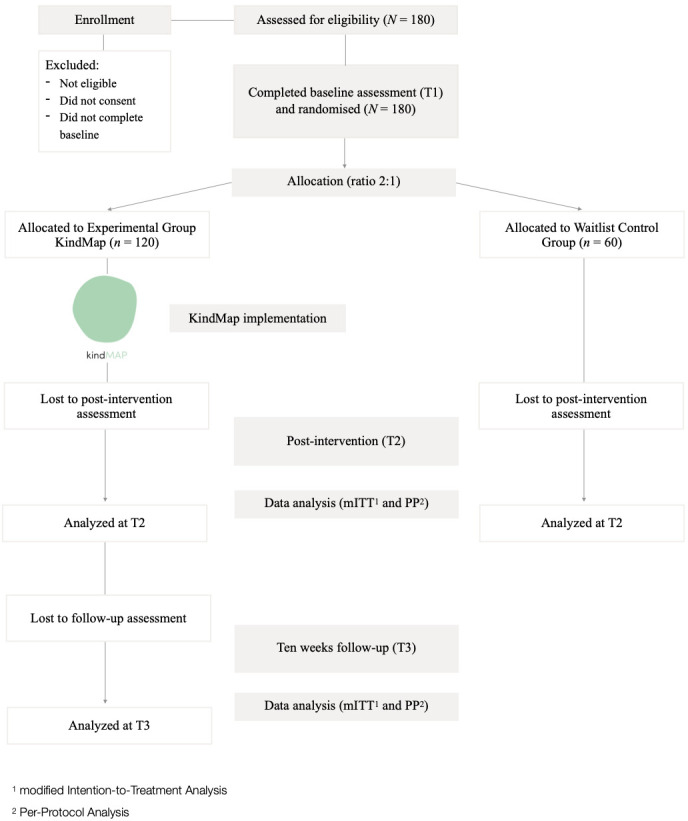
- The planned study is a two-arm, 2:1, non-blinded feasibility RCT with assessment at T1 (baseline), T2 (8–10 weeks), and T3 (10 weeks after T2 for the KindMap group).
- The protocol specifies a recruitment target of n=180; this is based on G*Power calculations indicating 54 participants would be needed for a repeated-measures ANOVA, and on assumed participation and retention rates of 60% and 34%.
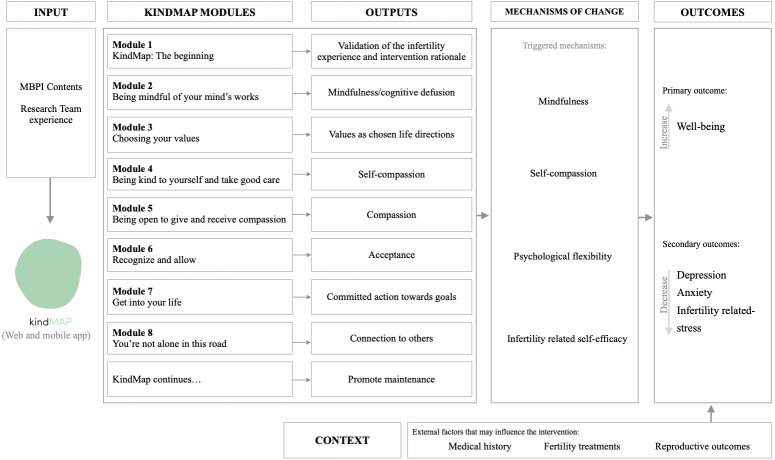
- The primary outcome is well-being measured by the WHO-5; secondary outcomes are infertility-related stress (FPI-SF) and anxiety/depression (PHQ-4), with mechanisms of change including mindfulness (FFMQ-SF), self-compassion (SCS-SF), psychological flexibility (Psy-Flex), and infertility-related self-efficacy (ISE).
- Feasibility will be assessed across demand, adaptation, acceptability, implementation, practicality, integration, and limited efficacy; demand includes adherence and participation/retention rates, and practicality includes completing 8 modules or at least 6 of 8 modules within the 8–10-week period.
Methods
- Design: Two-arm, parallel-group, non-blinded feasibility RCT with 2:1 computer-generated randomisation to immediate KindMap access versus waiting-list control; participants are stratified by Portuguese vs English language group in the intervention arm.
- Sample/data: People aged 18–45 with a self-reported infertility diagnosis, internet access, and Portuguese or English comprehension; exclusion criteria include current psychological intervention, pregnancy, or inability to use the app due to other health difficulties. Recruitment is planned for June to December 2024.
- Analysis: Descriptive statistics, t-tests and χ² tests for group differences, and mITT and PP analyses on primary and secondary outcomes to explore limited efficacy; analyses are conducted in IBM SPSS Statistics V.27.
Limitations
- The paper explicitly states that, because this is a feasibility study, the small sample size will not allow determining the intervention’s efficacy; it is intended to inform a future fully powered RCT.
- The study is non-blinded, which is stated in the design and may affect outcome assessment; this is evident from the protocol text.
- The protocol notes that there was no patient or public involvement in defining the research questions or study design; this is stated in the paper and may limit early co-design input.
Model-written summary. Check it against the paper before relying on it.
Integrity signals
Registry
Cites
Statistics
Figures
Verification
Claims the paper makes
7 Valid · 0 Not valid · 25 Not checked · 18 Own results and interpretations
Every source the paper cites for this claim was checked and supports it.
In the paper
“However, studies focusing on ACT within the infertility field are still limited.33”
§ KindMap: an e-mental health tool to promote the well-being and mental health of people facing infertility—study protocol for a feasibility randomised control trial > Introduction
What the sources say
- Supportedcites [33] Barbosa C Santos S Pedro J Mapping acceptance and commitment therapy outcomes in the context of infertility: a systematic review Curr Psychol 2023 43 1 11 10.1007/s12144-023-05294-6 source
The paper explicitly says that studies of ACT in the context of infertility are scarce (Abstract). Its Strengths and weaknesses section also reports that the review found only six eligible studies. (LLM, conf=0.95)
plain- Asserted: passes — The authors put it forward as true.
- Checkable: passes — It can be checked against evidence.
- Load-bearing: passes — The paper’s conclusions depend on it.
- Based: passes — The paper gives a reason why it holds.
- Supported
Every source the paper cites for this claim was checked and supports it.
In the paper
“Furthermore, a systematic review and meta-analysis conducted by Klimczak et al also found that ACT could be effectively delivered as a self-guided online intervention.34”
§ KindMap: an e-mental health tool to promote the well-being and mental health of people facing infertility—study protocol for a feasibility randomised control trial > Introduction
What the sources say
- Supportedcites [34] Klimczak KS San Miguel GG Mukasa MN et al A systematic review and meta-analysis of self-guided online acceptance and commitment therapy as a transdiagnostic self-help intervention Cogn Behav Ther 2023 52 269 94 10.1080/16506073.2023.2178498 36847182 source
The Abstract states that ACT can be effectively delivered online, and the Conclusions describe online ACT as an effective self-help intervention. The review also notes that many included interventions provided some human support, so its findings do not establish effectiveness for exclusively unsupported use. (LLM, conf=0.94)
hedgedstates a cause- Asserted: passes — The authors put it forward as true.
- Checkable: passes — It can be checked against evidence.
- Load-bearing: passes — The paper’s conclusions depend on it.
- Based: passes — The paper gives a reason why it holds.
- Supported
Every source the paper cites for this claim was checked and supports it.
In the paper
“ACT has also been related to better mental health outcomes in individuals dealing with health conditions (Gloster et al, for a review of meta-analyses).32”
§ KindMap: an e-mental health tool to promote the well-being and mental health of people facing infertility—study protocol for a feasibility randomised control trial > Introduction
What the sources say
- Supportedcites [32] Gloster AT Walder N Levin ME et al The empirical status of acceptance and commitment therapy: A review of meta-analyses J Contextual Behav Sci 2020 18 181 92 10.1016/j.jcbs.2020.09.009 source
The Discussion reports that ACT is efficacious across health conditions, including chronic pain, and describes small-to-medium controlled effects for chronic pain and physical conditions. It also reports benefits on well-being and functioning, supporting the claim about better mental health outcomes. (LLM, conf=0.90)
plainstates an association- Asserted: passes — The authors put it forward as true.
- Checkable: passes — It can be checked against evidence.
- Load-bearing: passes — The paper’s conclusions depend on it.
- Based: passes — The paper gives a reason why it holds.
- Supported
A conclusion the paper draws from its own results — it cites no other source for it, so there is none to check. The quote shows it is in the paper.
In the paper
“ACT may contribute to improving mental health indicators, such as anxiety, depression, stress and quality of life, through its targeted components.”
§ KindMap: an e-mental health tool to promote the well-being and mental health of people facing infertility—study protocol for a feasibility randomised control trial > Introduction
hedgedstates a possible cause- Asserted: passes — The authors put it forward as true.
- Checkable: passes — It can be checked against evidence.
- Load-bearing: passes — The paper’s conclusions depend on it.
- Based: passes — The paper gives a reason why it holds.
In the paper
“To our knowledge, none of the developed support apps targeting people with infertility integrates ACT components.27 29 31”
§ KindMap: an e-mental health tool to promote the well-being and mental health of people facing infertility—study protocol for a feasibility randomised control trial > Introduction
What the sources say
- Not matchedcites 27 29 31
This doesn’t read as a citation we can look up.
hedged- Asserted: passes — The authors put it forward as true.
- Checkable: passes — It can be checked against evidence.
- Load-bearing: passes — The paper’s conclusions depend on it.
- Based: passes — The paper gives a reason why it holds.
- Not matched
7 more claims
Create a free account to see all 50 claims and to verify the 1 reference still open.
- It may state two separate claims as one. 19
- Probably not a substantial claim. 29
Citations
Cites
Developing and evaluating complex interventions: the new Medical Research Council guidance
Craig, P., Dieppe, P., Macintyre, S., Michie, S., Nazareth, I., & Petticrew, M. (2008) · BMJ · doi:10.1136/bmj.a1655 · Cited by 10,995
Hoffmann, T. C., Glasziou, P. P., Boutron, I., Milne, R., Perera, R., Moher, D., Altman, D. G., Barbour, V., Macdonald, H., Johnston, M., et al. (2014) · BMJ · doi:10.1136/bmj.g1687 · Cited by 10,548 · cited 1×
“38 The KindMap web app was developed by a multidisciplinary research team following the framework commissioned by the Medical Research Council and the National Institute of Health Research for developing complex interventions 39 40 and a User-Centred Design methodology.”
Using Self-Report Assessment Methods to Explore Facets of Mindfulness
Baer, R. A., Smith, G. T., Hopkins, J., Krietemeyer, J., & Toney, L. (2006) · Assessment · doi:10.1177/1073191105283504 · Cited by 7,511
The Development and Validation of a Scale to Measure Self-Compassion
NEFF, K. D. (2003) · Self and Identity · doi:10.1080/15298860309027 · Cited by 6,436
Skivington, K., Matthews, L., Simpson, S. A., Craig, P., Baird, J., Blazeby, J. M., Boyd, K. A., Craig, N., French, D. P., McIntosh, E., et al. (2021) · BMJ · doi:10.1136/bmj.n2061 · Cited by 5,808 · cited 1×
“38 The KindMap web app was developed by a multidisciplinary research team following the framework commissioned by the Medical Research Council and the National Institute of Health Research for developing complex interventions 39 40 and a User-Centred Design methodology.”
The WHO-5 well-being index: A systematic review of the literature
Topp, C. W., Østergaard, S. D., Søndergaard, S., & Bech, P. (2015) · Psychotherapy and Psychosomatics · doi:10.1159/000376585 · Cited by 4,708 · cited 1×
“42 WHO-5 is a five-item self-report questionnaire of current well-being.”
An Ultra-Brief Screening Scale for Anxiety and Depression: The PHQ–4
Kroenke, K., Spitzer, R. L., Williams, J. B. W., & Löwe, B. (2009) · Psychosomatics · doi:10.1016/s0033-3182(09)70864-3 · Cited by 4,261 · cited 2×
“The Patient Health Questionnaire for Depression and Anxiety (PHQ-4) 46 47 is a 4-item self-report instrument widely used to identify individuals who may be suffering from anxiety, depression or both.”
How we design feasibility studies
Bowen, D. J., Kreuter, M., Spring, B., Cofta-Woerpel, L., Linnan, L., Weiner, D., Bakken, S., Kaplan, C. P., Squiers, L., Fabrizio, C., et al. (2009) · American Journal of Preventive Medicine · doi:10.1016/j.amepre.2009.02.002 · Cited by 4,021 · cited 3×
“Aligned with Bowen et al , 35 the current study uses several feasibility dimensions to evaluate the KindMap intervention and study protocol.”
Construction and factorial validation of a short form of the Self-Compassion Scale
Raes, F., Pommier, E., Neff, K. D., & Van Gucht, D. (2011) · Clinical Psychology & Psychotherapy · doi:10.1002/cpp.702 · Cited by 2,997
Fertility and infertility: Definition and epidemiology
Vander Borght, M., & Wyns, C. (2018) · Clinical Biochemistry · doi:10.1016/j.clinbiochem.2018.03.012 · Cited by 2,278
Eldridge, S. M., Lancaster, G. A., Campbell, M. J., Thabane, L., Hopewell, S., Coleman, C. L., & Bond, C. M. (2016) · PLOS ONE · doi:10.1371/journal.pone.0150205 · Cited by 1,581 · cited 3×
“Results will be reported according to the Consolidated Standards of Reporting Trials guidelines for feasibility and pilot studies 36 and will enlighten needed improvements and adjustments to be performed in the KindMap app and study protocol.”
The International Glossary on Infertility and Fertility Care, 2017
Zegers-Hochschild, F., Adamson, G. D., Dyer, S., Racowsky, C., de Mouzon, J., Sokol, R., Rienzi, L., Sunde, A., Schmidt, L., Cooke, I. D., et al. (2017) · Fertility and Sterility · doi:10.1016/j.fertnstert.2017.06.005 · Cited by 1,505
Sim, J., & Lewis, M. (2012) · Journal of Clinical Epidemiology · doi:10.1016/j.jclinepi.2011.07.011 · Cited by 1,036 · cited 1×
“This sample size is in accordance with Sim and Lewis 37 recommendation of at least 50 participants for feasibility studies.”
Psychological impact of infertility
Cousineau, T. M., & Domar, A. D. (2007) · Best Practice & Research Clinical Obstetrics & Gynaecology · doi:10.1016/j.bpobgyn.2006.12.003 · Cited by 997 · cited 1×
“3 Although several support apps have been developed, 27 28 very few have been evaluated and almost none using high-quality randomised controlled trials (RCTs).”
Bohlmeijer, E., ten Klooster, P. M., Fledderus, M., Veehof, M., & Baer, R. (2011) · Assessment · doi:10.1177/1073191111408231 · Cited by 990 · cited 1×
“The Five Facet Mindfulness Questionnaire—Short Form (FFMQ-SF) 48–50 is a 24 ‐ item self ‐ report questionnaire highly sensitive to change, aiming to assess different mindfulness skills.”
The fertility problem inventory: measuring perceived infertility-related stress
Newton, C. R., Sherrard, W., & Glavac, I. (1999) · Fertility and Sterility · doi:10.1016/s0015-0282(99)00164-8 · Cited by 626 · cited 3×
“The Fertility Problem Inventory—Short Form (FPI-SF) 43–45 is a 27-item self-report instrument designed to assess perceived infertility stress based on a comprehensive approach.”
The empirical status of acceptance and commitment therapy: A review of meta-analyses
Gloster, A. T., Walder, N., Levin, M. E., Twohig, M. P., & Karekla, M. (2020) · Journal of Contextual Behavioral Science · doi:10.1016/j.jcbs.2020.09.009 · Cited by 622 · cited 1×
“32 However, studies focusing on ACT within the infertility field are still limited.”
Avery, K. N. L., Williamson, P. R., Gamble, C., O'Connell Francischetto, E., Metcalfe, C., Davidson, P., Williams, H., & Blazeby, J. M. (2017) · BMJ Open · doi:10.1136/bmjopen-2016-013537 · Cited by 575
A review of psychosocial interventions in infertility
Boivin, J. (2003) · Social Science & Medicine · doi:10.1016/s0277-9536(03)00138-2 · Cited by 380
Frederiksen, Y., Farver-Vestergaard, I., Skovgård, N. G., Ingerslev, H. J., & Zachariae, R. (2015) · BMJ Open · doi:10.1136/bmjopen-2014-006592 · Cited by 380
Volgsten, H., Skoog Svanberg, A., Ekselius, L., Lundkvist, O., & Sundstrom Poromaa, I. (2008) · Human Reproduction · doi:10.1093/humrep/den154 · Cited by 303
Psy-Flex: A contextually sensitive measure of psychological flexibility
Gloster, A. T., Block, V. J., Klotsche, J., Villanueva, J., Rinner, M. T. B., Benoy, C., Walter, M., Karekla, M., & Bader, K. (2021) · Journal of Contextual Behavioral Science · doi:10.1016/j.jcbs.2021.09.001 · Cited by 175
The prevalence of depression symptoms among infertile women: a systematic review and meta-analysis
Kiani, Z., Simbar, M., Hajian, S., & Zayeri, F. (2021) · Fertility Research and Practice · doi:10.1186/s40738-021-00098-3 · Cited by 145
Quality of life and sexual functioning of Polish infertile couples
Drosdzol, A., & Skrzypulec, V. (2008) · The European Journal of Contraception & Reproductive Health Care · doi:10.1080/13625180802049187 · Cited by 133
Mindfulness-Based Program for Infertility: Efficacy study
Galhardo, A., Cunha, M., & Pinto-Gouveia, J. (2013) · Fertility and Sterility · doi:10.1016/j.fertnstert.2013.05.036 · Cited by 120 · cited 1×
“19 Furthermore, participants in the MBPI group continued to reveal therapeutic benefits at a 6-month follow-up and experienced lasting results for up to 7 years.”
Self-citationDevelopment and validation of the Infertility Self-Efficacy scale
Cousineau, T. M., Green, T. C., Corsini, E. A., Barnard, T., Seibring, A. R., & Domar, A. D. (2006) · Fertility and Sterility · doi:10.1016/j.fertnstert.2005.10.077 · Cited by 117
The prevalence of anxiety symptoms in infertile women: a systematic review and meta-analysis
Kiani, Z., Simbar, M., Hajian, S., Zayeri, F., Shahidi, M., Naz, M. S. G., & Ghasemi, V. (2020) · Fertility Research and Practice · doi:10.1186/s40738-020-00076-1 · Cited by 98
Klimczak, K. S., San Miguel, G. G., Mukasa, M. N., Twohig, M. P., & Levin, M. E. (2023) · Cognitive Behaviour Therapy · doi:10.1080/16506073.2023.2178498 · Cited by 88 · cited 1×
“34 To our knowledge, none of the developed support apps targeting people with infertility integrates ACT components.”
Psychosocial interventions for infertile couples: a critical review
Chow, K., Cheung, M., & Cheung, I. K. (2016) · Journal of Clinical Nursing · doi:10.1111/jocn.13361 · Cited by 83
Zurlo, M. C., Volta, M. F. C. D., & Vallone, F. (2019) · Journal of Clinical Psychology in Medical Settings · doi:10.1007/s10880-019-09653-z · Cited by 82
Castilho, P., & Gouveia, J. P. (2011) · Psychologica · doi:10.14195/1647-8606_54_8 · Cited by 78
Using Acceptance and Commitment Therapy to Treat Infertility Stress
Peterson, B. D., & Eifert, G. H. (2011) · Cognitive and Behavioral Practice · doi:10.1016/j.cbpra.2010.03.004 · Cited by 78
A Critical Appraisal of Fertility and Menstrual Tracking Apps for the iPhone
Zwingerman, R., Chaikof, M., & Jones, C. (2020) · Journal of Obstetrics and Gynaecology Canada · doi:10.1016/j.jogc.2019.09.023 · Cited by 67
Boivin, J., Vassena, R., Costa, M., Vegni, E., Dixon, M., Collura, B., Markert, M., Samuelsen, C., Guiglotto, J., Roitmann, E., et al. (2022) · Reproductive BioMedicine Online · doi:10.1016/j.rbmo.2022.01.015 · Cited by 63 · cited 1×
“26 Therefore, developing and evaluating patient-focused e-mental health tools rooted in evidence-based interventions should be a priority.”
Ngai, F., & Loke, A. Y. (2021) · Human Fertility · doi:10.1080/14647273.2021.1871781 · Cited by 55
Patient-focused Internet interventions in reproductive medicine: a scoping review
Aarts, J. W. M., van den Haak, P., Nelen, W. L. D. M., Tuil, W. S., Faber, M. J., & Kremer, J. A. M. (2012) · Human Reproduction Update · doi:10.1093/humupd/dmr045 · Cited by 52
Experiential avoidance, self-compassion, self-judgment and coping styles in infertility
Cunha, M., Galhardo, A., & Pinto-Gouveia, J. (2016) · Sexual & Reproductive Healthcare · doi:10.1016/j.srhc.2016.04.001 · Cited by 48
Self-citationFactor structure and psychometric properties of the Fertility Problem Inventory–Short Form
Zurlo, M. C., Volta, M. F. C. D., & Vallone, F. (2017) · Health Psychology Open · doi:10.1177/2055102917738657 · Cited by 48
Interventions promoting mental health dimensions in infertile women: a systematic review
Koochaksaraei, F. Y., Simbar, M., Khoshnoodifar, M., Faramarzi, M., & Nasiri, M. (2023) · BMC Psychology · doi:10.1186/s40359-023-01285-1 · Cited by 40
Facetas de mindfulness: características psicométricas de um instrumento de avaliação
Gregório, S., & Gouveia, J. P. (2011) · Psychologica · doi:10.14195/1647-8606_54_10 · Cited by 39
Self-compassion training and psychological well-being of infertile female
Afshani, S. A., Abooei, A., & Abdoli, A. M. (2019) · International Journal of Reproductive BioMedicine (IJRM) · doi:10.18502/ijrm.v17i10.5300 · Cited by 37
Meyers, A. J., & Domar, A. D. (2021) · Reproductive BioMedicine Online · doi:10.1016/j.rbmo.2020.12.004 · Cited by 36 · cited 3×
“3 Although several support apps have been developed, 27 28 very few have been evaluated and almost none using high-quality randomised controlled trials (RCTs).”
Warne, E., Oxlad, M., & Best, T. (2023) · Health Psychology Review · doi:10.1080/17437199.2022.2058582 · Cited by 34
Wang, G., Liu, X., & Lei, J. (2023) · Archives of Women s Mental Health · doi:10.1007/s00737-023-01307-2 · Cited by 34
Abdollahpour, S., Taghipour, A., Mousavi Vahed, S. H., & Latifnejad Roudsari, R. (2022) · Journal of Obstetrics and Gynaecology · doi:10.1080/01443615.2021.1904217 · Cited by 33 · cited 1×
“11 17–22 One of these interventions designed for people with infertility is the Mindfulness Based Programme for Infertility (MBPI).”
Galhardo, A., Alves, J., Moura-Ramos, M., & Cunha, M. (2020) · Journal of Reproductive and Infant Psychology · doi:10.1080/02646838.2019.1612046 · Cited by 31
Self-citationApplication of Mindfulness-Based Psychological Interventions in Infertility
Patel, A., Sharma, P. V. N., & Kumar, P. (2020) · Journal of Human Reproductive Sciences · doi:10.4103/jhrs.jhrs_51_19 · Cited by 26 · cited 1×
“20 ACT has also been related to better mental health outcomes in individuals dealing with health conditions (Gloster et al , for a review of meta-analyses).”
Galhardo, A., Cunha, M., & Pinto‐Gouveia, J. (2013) · Research in Nursing & Health · doi:10.1002/nur.21516 · Cited by 23
Self-citationGalhardo, A., Cunha, M., & Pinto‐Gouveia, J. (2019) · Clinical Psychology & Psychotherapy · doi:10.1002/cpp.2362 · Cited by 23 · cited 1×
“23 Fertility patients increasingly use web-based and mobile-based apps to access psychosocial care because these overcome identified barriers, such as financial constraints, travel, scheduling issues, apprehension, fear of being denied/excluded from treatment and stigmatisation.”
Self-citationDigital support tools for fertility patients – a narrative systematic review
Robertson, I., Ogundiran, O., & Cheong, Y. C. (2021) · Human Fertility · doi:10.1080/14647273.2021.1953711 · Cited by 18 · cited 1×
“3 Although several support apps have been developed, 27 28 very few have been evaluated and almost none using high-quality randomised controlled trials (RCTs).”
Cunha, M. I. V. A., Temido, A., Moniz, S., & Galhardo, A. B. (2024) · Journal of Contextual Behavioral Science · doi:10.1016/j.jcbs.2024.100730 · Cited by 17
Self-citationRowbottom, B., Galhardo, A., Donovan, E., & Gameiro, S. (2022) · Human Reproduction · doi:10.1093/humrep/deac168 · Cited by 16 · cited 2×
“31 In this context, a web app, KindMap, was developed as a stand-alone, cost-free e-mental health intervention derived from adapting MBPI contents to a digital format.”
Self-citationClifton, J., Parent, J. M., Worrall, G., Seehuus, M., Evans, M., Forehand, R., & Domar, A. D. (2016) · Fertility and Sterility · doi:10.1016/j.fertnstert.2016.07.1081 · Cited by 8 · cited 1×
“24 25 These e-mental health tools are becoming widespread and may be, to some extent, a helpful alternative to traditional psychological interventions, aligning with patients’ needs and preferences.”
Barbosa, C., Santos, S., & Pedro, J. (2024) · Current Psychology · doi:10.1007/s12144-023-05294-6 · Cited by 6 · cited 1×
“33 Since infertility is a significant life stressor, ACT emerges as a potentially suitable approach that could yield positive and protective effects among individuals experiencing infertility.”
Do the infertile couples need psychological support?
Iordăchescu, D., Vladislav, E. O., Paica, C.-I., Gică, C., Panaitescu, A. M., Peltecu, G. C., & Gică, N. (2021) · Romanian Medical Journal · doi:10.37897/rmj.2021.4.11 · Cited by 2 · cited 1×
“24 25 These e-mental health tools are becoming widespread and may be, to some extent, a helpful alternative to traditional psychological interventions, aligning with patients’ needs and preferences.”
Research works printed but not linked: 1
- Rodrigues L Santiago M Adaptação e Validação do instrumento PHQ-4 para Português Europeu e Sobrecarga Psicológica pela Gestão da Multimorbilidade em Medicina Geral e Familiar na Região Centro de Portugal [Cross-cultural adaptation and validation of the PHQ4 screening tool in European Portuguese and the Psychological Burden caused by the management of Multimorbidity in General and Family Medicine in Central Portugal] [Master’s dissertation] Coimbra Estudo Geral - Repositório Científico da UC 2021 Available https://hdl.handle.net/10316/98352
Cited by
Assessing Digital and Community Based Support Systems for Emotional Health in Infertility
Chowdhury, S., Juliastuti, D., Handra, T., Apriliasari, D., Sadan, S., Stephanie, & Purnama, D. E. (2025) · International Conference on Creative Communication and Innovative Technology (ICCIT) · doi:10.1109/iccit65724.2025.11167779
“Both PSS and STAI are widely recognized and reliable in psychological research for assessing stress and anxiety [22], [23].”
Advancing Knowledge on Assisted Reproductive Techniques and Stress
Calleja‐Agius, J., Gouni, O., & Calleja, N. (2025) · Springer eBooks · doi:10.1007/978-3-032-09245-8_8
Metadata
- Authors
- Carolino, N., Cunha, M., Pinto-Gouveia, J., Gameiro, S., & Galhardo, A.
- Affiliations
- Instituto Superior Miguel Torga (PT)
- CINEICC—Faculty of Psychology and Educational Sciences, University of Coimbra, Coimbra, Portugal
- Cardiff University (GB)
- Corresponding author
- Gameiro, Sofia
- Venue
- BMJ Open
- Publisher
- BMJ
- Published
- 2024-12
- Volume
- 14
- Issue
- 12
- Pages
- e087447
- ISSN
- 2044-6055 (ISSN-L)
- PMC
- PMC11628952
- OpenAlex
- W4405176135
- Cited by
- 3
- References
- 55
- Citations by year
- 2026: 1 · 2025: 2
- FWCI
- 1.19
- Type
- journal article
- Language
- en
- Open access
- gold
- doi.org
- Locations
- BMJ Open (publishedVersion, cc-by)
- PubMed Central (publishedVersion, cc-by)
- PubMed (publishedVersion)
- ORCA Online Research @Cardiff (Cardiff University) (acceptedVersion)
- DOAJ (DOAJ: Directory of Open Access Journals) (acceptedVersion)
- Portuguese National Funding Agency for Science, Research and Technology (RCAAP Project by FCT) (acceptedVersion, other-oa)
- Funders
- FCT (2022.13895)
- Topics
- Social Sciences › Psychology › Applied Psychology › Digital Mental Health Interventions
- Social Sciences › Psychology › Clinical Psychology › Mindfulness and Compassion Interventions
- Health Sciences › Medicine › Reproductive Medicine › Reproductive Health and Technologies
- Keywords
- infertility, e-mental health, online intervention, mindfulness, self-compassion, acceptance and commitment therapy, infertility-related stress, anxiety, depression, psychological flexibility, self-efficacy, well-being, mental health apps
- MeSH terms
- Adult, Feasibility Studies, Female, Humans, Infertility, Male, Mental Health, Quality of Life, Randomized Controlled Trials as Topic, Telemedicine, Mobile Applications, Mindfulness
About these checks
Registry, retraction, Cites and statistics results are computed, not judged, with one exception: a printed reference that no index lists is read once by a model before it counts as a citation error. Claims are extracted by a model and kept only when their quote appears verbatim in the text; each cited source is then checked, with a model’s help, for whether it says what the claim relies on. Those verdicts can be wrong — read the claim’s quote and the cited source before relying on one.
The claim verdicts this report counts are experimental: their accuracy is not yet measured.
A language model drew the claims from the paper on 2026-10-11, under version 3 of the claim definition (model deepseek-v4.1-flash, prompt extract-v3).
A second model labelled each claim on 2026-10-11 (model jev-1.13-20260917, definition revision gold-guideline-v0.2).
Cited sources are checked with a language model’s help (gpt-6-sol).
Statistics and arithmetic are recomputed, not judged.
Confidence bands are shown only for fields calibrated on our annotated test set. None is calibrated yet, so no band is shown.
What counts as a claim ›How we measure confidence ›How we check this ›
Are you an author, or do you see a problem with this page? Request a review
Data sources
Bibliographic data: Semantic Scholar, OpenAlex, Crossref.
Contains information from the Semantic Scholar Academic Graph Datasets, made available under the ODC Attribution License (ODC-BY 1.0).
Semantic Scholar’s data is described in: Kinney, R., et al. (2023). The Semantic Scholar Open Data Platform. arXiv:2301.10140.
