

Purpose-oriented review of public health surveillance systems: use of surveillance systems and recent advances
Open accessThe DOI matches its Crossref record; 34 of the 35 references it cites were found in a registry or an index; 4 of the 7 sources its claims cite were checked for support.
Abstract
Public health surveillance systems are an important tool for disease distribution and burden of disease as well as enable efficient distribution of resources to fight a disease. The surveillance systems are used to detect, report, track a disease as well as assess the response to the disease and people's attitudes. This paper provides a framework of review for purpose-oriented categorisation of public health surveillance systems. The framework for review of surveillance systems divides the systems into distribution or monitoring or prediction oriented. While there can be other categorisation based on data sources and data types used, the framework for review in this paper provides a cohesive system which can engulf such categories. The framework of review in this paper is purpose oriented, which categorises the surveillance system according to their stated objectives, which are the most important aspect of any public health surveillance system. This review and the framework of categorisation provide comprehensive details of the surveillance systems in terms of data types used, source of data and purpose of the surveillance system.
Overview
CoChat Summary
## TL;DR
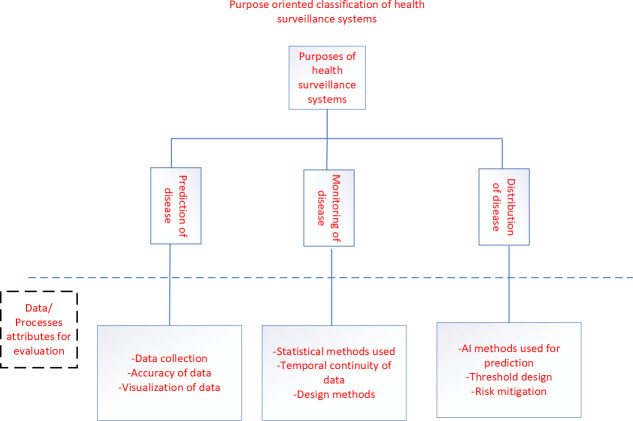
This paper proposes a purpose-oriented framework for classifying public health surveillance systems into three categories: distribution of disease, monitoring of disease, and prediction of disease. It argues that the system’s stated objective should guide evaluation, data-source choice, and expectations for accuracy, timeliness, and event detection.
## Key findings
- The authors divide public health surveillance systems (PHSS) into three purpose-based categories: distribution, monitoring, and prediction of disease.
- For the distribution category, they cite HealthMap as a web-based tool that uses online content to show the distribution of 87 disease categories in 89 countries; they also note a leishmaniasis mapping effort estimating around 1.7 billion people live in areas at potential risk.
- For the yellow fever distribution map, they report that vaccination in risk zones averts between 94,336 and 118,500 cases annually.
- For monitoring, they describe real-time systems such as ProMED-Mail (established in 1994) and GOARN, and note that systems like FluSight forecast seasonal influenza using weighted influenza-like illness (wILI) data; for prediction, they highlight AI/ML uses such as predicting dengue risk, Zika outbreak risk, and outbreak detection from Twitter/news sources.
## Methods
- This is a narrative review rather than a systematic review; the authors explicitly state they did not intend a systematic review because the topic is broad and divergent.
- The paper draws on an extensive literature review; the authors say a search on Google Scholar yielded 995 articles, which they then selected from to build the classification framework.
- The main analysis is a conceptual, purpose-oriented categorisation of surveillance systems based on their stated objective and the data/methods they use, organized into distribution, monitoring, and prediction.
## Limitations
- Stated in the paper: the authors say the categories are not exhaustive and there can be other systems under the same category.
- Stated in the paper: web-based and social-media surveillance systems are limited by internet penetration, asymmetrical global access, reliability of self-reported/news data, and language barriers that can reduce machine-learning accuracy.
- Evident from the text: because this is a narrative framework paper using examples selected from the literature, it does not report a formal search strategy, inclusion/exclusion criteria, or quality appraisal of studies.
Model-written summary. Check it against the paper before relying on it.
Integrity signals
Registry
Cites
Statistics
Figures
Verification
Claims the paper makes
4 Valid · 4 Not valid · 3 Not checked · 29 Own results and interpretations
Every source the paper cites for this claim was checked and supports it.
In the paper
“Online data recently have become a rapid source of disease or public health information with the advantage of making early information collected through automated or periodic methodology available through online tools.3”
§ Purpose-oriented review of public health surveillance systems: use of surveillance systems and recent advances > Introduction
What the sources say
- Supportedcites [3] Eysenbach G Infodemiology and infoveillance: framework for an emerging set of public health informatics methods to analyze search, communication and publication behavior on the Internet J Med Internet Res 2009 11 e11 10.2196/jmir.1157 19329408 PMC2762766 source
In “What Is Infodemiology?”, the paper says online information can be automatically collected and analyzed and that changes in online patterns can be early symptoms of changes in population health. “Classical and Recent Infodemiology Studies” describes automated, continuous analysis of Internet data and a system for collecting and monitoring public-health metrics. (LLM, conf=0.90)
plainstates a cause- Asserted: passes — The authors put it forward as true.
- Checkable: passes — It can be checked against evidence.
- Load-bearing: unclear — It is unclear whether the paper’s conclusions depend on it.
- Based: passes — The paper gives a reason why it holds.
- Supported
Every source the paper cites for this claim was checked and supports it.
In the paper
“This is not to assert that web-based or online methods of surveillance have replaced the conventional surveillance systems, but that the web has complemented the conventional systems of surveillance.8”
§ Purpose-oriented review of public health surveillance systems: use of surveillance systems and recent advances > Introduction
What the sources say
- Supportedcites [8] Ginsberg J Mohebbi MH Patel RS et al Detecting influenza epidemics using search engine query data Nature 2009 457 1012 4 10.1038/nature07634 19020500 source
The paper states that its web-search system is not designed to replace traditional surveillance networks. It also says search data are most useful for prompting further investigation and collection of direct measures of disease activity, supporting the claim that they complement conventional surveillance. (LLM, conf=0.92)
plainstates a cause- Asserted: passes — The authors put it forward as true.
- Checkable: passes — It can be checked against evidence.
- Load-bearing: unclear — It is unclear whether the paper’s conclusions depend on it.
- Based: passes — The paper gives a reason why it holds.
- Supported
A conclusion the paper draws from its own results — it cites no other source for it, so there is none to check. The quote shows it is in the paper.
In the paper
“The other problem is that of reliability of data which is self-reported or comes from news sources which may also not be as reliable as clinically validated data.”
§ Purpose-oriented review of public health surveillance systems: use of surveillance systems and recent advances > Purpose-oriented classification of PHSS > Monitoring of disease
hedgedstates a possible cause- Asserted: passes — The authors put it forward as true.
- Checkable: passes — It can be checked against evidence.
- Load-bearing: unclear — It is unclear whether the paper’s conclusions depend on it.
- Based: passes — The paper gives a reason why it holds.
A conclusion the paper draws from its own results — it cites no other source for it, so there is none to check. The quote shows it is in the paper.
In the paper
“While these three categories are not totally independent, and some have overlaps it is important conceptually to analyse these maps under the broader objective for which they have been defined.”
§ Purpose-oriented review of public health surveillance systems: use of surveillance systems and recent advances > Classification of health surveillance systems > Proposed framework
plainstates an association- Asserted: passes — The authors put it forward as true.
- Checkable: passes — It can be checked against evidence.
- Load-bearing: unclear — It is unclear whether the paper’s conclusions depend on it.
- Based: passes — The paper gives a reason why it holds.
A conclusion the paper draws from its own results — it cites no other source for it, so there is none to check. The quote shows it is in the paper.
In the paper
“While conventional PHS is more accurate and based on clinically validated data, the online surveillance systems can be seen to function better as early warning systems as the data collection is in real time.”
§ Purpose-oriented review of public health surveillance systems: use of surveillance systems and recent advances > Introduction
plainstates a cause- Asserted: passes — The authors put it forward as true.
- Checkable: passes — It can be checked against evidence.
- Load-bearing: unclear — It is unclear whether the paper’s conclusions depend on it.
- Based: passes — The paper gives a reason why it holds.
6 more claims
Create a free account to see all 40 claims and every source verdict.
- It may state two separate claims as one. 18
- Probably not a substantial claim. 25
Citations
Cites
The global distribution and burden of dengue
Bhatt, S., Gething, P. W., Brady, O. J., Messina, J. P., Farlow, A. W., Moyes, C. L., Drake, J. M., Brownstein, J. S., Hoen, A. G., Sankoh, O., et al. (2013) · Nature · doi:10.1038/nature12060 · Cited by 10,037
Detecting influenza epidemics using search engine query data
Ginsberg, J., Mohebbi, M. H., Patel, R. S., Brammer, L., Smolinski, M. S., & Brilliant, L. (2009) · Nature · doi:10.1038/nature07634 · Cited by 4,295
The spread of behavior in an online social network experiment
Centola, D. (2010) · Science · doi:10.1126/science.1185231 · Cited by 2,692
Eysenbach, G. (2009) · Journal of Medical Internet Research · doi:10.2196/jmir.1157 · Cited by 1,351
PUBLIC HEALTH SURVEILLANCE IN THE UNITED STATES
THACKER, S. B., & BERKELMAN, R. L. (1988) · Epidemiologic Reviews · doi:10.1093/oxfordjournals.epirev.a036021 · Cited by 767
Freifeld, C. C., Mandl, K. D., Reis, B. Y., & Brownstein, J. S. (2008) · Journal of the American Medical Informatics Association · doi:10.1197/jamia.m2544 · Cited by 499
Brownstein, J. S., Freifeld, C. C., Reis, B. Y., & Mandl, K. D. (2008) · PLoS Medicine · doi:10.1371/journal.pmed.0050151 · Cited by 403
Mapping global environmental suitability for Zika virus
Messina, J. P., Kraemer, M. U., Brady, O. J., Pigott, D. M., Shearer, F. M., Weiss, D. J., Golding, N., Ruktanonchai, C. W., Gething, P. W., Cohn, E., et al. (2016) · eLife · doi:10.7554/elife.15272 · Cited by 370
Public Health Surveillance Systems: Recent Advances in Their Use and Evaluation
Groseclose, S. L., & Buckeridge, D. L. (2017) · Annual Review of Public Health · doi:10.1146/annurev-publhealth-031816-044348 · Cited by 320
Cited by
Bilal, H., Khan, M. N., Khan, S., Shafiq, M., Fang, W., Khan, R. U., Rahman, M. U., Li, X., Lv, Q.-L., & Xu, B. (2025) · Computational and Structural Biotechnology Journal · doi:10.1016/j.csbj.2025.01.006 · Cited by 120
Sheppard, K. G., Rivera, A., Mora-Becerra, K., Bevan, K. V., Paoli, C., Berge, K., Petrosenko, K. R., Concha, M., Lindgren, S., Baez, L. P., et al. (2026) · Policing An International Journal · doi:10.1108/pijpsm-03-2026-0082
Predictors of Recent Incidence Trends in Sexually Transmitted Infections: A Narrative Synthesis
Garcia-Guerrero, S., Lawlor, R., Hogan, M., Bourke, A., Gilmore, J. P., Kelleher, C., Lohan, M., O’Connell, N., O'Donnell, K., Siersbaek, R., et al. (2026) · International Journal of Sexual Health · doi:10.1080/19317611.2026.2714314
Metadata
- Authors
- Shah, H. A., & Househ, M.
- Affiliations
- Hamad bin Khalifa University (QA)
- Corresponding author
- Househ, Mowafa
- Venue
- BMJ Public Health
- Publisher
- BMJ
- Published
- 2024-06
- Volume
- 2
- Issue
- 1
- Pages
- e000374
- ISSN
- 2753-4294 (ISSN-L)
- PMC
- PMC11812771
- OpenAlex
- W4399485169
- Cited by
- 7
- References
- 35
- Citations by year
- 2026: 5 · 2025: 2
- FWCI
- 0.46
- Type
- journal article
- Language
- en
- Open access
- diamond
- doi.org
- Licence
- Locations
- BMJ Public Health (publishedVersion, cc-by-nc)
- PubMed Central (publishedVersion, cc-by-nc)
- PubMed (publishedVersion)
- DOAJ (DOAJ: Directory of Open Access Journals) (submittedVersion)
- Topics
- Health Sciences › Medicine › Epidemiology › Data-Driven Disease Surveillance
- Health Sciences › Medicine › Epidemiology › Historical and modern epidemiology studies
- Health Sciences › Medicine › Public Health, Environmental and Occupational Health › Public Health Policies and Education
- Keywords
- public health surveillance systems, disease distribution, disease burden, disease tracking, data sources, data types
About these checks
Registry, retraction, Cites and statistics results are computed, not judged, with one exception: a printed reference that no index lists is read once by a model before it counts as a citation error. Claims are extracted by a model and kept only when their quote appears verbatim in the text; each cited source is then checked, with a model’s help, for whether it says what the claim relies on. Those verdicts can be wrong — read the claim’s quote and the cited source before relying on one.
The claim verdicts this report counts are experimental: their accuracy is not yet measured.
A language model drew the claims from the paper on 2026-10-10, under version 3 of the claim definition (model deepseek-v4.1-flash, prompt extract-v3).
A second model labelled each claim on 2026-10-10 (model jev-1.13-20260917, definition revision gold-guideline-v0.2).
Cited sources are checked with a language model’s help (gpt-6-sol).
Statistics and arithmetic are recomputed, not judged.
Confidence bands are shown only for fields calibrated on our annotated test set. None is calibrated yet, so no band is shown.
What counts as a claim ›How we measure confidence ›How we check this ›
Are you an author, or do you see a problem with this page? Request a review
How to cite
Cite CoChat for the checks on this page, and the paper for its own findings.
- This page
- CoChat. (2026). Citation check: Purpose-oriented review of public health surveillance systems: use of surveillance systems and recent advances. https://app.cochat.ai/papers/10.1136/bmjph-2023-000374
- The paper
- Shah, H. A., & Househ, M. (2024). Purpose-oriented review of public health surveillance systems: use of surveillance systems and recent advances. BMJ Public Health. https://doi.org/10.1136/bmjph-2023-000374
Data sources
Bibliographic data: Semantic Scholar, OpenAlex, Crossref.
Contains information from the Semantic Scholar Academic Graph Datasets, made available under the ODC Attribution License (ODC-BY 1.0).
Semantic Scholar’s data is described in: Kinney, R., et al. (2023). The Semantic Scholar Open Data Platform. arXiv:2301.10140.
