

Measuring and improving patient safety through health information technology: The Health IT Safety Framework
Open accessThe DOI matches its Crossref record; 34 of the 38 references it cites were found in a registry or an index.
Abstract
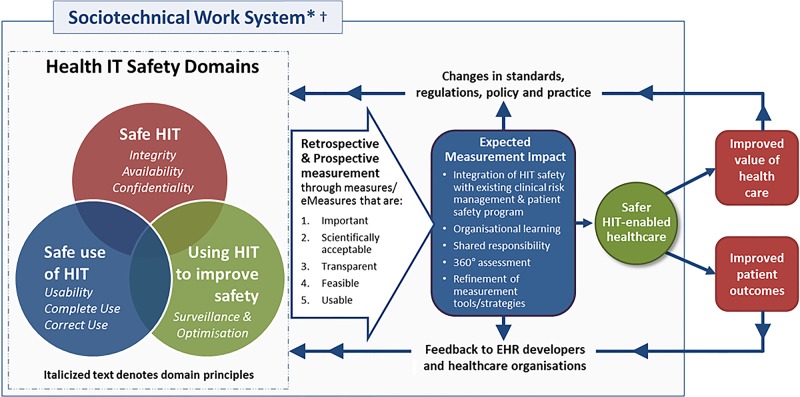
Health information technology (health IT) has potential to improve patient safety but its implementation and use has led to unintended consequences and new safety concerns. A key challenge to improving safety in health IT-enabled healthcare systems is to develop valid, feasible strategies to measure safety concerns at the intersection of health IT and patient safety. In response to the fundamental conceptual and methodological gaps related to both defining and measuring health IT-related patient safety, we propose a new framework, the Health IT Safety (HITS) measurement framework, to provide a conceptual foundation for health IT-related patient safety measurement, monitoring, and improvement. The HITS framework follows both Continuous Quality Improvement (CQI) and sociotechnical approaches and calls for new measures and measurement activities to address safety concerns in three related domains: 1) concerns that are unique and specific to technology (e.g., to address unsafe health IT related to unavailable or malfunctioning hardware or software); 2) concerns created by the failure to use health IT appropriately or by misuse of health IT (e.g. to reduce nuisance alerts in the electronic health record (EHR)), and 3) the use of health IT to monitor risks, health care processes and outcomes and identify potential safety concerns before they can harm patients (e.g. use EHR-based algorithms to identify patients at risk for medication errors or care delays). The framework proposes to integrate both retrospective and prospective measurement of HIT safety with an organization's existing clinical risk management and safety programs. It aims to facilitate organizational learning, comprehensive 360 degree assessment of HIT safety that includes vendor involvement, refinement of measurement tools and strategies, and shared responsibility to identify problems and implement solutions. A long term framework goal is to enable rigorous measurement that helps achieve the safety benefits of health IT in real-world clinical settings.
Overview
The claims and statistics of this paper haven’t been checked yet.
Free: it reads the open-access text and checks the first 5 claims that cite a source we can check. Create a free account to check every claim.
Integrity signals
Registry
Cites
Statistics
Figures
Verification
Claims the paper makes
The claims and statistics of this paper haven’t been checked yet.
Free: it reads the open-access text and checks the first 5 claims that cite a source we can check. Create a free account to check every claim.
Claims other papers make about this one
Each is checked against this paper’s own text: does it say what the citing paper says it does?
The source backs part of the claim, not all of it — or backs it for a different population, condition or comparison.
In the citing paper
“These frameworks emphasise governance, monitoring, and continuous learning as essential complements to technical controls and user training (48, 55).”
From Why digital health fails silently: a sociotechnical theory of health information technology–related risk (2026) · cites this paper as [55]
Experimental — accuracy not yet measuredThe source backs part of the claim, not all of it — or backs it for a different population, condition or comparison.
In the citing paper
“Recent guidance on digital safety governance, including updates to the SAFER Guides, reflects growing recognition of the need for shared responsibility and organisational accountability in managing EHR-related risks.”
From Why digital health fails silently: a sociotechnical theory of health information technology–related risk (2026) · cites this paper as [55]
Experimental — accuracy not yet measuredThe source backs part of the claim, not all of it — or backs it for a different population, condition or comparison.
In the citing paper
“National and international guidance increasingly reflects this shift, emphasising learning systems rather than static certification as the foundation for digital safety (1, 55, 59, 62).”
From Why digital health fails silently: a sociotechnical theory of health information technology–related risk (2026) · cites this paper as [55]
Experimental — accuracy not yet measuredThe cited source says what the claim attributes to it.
In the citing paper
“Rather than focusing primarily on preventing individual errors, the findings suggest that safer digital healthcare depends on strengthening organisational capacity to detect emerging hazards, contain their effects, and learn from system-level vulnerabilities (28, 55).”
From Why digital health fails silently: a sociotechnical theory of health information technology–related risk (2026) · cites this paper as [55]
Self-check
Percentages, sums and reported differences re-computed from the paper’s own numbers.
The self-check needs the paper’s full text.
Citations
Cites
Human error: models and management
Reason, J. (2000) · BMJ · doi:10.1136/bmj.320.7237.768 · Cited by 5,665
Role of Computerized Physician Order Entry Systems in Facilitating Medication Errors
Koppel, R. (2005) · JAMA · doi:10.1001/jama.293.10.1197 · Cited by 2,126
To Err is Human: Building a Safer Health System in 1999.
Stefl, M. E. (2001) · PubMed · Cited by 1,738
Sittig, D. F., & Singh, H. (2010) · Quality and Safety in Health Care · doi:10.1136/qshc.2010.042085 · Cited by 897
Self-citationAssociation of Interruptions With an Increased Risk and Severity of Medication Administration Errors
Westbrook, J. I. (2010) · Archives of Internal Medicine · doi:10.1001/archinternmed.2010.65 · Cited by 766
Measuring errors and adverse events in health care
Thomas, E. J., & Petersen, L. A. (2003) · Journal of General Internal Medicine · doi:10.1046/j.1525-1497.2003.20147.x · Cited by 455
Vincent, C., Burnett, S., & Carthey, J. (2014) · BMJ Quality & Safety · doi:10.1136/bmjqs-2013-002757 · Cited by 217
An analysis of electronic health record-related patient safety concerns
Meeks, D. W., Smith, M. W., Taylor, L., Sittig, D. F., Scott, J. M., & Singh, H. (2014) · Journal of the American Medical Informatics Association · doi:10.1136/amiajnl-2013-002578 · Cited by 207
Self-citationElectronic health records and national patient-safety goals
Sittig, D. F., & Singh, H. (2012) · New England Journal of Medicine · doi:10.1056/nejmsb1205420 · Cited by 204
Self-citationAdvancing the science of measurement of diagnostic errors in healthcare: the Safer Dx framework
Singh, H., & Sittig, D. F. (2015) · BMJ Quality & Safety · doi:10.1136/bmjqs-2014-003675 · Cited by 195
Self-citation
Research works printed but not linked: 3
- Weick KE, Sutcliffe KM, Obstfeld D Organizing for high reliability: Processes of collective mindfulness. Res Organ Behav 1999; 21: 81– 123.
- Institute of Medicine. Health IT and Patient Safety: Building Safer Care. 2011. 24600741
- Ruder DB Malpractice claims analysis confirms risks in EHRs. Patient Saf Qual Healthc 2014; 11: 20– 3.
Cited by
Kim, M. O., Coiera, E., & Magrabi, F. (2017) · Journal of the American Medical Informatics Association · doi:10.1093/jamia/ocw154 · Cited by 263
Current challenges in health information technology–related patient safety
Sittig, D. F., Wright, A., Coiera, E., Magrabi, F., Ratwani, R., Bates, D. W., & Singh, H. (2020) · Health Informatics Journal · doi:10.1177/1460458218814893 · Cited by 171
Self-citationA Socio-technical Approach to Preventing, Mitigating, and Recovering from Ransomware Attacks
Singh, H., & Sittig, D. (2016) · Applied Clinical Informatics · doi:10.4338/aci-2016-04-soa-0064 · Cited by 109
Self-citationSittig, D. F., Belmont, E., & Singh, H. (2018) · Healthcare · doi:10.1016/j.hjdsi.2017.06.004 · Cited by 98
“33 Assigning responsibility to address safety concerns to only the developer responsible for some but not all issues, or only to the health system that has no control over how the system was designed and built, will not be successful because overall safety is based on their combined actions.”
BackgroundSelf-citationPreckel, B., Staender, S. E. A., Velasco, D. A., Brattebø, G., Feldman, J. M., ffrench‐O'Carroll, R., Fuchs‐Buder, T., Goldhaber-Fiebert, S. N., Haller, G., Haugen, A. S., et al. (2020) · European Journal of Anaesthesiology · doi:10.1097/eja.0000000000001244 · Cited by 89
“They are based on electronic tracking, and examples include recognition of nosocomial infections, hazards associated with drugs or wrong patient orders and medical device dysfunctions.(141) To detect errors and complications, methods based on computing technologies use electronic algorithms to analyse hospital adminis…”
MethodAlolayyan, M. N., Alyahya, M. S. I., AlAlawin, A. H., Shoukat, A., & Nusairat, F. T. (2020) · Heliyon · doi:10.1016/j.heliyon.2020.e05040 · Cited by 90
“…save billions of dollars, reduces drug events, and lead to a better doctor-patient relationship (Cantiello et al., 2016; El-Kareh et al., 2013; Kruse and Beane, 2018; Kruse et al., 2014; Norton et al., 2019; Singh and Sittig, 2016; Sittig et al., 2018; Wang et al., 2018; Zineldin et al., 2014).”
BackgroundThe biopsychosociotechnical model: a systems-based framework for human-centered health improvement
Card, A. J. (2022) · Health Systems · doi:10.1080/20476965.2022.2029584 · Cited by 89
“In healthcare today, it is best known for contributions to systems safety (J. Braithwaite et al., 2009; Pascale Carayon et al., 2014; Runciman et al., 2010; P. Waterson et al., 2015; Wears, 2015) and health information technology (Gaskin et al., 2011; Singh & Sittig, 2016; Sittig & Singh, 2010).”
BackgroundKrankenhaus-Report 2019: Das digitale Krankenhaus
Klauber, J., Geraedts, M., Friedrich, J., & Wasem, J. (2019) · Springer eBooks · doi:10.1007/978-3-662-58225-1 · Cited by 87
What role for learning health systems in quality improvement within healthcare providers?
Foley, T., & Vale, L. D. (2017) · Learning Health Systems · doi:10.1002/lrh2.10025 · Cited by 82
“This, in part, may account for their broad impact on quality but also suggests the need for careful design and organisational planning, to avoid the unintended consequences for quality and professional satisfaction that have been associated with EHR implementation.(27,28) Further work is required to understand how pro…”
BackgroundTen key considerations for the successful optimization of large-scale health information technology
Cresswell, K. M., Bates, D. W., & Sheikh, A. (2016) · Journal of the American Medical Informatics Association · doi:10.1093/jamia/ocw037 · Cited by 78
“Some useful guidance in this respect can be found in a recent conceptual framework surrounding the monitoring and measurement of social and technical threats associated with HITs.(48) Learning from experiences with using electronic data can help to improve data quality, and careful tracking of progress can help to ens…”
BackgroundAbraham, J., Novak, L. L., Reynolds, T. L., Gettinger, A., & Zheng, K. (2016) · Yearbook of Medical Informatics · doi:10.15265/iy-2016-036 · Cited by 75
“…review only targeted original empirical investigations published in the scientific literature, we did not include thought pieces [e.g., 166], positions papers [e.g., 167], framework development [e.g., 168], books [e.g., 169], and policy briefs and government reports [e.g., 154 – 157, 160, 161].”
Palojoki, S., Pajunen, T., Saranto, K., & Lehtonen, L. (2016) · JMIR Medical Informatics · doi:10.2196/medinform.5238 · Cited by 69
“Organizations are encouraged to use clinicians trained in clinical informatics, and utilize a multidisciplinary oversight committee to help identify and prioritize risks [49].”
Evaluating diagnostic strategies for early detection of cancer: the CanTest framework
Walter, F. M., Thompson, M. J., Wellwood, I., Abel, G. A., Hamilton, W., Johnson, M., Lyratzopoulos, G., Messenger, M. P., Neal, R. D., Rubin, G., et al. (2019) · BMC Cancer · doi:10.1186/s12885-019-5746-6 · Cited by 57
Self-citationBell, S. K., Gerard, M., Fossa, A., Delbanco, T., Folcarelli, P. H., Sands, K. E., Sarnoff Lee, B., & Walker, J. (2017) · BMJ Quality & Safety · doi:10.1136/bmjqs-2016-006020 · Cited by 68
Communication in interprofessional rehabilitation teams: a scoping review
Paxino, J., Denniston, C., Woodward‐Kron, R. E., & Molloy, E. (2020) · Disability and Rehabilitation · doi:10.1080/09638288.2020.1836271 · Cited by 62
“Firstly, within this timeframe there has been an increasing focus on interprofessional collaboration and education in healthcare [44] and secondly, health-information technology (health-IT) has evolved rapidly and extensively, becoming an integral component of patient care [45].”
BackgroundMartin, G., Ghafur, S., Cingolani, I., Symons, J., King, D., Arora, S., & Darzi, A. W. (2019) · The Lancet Digital Health · doi:10.1016/s2589-7500(19)30057-3 · Cited by 59
Interprofessional practice in different patient care settings: A qualitative exploration
DiazGranados, D., Dow, A. W., Appelbaum, N., Mazmanian, P. E., & Retchin, S. M. (2018) · Journal of Interprofessional Care · doi:10.1080/13561820.2017.1383886 · Cited by 41
“An important factor not considered in this study is how the information technology shapes information exchange, healthcare delivery and interprofessional practice as part of the sociotechnical work system (Singh & Sittig, 2016).”
BackgroundSafety huddles to proactively identify and address electronic health record safety
Menon, S., Singh, H., Giardina, T. D., Rayburn, W. L., Davis, B. P., Russo, E. M., & Sittig, D. F. (2016) · Journal of the American Medical Informatics Association · doi:10.1093/jamia/ocw153 · Cited by 54
“13 This is compounded by the distributed nature of these systems and lack of feedback to end users regarding the consequences of their actions.”
BackgroundSelf-citationEHR‐related medication errors in two ICUs
Carayon, P., Du, S., Brown, R., Cartmill, R. S., Johnson, M., & Wetterneck, T. B. (2017) · Journal of Healthcare Risk Management · doi:10.1002/jhrm.21259 · Cited by 48
Georgiou, A., Li, J., Thomas, J., Dahm, M. R., & Westbrook, J. I. (2019) · Journal of the American Medical Informatics Association · doi:10.1093/jamia/ocz032 · Cited by 48
Pioneering digital disruption: Australia's first integrated digital tertiary hospital
Sullivan, C. M., Staib, A. N., Ayre, S. J., Daly, M., Collins, R., Draheim, M., & Ashby, R. (2016) · The Medical Journal of Australia · doi:10.5694/mja16.00476 · Cited by 45
Bim, L. L., Bim, F. L., da Silva, A. M. B., de Sousa, Á. F. L., Hermann, P. R. D. S., de Andrade, D., & Haas, V. J. (2017) · Escola Anna Nery · doi:10.1590/2177-9465-ean-2017-0127 · Cited by 44
Challenges in patient safety improvement research in the era of electronic health records
Russo, E. M., Sittig, D. F., Murphy, D. R., & Singh, H. (2016) · Healthcare · doi:10.1016/j.hjdsi.2016.06.005 · Cited by 45
Self-citationYusuf, Y., & Irwan, A. M. (2021) · British Journal of Healthcare Management · doi:10.12968/bjhc.2020.0083 · Cited by 42
Ausserhofer, D., Favez, L., Simon, M., & Zúñiga, F. (2021) · JMIR Medical Informatics · doi:10.2196/22974 · Cited by 41
“As with other systems that have delivered widespread improvements, the expected benefits of EHR can only be achieved in real-world settings through continuous feedback and improvement [41].”
BackgroundPowell, L., Sittig, D. F., Chrouser, K. L., & Singh, H. (2020) · JAMA Network Open · doi:10.1001/jamanetworkopen.2020.6752 · Cited by 40
Self-citationElshayib, M., & Pawola, L. M. (2020) · Health Informatics Journal · doi:10.1177/1460458220941750 · Cited by 40
“123,127,128”
BackgroundTurner, P. A., Kushniruk, A. W., & Nøhr, C. G. (2017) · Yearbook of Medical Informatics · doi:10.15265/iy-2017-014 · Cited by 40
“Singh et al. [49] also acknowledged the gap but attributed it to the lack of a solid and convincing conceptual foundation for use in practice.”
BackgroundPalojoki, S., Saranto, K., Reponen, E., Skants, N., Vakkuri, A., & Vuokko, R. (2021) · JMIR Medical Informatics · doi:10.2196/30470 · Cited by 37
“Risks associated with EHRs have been identified as being related to technologies, apps, and their use [21-24].”
BackgroundInfluentialWhat is the safety case for health IT? A study of assurance practices in England
Habli, I., White, S., Sujan, M. A., Harrison, S., & Ugarte, M. (2018) · Safety Science · doi:10.1016/j.ssci.2018.09.001 · Cited by 35
Araújo, G. L., Amorim, F. F., de Miranda, R. C. P. S., Amorim, F. F. P., Santana, L. A., & Göttems, L. B. D. (2022) · PLoS ONE · doi:10.1371/journal.pone.0271158 · Cited by 37
“Nowadays, patient safety culture has been widely discussed worldwide, a significant concern in health care services [9, 10].”
BackgroundWright, A., Ash, J. S., Aaron, S., Ai, A., Hickman, T.-T. T., Wiesen, J. F., Galanter, W., McCoy, A. B., Schreiber, R., Longhurst, C. A., et al. (2018) · International Journal of Medical Informatics · doi:10.1016/j.ijmedinf.2018.08.001 · Cited by 32
“One key issue that was raised several times was the issue of shared responsibility [52, 53].”
Self-citationImplementation of an Innovative Technology Called the OR Black Box: A Feasibility Study
Møller, K. E., Sørensen, J. L., Topperzer, M. K., Koerner, C., Ottesen, B., Rosendahl, M., Grantcharov, T., & Strandbygaard, J. J. S. (2022) · Surgical Innovation · doi:10.1177/15533506221106258 · Cited by 32
Krasuska, M., Williams, R., Sheikh, A., Franklin, B. D., Hinder, S., TheNguyen, H., Lane, W., Mozaffar, H., Mason, K., Eason, S., et al. (2021) · BMJ Health & Care Informatics · doi:10.1136/bmjhci-2021-100429 · Cited by 31
Wildenbos, G. A., Peute, L., & Jaspers, M. (2016) · Yearbook of Medical Informatics · doi:10.15265/iy-2016-031 · Cited by 29
“They concern issues regarding workflows, communication, cognitive aspects, and the healthcare organization’s culture and social interactions [12-20].”
Shawahna, R. (2019) · BMC Medical Informatics and Decision Making · doi:10.1186/s12911-019-0928-3 · Cited by 28
The Effects of Medication Alerts on Prescriber Response in a Pediatric Hospital
Dexheimer, J. W., Kirkendall, E. S., Kouril, M., Hagedorn, P. A., Minich, T., Duan, L. L., Mahdi, M., Szczesniak, R. D., & Spooner, S. A. (2017) · Applied Clinical Informatics · doi:10.4338/aci-2016-10-ra-0168 · Cited by 27
Scott, P., Rigby, M., Ammenwerth, E., McNair, J., Georgiou, A., Hyppönen, H., de Keizer, N. F., Magrabi, F., Nykänen, P., Gude, W. T., et al. (2017) · Yearbook of Medical Informatics · doi:10.1055/s-0037-1606530 · Cited by 27
Campione, J. R., & Liu, H. K. (2024) · BMC Health Services Research · doi:10.1186/s12913-024-11322-3 · Cited by 22
Barnes, G. D., Sippola, E., Ranusch, A., Takamine, L. H., Lanham, M. S. M., Dorsch, M. P., Sales, A. E., & Sussman, J. B. (2022) · Implementation Science Communications · doi:10.1186/s43058-022-00262-w · Cited by 22
“” In contrast, emerging health information technology frameworks are being developed to detail the numerous factors that influence successful EHR-and technology-based implementation within health care delivery [29, 30].”
BackgroundPalojoki, S., Saranto, K., & Lehtonen, L. (2017) · Health Informatics Journal · doi:10.1177/1460458217720400 · Cited by 21
Nursing leadership style and error management culture: a scoping review
Moraca, E., Zaghini, F., Fiorini, J., & Sili, A. (2024) · Leadership in health services · doi:10.1108/lhs-12-2023-0099 · Cited by 21
Georgiou, A., McCaughey, E. J., Tariq, A., Walter, S. R., Li, J., Callen, J. L., Paoloni, R., Runciman, W. B., & Westbrook, J. I. (2016) · International Journal of Medical Informatics · doi:10.1016/j.ijmedinf.2016.12.006 · Cited by 20
Abdelaziz, S., Garfield, S., Neves, A. L., Lloyd, J., Norton, J., van Dael, J., Wheeler, C., McLeod, M., & Franklin, B. D. (2024) · BMJ Open · doi:10.1136/bmjopen-2024-089026 · Cited by 19
“Existing tools and frameworks to support use of technologies in healthcare 19–22 tend to focus on high-level organisational issues around implementation, rather than identifying and mitigating any negative unintended consequences that may arise once technologies are in use.”
Verma, A. A., Trbovich, P., Mamdani, M., & Shojania, K. G. (2023) · BMJ Quality & Safety · doi:10.1136/bmjqs-2022-015713 · Cited by 19
“17 25 Consequently we refer to ‘ML solutions’ to describe the sociotechnical system that includes data inputs, ML models and their outputs, computational and IT infrastructure and human interactions with user interfaces, leading to a clinical response.”
BackgroundNaumann, L., Babitsch, B., & Hübner, U. (2021) · Health Policy and Technology · doi:10.1016/j.hlpt.2021.100505 · Cited by 19
Selna, A., Othman, Z., Tham, J., & Yoosuf, A. K. (2022) · Records Management Journal · doi:10.1108/rmj-03-2022-0008 · Cited by 18
Using and choosing digital health technologies: a communications science perspective
Øvretveit, J., Wu, A. W., Street, R. L., Thimbleby, H., Thilo, F. J. S., & Hannawa, A. F. (2017) · Journal of Health Organization and Management · doi:10.1108/jhom-07-2016-0128 · Cited by 18
Measuring safety of healthcare: an exercise in futility?
Sauro, K. M., Ghali, W. A., & Stelfox, H. T. (2019) · BMJ Quality & Safety · doi:10.1136/bmjqs-2019-009824 · Cited by 18
Lafferty, M., Fauer, A. J., Wright, N., Manojlovich, M., & Friese, C. R. (2020) · Oncology nursing forum · doi:10.1188/20.onf.417-427 · Cited by 17
“…guiding this inquiry (see Figure 1) was derived from a sociotechnical theoretical framework incorporating concepts from communication, information technology, and organizational studies (Bostrom & Heinen, 1977; Singh & Sittig, 2016; Zheng, Ciemins, et al., 2015; Zheng, Hanauer, et al., 2015).”
MethodWyatt, K. D., Benning, T. J., Morgenthaler, T. I., & Arteaga, G. M. (2020) · Applied Clinical Informatics · doi:10.1055/s-0040-1717084 · Cited by 17
Forood, A. M. K., Osifuwa, A. D., Idoko, J. E., Oni, O., Ajaelu, C. S., & Idoko, F. A. (2024) · GSC Advanced Research and Reviews · doi:10.30574/gscarr.2024.21.1.0380 · Cited by 16
“Regulations such as HIPAA and GDPR play a vital role in ensuring data privacy and secure management, which are critical in safeguarding sensitive patient information [5].”
BackgroundChen, C.-H., Lan, Y. L., Yang, W., Hsu, F., Lin, C., & Chen, H.-C. (2019) · International Journal of Environmental Research and Public Health · doi:10.3390/ijerph16203988 · Cited by 16
“By improving record-keeping, communication, and collaborative care systems, HIT can help ensure that information is accurate and used as a basis for care decisions [51,60].”
BackgroundFighting a common enemy: a catalyst to close intractable safety gaps
Singh, H., Sittig, D. F., & Gandhi, T. K. (2020) · BMJ Quality & Safety · doi:10.1136/bmjqs-2020-011390 · Cited by 16
Self-citationEmergency thoracic ultrasound and clinical risk management
Interrigi, M., Trovato, F. M., Catalano, D., & Trovato, G. M. (2017) · Therapeutics and Clinical Risk Management · doi:10.2147/tcrm.s126770 · Cited by 16
Lai, J., Klag, M., & Shikako‐Thomas, K. (2019) · Learning Health Systems · doi:10.1002/lrh2.10192 · Cited by 16
Integrating and safeguarding care: The potential role of health information technologies
Desmedt, M., Pless, S., Dessers, E., & Vandijck, D. M. (2017) · International Journal of Care Coordination · doi:10.1177/2053434517715781 · Cited by 16
“Several guidelines and new frameworks – for example the SAFER guidelines and the Health IT Safety framework – can provide conceptual foundation for HIT-related patient safety measurement, monitoring and improvement.(33,50) In particular, the WHO National eHealth Strategy Toolkit is a practical guide that provides gove…”
Toward More Proactive Approaches to Safety in the Electronic Health Record Era
Sittig, D. F., & Singh, H. (2017) · The Joint Commission Journal on Quality and Patient Safety · doi:10.1016/j.jcjq.2017.06.005 · Cited by 16
“They address the three domains of health IT–related patient safety, 20 as follows; each domain is supported by one to three SAFER principles (Table 1).”
MethodSelf-citationMartin, G., Arora, S., Shah, N., King, D., & Darzi, A. W. (2019) · Health Informatics Journal · doi:10.1177/1460458219854602 · Cited by 15
“26 Using a deductive approach to analysis, the HITS Framework was employed to categorise statements across the three domains of safe health IT, using health IT safely and monitoring safety 24 with direct excerpts used as illustrative examples.”
MethodGovernance for Patient Safety: A Framework of Strategy Domains for Risk Management
Buja, A., Damiani, G., Manfredi, M., Zampieri, C., Dentuti, E., Grotto, G., & Sabatelli, G. (2022) · Journal of Patient Safety · doi:10.1097/pts.0000000000000947 · Cited by 15
Leveraging the Electronic Health Record to Implement Emergency Department Delirium Screening
Chary, A. N., Brickhouse, E., Torres, B., Santangelo, I., Carpenter, C. R., Liu, S. W., Godwin, K. M., Naik, A. D., Singh, H., & Kennedy, M. (2023) · Applied Clinical Informatics · doi:10.1055/a-2073-3736 · Cited by 15
Self-citationUsing Active Learning to Identify Health Information Technology Related Patient Safety Events
Fong, A., Howe, J. L., Adams, K., & Ratwani, R. M. (2017) · Applied Clinical Informatics · doi:10.4338/aci-2016-09-cr-0148 · Cited by 15
Savoy, A., Patel, H., Flanagan, M., Daggy, J., Russ, A. L., & Weiner, M. (2018) · Applied Ergonomics · doi:10.1016/j.apergo.2018.05.013 · Cited by 15
Ijaz, F., & Chaudhry, N. I. (2021) · Pakistan Journal of Commerce and Social Sciences · Cited by 13
Mondal, R., & Sameer, M. (2024) · Global Journal on Quality and Safety in Healthcare · doi:10.36401/jqsh-24-23 · Cited by 13
Campione, J. R., Mardon, R. E., & McDonald, K. M. (2018) · Journal of Patient Safety · doi:10.1097/pts.0000000000000531 · Cited by 13
Real-Time Automated Hazard Detection Framework for Health Information Technology Systems
Omitaomu, O. A., Özmen, Ö., Olama, M. M., Pullum, L., Kuruganti, T. P., Nutaro, J. J., Klasky, H. B., Zandi, H., Advani, A. A., Laurio, A., et al. (2019) · Health Systems · doi:10.1080/20476965.2019.1599701 · Cited by 12
“Thus, there have been calls to provide a means to study HIT safety measurement, monitoring, and improvement (Singh & Sittig, 2016; Sittig & Singh, 2015).”
BackgroundThe health information technology safety framework: building great structures on vast voids
Koppel, R. (2015) · BMJ Quality & Safety · doi:10.1136/bmjqs-2015-004746 · Cited by 12
Palojoki, S. (2017) · UEF eRepo (University of Eastern Finland) · Cited by 12
Lo, B., Durocher, K., Charow, R., Kimball, S., Phạm, Q., Sockalingam, S., Wiljer, D., & Strudwick, G. (2025) · Journal of Medical Internet Research · doi:10.2196/67820 · Cited by 11
Can Nurses' Informatics Competency Predict Their Professional Competency?
Jaberi, A. A., Sahebi, Z., Paghaleh, Z. R., Jaberi, K. A., & Bonabi, T. N. (2022) · Journal of Occupational Health and Epidemiology · doi:10.52547/johe.11.1.41 · Cited by 11
“Despite well-documented positive effects of HIT, some studies have reported that the introduction of HIT in clinical settings is associated with intended and unintended adverse effects, such as adverse patient outcomes, patient safety risks, and patient harm [12, 13].”
Descriptive Epidemiology of Safety Events at an Academic Medical Center
Marra, A. R., Algwizani, A. R., Alzunitan, M. A., Brennan, T. M. H., & Edmond, M. B. (2020) · International Journal of Environmental Research and Public Health · doi:10.3390/ijerph17010353 · Cited by 11
“Healthcare Performance Improvement, a consulting firm, has developed a safety event classification that is currently used in some hospitals [9], and their methods can be used to detect and avoid safety events [2,3,10].”
BackgroundEspinoza, J., Sikder, A. T., Dickhoner, J., & Lee, T. (2021) · JMIR Formative Research · doi:10.2196/25833 · Cited by 11
“This type of conceptual framework has been leveraged to address various issues in informatics, such as the development of global health networks, patient safety, and conceptual models for research [89-91].”
Habli, I., Jia, Y., White, S., Gabriel, G., Lawton, T., Sujan, M. A., & Tomsett, C. (2019) · Health Informatics Journal · doi:10.1177/1460458219852789 · Cited by 11
“…flexible in the level of detail that a user enters in describing care settings and processes, leaving it to the user to select an appropriate socio-technical model 28,29 and the granularity of the clinical activities and decisions, considering the complexity and criticality of the HIT deployment.”
BackgroundJabin, M. S. R. (2026) · Frontiers in Digital Health · doi:10.3389/fdgth.2026.1785086 · Cited by 10
“National and international guidance increasingly reflects this shift, emphasising learning systems rather than static certification as the foundation for digital safety (1, 55, 59, 62).”
Jabin, M. S. R. (2026) · Frontiers in Digital Health · doi:10.3389/fdgth.2026.1786358 · Cited by 11
“This iterative relationship underscores the role of incident analysis in a continuous learning cycle aimed at improving the safety and resilience of digital healthcare systems (1, 46, 61).”
Koike, D., Yamakami, J., Miyashita, T., Kataoka, Y., Nishida, H., Hattori, H., & Yasuda, A. (2022) · International Journal for Quality in Health Care · doi:10.1093/intqhc/mzac002 · Cited by 10
The Inpatient Nursing Leadership Perspective of Using Mobile Technology at the Bedside
Giannini, R. C. (2022) · CIN Computers Informatics Nursing · doi:10.1097/cin.0000000000000873 · Cited by 10
“H ealthcare organizations (HCOs) are complex, dynamic systems; implementing health information technology (HIT) of any type adds to this complexity.(1,2) Innovative technology such as mobile devices can support patient care, yet it can be challenging to understand the impact on patient care and nurse workflow.”
BackgroundSujan, M. A. (2018) · BMJ Health & Care Informatics · doi:10.14236/jhi.v25i1.952 · Cited by 9
“14 There is a need to provide greater awareness and education about the existence and possible use of such techniques, along with the recognition of their limitations.”
BackgroundFIN-TIERA: A Tool for Assessing Technology Induced Errors
Pajunen, T., Lehtonen, L., Saranto, K., & Palojoki, S. (2017) · Methods of Information in Medicine · doi:10.3414/me16-01-0097 · Cited by 9
“Many EHR-related errors are latent and involve both technological features, user behavior and regulations, which makes error prevention challenging [12].”
BackgroundDevelopment of safety and usability guideline for clinical information system
Lee, Y., Bahn, S., Shin, G. W., Jung, M.-Y., Park, T., Cho, I., & Lee, J.-H. (2021) · Medicine · doi:10.1097/md.0000000000025276 · Cited by 9
Yarahuan, J. W., Billett, A. L., & Hron, J. D. (2019) · Applied Clinical Informatics · doi:10.1055/s-0039-1693123 · Cited by 9
“29,31 An example of this new kind oferrorincludesa “ juxtaposition ” error,whereauserunknow-ingly selects the wrong option between choices that were adjacent to one another in a selectable list.”
BackgroundJabin, M. S. R. (2026) · JMIR Human Factors · doi:10.2196/92560 · Cited by 9
“…enabled precise characterization of HIT-specific failure mechanisms [9,10], and the SEIPS, sociotechnical, and HFACS-Healthcare frameworks highlighted how interactions among technology, workflows, supervision, and organizational context shaped the emergence and impact of incidents [13,15,19].”
InfluentialBankole, A. A., & Greear, E. (2023) · European Journal of Rheumatology · doi:10.5152/eurjrheum.2023.22086 · Cited by 8
“13 As a result of GIO occurring in a different patient group compared to age-related osteoporosis, it is not always addressed.”
BackgroundPages, K. P., Aaronson, S. T., Carpenter, L. L., Hutton, T. M., Rush, A. J., & Sackeïm, H. A. (2024) · Transcranial magnetic stimulation . · doi:10.1016/j.transm.2024.100075 · Cited by 8
Ahmed, Z., Jani, Y. H., & Franklin, B. D. (2018) · BMC Health Services Research · doi:10.1186/s12913-018-3750-1 · Cited by 8
“To eliminate unintended consequences of health IT and ensure patient safety it is vital to combine measurement of health IT safety with existing clinical risk management and safety program(s) in hospitals [16].”
BackgroundPatient-directed Digital Health Technologies: Is Implementation Outpacing Evidence?
Houston, T. K., Richardson, L. M., & Cotten, S. R. (2019) · Medical Care · doi:10.1097/mlr.0000000000001068 · Cited by 8
“Recently, frameworks 10,11 for studying and monitoring for safety of information technology have been published, and should be applied to patient-directed technologies in the inpatient and outpatient setting.”
BackgroundImproving the Effectiveness of Health Information Technology: The Case for Situational Analytics
Novak, L. L., Anders, S. H., Unertl, K. M., France, D. J., & Weinger, M. B. (2019) · Applied Clinical Informatics · doi:10.1055/s-0039-1697594 · Cited by 8
“8,12,16,23,24 Contextual issues present a major challenge.”
Shin, G. W., Bahn, S., Lee, Y., & Lee, J. (2021) · Human Factors and Ergonomics in Manufacturing & Service Industries · doi:10.1002/hfm.20900 · Cited by 9
Awad, S., Begg, R., Loveday, T., & Baysari, M. T. (2025) · BMC Health Services Research · doi:10.1186/s12913-025-13293-5 · Cited by 7
“…context of use, workflows, clinical practices, organisational policies, staffing, resources, digital health infrastructure, the quality of training provided, and other dynamic contextual factors at play within the local environments and ecosystems in which the technology is implemented [3, 13–15].”
Richardson, J. E., Rasmussen, L. V., Dorr, D. A., Sirkin, J. T., Shelley, D., Rivera, A. S., Wu, W. Y., Cykert, S., Cohen, D. J., & Kho, A. (2022) · Applied Clinical Informatics · doi:10.1055/s-0042-1748145 · Cited by 7
Digitalisierung und Patientensicherheit
Sellge, E., & Hagenmeyer, E.-G. (2019) · Springer eBooks · doi:10.1007/978-3-662-58225-1_10 · Cited by 7
A new methodological framework for hazard detection models in health information technology systems
Omitaomu, O. A., Klasky, H. B., Olama, M. M., Özmen, Ö., Pullum, L., Thakur, A. M., Kuruganti, T. P., Scott, J. M., Laurio, A., Drews, F. A., et al. (2021) · Journal of Biomedical Informatics · doi:10.1016/j.jbi.2021.103937 · Cited by 7
Palojoki, S., Skants, N., Reponen, E., Vakkuri, A., Saranto, K., & Vuokko, R. (2022) · Finnish Journal of eHealth and eWelfare · doi:10.23996/fjhw.110823 · Cited by 7
“Potilastietojärjestelmiin liittyviä, kirjallisuudessa dokumentoituja potilasturvallisuuskysymyksiä ovat esimerkiksi käytettävyys, tutkimustulosten virheellinen välittyminen, käyttökatko, järjestelmien väliset rajapintaongelmat, lääkitysvirheet ja hoitoon liittyvät ajastusvirheet [14-18].”
BackgroundInfluentialRabbani, N., Pageler, N. M., Hoffman, J. M., Longhurst, C., & Sharek, P. J. (2023) · Applied Clinical Informatics · doi:10.1055/a-2077-4419 · Cited by 6
Dhopeshwarkar, R. V., Freij, M., Callaham, M., Desai, P. J., Harrison, M. I., Swiger, J., Lomotan, E. A., Dymek, C., & Dullabh, P. (2023) · Applied Clinical Informatics · doi:10.1055/s-0043-1769911 · Cited by 6
“30 The few studies on the ef fi cacy of publicly available, standards-based CDS generally focus on new productsandthe design or pilot stages of CDS development, rather than outcomes.”
Agha-Mir-Salim, L., & Sarmiento, R. F. (2020) · Springer eBooks · doi:10.1007/978-3-030-47994-7_1 · Cited by 6
Topic Modeling to Discern Irregular Order Patterns in Unlabeled Electronic Health Records
Özmen, Ö., Klasky, H. B., Omitaomu, O. A., Olama, M. M., Kuruganti, T. P., Pullum, L., Ward, M. C., Scott, J. M., Laurio, A., & Nebeker, J. R. (2019) · IEEE-EMBS International Conference on Biomedical and Health Informatics (BHI ...) · doi:10.1109/bhi.2019.8834659 · Cited by 6
“Recently, a HIT safety framework was introduced to provide a conceptual foundation to address the complexity of these socio-technical interactions and to provide a means to study HIT safety measurement, monitoring, and improvement [3, 4].”
BackgroundFive Strategies for a Safer EHR Modernization Journey
Sittig, D. F., Yackel, E. E., & Singh, H. (2023) · Journal of General Internal Medicine · doi:10.1007/s11606-023-08331-z · Cited by 6
Self-citationJabin, M. S. R. (2026) · JMIR Human Factors · doi:10.2196/91783 · Cited by 5
“In HIT, these investigations are often informed by sociotechnical frameworks such as the SAFER (Safety Assurance Factors for Electronic Health Record Resilience) Guides and related evaluation methods for electronic health record safety [18,56,58].”
Metadata
- Authors
- Singh, H., & Sittig, D. F.
- Affiliations
- Michael E. DeBakey VA Medical Center (US)
- Memorial Hermann (US)
- Corresponding author
- Singh, Hardeep
- Venue
- BMJ Quality & Safety
- Publisher
- BMJ
- Published
- 2015-09-14
- Volume
- 25
- Issue
- 4
- Pages
- 226-232
- ISSN
- 1475-3898 (ISSN-L)
- 2044-5415
- 2044-5423
- PMC
- PMC4819641
- OpenAlex
- W2175323185
- Cited by
- 167
- References
- 38
- Citations by year
- 2026: 18 · 2025: 9 · 2024: 17 · 2023: 12 · 2022: 20 · 2021: 16 · 2020: 13 · 2019: 20 · 2018: 8 · 2017: 17 · 2016: 14 · 2015: 2
- FWCI
- 1.49
- Type
- journal article
- Language
- en
- Open access
- hybrid
- doi.org
- Licence
- cc-by-nc
- Locations
- BMJ Quality & Safety (publishedVersion, cc-by-nc)
- Europe PMC (PubMed Central) (publishedVersion, cc-by-nc)
- PubMed Central (publishedVersion, cc-by-nc)
- PubMed (publishedVersion)
- HighWire Press Open Archive (submittedVersion)
- Funders
- Health Services Research and Development (CIN 13‐413, CRE12-033, USA 14-274)
- Agency for Healthcare Research and Quality (R01HS022087)
- Center for Innovations in Quality, Effectiveness and Safety (CIN 13–413, 13–413)
- VA National Center for Patient Safety
- Topics
- Health Sciences › Health Professions › Health Information Management › Electronic Health Records Systems
- Health Sciences › Medicine › Public Health, Environmental and Occupational Health › Patient Safety and Medication Errors
- Health Sciences › Medicine › Surgery › Healthcare Technology and Patient Monitoring
- Keywords
- health information technology, patient safety, safety measurement, electronic health records, clinical decision support alerts, medication errors, continuous quality improvement, socio-technical approach, clinical risk management, organizational learning
- MeSH terms
- Humans, Medical Informatics, United States, Information Dissemination, Electronic Health Records, Quality Improvement, Patient Safety
About these checks
Registry, retraction, Cites and statistics results are computed, not judged, with one exception: a printed reference that no index lists is read once by a model before it counts as a citation error. Claims are extracted by a model and kept only when their quote appears verbatim in the text; each cited source is then checked, with a model’s help, for whether it says what the claim relies on. Those verdicts can be wrong — read the claim’s quote and the cited source before relying on one.
Statistics and arithmetic are recomputed, not judged.
Confidence bands are shown only for fields calibrated on our annotated test set. None is calibrated yet, so no band is shown.
What counts as a claim ›How we measure confidence ›How we check this ›
Are you an author, or do you see a problem with this page? Request a review
Data sources
Bibliographic data: Semantic Scholar, OpenAlex, Crossref.
Contains information from the Semantic Scholar Academic Graph Datasets, made available under the ODC Attribution License (ODC-BY 1.0).
Semantic Scholar’s data is described in: Kinney, R., et al. (2023). The Semantic Scholar Open Data Platform. arXiv:2301.10140.
