

Measuring and improving patient safety through health information technology: The Health IT Safety Framework
Open accessThe DOI matches its Crossref record; 34 of the 38 references it cites were found in a registry or an index.
Abstract
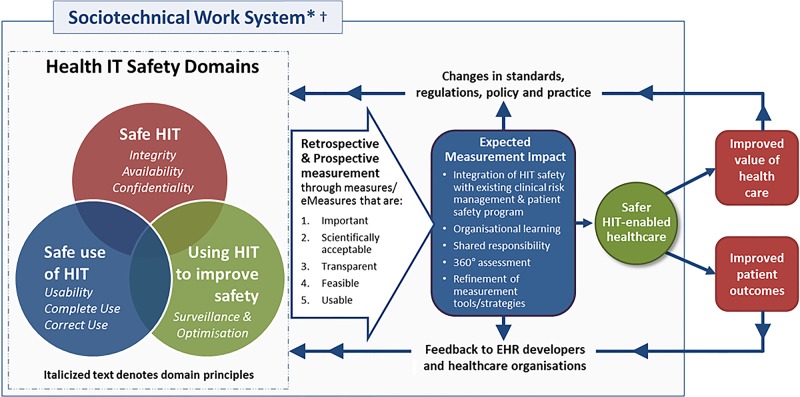
Health information technology (health IT) has potential to improve patient safety but its implementation and use has led to unintended consequences and new safety concerns. A key challenge to improving safety in health IT-enabled healthcare systems is to develop valid, feasible strategies to measure safety concerns at the intersection of health IT and patient safety. In response to the fundamental conceptual and methodological gaps related to both defining and measuring health IT-related patient safety, we propose a new framework, the Health IT Safety (HITS) measurement framework, to provide a conceptual foundation for health IT-related patient safety measurement, monitoring, and improvement. The HITS framework follows both Continuous Quality Improvement (CQI) and sociotechnical approaches and calls for new measures and measurement activities to address safety concerns in three related domains: 1) concerns that are unique and specific to technology (e.g., to address unsafe health IT related to unavailable or malfunctioning hardware or software); 2) concerns created by the failure to use health IT appropriately or by misuse of health IT (e.g. to reduce nuisance alerts in the electronic health record (EHR)), and 3) the use of health IT to monitor risks, health care processes and outcomes and identify potential safety concerns before they can harm patients (e.g. use EHR-based algorithms to identify patients at risk for medication errors or care delays). The framework proposes to integrate both retrospective and prospective measurement of HIT safety with an organization's existing clinical risk management and safety programs. It aims to facilitate organizational learning, comprehensive 360 degree assessment of HIT safety that includes vendor involvement, refinement of measurement tools and strategies, and shared responsibility to identify problems and implement solutions. A long term framework goal is to enable rigorous measurement that helps achieve the safety benefits of health IT in real-world clinical settings.
Overview
The claims and statistics of this paper haven’t been checked yet.
Free: it reads the open-access text and checks the first 5 claims that cite a source we can check. Create a free account to check every claim.
Integrity signals
Registry
Cites
Statistics
Figures
Verification
Claims the paper makes
The claims and statistics of this paper haven’t been checked yet.
Free: it reads the open-access text and checks the first 5 claims that cite a source we can check. Create a free account to check every claim.
Claims other papers make about this one
Each is checked against this paper’s own text: does it say what the citing paper says it does?
The source backs part of the claim, not all of it — or backs it for a different population, condition or comparison.
In the citing paper
“These frameworks emphasise governance, monitoring, and continuous learning as essential complements to technical controls and user training (48, 55).”
From Why digital health fails silently: a sociotechnical theory of health information technology–related risk (2026) · cites this paper as [55]
Experimental — accuracy not yet measuredThe source backs part of the claim, not all of it — or backs it for a different population, condition or comparison.
In the citing paper
“Recent guidance on digital safety governance, including updates to the SAFER Guides, reflects growing recognition of the need for shared responsibility and organisational accountability in managing EHR-related risks.”
From Why digital health fails silently: a sociotechnical theory of health information technology–related risk (2026) · cites this paper as [55]
Experimental — accuracy not yet measuredThe source backs part of the claim, not all of it — or backs it for a different population, condition or comparison.
In the citing paper
“National and international guidance increasingly reflects this shift, emphasising learning systems rather than static certification as the foundation for digital safety (1, 55, 59, 62).”
From Why digital health fails silently: a sociotechnical theory of health information technology–related risk (2026) · cites this paper as [55]
Experimental — accuracy not yet measuredThe cited source says what the claim attributes to it.
In the citing paper
“Rather than focusing primarily on preventing individual errors, the findings suggest that safer digital healthcare depends on strengthening organisational capacity to detect emerging hazards, contain their effects, and learn from system-level vulnerabilities (28, 55).”
From Why digital health fails silently: a sociotechnical theory of health information technology–related risk (2026) · cites this paper as [55]
Self-check
Percentages, sums and reported differences re-computed from the paper’s own numbers.
The self-check needs the paper’s full text.
Citations
Cites
Human error: models and management
Reason, J. (2000) · BMJ · doi:10.1136/bmj.320.7237.768 · Cited by 5,665
Role of Computerized Physician Order Entry Systems in Facilitating Medication Errors
Koppel, R. (2005) · JAMA · doi:10.1001/jama.293.10.1197 · Cited by 2,126
To Err is Human: Building a Safer Health System in 1999.
Stefl, M. E. (2001) · PubMed · Cited by 1,738
Sittig, D. F., & Singh, H. (2010) · Quality and Safety in Health Care · doi:10.1136/qshc.2010.042085 · Cited by 897
Self-citationAssociation of Interruptions With an Increased Risk and Severity of Medication Administration Errors
Westbrook, J. I. (2010) · Archives of Internal Medicine · doi:10.1001/archinternmed.2010.65 · Cited by 766
Measuring errors and adverse events in health care
Thomas, E. J., & Petersen, L. A. (2003) · Journal of General Internal Medicine · doi:10.1046/j.1525-1497.2003.20147.x · Cited by 455
Vincent, C., Burnett, S., & Carthey, J. (2014) · BMJ Quality & Safety · doi:10.1136/bmjqs-2013-002757 · Cited by 217
An analysis of electronic health record-related patient safety concerns
Meeks, D. W., Smith, M. W., Taylor, L., Sittig, D. F., Scott, J. M., & Singh, H. (2014) · Journal of the American Medical Informatics Association · doi:10.1136/amiajnl-2013-002578 · Cited by 207
Self-citationElectronic health records and national patient-safety goals
Sittig, D. F., & Singh, H. (2012) · New England Journal of Medicine · doi:10.1056/nejmsb1205420 · Cited by 204
Self-citationAdvancing the science of measurement of diagnostic errors in healthcare: the Safer Dx framework
Singh, H., & Sittig, D. F. (2015) · BMJ Quality & Safety · doi:10.1136/bmjqs-2014-003675 · Cited by 195
Self-citation
Research works printed but not linked: 3
- Weick KE, Sutcliffe KM, Obstfeld D Organizing for high reliability: Processes of collective mindfulness. Res Organ Behav 1999; 21: 81– 123.
- Institute of Medicine. Health IT and Patient Safety: Building Safer Care. 2011. 24600741
- Ruder DB Malpractice claims analysis confirms risks in EHRs. Patient Saf Qual Healthc 2014; 11: 20– 3.
Cited by
Items 101–200 of 205
Elkefi, S., & Asan, O. (2022) · IEEE International Symposium on Systems Engineering · doi:10.1109/isse54508.2022.10005506 · Cited by 5
Classification of Health Information Technology Safety Events in a Pediatric Tertiary Care Hospital
Khan, A., Karavite, D., Muthu, N., Shelov, E. D., Nawab, U. S., Desai, B. R., & Luo, B. T. (2023) · Journal of Patient Safety · doi:10.1097/pts.0000000000001119 · Cited by 5
Are Regulations Safe? Reflections From Developing a Digital Cancer Decision-Support Tool
McInerney, C. D., Scott, B. C., & Johnson, O. A. (2021) · JCO Clinical Cancer Informatics · doi:10.1200/cci.20.00148 · Cited by 5
Patient Safety Informatics: Meeting the Challenges of Emerging Digital Health
McInerney, C. D., Benn, J., Dowding, D., Habli, I., Jenkins, D. A., McCrorie, C., Peek, N. B., Randell, R., Williams, R., & Johnson, O. A. (2022) · Studies in health technology and informatics · doi:10.3233/shti220097 · Cited by 6
AlHussainan, A., & Alhuwail, D. (2025) · JMIR Medical Informatics · doi:10.2196/70782 · Cited by 4
“These measures protect patients by preventing errors, harm, or any compromise to the quality of care [3,39-41].”
Davies, J., Tuckley, V., McGrann, A., Rowley, M., Clarke, H., Baker, P., & Narayan, S. (2023) · Transfusion Medicine · doi:10.1111/tme.13010 · Cited by 4
From emergence to recoverability: a sociotechnical control trajectory theory of HIT-related risk
Jabin, M. S. R. (2026) · Frontiers in Digital Health · doi:10.3389/fdgth.2026.1811981 · Cited by 5
“When this alignment erodes, risk emerges even if care continues without immediate disruption (26, 29, 43).”
Cifra, C. L., Tigges, C. R., Miller, S. L., Curl, N. D., Monson, C. D., Dukes, K., Reisinger, H. S., Pennathur, P. R., Sittig, D. F., & Singh, H. (2022) · Applied Clinical Informatics · doi:10.1055/s-0042-1748147 · Cited by 4
Self-citationIngvaldsen, J. A., de Boer, L., Enam, A., & Dreyer, H. C. (2022) · International Journal of Healthcare Technology and Management · doi:10.1504/ijhtm.2022.10051288 · Cited by 5
Vuokko, R., Vakkuri, A., & Palojoki, S. (2022) · JMIR Formative Research · doi:10.2196/35474 · Cited by 4
Ивановна, Г. В. (2024) · Messenger of Anesthesiology and Resuscitation · doi:10.24884/2078-5658-2024-21-2-64-69 · Cited by 4
Santos, R., Sylvia Pelayo, A., & Issues, S. E. F. T. I. Y. S. O. H. F. A. O. (2016) · Yearbook of Medical Informatics · doi:10.15265/iy-2016-043 · Cited by 4
Challenges and Future Directions: From Panacea to Realisation
Charalambous, A. (2020) · Springer eBooks · doi:10.1007/978-3-030-60697-8_11 · Cited by 5
Obulesu, O., Suneel, S., Jangili, S., Ledalla, S., Swetha, B., & Borra, S. R. (2024) · International Journal of Power Electronics and Drive Systems/International Journal of Electrical and Computer Engineering · doi:10.11591/ijece.v14i4.pp4195-4203 · Cited by 4
Tung, T., DeLaurentis, P.-C. C., Sinner, J. A., Scanlon, M. C., & Yih, Y. (2021) · Journal of Medical Systems · doi:10.1007/s10916-021-01784-x · Cited by 4
A Research Agenda for Diagnostic Excellence in Critical Care Medicine
Cifra, C. L., Custer, J. W., & Fackler, J. C. (2021) · Critical Care Clinics · doi:10.1016/j.ccc.2021.07.003 · Cited by 5
Viola, C. G. (2019) · Digital Library of Theses and Dissertations (Universidade de São Paulo) · doi:10.11606/d.22.2019.tde-23102019-170743 · Cited by 4
Improving Alarm Management Practices: Wireless Bed Exit Alerts on Medical-Surgical Units
Clodfelter, A. D. (2025) · CIN Computers Informatics Nursing · doi:10.1097/cin.0000000000001324 · Cited by 3
Uncertainty Detection: A Multi-View Decision Boundary Approach Against Healthcare Unknown Intents
Zhang, Y., & Lau, R. Y. K. (2025) · Applied Sciences · doi:10.3390/app15137114 · Cited by 3
Zeayter, M. (2021) · International Journal of Academic Research in Business and Social Sciences · doi:10.6007/ijarbss/v11-i6/10393 · Cited by 3
“There are many unintended consequences and security concerns of using HIT including tech-based issues due to malfunctions of software or hardware, uneducated or misuse of HIT, and potential safety concerns related to patient’s data/ medication error (Singh & Sittig, 2016).”
BackgroundKhan, S., Sultan, A., Hanif, J., Jamil, K., & Batool, Z. (2022) · Pakistan Journal of Health Sciences · doi:10.54393/pjhs.v3i04.87 · Cited by 3
Patient Safety and Health Information Technology
Yang, Y., Pitts, S. I., Chen, A. R., Mollenkopf, N. L., Woodroof, T., & Thomas, B. A. (2022) · Health informatics · doi:10.1007/978-3-031-07912-2_13 · Cited by 3
Cognitive Behavior and Clinical Workflows
Horsky, J. (2019) · Health informatics · doi:10.1007/978-3-030-16916-9_2 · Cited by 3
Die ePA vor dem Hintergrund der Gesetzgebung - Der eigenwillige deutsche Weg
Schrahe, D. (2021) · Gesundheitsökonomie & Qualitätsmanagement · doi:10.1055/a-1521-5431 · Cited by 3
“Nach Singh und Sitting [26] kann die (IT-)Sicherheit im Gesundheitswesen in drei Domänen unterteilt werden.”
BackgroundFrom bedside to bytes: the digital transformation of the healthcare workforce
Kyratsis, Y. (2026) · Frontiers in Digital Health · doi:10.3389/fdgth.2026.1777607 · Cited by 2
Atiku, S. O., Owolanke, K., & Olakotan, O. O. (2026) · Journal of Evaluation in Clinical Practice · doi:10.1111/jep.70554 · Cited by 2
“Socio‐ technical frameworks for health information technology (HIT) emphasise that such interactions can produce unintended consequences and complicate attribution of failure and harm [20, 21].”
Development and Usability Testing of a System to Detect Adverse Events and Medical Mistakes
Blakeney, E. A., Dardas, T., Zierler, B. K., & Wolpin, S. E. (2022) · CIN Computers Informatics Nursing · doi:10.1097/cin.0000000000000964 · Cited by 2
Implementation of a patient safety policy in hospitalisation of surgical cases
Kristiani, R. B., Orizani, C. M., Iswati, I., Qomariah, S. N., Bakar, A., & Yobel, S. (2025) · Scripta Medica · doi:10.5937/scriptamed56-52374 · Cited by 2
Comparison of electronic versus manual abstraction for 2 standardized perinatal care measures
Schmaltz, S. P., Vaughn, J., & Elliott, T. C. (2021) · Journal of the American Medical Informatics Association · doi:10.1093/jamia/ocab276 · Cited by 2
Andison, M. (2024) · Studies in health technology and informatics · doi:10.3233/shti230982 · Cited by 2
Nhassengo, P. P., Zandamela, A., Nhamuave, C., Cassy, S. R., Chiaú, R., Mutaquiha, C., Zindoga, P., Manhiça, I., Khosa, C., & Cowan, J. (2024) · BMC Global and Public Health · doi:10.1186/s44263-024-00039-4 · Cited by 2
“We generated two themes which are explained in detail below and fit our results to a conceptual framework consisting of three domains in the implementation of technological innovations in health [16].”
MethodClodfelter, A. D. (2024) · Studies in health technology and informatics · doi:10.3233/shti240191 · Cited by 2
Cognitive Support for Decisions in the Context of Clinical Workflows
Horsky, J. (2025) · Cognitive informatics in biomedicine and healthcare · doi:10.1007/978-3-031-82971-0_2 · Cited by 2
Benneyan, J. C., Lemonias, D. P., & Ilieş, I. (2017) · Winter Simulation Conference · doi:10.1109/wsc.2017.8248223 · Cited by 2
Building an Ambulatory Safety Program at an Academic Health System
Desai, S. P., Fiumara, K., & Kachalia, A. B. (2019) · Journal of Patient Safety · doi:10.1097/pts.0000000000000594 · Cited by 2
Implementation of an Electronic Health Record-Keeping System
Kilgore, D. J. (2020) · ScholarWorks (Walden University) · Cited by 2
Tella, F. (2020) · ScholarWorks (Walden University) · Cited by 2
Patients Safety Events at Philippine General Hospital
Maria Antonia E. Habana, M., Homer U. Co, M., Koleen C. Pasamba, M., & Maria Cecilia E. Punzalan, R. (2025) · Acta Medica Philippina · doi:10.47895/amp.vi0.11782 · Cited by 1
“12 They are developing a framework, the Health IT Safety (HITS), that creates a basis for development of health information technology-related patient safety tool that can prevent and address patient safety events.”
Challenges to Healthcare Professionals Regarding the Use of Electronic Health Records in PHCs
Alonazi, E. (2025) · Journal of Clinical Practice and Medical Research · doi:10.59324/jcpmr.2025.1(3).05 · Cited by 1
Hyvämäki, P. J., Härkönen, H., Kääriäinen, M., Pikkarainen, M. A., & Jansson, M. M. (2025) · Finnish Journal of eHealth and eWelfare · doi:10.23996/fjhw.162926 · Cited by 1
Siette, J., Kim, J. W., Zammit, J., Butt, A., Sonego, S., Ginige, J. A., Georgiou, A., & Low, L. (2026) · Alzheimer s & Dementia Diagnosis Assessment & Disease Monitoring · doi:10.1002/dad2.70313 · Cited by 1
“20 Here we refer to electronic health record (EHR) systems as an integrated digital platform used by healthcare organizations to capture, store, and manage patient information across clinical encounters.”
Patient safety concerns in the go-live phase of an electronic health record implementation
Jämsä, J. O., Tissari, P., Kovanen, J., & Lehtonen, L. (2026) · International Journal of Medical Informatics · doi:10.1016/j.ijmedinf.2026.106539 · Cited by 1
Human factors methods for designing safe health information technology: what do the experts think?
Awad, S., Begg, R., Loveday, T., Baillie, A., & Baysari, M. T. (2026) · Journal of the American Medical Informatics Association · doi:10.1093/jamia/ocag106 · Cited by 1
IT-driven Clinical Improvement Processes: The SkunkwORks
Yuan, J. J., Paganelli, W. C., & Jacques, P. S. (2018) · International Anesthesiology Clinics · doi:10.1097/aia.0000000000000213 · Cited by 1
“21 Some forward-thinking independent groups have addressed these problems with varying levels of success.”
BackgroundPatient Safety: Opportunities and Risks of Health IT Applications, Methods and Devices
Barbosa, S. D. F. F., & Sasso, G. T. M. D. (2022) · Health informatics · doi:10.1007/978-3-030-91237-6_24 · Cited by 1
Ивановна, Г. В. (2024) · Messenger of Anesthesiology and Resuscitation · doi:10.24884/2078-5658-2024-21-3-87-92 · Cited by 1
Hamidi, M., Ebrahimi, S., Bouraghi, H., Vakilimofrad, H., Faradmal, J., & Mohammadpour, A. (2024) · Avicenna journal of Care and Health in Operating Room · doi:10.34172/ajchor.78 · Cited by 1
Tendencias de investigación de informática en enfermería durante la pandemia por COVID-19
Camara, D. F. C., Valenzuela, L., & Machuca-Bran, W. (2024) · Revista Cubana de Informática Médica · Cited by 1
Clarke, A. (2015) · White Rose eTheses Online (University of Leeds, The University of Sheffield, University of York) · Cited by 1
The importance of patient involvement in implementing electronic health record systems
Kusumo, W. (2016) · BMJ · doi:10.1136/bmj.i5035 · Cited by 1
Hahn, F. M. (2024) · eDiss (Georg-August-Universität Göttingen) · doi:10.53846/goediss-10319 · Cited by 1
Identifying vendors in studies of electronic health records: the editor replies
Shojania, K. G. (2017) · BMJ Quality & Safety · doi:10.1136/bmjqs-2017-007212
Ambulatory Care Organizations: Improving Diagnosis
McDonald, K. M. (2017) · eScholarship (California Digital Library)
Strategies to Mitigate Information Technology Discrepancies in Health Care Organizations
Oluokun, O. T. (2018) · ScholarWorks (Walden University)
Buchana, Y. (2018) · Open University of Cape Town (University of Cape Town)
Cresswell, K. M., Callaghan, M., Mozaffar, H., & Sheikh, A. (2019) · Strathprints: The University of Strathclyde institutional repository (University of Strathclyde) · doi:10.17868/67863
Prior, S. (2018) · Queen Margaret University Publications Repository (Queen Margaret University)
Reducing Errors with Blood Administration Transfusion Systems
Stevens, K. D. (2019) · ScholarWorks (Walden University)
Gibson, J. A. (2019) · cIRcle (University of British Columbia) · doi:10.14288/1.0385809
“For example, several authors have recommended health care organizations develop reporting and surveillance systems and creation of processes to review and alter HIT when necessary (Borycki; Sittig & Singh; Singh & Sittig, 2016).”
BackgroundSuccessful Strategies for Implementing Health Information Technology in Primary Care Practice
Otoo, S. O. (2019) · ScholarWorks (Walden University)
Maserat, E., Mohammadzadeh, Z., & mpnaghesh, E. (2020) · Journal of Modern Medical Information Sciences · doi:10.29252/jmis.5.2.51
Kipkech, F. J., Makindi, S. M., & Juma, J. N. (2020) · International Journal of Community Medicine and Public Health · doi:10.18203/2394-6040.ijcmph20203366
“A standardized clinical care protocol and guidelines to support adherence to quality standardized care through adaptation of healthcare providers and managers to the knowhow and quick access to safety protocols.(3) ABSTRACT”
MethodCovid19: The Global Health Crisis and Telemedicine’s Role in Maintaining Access to Outpatient Care
Lee, J. (2021) · D-Scholarship@Pitt (University of Pittsburgh)
Cent Raos per preservar les trames medievals. Les motivacions sentimentals i la tasca de Quadrado
Ramis, A. F. G. I. (2007) · El Mirall: revista cultural
Yusof, M. M., Olakotan, O. O., & Puteh, S. E. W. (2019) · doi:10.2196/preprints.16809
Rueda, M. M. N., Ana, M., & Mondragón Villanueva Mabel, E. (2023) · Journal of Anesthesia & Critical Care Open Access · doi:10.15406/jaccoa.2023.15.00563
Salahuddin, L. B., Ismail, Z., Rahim, F. A., Anawar, S., & Hashim, U. R. (2023) · Applied Clinical Informatics · doi:10.1055/s-0043-1771394
A System Approach to Detect Medical Errors in Operational Data in Hospitals
Aldoihi, S. A., Alblalaihid, K. S., Alzemaia, F. A., Almoajel, A. M., Hammami, O., & Alwablely, S. (2023) · IEEE/ACS International Conference on Computer Systems and Applications (AICCSA) · doi:10.1109/aiccsa59173.2023.10479263
“These errors can occur at various stages of patient care, including diagnosis, treatment, and medication administration [7].”
BackgroundHyvämäki, P. J., Härkönen, H., Kääriäinen, M., Pikkarainen, M. A., & Jansson, M. M. (2024) · SSRN Electronic Journal · doi:10.2139/ssrn.4796542
Quality and Safety Standards in Health Services: Development and Implementation
Petryk, S., Zenkina, V. I., Stepanenko, V. V., Shevchuk, A., & Yurchenko, K. (2024) · Revista de la Universidad del Zulia · doi:10.46925//rdluz.43.15
Hamapa, A. M., Zulu, J. M., Khondowe, O., Jacobs, C., Monde, M. W., Silumbwe, A., & Hangulu, L. (2023) · doi:10.17504/protocols.io.261ge589wg47/v1
Gaetani, M., Pinkevych, S., Chemali, D., Middaugh, K., & Parshuram, C. S. (2024) · Intensive Care Medicine – Paediatric and Neonatal · doi:10.1007/s44253-024-00048-z
“In the current information age, ensuring providers have mobile and rapid access to updated and useful drug and fluid information is a fundamental component of improved patient safety in complex and critical care [7, 8].”
de Souza, A. C. (2024) · Digital Library of Theses and Dissertations (Universidade de São Paulo) · doi:10.11606/d.22.2024.tde-09082024-092158
Giess, C. S., Lynch, E. A., Lacson, R. C., DiPiro, P. J., Salah, F., Chung, S., Wang, G. X., & Khorasani, R. (2024) · Academic Radiology · doi:10.1016/j.acra.2024.09.037
Assessing the impact of health information technology on community health administration
Alotaibi, B. N., Alshamri, A. S., Alanazi, M. A., & Alharbi, M. S. S. (2019) · International Journal of Health Sciences · doi:10.53730/ijhs.v3ns1.15277
Infection Control in Digital Era: Future or Futile?
Ismaeil, R., Nahas, A. R. F., Mohamed, M. H. N., Nor, M. B. M., & Kamarudin, N. B. (2023) · Journal of Pharmacy · doi:10.31436/jop.v3i1.195
“However, it is limited by the awareness of the IPC challenge, objectives and processes that relate to the health system (Singh & sittig, 2015; Lowe et al., 2021).”
Patient Safety Culture in the Primary Health Care Institutions from the Republic of Moldova
Buta, G., Deleu, R., & Puia, R. (2025) · World Congress on Medical Physics and Biomedical Engineering, September 7 - 12, 2009, Munich, Germany · doi:10.1007/978-3-032-06497-4_57
Alharbi, T. M., Almutairi, A. M., Almutairi, S. S., Almutairi, N. H., Almutairi, A. F., Aldowimar, M. A., Almutairi, E. S., & Alhilali, A. M. (2025) · Journal of Posthumanism · doi:10.63332/joph.v5i9.3440
Barnes, G. D., Sippola, E., Ranusch, A., Takamine, L., Lanham, M. S. M., Dorsch, M. P., Sales, A., & Sussman, J. B. (2022) · Figshare · doi:10.6084/m9.figshare.19112890
Campione, J. R., & Liu, H. (2024) · Figshare · doi:10.6084/m9.figshare.26798814
(2019) · OAPEN (The OAPEN Foundation)
Jackson, A. M. (2021) · Digital Commons (Liberty University)
Kuvantamisen tietojärjestelmien poikkeamien aiheuttamat vaaratapahtumat
Björkman, J. (2021) · UEF eRepo (University of Eastern Finland)
Goddard, J. (2024) · University Of Wales Trinity Saint David Research Repository (University of Wales Trinity Saint David) · doi:10.82227/repository.uwtsd.ac.uk.00003189
Chary, A. N., Bhananker, A. R., Franks, R., Jason, B., Haimovich, A. D., Martell, V., Schoenfeld, E. M., Gettel, C. J., Liu, S. W., Ouchi, K., et al. (2026) · Academic Emergency Medicine · doi:10.1111/acem.70272
“System-level interventions, such as brief electronic health record alerts, could help emergency clinicians recognize when hospitalization may carry significant risks [35, 36].”
Impacto das Recomendações do NATS na Incorporação de Tecnologias em um Hospital de Ensino
Ângelo, B. H. D. B., Barbosa, E. M. D. N. F., Alves, R. C., Santos, K. T. D. A., & Oliveira, M. M. B. D. (2026) · HU Revista · doi:10.34019/1982-8047.2025.v51.51457
Priou, S., Kempf, E., Janković, M., Châtellier, G., & Lamé, G. (2026) · Health Systems · doi:10.1080/20476965.2026.2665355
Cioca, A.-L., Cioca, M., & Neamtu, B. (2026) · Risk Management and Healthcare Policy · doi:10.2147/rmhp.s601882
“9 There is comparatively limited evidence on whether simple, low-cost digital tools can meaningfully support risk awareness and management in everyday primary care settings.”
Professional Burnout in Contemporary Health Systems Through the Lens of Electronic Health
Balaska, D., Karaferis, D. C., Konstantakopoulou, D., & Pollalis, Y. (2026) · International Journal of Medical Science and Clinical Research Studies · doi:10.47191/ijmscrs/v6-i5-21
Heslin, S. M. (2026) · Journal of Patient Safety · doi:10.1097/pts.0000000000001545
Sowan, A. K., Hayward, M., Holzknecht, A., Mourad, M., Rodschat, C., & Vera, A. (2026) · Intensive and Critical Care Nursing · doi:10.1016/j.iccn.2026.104475
Rahmi, N., & Dewi, A. (2026) · Jurnal Bioteknologi & Biosains Indonesia (JBBI) · doi:10.55981/jbbi.2026.14154
“…phase of the Patient Safety and Quality of Service study concentrated on technical medical outcomes and the efficacy of clinical interventions as the primary indicators of service quality and patient safety(Brown et al., 2016; Ghahramanian et al., 2017; Singh & Sittig, 2016; Waring et al., 2016).”
Patterson, E. S., Baird, G. L., Bates, D. W., Brady, J., Catchpole, K., Gangai, L., Graber, M. L., Gürses, A. P., Kahn, C. E., Krupinski, E. A., et al. (2026) · Diagnosis · doi:10.1515/dx-2026-0082
“A conceptual foundation for health IT-related patient safety measurement, monitoring, and improvement has been proposed, called the health IT safety (HITS) measurement framework [7].”
Weigl, M., Berger, K., Mayerle, J. V., Behr, J., von Bergwelt‐Baildon, M., Ostermann, H., & Schmidt, K. (2026) · JAMIA Open · doi:10.1093/jamiaopen/ooag177
“19,20 A convenience recruiting sampling approach was used, where a study team member (author KS) approached clinicians and stakeholders who were assuming key roles in the implementation process or intra-departmental promotion of the new EHR software.”
Hospital Information System (HIS) Project Success: A Practical Guide in the Digital Era
Gharib, S. (2026) · Productivity Press eBooks · doi:10.4324/9781003795254
Tryggjum öryggi sjúklinga með stafrænum heilbrigðislausnum
Jóhannsdóttir, L. G. (2025) · Opin vísindi (Opin vísindi)
Alharbi, H. H., Allhebey, M. L., Algohani, A. S. A., & Alhawiti, F. I. (2024) · Cultura
Le, J., Li, X.-X., & Qin, S.-L. (2026) · Digital Health · doi:10.1177/20552076261494727
Metadata
- Authors
- Singh, H., & Sittig, D. F.
- Affiliations
- Michael E. DeBakey VA Medical Center (US)
- Memorial Hermann (US)
- Corresponding author
- Singh, Hardeep
- Venue
- BMJ Quality & Safety
- Publisher
- BMJ
- Published
- 2015-09-14
- Volume
- 25
- Issue
- 4
- Pages
- 226-232
- ISSN
- 1475-3898 (ISSN-L)
- 2044-5415
- 2044-5423
- PMC
- PMC4819641
- OpenAlex
- W2175323185
- Cited by
- 167
- References
- 38
- Citations by year
- 2026: 18 · 2025: 9 · 2024: 17 · 2023: 12 · 2022: 20 · 2021: 16 · 2020: 13 · 2019: 20 · 2018: 8 · 2017: 17 · 2016: 14 · 2015: 2
- FWCI
- 1.49
- Type
- journal article
- Language
- en
- Open access
- hybrid
- doi.org
- Licence
- cc-by-nc
- Locations
- BMJ Quality & Safety (publishedVersion, cc-by-nc)
- Europe PMC (PubMed Central) (publishedVersion, cc-by-nc)
- PubMed Central (publishedVersion, cc-by-nc)
- PubMed (publishedVersion)
- HighWire Press Open Archive (submittedVersion)
- Funders
- Health Services Research and Development (CIN 13‐413, CRE12-033, USA 14-274)
- Agency for Healthcare Research and Quality (R01HS022087)
- Center for Innovations in Quality, Effectiveness and Safety (CIN 13–413, 13–413)
- VA National Center for Patient Safety
- Topics
- Health Sciences › Health Professions › Health Information Management › Electronic Health Records Systems
- Health Sciences › Medicine › Public Health, Environmental and Occupational Health › Patient Safety and Medication Errors
- Health Sciences › Medicine › Surgery › Healthcare Technology and Patient Monitoring
- Keywords
- health information technology, patient safety, safety measurement, electronic health records, clinical decision support alerts, medication errors, continuous quality improvement, socio-technical approach, clinical risk management, organizational learning
- MeSH terms
- Humans, Medical Informatics, United States, Information Dissemination, Electronic Health Records, Quality Improvement, Patient Safety
About these checks
Registry, retraction, Cites and statistics results are computed, not judged, with one exception: a printed reference that no index lists is read once by a model before it counts as a citation error. Claims are extracted by a model and kept only when their quote appears verbatim in the text; each cited source is then checked, with a model’s help, for whether it says what the claim relies on. Those verdicts can be wrong — read the claim’s quote and the cited source before relying on one.
Statistics and arithmetic are recomputed, not judged.
Confidence bands are shown only for fields calibrated on our annotated test set. None is calibrated yet, so no band is shown.
What counts as a claim ›How we measure confidence ›How we check this ›
Are you an author, or do you see a problem with this page? Request a review
Data sources
Bibliographic data: Semantic Scholar, OpenAlex, Crossref.
Contains information from the Semantic Scholar Academic Graph Datasets, made available under the ODC Attribution License (ODC-BY 1.0).
Semantic Scholar’s data is described in: Kinney, R., et al. (2023). The Semantic Scholar Open Data Platform. arXiv:2301.10140.
