

Marriage and risk of dementia: systematic review and meta-analysis of observational studies
Open accessThe DOI matches its Crossref record; 44 of the 44 references it cites were found in a registry or an index.
Abstract
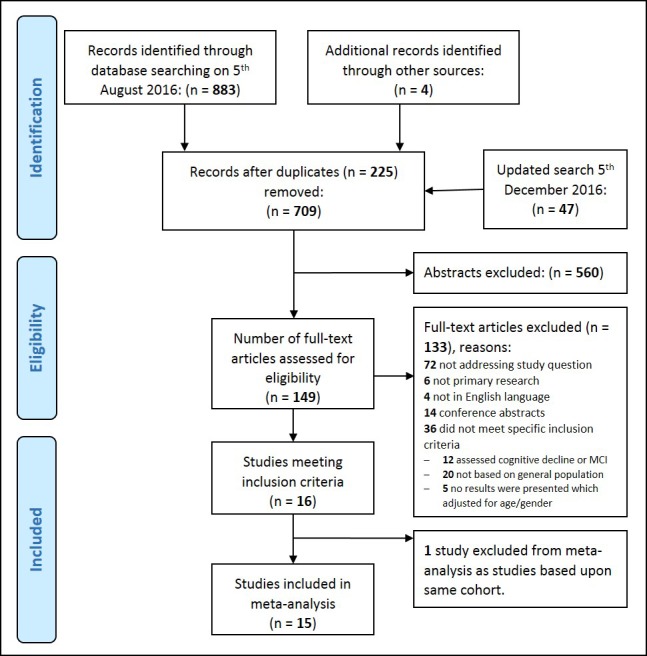
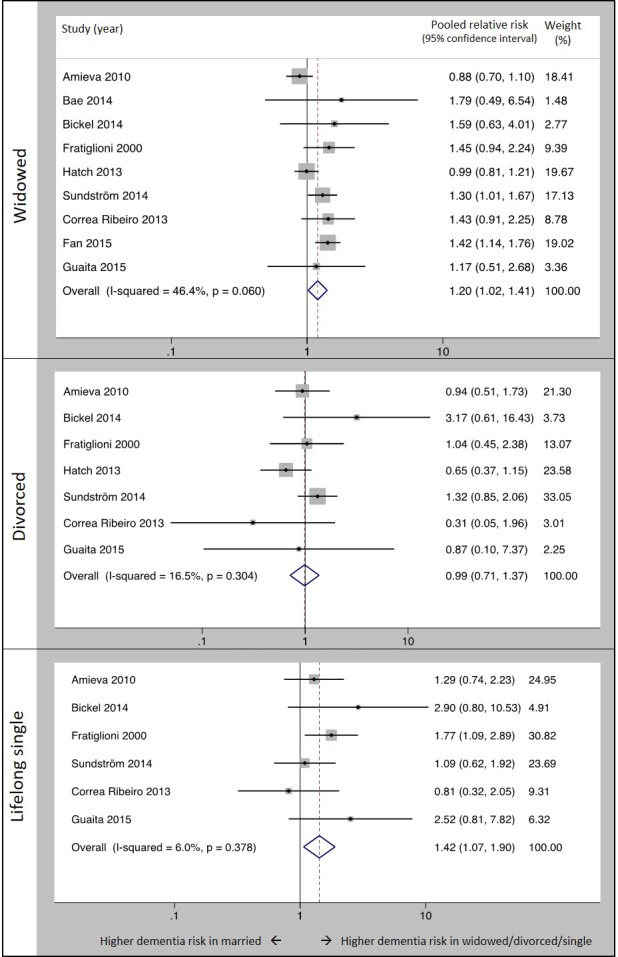
Background: Being married is associated with healthier lifestyle behaviours and lower mortality and may reduce risk for dementia due to life-course factors. We conducted a systematic review and meta-analysis of studies of the association between marital status and the risk of developing dementia. Methods: We searched medical databases and contacted experts in the field for relevant studies reporting the relationship, adjusted for age and sex, between marital status and dementia. We rated methodological quality and conducted random-effects meta-analyses to summarise relative risks of being widowed, divorced or lifelong single, compared with being married. Secondary stratified analyses with meta-regression examined the impact of clinical and social context and study methodology on findings. Results: We included 15 studies with 812 047 participants. Compared with those who are married, lifelong single (relative risk=1.42 (95% CI 1.07 to 1.90)) and widowed (1.20 (1.02 to 1.41)) people have elevated risk of dementia. We did not find an association in divorced people. Further analyses showed that less education partially confounds the risk in widowhood and worse physical health the elevated risk in lifelong single people. Compared with studies that used clinical registers for ascertaining dementia diagnoses, those which clinically examined all participants found higher risk for being unmarried. Conclusions: Being married is associated with reduced risk of dementia than widowed and lifelong single people, who are also underdiagnosed in routine clinical practice. Dementia prevention in unmarried people should focus on education and physical health and should consider the possible effect of social engagement as a modifiable risk factor.
Overview
The claims and statistics of this paper haven’t been checked yet.
Free: it reads the open-access text and checks the first 5 claims that cite a source we can check. Create a free account to check every claim.
Integrity signals
Registry
Cites
Statistics
Figures
Verification
Claims the paper makes
The claims and statistics of this paper haven’t been checked yet.
Free: it reads the open-access text and checks the first 5 claims that cite a source we can check. Create a free account to check every claim.
Claims other papers make about this one
Each is checked against this paper’s own text: does it say what the citing paper says it does?
The source backs part of the claim, not all of it — or backs it for a different population, condition or comparison.
In the citing paper
“A systematic review and meta-analysis including 812 047 people worldwide found dementia risk to be elevated in lifelong single (RR 1·4, 95% CI 1·1–1·9) and widowed people (1·2, 1·0–1·4), compared with married people and the association was consistent in different sociocultural settings.”
From Dementia prevention, intervention, and care: 2020 report of the Lancet Commission (2020) · cites this paper as [120]
Experimental — accuracy not yet measuredThe source backs part of the claim, not all of it — or backs it for a different population, condition or comparison.
In the citing paper
“Despite clear cultural variation in the meaning and perception of social isolation, findings of protective effect of more social contact are largely consistent in different settings and for either sex across the studies and meta-analyses.”
From Dementia prevention, intervention, and care: 2020 report of the Lancet Commission (2020) · cites this paper as [120]
Experimental — accuracy not yet measuredThe cited source says what the claim attributes to it.
In the citing paper
“Differences persisted in studies that adjusted for education and physical health so might be attributable to married people having more social contact, rather than solely because they tend to have better physical health and more education, although residual confounding is possible.”
From Dementia prevention, intervention, and care: 2020 report of the Lancet Commission (2020) · cites this paper as [120]
Self-check
Percentages, sums and reported differences re-computed from the paper’s own numbers.
The self-check needs the paper’s full text.
Citations
Cites
Meta-analysis in clinical trials
DerSimonian, R., & Laird, N. (1986) · Controlled Clinical Trials · doi:10.1016/0197-2456(86)90046-2 · Cited by 39,552 · cited 1×
“23 All included studies provided an estimate of relative risk and CI that we used for the analysis.”
MethodDermyshi, E., Wang, Y., Yan, C., Hong, W., Qiu, G., Gong, X., & Zhang, T. (2017) · Neonatology · doi:10.1159/000454668 · Cited by 24,451
Meta-analysis of Observational Studies in Epidemiology<SUBTITLE>A Proposal for Reporting</SUBTITLE>
Stroup, D. F. (2000) · JAMA · doi:10.1001/jama.283.15.2008 · Cited by 20,623
(2014) · Medical Entomology and Zoology · Cited by 17,633
The social readjustment rating scale
Holmes, T. H., & Rahe, R. H. (1967) · Journal of Psychosomatic Research · doi:10.1016/0022-3999(67)90010-4 · Cited by 11,067
Cognitive reserve in ageing and Alzheimer's disease
Stern, Y. (2012) · The Lancet Neurology · doi:10.1016/s1474-4422(12)70191-6 · Cited by 3,557
How should meta‐regression analyses be undertaken and interpreted?
Thompson, S. G., & Higgins, J. P. T. (2002) · Statistics in Medicine · doi:10.1002/sim.1187 · Cited by 3,026 · cited 1×
“We conducted stratified analyses and used meta-regression 24 to quantify the effect of various study design factors on the association between marital status and all-cause mortality: (1) dementia case ascertainment method: clinical assessment of study participants versus clinical register data; (2)…”
MethodPotential for primary prevention of Alzheimer's disease: an analysis of population-based data
Norton, S., Matthews, F. E., Barnes, D. E., Yaffe, K., & Brayne, C. (2014) · The Lancet Neurology · doi:10.1016/s1474-4422(14)70136-x · Cited by 2,466 · cited 1×
“44 Our findings support the need for further work to develop preventative approaches in these lifestyle domains and indicate this may be particularly important for the high-risk groups of widowed and lifelong single people.”
Background(2015) · HAL · Cited by 2,238
Investigating and dealing with publication and other biases in meta-analysis
Sterne, J. A. C., Egger, M., & Smith, G. D. (2001) · BMJ · doi:10.1136/bmj.323.7304.101 · Cited by 2,225
Research works printed but not linked: 1
- Institute TJB. Joanna briggs institute reviewers' manual: 2016 edition. Australia: The Joanna Briggs Institute, 2016.
Cited by
Items 101–200 of 252
Dementia Is Associated With Earlier Mortality for Men and Women in the United States
White, L. L. Y., Fishman, P. A., Basu, A., Crane, P. K., Larson, E. B., & Coe, N. B. (2020) · Gerontology and Geriatric Medicine · doi:10.1177/2333721420945922 · Cited by 7
“Most prior studies of sociodemographic factors and dementia have focused on how these factors influence a person’s lifetime risk of developing dementia, with findings indicating a higher lifetime risk for women, people with lower levels of educational attainment, and people who are widowed or have never married compar…”
BackgroundSimilarities in cognitive abilities in older couples: a study of mutual influences
Caillot-Ranjeva, S., Amieva, H., Meillon, C., Helmer, C., Berr, C., & Bergua, V. (2021) · Journal of Clinical and Experimental Neuropsychology · doi:10.1080/13803395.2021.1874882 · Cited by 7
Marital Loss and Cognitive Function: Does Timing Matter?
Zhang, Z., Liu, H., & Zhang, Y. (2022) · The Journals of Gerontology Series B · doi:10.1093/geronb/gbac069 · Cited by 8
Association between zinc deficiency and cognitive decline in community-dwelling older adults
Marchetti, M. F., da Silva, G. M., Freiria, C. N., Borim, F. S. A., de Brito, T. R. P., Milanski, M., & Corona, L. P. (2022) · Ciência & Saúde Coletiva · doi:10.1590/1413-81232022277.19932021en · Cited by 7
Palpatzis, E., Akinci, M., García-Prat, M., Blennow, K., Zetterberg, H., Quijano‐Rubio, C., Kollmorgen, G., Wild, N., Gispert, J. D., Suárez‐Calvet, M., et al. (2025) · Neurology · doi:10.1212/wnl.0000000000213377 · Cited by 12
Jancev, M., Eliasson, B., Gerstein, H. C., Eeg‐Olofsson, K., Cukierman‐Yaffe, T., Biessels, G. J., DeVries, J. H., Visseren, F. L. J., Sattar, N. A., & van Sloten, T. T. (2025) · Diabetes Care · doi:10.2337/dc25-0773 · Cited by 7
Nakahori, N., Sekine, M., Yamada, M., Tatsuse, T., Kido, H., & Suzuki, M. (2021) · Psychogeriatrics · doi:10.1111/psyg.12724 · Cited by 6
Wang, X., Li, S., Zhang, Z., Cui, Z., & Wang, Z. (2024) · BMC Geriatrics · doi:10.1186/s12877-024-05358-7 · Cited by 7
“The findings of our multiple linear regression analysis indicated that widowhood was negatively associated with the cognitive function of older adults, which is consistent with the results of prior studies [26, 28].”
BackgroundResultSiette, J., Hope, E., Karamacoska, D., Jacobs, R., & Catanzaro, M. (2024) · Scientific Reports · doi:10.1038/s41598-024-73754-5 · Cited by 10
Number of children and risk of dementia: a cohort study
Wolfová, K., Hubbard, R. A., Kearns, P. B., Chang, V. W., Crane, P. K., LaCroix, A. Z., Larson, E. B., & Tom, S. E. (2024) · Journal of Epidemiology & Community Health · doi:10.1136/jech-2024-222717 · Cited by 9
Arayıcı, M. E., & Köse, A. (2025) · Journal of Epidemiology and Global Health · doi:10.1007/s44197-025-00435-5 · Cited by 7
“Indeed, meta-analytic evidence shows that lifelong single and wid-owed individuals have significantly higher AD risk than married peers [21].”
Matsuo, L. H., Confortin, S. C., Ceolin, G., Soar, C., Xavier, A. J., d’Orsi, E., & Moreira, J. D. (2021) · Public Health Nutrition · doi:10.1017/s1368980021004407 · Cited by 9
“It is suggested that beingmarried is associated with a reduced risk of dementia than lifelong single and widowed(57).”
BackgroundHsieh, S., Kim, S.-Y., Shim, Y., Huang, L., & Yang, Y. (2020) · Medicine · doi:10.1097/md.0000000000019690 · Cited by 7
“dementia by Livingston et al([18]); therefore, social isolation due to unmarried status might contribute to the development of dementia.([37]) Sjöberg et al([38]) concluded marital status and living situation both had the potential to buffer the detrimental effects of low mood on dementia onset.”
BackgroundRisk Factors of Dementia in Elderly of Bandung City, Indonesia: A Community-Dwelling Study
Janaris, S. F., Gondodiputro, S., & Arisanti, N. (2020) · Althea Medical Journal · doi:10.15850/amj.v7n4.2150 · Cited by 9
Life Course Associations of Sibling Relationships and Cognitive Functioning in Late Adulthood
Kong, J., Moorman, S. M., Lee, G., & Engelman, M. (2024) · The Journals of Gerontology Series B · doi:10.1093/geronb/gbae191 · Cited by 9
Potentially modifiable risk factors for dementia in Norway (HUNT4 70+): a retrospective cohort study
Ellingjord‐Dale, M., Strand, B. H., Skirbekk, V., Bratsberg, B., Sharma, A. M., Zotcheva, E., Selbæk, G., Stern, Y., Haberg, A. K., & Engdahl, B. (2025) · The Lancet Healthy Longevity · doi:10.1016/j.lanhl.2025.100802 · Cited by 9
Lee, Y., & Jiang, Y. (2023) · Aging & Mental Health · doi:10.1080/13607863.2023.2205350 · Cited by 7
“…the most relevant longitudinal studies, some found a significant relationship between widowhood and cognitive decline or risk of dementia (Biddle et al., 2020; Shin et al., 2018; Singham et al., 2021; Sommerlad et al., 2018), whereas others did not (Comijs et al., 2011; Vidarsdottir et al., 2014).”
Managing dementia care during COVID-19 pandemic: caregivers’ experiences in Odisha, India
Mahapatra, P., Sahoo, K. C., Desaraju, S., Nath, B., & Pati, S. (2023) · Primary Health Care Research & Development · doi:10.1017/s1463423622000664 · Cited by 6
Chen, S., Zhang, Y., Wang, Y., Lawrence, W. R., Rhee, J., Guo, T., Chen, S., Wu, W., Wu, W., Li, Z., et al. (2023) · Chemosphere · doi:10.1016/j.chemosphere.2023.140397 · Cited by 5
“For instance, a meta-analysis reported lifelong single people had a higher vulnerability to dementia compared to those who were married (Sommerlad et al., 2018).”
Wang, R., & Yu, Q. (2024) · Journal of Global Health · doi:10.7189/jogh.14.04088 · Cited by 8
“A recent meta-analysis showed that elderly individuals who are lifelong singles or widowed have a 1.42-fold and 1.20-fold increased risk of dementia diagnosis, respectively, compared to their married counterparts [44].”
BackgroundInfluentialMarital status, brain health, and cognitive reserve among diverse older adults
Lee, J. H., Scambray, K. A., Morris, E. P., Sol, K., Palms, J. D., Zaheed, A. B., Martinez, M. N., Schupf, N., Manly, J. J., Brickman, A. M., et al. (2024) · Journal of the International Neuropsychological Society · doi:10.1017/s1355617724000638 · Cited by 8
The Impact of Self-Reported Hearing Difficulties on Memory Collaboration in Older Adults
Barnier, A. J., Harris, C. B., Morris, T., Strutt, P. A., & Savage, G. R. (2019) · Frontiers in Neuroscience · doi:10.3389/fnins.2019.00870 · Cited by 5
“…may help to explain significant, but still unexplained, links between hearing loss and increased dementia risk (e.g., Livingston et al., 2017) as well as the more recent and provocative links between marriage and reduced dementia risk (e.g., Sundström et al., 2016; Sommerlad et al., 2017).”
BackgroundFamily-work history and inequalities in old-age cognition in China
Wu, J., & Marois, G. (2025) · Social Science & Medicine · doi:10.1016/j.socscimed.2025.118318 · Cited by 6
Estimating the impact of risk factor reduction on dementia prevalence in New Zealand
Ma’u, E., Mukadam, N., Livingston, G., Walsh, S., Röhr, S., Brayne, C., Cheung, G., & Cullum, S. J. (2025) · Alzheimer s & Dementia · doi:10.1002/alz.70440 · Cited by 5
Self-citationMiyazaki, R., Abe, T., Yano, S., Okuyama, K., Sakane, N., Ando, H., Isomura, M., Yamasaki, M., & Nabika, T. (2022) · Journal of General and Family Medicine · doi:10.1002/jgf2.544 · Cited by 6
Ogawa, N., Fukai, T., Mansor, N. B., & Kamarulzaman, N. D. (2022) · Asian Development Review · doi:10.1142/s0116110522500068 · Cited by 5
Cardiovascular risk factors among older persons with cognitive frailty in middle income country
Ibrahim, A., Singh, D. K. A., Ludin, A. F. M., Sakian, N. I. M., Rivan, N. F. M., & Shahar, S. (2024) · World Journal of Clinical Cases · doi:10.12998/wjcc.v12.i17.3076 · Cited by 4
“On the other hand, married status might involve a caretaker role for spouse which may also increase stress; therefore, it is a complex relationship[47].”
Aspects of Quality of Life: Single vs. Mated People
Apostolou, M., Tekeş, B., Kagialis, A., & Lajunen, T. J. (2024) · Behavioral Sciences · doi:10.3390/bs14100954 · Cited by 5
“Another meta-analysis including 15 studies and over 800,000 participants found that being married was associated with a reduced risk of dementia compared to being widowed or lifelong single [28].”
BackgroundSocial health and prevention of dementia: Integration of human and mice studies
Vernooij-Dassen, M. J. F. J., van der Velpen, I. F., Lanooij, S. D., van der Zee, E. A., Ikram, M. A., Drinkenburg, W. H. I. M., Costanzo, A., Vernooij, M. W., Eisel, U. L. M., Melis, R. J. F., et al. (2025) · International Psychogeriatrics · doi:10.1016/j.inpsyc.2025.100054 · Cited by 4
Shimaoka, A. M., Lopes, L. R., da Silva, A. C., & Bandiera‐Paiva, P. (2025) · International Journal of Health Management Review · doi:10.47172/ijhmreview.v11i1.407 · Cited by 4
Bi, S., Guo, D., Tan, H., Chen, Y., & Li, G. (2025) · Risk Management and Healthcare Policy · doi:10.2147/rmhp.s519049 · Cited by 5
Bautista, Y. J. P., Messeha, S. S., Theran, C., Aló, R., Yedjou, C. G., Adankai, V., Babatunde, S., & (TADPOLE), O. B. O. T. A. D. P. O. L. E. (2023) · Applied Sciences · doi:10.3390/app13031656 · Cited by 3
Muhammad, T., Mu, C., Srivastava, S., Joseph, V. J. K., Drishti, D., Ali, W., & Zanwar, P. (2025) · Social Psychiatry and Psychiatric Epidemiology · doi:10.1007/s00127-025-02950-z · Cited by 7
“However, such relationships in findings from Western studies differ due to different sociocultural contexts, in which roles and responsibilities do not have a positive impact on older women [73, 86, 87].”
Usability of Over-the-Counter Hearing Aids in Older Adults
Coco, L., Weeks, T., Mouzin, C., Rodriguez, C., Marvizon, E., Wynsma, R., & Stickel, A. M. (2025) · American Journal of Audiology · doi:10.1044/2025_aja-25-00013 · Cited by 4
Cognitive Functioning in Rural Older Adults: The Mediating Role of Perceived Social Support
Krnjajić, M., Mudri, Ž., Barišić, M., Barać, I., Vujanić, J., Čebohin, M., Lovrić, R., Poljak, K., & Farčić, N. (2026) · Healthcare · doi:10.3390/healthcare14020152 · Cited by 3
“Married older adults perceive higher levels of social support and achieve better cognitive outcomes, consistent with Sommerlad et al. [52], who report that being married is associated with healthier lifestyle behaviors and lower mortality, and may reduce the risk of dementia due to life-course…”
Marital History and Cognition in a Chinese Longevity Cohort
Huang, X., & Hilal, S. (2024) · Journal of Alzheimer s Disease · doi:10.3233/jad-240176 · Cited by 5
Marital dissolution and cognition: The mediating effect of Aβ neuropathology
Chandra, A., Anjum, R., Waters, S., Proitsi, P., Smith, L., Marshall, C. R., & Initiative, A. D. N. (2024) · Alzheimer s & Dementia Diagnosis Assessment & Disease Monitoring · doi:10.1002/dad2.70032 · Cited by 6
Asbroeck, S. V., Huque, M. H., Kootar, S., Peters, R., Cherbuin, N., Mortby, M. E., Köhler, S., van Boxtel, M. P. J., Deckers, K., & Anstey, K. J. (2025) · The Journal of Prevention of Alzheimer s Disease · doi:10.1016/j.tjpad.2024.100014 · Cited by 3
Alexander, D. R. (2020) · Perspectives on Science and Christian Faith · doi:10.1017/9781108566520 · Cited by 3
Rapp, I., & Klein, T. (2022) · Springer eBooks · doi:10.1007/978-3-658-35215-8_32-1 · Cited by 4
Bernard, C., Font, H., Diallo, Z., Ahonon, R., Tine, J. M., Abouo, F., Tanon, A., Messou, E., Seydi, M., Dabis, F., et al. (2022) · Tropical Medicine & International Health · doi:10.1111/tmi.13830 · Cited by 2
“Widowhood is also a stressful life event that could impact cognitive functioning and is associated with a higher risk of dementia [55].”
BackgroundCognitive impairments in cardiological patients: diagnosis and prevention
Shavarova, E. K., Анатольевич, Ш. А., Akhmetov, R., & Kobalava, Z. D. (2022) · Russian Journal of Cardiology and Cardiovascular Surgery · doi:10.17116/kardio202215061560 · Cited by 6
Mima, D., Wang, L.-P., Zhai, Y., De, Q., Ba, S., Da, G., Wang, B., Zhao, J., & Tang, Y. (2023) · Journal of Affective Disorders · doi:10.1016/j.jad.2023.04.075 · Cited by 9
Prävention demenzieller Erkrankungen
Schippinger, W., & Pichler, G. (2023) · Zeitschrift für Gerontologie und Geriatrie · doi:10.1007/s00391-023-02175-2 · Cited by 5
Unraveling the Impact of Widowhood Duration on Depression: Does Time Heal All Wounds?
Huang, X., Tey, N. P., & Lai, S. L. (2024) · Asia Pacific Journal of Public Health · doi:10.1177/10105395241244960 · Cited by 3
Life Events and Incident Dementia: A Prospective Study of 493,787 Individuals Over 16 Years
Karaköse, S., Luchetti, M., Stéphan, Y., Sutin, A. R., & Terracciano, A. (2024) · The Journals of Gerontology Series B · doi:10.1093/geronb/gbae114 · Cited by 6
Huang, X., Tian, L., Li, C., Liu, J., Shi, R., Lin, F., & Luo, Y. (2024) · Translational Cancer Research · doi:10.21037/tcr-24-1215 · Cited by 3
“Additionally, marriage is also related to a significantly reduced risk of dementia (20).”
Ramos‐Henderson, M., Soto‐Añari, M., Herrera‐Pino, J., Porto, M. F., Camargo, L., Hesse, H., †, R. F., Quispe-Ayala, C., de la Cadena, C. G., Mendoza-Ruvalcaba, N. M., et al. (2023) · Alzheimer s & Dementia Diagnosis Assessment & Disease Monitoring · doi:10.1002/dad2.12427 · Cited by 4
Li, J., Xu, H., Lu, Z., Ren, X., Yan, W., Yan, P., Yao, L., & Yang, K. (2022) · Campbell Systematic Reviews · doi:10.1002/cl2.1252 · Cited by 2
“…cohort ageing study (LUCAS); The Korean Frailty and Aging Cohort Study (KFACS) and et al. 3.2.2.1 | Other reviews We will also search the reference lists of previous systematic reviews for additional studies (Dinour et al., 2012; Manzoli et al., 2007; Sommerlad et al., 2018; Walker & Luszcz, 2009).”
MethodInfluentialRapp, I., & Klein, T. (2023) · Springer eBooks · doi:10.1007/978-3-658-35219-6_32 · Cited by 3
Park, K., & Kim, J. (2025) · The Journals of Gerontology Series B · doi:10.1093/geronb/gbaf152 · Cited by 2
Zhu, Y., Singh, R. K., Bekena, S., Brown, D. C., Chen, C., Blake, M., Trani, J., & Babulal, G. M. (2026) · Innovation in Aging · doi:10.1093/geroni/igag013 · Cited by 2
Soylu, C., & Irmak, T. Y. (2021) · European Journal of Geriatrics and Gerontology · doi:10.4274/ejgg.galenos.2021.425 · Cited by 3
“First of all, many researchers show that being married is associated with many health benefits (29,30).”
Fitriana, L. A., Pragholapati, A., Rohaedi, S., Anggadiredja, K., Setiawan, I., & Adnyana, I. K. (2021) · Journal of Engineering Research · doi:10.36909/jer.asseee.16059 · Cited by 3
“Other studies have shown that dementia is higher in unmarried people (relative risk = 1.42) and widowed (1.20) compared to married people (Sommerlad et al., 2018).”
BackgroundInfluentialYin, W., Li, X., Chen, R., Zhan, Y., Jylhävä, J., Fang, F., & Hägg, S. (2025) · Biogerontology · doi:10.1007/s10522-024-10171-1 · Cited by 3
Fottrell, E. F., Costello, H., Ahmed, N., King, C., Shaha, S. K., Nahar, T., Pires, M., Copas, A. J., Haghparast‐Bidgoli, H., Morrison, J., et al. (2025) · The Lancet Regional Health - Southeast Asia · doi:10.1016/j.lansea.2025.100575 · Cited by 4
“29 Previous studies have shown that people who are lifelong single and those who are widowed have a 42% and 20% higher risk of developing dementia respectively than those who are married, 42 and a recent meta-analysis also shows a signi fi cant association between widowhood and cognition.”
Impact of marriage on diagnosis and survival in patients with urological cancers
Wang, H., Zhao, Y. X., Feng, S., & Wei, G. (2025) · Scientific Reports · doi:10.1038/s41598-025-00479-4 · Cited by 2
Sharma, S., Hale, J. M., Myrskylä, M., & Kulu, H. (2023) · Population Studies · doi:10.1080/00324728.2023.2174267 · Cited by 2
“Unpartnered adults are more likely than part-nered adults to experience cognitive impairment (Sommerlad et al. 2018).”
BackgroundInfluentialRisk factors for vascular dementia
Ivanova, L. A. (2023) · Бюллетень Восточно-Сибирского научного центра Сибирского отделения Российской академии медицинских наук · doi:10.29413/abs.2023-8.3.13 · Cited by 4
Schultz, R. R., Fernandez, P. E. L., Novo, N. F., Juliano, Y., & Wajman, J. R. (2019) · Revista Brasileira de Geriatria e Gerontologia · doi:10.1590/1981-22562019022.180122 · Cited by 2
Determinants of Cognitive Impairment among The Elderly in Indonesia
Rismawaty, R., & Adioetomo, S. M. (2021) · Jurnal Berkala Kesehatan · doi:10.20527/jbk.v7i1.9786 · Cited by 6
Prevention of dementia by targeting risk factors – Authors' reply
Livingston, G., Sommerlad, A., Schneider, L. S. S., Mukadam, N., & Costafreda, S. G. (2018) · The Lancet · doi:10.1016/s0140-6736(18)30570-1 · Cited by 2
Self-citationRamos, H., Alacreu, M., Guerrero, M. D., Sánchez, R. M., & Moreno, L. (2020) · Preprints.org · doi:10.20944/preprints202006.0150.v1 · Cited by 1
“These results are supported by other studies that affirm that social isolation of those living alone may be at risk for decline cognitive function and marital status have the potential to buffer the effects of low mood on dementia onset [8,20,21,22].”
ResultOrder selection for heterogeneous semiparametric hidden Markov models
Zou, Y., Song, X., & Zhao, Q. (2024) · Statistics in Medicine · doi:10.1002/sim.10069 · Cited by 1
“These results contradict the existing literature.”
BackgroundResultInfluentialFairness-Aware Estimation of Graphical Models
Zhou, Z., Tarzanagh, D. A., Hou, B., Long, Q., & Shen, L. (2024) · neural information processing systems · doi:10.52202/079017-0568 · Cited by 9
Nasaruddin, N. H., Ganapathy, S. S., & Tham, S. W. (2024) · Australian Journal on Ageing · doi:10.1111/ajag.13392 · Cited by 3
“33 It is important to note that one-fifth of older people with no formal education, and one-tenth with only primary education, had dementia in our study.”
Kaur, I., Upadhyay, N. N., & Chandel, S. (2025) · Clinical Epidemiology and Global Health · doi:10.1016/j.cegh.2025.102108 · Cited by 1
Tang, X., Li, S., Liu, H., Ge, Y., Zhou, D., Sun, T., Zhang, C., Feng, S., & Zhang, H. (2025) · Comprehensive Psychoneuroendocrinology · doi:10.1016/j.cpnec.2025.100323 · Cited by 1
“Regarding marital status, being married serves as a protective factor for cognitive function, likely due to spousal emotional support, reduced risk of depression and anxiety, guidance toward healthier lifestyles, and access to stable financial resources [25].”
Climate change, marriage and health
Chuang, J.-Y., & Capellan, J. A. (2025) · Frontiers in Climate · doi:10.3389/fclim.2025.1665070 · Cited by 1
Mair, C. A., & Ornstein, K. A. (2025) · Social Science & Medicine · doi:10.1016/j.socscimed.2025.118861 · Cited by 4
Accelerated brain aging in prolonged grief disorder of later life: Influence of comorbid depression
Hwang, G., Blair, N.-O. P., Claesges, S. A., Reynolds, C. F., Davatzikos, C. A., & Goveas, J. S. (2026) · Journal of Affective Disorders · doi:10.1016/j.jad.2026.121387 · Cited by 1
Genetic Information and How It Flows
Alexander, D. R. (2020) · Cambridge University Press eBooks · doi:10.1017/9781108566520.003 · Cited by 1
Investigation of dementia awareness among stroke patients in China: A cross-sectional study
Zhou, J. W., Wang, Y., Zhao, J., Chen, B., Liu, X., Fu, C., Hou, X., Niu, H., Zhang, Y., & Jin, X. (2021) · Journal of Traditional Chinese Medical Sciences · doi:10.1016/j.jtcms.2021.06.002 · Cited by 1
People living with dementia using eldercare in Sweden
Rahman, A. (2023) · Linköping studies in arts and science · doi:10.3384/9789180751872 · Cited by 3
The Predictors of Negative and Positive Affect among People with Dementia: A Cross-Sectional Study
Rababa, M., Aldrawsheh, A., Hayajneh, A. A., Eyadat, A. M., & Tawalbeh, R. (2023) · Medicina · doi:10.3390/medicina59101724 · Cited by 2
“Moreover, widowed or divorced PWDs had significantly higher mean negative affect scores than married or single PWDs [7,34–36].”
BackgroundCecchini, V., & Agahi, N. (2024) · Aging & Mental Health · doi:10.1080/13607863.2024.2341877 · Cited by 2
“However, research indicates that spousal loss worsens cognitive function in the older population (Shin et al., 2018; Sommerlad et al., 2018).”
Galvin, A., Pedersen, J. K., Arbeev, K. G., Feitosa, M. F., Ukraintseva, S. V., Yao, S., Newman, A. B., & Christensen, K. (2024) · Journal of Alzheimer s Disease · doi:10.3233/jad-231204 · Cited by 1
Hou, T., Liu, M., Wu, B., Ho, M., & Lin, C. (2025) · American Journal of Geriatric Psychiatry · doi:10.1016/j.jagp.2025.03.014 · Cited by 1
Tkacheva, O. N., Рунихина, Н. К., Mkhitaryan, E. A., Шарашкина, Н. В., Vorobyeva, N. M., Koberskaya, N. N., & Yakhno, N. N. (2022) · Advances in Gerontology · doi:10.1134/s2079057022010155 · Cited by 1
“Vertebral arteries are involved in the brain posterior circulation, insufficiency of which can cause CI extending into occipital lobe, hippocampus, and corpus callosum [9, 19, 26].”
BackgroundTitarenko, A. V., Shishkin, S. V., Щербакова, Л. В., Verevkin, E. G., Hubacek, J. A., Bobák, M., & Malyutina, S. K. (2022) · Meditsinskiy sovet = Medical Council · doi:10.21518/2079-701x-2022-16-11-27-35 · Cited by 1
Cognitive Impairment and Dementia Data Modelling
Petrova‐Antonova, D., Kunchev, T., Manova, I., & Spasov, I. (2022) · Lecture notes in computer science · doi:10.1007/978-3-031-10450-3_5 · Cited by 1
Asociaciones entre dieta y función cognitiva en el Proyecto SUN
Muñoz, M. I. (2022) · Depósito Académico Digital Universidad de Navarra (University of Navarra) · doi:10.15581/10171/63292 · Cited by 1
Marital dissolution and cognition: The mediating effect of β-amyloid neuropathologyPreprint
Chandra, A., Anjum, R., Waters, S., Proitsi, P., Smith, L. J., Marshall, C. R., & Initiative, T. A. D. N. (2024) · medRxiv · doi:10.1101/2024.05.15.24307413 · Cited by 1
Gay Genes? Genetics and Sexual Orientation
Alexander, D. R. (2020) · Cambridge University Press eBooks · doi:10.1017/9781108566520.011
Public Health Approaches to Alzheimer’s Disease
Blank, R. H. (2018) · Springer eBooks · doi:10.1007/978-981-13-0656-3_5
Goldfisch oder Gassi gehen? Soziale Aktivität und Einsamkeit
Folkerts, A., & Linden, P. (2020) · Springer eBooks · doi:10.1007/978-3-662-60606-3_16
Definitions of Technical Terms
Alexander, D. R. (2020) · Cambridge University Press eBooks · doi:10.1017/9781108566520.015
Alexander, D. R. (2020) · Cambridge University Press eBooks · doi:10.1017/9781108566520.005
Genes and Environments in Human Development
Alexander, D. R. (2020) · Cambridge University Press eBooks · doi:10.1017/9781108566520.004
Genes, Personality and Personality Disorders
Alexander, D. R. (2020) · Cambridge University Press eBooks · doi:10.1017/9781108566520.008
Alexander, D. R. (2020) · Cambridge University Press eBooks · doi:10.1017/9781108566520.006
Alexander, D. R. (2020) · Cambridge University Press eBooks · doi:10.1017/9781108566520.013
Risk factors for dementia. Lifestyle, hormones, neurochemistry, and genetics
Najar, J. (2021) · Gothenburg University Publications Electronic Archive (Gothenburg University)
Entstehung und Prävention altersassoziierter neurodegenerativer Erkrankungen
Calabrese, P. (2022) · Springer eBooks · doi:10.1007/978-3-662-61417-4_16 · Cited by 1
Ertle, E., Simon, D. M., & Mast, B. T. (2021) · Elsevier eBooks · doi:10.1016/b978-0-12-818697-8.00108-4
Genes, Religiosity and Political Commitment
Alexander, D. R. (2020) · Cambridge University Press eBooks · doi:10.1017/9781108566520.010 · Cited by 1
Genes, Education and Intelligence
Alexander, D. R. (2020) · Cambridge University Press eBooks · doi:10.1017/9781108566520.007
Alexander, D. R. (2020) · Cambridge University Press eBooks · doi:10.1017/9781108566520.012
Genes, Food, Exercise and Weight
Alexander, D. R. (2020) · Cambridge University Press eBooks · doi:10.1017/9781108566520.009
Metadata
- Authors
- Sommerlad, A., Ruegger, J., Singh-Manoux, A., Lewis, G., & Livingston, G.
- Affiliations
- University College London (GB)
- Camden and Islington NHS Foundation Trust (GB)
- Corresponding author
- Sommerlad, Andrew
- Venue
- Journal of Neurology, Neurosurgery & Psychiatry
- Publisher
- BMJ
- Published
- 2017-11-28
- Volume
- 89
- Issue
- 3
- Pages
- 231-238
- ISSN
- 0022-3050 (ISSN-L)
- 1468-330X
- PMC
- PMC5869449
- OpenAlex
- W2770396411
- Cited by
- 252
- References
- 44
- Citations by year
- 2026: 24 · 2025: 36 · 2024: 34 · 2023: 27 · 2022: 33 · 2021: 33 · 2020: 44 · 2019: 11 · 2018: 9 · 2017: 1
- FWCI
- 2.70
- Type
- journal article
- Language
- en
- Open access
- hybrid
- doi.org
- Licence
- cc-by
- Locations
- Journal of Neurology Neurosurgery & Psychiatry (publishedVersion, cc-by)
- PubMed Central (publishedVersion, cc-by)
- PubMed (publishedVersion)
- UCL Discovery (University College London) (submittedVersion, cc-by)
- HighWire Press Open Archive (submittedVersion)
- Funders
- Wellcome Trust
- Topics
- Health Sciences › Medicine › Psychiatry and Mental health › Dementia and Cognitive Impairment Research
- Social Sciences › Health › Health disparities and outcomes
- Social Sciences › Demography › Family Dynamics and Relationships
- Keywords
- dementia risk, marital status, widowhood, divorce, social engagement, physical health, underdiagnosis of dementia, dementia prevention, social determinants of health
- MeSH terms
- Dementia, Divorce, Educational Status, Humans, Marriage, Risk Factors, Single Person, Confounding Factors, Epidemiologic, Marital Status, Widowhood, Observational Studies as Topic, Protective Factors
About these checks
Registry, retraction, Cites and statistics results are computed, not judged, with one exception: a printed reference that no index lists is read once by a model before it counts as a citation error. Claims are extracted by a model and kept only when their quote appears verbatim in the text; each cited source is then checked, with a model’s help, for whether it says what the claim relies on. Those verdicts can be wrong — read the claim’s quote and the cited source before relying on one.
Statistics and arithmetic are recomputed, not judged.
Confidence bands are shown only for fields calibrated on our annotated test set. None is calibrated yet, so no band is shown.
What counts as a claim ›How we measure confidence ›How we check this ›
Are you an author, or do you see a problem with this page? Request a review
Data sources
Bibliographic data: Semantic Scholar, OpenAlex, Crossref.
Contains information from the Semantic Scholar Academic Graph Datasets, made available under the ODC Attribution License (ODC-BY 1.0).
Semantic Scholar’s data is described in: Kinney, R., et al. (2023). The Semantic Scholar Open Data Platform. arXiv:2301.10140.
