

Marriage and risk of dementia: systematic review and meta-analysis of observational studies
Open accessThe DOI matches its Crossref record; 44 of the 44 references it cites were found in a registry or an index.
Abstract
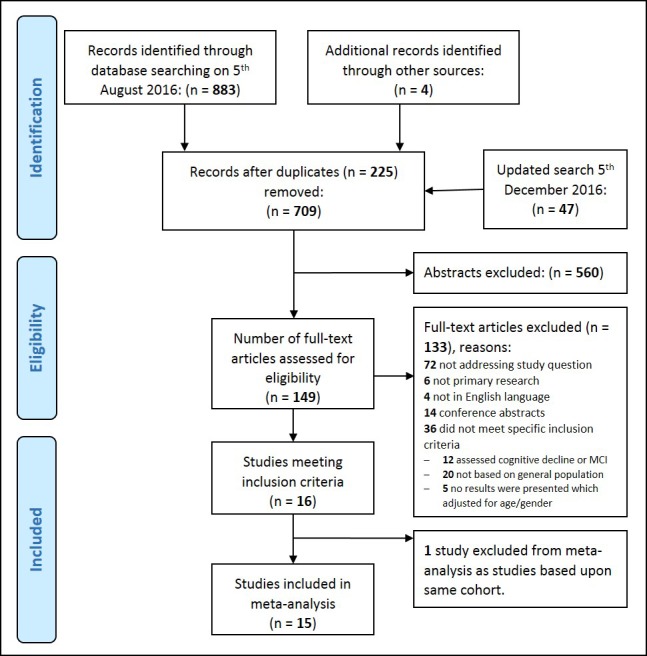
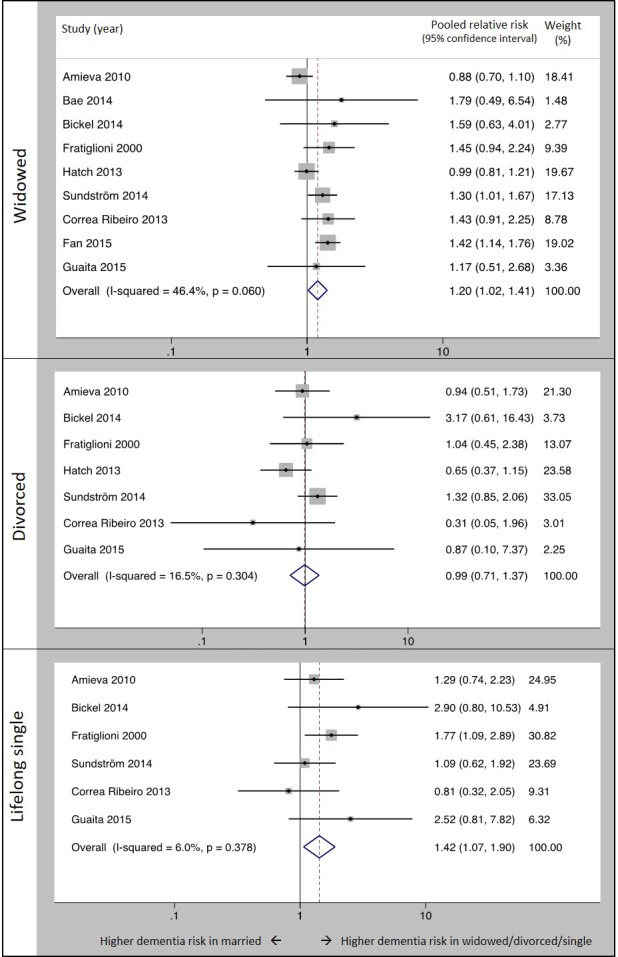
Background: Being married is associated with healthier lifestyle behaviours and lower mortality and may reduce risk for dementia due to life-course factors. We conducted a systematic review and meta-analysis of studies of the association between marital status and the risk of developing dementia. Methods: We searched medical databases and contacted experts in the field for relevant studies reporting the relationship, adjusted for age and sex, between marital status and dementia. We rated methodological quality and conducted random-effects meta-analyses to summarise relative risks of being widowed, divorced or lifelong single, compared with being married. Secondary stratified analyses with meta-regression examined the impact of clinical and social context and study methodology on findings. Results: We included 15 studies with 812 047 participants. Compared with those who are married, lifelong single (relative risk=1.42 (95% CI 1.07 to 1.90)) and widowed (1.20 (1.02 to 1.41)) people have elevated risk of dementia. We did not find an association in divorced people. Further analyses showed that less education partially confounds the risk in widowhood and worse physical health the elevated risk in lifelong single people. Compared with studies that used clinical registers for ascertaining dementia diagnoses, those which clinically examined all participants found higher risk for being unmarried. Conclusions: Being married is associated with reduced risk of dementia than widowed and lifelong single people, who are also underdiagnosed in routine clinical practice. Dementia prevention in unmarried people should focus on education and physical health and should consider the possible effect of social engagement as a modifiable risk factor.
Overview
The claims and statistics of this paper haven’t been checked yet.
Free: it reads the open-access text and checks the first 5 claims that cite a source we can check. Create a free account to check every claim.
Integrity signals
Registry
Cites
Statistics
Figures
Verification
Claims the paper makes
The claims and statistics of this paper haven’t been checked yet.
Free: it reads the open-access text and checks the first 5 claims that cite a source we can check. Create a free account to check every claim.
Claims other papers make about this one
Each is checked against this paper’s own text: does it say what the citing paper says it does?
The source backs part of the claim, not all of it — or backs it for a different population, condition or comparison.
In the citing paper
“A systematic review and meta-analysis including 812 047 people worldwide found dementia risk to be elevated in lifelong single (RR 1·4, 95% CI 1·1–1·9) and widowed people (1·2, 1·0–1·4), compared with married people and the association was consistent in different sociocultural settings.”
From Dementia prevention, intervention, and care: 2020 report of the Lancet Commission (2020) · cites this paper as [120]
Experimental — accuracy not yet measuredThe source backs part of the claim, not all of it — or backs it for a different population, condition or comparison.
In the citing paper
“Despite clear cultural variation in the meaning and perception of social isolation, findings of protective effect of more social contact are largely consistent in different settings and for either sex across the studies and meta-analyses.”
From Dementia prevention, intervention, and care: 2020 report of the Lancet Commission (2020) · cites this paper as [120]
Experimental — accuracy not yet measuredThe cited source says what the claim attributes to it.
In the citing paper
“Differences persisted in studies that adjusted for education and physical health so might be attributable to married people having more social contact, rather than solely because they tend to have better physical health and more education, although residual confounding is possible.”
From Dementia prevention, intervention, and care: 2020 report of the Lancet Commission (2020) · cites this paper as [120]
Self-check
Percentages, sums and reported differences re-computed from the paper’s own numbers.
The self-check needs the paper’s full text.
Citations
Cites
Meta-analysis in clinical trials
DerSimonian, R., & Laird, N. (1986) · Controlled Clinical Trials · doi:10.1016/0197-2456(86)90046-2 · Cited by 39,552 · cited 1×
“23 All included studies provided an estimate of relative risk and CI that we used for the analysis.”
MethodDermyshi, E., Wang, Y., Yan, C., Hong, W., Qiu, G., Gong, X., & Zhang, T. (2017) · Neonatology · doi:10.1159/000454668 · Cited by 24,451
Meta-analysis of Observational Studies in Epidemiology<SUBTITLE>A Proposal for Reporting</SUBTITLE>
Stroup, D. F. (2000) · JAMA · doi:10.1001/jama.283.15.2008 · Cited by 20,623
(2014) · Medical Entomology and Zoology · Cited by 17,633
The social readjustment rating scale
Holmes, T. H., & Rahe, R. H. (1967) · Journal of Psychosomatic Research · doi:10.1016/0022-3999(67)90010-4 · Cited by 11,067
Cognitive reserve in ageing and Alzheimer's disease
Stern, Y. (2012) · The Lancet Neurology · doi:10.1016/s1474-4422(12)70191-6 · Cited by 3,557
How should meta‐regression analyses be undertaken and interpreted?
Thompson, S. G., & Higgins, J. P. T. (2002) · Statistics in Medicine · doi:10.1002/sim.1187 · Cited by 3,026 · cited 1×
“We conducted stratified analyses and used meta-regression 24 to quantify the effect of various study design factors on the association between marital status and all-cause mortality: (1) dementia case ascertainment method: clinical assessment of study participants versus clinical register data; (2)…”
MethodPotential for primary prevention of Alzheimer's disease: an analysis of population-based data
Norton, S., Matthews, F. E., Barnes, D. E., Yaffe, K., & Brayne, C. (2014) · The Lancet Neurology · doi:10.1016/s1474-4422(14)70136-x · Cited by 2,466 · cited 1×
“44 Our findings support the need for further work to develop preventative approaches in these lifestyle domains and indicate this may be particularly important for the high-risk groups of widowed and lifelong single people.”
Background(2015) · HAL · Cited by 2,238
Investigating and dealing with publication and other biases in meta-analysis
Sterne, J. A. C., Egger, M., & Smith, G. D. (2001) · BMJ · doi:10.1136/bmj.323.7304.101 · Cited by 2,225
Influence of social network on occurrence of dementia: a community-based longitudinal study
Fratiglioni, L., Wang, H.-X., Ericsson, K., Maytan, M., & Winblad, B. (2000) · The Lancet · doi:10.1016/s0140-6736(00)02113-9 · Cited by 1,361 · cited 1×
“19 We registered the study protocol prospectively in the PROS-PERO register of systematic reviews (http://www. crd. york. ac. uk/ PROSPERO/ display_ record. asp?”
MethodMatthews, F. E., Arthur, A., Barnes, L. E., Bond, J., Jagger, C., Robinson, L., & Brayne, C. (2013) · The Lancet · doi:10.1016/s0140-6736(13)61570-6 · Cited by 1,155
Kuiper, J. S., Zuidersma, M., Oude Voshaar, R. C., Zuidema, S. U., van den Heuvel, E. R., Stolk, R. P., & Smidt, N. (2015) · Ageing Research Reviews · doi:10.1016/j.arr.2015.04.006 · Cited by 1,090 · cited 2×
“5 Marriage may result in more frequent social contact, which is associated with reduced dementia risk, 6 and reduced harmful lifestyle behaviours.”
BackgroundA Comparison of the Prevalence of Dementia in the United States in 2000 and 2012
Langa, K. M., Larson, E. B., Crimmins, E. M., Faul, J. D., Levine, D. A., Kabeto, M. U., & Weir, D. R. (2017) · JAMA Internal Medicine · doi:10.1001/jamainternmed.2016.6807 · Cited by 910
Fu, R., Gartlehner, G., Grant, M., Shamliyan, T., Sedrakyan, A., Wilt, T. J., Griffith, L., Oremus, M., Raina, P., Ismaila, A., et al. (2011) · Journal of Clinical Epidemiology · doi:10.1016/j.jclinepi.2010.08.010 · Cited by 730 · cited 1×
“The random-effects model allows for HRs and ORs to be incorporated into the same meta-analysis 22 and accounts for heterogeneity between studies.”
MethodMarital status and mortality in the elderly: A systematic review and meta-analysis
Manzoli, L., Villari, P., M Pirone, G., & Boccia, A. (2007) · Social Science & Medicine · doi:10.1016/j.socscimed.2006.08.031 · Cited by 664 · cited 2×
“The magnitude of effect of marital status on dementia is higher than the risk for mortality in unmarried compared with married people (RR=1.1), 11 supporting the idea that marriage’s effect on dementia risk is more than just improving physical health and that there may a direct cognitive benefit of…”
BackgroundInfluentialMarital status and health among the elderly
Goldman, N., Korenman, S., & Weinstein, R. (1995) · Social Science & Medicine · doi:10.1016/0277-9536(94)00281-w · Cited by 550 · cited 1×
“13 In this study, we aim to synthesise evidence from published studies examining the effect of marital status (married/cohabiting, widowed, divorced/ separated and lifelong single) on dementia incidence and the extent to which this risk is modified by sociodemographic factors, study design and…”
BackgroundThe Global Impact of Dementia 2013-2050
Prince, M. J., Guerchet, M., & Prina, M. A. (2013) · Research Portal (King's College London) · Cited by 366
Hakansson, K., Rovio, S., Helkala, E.-L., Vilska, A.-R., Winblad, B., Soininen, H., Nissinen, A., Mohammed, A. H., & Kivipelto, M. (2009) · BMJ · doi:10.1136/bmj.b2462 · Cited by 328
Sarkisian, N., & Gerstel, N. (2016) · Journal of Social and Personal Relationships · doi:10.1177/0265407515597564 · Cited by 259 · cited 1×
“…increased risk for lifelong single people in studies that adjusted for age, sex, education and physical health is likely to be due to different social engagement in married and single people, 37 which may contribute to building cognitive reserve and reducing dementia risk 6 over the lifespan.”
BackgroundLivingston, G., Leavey, G., Manela, M., Livingston, D., Rait, G., Sampson, E., Bavishi, S., Shahriyarmolki, K., & Cooper, C. (2010) · BMJ · doi:10.1136/bmj.c4184 · Cited by 239
Self-citationDo Divorcing Couples Become Happier by Breaking up?
Gardner, J., & Oswald, A. J. (2006) · Journal of the Royal Statistical Society Series A: Statistics in Society · doi:10.1111/j.1467-985x.2006.00403.x · Cited by 232 · cited 1×
“38 39 Third, developing dementia could be related to other underlying cognitive or personality traits meaning that in societies where marriage was the social norm, people with difficulties in flexibility of thought or communication and consequent smaller lifelong cognitive reserve (therefore more…”
BackgroundAmieva, H., Stoykova, R., Matharan, F., Helmer, C., Antonucci, T. C., & Dartigues, J.-F. (2010) · Psychosomatic Medicine · doi:10.1097/psy.0b013e3181f5e121 · Cited by 217
Marital status and risk of dementia: a nationwide population-based prospective study from Sweden
Sundström, A., Westerlund, O., & Kotyrlo, E. (2016) · BMJ Open · doi:10.1136/bmjopen-2015-008565 · Cited by 201
Adverse Stress, Hippocampal Networks, and Alzheimer’s Disease
Rothman, S. M., & Mattson, M. P. (2010) · NeuroMolecular Medicine · doi:10.1007/s12017-009-8107-9 · Cited by 198 · cited 2×
“7 8 Bereavement or divorce in people who had been married may promote dementia development through stress, which is pathogenic 9 and associated with increased dementia risk.”
BackgroundMarital status and risk of Alzheimer’s disease: A French population-based cohort study
Helmer, C., Damon, D., Letenneur, L., Fabrigoule, C., Barberger-Gateau, P., Lafont, S., Fuhrer, R., Antonucci, T., Commenges, D., Orgogozo, J. M., et al. (1999) · Neurology · doi:10.1212/wnl.53.9.1953 · Cited by 184
Bickel, H., & Cooper, B. (1994) · Psychological Medicine · doi:10.1017/s0033291700026945 · Cited by 172
The impact of marital status on cancer survival
Kravdal, Ø. (2001) · Social Science & Medicine · doi:10.1016/s0277-9536(00)00139-8 · Cited by 168 · cited 1×
“A meta-analysis of observational studies found lower mortality for married than unmarried people 11 ; health of unmarried Americans is worse than that of married people 8 ; being married is related to improved cancer survival 12 ; and widow-hood is associated with disability in older people.”
BackgroundThe Decline of Marriage and Rise of New Families.
Taylor, P. H. (2010) · Cited by 157
Beard, C. M., Kokmen, E., Offord, K. P., & Kurland, L. T. (1992) · Neurology · doi:10.1212/wnl.42.11.2063 · Cited by 137 · cited 1×
“In the one study 14 that used lifelong single people as the reference group, we inverted the ORs, and for this study and another, 15 we calculated CIs based on raw published data.”
BackgroundSavva, G. M., & Arthur, A. (2015) · Age and Ageing · doi:10.1093/ageing/afv020 · Cited by 136 · cited 1×
“46 Diagnosing dementia in people who attend clinic alone is more difficult, due to lack of collateral information and because individuals with dementia may not complain of memory impairment, 47 so clinicians should have a high index of suspicion for dementia in these groups.”
BackgroundJoung, I. M., Stronks, K., van de Mheen, H., & Mackenbach, J. P. (1995) · Journal of Epidemiology and Community Health · doi:10.1136/jech.49.5.482 · Cited by 136 · cited 1×
“10 Being unmarried is associated with adverse health behaviours 7 and a range of poorer health outcomes.”
BackgroundZhang, Z.-X., Zahner, G. E. P., Román, G. C., Liu, X.-H., Wu, C.-B., Hong, Z., Hong, X., Tang, M.-N., Zhou, B., Qu, Q.-M., et al. (2006) · Neuroepidemiology · doi:10.1159/000096131 · Cited by 119
Bae, J. B., Kim, Y. J., Han, J. W., Kim, T. H., Park, J. H., Lee, S. B., Lee, J. J., Jeong, H. G., Kim, J. L., Jhoo, J. H., et al. (2015) · Dementia and Geriatric Cognitive Disorders · doi:10.1159/000366555 · Cited by 103
Johansson, L., Guo, X., Hällström, T., Norton, M. C., Waern, M., Östling, S., Bengtsson, C., & Skoog, I. (2013) · BMJ Open · doi:10.1136/bmjopen-2013-003142 · Cited by 101 · cited 1×
“…through bereavement could act directly to increase dementia risk, through the detrimental effect of stress on hippocampal neurons 9 or cognition, 10 and this theory could explain the increased dementia risk for widowed, but not divorced, people, as studies have found widowhood to be more…”
BackgroundSensitivity and specificity of dementia coding in two Swedish disease registries
Jin, Y.-P., Gatz, M., Johansson, B., & Pedersen, N. L. (2004) · Neurology · doi:10.1212/01.wnl.0000134604.48018.97 · Cited by 98
The relationship between marital and parental status and the risk of dementia
Sundström, A., Westerlund, O., Mousavi-Nasab, H., Adolfsson, R., & Nilsson, L.-G. (2014) · International Psychogeriatrics · doi:10.1017/s1041610213002652 · Cited by 55
Marital Status, Lifestyle and Dementia: A Nationwide Survey in Taiwan
Fan, L., Sun, Y., Lee, H.-J., Yang, S.-C., Chen, T., Lin, K.-N., Lin, C.-C., Wang, P., Tang, L.-Y., & Chiu, M. (2015) · PLoS ONE · doi:10.1371/journal.pone.0139154 · Cited by 52 · cited 1×
“No further attenuation of the effect was found in three studies 27 32 34 that additionally adjusted for physical health (1.12 (0.92 to 1.37)).”
BackgroundInfluentialAssociation between the psychosocial network and dementia—a case–control study
Seidler, A., Bernhardt, T., Nienhaus, A., & Frölich, L. (2002) · Journal of Psychiatric Research · doi:10.1016/s0022-3956(02)00065-1 · Cited by 51
Relationship Status, Health, and Health Behavior: An Examination of Cohabiters and Commuters
Fuller, T. D., & Tech, V. (2010) · Sociological Perspectives · doi:10.1525/sop.2010.53.2.221 · Cited by 49
Ribeiro, P. C. C., Lopes, C. D. S., & Lourenço, R. A. (2013) · Dementia and Geriatric Cognitive Disorders · doi:10.1159/000345984 · Cited by 36
Guaita, A., Vaccaro, R., Davin, A., Colombo, M. M., Vitali, S. F., Polito, L., Abbondanza, S., Valle, E., Forloni, G., Ferretti, V. V., et al. (2014) · Archives of Gerontology and Geriatrics · doi:10.1016/j.archger.2014.11.006 · Cited by 35
Arai, A., Katsumata, Y., Konno, K., & Tamashiro, H. (2004) · Care management journals · doi:10.1891/cmaj.2004.5.3.159 · Cited by 19
The Influence of Widowhood and Sociodemographic Moderators on Dementia and Alzheimer's Disease Risk
Hatch, D. (2013) · Digital Commons - USU (Utah State University) · doi:10.26076/7885-c750 · Cited by 2
Research works printed but not linked: 1
- Institute TJB. Joanna briggs institute reviewers' manual: 2016 edition. Australia: The Joanna Briggs Institute, 2016.
Cited by
Dementia prevention, intervention, and care: 2020 report of the Lancet Commission
Livingston, G., Huntley, J., Sommerlad, A., Ames, D., Ballard, C., Banerjee, S., Brayne, C., Burns, A., Cohen-Mansfield, J., Cooper, C., et al. (2020) · The Lancet · doi:10.1016/s0140-6736(20)30367-6 · Cited by 10,430
“118,120,121”
Self-citationRetractedDementia prevention, intervention, and care: 2024 report of the Lancet standing Commission
Livingston, G., Huntley, J., Liu, K. Y., Costafreda, S. G., Selbæk, G., Alladi, S., Ames, D., Banerjee, S., Burns, A., Brayne, C., et al. (2024) · The Lancet · doi:10.1016/s0140-6736(24)01296-0 · Cited by 3,860
Self-citationAlzheimer’s disease: risk factors and potentially protective measures
Silva, M. V. F., Loures, C. D. M. G., Alves, L. C. V., de Souza, L. C., Borges, K. B. G., & Carvalho, M. D. G. (2019) · Journal of Biomedical Science · doi:10.1186/s12929-019-0524-y · Cited by 937
Social participation and risk of developing dementia
Sommerlad, A., Kivimäki, M., Larson, E. B., Röhr, S., Shirai, K., Singh-Manoux, A., & Livingston, G. (2023) · Nature Aging · doi:10.1038/s43587-023-00387-0 · Cited by 207
Self-citationLiu, H., Zhang, Y., Burgard, S. A., & Needham, B. L. (2019) · Annals of Epidemiology · doi:10.1016/j.annepidem.2019.08.007 · Cited by 159
“, degree of participation in a community or society) and a larger network size may reduce the risk of dementia by improving cognitive reserves, which strengthen the ability to cope with neuropathological damage [38,58].”
BackgroundMethod
Metadata
- Authors
- Sommerlad, A., Ruegger, J., Singh-Manoux, A., Lewis, G., & Livingston, G.
- Affiliations
- University College London (GB)
- Camden and Islington NHS Foundation Trust (GB)
- Corresponding author
- Sommerlad, Andrew
- Venue
- Journal of Neurology, Neurosurgery & Psychiatry
- Publisher
- BMJ
- Published
- 2017-11-28
- Volume
- 89
- Issue
- 3
- Pages
- 231-238
- ISSN
- 0022-3050 (ISSN-L)
- 1468-330X
- PMC
- PMC5869449
- OpenAlex
- W2770396411
- Cited by
- 252
- References
- 44
- Citations by year
- 2026: 24 · 2025: 36 · 2024: 34 · 2023: 27 · 2022: 33 · 2021: 33 · 2020: 44 · 2019: 11 · 2018: 9 · 2017: 1
- FWCI
- 2.70
- Type
- journal article
- Language
- en
- Open access
- hybrid
- doi.org
- Licence
- cc-by
- Locations
- Journal of Neurology Neurosurgery & Psychiatry (publishedVersion, cc-by)
- PubMed Central (publishedVersion, cc-by)
- PubMed (publishedVersion)
- UCL Discovery (University College London) (submittedVersion, cc-by)
- HighWire Press Open Archive (submittedVersion)
- Funders
- Wellcome Trust
- Topics
- Health Sciences › Medicine › Psychiatry and Mental health › Dementia and Cognitive Impairment Research
- Social Sciences › Health › Health disparities and outcomes
- Social Sciences › Demography › Family Dynamics and Relationships
- Keywords
- dementia risk, marital status, widowhood, divorce, social engagement, physical health, underdiagnosis of dementia, dementia prevention, social determinants of health
- MeSH terms
- Dementia, Divorce, Educational Status, Humans, Marriage, Risk Factors, Single Person, Confounding Factors, Epidemiologic, Marital Status, Widowhood, Observational Studies as Topic, Protective Factors
About these checks
Registry, retraction, Cites and statistics results are computed, not judged, with one exception: a printed reference that no index lists is read once by a model before it counts as a citation error. Claims are extracted by a model and kept only when their quote appears verbatim in the text; each cited source is then checked, with a model’s help, for whether it says what the claim relies on. Those verdicts can be wrong — read the claim’s quote and the cited source before relying on one.
Statistics and arithmetic are recomputed, not judged.
Confidence bands are shown only for fields calibrated on our annotated test set. None is calibrated yet, so no band is shown.
What counts as a claim ›How we measure confidence ›How we check this ›
Are you an author, or do you see a problem with this page? Request a review
Data sources
Bibliographic data: Semantic Scholar, OpenAlex, Crossref.
Contains information from the Semantic Scholar Academic Graph Datasets, made available under the ODC Attribution License (ODC-BY 1.0).
Semantic Scholar’s data is described in: Kinney, R., et al. (2023). The Semantic Scholar Open Data Platform. arXiv:2301.10140.
